40 new paragraphs in the 10-K, 25 new in the latest 10-Q
Paragraphs with nothing like them in last year's 10-K
40 paragraphs in Risk Factors of the 10-K filed Jun 22, 2026 with nothing like them in the 10-K filed Jun 18, 2025. Quoted exactly. Paragraphs that were only edited are under 10-K change.
Compared with the Risk Factors in the latest 10-K of the other 74 Technology companies: a paragraph with at least half its words the same at another company is called similar, and the companies are listed under it. A paragraph most of them have is marked boilerplate. No line means no other company has one like it. This counts text; it does not say how serious a risk is.
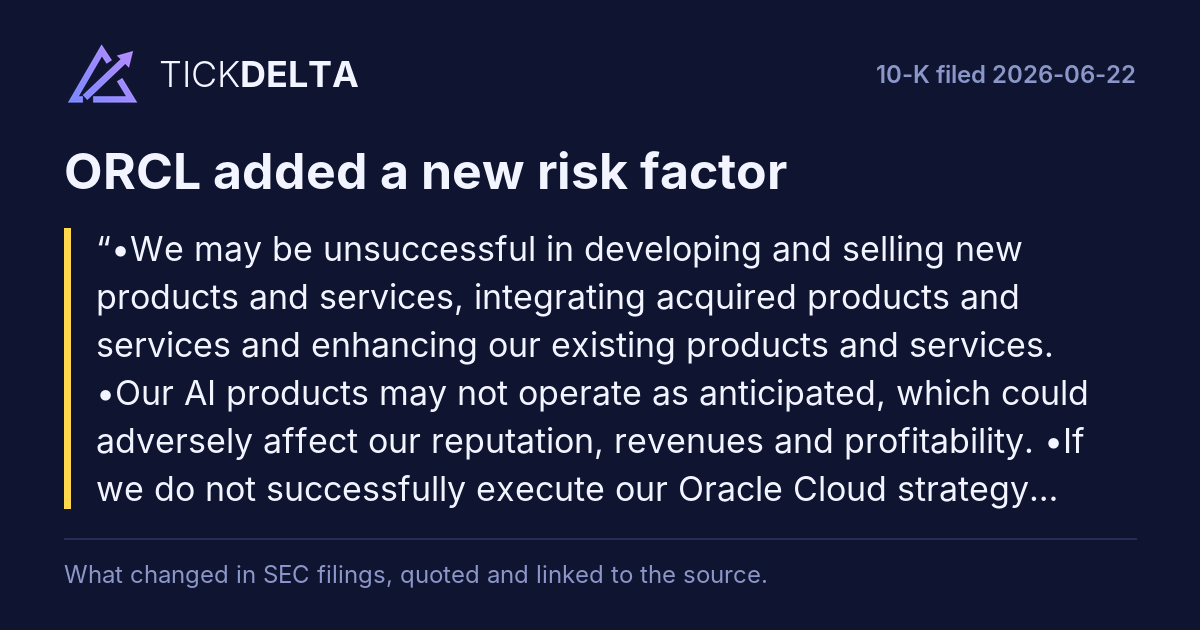
•We may be unsuccessful in developing and selling new products and services, integrating acquired products and services and enhancing our existing products and services.
•Our AI products may not operate as anticipated, which could adversely affect our reputation, revenues and profitability.
•If we do not successfully execute our Oracle Cloud strategy, including our offerings of Oracle Cloud, our revenues and profitability may decline.
Similar paragraph at 1 of 74 other Technology companies: Q•If we are unable to secure data center capacity at affordable rates or do not accurately plan for and manage our infrastructure capacity requirements, our profitability may decline.
•Our cloud offerings and hardware offerings are complex, and if we cannot successfully manage this complexity, including the sourcing of technologies and components, the results of these businesses will suffer.
•We may not receive significant revenues from our current research and development efforts for several years, if at all.
•Our products and services may not function properly if we experience significant coding, manufacturing or configuration errors in our cloud, software and hardware offerings.
•If we are unable to compete effectively, the results of operations and prospects for our business could be harmed.
Similar paragraph at 17 of 74 other Technology companies: ADSK, ANET, CRM, CRWD, DDOG, FICO, GDDY, GEN and 9 more•Any failure to offer high-quality technical support services may adversely affect our relationships with our customers and our financial results.
Read in the 10-K ↗
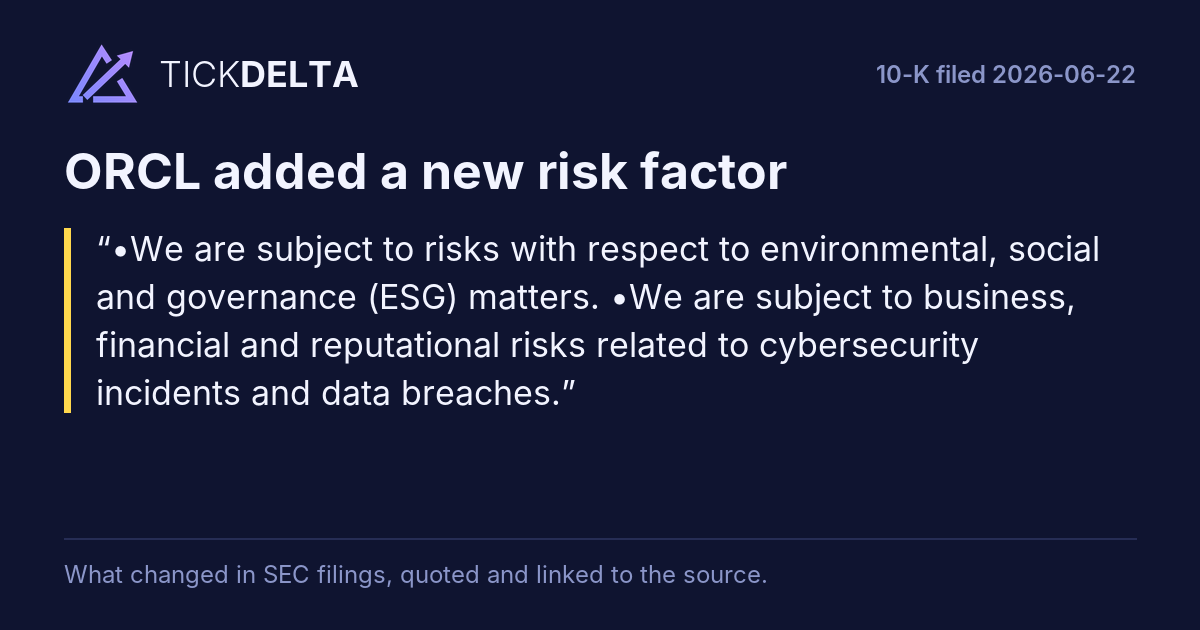
•We are subject to risks with respect to environmental, social and governance (ESG) matters.
•We are subject to business, financial and reputational risks related to cybersecurity incidents and data breaches.
Read in the 10-K ↗
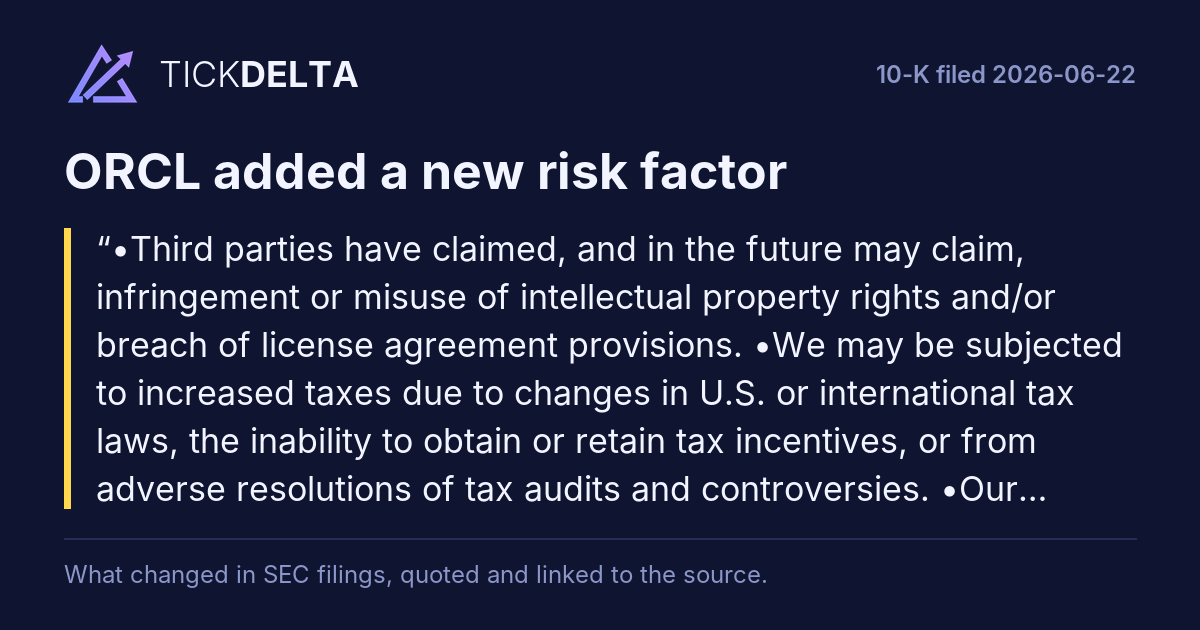
•Third parties have claimed, and in the future may claim, infringement or misuse of intellectual property rights and/or breach of license agreement provisions.
•We may be subjected to increased taxes due to changes in U.S. or international tax laws, the inability to obtain or retain tax incentives, or from adverse resolutions of tax audits and controversies.
•Our international sales and operations and global customer base subject us to additional risks, including trade restrictions, export controls and sanctions, that can adversely affect our operating results.
Similar paragraph at 1 of 74 other Technology companies: PLTR•The healthcare industry is highly regulated, and thus, we are subject to several laws, regulations and industry initiatives, non-compliance with certain of which could adversely affect our healthcare business.
Read in the 10-K ↗
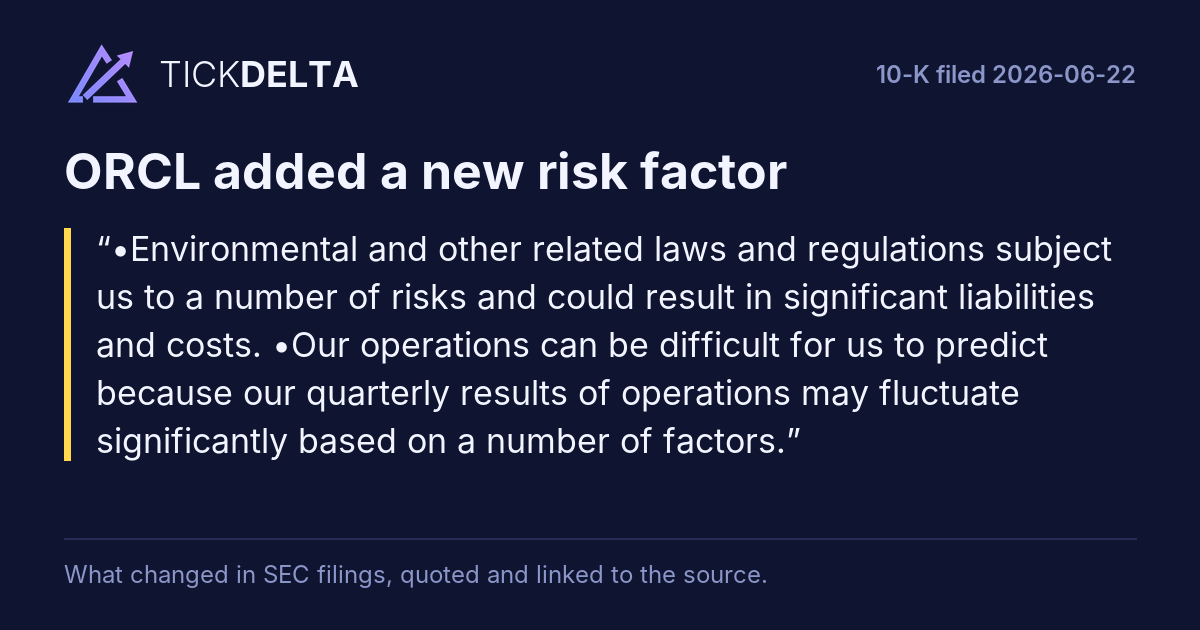
•Environmental and other related laws and regulations subject us to a number of risks and could result in significant liabilities and costs.
Similar paragraph at 1 of 74 other Technology companies: Q•Our operations can be difficult for us to predict because our quarterly results of operations may fluctuate significantly based on a number of factors.
Read in the 10-K ↗
•If our accounting estimates and judgments turn out to be inaccurate, our future financial results could fall short of expectations, which could have a material adverse effect on our stock price.
•Our stock price could become more volatile and your investment could lose value.
•Conversion of our 6.50% Series D Mandatory Convertible Preferred Stock (Mandatory Convertible Preferred Stock) and our depositary shares, or the payment of dividends on Mandatory Convertible Preferred Stock in shares of common stock, or the issuance of shares of our common stock under the At the Market (ATM) Program will dilute the ownership interest of the holders of our common stock.
•The ATM Program, the Mandatory Convertible Preferred Stock or our depositary shares may adversely affect the market price of our common stock, and we cannot guarantee that our ATM Program will be fully implemented.
•Our common stock ranks junior to our Mandatory Convertible Preferred Stock with respect to the payment of dividends and amounts payable in the event of our liquidation, winding-up or dissolution.
Similar paragraph at 1 of 74 other Technology companies: MCHPRead in the 10-K ↗
Show the other 13
•Significant events in certain geographic locations could adversely affect our operating results and disrupt our business.
Read in the 10-K ↗
•it takes more time or costs more than anticipated to build out the infrastructure required to deliver new or enhanced products and services;
Read in the 10-K ↗
continue to invest significant resources to develop and support our AI products, we may fall behind technological developments and evolving industry standards, which would likewise harm our ability to compete.
Read in the 10-K ↗
otherwise perform under their contracts with us, we could be locked into multi-year commitments for excess data center space and related capital expenditures, as well as associated financings, without receiving corresponding revenue. In addition, the terms, renewal options and pricing adjustments in our long-term data center leases typically do not align with the duration and pricing of customer contracts, and if customers do not renew their contracts, we may be unable to re-lease, repurpose or assign such capacity on acceptable terms, if at all. Our business is, and may continue to be, exposed to risks of customer non-payment and non-performance. Our customer base and our policies and procedures to manage our exposure to credit risk, including through receipt of prepayments under some of our committed contracts, credit analysis and monitoring procedures, cannot fully eliminate customer credit risk, and to the extent our policies and procedures prove to be inadequate, it could negatively affect our business, operating results and financial condition. In addition, some of our customers may be highly leveraged and subject to their own operating and regulatory risks and, even if our credit review and analysis mechanisms work properly, we may experience risks of non-payment and non-performance in our dealings with such parties. In certain OCI offerings, we are more concentrated among a number of large customers, which could increase these risks.
Our data center expansion depends on access to suitable, permitted build sites; reliable and predictable power sources; networking hardware; and server availability, including graphics processing units, memory devices and other critical components. Data centers in geographies that we rely on may be unavailable on commercially reasonable terms or at all. Government-imposed limits or moratoria on data center construction in a given market could hinder our ability to execute our expansion plans or prevent us from completing planned data center projects. Even where suitable sites and capacity are available, our data center expansion plans are complex and subject to execution risks, including, among others, delays or cost increases related to design, engineering, permitting, construction, utility interconnection, equipment delivery and contractor performance. Our ability to build and operate data centers also may be affected by existing and evolving laws, regulations and policies relating to land use and zoning, environmental permitting, energy usage, grid reliability, greenhouse gas emissions, water usage, building codes, health and safety, tax incentives and data localization. These requirements, or changes in their interpretation or enforcement, could increase our capital and operating costs, delay or prevent planned projects, limit where or how we build or operate data centers, or adversely affect our ability to meet customer commitments and anticipated demand.
In addition, we depend on third parties to develop and deliver certain data center capacity and related infrastructure, and their inability to obtain financing, complete construction on schedule or manage construction cost overruns could delay the availability of data center space or increase our costs. We have faced, and may continue to face, challenges with securing reliable and cost-effective power sources for our data center energy demands, which are constrained globally due to the significant increase in demand for and limited availability of energy to power AI compute. These constraints on available power sources could disrupt operations at affected data centers or restrict our capacity to grow, adversely impacting our business, operating results, financial condition and prospects. In addition, power prices can be volatile, including due to extreme weather events and market structure in certain regions, and increases in energy costs can adversely affect our margins, particularly where customer pricing is fixed or committed. We also may enter into long-term power supply arrangements, including power purchase agreements or similar arrangements, that may extend beyond customer contract terms and expose us to counterparty risk, pricing risk and potential collateral or credit support requirements. We also may be unable to secure sufficient energy resources on acceptable terms to meet customer expectations or our sustainability goals. These investments and commitments may require significant cash outlays before, or in excess of, the revenues or cash flows generated by the related capacity, which could adversely affect our cash flows, increase our need for external financing or require us to reduce, delay or reprioritize other investments.
Read in the 10-K ↗
require retrofits or other incremental capital expenditures, and physical damage to data centers or key energy infrastructure from natural disasters, geopolitical events, terrorist events or other catastrophic events could adversely affect our profitability.
Read in the 10-K ↗
•introduction of additional compliance obligations or new risks, including with respect to increased privacy and data collection concerns, content moderation and censorship, and system outages;
Read in the 10-K ↗
•the potential for worsening trade and economic relations between the U.S. and China, including the imposition of additional tariffs, export controls, sanctions, retaliatory measures or other trade restrictions;
Read in the 10-K ↗
•losses arising from bank failures, uninsured or underinsured deposit balances, fraud, theft, employee misconduct, or errors in initiating or processing payments or fund transfers;
Read in the 10-K ↗
•The federal Anti-Kickback Statute (AKS) prohibits us from knowingly and willfully soliciting, receiving, offering or providing remuneration (including any kickback or price concession) in exchange for referrals or the purchase, order, or recommendation of any products or services which are paid for by federal healthcare programs such as Medicare and Medicaid. The Centers for Medicare & Medicaid Services has stated that kickbacks have led to overutilization and increased costs of healthcare services, corruption of medical decision making, steering patients away from valid services or therapies and unfair, non-competitive service delivery. Certain of our products and services may now, or in the future, be subject to the AKS, the federal False Claims Act (FCA) and other fraud and abuse laws. In addition, a claim including products or services resulting from a violation of AKS constitutes a violation of the FCA. Companies can be held liable under the FCA even when they do not submit claims directly to government payors if they are deemed to “cause” the submission of false or fraudulent claims. The FCA also permits a private individual acting as a “whistleblower” to bring actions on behalf of the federal government alleging violations of the FCA and to share in any monetary recovery. The federal government has used the FCA to prosecute a wide variety of alleged false claims and fraud allegedly perpetrated against federal and state healthcare programs, including a variety of coverage, reimbursement, billing and coding errors, fraud and conduct.
The healthcare industry is regularly subject to negative publicity, including as a result of governmental investigations, adverse media coverage and political debate concerning industry regulation. We have been, and in the future may become involved in routine, regular and special governmental inquiries, audits, reviews and assessments. Negative publicity may damage our reputation and expose us to regulatory scrutiny.
Read in the 10-K ↗
All of these factors can from time to time materially impact our results of operations, financial position and cash flows.
Read in the 10-K ↗
There are risks associated with our outstanding and future indebtedness. As of May 31, 2026, we had an aggregate of $129.5 billion of outstanding indebtedness that will mature between calendar year 2026 and calendar year 2066. We may incur additional indebtedness from time to time to finance capital expenditures, future investments or acquisitions, to finance the payment of cash dividends on or repurchases of our common stock, to refinance existing debt or for other purposes. Future financing or funding needs could differ from our projections. Our ability to pay interest and repay the principal for our indebtedness is dependent upon our ability to manage our business operations, generate sufficient cash flows to service such debt and the other factors discussed in this Risk Factors section. There can be no assurance that we will be able to manage any of these risks successfully. The incurrence of additional indebtedness will also result in increased fixed obligations and increased interest expense and could also include covenants or other restrictions that may impede our ability to manage our operations. Some of our indebtedness may bear interest at variable rates, and increases in interest rates could increase our debt service obligations. In addition, changes in interest rates could adversely affect the economics of certain long-term commitments or customer arrangements, particularly where pricing is fixed or committed.
Read in the 10-K ↗
If our accounting estimates and judgments turn out to be inaccurate, our future financial results could fall short of expectations, which could have a material adverse effect on our stock price. The preparation of financial statements in conformity with U.S. generally accepted accounting principles (GAAP) requires management to make certain estimates, judgments and assumptions that can affect the reported amounts of assets, liabilities, revenues, expenses and related disclosures. We base our estimates, judgments and assumptions on information available to us at the time that they are made, as discussed in “Critical Accounting Estimates” under Item 7 Management's Discussion and Analysis of Financial Condition and Results of Operations and in “Significant Accounting Policies” discussed in Note 1 of Notes to Consolidated Financial Statements included elsewhere in this Annual Report. For example, we make certain judgments related to revenue recognition and remaining performance obligations. While we believe these judgments and assumptions are reasonable under the circumstances, they are subject to uncertainties and actual results may differ.
Read in the 10-K ↗
Conversion of our Mandatory Convertible Preferred Stock (and our depositary shares), or the payment of dividends on Mandatory Convertible Preferred Stock in shares of common stock, or the issuance of shares of our common stock under the ATM Program will dilute the ownership interest of the holders of our common stock. The conversion of some or all of our shares of Mandatory Convertible Preferred Stock and our depositary shares, or the payment of dividends on our Mandatory Convertible Preferred Stock in the form of common stock or the issuance of shares of our common stock under the ATM Program will dilute the ownership interest of the holders of our common stock and may depress the market price of our common stock.
The ATM Program, the Mandatory Convertible Preferred Stock or our depositary shares may adversely affect the market price of our common stock, and we cannot guarantee that our ATM Program will be fully implemented. The market price of our common stock is likely to be influenced by our ATM Program, the Mandatory Convertible Preferred Stock and our depositary shares. The market price of our common stock could become more volatile and could be depressed by: (1) investors’ anticipation of the potential sale or resale, as applicable, in the market of a substantial number of additional shares of common stock issued under the ATM Program or received upon conversion of the Mandatory Convertible Preferred Stock or our depositary shares; (2) possible sales of our common stock by investors who view the Mandatory Convertible Preferred Stock or our depositary shares as a more attractive means of equity participation in us than owning shares of common stock; and (3) any hedging or arbitrage trading activity involving the Mandatory Convertible Preferred Stock or our depositary shares and our common stock. Our ATM Program may not be fully implemented. Disruptions in equity markets, including reduced liquidity or changes in investor sentiment, could limit our ability to access equity financing on acceptable terms, or at all.
Our common stock ranks junior to our Mandatory Convertible Preferred Stock with respect to the payment of dividends and amounts payable in the event of our liquidation, winding-up or dissolution. This means that, unless accumulated dividends have been paid or set aside for payment on all our outstanding Mandatory Convertible Preferred Stock through the most recently completed dividend period, no dividends may be declared or paid on our common stock, subject to limited exceptions. Likewise, in the event of our voluntary or involuntary liquidation, winding-up or dissolution, no distribution of our assets may be made to holders of our common stock until we have paid to holders of our Mandatory Convertible Preferred Stock a liquidation preference equal to $100,000 per share plus accumulated and unpaid dividends.
Similar paragraph at 1 of 74 other Technology companies: MCHPRead in the 10-K ↗
Paragraphs in the 10-Q filed Sep 11, 2026 that were not in the one before
25 paragraphs in the 10-Q filed Sep 11, 2026 with nothing like them in the 10-Q filed Mar 11, 2026 (at least half the words must differ; new numbers alone do not count). Quoted exactly, grouped by the item heading above them. This is text that changed, not a judgement of how serious it is.
Financial statements and notes
August 31, (in millions, except per share data) 2026 2025 ────────────────────────────────────────────────────────────────────────────────────────────────────────────────────── Revenues: Cloud $ 11,607 $ 7,186 Software 5,550 5,721 Hardware 774 670 Services 1,414 1,349 Total revenues 19,345 14,926 Operating expenses: Cloud and software(1) 6,400 3,607 Hardware(1) 281 178 Services(1) 1,052 1,099 Sales and marketing 1,811 2,063 Research and development 2,401 2,491 General and administrative 376 376 Amortization of intangible assets 202 420 Restructuring and other 94 415 Total operating expenses 12,617 10,649 Operating income 6,728 4,277 Interest expense (1,428) (923) Non-operating income, net 307 73 Income before income taxes 5,607 3,427 Provision for income taxes 847 500 Net income $ 4,760 $ 2,927 Preferred stock dividends 81 — Net income available to common shareholders $ 4,679 $ 2,927 Earnings per share attributable to common shareholders: Basic $ 1.58 $ 1.04 Diluted $ 1.56 $ 1.01 Weighted average common shares outstanding: Basic 2,966 2,826 Diluted 3,000 2,909
Read in the 10-Q ↗
August 31, (in millions, except per share data) 2026 2025 ───────────────────────────────────────────────────────────────────────────────────────────────────────────────── Preferred stock and additional paid in capital Balance, beginning and end of period $ 4,954 $ — Common stock and additional paid in capital Balance, beginning of period $ 43,243 $ 37,107 Common stock issued via at-the-market program 19,909 — Net share issuances from employee stock programs 41 1,153 Stock-based compensation 1,127 1,124 Repurchases of common stock — (6) Other, net (1) — Balance, end of period $ 64,319 $ 39,378 Accumulated deficit Balance, beginning of period $ (4,309) $ (15,481) Repurchases of common stock — (87) Preferred stock dividends (81) — Common stock dividends (1,484) (1,413) Net income 4,760 2,927 Balance, end of period $ (1,114) $ (14,054) Other stockholders’ equity, net Balance, beginning of period $ (832) $ (657) Other, net (131) (1) Balance, end of period $ (963) $ (658) Total stockholders’ equity $ 67,196 $ 24,666 Preferred stock dividends declared per share $ 1,625 $ — Common stock dividends declared per share $ 0.50 $ 0.50
Read in the 10-Q ↗
August 31, (in millions) 2026 2025 ───────────────────────────────────────────────────────────────────────────────────────────────────────────────────────────────────────────────────────────── Cash flows from operating activities: Net income $ 4,760 $ 2,927 Adjustments to reconcile net income to net cash provided by operating activities: Depreciation 3,156 1,351 Amortization of intangible assets 202 420 Deferred income taxes (73) 515 Stock-based compensation 1,127 1,124 Other, net (4) 164 Changes in operating assets and liabilities: Increase in trade receivables, net (1,009) (245) Decrease in prepaid expenses and other assets 114 59 Decrease in accounts payable and other liabilities (1,076) (334) Increase (decrease) in income taxes payable 546 (391) Increase in deferred revenues from customer prepayments with significant financing component 11,363 — Increase in other deferred revenues 3,997 2,550 Net cash provided by operating activities 23,103 8,140 Cash flows from investing activities: Purchases of marketable securities and other investments (306) (471) Proceeds from sales and maturities of marketable securities and other investments 225 255 Capital expenditures (28,499) (8,502) Net cash used for investing activities (28,580) (8,718) Cash flows from financing activities: Proceeds from issuances of common stock via at-the-market program, net of issuance costs 19,909 — Net proceeds from employee stock programs 41 1,153 Payments of dividends to stockholders (1,565) (1,413) Repayments of commercial paper, net — (238) (Repayments of) proceeds from short-term financing related to capital expenditures, net (830) 1,958 Repayments of senior notes, term loan credit agreements and other borrowings (4,202) (1,052) Other financing activities, net (242) (198) Net cash provided by financing activities 13,111 210 Effect of exchange rate changes on cash, cash equivalents and restricted cash 11 27 Net increase (decrease) in cash, cash equivalents and restricted cash 7,645 (341) Cash, cash equivalents and restricted cash at beginning of period 31,289 10,786 Cash, cash equivalents and restricted cash at end of period $ 38,934 $ 10,445 Non-cash investing activities: Unpaid capital expenditures $ 6,247 $ 4,010
Read in the 10-Q ↗
Certain of our customer contracts include a significant financing component either because the customer has made significant prepayments before the corresponding performance obligations are delivered or because we have provided long-term payment plans to the customer. In determining whether a contract contains a significant financing component, we consider: (1) the expected timing between the transfer of goods and services and customer payment; (2) the difference between the promised consideration and the cash selling price; and (3) prevailing market interest rates. We apply the practical expedient and do not adjust the promised amount of consideration for the effects of a significant financing component when the period between the transfer of goods or services and customer payment is one year or less. During the first quarter of fiscal 2027, we received $11.4 billion of prepayments from customers that included a significant financing component. No prepayments from customers that included a significant financing component were received during the first quarter of fiscal 2026. We recognize interest expense related to significant financing components separately from revenue. During the first quarter of fiscal 2027, such amounts were immaterial. We determine the discount rate based on a rate that reflects the credit characteristics of the party receiving financing, which is generally consistent with our incremental borrowing rate. The effects of significant financing components are reflected in deferred revenues and recognized over the period of performance.
Read in the 10-Q ↗
Assets and Liabilities Measured at Fair Value on a Recurring Basis Our assets and liabilities measured at fair value on a recurring basis consisted of the following (Level 1 and Level 2 inputs are defined above): August 31, 2026 May 31, 2026 Fair Value Measurements Fair Value Measurements
Read in the 10-Q ↗
Show the other 20
Comprised primarily of servers, networking equipment and leasehold improvements to be deployed at our data centers.
Read in the 10-Q ↗
Depreciation expenses on property, plant and equipment during the three months ended August 31, 2026 and 2025 were $3.2 billion and $1.4 billion, respectively. Property, plant and equipment, net includes right-of-use (ROU) assets recorded in connection with lease arrangements that are accounted for as finance leases, totaling $8.9 billion and $7.5 billion as of August 31, 2026 and May 31, 2026, respectively.
Read in the 10-Q ↗
Summary of All Plans Accrued Three Months Ended August 31, 2026 Accrued Total Total
Read in the 10-Q ↗
Maturities of lease liabilities were as follows as of August 31, 2026 (in millions):
Read in the 10-Q ↗
indebtedness, future investments or acquisitions and payment of cash dividends on or repurchases of our common stock.
Read in the 10-Q ↗
we determine the liabilities are no longer necessary. If our estimates of the federal, state and foreign income tax liabilities and indirect tax liabilities are less than the ultimate assessment, it could result in a further charge to expense.
Read in the 10-Q ↗
(2) software support revenues, which are typically contracted with customers directly, billed to customers in advance, delivered to customers over time with our revenue recognition occurring over the contractual terms and renewed by customers upon completion of the contractual terms.
Read in the 10-Q ↗
Our hardware business provides infrastructure technologies including Oracle Engineered Systems, servers, storage, industry-specific hardware, operating systems, virtualization, management and other hardware-related software to
Read in the 10-Q ↗
The following table reconciles total margin for operating segments to income before income taxes:
Read in the 10-Q ↗
The following table presents a summary of our total revenues by geographic region, which are generally based on the location of our customers:
Read in the 10-Q ↗
and compensation for the costs of the litigation funder (10% to 25% of the compensation awarded); and the (actual) cost of the proceedings and extrajudicial costs.
Read in the 10-Q ↗
This Quarterly Report on Form 10-Q (Quarterly Report) contains forward-looking statements within the meaning of Section 27A of the Securities Act of 1933, as amended, and Section 21E of the Securities Exchange Act of 1934, as amended. All statements other than statements of historical fact, including statements regarding our business, strategy, customer demand, products and services, results of operations, financial condition, cash flows, capital expenditures and other future events or results, are forward-looking statements. Words such as “anticipates,” “believes,” “continues,” “could,” “expects,” “future,” “intends,” “may,” “plans,” “projects,” “seeks,” “should,” “will” and similar expressions are intended to identify forward-looking statements.
Read in the 10-Q ↗
Readers are cautioned not to place undue reliance on these forward-looking statements, which speak only as of the date of this Quarterly Report. Except as required by law, we undertake no obligation to update or revise publicly any forward-looking statements.
Read in the 10-Q ↗
Costs associated with our cloud and software business are included in cloud and software expenses and sales and marketing expenses. These costs are largely infrastructure- and personnel-related and include the cost of providing
Read in the 10-Q ↗
our cloud and software support offerings, salaries and commissions earned by our sales force for the sale of our cloud and software offerings and marketing program costs.
Read in the 10-Q ↗
activities in the first quarter of each of fiscal 2027 and 2026 primarily related to the 2026 Restructuring Plan that our management approved, committed to and initiated during fiscal 2026 to implement certain strategic measures and further improve operational efficiencies, including through the adoption and integration of artificial intelligence technologies across certain functions and other operational activities.
Read in the 10-Q ↗
2026 2026 Working capital $8,116 69% $4,803 Cash, cash equivalents and marketable securities $37,077 16% $31,894
Read in the 10-Q ↗
ATM Program). During the first quarter ended August 31, 2026, we fully utilized the ATM Program and issued approximately 141 million shares of common stock under the ATM Program for net proceeds of $19.9 billion.
Read in the 10-Q ↗
Other information
Lawrence J. Ellison, our Executive Chair of the Board of Directors and Chief Technology Officer, adopted a new trading plan on June 22, 2026. Mr. Ellison’s plan is scheduled to terminate on October 24, 2026, subject to early termination for certain specified events set forth in the plan. The trading plan is intended to permit Mr. Ellison to sell up to 50 million shares of Oracle common stock.
Read in the 10-Q ↗
The Rule 10b5-1 trading arrangement described above was adopted and precleared in accordance with Oracle’s Insider Trading Policy and actual sale transactions made pursuant to such trading arrangement will be disclosed publicly in future Section 16 filings with the SEC.
Read in the 10-Q ↗
The 10-Q's risk factors against the 10-K
Item 1A of the 10-Q filed Sep 11, 2026 against Item 1A of the 10-K filed Jun 22, 2026.
A 10-Q repeats only the risks that changed, so a 10-K paragraph that is missing from it is not counted as removed.
Added is a paragraph with nothing like it in the 10-K, Reworded a sentence that is in both with several words changed,
Quiet changes a sentence in both where one to four words changed and one is a hedge or a modal
(cut words struck through, new words highlighted and underlined).
Text on the page, not a score; each links to the filing at sec.gov.
1 paragraph in the 10-Q's Item 1A, and none of them adds, rewords or quietly edits a paragraph of the 10-K's.