Screener / SEC EDGAR /CIK 0000074260 /10-K filed Feb 26, 2026, compared with Feb 27, 2025 /Numbers from the XBRL of the 10-Ks
NYSE Financials · Surety Insurance

OLD Republic International Corp ORI

Compare with peers Embed
SEC comment letters, last 20 years

2 reviews of ORI's filings by SEC staff

UPLOAD and CORRESP
Reviews 2 latest letter Jul 1, 2013
Questions asked 11 each answered in the company's own letter
No closing letter 0 reviews without a letter saying the staff completed it

When the SEC's staff reviews a filing, it writes to the company with numbered questions, and the company answers each one in a letter. SEC publishes the exchange once the review is over, at least 20 business days later. A question is not an accusation; most reviews end with the company adding detail to its next filing.

How the reviews went

Every review on EDGAR, from the first staff letter to the letter that closes it

  1. 1. Staff letters 3 UPLOAD
  2. 2. Questions in them 11 numbered comments
  3. 3. Company replies 5 CORRESP
  4. 4. Reviews closed 2 of 2 closing letter

Half the closed reviews took 119 days or less from the first letter to the closing letter.

Form 10-K for the Fiscal Year Ended December 31, 2012

2013-07-01 to 2013-08-15 · 2 questions · 1 letter from the SEC, 2 from the company
Review closed 2013-08-15
Results discussion (MD&A)Non-GAAP measures
Management Analysis of Financial Position and Results of Operations · Executive Summary, page 32
SEC asked (1)
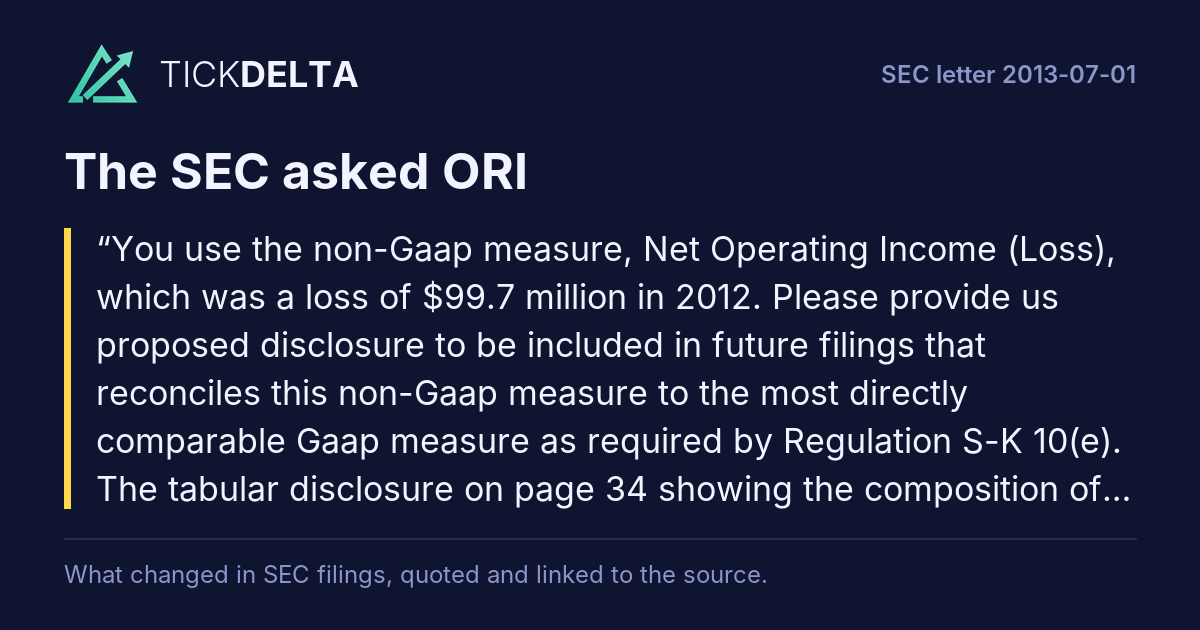
You use the non-Gaap measure, Net Operating Income (Loss), which was a loss of $99.7 million in 2012. Please provide us proposed disclosure to be included in future filings that reconciles this non-Gaap measure to the most directly comparable Gaap measure as required by Regulation S-K 10(e).
Rest of the question

The tabular disclosure on page 34 showing the composition of realized gains or losses does not appear to meet this requirement. Notes to Consolidated Financial Statements Note 1 – Summary of Significant Accounting Policies (s) Regulatory Matters, page 87

ORI answered
We have historically believed that the table presentation on pages 32 and 33 along with the narrative disclosure following the table on page 33 sufficiently informs the reader that the difference between Operating Income (Loss), a non-GAAP measure, and Net Income (Loss), the most directly comparable GAAP measure, is attributable to the effects of realized investment gains and losses.
Rest of the answer

However, in order to respond to the Commission’s comment and clarify the reconciliation between Net Operating Income (Loss) and Net Income (Loss) we propose to modify the Financial Highlights table on page 32 to add the sections entitled, “Realized Investment Gains (Losses), net of tax". The revised table will read as follows:

Financial Highlights

% Change

2012

2011

Years Ended December 31:

2010 vs. 2011 vs. 2010

Operating Revenues:

Excluding run-off business

$

4,474.9

3,965.3

3,317.0

12.9 %

19.5 %

RFIG run-off business

447.3

564.6

676.5

(20.8)

(16.5)

Total

4,922.2

4,529.9

3,993.5

8.7 %

13.4 %

Net Operating Income (Loss):

231.0

257.5

218.9

(10.3)%

17.7 %

(330.8

)

(476.1

(259.5

30.5

(83.4)

(99.7

(218.5

(40.6

54.3

N/M

Realized Investment

Gains (Losses), net of tax

31.1

78.0

70.8

(60.2)

10.2

Net Income (Loss)

(68.6

(140.5

30.1

51.1 %

Components of Net Income (Loss):

253.1

280.5

261.6

(9.8)%

7.2%

(321.8

(421.1

(231.4

23.6

(81.9)

Diluted Earnings Per Share:

Net Operating Income (Loss)

0.90

1.01

0.92

(10.9)%

9.8 %

(1.29

(1.87

(1.08

31.0

(73.1)

(0.39

(0.86

(0.16

54.7

0.12

0.31

0.29

(61.3)

6.9

(0.27

(0.55

0.13

50.9%

0.99

1.10

1.09

(10.0)%

0.9%

(1.26

(1.65

(0.96

(71.9)

Cash Dividends Per Share

0.71

0.70

0.69

1.4 %

Ending Book Value Per Share

14.03

14.76

16.16

(4.9)%

(8.7)%

N/M = Not Meaningful

We intend to make any proposed revisions to disclosures as noted herein on a prospective basis beginning with the Company’s June 30, 2013 Form 10-Q and the 2013 Form 10-K.

Notes to Consolidated Financial Statements

Note 1 – Summary of Significant Accounting Policies

(s) Regulatory Matters, page 87

Read in the reply
In its next report

First report after the company's reply of Jul 16, 2013: 10-Q filed Aug 2, 2013 ↗, against the 10-Q filed May 9, 2013 ↗.

Tickdelta does not hold the text of both reports, so they are not compared here.
Management Analysis of Financial Position and Results of Operations · Executive Summary, page 32
SEC asked (2)
Please provide us proposed disclosure to be included in future filings that states the amount of statutory capital and surplus necessary to satisfy regulatory requirements, if significant in relation to the entity’s statutory capital and surplus, or state that such amount is not significant. Refer to ASC 944-505-1b.
ORI answered
In response to the Commission’s comment we will modify our footnote disclosures to read as follows (underline indicates additions, strikeouts represent deletions):

Note 1 (a) Accounting Principles - The Company's insurance subsidiaries are managed pursuant to the laws and regulations of the various states in which they operate. As a result, the subsidiaries operate and maintain their accounts in conformity with accounting practices prescribed or permitted by various states' insurance regulatory authorities.
Rest of the answer

Federal income taxes and dividends to shareholders are based on financial statements and reports complying with such practices. The statutory accounting requirements vary from the Financial Accounting Standards Board's ("FASB") Accounting Standards Codification ("ASC") of accounting principles generally accepted in the United States of America ("GAAP") in the following major respects: (1) the costs of selling insurance policies are charged to operations immediately, while the related premiums are taken into income over the terms of the policies; (2) investments in fixed maturity securities designated as available for sale are generally carried at amortized cost rather than their estimated fair value; (3) certain assets classified as "non-admitted assets" are excluded from the balance sheet through a direct charge to earned surplus; (4) changes in allowed deferred income tax assets or liabilities are recorded directly in earned surplus and not through the income statement; (5) mortgage guaranty contingency reserves intended to provide for future catastrophic losses are established as a liability through a charge to earned surplus whereas, GAAP does not allow provisions for future catastrophic losses; (6) title insurance premium reserves, which are intended to cover losses that will be reported at a future date are based on statutory formulas, and changes therein are charged in the income statement against each year's premiums written; (7) certain required formula-derived reserves for general insurance in particular are established for claim reserves in excess of amounts considered adequate by the Company as well as for credits taken relative to reinsurance placed with other insurance companies not licensed in the respective states, all of which are charged directly against earned surplus; (8) surplus notes are classified as equity; and (9) the mortgage guaranty deferred payment obligation ("DPO") retained in claim reserves is classified as an admissible asset and as a component of policyholder surplus pursuant to a permitted practice of the NCDOI. In consolidating the statutory financial statements of its insurance subsidiaries, the Company has therefore made necessary adjustments to conform their accounts with GAAP. The following table reflects a summary of all such adjustments:

Shareholders' Equity

December 31,

Years Ended December 31,

Statutory totals of insurance company subsidiaries(b):

General

2,905.9

2,849.7

225.5

292.5

255.6

(a)

Title

358.1

236.6

70.3

46.7

14.6

RFIG Run-off

149.2

113.6

(285.0

(422.6

(196.3

Life & Health

71.9

70.1

3.0

4.8

4.3

Sub-total

3,485.1

3,270.0

13.8

(78.6

78.2

GAAP totals of non-insurance company subsidiaries and consolidation adjustments

(111.6

140.9

(64.2

(38.7

(41.2

Unadjusted totals

3,374.0

3,411.1

(50.4

(117.4

36.8

Adjustments to conform to GAAP statements:

Deferred policy acquisition costs

161.7

193.3

(33.3

(30.6

(19.8

Fair value of fixed maturity securities

552.7

468.8

—

Non-admitted assets

99.0

Deferred income taxes

(113.9

(93.8

35.7

73.4

49.8

Mortgage contingency and deferred payment obligation reserves

(296.9

8.2

Title unearned premiums

390.4

360.4

30.0

6.7

Loss reserves

(360.7

(290.4

(70.4

(49.6

(21.7

Surplus notes

(202.5

(365.0

Sundry adjustments

13.0

(19.5

19.4

(30.9

(21.6

Total adjustments

222.3

361.4

(18.2

(23.1

(6.6

Consolidated GAAP totals

3,596.2

3,772.5

__________

Includes the effect of PMA Capital Corporation's statutory results from the date of acquisition through year-end, excluding adjustments to conform to Old Republic's accounting policies.

(b)

The Company's General, Title, and Life and Health insurance subsidiaries were in compliance with minimum statutory capital and surplus requirements as of December 31, 2012. Refer to Note 1 (s) Regulatory Matters for a discussion regarding the RFIG Run-off group.

The preparation of financial statements in conformity with either statutory practices or GAAP requires management to make estimates and assumptions that affect the reported amounts of assets and liabilities and disclosure of contingent assets and liabilities at the date of the financial statements and the reported amounts of revenues and expenses during the reporting period. Accordingly, actual results could differ from those estimates.

Note 1 (s) Regulatory Matters - The material increases in mortgage guaranty insurance claims and loss payments that began in 2007 gradually depleted RMIC's statutory capital base and forced it to discontinue writing new business. The insurance laws of 16 jurisdictions, including RMIC and RMICNC’s domiciliary state of North Carolina, require a mortgage insurer to maintain a minimum amount of statutory capital relative to risk in force (or a similar measure) in order to continue to write new business. The formulations currently allow for a maximum risk-to-capital ratio of 25 to 1, or alternatively stated, a “minimum policyholder position” (“MPP”) of one-twenty-fifth of the total risk in force. Sixteen states have insurance laws or regulations which require a mortgage insurer to maintain a minimum amount of statutory capital relative to the level of risk in force, the most common measure being a risk to capital ratio of 25 to 1. The failure to maintain the prescribed minimum capital level in a particular state generally requires a mortgage insurer to immediately stop writing new business until it reestablishes the required level of capital or receives a waiver of the requirement from a state's insurance regulatory authority. RMIC breached the minimum capital requirement during the third quarter of 2010. RMIC had previously requested and, subsequently received waivers or forbearance of the minimum policyholder position requirements from the regulatory authorities in substantially all affected states. Following several brief extensions, the waiver from its domiciliary state of North Carolina expired on August 31, 2011, and RMIC and its sister company, Republic Mortgage Insurance Company of North Carolina (RMIC-NC), discontinued writing new business in all states and limited themselves to servicing the run-off of their existing business.

During 2012 the North Carolina Department of Insurance ("NCDOI") issued several orders the ultimate effects of which were:

• To place RMIC and its affiliate, Republic Mortgage Insurance Company of North Carolina ("RMICNC") under NCDOI supervision;

• To approve a Corrective Plan submitted by RMIC pursuant to which all settled claims are to be paid in cash for 60% of the settled amount, with the remaining 40% retained in claim reserves as a Deferred Payment Obligation ("DPO") until a future payment of all or a portion of this 40% is approved by the NCDOI; and

• To execute the DPO-based run-off plan under Old Republic's ownership and NCDOI supervision of RMIC and RMICNC to effect a most economically sound realization of ultimate benefits to policyholders during a sufficiently long future period.

RMIC's evaluation of the potential long-term performance of the run-off book of business is based on various modeling techniques. Of necessity the resulting models take into account actual premium and paid claim experience of prior periods, together with a large number of assumptions and judgments about future outcomes that are highly sensitive to a wide range of estimates. Many of these estimates and underlying assumptions relate to matters over which the Company has no control, including: 1) The conflicted interests, as well as the varying mortgage servicing and foreclosure practices of a large number of insured lending institutions; 2) General economic and industry-specific trends and events; and 3) The evolving or future social and economic policies of the U.S. Government vis-à-vis such critical sectors as the banking, mortgage lending, and housing industries, as well as its policies for resolving the insolvencies and assigning a possible future role to Fannie Mae and Freddie Mac. These matters notwithstanding, RMIC's ten year standard model of forecasted results extending through 2022 continues to reflect ultimate profitability for the book of business. Accordingly, the establishment of a premium deficiency reserve as of December 31, 2012 is unwarranted.

The indicated positive outcome of the ten year standard model notwithstanding, it is more likely than not that MI operating results for 2013 and 2014 will be negative. As long as the run-off under NCDOI supervision remains in place, however, the statutory DPO accounting treatment should mitigate the adverse effect of operating losses on the statutory capital balance. In these circumstances, RMIC's and RMICNC's statutory solvency would be retained and the risk of a regulatory receivership action would be averted. In management's opinion, the DPO Plan under NCDOI supervision should be continued for a sufficiently long period of time to achieve the objectives contemplated by the above referenced NCDOI orders.

In light of all the above, the mortgage guaranty run-off will devolve within constraints of Old Republic's currently committed capital resources. As of December 31, 2012, the total statutory capital, inclusive of accumulated DPO reserve funds of $299.5 held in RFIG's mortgage insurance subsidiaries was approximately $132.8, which was $300.4 below the required MPP of $433.2. As of the same date, RFIG's consolidated GAAP capitalization amounted to $(56.6) (or a negative capital contribution of approximately 22 cents per Old Republic common share). Based on the above-noted loss expectations for 2013 and 2014 it is most likely that the RFIG consolidated GAAP capital account will reflect a continuing and increasingly negative balance. Moreover, Old Republic will be required to recognize RFIG's continuing net losses in its consolidated GAAP financial statements so long as it retains a controlling financial interest in RFIG. Under GAAP, the Company would deconsolidate RFIG and restore any accumulated deficit to the consolidated shareholders' equity account at the point in time that it relinquishes control of RFIG. This accounting treatment does not affect the liquidity of the Old Republic parent holding company or that of its separately capitalized and organized insurance companies and their individual abilities to meet their respective obligations.

We will make the underlined changes prospectively in Old Republic's 2013 Form 10-K.

*******

With this letter Old Republic also acknowledges that:

·

The Company is responsible for the adequacy and accuracy of the disclosure in the filings;

Staff comments or changes to disclosure in response to staff comments do not foreclose the Commission from taking any action with respect to the filing; and

The Company may not assert staff comments as a defense in any proceeding initiated by the Commission or any person under the federal securities laws of the United States.

We trust that the discussion above is responsive to the Commission’s comments. Please feel free to contact me at (312) 762-4229 if you have any comments or questions.

Read in the reply
In its next report

First report after the company's reply of Jul 16, 2013: 10-Q filed Aug 2, 2013 ↗, against the 10-Q filed May 9, 2013 ↗.

Tickdelta does not hold the text of both reports, so they are not compared here.

Also in this review: company letter, Aug 2, 2013, closing letter, 2013-08-15

Form 10-K for the Fiscal Year Ended December 31, 2010

2011-08-23 to 2011-12-20 · 9 questions · 2 letters from the SEC, 3 from the company
Review closed 2011-12-20
Risk factorsGoodwill and impairmentResults discussion (MD&A)Reserves and insuranceSegmentsLegal and contingenciesIncome taxes
Risk Factors · Fewer Coverage Rescissions, page 22
SEC asked (1)
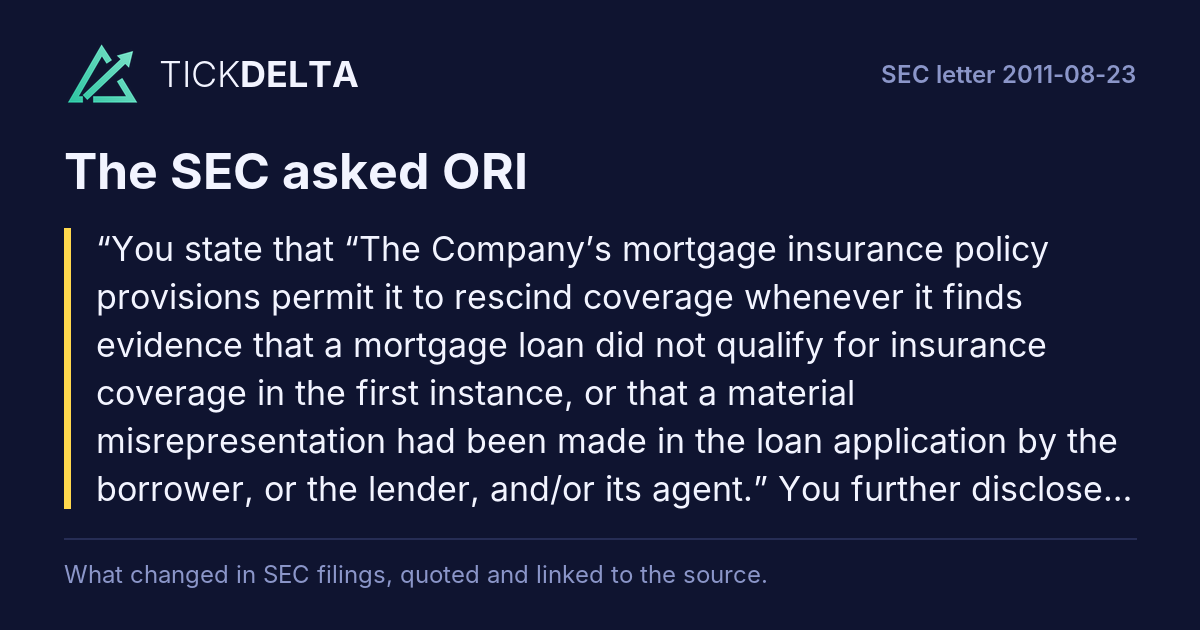
You state that “The Company’s mortgage insurance policy provisions permit it to rescind coverage whenever it finds evidence that a mortgage loan did not qualify for insurance coverage in the first instance, or that a material misrepresentation had been made in the loan application by the borrower, or the lender, and/or its agent.” You further disclose (page 70) that “Claims not paid by virtue of coverage rescissions
Rest of the question

and claims denials amounted to $748.8 million, $719.5 million and $211.0 million for 2010, 2009, and 2008, respectively.” Please provide us proposed disclosures to be included in MD&A under Results of Operations – Overview of Loss Reserving Process – Mortgage guarantee on page 52 in future filings that address the following:  Disclose, if true, that it is your legal right to unilaterally rescind coverage on your mortgage insurance policies as if such coverage never existed, and disclose the conditions that must be met in order for this right to be exercised.  Disclose how, as an operational matter, the rescission and claim denials work. For example, after you have determined the loan did not qualify for insurance coverage or origination documents and information you received and relied upon included material misrepresentations, do you immediately send a letter to the lender notifying them of the rescission and refund premium related to that policy?  Disclose how you determine claims not paid by virtue of coverage rescissions and claims denials as discussed in note (a) to the table on page 70 and its relationship to the reserves you accrued. For example, are reserves reduced when you officially communicate the rescission to the lender, or after all lender appeals are considered?  Disclose whether the insured has a contractual right to appeal the rescission or claim denial and describe the process, timing of reinstating rescinded policies and at what point you deem a rescission is resolved.  Disclose whether you have sought or are planning to seek recoveries from the beneficiaries of your mortgage insurance policies for previously paid claims. If so, please disclose how you are accounting for such recoveries and tell us the supporting GAAP literature. Notes to Consolidated Financial Statements Note 1 – Summary of Significant Accounting Policies (d) – Investments, page 63

ORI answered
We have reviewed the comments on our above referenced filing in your letter dated August 23, 2011. Our Company’s response to the Commission’s comments follows. The references to “Old Republic”, “the Company”, “Republic Mortgage Insurance Company”, and “RMIC” herein, refer to Old Republic International Corporation and its subsidiaries as the context requires. All dollar amounts referenced in the Company’s response are presented in millions, except per share data.
Rest of the letter

You state that “The Company’s mortgage insurance policy provisions permit it to rescind coverage whenever it finds evidence that a mortgage loan did not qualify for insurance coverage in the first instance, or that a material misrepresentation had been made in the loan application by the borrower, or the lender, and/or its agent.” You further disclose (page 70) that “Claims not paid by virtue of coverage rescissions and claims denials amounted to $748.8 million, $719.5 million and $211.0 million for 2010, 2009, and 2008, respectively.” Please provide us proposed disclosures to be included in MD&A under Results of Operations – Overview of Loss Reserving Process – Mortgage guarantee on page 52 in future filings that address the following: Disclose, if true, that it is your legal right to unilaterally rescind coverage on your mortgage insurance policies as if such coverage never existed, and disclose the conditions that must be met in order for this right to be exercised. Disclose how, as an operational matter, the rescission and claim denials work. For example, after you have determined the loan did not qualify for insurance coverage or origination documents and information you received and relied upon included material misrepresentations, do you immediately send a letter to the lender notifying them of the rescission and refund premium related to that policy? Disclose how you determine claims not paid by virtue of coverage rescissions and claims denials as discussed in note (a) to the table on page 70 and its relationship to the reserves you accrued. For example, are reserves reduced when you officially communicate the rescission to the lender, or after all lender appeals are considered? Disclose whether the insured has a contractual right to appeal the rescission or claim denial and describe the process, timing of reinstating rescinded policies and at what point you deem a rescission is resolved. Disclose whether you have sought or are planning to seek recoveries from the beneficiaries of your mortgage insurance policies for previously paid claims. If so, please disclosure how you are accounting for such recoveries and tell us the supporting GAAP literature. In order to respond to the Commission’s comment and clarify the Company’s disclosures regarding coverage rescission and claim denial activity we propose to add the following disclosure to the 2011 MD&A under Results of Operations – Overview of the Loss Reserving Process – Mortgage Guaranty: “The Company has the legal right to rescind mortgage insurance coverage unilaterally as expressly stated in its policy. Moreover, the two federal courts to have recently considered that policy wording have each affirmed that right (See First Tennessee Bank N.A. v. Republic Mortg. Ins. Co., Case No. 2:10-cv-02513-JPM-cgc (W.D. Tenn., Feb. 25, 2011) and JPMorgan Chase Bank N.A. v. Republic Mortg. Ins. Co., Civil Action No. 10-06141 (SRC) (D. NJ, May 4, 2011), each decision citing supporting state law legal precedent). RMIC’s mortgage insurance policy provides that the insured represents that all statements made and information provided to it in an application for coverage for a loan, without regard to who made the statements or provided the information, have been made and presented for and on behalf of the insured; and that such statements and information are neither false nor misleading in any material respect, nor omit any fact necessary to make such statements and information not false or misleading in any material respect. According to the policy, if any of those representations are materially false or misleading with respect to a loan, the Company has the right to cancel or rescind coverage for that loan retroactively to commencement of the coverage. Where the Company determines that an application contains a material misrepresentation, it either advises the insured in writing of its findings prior to rescinding coverage or exercises its unilateral right to rescind coverage for that loan, stating the reasons for that action in writing and returning the applicable premium. The rescission of coverage in instances of materially faulty representations or warranties provided in applications for insurance is a necessary and prevailing practice throughout the insurance industry. In the case of mortgage guaranty insurance, rescissions have occurred regularly over the years but have been generally immaterial. Since 2008, however, the Company has experienced a much greater incidence of rescissions due to increased levels of observed fraud and misrepresentations in insurance applications pertaining to business underwritten between 2004 and the early part of 2008. As a result, the Company has of necessity incorporated estimates of expected levels of coverage rescissions and claim denials in its reserving methodology since 2008. Such estimates are evaluated at each balance sheet date and take into account observed trends in rescission and denial rates. The table below shows the estimated effects of coverage rescissions and claim denials on loss reserves and paid and incurred losses. Estimated rescission reduction in beginning reserve Estimated rescission reduction (increase) in losses incurred Estimated rescission reduction in paid claims Estimated reduction related to pool insurance terminations Estimated rescission reduction in ending reserve The estimated reduction in carried loss reserves is based on management’s judgments relative to the level of expected coverage rescissions and claim denials on loans that are in default as of each balance sheet date. The reduced benefit to incurred losses and decline in ending reserves from 2009 through 2010 attributable to rescission and claim denials is due to lower estimates of defaulted loans for which coverage is likely to be rescinded or denied. Variances between the ultimate actual rescission and claim denial rate are inherently reflected in the periods during which they occur. Claims not paid by virtue of rescission or denial represent the Company’s estimated contractual risk, before consideration of the impacts of any reinsurance and deductibles or aggregate loss limits, on cases that are settled by the issuance of a rescission or denial notification. In 2010, the above noted release of the estimated rescissions and claim denials of $431.4 relates to certain pool insurance contracts which were terminated during the year. Although the insured has no right under the policy to appeal, if the insured, at any time, contests in writing the Company’s findings or action with respect to a loan or a claim, the Company considers any additional information supplied by the insured. This consideration may lead to further investigation, retraction or confirmation of the initial determination. If the Company concludes that it will reinstate coverage, it advises the insured in writing that it will do so immediately upon receipt of the premium previously returned. Reserves are not adjusted for potential reversals of rescissions or adverse rulings for loans under dispute since such reversals of claim rescissions and denials have historically been immaterial to the reserve estimation process. There is currently a single instance in which the Company seeks to recover from an insured for previously paid claims. In its counterclaim in the pending arbitration with Countrywide (Countrywide Fin’l Corp. v. Republic Mortg. Ins. Co., Case No. 72 195 Y 0011510 (AAA). The Countrywide parties are Countrywide Financial Corporation, Countrywide Home Loans, Inc., Bank of America, N.A., in its own capacity and as successor by merger of BAC Home Loan Servicing L.P.), RMIC is seeking to rescind a June 2006 amendment to a mortgage insurance policy that it contends was fraudulently induced by Countrywide. The amendment made coverage for a loan immediately incontestable for borrower misrepresentation. The Company seeks a declaration that the amendment is null and void and to recover the claim amounts totaling at least $26.6 that it paid notwithstanding the existence of borrower misrepresentations that otherwise would have supported a rescission of coverage for those loans. The Company does not anticipate recoveries from previously paid claims in its reserving process until such time as a recovery is deemed probable and the amount can be reasonably estimated.” Notes to Consolidated Financial Statements Note 1: Summary of Significant Accounting Policies Tell us how your presentation of other-than-temporary impairment losses on the statement of income complies with ASC 320-10-45-8A and 320-10-55-21A. ASC 320-10-45-8A states that “in periods in which an entity determines that a security’s decline in fair value below its amortized cost basis is other than temporary, the entity shall present the total other-than-temporary impairment in the statement of earnings with an offset for the amount of total other-than-temporary impairment that is recognized in other comprehensive income…, if any.” ASC 320-10-55-21A illustrates the application of this guidance. The Company’s other-than-temporary-impairment (OTTI) losses are presented within a single line item on the consolidated statements of income. This single line item presentation has been adopted in all periods presented since 100% of the OTTI losses were recognized in the statements of income and no offset applied for amounts recognized in other comprehensive income. (h) – Losses, Claims and Settlement Expenses, page 70 Refer to the table on page 70. It is not clear to us what is included in “Incurred claims and claim adjustment expenses” for mortgage guaranty. For example, regarding the “change in provision for insured events of prior years” for mortgage guaranty in 2010, 2009 and 2008, footnote (a) would appear to infer that included in this line item is $1,001.9 million, ($881.9) million and ($830.5) million for the years ended December 31, 2010, 2009 and 2008 due to the effect of changes in anticipated coverage rescissions and claims denials. In this regard, if this is not the case, provide us proposed disclosure to be included in future filings as to where in the three lines denoted with an (a) in the table the amounts of $1,001.9 million, ($881.9) million and ($830.5) million in 2010, 2009 and 2008, respectively, in footnote (a) are included. If it is the case that these amounts are included in the line item “change in provision for insured events of prior years.” Tell us: What other changes are included in each period. For example, if $1,001.9 million increase is included in the ($15.2) million in 2010, what is the remainder of ($1,017.1) million decrease and what caused these changes. Further, with respect to amounts due to the effect of changes in anticipated coverage rescissions and claims denials, please tell us why it is appropriate under GAAP to increase (reduce) your loss reserves by estimating rescissions and claims denials. In addition, please provide us proposed disclosure to be included in future filings that addresses the following: How you determine your estimates of rescissions and claims denials. Whether your reserve estimate includes an assumption for reinstatement of previously rescinded policies, and if not, your basis for not including such an assumption. If included, please quantify the amounts for the periods presented. Address how you considered your ongoing litigation and arbitration proceedings with, for example, Bank of America, Countrywide and Chase Bank. ASC 944-40, “Unpaid Claim Costs” states: “A liability for unpaid claim costs relating to insurance contracts, other than title insurance contracts, shall be accrued when insured events occur. This amount shall include an estimate of costs relating to claims incurred but not reported. The liability for unpaid claims shall be based on the estimated ultimate cost of settling the claims.” For each of its lines of insurance, the Company establishes loss reserves at each balance sheet date based on estimates of the ultimate cost of settling valid claims. The reserve setting process encompasses a wide range of variables and management judgments including, among others, anticipated levels of mortgage insurance coverage rescissions and claim denials. Where the Company determines that an application contains a material misrepresentation and rescinds coverage, the estimated cost to settle a claim is limited to investigative costs and the return of premium, both of which are incorporated into the Company’s loss reserving methodology. To respond to the Commission’s comments, we propose to replace footnote 1(h), Losses, Claims and Settlement Expenses – Mortgage Guaranty on page 69 of the 2010 Form 10-K with the following disclosure on a prospective basis beginning with the Company’s 2011 Form 10-K: “Mortgage guaranty insurance reserves for unpaid claims and claim adjustment expenses are recognized only upon an instance of default, defined as an insured mortgage loan for which two or more consecutive monthly payments have been missed. Loss reserves are based on statistical calculations that take into account the number of reported insured mortgage loan defaults as of each balance sheet date, as well as experience-based estimates of loan defaults that have occurred but have not as yet been reported ("IBNR"). Further, the loss reserve estimating process takes into account a large number of variables including trends in claim severity, potential salvage recoveries, expected cure rates for reported loan delinquencies at various stages of default, the level of coverage rescissions and claims denials due to material misrepresentation in key underwriting information or non-compliance with prescribed underwriting guidelines, and management judgments relative to future employment levels, housing market activity, and mortgage loan interest costs, demand, and extensions. Historically coverage rescissions and claims denials resulting from material misrepresentation in key underwriting information or non-compliance with terms of the master policy have not been material. Since 2008, however, in response to the significant increase in fraud and misrepresentation, the Company has incorporated into its reserving methodology certain assumptions regarding the expected levels of coverage rescissions and claim denials. Such estimates, which are evaluated as of each balance sheet date, take into account observed trends in rescission and denial rates. The table below shows the estimated impact coverage rescissions and claim denials have had on loss reserves and paid and incurred losses. The estimated reduction in carried loss reserves is based on management’s judgments relative to the level of expected coverage rescissions and claim denials on loans that are in default as of each balance sheet date. The reduced benefit to incurred losses and decline in ending reserves from 2009 through 2010 attributable to rescission and claim denials is due to lower estimates of defaulted loans for which coverage is likely to be rescinded or denied. Variances between the ultimate actual rescission and claim denial rate are inherently reflected in the periods during which they occur. Claims not paid by virtue of rescission or denial represent the Company’s estimated contractual risk, before consideration of the impacts of any reinsurance and deductibles or aggregate loss limits, on cases that are settled by the issuance of a rescission or denial notification. In 2010, the above noted release of the estimated rescissions and claim denials of $431.4 relates to certain pool insurance contracts which were terminated during the year.” Footnote (a) following the table on page 70 in the 2010 Form 10-K will include the following modified disclosure on a prospective basis beginning with the Company’s 2011 Form 10-K: In common with all other insurance lines, mortgage guaranty paid and incurred claim and claim adjustment expenses include only those costs actually or expected to be paid by the Company. Changes in mortgage guaranty aggregate case, IBNR, and loss adjustment expense reserves shown in the following table and entering into the determination of incurred claim costs, take into account, among a large number of variables, claim cost reductions for anticipated coverage rescissions and claims denials. The favorable reserve development of $149.9 in 2009 for prior years’ mortgage guaranty incurred claim provisions resulted mostly from greater than originally estimated coverage rescissions and claim denials on loans that were in default as of the prior year end balance sheet date.” Please provide us a break out of the line items “Provisions for insured events of the current year” and “Change in provision for insured events of prior years” in the table on page 70 for your Mortgage Guaranty segment for each period presented. The break out should include amounts attributable to the following, as applicable, for each of the line items: Reinstatement of rescissions and claims denials. Please see the responses to comments 1 and 3 for the Company’s proposed disclosures in its 2011 Form 10-K responding to this comment. Tell us how you account for claims not paid by virtue of coverage rescissions and claims denials which amounted to $748.8 million, $719.5 million and $211.0 million for 2010, 2009, and 2008, respectively, that you discuss in footnote (a) to the table on page 70. Claims not paid by virtue of coverage rescissions represent the Company’s estimated contractual risk, before consideration of the impacts of any reinsurance, deductibles, or aggregate loss limits, on cases that are settled by the issuance of a rescission or denial notification. These amounts have been reflected in the new table that is proposed in our response to comments 1 and 3. Please tell us why “Other items-net” in the table should not be disaggregated in 2010. Refer to Rule 4-08(h) of Regulation S-X. Rule 4-08(h) of Regulation S-X states to “Provide a reconciliation between the amount of reported total income tax expense (benefit) and the amount computed by multiplying the income (loss) before tax by the applicable statutory Federal income tax rate, showing the estimated dollar amount of each of the underlying causes for the difference.” The Rule further states that, “Reconciling items that are individually less than five percent of the computed amount may be aggregated in the reconciliation. The reconciliation may be presented in percentages rather than in dollar amounts.” The Company has elected to present the income tax reconciliation on page 71 in its 2010 Form 10-K in percentages. Certain reconciling items aggregated within “Other items – net” exceed the five percent threshold referenced in Rule 4-08(h) of Regulation S-X, however, such reconciling items are individually less than $2. The computed percentages are higher than previous years due to the comparatively low level of pretax income generated by the Company in 2010. Management concluded that the dollar amounts giving rise to such reconciling items were immaterial to the financial statements taken as a whole and would not be significant in appraising the trend in earnings. Consequently, these reconciling items were aggregated for purposes of disclosure in the 2010 Form 10-K. (m) – Goodwill and Intangible Assets, page 73 Provide proposed disclosure to be included in future filings required by ASC 350-20-50-1 including goodwill for each reportable segment. To respond to the Commission’s comment we propose to replace footnote 1(m), Goodwill and Intangible Assets on page 73 of the 2010 Form 10-K with the following disclosure on a prospective basis beginning with the Company’s 2011 Form 10-K: “(m) Goodwill and Intangible Assets - The following table presents the components of the Company’s goodwill balance: Goodwill resulting from business combinations is no longer amortizable against operations but must be tested annually for possible impairment of its continued value. In addition to the $3.3 of goodwill included in the above table, intangible assets of $30.4 were also established during 2010 as a result of the PMA merger. Intangible assets with definitive lives are amortized against future operating results; whereas indefinite-lived intangibles are tested annually for impairment. No impairment charges were required for any periods presented.” You state on page 22 that “It is likely that the Company’s mortgage insurance segment will continue to incur material losses…” Further, your market capitalization appears to be materially less than your total Shareholders’ Equity at December 31, 2010 and June 30, 2011. Please address the following: For reporting units in which the estimated fair value is not substantially in excess of the carrying amount and therefore are at risk of failing step one of the impairment test, please provide us proposed disclosure to be included in future filings addressing the following: Percentage by which fair value exceeded carrying value as of the date of the most recent test; Amount of goodwill allocated to each reporting unit; Description of how the key assumptions in the impairment analysis were determined; Discussion of the degree of uncertainty associated with the key assumptions. The discussion regarding uncertainty should provide specifics to the extent possible (e.g., the valuation model assumes recovery from a business downturn within a defined period of time); and Description of potential events and/or changes in circumstances that could reasonably be expected to negatively affect the key assumptions. If you believe that material goodwill does not exist at reporting units that are at risk of failing step one or that no reporting units are at risk, please provide us proposed disclosure of this information to be included in future filings. Tell us how you consider your market capitalization in assessing the reasonableness of the fair values estimated for your reporting units in your goodwill test. Please provide us with a summary that compares your market capitalization to the sum of the fair values of your reporting units and tell us how it supports your conclusion that all reporting units’ fair value exceeds book value. The Company’s annual goodwill impairment testing is completed during the first quarter of each year using data through the prior year-end. Based on results of the impairment test completed in March of 2010, the estimated fair value of the Company’s Mortgage Guaranty reporting unit exceeded its carrying value by approximately 3%. The Company performed analyses throughout 2010 to determine whether any events had occurred to suggest that it was more likely than not that the market value of the Mortgage Guaranty reporting unit was less than its carrying value. The Company concluded that additional impairment testing relative to this reporting unit was not necessary based, in part, on the following considerations: Significant downward trends in recurring mortgage guaranty claims costs throughout 2010 due to decreases in newly reported and outstanding traditional primary loan delinquencies as well as the continuation of high claim rescission and denial levels. Favorable results of a premium deficiency analysis performed during the fourth quarter of 2010. The lack of changes in key personnel, planned or announced closures or asset dispositions, sales/dispositions of a reporting unit, impairments of other assets, etc. during 2010. Furthermore, goodwill attributed to this reporting unit as of December 31, 2010 was $10.7, or less than .1% of consolidated assets and .3% of consolidated shareholders’ equity. Due to the insignificance of this goodwill balance, we propose to expand the disclosure proposed in Response #7 above, with the following: “Furthermore, there are no significant goodwill balances within reporting units with estimated fair values not significantly in excess of their carrying values.” The following represents a comparison of the Company’s market capitalization as of December 31, 2009 and March 31, 2010 to the estimated fair values of our reporting units as determined in step one of the impairment testing completed in March of 2010: It is the Company's opinion that its recent share price reflects the negative impact of its exposure to the U. S. housing industry. Various supplemental analyses performed in conjunction with the Company’s March 2010 impairment test demonstrate that the Company’s stock traded, on average, at 1.1 x book value over a 20 year period ending December 31, 2006; however, declined beginning in the third quarter of 2007 when the housing market began experiencing difficulties to an average of .75x book value. Additionally, the market price of the Company’s common stock experienced significant volatility during 2010 ranging from a high of $15.50 per share to a low of $10.02 per share. In management’s opinion, this degree of discount is indicative of the markets’ temporarily negative reaction to the Company’s exposure to the housing market through its mortgage guaranty business in particular and without adequate consideration to the Company’s diversified business model. Furthermore, market prices of individual trades of an entity’s equity securities (and thus its computed market capitalization) may not be representative of the fair value of the entity as a whole. Substantial value may arise from the ability to take advantage of synergies and other benefits that flow from control over another entity. Consequently, measuring the fair value of a collection of assets and liabilities that operate together in a controlled entity is different from measuring the fair value of that entity’s individual equity securities. Therefore, once the above fair value calculations have been determined the Company also considers a control premium to those calculations. Since the amount of the control premium is judgmental the Company concluded that the difference between the fair value of its reporting units and its market capitalization was reasonable in light of the above factors. With this letter Old Republic also acknowledges that: The Company is responsible for the adequacy and accuracy of the disclosure in the filings; Staff comments or changes to disclosure in response to staff comments do not foreclose the Commission from taking any action with respect to the filing; and The Company may not assert staff comments as a defense in any proceeding initiated by the Commission or any person under the federal securities laws of the United States. We trust that the discussion above is responsive to the Commission’s comments. Please feel free to contact me at (312) 762-4229 if you have any comments or questions.

One letter for all the questions, without numbered answers. Read the reply
In its next report

First report after the company's reply of Sep 20, 2011: 10-Q filed Nov 9, 2011 ↗, against the 10-Q filed Aug 2, 2011 ↗.

Tickdelta does not hold the text of both reports, so they are not compared here.

Risk Factors · Fewer Coverage Rescissions, page 22
SEC asked (2)
Tell us how your presentation of other-than-temporary impairment losses on the statement of income complies with ASC 320-10-45-8A and 320-10-55-21A. (h) – Losses, Claims and Settlement Expenses, page 70
ORI answered

See the reply above.

In its next report

First report after the company's reply of Sep 20, 2011: 10-Q filed Nov 9, 2011 ↗, against the 10-Q filed Aug 2, 2011 ↗.

Tickdelta does not hold the text of both reports, so they are not compared here.

Risk Factors · Fewer Coverage Rescissions, page 22
SEC asked (3)
Refer to the table on page 70. It is not clear to us what is included in “Incurred claims and claim adjustment expenses” for mortgage guaranty. For example, regarding the “change in provision for insured events of prior years” for mortgage guaranty in 2010, 2009 and 2008, footnote (a) would appear to infer that included in this line item is $1,001.9 million, ($881.9) million and ($830.5) million for the years ended
Rest of the question

December 31, 2010, 2009 and 2008 due to the effect of changes in anticipated coverage rescissions and claims denials. In this regard, if this is not the case, provide us proposed disclosure to be included in future filings as to where in the three lines denoted with an (a) in the table the amounts of $1,001.9 million, ($881.9) million and ($830.5) million in 2010, 2009 and 2008, respectively, in footnote (a) are included. If it is the case that these amounts are included in the line item “change in provision for insured events of prior years,” tell us:  What caused changes of this magnitude;  What other changes are included in each period. For example, if $1,001.9 million increase is included in the ($15.2) million in 2010, what is the remainder of ($1,017.1) million decrease and what caused these changes. Further, with respect to amounts due to the effect of changes in anticipated coverage rescissions and claims denials, please tell us why it is appropriate under GAAP to increase (reduce) your loss reserves by estimating rescissions and claims denials. In addition, please provide us proposed disclosure to be included in future filings that addresses the following:  How you determine your estimates of rescissions and claims denials.  Whether your reserve estimate includes an assumption for reinstatement of previously rescinded policies, and if not, your basis for not including such an assumption. If included, please quantify the amounts for the periods presented.  Address how you considered your ongoing litigation and arbitration proceedings with, for example, Bank of America, Countrywide and Chase Bank.

ORI answered

See the reply above.

In its next report

First report after the company's reply of Sep 20, 2011: 10-Q filed Nov 9, 2011 ↗, against the 10-Q filed Aug 2, 2011 ↗.

Tickdelta does not hold the text of both reports, so they are not compared here.

Risk Factors · Fewer Coverage Rescissions, page 22
SEC asked (4)
Please provide us a break out of the line items “Provisions for insured events of the current year” and “Change in provision for insured events of prior years” in the table on page 70 for your Mortgage Guaranty segment for each period presented.
Rest of the question

The break out should include amounts attributable to the following, as applicable, for each of the line items:  Mortgage loan defaults;  Rescissions and claims denials; and  Reinstatement of rescissions and claims denials.

ORI answered

See the reply above.

In its next report

First report after the company's reply of Sep 20, 2011: 10-Q filed Nov 9, 2011 ↗, against the 10-Q filed Aug 2, 2011 ↗.

Tickdelta does not hold the text of both reports, so they are not compared here.

Risk Factors · Fewer Coverage Rescissions, page 22
SEC asked (5)
Tell us how you account for claims not paid by virtue of coverage rescissions and claims denials which amounted to $748.8 million, $719.5 million and $211.0 million for 2010, 2009, and 2008, respectively, that you discuss in footnote (a) to the table on page 70. (j) – Income Taxes, page 71
ORI answered

See the reply above.

In its next report

First report after the company's reply of Sep 20, 2011: 10-Q filed Nov 9, 2011 ↗, against the 10-Q filed Aug 2, 2011 ↗.

Tickdelta does not hold the text of both reports, so they are not compared here.

Risk Factors · Fewer Coverage Rescissions, page 22
SEC asked (6)
Please tell us why “Other items-net” in the table to should not be disaggregated in 2010. Refer to Rule 4-08(h) of Regulation S-X. (m) – Goodwill and Intangible Assets, page 73
ORI answered

See the reply above.

In its next report

First report after the company's reply of Sep 20, 2011: 10-Q filed Nov 9, 2011 ↗, against the 10-Q filed Aug 2, 2011 ↗.

Tickdelta does not hold the text of both reports, so they are not compared here.

Risk Factors · Fewer Coverage Rescissions, page 22
SEC asked (7)
Provide proposed disclosure to be included in future filings required by ASC 350-20-50-1 including goodwill for each reportable segment.
ORI answered

See the reply above.

In its next report

First report after the company's reply of Sep 20, 2011: 10-Q filed Nov 9, 2011 ↗, against the 10-Q filed Aug 2, 2011 ↗.

Tickdelta does not hold the text of both reports, so they are not compared here.

Risk Factors · Fewer Coverage Rescissions, page 22
SEC asked (8)
You state on page 22 that “It is likely that the Company’s mortgage insurance segment will continue to incur material losses…” Further, your market capitalization appears to be materially less than your total Shareholders’ Equity at December 31, 2010 and June 30, 2011.
Rest of the question

Please address the following:  For reporting units in which the estimated fair value is not substantially in excess of the carrying amount and therefore are at risk of failing step one of the impairment test, please provide us proposed disclosure to be included in future filings addressing the following: o Percentage by which fair value exceeded carrying value as of the date of the most recent test; o Amount of goodwill allocated to each reporting unit; o Description of how the key assumptions in the impairment analysis were determined; o Discussion of the degree of uncertainty associated with the key assumptions. The discussion regarding uncertainty should provide specifics to the extent possible (e.g., the valuation model assumes recovery from a business downturn within a defined period of time); and o Description of potential events and/or changes in circumstances that could reasonably be expected to negatively affect the key assumptions.  If you believe that material goodwill does not exist at reporting units that are at risk of failing step one or that no reporting units are at risk, please provide us proposed disclosure of this information to be included in future filings.  Tell us how you consider your market capitalization in assessing the reasonableness of the fair values estimated for your reporting units in your goodwill test. Please provide us with a summary that compares your market capitalization to the sum of the fair values of your reporting units and tell us how it supports your conclusion that all reporting units’ fair value exceeds book value.

ORI answered

See the reply above.

In its next report

First report after the company's reply of Sep 20, 2011: 10-Q filed Nov 9, 2011 ↗, against the 10-Q filed Aug 2, 2011 ↗.

Tickdelta does not hold the text of both reports, so they are not compared here.

SEC asked
Refer to your responses to our comments three, four and five. Refer to the table on page 70. We acknowledge the Table you provided in your response letter that shows “the estimated effects of coverage rescissions and claim denials on loss reserves and paid and incurred losses.” Please provide us proposed disclosure to be included in future filings that addresses the following:  The table in your response letter
Rest of the question

contains a line item titled “Estimated rescission reduction (increase) in losses incurred” of $178.3 million and $1,601.4 million for years 2010 and 2009 respectively. Quantify and disclose the amount of this item that is included in “Benefits, claims and settlement expenses” on your Consolidated Statements of Income for each year presented. Further disclose what individual line items these amounts impact on the table on page 70 of your Form 10-K and the amount included in each line item identified for all periods presented. reduction in paid claims” of $748.8 million and $719.5 million for years 2010 and 2009 respectively. Quantify and disclose the amount of this item that is included in “Benefits, claims and settlement expenses” on your Consolidated Statements of Income for each year presented.  To the extent that significant amounts are included in the line item “change in provision for insured events of prior years” on the table on page 70, disclose the reasons why your rescission estimates were significantly overstated/understated and discuss your assessment of the trend for years 2011 and beyond.  Address how you considered your ongoing litigation and arbitration proceedings with, for example, Bank of America, Countrywide and Chase Bank in estimating your rescission reduction reserve at December 31, 2010 and for future period estimates.

ORI answered
We have received your letter of October 20, 2011 and acknowledge your request that we respond within ten business days to the inquiries and directions cited in the letter. Due to the timing of the Commission’s letter our resources have been directed to the preparation of and timely filing of the Company’s Form 10-Q for the quarterly period ended September 30, 2011. Accordingly, we ask for your forbearance and allow us an additional ten business days to comply with the Commission’s request.
Read in the reply

Also in this review: request for more time, Sep 1, 2011, company letter, Nov 16, 2011, closing letter, 2011-12-20

Letters without questions

Other letters

UPLOAD and CORRESP
2 other letters: notices that a filing will not be reviewed, requests to declare a registration effective, and the like

From the SEC's correspondence on EDGAR: staff letters (form UPLOAD) and company letters (form CORRESP), 13 letters filed since 2011-08-24. Questions and answers are matched by their numbers; topics come from words in each question. The reports are compared word for word (same form, before the first SEC letter against the first report after the company's reply). No AI.

Sources

The SEC's correspondence on EDGAR: staff letters (form UPLOAD) and company letters (form CORRESP), matched question by question. No AI.

Also

Filings: the letters in the filing list.

Work with it

Excel workbook · CSV. Google Sheet that stays up to date: paste =IMPORTDATA("https://tickdelta.com/company/ORI/export.csv") into a cell.

Next in Owners and insiders:Insider trades
Esc

Type a ticker such as AAPL, a name, an investor such as Buffett, or a topic such as tariffs. ↑ ↓ to move, Enter to open.