tickdelta
Sign in

Tickdelta is free for now. Sign up and get Pro free

← Screener

ORLYO'Reilly Automotive

Consumer discretionary · Auto Parts Retail · Nasdaq
Compare with peers → Embed

When the SEC's staff reviews a filing, it writes to the company with numbered questions, and the company answers each one in a letter. SEC publishes the exchange once the review is over, at least 20 business days later. Below: what the staff asked ORLY, and the company's answer to each question, quoted from the letters. A question is not an accusation; most reviews end with the company adding detail to its next filing.

Form 10-K

2025-06-30 to 2025-07-29 · 2 questions · 1 letter from the SEC, 1 from the company
Review closed 2025-07-29
SegmentsAcquisitions
Note 1 - Summary of Signficant Accounting Policies · Segment Reporting, page 51
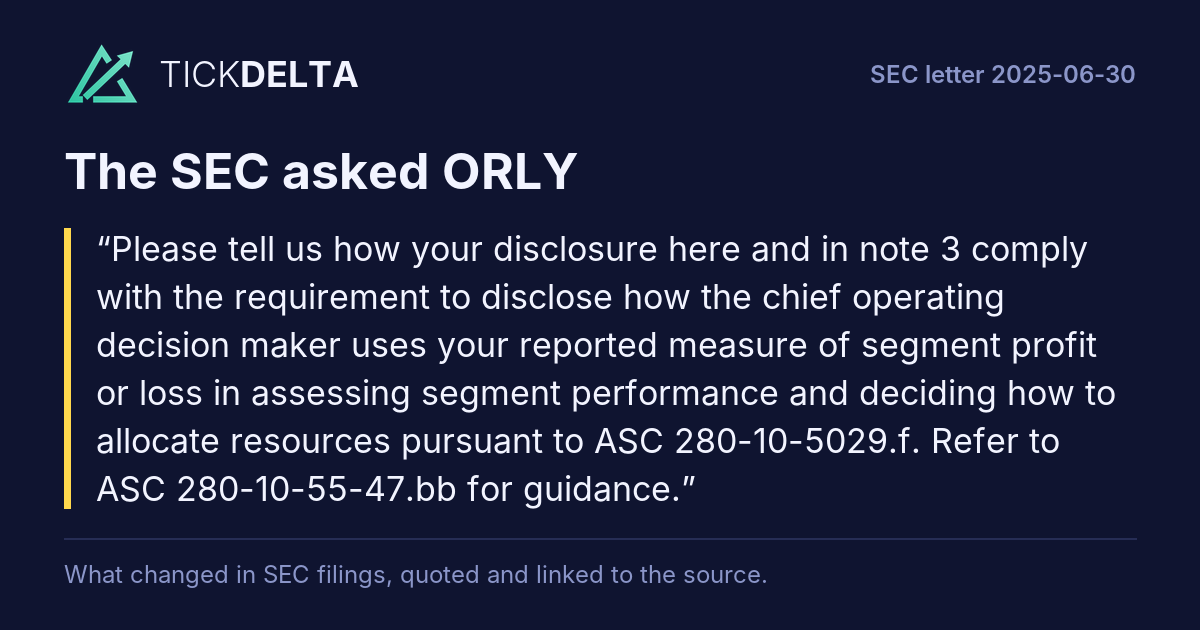
SEC asked (1)
Please tell us how your disclosure here and in note 3 comply with the requirement to disclose how the chief operating decision maker uses your reported measure of segment profit or loss in assessing segment performance and deciding how to allocate resources pursuant to ASC 280-10-5029.f. Refer to ASC 280-10-55-47.bb for guidance.
ORLY answered
The Company respectfully advises the Staff that it considers the provisions of Financial Accounting Standards Board Accounting Standards Codification (“ASC”) Topic 280-10-50, Segment Reporting (“ASC 280”), when drafting segment related disclosures. ASC 280 requires that entities disclose how the reported measure(s) of profit or loss are used by the chief operating decision maker in assessing segment performance and deciding how to allocate resources.

As disclosed on page 51 of the Company’s Form 10-K for the fiscal year ended December 31, 2024:

The Company’s chief operating decision maker
Rest of the answer

is its Chief Executive Officer. The Company evaluates its reportable segment primarily on the basis of sales and segment profit, which is net income. The loss of any single customer would not have a material adverse effect on the Company. See Note 3 for further information concerning the Company’s segment reporting.

As disclosed, segment profit has been determined to be net income, which is utilized by the chief operating decision maker in assessing performance and allocating resources. As stated within Item 1 on page 5 of the Company’s Form 10-K for the fiscal year ended December 31, 2024, the stated goal of the Company as a whole is to “…continue to achieve growth in sales and profitability…”. As net income and segment profit have been determined to be the same, the Company believes that the stated overall goals of growth in sales and profitability should be expected to apply to the segment as well as the Company as a whole. To ensure clarity, the Company will revise future filings to clarify how segment profit is utilized in assessing performance and allocating resources.

The proposed revised disclosure will prospectively be as follows (additions are marked in bold):

The Company’s chief operating decision maker is its Chief Executive Officer. The Company evaluates its reportable segment primarily on the basis of sales and segment profit, which is net income. Net income is utilized by the chief operating decision maker to evaluate budget to actual results, as well as trends over time, to allocate resources, and evaluate performance. The loss of any single customer would not have a material adverse effect on the Company. See Note 3 for further information concerning the Company’s segment reporting.

Read in the reply ↗
In its next report

First report after the company's reply of 2025-07-14: 10-Q filed 2025-08-08 ↗, against the 10-Q filed 2025-05-09 ↗.

Tickdelta does not hold the text of both reports, so they are not compared here.
Note 2 - Business Combination, page 57
SEC asked (2)
Please tell us why it appears you did not provide disclosure pursuant to ASC 805-1050-2.h.1, 805-20-50-1.c, and 805-30-50-1.a. and b. regarding your acquisition of Vast Auto, and provide us with the relevant disclosure for each.
ORLY answered
The Company respectfully advises the Staff that it considers the provisions of ASC Topic 805, Business Combinations (“ASC 805”), when evaluating necessary disclosures related to acquisitions, including the acquisition of Vast Auto.

The Company performed an analysis of both quantitative and qualitative factors during the preparation of the disclosures in Note 2 – Business Combination, and concluded that the acquisition of Vast Auto was immaterial such that the disclosures prescribed by the relevant subtopics of ASC 805 were not applicable.
Rest of the answer

In making this determination, the Company found that Vast Auto represented approximately one percent or less of the Company’s consolidated total revenues, earnings, assets, or liabilities. This evaluation included consideration of total revenue and earnings from the acquisition that were included in the consolidated income statement, total assets and liabilities recognized upon acquisition compared to total assets and liabilities in the consolidated balance sheet, the amount of goodwill recognized, and fair value of consideration transferred. The full amount of consideration transferred is disclosed to be cash only, therefore any discrete disclosures pertaining to different classes of consideration and their related fair values are not applicable.

In addition, we considered qualitative factors related to the acquisition, including any impact of the acquisition on the Company’s business and growth strategies. Vast Auto has similar characteristics as the Company’s existing operations, including the nature of the products and services, the type and class of customers, and the methods used to distribute products and provide service to its customers. The Company concluded that none of the qualitative factors supported a conclusion that the Vast Auto acquisition was material.

Due to the determination that the above items were, individually and in aggregate, immaterial to the consolidated financial statements as a whole, and that the acquisition was not qualitatively material to the Company, no further disclosure was deemed necessary. The Company will continue to monitor and evaluate the requirements of ASC 805 and make appropriate disclosures in the future, as necessary.

We believe that the foregoing is fully responsive to the comment letter. Please direct any further questions or comments to the undersigned.

Read in the reply ↗
In its next report

First report after the company's reply of 2025-07-14: 10-Q filed 2025-08-08 ↗, against the 10-Q filed 2025-05-09 ↗.

Tickdelta does not hold the text of both reports, so they are not compared here.

Also in this review: closing letter, 2025-07-29
Form 10-K for the Fiscal Year Ended December 31, 2020

2021-12-21 to 2022-01-24 · 2 questions · 1 letter from the SEC, 1 from the company
Review closed 2022-01-24
RevenueSegmentsResults discussion (MD&A)Legal and contingencies
Item 7. Management's Discussion and Analysis of Financial Condition and Results of Operations · Overview, page 26
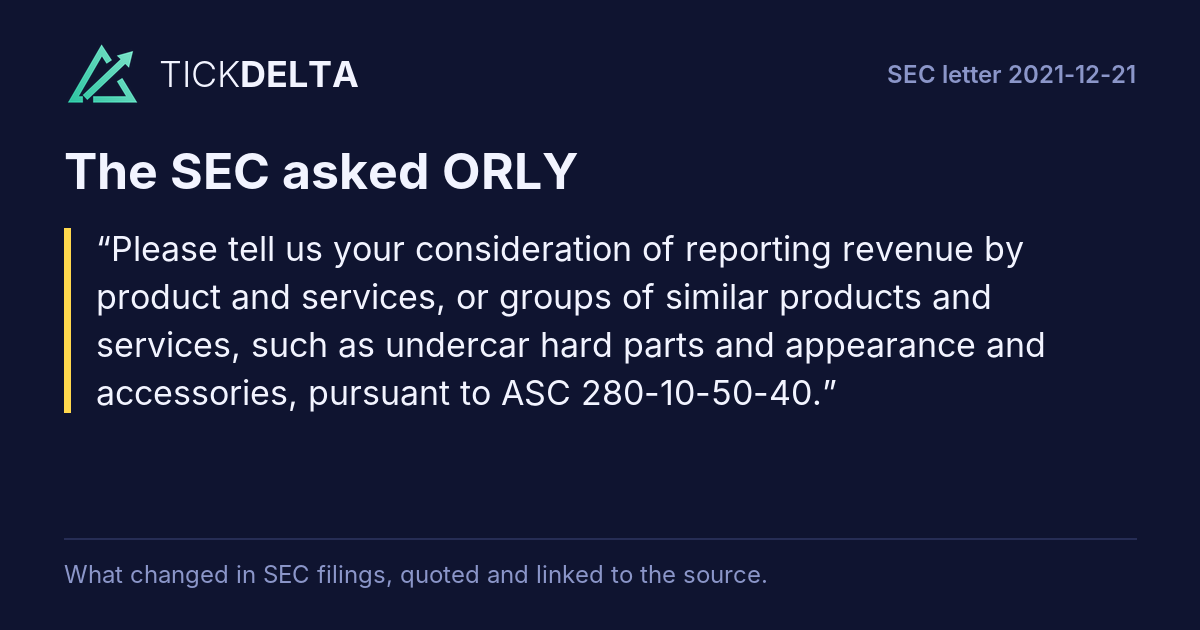
SEC asked (1)
Please tell us your consideration of reporting revenue by product and services, or groups of similar products and services, such as undercar hard parts and appearance and accessories, pursuant to ASC 280-10-50-40.
ORLY answered
The Company respectfully advises the Staff that it considers the provisions of Financial Accounting Standards Board (“FASB”) Accounting Standards Codification (“ACS”) Topic 280-10-50-40, Information about Products and Services (“ASC 280”) when drafting revenue disclosures. ASC 280 states a public entity shall report the revenues from external customers for each product and service or each group of similar products and services unless it is impracticable to do so.
Rest of the answer

The amounts of revenues reported shall be based on the financial information used to produce the public entity's general-purpose financial statements. If providing the information is impracticable, that fact shall be disclosed.

As disclosed on page 26 of the Company’s Form 10-K for the fiscal year ended December 31, 2020, under Item 7:

We are a specialty retailer of automotive aftermarket parts, tools, supplies, equipment and accessories in the United States and Mexico. We are one of the largest U.S. automotive aftermarket specialty retailers, selling our products to both do-it-yourself (“DIY”) customers and professional service providers – our “dual market strategy.” Our stores carry an extensive product line consisting of new and remanufactured automotive hard parts, maintenance items, accessories, a complete line of auto body paint and related materials, automotive tools and professional service provider service equipment.

Our extensive product line includes an assortment of products that are differentiated by quality and price for most of the product lines we offer. For many of our product offerings, this quality differentiation reflects “good,” “better,” and “best” alternatives. Our sales and total gross profit dollars are highest for the “best” quality category of products. Consumers’ willingness to select products at a higher point on the value spectrum is a driver of sales and profitability in our industry. We have ongoing initiatives focused on marketing and training to educate customers on the advantages of ongoing vehicle maintenance, as well as “purchasing up” on the value spectrum.

ASC 280 does not define “similar” products and services. Therefore, the Company believes that determination of whether two or more products and services are similar and can be combined for purposes of the entity-wide disclosures will depend on the facts and circumstances of the particular entity.

The Company is a specialty retailer in the automotive aftermarket and does not sell a broad range of essentially different products. Product sales are the only material source of revenue for the Company and the products sold by the Company all have similar economic characteristics. The products sold are all, in nature, vehicle application components with similar purposes and end uses. The Company does not generate summarized financial results for any specific product category. The Company does not produce or manufacture the products it sells; however, the process of sourcing its products from its various suppliers does occur in a similar manner. Although the Company has two primary types of customers, DIY and professional service providers, all products are available for sale to all of the Company’s customers and are distributed in a similar manner through the Company’s comprehensive and interconnected distribution and store network. While the Company’s extensive product line offerings are used by its customers in a variety of vehicle specific applications, the Company believes all of these applications constitute a group of similar automotive aftermarket products.

Based upon the above considerations regarding revenues for each product or service or each group of similar products or services, the Company has concluded that its disclosure of comprehensive automotive aftermarket products constitutes a group of similar products, and therefore, the Company believes it complies with the provisions of ASC 280 within its previously filed disclosures.

Read in the reply ↗
In its next report

First report after the company's reply of 2022-01-20: 10-K filed 2022-02-28 ↗, against the 10-K filed 2021-02-26 ↗.

Tickdelta does not hold the text of both reports, so they are not compared here.

Note 1. Summary of Significant Accounting Policies · Litigation accruals, page 53
SEC asked (2)
It appears based on your disclosure that you only accrue for litigation losses that are material. Please tell us and revise your disclosure to clarify that your litigation accrual policy is in accordance with ASC 450-20-25-2.
ORLY answered
The Company respectfully advises the Staff that it performs an analysis under the provisions of the FASB ASC Topic 450-20, Loss Contingencies (“ASC 450-20”) for all matters. ASC 450-20 requires an estimated loss from a loss contingency to be accrued as a charge to income if both of the following conditions are met: (a) information as of the date of the financial statements indicates that it is probable (i.e., the future event is likely to occur) that one or more future events will occur confirming the fact that a liability had been incurred, and (b) the amount of the loss can be reasonably
Rest of the answer

estimated. If the reasonable estimate of the loss is a range, then condition (b) is still deemed to be met. If an amount within the range appears at the time to be a better estimate of the loss than any other amount within the range, such amount shall be accrued. However, if no amount within the range is a better estimate than any other amount, the lowest amount in the range shall be accrued. In accordance with the above analysis, the Company accrues estimated losses as charges to income when the criteria in ASC 450-20-25-2 are met.

On the other hand, disclosure of the contingency, but no accrual, is required if there is at least a reasonable possibility that a loss or an additional loss will occur and either of the following conditions exist: (a) an accrual is not made for a loss contingency because the conditions described above are not met or (b) an exposure to the loss potentially exists in excess of the amount accrued. If disclosure is required under either of these conditions, the Company discloses the nature of the contingency and an estimate of the possible loss or range of loss or a statement that such an estimate cannot be made.

While the Company has consistently followed the guidance of ASC 450-20-25-2, in future filings the Company will revise its disclosure to clarify that its litigation accrual policy is in accordance with ASC 450-20-25-2.

The proposed revised disclosure is updated as follows:

Litigation accruals:

O’Reilly is currently involved in litigation incidental to the ordinary conduct of the Company’s business. Based on existing facts and historical patterns, the Company accrues for litigation losses in instances where an adverse outcome is probable and the Company is able to reasonably estimate the probable loss in accordance with ASC 450-20. The Company also accrues for an estimate of legal costs to be incurred for litigation matters. Although the Company cannot ascertain the amount of liability that it may incur from legal matters, it does not currently believe that, in the aggregate, these matters, taking into account applicable insurance and accruals, will have a material adverse effect on its consolidated financial position, results of operations or cash flows in a particular quarter or annual period.

We believe that the foregoing is fully responsive to the comment letter. Please direct any further questions or comments to the undersigned.

Read in the reply ↗
In its next report

First report after the company's reply of 2022-01-20: 10-K filed 2022-02-28 ↗, against the 10-K filed 2021-02-26 ↗.

Tickdelta does not hold the text of both reports, so they are not compared here.

Also in this review: closing letter, 2022-01-24

Form 10-K for the Fiscal Year Ended December 31, 2017

2018-07-20 to 2018-07-26 · 2 questions · 1 letter from the SEC, 1 from the company
Review closed 2018-07-26
Results discussion (MD&A)Non-GAAP measuresLiquidity and cash
Operations · Results of Operations, page 27
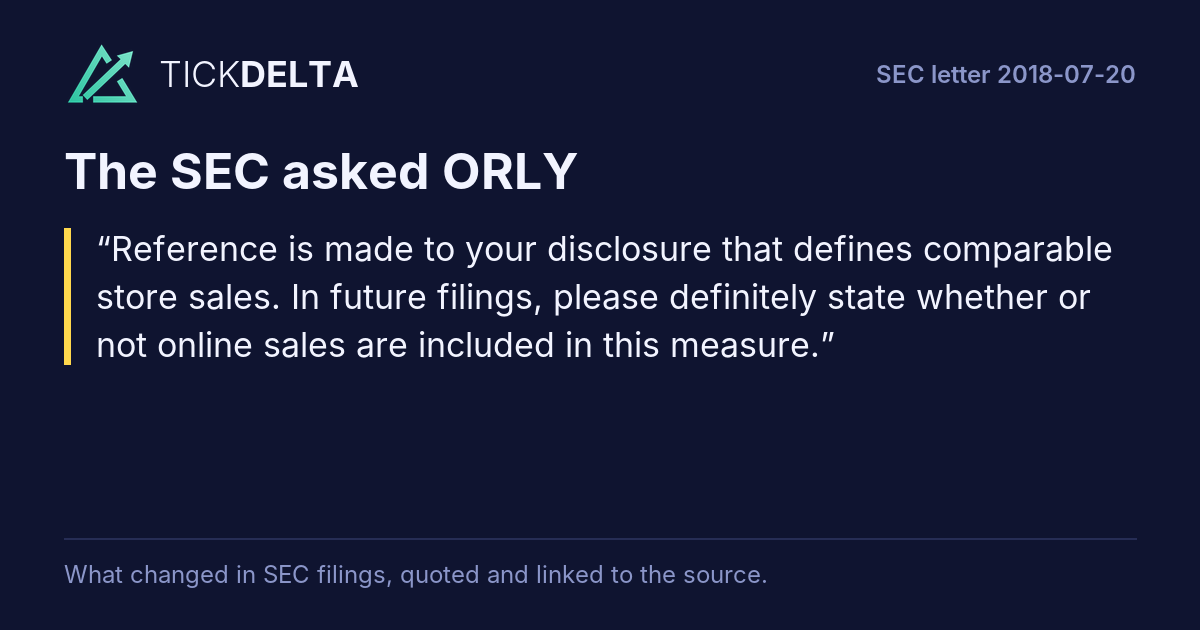
SEC asked (1)
Reference is made to your disclosure that defines comparable store sales. In future filings, please definitely state whether or not online sales are included in this measure.
ORLY answered
In future filings, we will expand our disclosure to definitively state whether or not online sales are included in our calculation of comparable store sales. Our proposed revised disclosure is expanded as follows:

Comparable store sales are calculated based on the change in sales for stores open at least one year and exclude sales of specialty machinery, sales to independent parts stores and sales to Team Members. Online sales, resulting from ship-to-home orders and pick-up-in-store orders, for stores open at least one year, are included in the comparable store sales calculation. Read in the reply ↗
In its next report

First report after the company's reply of 2018-07-24: 10-Q filed 2018-08-08 ↗, against the 10-Q filed 2018-05-07 ↗.

Tickdelta does not hold the text of both reports, so they are not compared here.

Exhibit 99.1
SEC asked (2)
Reference is made to your disclosure of expected fiscal 2018 free cash flow. In future earnings releases filed under Item 2.02 of Form 8-K, please present the most directly comparable financial measure calculated and presented in accordance with GAAP; and provide a reconciliation (by schedule or other clearly understandable method), which shall be quantitative, to the extent available without unreasonable efforts,
Rest of the question

of the differences between the non-GAAP financial measure and the most comparable financial measure calculated and presented in accordance with GAAP. Refer to Item 10(e)(1)(i)(A) and (B) of Regulation S-K.

ORLY answered
In future earnings releases filed under Item 2.02 of Form 8-K, where reference is made to disclosure of expected free cash flow, we will expand our disclosure to present expected net cash provided by operating activities, the most directly comparable financial measure calculated and presented in accordance with GAAP, and we will provide a quantitative reconciliation of the differences between expected free cash flow and expected net cash provided by operating activities, the most directly comparable financial measure calculated and presented in accordance with GAAP.
Rest of the answer

Our proposed revised disclosure is expanded as follows:

The table below outlines the Company’s guidance for selected full-year XXXX financial data:

For the Year Ending

December 31, XXXX

Net cash provided by operating activities

$X.X to $X.X

Capital expenditures

Free cash flow (1)

(1)

Free cash flow is a non-GAAP financial measure. The table below reconciles Free cash flow guidance to Net cash provided by operating activities guidance, the most directly comparable GAAP financial measure:

(in millions)

$ X to

Less:

X

Excess tax benefit from share-based compensation payments

Free cash flow

We believe that the foregoing is fully responsive to the comment letter. Please direct any further questions or comments to the undersigned.

Read in the reply ↗
In its next report

First report after the company's reply of 2018-07-24: 10-Q filed 2018-08-08 ↗, against the 10-Q filed 2018-05-07 ↗.

Tickdelta does not hold the text of both reports, so they are not compared here.

Also in this review: closing letter, 2018-07-26

From the SEC's correspondence on EDGAR: staff letters (form UPLOAD) and company letters (form CORRESP), 9 letters filed since 2018-07-23. Questions and answers are matched by their numbers; topics come from words in each question. The reports are compared word for word (same form, before the first SEC letter against the first report after the company's reply). No AI.

Next in Owners and insiders Insider trades →

Work on ORLY in a spreadsheet: Excel workbook (a sheet per section, ten years by column, charts, links to the filings) · CSV. For a Google Sheet that stays up to date, paste =IMPORTDATA("https://tickdelta.com/company/ORLY/export.csv") into a cell.