Screener / SEC EDGAR /CIK 0001039065 /10-K filed Aug 21, 2026, compared with Aug 25, 2025 /Numbers from the XBRL of the 10-Ks
Nasdaq Technology · Semiconductors

OSI Systems Inc OSIS

Compare with peers Embed
SEC comment letters, last 20 years

3 reviews of OSIS's filings by SEC staff

UPLOAD and CORRESP
Reviews 3 latest letter Mar 2, 2021
Questions asked 20 each answered in the company's own letter
No closing letter 0 reviews without a letter saying the staff completed it

When the SEC's staff reviews a filing, it writes to the company with numbered questions, and the company answers each one in a letter. SEC publishes the exchange once the review is over, at least 20 business days later. A question is not an accusation; most reviews end with the company adding detail to its next filing.

How the reviews went

Every review on EDGAR, from the first staff letter to the letter that closes it

  1. 1. Staff letters 4 UPLOAD
  2. 2. Questions in them 20 numbered comments
  3. 3. Company replies 5 CORRESP
  4. 4. Reviews closed 3 of 3 closing letter

Half the closed reviews took 16 days or less from the first letter to the closing letter.

Form 10-K for the Fiscal Year Ended June 30, 2020

2021-03-02 to 2021-03-12 · 4 questions · 1 letter from the SEC, 1 from the company
Review closed 2021-03-12
Results discussion (MD&A)RevenueSegmentsNon-GAAP measuresIncome taxes
Note 15. Segment Information, page F-39
SEC asked (1)
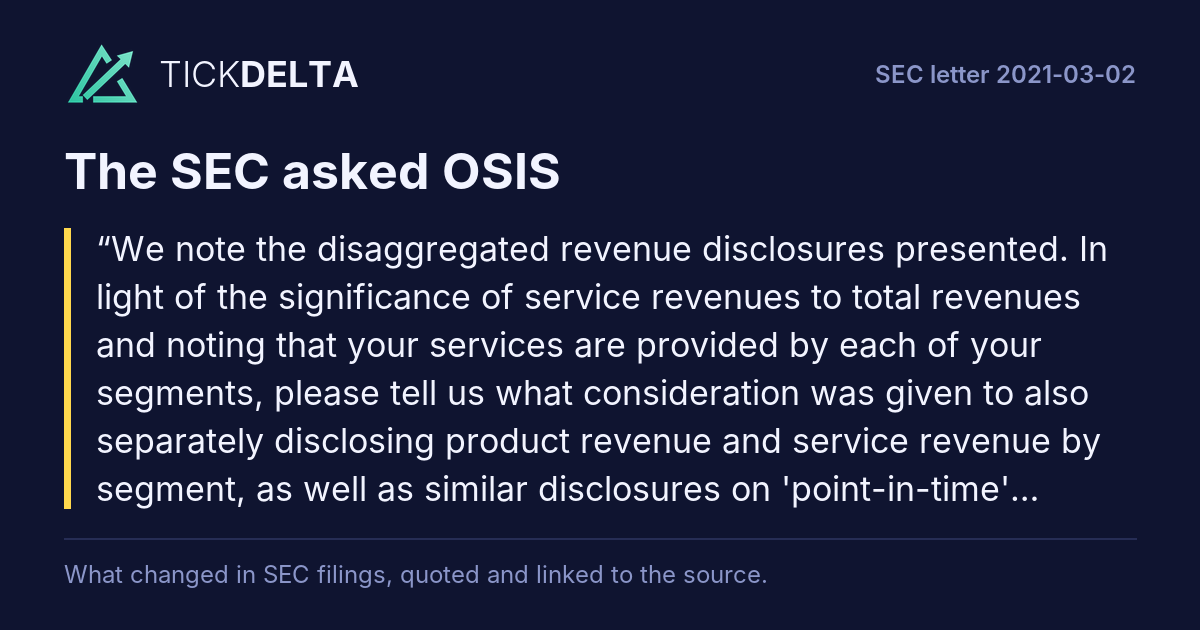
We note the disaggregated revenue disclosures presented. In light of the significance of service revenues to total revenues and noting that your services are provided by each of your segments, please tell us what consideration was given to also separately disclosing product revenue and service revenue by segment, as well as similar disclosures on 'point-in-time' versus 'over time' revenues.
Rest of the question

Tell us how you considered the guidance in ASC 606-10-50-5 through 7 and ASC 606-10-55-89 through 91 in reaching your conclusion.

OSIS answered
The Company has evaluated the guidance in ASC 606-10-50-5 through 7 and the related implementation guidance in ASC 606-10-55-89 through 91 with respect to additional disclosures of disaggregated revenues and has specifically considered the guidance in ASC 606-10-50-5 through 7 which requires an entity to disaggregate revenue from contracts with customers into categories that depict how the nature, amount, timing, and uncertainty of revenue and cash flows are affected by economic factors.
Rest of the answer

Further, the Company considered the examples in ASC 606-10-55-91 which provide additional clarity.

In consideration of the factors in ASC 606-10-55-90, which requires that the Company consider how information about the Company’s revenue has been presented for other purposes, the Company considered, among other items, disclosures outside the financial statements and information reviewed by its chief operating decision maker. The Company disaggregates revenues by product and service on the face of the statement of operations and the Company also reports total revenue by segment and geographical region which is consistent with how its chief operating decision maker reviews financial performance. This disaggregation also aligns to disclosures in the Company’s quarterly earnings releases and the prepared remarks discussed as part of its quarterly earnings announcement process.

The Company considered the examples of categories of disaggregated revenues in ASC 606-10-55-91. A key depiction of how the nature, amount, timing, and uncertainty of the Company’s revenue and cash flows are affected by economic factors is geographical region, as noted in example ‘b’. The Company believes geographical region provides a meaningful indication of how its revenue from contracts with customers are affected by economic factors due to the global nature of its customers and operations. Within the Company’s segment disclosures, it has included a disaggregation of revenues by significant geographical region. Further, as it relates to the examples in ASC 606-10-55-91, in response to the Staff’s comment, the Company specifically considered example ‘f’ within the guidance pertaining to the timing of transfer of goods or services noting that substantially all of the Company’s service revenue is recognized over time while substantially all of its product revenue is recognized on a point-in-time basis. This disaggregation of revenue between types provides clarity as to the timing of the transfer of goods or services.

For the reasons discussed above, the Company believes that the various revenue disaggregation disclosures currently reported are appropriate.

Read in the reply
In its next report

First report after the company's reply of Mar 10, 2021: 10-Q filed Apr 30, 2021 ↗, against the 10-Q filed Jan 29, 2021 ↗.

Tickdelta does not hold the text of both reports, so they are not compared here.
Note 11. Income Taxes, page 22
SEC asked (2)
We note that you present in this note an effective tax rate excluding the impact of discrete tax items, which appears to be a non-GAAP measure. Please refer to the guidance in Item 10(e)(1)(ii)(C) of Regulation S-K which prohibits you from presenting non-GAAP measures on the face of or in the notes to your financial statements, and revise future filings to comply.
Rest of the question

Also, revise your similar disclosures on page 27 in MD&A to provide all disclosures required by Item 10(e) of Regulation S-K.

OSIS answered
The Company will undertake in future filings to comply with the Staff’s request.
Read in the reply
In its next report

First report after the company's reply of Mar 10, 2021: 10-Q filed Apr 30, 2021 ↗, against the 10-Q filed Jan 29, 2021 ↗.

Tickdelta does not hold the text of both reports, so they are not compared here.

Results of Operations, page 26
SEC asked (3)
We note your discussion of gross profit only addresses the impact of increased or decreased revenues. Given the significant changes we note in your cost of goods sold in the reported periods, in order to assist an investor's understanding, please revise future filings to also address the impact of changes in your cost of goods sold on your gross profit.
Rest of the question

Separately quantify and discuss factors responsible for changes in cost of goods sold, including the impact of material variances in components that offset each other within periods. Please consider providing a similar discussion at the segment level. Refer to FR-72.

OSIS answered
The Company will undertake in future filings to comply with the Staff’s request to also address the impact of significant changes in cost of goods sold on gross profit and separately quantify and discuss factors responsible for significant changes in cost of goods sold. The Company will also consider providing similar discussion at the segment level.
Read in the reply
In its next report

First report after the company's reply of Mar 10, 2021: 10-Q filed Apr 30, 2021 ↗, against the 10-Q filed Jan 29, 2021 ↗.

Tickdelta does not hold the text of both reports, so they are not compared here.

Results of Operations, page 26
SEC asked (4)
Please revise the discussion of your results of operations throughout your future filings to not only highlight the reasons for the changes in your income statement line items but to also quantify the impact of each material factor on your results and to describe the reasons underlying each change, including the impact of material variances in components that offset each other within line items.
Rest of the question

Also, in your future discussions avoid terms such as "primarily" or "partially offset". Refer to FR-72.

OSIS answered
If you have any additional questions regarding these responses, please contact me at (310) 978-0516.
Read in the reply
In its next report

First report after the company's reply of Mar 10, 2021: 10-Q filed Apr 30, 2021 ↗, against the 10-Q filed Jan 29, 2021 ↗.

Tickdelta does not hold the text of both reports, so they are not compared here.

Also in this review: closing letter, 2021-03-12
Form 10-K for the Fiscal Year Ended June 30, 2016

2017-01-18 to 2017-02-03 · 7 questions · 1 letter from the SEC, 1 from the company
Review closed 2017-02-03
SegmentsGoodwill and impairmentResults discussion (MD&A)AcquisitionsRevenueDebtLegal and contingenciesNon-GAAP measuresIncome taxes
Revenue Recognition, page F-13
SEC asked (1)
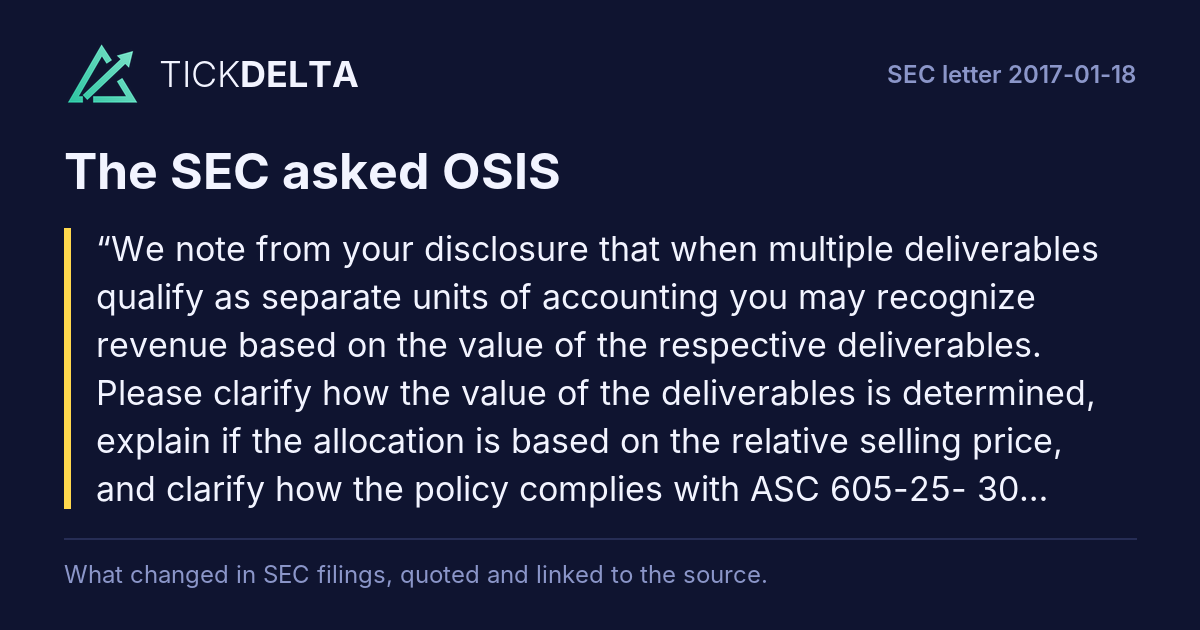
We note from your disclosure that when multiple deliverables qualify as separate units of accounting you may recognize revenue based on the value of the respective deliverables. Please clarify how the value of the deliverables is determined, explain if the allocation is based on the relative selling price, and clarify how the policy complies with ASC 605-25- 30.
Rest of the question

Revise future filings to provide the disclosures required by ASC 605-25-50-2.

OSIS answered
The Company advises the Staff that pursuant to ASC 605-25-30 the Company allocates revenue at the inception of the arrangement to all deliverables using the relative selling price method. The selling price of each deliverable is determined by establishing vendor-specific objective evidence (“VSOE”), third party evidence (“TPE”) or best estimate of selling price (“BESP”) for each delivered item.
Rest of the answer

Generally, either VSOE or TPE is determinable; however, in the few

Page OSI-3 instances where neither VSOE nor TPE is determinable, the Company utilizes its BESP in order to allocate consideration to those deliverables. BESP for the Company’s product deliverables is determined by utilizing a weighted average price approach. BESP for the Company’s service deliverables is determined primarily by utilizing a cost plus margin approach, and in some instances the Company uses an average price per hour.

The Company will undertake in applicable future filings to provide the disclosures required by ASC 605-25-50-2.

Read in the reply
In its next report

First report after the company's reply of Jan 24, 2017: 10-Q filed Feb 1, 2017 ↗, against the 10-Q filed Oct 31, 2016 ↗.

Tickdelta does not hold the text of both reports, so they are not compared here.

Note 5 – Impairment, Restructuring and Other Charges, page F-19
SEC asked (2)
We note that you recognized an asset impairment charge of approximately $6.8 million during the year ended June 30, 2016. Please revise future filings to describe the facts and circumstances leading to the impairment, your method for determining fair value of the impaired assets and the reportable segment of the long-lived assets. Refer to ASC 36010-50-2.
OSIS answered
The Company will undertake in applicable future Form 10-K filings to describe the facts and circumstances leading to the impairment, the Company’s method for determining fair value of impaired assets and the reportable segment of the long-lived assets as required by ASC 360-10-50-2.
Read in the reply
In its next report

First report after the company's reply of Jan 24, 2017: 10-Q filed Feb 1, 2017 ↗, against the 10-Q filed Oct 31, 2016 ↗.

Tickdelta does not hold the text of both reports, so they are not compared here.

Note 5 – Impairment, Restructuring and Other Charges, page F-19
SEC asked (3)
We note the significance of facility closure / consolidations and employee termination costs incurred during the three year period ended June 30, 2016. Please address the following:  Revise your footnotes in future filings to provide the disclosures required by ASC 420-10-50-1 or tell us why such disclosure is not required.
Rest of the question

 Revise your managements’ discussion and analysis in future filings to quantify the anticipated future cost savings at the consolidated and reportable segment levels along with the timing of the future cost savings. With respect to any prior year restructuring activities, revise future filings to disclose if the anticipated cost savings were realized. Refer to SAB Topic 5P.4 for guidance.

OSIS answered
The Company will undertake in applicable future Form 10-K filings to (i) provide in its footnotes the disclosures required by ASC 420-10-50-1, and, (ii) pursuant to SAB Topic 5P.4, revise its managements’ discussion and analysis to quantify the anticipated future costs savings at the consolidated and reportable segment levels

Page OSI-4 along with the timing of the future cost savings, and, with respect to any prior year restructuring activities, to disclose if the anticipated cost savings were realized.
Read in the reply
In its next report

First report after the company's reply of Jan 24, 2017: 10-Q filed Feb 1, 2017 ↗, against the 10-Q filed Oct 31, 2016 ↗.

Tickdelta does not hold the text of both reports, so they are not compared here.

Note 6 – Line-of-credit Borrowings and Debt, page F-20
SEC asked (4)
We see on page F-28 that you report your line-of-credit as due in less than one year. Please revise future filings to disclose the repayment provisions of your line-of-credit agreement.
OSIS answered
Under the terms of the Company’s revolving credit facility, loans may be borrowed, repaid and re-borrowed during the term. Although the principal amount of all revolving loans are due and payable in full on the maturity date, the Company has the right to repay the revolving loans in whole or in part from time to time without penalty. It is the Company’s practice to routinely borrow and repay several times per year under this revolving facility as part of the Company’s overall treasury function. Therefore, borrowings under the line of credit are classified in current liabilities.
Rest of the answer

Accordingly, the Company will undertake in applicable future filings to disclose the repayment provisions of its line-of-credit agreement.

Read in the reply
In its next report

First report after the company's reply of Jan 24, 2017: 10-Q filed Feb 1, 2017 ↗, against the 10-Q filed Oct 31, 2016 ↗.

Tickdelta does not hold the text of both reports, so they are not compared here.

Note 9 – Commitments and Contingencies · Contingent Acquisition Obligations, page F-29
SEC asked (5)
We note from your disclosures on page F-12 that your contingent acquisition obligations are considered level 3 fair value measurements. Please revise future filings to disclose the valuation methodology and any significant inputs used in determining the fair value of your contingent acquisition obligations as required by ASC 820-10-50-1.
Rest of the question

Also revise to include a reconciliation of the beginning and ending balances of your level 3 fair value measurements as required by ASC 820-10-50-2(c).

OSIS answered

No numbered answer found in the reply. Read the reply ↗

In its next report

First report after the company's reply of Jan 24, 2017: 10-Q filed Feb 1, 2017 ↗, against the 10-Q filed Oct 31, 2016 ↗.

Tickdelta does not hold the text of both reports, so they are not compared here.

Exhibit 99.1
SEC asked (6)
We note that the adjustments to arrive at non-GAAP net income and non-GAAP earnings per share are presented “net of tax”. Please present the income tax effects of your non- GAAP adjustments as a separate adjustment in your next earnings release. Refer to Question 102.11 of the updated Non-GAAP Compliance and Disclosure Interpretations issued on May 17, 2016.
OSIS answered
The Company will undertake in applicable future earnings releases to present the income tax effects of its non-GAAP adjustments as a separate line item adjustment.
Read in the reply
In its next report

First report after the company's reply of Jan 24, 2017: 10-Q filed Feb 1, 2017 ↗, against the 10-Q filed Oct 31, 2016 ↗.

Tickdelta does not hold the text of both reports, so they are not compared here.

Note 2. Business Combinations, page 10
SEC asked (7)
Please quantify and describe to us in greater detail the accounts included within Other long-term liabilities in the AS&E purchase price allocation.
OSIS answered
If you have any additional questions regarding these responses, please contact me at (310) 978-0516.
Read in the reply
In its next report

First report after the company's reply of Jan 24, 2017: 10-Q filed Feb 1, 2017 ↗, against the 10-Q filed Oct 31, 2016 ↗.

Tickdelta does not hold the text of both reports, so they are not compared here.

Also in this review: closing letter, 2017-02-03

Form 10-K

2015-10-30 to 2015-12-18 · 9 questions · 2 letters from the SEC, 3 from the company
Review closed 2015-12-18
RevenueResults discussion (MD&A)AcquisitionsInventory
Business, page 1
SEC asked (1)
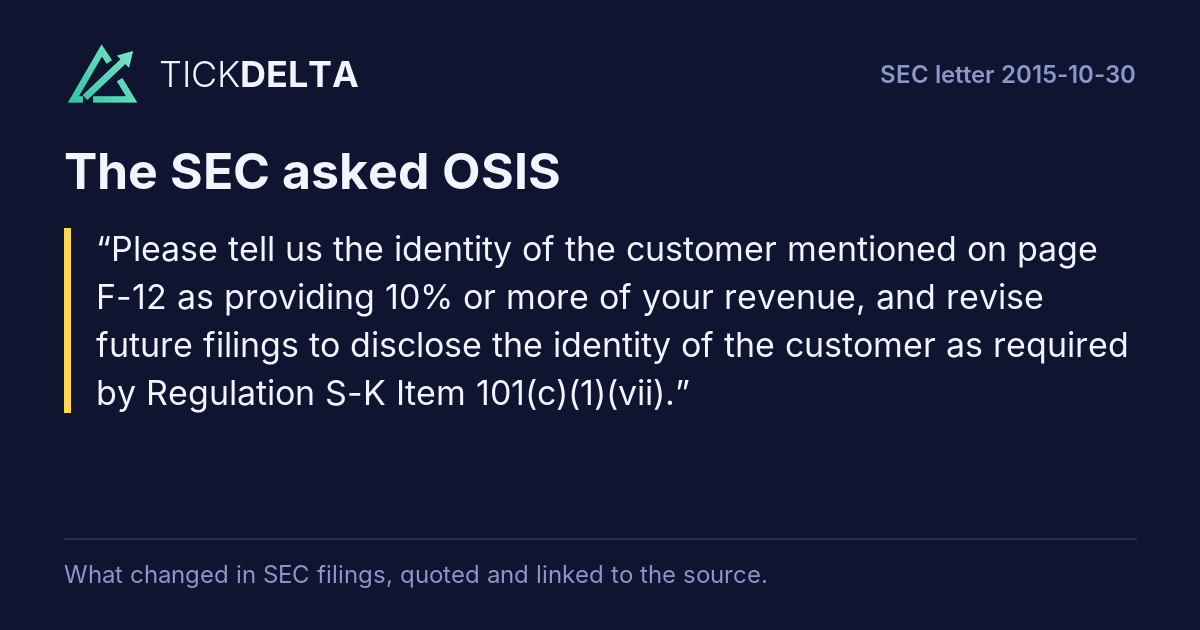
Please tell us the identity of the customer mentioned on page F-12 as providing 10% or more of your revenue, and revise future filings to disclose the identity of the customer as required by Regulation S-K Item 101(c)(1)(vii).
OSIS answered
The Company hereby advises the Staff that the customer mentioned on page F-12 as providing 10% or more of the Company’s revenue is the Mexico Servicio de Administración Tributaria. The Company will undertake in applicable future filings to disclose the identity of customers as required by Regulation S-K Item 101(c)(1)(vii).
Read in the reply
Backlog, page 20
SEC asked (2)
Please tell us the portion of your disclosed backlog that is not reasonably expected to be filled within the current fiscal year. Also tell us the portion of the disclosed backlog that represents government orders that are not yet funded, and describe to us the portion of your business that may be subject to renegotiation of profits or termination of contracts or subcontracts at the election of the government.
Rest of the question

Address in your response the portion of your business that would be at issue in any debarment proceedings that you mention in the first paragraph on page 26, and whether the mutual agreement mentioned on page 44 implicates your obligation to remain in compliance with the Administrative Agreement disclosed on page 26 or otherwise affects your ability to contract with the government. Clarify in future filings as appropriate; see Regulation S-K Item 101(c)(1)(viii) and (ix).

OSIS answered
The Company hereby advises the Staff that we believe approximately $0.2 billion of our $0.6 billion backlog as of June 30, 2015 is not reasonably expected to be filled within fiscal year 2016. To the Company’s knowledge, we do not include in backlog any unfunded portion of government orders.

The Company further advises the Staff that, as disclosed under “Industry Overview – Security” on page 3 and under “Risk Factors” on pages 25 and 39 of our Form 10-K, our contracts with the United States and foreign governments are generally subject to termination for convenience at the election of the
Rest of the answer

government.

As disclosed on pages 25 and 26 of our Form 10-K, we are party to an Administrative Agreement with the U.S. Government, which allows us to continue with our current and future business with U.S. Government agencies. If, however, our Security division fails to remain in compliance with the Administrative Agreement, the U.S. Department of Homeland Security could initiate debarment proceedings that could implicate our Security division’s dealings with the U.S. Government.

The Company further advises the Staff that the mutual agreement referenced on page 44 of the Form 10-K was a resolution of a particular contract performance obligation. It is independent of the Company’s obligations under the Administrative Agreement and does not affect our ability to contract with the government.

Read in the reply
Net Revenues, page 53
SEC asked (3)
Please tell us the reasons for the changes mentioned in the last sentences of the first three paragraphs of this section. Also, tell us the extent of (1) the offsetting effect mentioned in those sentences and (2) the impact of the new product introductions mentioned in the second paragraph of this section; see Regulation S-K Item 303(a)(3)(iii).
OSIS answered
The Company advises the Staff that the reasons for the changes mentioned in the last sentence of each of the three paragraphs of the Fiscal 2015 Compared with Fiscal 2014 section under Net Revenues are as follows. The increases in net revenues for the Security division were partially offset by an approximate decrease of $7 million in revenues from the Mexico turnkey screening services program as well as small decreases in sales of certain product lines for fiscal 2015 as compared to fiscal 2014.

Increases in net revenues in the Healthcare division were partially offset by a decrease of
Rest of the answer

approximately 16% in organic sales in the Europe, Middle East and Africa regions, primarily because of economic uncertainty in those regions as well as unfavorable exchange rate fluctuations. The Company advises the Staff that the new product introductions mentioned in this section were primarily related to sales of upgraded products within our patient monitoring line, and the reference was intended to provide greater detail as to why we believe organic sales of this product line increased.

Decreases in net revenues in the Optoelectronics and Manufacturing division were offset by increased sales within the division’s commercial optoelectronics business of approximately $5.0 million. This increase was primarily attributable to increased sales to our original equipment manufacturer (OEM) customers in the defense, industrial and medical industries.

Read in the reply
In its next report

First report after the company's reply of Nov 10, 2015: 10-Q filed Jan 28, 2016 ↗, against the 10-Q filed Oct 30, 2015 ↗.

Tickdelta does not hold the text of both reports, so they are not compared here.

Net Revenues, page 53
SEC asked (4)
Please tell us, and clarify in future filings, the extent to which the “FMS Contract” provides revenue in future periods at the level disclosed for fiscal 2015. Include in your response when the contract ends.
OSIS answered
The Company advises the Staff and will clarify in future filings that the amount of revenues from the current FMS Contract in future periods is not expected to be significant. The current FMS Contract expires June 30, 2017.
Read in the reply
In its next report

First report after the company's reply of Nov 10, 2015: 10-Q filed Jan 28, 2016 ↗, against the 10-Q filed Oct 30, 2015 ↗.

Tickdelta does not hold the text of both reports, so they are not compared here.

Net Revenues, page 53
SEC asked (5)
We note your reference to “ramped up” sales from your turnkey screening services in Mexico during fiscal 2014. Also, from your disclosure on page F-12, it appears that revenue from those services might have decreased in fiscal 2015. Please tell us, and clarify in future filings, how those services generate revenue and the reason for the decrease in revenue.
Rest of the question

For example, do you receive a fixed amount of revenue per container screened? If so, why did the number of screenings decrease?

OSIS answered
The Company advises the Staff that billings from the Mexico turnkey screening program are generated from the operations of the sites on a fixed amount per site per month (not based upon the volume of containers screened), and revenue is recognized based upon proportional performance as described on page F-11 of our Form 10-K. Revenues from this program decreased in fiscal 2015 as compared to fiscal 2014 due to customer changes in the number of sites that are operational.
Rest of the answer

The Company will undertake to clarify this disclosure in future filings.

In connection with the aforementioned responses, the Company acknowledges that:

· the Company is responsible for the adequacy and accuracy of the disclosure in the filing;

· Staff comments or changes to disclosure in response to the Staff comments do not foreclose the Commission from taking any action with respect to the filing; and

· the Company may not assert Staff comments as a defense in any proceeding initiated by the Commission or any person under the federal securities laws of the United States.

If you should have any additional questions regarding these responses, please contact me at (310) 978-0516.

Read in the reply
In its next report

First report after the company's reply of Nov 10, 2015: 10-Q filed Jan 28, 2016 ↗, against the 10-Q filed Oct 30, 2015 ↗.

Tickdelta does not hold the text of both reports, so they are not compared here.

SEC asked (1)
Please address that part of prior comment 2 that asked you to tell us (1) the portion of your business that may be subject to renegotiation of profits or termination of contracts or subcontracts at the election of the government and (2) the portion of your business that would be at issue in any debarment proceedings that you mention in the first paragraph on page 26.
OSIS answered
The Company advises the Staff that, as indicated in our prior response dated November 10, 2015, our government contracts are generally subject to termination for convenience at the election of the government. For U.S. government contracts, upon a termination for convenience, we would generally be able to recover our incurred or committed costs, settlement expenses and profit on the work completed prior to termination. Additionally, we manufacture products and provide services as a subcontractor that could ultimately be for the benefit of U.S. government customers.
Rest of the answer

For the fiscal year ended June 30, 2015, direct sales by our Security division to U.S. government customers were $127.3 million.

Further, the Company advises the Staff that, with respect to the first paragraph on page 26 of our Form 10-K, the portion of our business that would be implicated in a debarment proceeding is our Security division. In the event that a U.S. government agency were to initiate debarment proceedings, there are various possible outcomes, which could include suspension or termination of current contracts as well as restrictions on our ability to seek and/or accept additional federal government contracts or subcontracts for a period of time. Because there is a range of possible outcomes, the Company cannot reasonably predict the outcome nor quantify the portion of our business that would be affected if debarment proceedings were to be initiated.

Read in the reply
Net Revenues, page 21
SEC asked (2)
Refer to prior comment 3 and the second paragraph under the table in this section. Please tell us the extent of the revenue increase attributable to the acquisition that you mention. Also tell us the extent to which sales in your “Latin America and Asia regions” decreased, and the reasons for the increases and decreases in the regions that you mention. Also revise future filings to clarify as appropriate.
OSIS answered
The Company advises the Staff that the increase in revenue attributable to the acquisition was $1.7 million. Excluding the impact of the acquisition stated above, sales in the Latin America and Asia regions decreased by $1.2 million from the prior year, which we believe was attributable to timing of hospital purchases and a slowdown of patient monitoring sales in China. We believe that the rise in sales in our North America and Europe, Middle East and Africa regions are a result of increased capital spending in hospitals in the United States and in the Europe, Middle East and Africa regions.
Rest of the answer

The Company will undertake to clarify this disclosure in future filings.

Read in the reply
In its next report

First report after the company's reply of Nov 27, 2015: 10-Q filed Jan 28, 2016 ↗, against the 10-Q filed Oct 30, 2015 ↗.

Tickdelta does not hold the text of both reports, so they are not compared here.

Net Revenues, page 21
SEC asked (3)
We note that you attribute the decrease mentioned in the third paragraph to an exceptionally high prior year sale to a single customer. We also note that the “Net Revenues” discussion on page 18 of your Form 10-Q for the fiscal quarter ended September 30, 2014 describes a decrease in the same division and attributes the decrease to exceptionally high sales to a single customer in the prior fiscal year, and does not
Rest of the question

mention an exceptionally high sale to a customer in the current year. Please tell us how those disclosures can be reconciled and the reasons for the exceptionally high sales in individual quarters; clarify in future filings as appropriate.

OSIS answered
The Company advises the Staff that the customer identified in each of our Forms 10-Q for the quarters ended September 30, 2014 and 2015 is the same customer to whom we have had historically high sales and to whom we still sell. Revenues from sales to this customer were $14.5 million, $8.3 million and $4.1 million for the first quarter ended September 30, 2013, 2014 and 2015, respectively, which led to the comment in the Form 10-Q for each of the periods ended September 30, 2014 and 2015.
Rest of the answer

Sales to this consumer products customer, who sells health and beauty products, may fluctuate significantly as a result of our customer’s end market demand. The Company will undertake to clarify this disclosure in future filings.

Read in the reply
In its next report

First report after the company's reply of Nov 27, 2015: 10-Q filed Jan 28, 2016 ↗, against the 10-Q filed Oct 30, 2015 ↗.

Tickdelta does not hold the text of both reports, so they are not compared here.

Cash Provided by Operating Activities, page 23
SEC asked (4)
Please tell us the reasons for the changes in inventory and accounts payable. Also clarify in future filings as appropriate.
OSIS answered
The Company advises the Staff that the $23.6 million increase in inventory during the quarter ended September 30, 2015 was attributable to building inventory to support future sales. Further, the $23.9 million increase in accounts payable during the quarter ended September 30, 2015 was attributable to the inventory build and the timing of payments to suppliers.
Rest of the answer

The Company will undertake to clarify this disclosure in future filings.

In connection with the aforementioned responses, the Company acknowledges that:

· the Company is responsible for the adequacy and accuracy of the disclosure in the filing;

· Staff comments or changes to disclosure in response to the Staff comments do not foreclose the Commission from taking any action with respect to the filing; and

· the Company may not assert Staff comments as a defense in any proceeding initiated by the Commission or any person under the federal securities laws of the United States.

If you should have any additional questions regarding these responses, please contact me at (310) 978-0516.

Read in the reply
In its next report

First report after the company's reply of Nov 27, 2015: 10-Q filed Jan 28, 2016 ↗, against the 10-Q filed Oct 30, 2015 ↗.

Tickdelta does not hold the text of both reports, so they are not compared here.

Also in this review: company letter, Dec 14, 2015, closing letter, 2015-12-18

From the SEC's correspondence on EDGAR: staff letters (form UPLOAD) and company letters (form CORRESP), 12 letters filed since 2015-10-30. Questions and answers are matched by their numbers; topics come from words in each question. The reports are compared word for word (same form, before the first SEC letter against the first report after the company's reply). No AI.

Sources

The SEC's correspondence on EDGAR: staff letters (form UPLOAD) and company letters (form CORRESP), matched question by question. No AI.

Also

Filings: the letters in the filing list.

Work with it

Excel workbook · CSV. Google Sheet that stays up to date: paste =IMPORTDATA("https://tickdelta.com/company/OSIS/export.csv") into a cell.

Next in Owners and insiders:Insider trades
Esc

Type a ticker such as AAPL, a name, an investor such as Buffett, or a topic such as tariffs. ↑ ↓ to move, Enter to open.