For the three months ended September 30, 2026, total interest expense for the 2031 Notes was $1.3 million, which consisted of $0.7 million of contractual interest expense and $0.6 million of amortization of debt discount and issuance costs. The unamortized debt issuance cost is amortized on the effective interest method over the life of the 2031 Notes.
Read in the 10-Qopen_in_new
Several of our foreign subsidiaries maintain bank lines-of-credit, denominated in local currencies and U.S. dollars, primarily for the issuance of letters-of-credit. As of September 30, 2026, $61.8 million was outstanding under these letter-of-credit facilities. As of September 30, 2026, the total amount available under these credit facilities was $58.4 million.
Read in the 10-Qopen_in_new
In the normal course of business, we have agreed to indemnify certain parties with respect to certain matters. We have agreed to hold certain parties harmless against losses arising from a breach of representations, warranties or covenants, or intellectual property infringement or other claims made by third parties. These agreements may limit the time within which an indemnification claim can be made and the amount of the claim. In addition, we have entered into indemnification agreements with our directors and certain of our officers. It is not possible to determine the maximum potential amount under these indemnification agreements due to the limited history of prior indemnification claims and the unique facts and circumstances involved in each particular agreement. We have not recorded any liability for costs related to contingent indemnification obligations as of September 30, 2026.
Read in the 10-Qopen_in_new
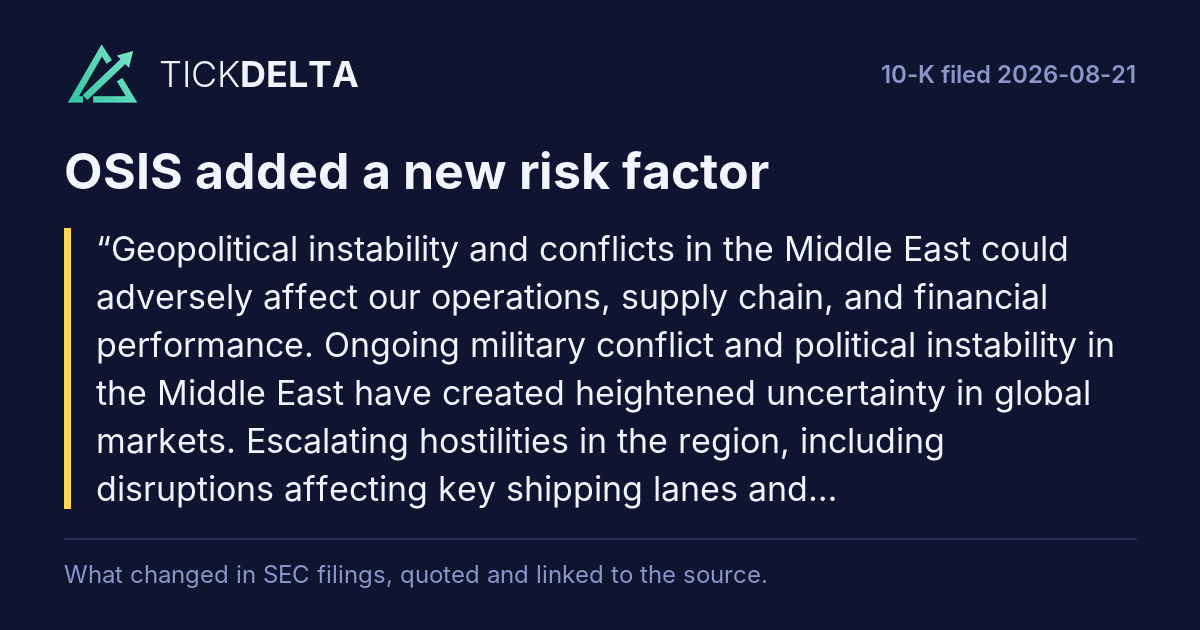
Geopolitical Environment. The global security environment remains subject to significant uncertainty due to ongoing geopolitical tensions, military conflicts, terrorist threats, and regional instability, including the ongoing military conflict in the Middle East. Governments, transportation authorities, border protection agencies, and critical infrastructure operators continue to assess evolving security risks and may increase investments in security screening, inspection, and detection technologies. As a result, demand for certain of our security inspection products and related services could be affected by changes in government spending priorities and security requirements. At the same time, geopolitical events may influence the timing and execution of customer procurement decisions, funding approvals, contract awards, and project implementations. The extent to which current or future conflicts may affect our business will depend on the duration, geographic scope, and economic consequences of such events, as well as governmental responses that remain difficult to predict.
Read in the 10-Qopen_in_new
Conflicts in the Middle East. We generate a significant portion of our revenues from international markets and maintain a global supply chain supporting the design, manufacture, and servicing of our products. Escalation of geopolitical conflicts, including the military conflict involving the United States, Israel and Iran, which escalated significantly in February 2026 and included the closure of strategic airspaces and critical maritime routes such as the Strait of Hormuz and the Red Sea, have disrupted transportation routes, logistics networks, airspace, supplier operations, and international trade flows. These disruptions have resulted, and may continue to result, in shipment delays, longer lead times, project schedule delays, inventory management challenges, or higher operating costs. The conflicts in the Middle East continued to adversely affect certain customer projects during the first quarter of fiscal 2027, resulting in delays in shipments, installations, customer acceptance procedures, project schedules and the timing of certain orders, which negatively impacted our revenues and operating results for the period. Certain customers in the region have also reprioritized near-term spending and procurement activities. To date, these delays have not resulted in the cancellation of orders, and the related orders remain in our backlog with revised delivery schedules; however, there can be no assurance that further delays or cancellations will not occur. Continuation or further escalation of the conflict, including any expansion of hostilities to additional countries in which we or our customers operate, a prolonged disruption of shipping through the Strait of Hormuz or the imposition of additional sanctions or export controls, could adversely affect our ability to procure components, fulfill customer orders, deploy personnel, or complete installations in a timely manner and could have a material adverse effect on our business, results of operations and financial condition.
Read in the 10-Qopen_in_new
Healthcare Considerations. Certain hospitals and healthcare systems continue to face financial pressures arising from labor costs, inflation, reimbursement challenges and elevated interest rates. To the extent these conditions persist, healthcare providers may defer or reduce capital equipment purchases, which could adversely affect demand for our Healthcare products.
Read in the 10-Qopen_in_new
Maximum number (or approximate dollar value) of Total number of shares (or shares (or units) units) purchased as that may Total number of Average price part of publicly yet be purchased shares (or units) paid per share (or announced plans or under the plans or purchased unit) programs programs (1) July 1 to July 31, 2026 — $ — — 78,731 August 1 to August 31, 2026 94,997 $ 207.49 94,997 983,734 September 1 to September 30, 2026 210,562 $ 202.83 210,562 773,172 305,559 305,559
Read in the 10-Qopen_in_new
(1) Upon repurchase, shares of common stock are restored to the status of authorized but unissued shares, and we record them as a reduction in the number of shares of common stock issued and outstanding in our consolidated financial statements. In August 2026, our Board of Directors approved an additional 1,000,000 shares for repurchase under our stock repurchase program. As of September 30, 2026, 773,172 shares remained available for repurchase under the program.
Read in the 10-Qopen_in_new