Screener / SEC EDGAR /CIK 0001466593 /10-K filed Feb 18, 2026, compared with Feb 19, 2025 /Numbers from the XBRL of the 10-Ks
Nasdaq Utilities · Electric Utilities

Otter Tail Corp OTTR

Compare with peers Embed
SEC comment letters, last 20 years

3 reviews of OTTR's filings by SEC staff

UPLOAD and CORRESP
Reviews 3 latest letter Dec 12, 2013
Questions asked 6 each answered in the company's own letter
No closing letter 0 reviews without a letter saying the staff completed it

When the SEC's staff reviews a filing, it writes to the company with numbered questions, and the company answers each one in a letter. SEC publishes the exchange once the review is over, at least 20 business days later. A question is not an accusation; most reviews end with the company adding detail to its next filing.

How the reviews went

Every review on EDGAR, from the first staff letter to the letter that closes it

  1. 1. Staff letters 4 UPLOAD
  2. 2. Questions in them 6 numbered comments
  3. 3. Company replies 5 CORRESP
  4. 4. Reviews closed 3 of 3 closing letter

Half the closed reviews took 42 days or less from the first letter to the closing letter.

Form 10-K

2013-12-12 to 2014-01-29 · 1 question · 1 letter from the SEC, 2 from the company
Review closed 2014-01-29
RevenueResults discussion (MD&A)
Item 8. Financial Statements and Supplementary Data, page 63 · Consolidated Statements of Income, page 66
SEC asked
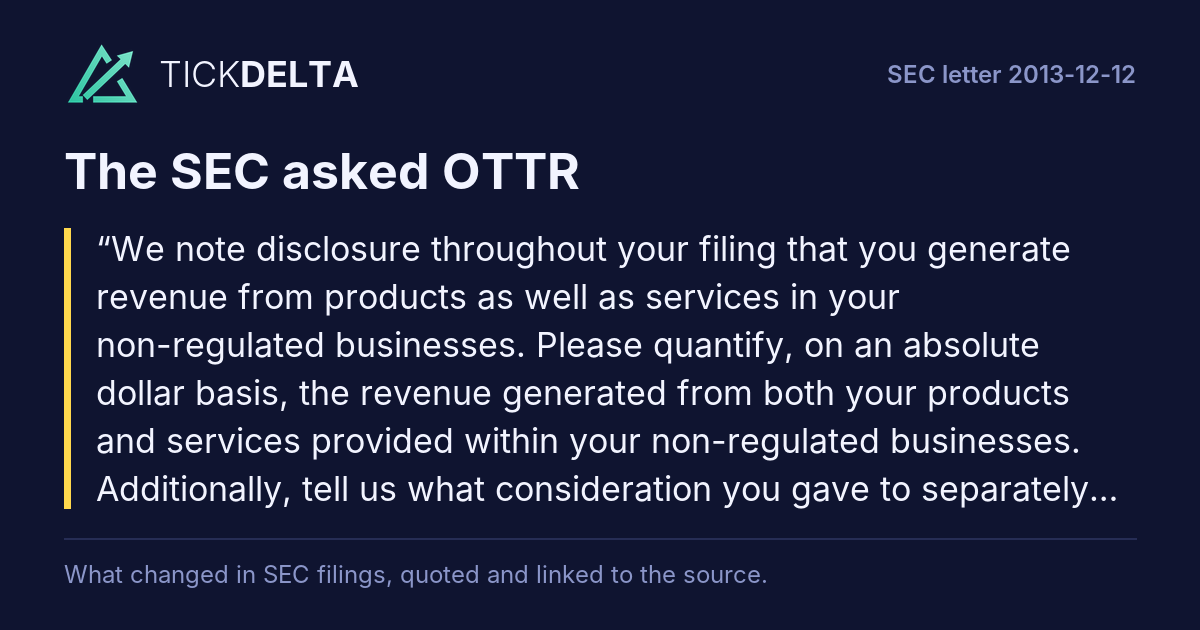
We note disclosure throughout your filing that you generate revenue from products as well as services in your non-regulated businesses. Please quantify, on an absolute dollar basis, the revenue generated from both your products and services provided within your non-regulated businesses.
Rest of the question

Additionally, tell us what consideration you gave to separately disclosing revenues and cost of revenues by products and services pursuant to Rules 503(b)(1) and (2) of Regulation S-X for your non-regulated businesses.

OTTR answered
We have a number of business segments due to the diversification of our Company. The operating segments identified in our Annual Report on Form

10-K are the components of our overall organization that engage in business activities from which we earn revenues and incur expenses and whose operating results are regularly reviewed by our chief economic decision maker. This is the individual who makes decisions about resources to be allocated to the segments and assesses the segment’s performance.
Rest of the answer

Accordingly, we believe it is more meaningful to present our revenues by business segment rather than the categories in Regulation S-X, Rule 5-03. Also, we believe the disclosures provided in our Management’s Discussion and Analysis of Financial Condition and Results of Operations (MD&A) and in Notes 1 and 2 of our Notes to Consolidated Financial Statements provide further disclosures related to the requirements of Regulation S-X, Rule 5-03. Information presented by business segment provides greater transparency in the consolidated financial statements.

We assess the performance of our operating companies over time using the following criteria:

Accordingly, the disclosures in our MD&A are designed around how we manage our business. The segment disclosures summarize the results by segment by disclosing and discussing the revenues and expenses related to these segments in arriving at operating income. The disclosures in Note 2 delineate the specific types of products and services these segments provide.

in the categories referred to in Regulation S-X, Rule 5-03 would result in reporting revenues and expenses in a manner in which is inconsistent with how we manage our business. We also believe this type of presentation would not be meaningful to the users of the Company’s consolidated financial statements.

We will enhance in future filings the consolidated statements of income to disclose revenue and expenses by electric and non-electric activities.

The table below shows the changes we will make to our consolidated statements of income:

Current Format

New Format

Operating Revenues

Operating Revenues:

Electric

Non-electric

Total operating revenues

Operating Expenses:

Read in the reply
In its next report

First report after the company's reply of Dec 26, 2013: 10-K filed Mar 3, 2014 ↗, against the 10-K filed Feb 27, 2013 ↗.

Tickdelta does not hold the text of both reports, so they are not compared here.
Also in this review: company letter, Jan 24, 2014, closing letter, 2014-01-29
Form 10-K

2012-12-31 to 2013-01-28 · 1 question · 1 letter from the SEC, 1 from the company
Review closed 2013-01-28
Note 17. Discontinued Operations, page 119
SEC asked
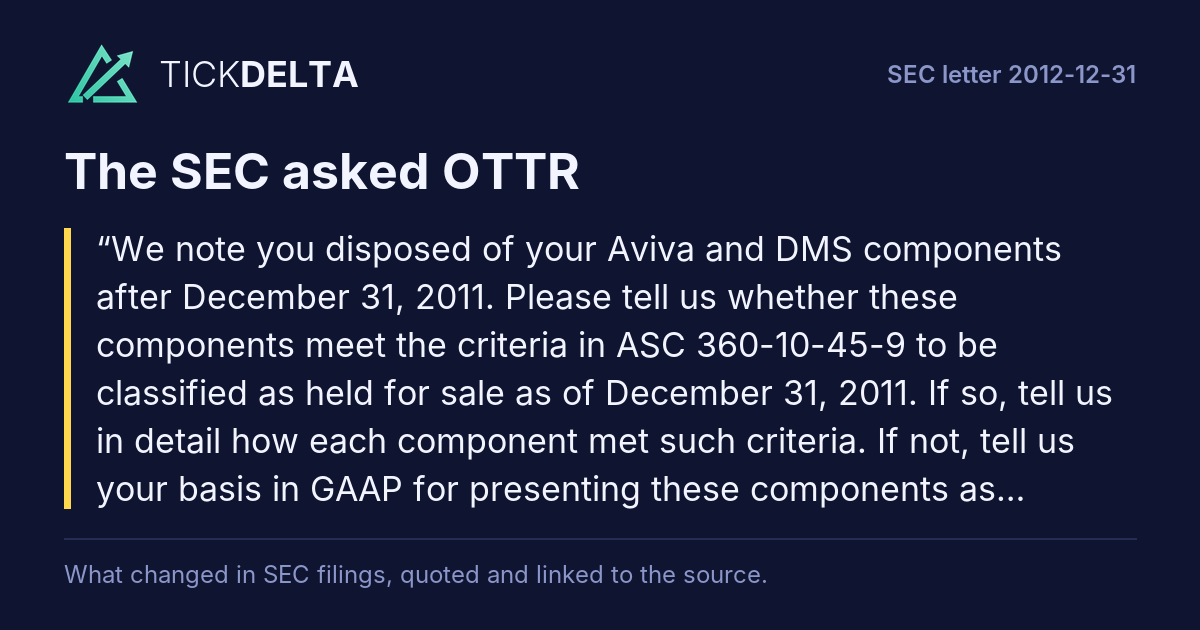
We note you disposed of your Aviva and DMS components after December 31, 2011. Please tell us whether these components meet the criteria in ASC 360-10-45-9 to be classified as held for sale as of December 31, 2011. If so, tell us in detail how each component met such criteria. If not, tell us your basis in GAAP for presenting these components as discontinued operations as of December 31, 2011.
Rest of the question

Additionally, please tell us your basis in GAAP for reclassifying the assets and liabilities of the disposed components as assets and liabilities of discontinued operations as of December 31, 2010.

OTTR answered
The Aviva and DMS components did meet the criteria in ASC 360-10-45-9 to be classified as held for sale as of December 31, 2011. The specific criteria are listed below along with how each respective component met them.

Aviva:

Aviva’s assets and liabilities constituted a disposal group that meet the requirements under Financial Accounting Standards Board (FASB) Accounting Standards Codification (ASC) paragraph 360-10-45-9 to be classified as held for sale (addressed below) and Aviva constitutes a component of the Company with operations and cash flows that are clearly distinguishable,
Rest of the answer

operationally and for financial reporting purposes, from the rest of the entity. The results of operations of a component of an entity that either has been disposed of or is classified as held for sale under the requirements of ASC paragraph 360-10-45-9, shall be reported in discontinued operations in accordance with ASC paragraph 205-20-45-3 if both of the following conditions are met:

The operations and cash flows of the component have been (or will be) eliminated from the ongoing operations of the entity as a result of the disposal transaction.

Read in the reply
In its next report

First report after the company's reply of Jan 23, 2013: 10-K filed Feb 27, 2013 ↗, against the 10-K filed Feb 29, 2012 ↗.

Tickdelta does not hold the text of both reports, so they are not compared here.

Also in this review: closing letter, 2013-01-28

Form 10-K

2010-09-16 to 2010-10-28 · 4 questions · 2 letters from the SEC, 2 from the company
Review closed 2010-10-28
Purpose and Philosophy, page 11
SEC asked (1)
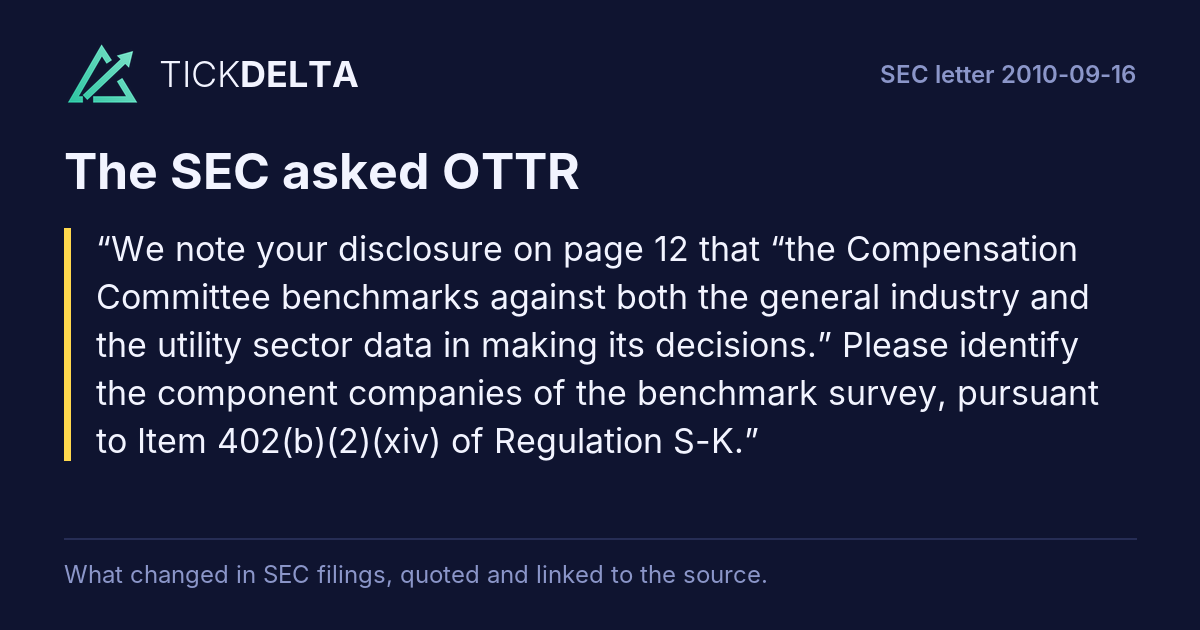
We note your disclosure on page 12 that “the Compensation Committee benchmarks against both the general industry and the utility sector data in making its decisions.” Please identify the component companies of the benchmark survey, pursuant to Item 402(b)(2)(xiv) of Regulation S-K.
OTTR answered
The Staff issued a similar comment in its letter dated September 23, 2008 regarding the

Company’s Definitive Proxy Statement filed March 3, 2008. In our response letter dated October

16, 2008, we indicated the following to the Commission:

“Related to comment four, we do not use a self-constructed peer group for benchmarking compensation, but instead utilize general survey data computed by Towers Perrin. Accordingly, we will add two footnotes substantially as follows:

Towers Perrin utilized data from a general industry compensation survey performed by it.
Rest of the answer

The survey had 584 participants from a wide variety of industries. From that survey data Towers Perrin completed a regression analysis to account for Otter Tail Corporation’s size as measured by revenue.

Read in the reply
In its next report

First report after the company's reply of Sep 29, 2010: 10-Q filed Nov 8, 2010 ↗, against the 10-Q filed Aug 9, 2010 ↗.

Tickdelta does not hold the text of both reports, so they are not compared here.

Long-Term Incentives, page 13
SEC asked (2)
We note you have provided the formula for how you awarded the amount of performance shares and restricted shares for your executives. Please describe in greater detail how you calculated the amount of performance shares and restricted shares for each executive officer. Note that under Item 402(b)(1)(v) of Regulation S-K, a filer must disclose how it determined the amount and formula for each element of compensation.
OTTR answered
Related to comment two, in future filings, we will enhance our disclosure to include the following additional information, if then applicable:

In 2009, the Compensation Committee determined to reduce the value delivered through long-term incentives as compared to 2008, based in part upon information provided by Towers Perrin and in part upon the difficult economic climate. The actual targeted value delivered was reduced for each executive officer by 9.5% from 2008 to 2009.
Rest of the answer

For performance shares, the precise number of shares for each executive officer was calculated by dividing the targeted value delivered for each executive officer by the product of the per share price of the

Company’s common stock on March 2, 2009 ($16.85) and a discount rate of 81% to account for the three-year performance period. For restricted stock, the precise number of shares for each executive officer was calculated by dividing the targeted value delivered for each executive officer by the product of the per share price of the Company’s common stock on March 2, 2009

($16.85) and a discount rate of 89% to account for the four-year vesting period.

Read in the reply
In its next report

First report after the company's reply of Sep 29, 2010: 10-Q filed Nov 8, 2010 ↗, against the 10-Q filed Aug 9, 2010 ↗.

Tickdelta does not hold the text of both reports, so they are not compared here.

Compensation Policies and Risk, page 24
SEC asked (3)
We note your disclosure in response to Item 402(s) of Regulation S-K. Please describe to us the process you undertook to reach the conclusion that disclosure is not necessary.
OTTR answered
We believe that the Company’s compensation policies and practices for its employees are such that they are not likely to create risk that would have a material adverse effect on the

Company. As described in the 2010 Proxy Statement, the executive officers of Otter Tail

Corporation are paid two forms of incentive compensation. Short-term incentives are measured against earnings per share, return on equity and cash flow from operations, and as a result are transparent, subject to review, and verified by audit.
Rest of the answer

The Company’s long-term incentives are based upon stock performance, and again, are transparent and subject to review. In short, we believe there is little room for manipulation and a relatively low level of risk. To the extent that incentive compensation is utilized for other employees in the Company, consistent practices are followed. The Company’s disclosure in the 2010 Proxy

Statement to this effect was considered and discussed first by the executive team, including its Vice President of Human Resources, and then by the Compensation Committee and the Board of Directors.

The Company acknowledges that:

•

The Company is responsible for the adequacy and accuracy of the disclosure in the filing;

Staff comments or changes to disclosure in response to Staff comments do not foreclose the Commission from taking any action with respect to the filing; and

The Company may not assert Staff comments as a defense in any proceeding initiated by the Commission or any person under the federal securities laws of the United States.

Read in the reply
In its next report

First report after the company's reply of Sep 29, 2010: 10-Q filed Nov 8, 2010 ↗, against the 10-Q filed Aug 9, 2010 ↗.

Tickdelta does not hold the text of both reports, so they are not compared here.

Purpose and Philosophy, page 11
SEC asked
We note your response to comment one in our letter dated September 16, 2010. However, it is unclear whether you are using the survey data for a general understanding of compensation practices or as a reference point to base compensation decisions. Please revise to clarify your disclosure and, if applicable, identify the component companies.
Rest of the question

For guidance, refer to Question 118.05 of the Division of Corporation Finance Compliance and Disclosure Interpretations (Regulation S-K), which is available on our website at www.sec.gov.

OTTR answered
We have reviewed Question 118.05 of the Division of Corporation Finance Compliance and

Disclosure Interpretations (Regulation S-K). For purposes of our compensation decisions made in

2008 (as described in our 2009 Proxy Statement), our compensation committee utilized the general survey data computed by Towers Perrin in 2007 as a reference point.
Rest of the answer

For purposes of our compensation decisions in 2009 (as described in our 2010 Proxy Statement), our compensation committee utilized the same general survey data computed by Towers Perrin in

2007, but only for a general understanding of compensation practices and not as a reference point. In 2010, we do not presently intend to utilize survey data for purposes of our compensation decisions. However, if we do utilize surveys or databases to benchmark compensation for our named executive officers, we will provide disclosure consistent with the requirements of Item 402(b)(2)(xiv) of Regulation S-K, taking into consideration your guidance referenced above, in our future filings.

Read in the reply
In its next report

First report after the company's reply of Oct 25, 2010: 10-Q filed Nov 8, 2010 ↗, against the 10-Q filed Aug 9, 2010 ↗.

Tickdelta does not hold the text of both reports, so they are not compared here.

Also in this review: closing letter, 2010-10-28

Letters without questions

Other letters

UPLOAD and CORRESP
1 other letter: notices that a filing will not be reviewed, requests to declare a registration effective, and the like
  • Jan 13, 2014 · SEC: letter · Otter Tail Corporation · Form 10-K for Fiscal Year Ended December 31, 2012 · Filed...

From the SEC's correspondence on EDGAR: staff letters (form UPLOAD) and company letters (form CORRESP), 13 letters filed since 2010-09-16. Questions and answers are matched by their numbers; topics come from words in each question. The reports are compared word for word (same form, before the first SEC letter against the first report after the company's reply). No AI.

Sources

The SEC's correspondence on EDGAR: staff letters (form UPLOAD) and company letters (form CORRESP), matched question by question. No AI.

Also

Filings: the letters in the filing list.

Work with it

Excel workbook · CSV. Google Sheet that stays up to date: paste =IMPORTDATA("https://tickdelta.com/company/OTTR/export.csv") into a cell.

Next in Owners and insiders:Insider trades
Esc

Type a ticker such as AAPL, a name, an investor such as Buffett, or a topic such as tariffs. ↑ ↓ to move, Enter to open.