Form 10-K for the Year Ended December 31, 2014
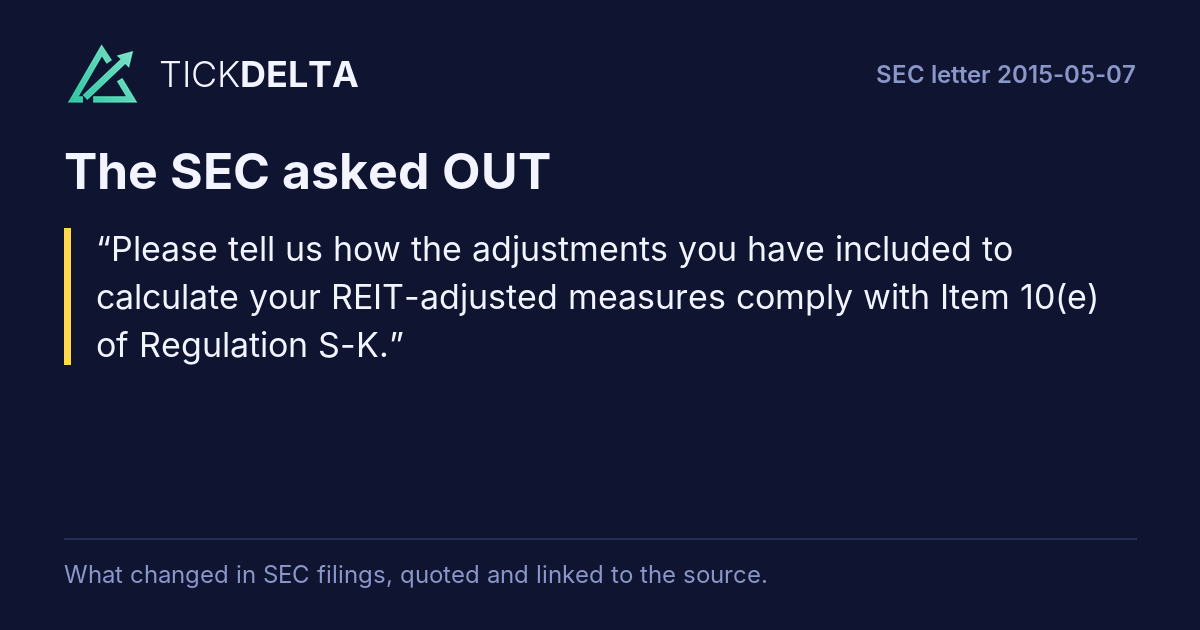
Please tell us how the adjustments you have included to calculate your REIT-adjusted measures comply with Item 10(e) of Regulation S-K.
In a discussion with Mr. Eric McPhee, a member of the Staff, on May 12, we understand that this comment is focused on certain adjustments that impact the 2013 non-GAAP measures, Adjusted OIBDA, FFO and AFFO, and that relate to the 2014 capital structure and formation activities resulting in the Company becoming a stand-alone public company.Read in the reply
The Company advises the Staff that these adjustments impacted Adjusted OIBDA, FFO and AFFO, so as to present these non-GAAP performance measures on a REIT-comparable basis, as follows:
•
Adjusted OIBDA - adjusting 2013 to include the incremental costsRest of the answer
associated with operating as a stand-alone public company, which were incurred in 2014.
FFO and AFFO – (1) adjusting 2013 to include the incremental costs associated with operating as a stand-alone public company; (2) adjusting 2013 to include interest expense, which was incurred in 2014, relating to our formation borrowings in January 2014: (3) adjusting 2013 for the lender commitment fees in connection with the acquisition of certain outdoor advertising businesses of Van Wagner (the “Acquisition”); and
(4) adjusting 2013 to include the amortization of deferred financing costs incurred in 2014 relating to items (2) and (3) above.
The Company believes that these REIT-comparable basis adjustments comply with Item 10(e) of Regulation S-K for the following reasons:
The REIT-comparable basis non-GAAP performance measure is reconciled back to the corresponding GAAP measures of operating income and net income in the reconciliation table beginning on page 41 of the Form 10-K. These
GAAP measures are shown with equal or greater prominence as REIT-comparable basis.
The Company discloses the reasons why management believes the presentation of REIT-comparable basis provides useful information to investors regarding its results of operations in the “Key Performance
Indicators” section beginning on page 38 of the Form 10-K.
The Company does not present any prohibited adjustments under Item 10(e) of Regulation S-K. For example, the Company does not present REIT-comparable basis as a non-GAAP liquidity measure, adjustments related to
REIT-comparable basis do not eliminate or smooth items identified as non-recurring, infrequent or unusual when the nature of the charge or gain is such that it is reasonably likely to recur within two years or there was a similar charge or gain within the prior two years, and the title and description “REIT-comparable basis” is not confusingly similar to the title or description used for GAAP financial measures.
The incremental costs associated with operating as a stand-alone public company were significant in 2014, and resulted from a series of major public company formation events, namely the Company’s corporate reorganization and formation borrowings in January 2014, initial public offering in April 2014 and eventual split-off from CBS Corporation (“CBS”) in July 2014. In order to become a truly independent company from CBS, the Company had to build capabilities and functions to replace those previously performed by CBS. This entailed hiring new employees and thirdparty resources with the necessary experience to provide the appropriate governance and operating functions needed in areas like accounting, financial reporting, legal, income taxes, investor relations, treasury and cash management, information technology, human resources, and internal audit. The development of these capabilities commenced in late 2013 and significantly increased in 2014 to enable the Company to become self-sufficient by the time of the split-off from CBS in July 2014. While expenses relating to these items are recurring expenses, they represent a very significant change in the Company’s business capabilities and operating performance between 2013 and 2014, due to the Company becoming a stand-alone public company in 2014.
The interest expense and amortization of deferred financing costs were also significant in 2014, and resulted from the $1.6 billion of borrowings in January 2014 used to finance the Company’s reorganization and split-off from CBS. While expenses relating to these items are recurring expenses, they represent a very significant change in the capital structure costs between 2013 and 2014, due to the Company becoming a stand-alone public company.
In addition, the Company adjusted for interest expense, as well as the amortization of deferred financing costs, related to the lender commitment in connection with the Acquisition. This was a one-time non-recurring matter. The Company financed the Acquisition with cash and proceeds from the issuance of senior notes in October 2014, and did not utilize the bridge term loan facility. The Company did not make an adjustment for the financing costs regarding the October 2014 senior notes issuance as they are normal recurring charges and were not part of the formation activities.
The Company believes that reflecting the amounts for incremental stand-alone costs, formation borrowings interest expense and lender commitment fees, as well as the amortization of deferred financing costs related to both the formation borrowings and Acquisition commitment fees in 2013, provides the most transparent view of the
Company’s underlying operating performance when comparing 2013 to 2014. The Company also believes that these formation activities were so significant in 2014 that to not reflect them as adjustments to 2013 would inappropriately present to the reader a reduction in Adjusted OIBDA, FFO and AFFO from 2013 to 2014. Furthermore, since the costs incurred in 2014 that relate to incremental stand-alone costs and formation borrowings interest expenses are ongoing and recurring, the Company believes making such adjustments in 2014 would not be appropriate to achieve the purposes of Item 10(e) of Regulation S-K. Please note that we expect that these adjustments will not be necessary in periods after 2015 as we reach a point whereby all periods presented will include these recurring costs.
First report after the company's reply of May 20, 2015: 10-Q filed Aug 12, 2015 ↗, against the 10-Q filed May 7, 2015 ↗.
Tickdelta does not hold the text of both reports, so they are not compared here.
In future filings, please revise the presentation of your summary of real estate activities to separately present information on your capitalized costs broken out by 1) new investments, 2) redevelopments, 3) recurring capex, and 4) land acquisitions (i.e. ground lease purchases).Rest of the question
In responding to our comments, please provide a written statement from the company acknowledging that: the company is responsible for the adequacy and accuracy of the disclosure in the filing; staff comments or changes to disclosure in response to staff comments do not foreclose the Commission from taking any action with respect to the filing; and the company may not assert staff comments as a defense in any proceeding initiated by the Commission or any person under the federal securities laws of the United States.
In response to the Staff’s comment, the Company hereby confirms that it will revise its presentation of its summary of real estate activities to separately present information on its “additions for construction of/improvements to structures” to be broken out as requested in future filings.Read in the reply
In addition, the Company hereby acknowledges that:
It is responsible for the adequacy and accuracy of the disclosure in the filing;
Staff comments or changes to disclosure in response to Staff comments do not foreclose the Commission from taking any action with respect to the filing; and
The Company mayRest of the answer
not assert Staff comments as a defense in any proceeding initiated by the Commission or any person under the federal securities laws of the United States.
We hope that the foregoing has been responsive to the Staff’s comments.
First report after the company's reply of May 20, 2015: 10-Q filed Aug 12, 2015 ↗, against the 10-Q filed May 7, 2015 ↗.
Tickdelta does not hold the text of both reports, so they are not compared here.
Also in this review: closing letter, 2015-06-02