Form 10-K for the Fiscal Year Ended May 31, 2019
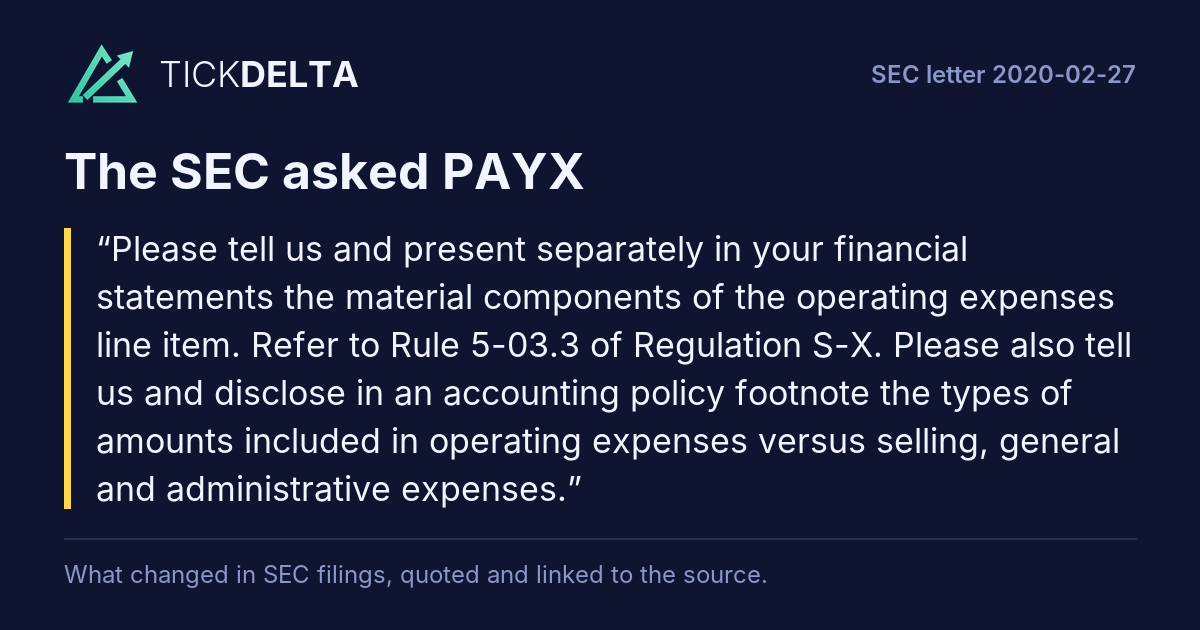
Please tell us and present separately in your financial statements the material components of the operating expenses line item. Refer to Rule 5-03.3 of Regulation S-X. Please also tell us and disclose in an accounting policy footnote the types of amounts included in operating expenses versus selling, general and administrative expenses.
to the Staff’s comment, the Company reviewed its presentation of operating expenses and determined that the operating expense line item reported on our Consolidated Statements of Income and Comprehensive Income are the cost of services provided to our clients and we believe appropriately fall under Rule 5-03.2(d) of Regulation S-X.
As such, we will update the presentation of our Consolidated Statements of Income and Comprehensive Income in future filings, beginning with our next required report under the Securities Exchange Act of 1934, as amended (the “Exchange Act”) after the Staff’sRead in the reply ↗Rest of the answer
comments have been resolved, as follows:
2018
2017
Year ended May 31,
2019
As Adjusted
Revenue:
Management Solutions
$
2,877.7
2,758.4
2,680.7
PEO and Insurance Services
814.2
555.8
421.7
Total service revenue
3,691.9
3,314.2
3,102.4
Interest on funds held for clients
80.6
63.5
50.6
Total revenue
3,772.5
3,377.7
3,153.0
Expenses:
Cost of service revenue
1,177.8
1,018.2
919.4
Selling, general and administrative expenses
1,223.4
1,068.0
979.7
Total expenses
2,401.2
2,086.2
1,899.1
Operating income
1,371.3
1,291.5
1,253.9
In response to the Staff’s comment, the Company will disclose in an accounting policy footnote the types of amounts included in cost of service revenue versus selling, general and administrative expenses. In future filings, beginning with our next required report under the Exchange Act after the Staff’s comments have been resolved, we will expand our accounting policy as follows:
“Cost of service revenue: Our costs and expenses applicable to total service revenue represent direct costs associated with providing payroll, benefits, human resource, and insurance services. This includes labor-related costs, direct costs related to certain PEO offerings, postage and delivery costs, facility costs, professional services, and depreciation and amortization of property and equipment, including internally developed software.
Selling, general and administrative expenses: Our selling, general and administrative expenses represent labor-related costs, including amortization of deferred sales commissions and bonuses, corporate asset depreciation and amortization, marketing, and other general and administrative expenses incurred by the Company.”
First report after the company's reply of 2020-03-11: 10-Q filed 2020-03-27 ↗, against the 10-Q filed 2019-12-20 ↗.
Tickdelta does not hold the text of both reports, so they are not compared here.
Please tell us the specific types of incremental costs of obtaining a contract that you have recognized as an asset. Also, tell us separately for each type of incremental cost how you determined the asset recognition criteria in paragraphs 25-1 through 25-3 of ASC 340-4025 were met.
The specific incremental costs to obtain a contract that the Company recognizes as an asset are sales commissions and bonuses, including related fringe benefits.
In accordance with ASC 340-40-25-1, the Company has applied the asset recognition criteria as follows:
·
Sales commissions are paid on each new contract sold. Sales commissions are considered incremental costs as they would not be incurred unless the underlying sales were completed.
Sales bonuses are typically earned once a certain level, or tier, of sales units (or revenue) has been achieved.Read in the reply ↗Rest of the answer
Achievement is based on cumulative sales during a period, which consists of multiple contracts. Sales bonuses incurred based on new contracts sold are considered incremental costs.
The Company incurs FICA expenses and 401(k) match expenses on compensation paid in the form of sales commissions and sales bonuses. The Company considers these fringe benefit costs to be incremental as they would not be incurred if the underlying sales were not completed.
For all the above items, at the time a sale is completed, the Company expects these incremental costs to be recovered over the life of the client relationship.
In accordance with ASC 340-40-25-3, the Company has determined that each of the above incremental costs act as an incentive to obtain a contract and would not be incurred unless the underlying sales were completed. If a new sale was not completed, these costs would not be incurred by the Company.
The Company will expand disclosures within ‘Note B – Service Revenue’ in future filings, beginning with our next required report under the Exchange Act after the Staff’s comments have been resolved. The additional disclosure will read as follows:
“The Company recognizes an asset for the incremental costs of obtaining a contract with a client if it is expected that the economic benefit and amortization period will be longer than one year. Incremental costs of obtaining a contract include only those costs the Company incurs to obtain a contract that it would not have incurred if the contract had not been obtained. The Company determined that certain sales commissions and bonuses, including related fringe benefits meet the capitalization criteria under ASC Subtopic 340-40, “Other Assets and Deferred Costs: Contracts with Customers” (“ASC 340-40”).”
First report after the company's reply of 2020-03-11: 10-Q filed 2020-03-27 ↗, against the 10-Q filed 2019-12-20 ↗.
Tickdelta does not hold the text of both reports, so they are not compared here.
We read your response to comment 2. Please also tell us and disclose your accounting policy for incremental costs of obtaining a contract renewal, including whether a commission paid for a renewal is commensurate with a commission paid on the initial contract, any material differences in the incremental costs capitalized for a contract renewal versus the initial contract and the amortization period for incrementalRest of the question
costs capitalized upon obtaining a contract renewal. Refer to ASC 340-40-50-2 and Revenue Recognition Transition Resource Group Memo No. 23.
The Company’s incremental costs to obtain a contract include commissions paid upon the initial commencement of a contract with its clients. The Company’s contracts generally do not contain specified contract periods and may be terminated by either party with 30-days’ notice of termination. As a result, the Company does not incur incremental costs related to contract renewals. The incremental costs of obtaining a new contract with a client are capitalized if it is expected that the economic benefit and amortization period will be longer than one year.Read in the reply ↗Rest of the answer
The Company’s assets related to incremental costs to obtain contracts with clients are capitalized and amortized using an accelerated method to closely align with the pattern of client attrition over the estimated life of the client relationship.
The Company will expand disclosures within ‘Note B – Service Revenue’ in future filings, beginning with our next required report under the Exchange Act after the Staff’s comments have been resolved. The revised disclosures will read as follows:
“The Company’s contracts generally do not contain specified contract periods and may be terminated have a term of 30 days as they are cancellable at any time by either party with 30-days’ notice of termination.”
“The Company recognizes an asset for the incremental costs of obtaining a contract with a client if it is expected that the economic benefit and amortization period will be longer than one year. Incremental costs of obtaining a contract include only those costs that are directly related to the acquisition of new contracts and that would not have been incurred if the contract had not been obtained. The Company does not incur incremental costs to obtain a contract renewal. The Company determined that certain sales commissions and bonuses, including related fringe benefits, selling and commission costs meet the capitalization criteria under ASC Subtopic 340-40, “Other Assets and Deferred Costs: Contracts with Customers” (“ASC 340-40”).”
First report after the company's reply of 2020-04-08: 10-K filed 2020-07-17 ↗, against the 10-K filed 2019-07-24 ↗.
Tickdelta does not hold the text of both reports, so they are not compared here.
Also in this review: closing letter, 2020-04-09