Form 10-K
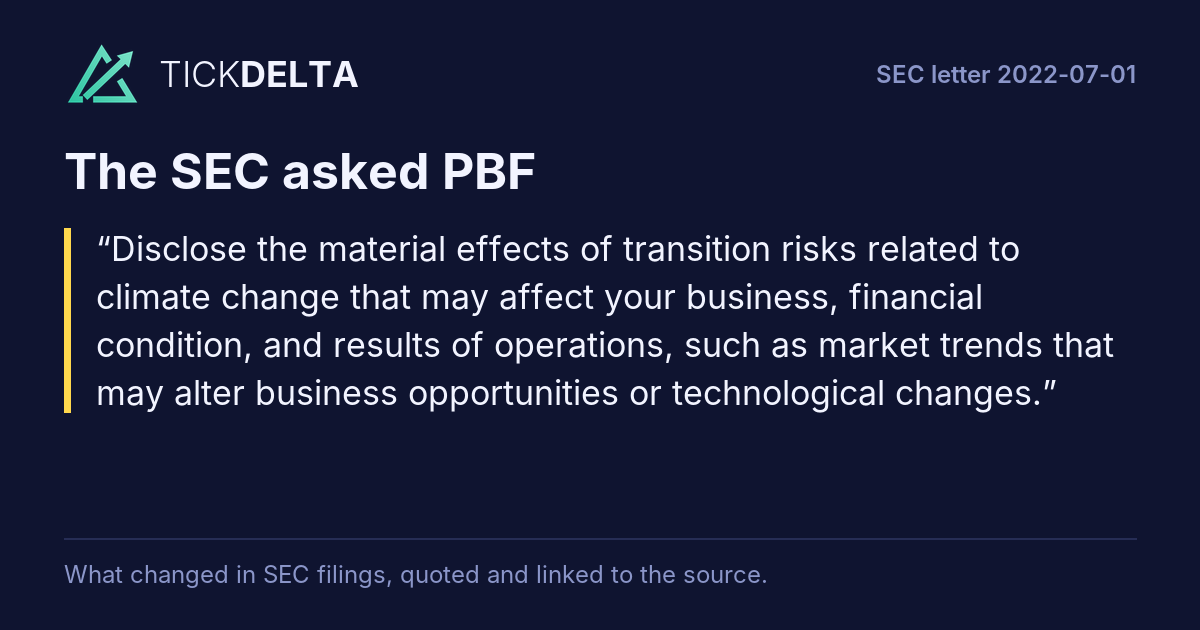
Disclose the material effects of transition risks related to climate change that may affect your business, financial condition, and results of operations, such as market trends that may alter business opportunities or technological changes.
We note the revised disclosure you intend to provide in response to prior comment 2. Please further revise to more clearly explain the potential impact to the company of litigation risks related to climate change. For example, you state that you operate in jurisdictions where large and unpredictable damage awards may occur in the context of litigation and that private plaintiffs may initiate legal action against you for alleged environmental impacts to obtain monetary awards, but you do not appear to specifically refer to climate change or explain how you would be affected.Read in the reply
As noted in ourRest of the answer
previous response, we respectfully advise the Staff that our 2021 Form 10-K includes a risk factor on page 37 where we highlight “Environmental clean-up and remediation costs of our sites and environmental litigation could decrease our net cash flow, reduce our results of operations and impair our financial condition.” In response to the Staff’s further comment, in future Form 10-K filings, we propose to change the title of the risk factor and include the following further revised disclosure (underlined for emphasis) about litigation risks related to climate change and the potential impact to the Company as part of this existing risk factor:
Environmental clean-up and remediation costs of our sites and environmental litigation, including related to climate change, could decrease our net cash flow, reduce our results of operations and impair our financial condition.
Changes in law or interpretation of settled law and changes in policy, including with respect to climate change, other environmental regulations or regulations mandating efficiency standards or the use of alternative fuels or uncompetitive fuel components, could adversely affect our operations and results by increasing our cost of compliance, delaying or eliminating available business opportunities and/or preventing or limiting existing operations. Our operations also may give rise to federal, state or local government enforcement proceedings alleging non-compliance with applicable laws or regulations.
We operate in jurisdictions where very large and unpredictable punitive damage awards may occur in the context of litigation. Private plaintiffs may also initiate legal action against us for alleged environmental impacts. These parties may attempt to use the legal system to promote public policy agendas (including seeking to reduce the production and sale of hydrocarbon products through litigation targeting the company or other industry participants), gain political notoriety, or obtain monetary awards from the company. For example, in recent years, private litigation has been increasingly initiated against oil and gas companies by local and state agencies and private parties alleging climate change impacts arising from their operations and seeking damages and equitable relief. We have not had any climate change litigation initiated against us to date and we cannot reasonably predict whether any such litigation will be initiated against us or, if initiated, what the outcome would be. If any such litigation were to be initiated against us, at a minimum, we would incur legal and other expenses to defend such lawsuits, which amounts may be significant. If we failed to prevail in any such litigation and were required to pay significant damages and/or materially alter the manner in which we conduct our business, there could be a material adverse impact on our operations, financial condition or results of operations.
First report after the company's reply of Aug 16, 2022: 10-Q filed Oct 27, 2022 ↗, against the 10-Q filed Apr 28, 2022 ↗.
Tickdelta does not hold the text of both reports, so they are not compared here.
We note your disclosure on page 39 of your Form 10-K regarding increased litigation risks related to climate change. Please expand your disclosure to explain the potential impact to the company.
We note your response to prior comment 4 and reissue it in part. Consistent with our prior comment, please revise to provide disclosure explaining the possible consequences to your operations or results if your customers or suppliers are impacted by severe weather events.Read in the reply
In addition, as previously requested, provide us with quantitative information regarding the cost of insurance for the periods for which financial statements are presented in your Form 10-K and tell us whether changes are expected in future periods.
As noted in our previous response, our 2021 Form 10-K filing includesRest of the answer
disclosure of potential impacts that weather-related events could have on our business, supply chain and results of operations as detailed within our risk factors on pages 32 and 33 of our 2021 Form 10-K.
With regard to possible consequences to our operations or results if our customers or suppliers are impacted by severe weather events, we propose to expand on our existing risk factor on page 33 of our 2021 Form 10-K where we highlight that “Our refineries are subject to interruptions of supply and distribution as a result of our reliance on pipelines and railroads for transportation of crude oil and refined products”. Specifically, we propose in future 10-K filings to add the following incremental disclosure (underlined for emphasis) to this risk factor to more directly disclose the risks related to our customers or suppliers that are impacted by severe weather events:
Our refineries are subject to interruptions of supply and distribution, including due to severe weather events, as a result of our reliance on pipelines and railroads for transportation of crude oil and refined products.
Our Toledo, Chalmette, Torrance and Martinez refineries receive a significant portion of their crude oil through our owned, as well as third-party, pipelines. These pipelines include the Enbridge system, Capline and Mid-Valley pipelines for supplying crude to our Toledo refinery, the MOEM Pipeline (which is owned by our subsidiary) and CAM Pipeline for supplying crude to our Chalmette refinery and the Torrance Valley Pipeline, San Pablo Bay Pipeline, San Ardo and Coastal Pipeline systems for supplying crude to our Torrance and Martinez refineries. Additionally, our Toledo, Chalmette, Torrance and Martinez refineries deliver a significant portion of the refined products through pipelines. These pipelines include pipelines such as the Sunoco Logistics Partners L.P. and Buckeye Partners L.P. pipelines at the Toledo refinery, the Collins pipeline (which is owned by our subsidiary) at our Chalmette refinery, the Jet Pipeline to the Los Angeles International Airport, the Product Pipeline to Vernon at our Torrance refinery and the KinderMorgan SFPP North Pipeline at our Martinez refinery. We could experience an interruption of supply or delivery, or an increased cost of receiving crude oil and delivering refined products to market, if the ability of these pipelines to transport crude oil or refined products is disrupted because of accidents, severe weather events, including storms, hurricanes or floods, governmental regulations, terrorism, other third-party actions or casualties or other events.
The Delaware City rail unloading facilities and the assets acquired in connection with the PBFX acquisition of CPI Operations LLC (the “East Coast Storage Assets”), allow our East Coast Refining System to source WTI-based crudes from Western Canada and the Mid-Continent, which may provide significant cost advantages versus traditional Brent-based international crudes in certain market environments. Any disruptions or restrictions to our supply of crude by rail due to problems with third-party logistics infrastructure or operations or as a result of increased regulations, could increase our crude costs and negatively impact our results of operations and cash flows.
Due to the common carrier regulatory obligation applicable to interstate oil pipelines, capacity allocation among shippers can become contentious in the event demand is in excess of capacity. Therefore, nominations by new shippers or increased nominations by existing shippers may reduce the capacity available to us. Any prolonged interruption in the operation or curtailment of available capacity of the pipelines that we rely upon for transportation of crude oil and refined products could have a further material adverse effect on our business, financial condition, results of operations and cash flows.
In addition, substantial weather-related conditions could impact our relationships and arrangements with our major customers and suppliers by materially affecting the normal flow of crude oil and refined products, especially seaborne transactions. For example, severe weather events could damage transportation infrastructures and lead to interruptions of our operations, including our ability to deliver our products, or increases in costs to receive crude oil.
As it pertains to the cost of insurance for the periods presented in our 2021 Form 10-K, we respectively advise the Staff that we purchase property insurance through the commercial insurance markets. The premiums we pay for our insurance program are impacted by factors that we control as well as factors that are beyond our control and our premiums are not necessarily directly comparable to the premiums that are paid by other companies in our industry because of the decisions that we make in designing our insurance program. For example, since our premiums are affected directly by the aggregate value of the property for which we elect coverage, our acquisition of the Martinez Refinery in 2020 increased our insurance premiums by approximately [***] on an annualized basis.
As it pertains to the Staff’s request to quantify our cost of insurance, our Company incurred total property and business interruption insurance costs of approximately [***], representing, on a normalized basis, adjusting for our acquisition of the Martinez Refinery, an increase of approximately [***]% in 2020 as compared to 2019 and an increase of approximately [***]% in 2021 as compared to 2020. Excluding the incremental insurance costs associated with the addition of our Martinez refinery, increases in our insurance costs for all periods presented were determined to be immaterial as they accounted for less than 1% of our total Operating Expenses for each respective period. As the foregoing demonstrates, even without an increase in the aggregate value of the properties covered by our insurance program, our insurance costs have increased and, based on recent industry experience, we expect that they will continue to increase in the future although we cannot predict the extent of such increases. We believe insurance costs for our company and our industry peers have increased as a result of significant losses (in excess of premium income) experienced by insurers in the global downstream/midstream energy markets attributable to both operational events and weather-related events. These losses also led certain insurers to exit the market or reduce their exposures on a go forward basis, which further contributed to increased premium costs. To the extent that insurers experience losses (regardless of the nature in terms of being operational or weather-related) that exceed their premium income and/or the capacity in the insurance markets decreases, we expect that industry premiums will increase in subsequent years.
As mentioned in our previous response, we cannot predict whether we will incur material weather-related damage or loss events in the future, but we believe it is reasonable to expect that such events may occur. As a result, we maintain a comprehensive property insurance coverage (including Named Windstorm coverage) with reputable insurers to mitigate such risks in accordance with customary industry practices and in such amounts and at such costs that we believe to be prudent and commercially practicable. Nevertheless, our total property and business interruption insurance costs for 2022 are anticipated to be in line with total costs incurred in 2021 and are currently estimated to approximate [***]. Considering the quantitative and qualitative factors discussed above, we believe that our disclosures, including in our 2021 Form 10-K, provide all material information regarding severe weather events and insurance costs.
First report after the company's reply of Aug 16, 2022: 10-Q filed Oct 27, 2022 ↗, against the 10-Q filed Apr 28, 2022 ↗.
Tickdelta does not hold the text of both reports, so they are not compared here.
We note your 2022 Proxy Statement states that your facilities utilize state of the art pollution control equipment to reduce emissions. Please revise your disclosure to identify any material past and/or future capital expenditures for climate-related projects.Rest of the question
Please provide quantitative information for each of the periods for which financial statements are presented in your Form 10-K and for any future periods as part of your response.
No numbered answer found in the reply. Read the reply ↗
First report after the company's reply of Aug 16, 2022: 10-Q filed Oct 27, 2022 ↗, against the 10-Q filed Apr 28, 2022 ↗.
Tickdelta does not hold the text of both reports, so they are not compared here.
We note your disclosures on pages 35-36 of your Form 10-K regarding the physical effects of climate change. If material, discuss the physical effects of climate change on your operations and results in greater detail.Rest of the question
This disclosure may include the following: • quantification of material weather-related damages to your property or operations, including any damages due to rising sea levels; • potential for indirect weather-related impacts that have affected or may affect your major customers or suppliers; and • any weather-related impacts on the cost or availability of insurance. Your response should include quantitative information for each of the periods for which financial statements are presented in your Form 10-K and explain whether changes are expected in future periods.
No numbered answer found in the reply. Read the reply ↗
First report after the company's reply of Aug 16, 2022: 10-Q filed Oct 27, 2022 ↗, against the 10-Q filed Apr 28, 2022 ↗.
Tickdelta does not hold the text of both reports, so they are not compared here.
We note your disclosures on page 70 regarding your Renewable Fuel Standard compliance costs and page 105 regarding environmental and regulatory capital expenditures. Please tell us about and quantify any additional compliance costs related to climate change for each of the periods covered by your Form 10-K and whether increased amounts are expected to be incurred in future periods.
No numbered answer found in the reply. Read the reply ↗
First report after the company's reply of Aug 16, 2022: 10-Q filed Oct 27, 2022 ↗, against the 10-Q filed Apr 28, 2022 ↗.
Tickdelta does not hold the text of both reports, so they are not compared here.
We note the revised disclosure you intend to provide in response to prior comment 2. Please further revise to more clearly explain the potential impact to the company of litigation risks related to climate change.Rest of the question
For example, you state that you operate in jurisdictions where large and unpredictable damage awards may occur in the context of litigation and that private plaintiffs may initiate legal action against you for alleged environmental impacts to obtain monetary awards, but you do not appear to specifically refer to climate change or explain how you would be affected.
No reply letter found.
First report after the SEC's letter of Aug 5, 2022: 10-Q filed Oct 27, 2022 ↗, against the 10-Q filed Apr 28, 2022 ↗.
Tickdelta does not hold the text of both reports, so they are not compared here.
We note your response to prior comment 4 and reissue it in part. Consistent with our prior comment, please revise to provide disclosure explaining the possible consequences to your operations or results if your customers or suppliers are impacted by severe weather events.Rest of the question
In addition, as previously requested, provide us with quantitative information regarding the cost of insurance for the periods for which financial statements are presented in your Form 10-K and tell us whether changes are expected in future periods. Please contact Michael Purcell at 202-551-5351 or Karina Dorin at 202-551-3763 with any questions.
No reply letter found.
First report after the SEC's letter of Aug 5, 2022: 10-Q filed Oct 27, 2022 ↗, against the 10-Q filed Apr 28, 2022 ↗.
Tickdelta does not hold the text of both reports, so they are not compared here.
Also in this review: request for more time, Jul 6, 2022, company letter, Jul 28, 2022, closing letter, 2022-08-22