PFEPfizer
Pfizer Inc. is a research-based, global biopharmaceutical company. 10-K, Item 1
- Employees
- 75,000
- Headquarters
- New York, NY
- CEO
- Albert Bourla
- Next results
- around Feb 2, 2027
6 paragraphs in Risk Factors of the 10-K filed Feb 26, 2026 with nothing like them in the 10-K filed Feb 27, 2025. Quoted exactly. Paragraphs that were only edited are under 10-K change.
Compared with the Risk Factors in the latest 10-K of the other 59 Health care companies: a paragraph with at least half its words the same at another company is called similar, and the companies are listed under it. A paragraph most of them have is marked boilerplate. No line means no other company has one like it. This counts text; it does not say how serious a risk is.
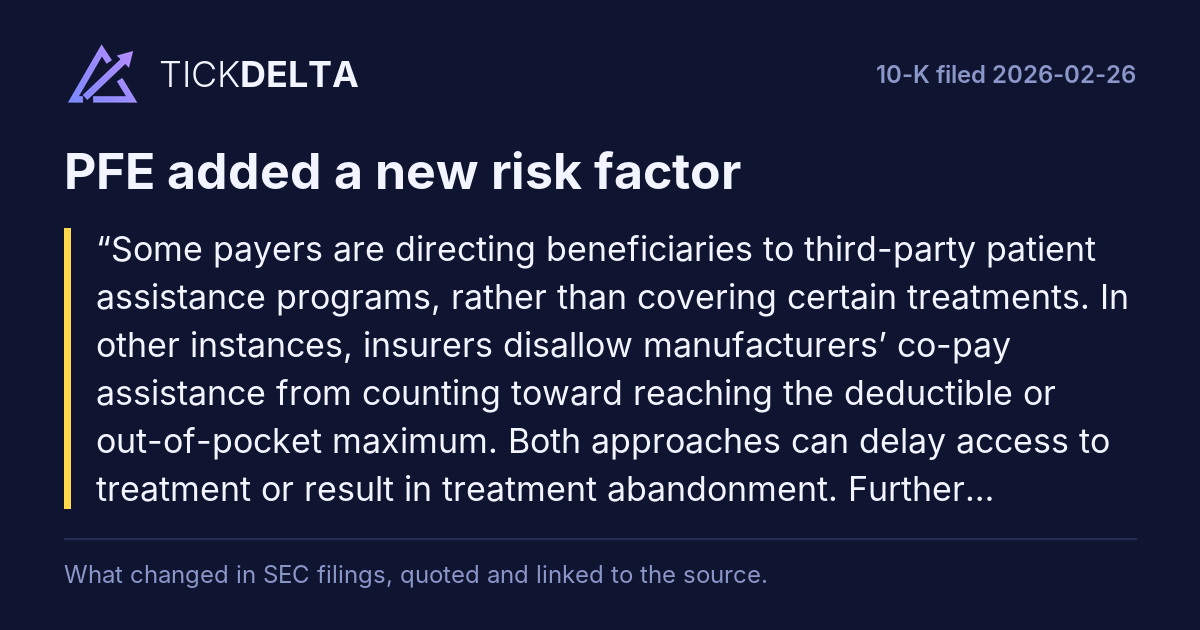
Some payers are directing beneficiaries to third-party patient assistance programs, rather than covering certain treatments. In other instances, insurers disallow manufacturers’ co-pay assistance from counting toward reaching the deductible or out-of-pocket maximum. Both approaches can delay access to treatment or result in treatment abandonment. Further, consumers are facing responsibility for a larger portion of their prescription costs, or administrative hurdles to access, and may favor lower-cost, or generic alternatives, or seek direct-to-consumer medications outside of insurance plans.
Read in the 10-K ↗
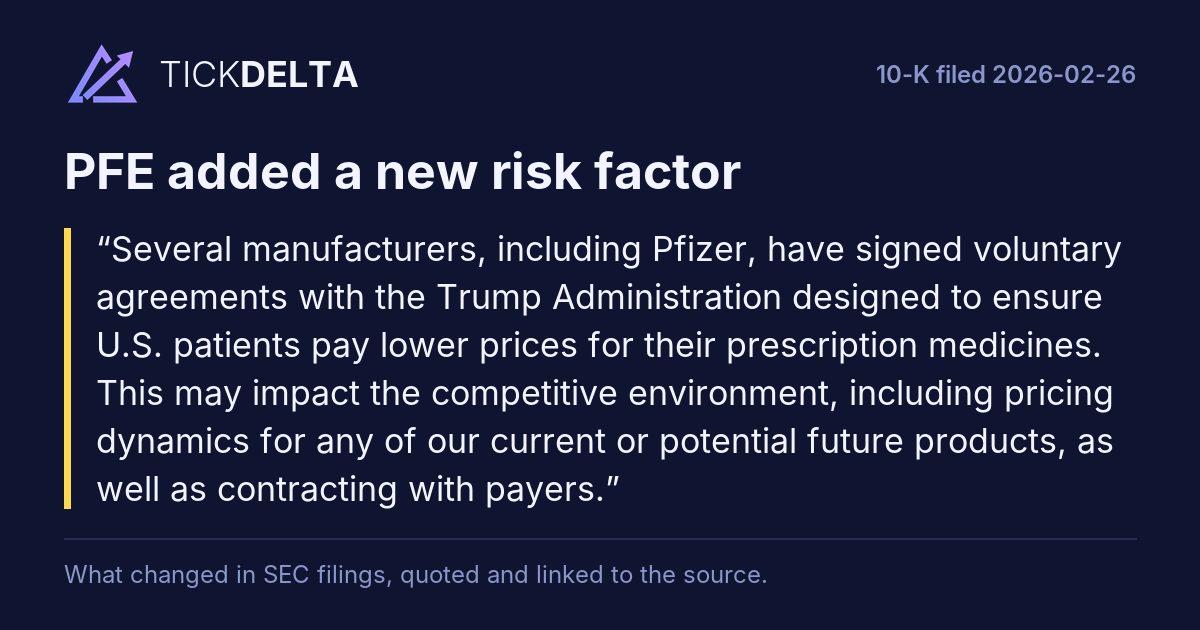
Several manufacturers, including Pfizer, have signed voluntary agreements with the Trump Administration designed to ensure U.S. patients pay lower prices for their prescription medicines. This may impact the competitive environment, including pricing dynamics for any of our current or potential future products, as well as contracting with payers.
Read in the 10-K ↗
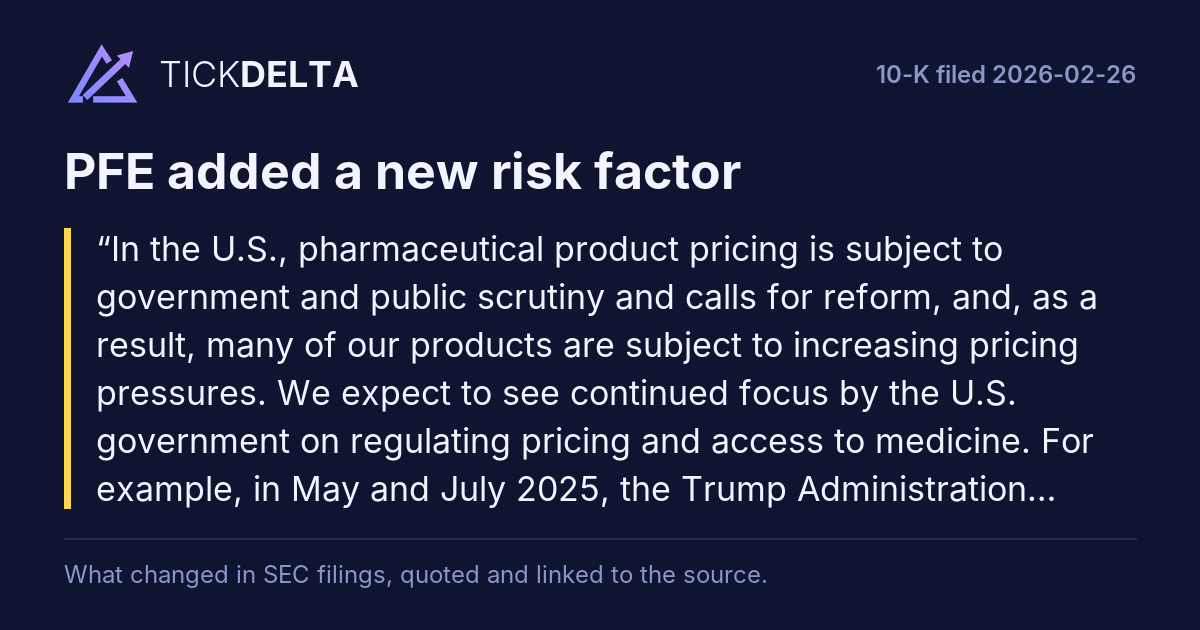
In the U.S., pharmaceutical product pricing is subject to government and public scrutiny and calls for reform, and, as a result, many of our products are subject to increasing pricing pressures. We expect to see continued focus by the U.S. government on regulating pricing and access to medicine. For example, in May and July 2025, the Trump Administration issued the MFN Initiatives and, in September 2025, we announced an agreement with the Trump Administration in which we voluntarily agreed to implement measures designed to make certain drug prices for U.S. patients more comparable to those in other developed countries (the MFN Agreement). We are also participating in the TrumpRx.gov platform, which allows U.S. patients to purchase certain medicines at significant discounts to current retail prices. These discounts may adversely affect revenue generated from participating drugs. Further, we face risks and uncertainties associated with the MFN Agreement, including the possibility of, among other things, unfavorable impacts to pricing and access. The MFN Agreement and broader U.S. policy efforts to implement measures designed to make certain drug prices for U.S. patients more comparable to those in other developed countries is subject to risks and uncertainties and could, among other things, negatively impact our pricing strategies, product demand or access, or competitive positioning across global markets, and may adversely affect revenues in certain markets.
Similar paragraph at 1 of 59 other Health care companies: LLYRead in the 10-K ↗
•Regulatory decisions or feedback could impact the future development of our product candidates, including our vaccine candidates such as our next generation pneumococcal conjugate vaccine candidate.
Read in the 10-K ↗
•We may experience increasing inconsistencies and unexpected changes in the evaluations and determinations made by the FDA during the process of applying for marketing approvals of our products due to reductions in workforce, personnel movements, and policy changes.
Read in the 10-K ↗
may also lead to the unauthorized release of confidential or proprietary information which may impact our ability to realize the benefits of our data, including intellectual property. Further, reliance on third-party AI tools or services that incorporate AI may expose our organization to compliance gaps that are outside of our control. In addition, we could face risks related to our reliance on a small number of AI models or service providers.
Read in the 10-K ↗
New in the latest 10-Q
33 paragraphs in the 10-Q filed Nov 3, 2026 with nothing like them in the 10-Q filed Aug 4, 2026 (at least half the words must differ; new numbers alone do not count). Quoted exactly, grouped by the item heading above them. This is text that changed, not a judgement of how serious it is.
Financial statements and notes
2026 2025 2026 2025 Interest income $ (108) $ (138) $ (336) $ (437) Interest expense 662 652 1,998 1,960 Net interest expense 554 514 1,662 1,523 Net (gains)/losses on asset disposals (132) (2) (150) (91) Net (gains)/losses recognized during the period on equity securities 75 (201) 121 94 Income from collaborations, out-licensing arrangements and sales of compound/product rights (111) (45) (165) (82) Net periodic benefit costs/(credits) other than service costs (103) (73) (258) (333) Certain legal matters, net(a) 13 191 1,047 755 Certain asset impairments(b) — 260 4,325 577 Net gain from the sale of investment in ViiV(c) — — (1,870) — Changes in fair value of contingent consideration liabilities(d) 159 15 709 57 Other, net(e) (167) (141) (556) (291) Other (income)/deductions––net $ 288 $ 517 $ 4,866 $ 2,210
Read in the 10-Q ↗
effective tax rates for the third quarter and the first nine months of 2026, compared to the third quarter and the first nine months of 2025 were primarily due to the non-recurrence of the remeasurement of certain deferred tax liabilities, agreements, and resolutions with tax authorities, partially offset by favorable changes in the jurisdictional mix of earnings.
Read in the 10-Q ↗
(a)Income from continuing operations before provision/(benefit) for taxes on income.
Read in the 10-Q ↗
in revenues from COVID-19 products, the Prevnar family and several other products across categories. Excluding contributions from Comirnaty and Paxlovid, Total revenues increased 7% operationally.
Read in the 10-Q ↗
Vyndaqel family QTD $1,773 U.S. $1,086 $948 14 QTD and YTD growth primarily driven by continued market expansion in the U.S., as well as strong demand with continuing uptake in patient diagnosis across international markets and improved access in certain international markets.
Read in the 10-Q ↗
Up 12% YTD growth was partially offset by net price erosion in the U.S. as a result of new payer contracts.
Read in the 10-Q ↗
Prevnar family QTD $1,564 U.S. $1,026 $1,155 (11) QTD decline primarily driven by:
Read in the 10-Q ↗
Down 10% •lower vaccination rates in the adult and pediatric indications, as well as market share erosion for the adult indication, both in the U.S.; and
Read in the 10-Q ↗
(operationally) •lower demand in the pediatric indication in certain international markets.
Read in the 10-Q ↗
•lower vaccination rates in the adult and pediatric indications, as well as market share erosion for the adult indication, both in the U.S.,
Read in the 10-Q ↗
•favorable buying patterns in both the pediatric and adult indications, primarily in the U.S.;
Read in the 10-Q ↗
•higher market share and demand earlier in the year across certain international markets in both the pediatric and adult indications, despite lower demand in the current quarter.
Read in the 10-Q ↗
Ibrance QTD $1,082 U.S. $761 $670 14 QTD growth primarily driven by higher demand mostly in the U.S. and certain developed markets, favorable buying patterns and higher net price, both in the U.S., partially offset by the non-recurrence of a favorable rebate accrual adjustment in the prior year for certain international markets related to prior periods and competitive pressure in certain emerging markets.
Read in the 10-Q ↗
Up 3% YTD growth primarily driven by higher demand in the U.S. and certain developed markets, partially offset by the non-recurrence of a favorable rebate accrual adjustment in the prior year for certain international markets related to prior periods, lower net price in the U.S., as well as unfavorable buying patterns and competitive pressure in certain emerging markets.
Read in the 10-Q ↗
Padcev QTD $720 U.S. $696 $449 55 QTD and YTD growth primarily driven by increased market share in first-line locally advanced or metastatic urothelial cancer (la/mUC), as well as launch uptake in the cisplatin-ineligible indication for muscle-invasive bladder cancer.
Read in the 10-Q ↗
Up 55% YTD growth was partially offset by a one-time favorable impact associated with transition to a wholesaler distribution model in the U.S. in the prior year.
Read in the 10-Q ↗
Xtandi QTD $541 U.S. $541 $578 (6) QTD decline mainly driven by lower net price, unfavorable buying patterns and lower demand.
Read in the 10-Q ↗
Down 6% YTD decline mainly driven by lower net price and unfavorable buying patterns, partially offset by higher demand.
Read in the 10-Q ↗
Nurtec ODT/Vydura QTD $547 U.S. $485 $383 27 QTD and YTD growth primarily driven by strong demand in the U.S., as well as launch uptake in certain international markets.
Read in the 10-Q ↗
Comirnaty QTD $808 U.S. $562 $870 (35) QTD and YTD declines primarily driven by a lower favorable adjustment to the returns provision in the U.S., lower utilization in the U.S. primarily resulting from a narrower recommendation for vaccination, as well as lower contractual deliveries in certain international markets.
Read in the 10-Q ↗
Lorbrena QTD $387 U.S. $151 $103 46 QTD and YTD growth primarily driven by increased patient share in the first-line ALK+ metastatic NSCLC treatment setting in the U.S., China and certain other international markets.
Read in the 10-Q ↗
Abrysvo QTD $303 U.S. $141 $210 (33) QTD growth primarily driven by launch uptake in certain international markets, partially offset by unfavorable buying patterns and lower vaccination rates in the U.S.
Read in the 10-Q ↗
Up 9% YTD growth primarily driven by launch uptake in certain international markets, partially offset by lower vaccination rates and lower market share in the U.S.
Read in the 10-Q ↗
Paxlovid QTD $449 U.S. $373 $1,122 (67) QTD decline primarily driven by lower COVID-19 infections across the U.S. and international markets, partially offset by timing of government purchases in certain emerging markets.
Read in the 10-Q ↗
Down 63% YTD decline primarily driven by lower COVID-19 infections across the U.S. and international markets and lower government purchases in certain international markets.
Read in the 10-Q ↗
PC1 QTD $300 U.S. $ 56 $ 92 (39) QTD decline primarily driven by lower manufacturing of divested products under manufacturing and supply agreements, partially offset by higher active pharmaceutical ingredient sales.
Read in the 10-Q ↗
Down 12% YTD decline reflects the wind-down in 2025 of our former Pfizer Ignite operating segment and lower manufacturing of divested products under manufacturing and supply agreements, partially offset by higher active pharmaceutical ingredient sales and higher manufacturing of third-party products under manufacturing and supply agreements.
Read in the 10-Q ↗
• an increase of $40 million due to a lower favorable adjustment of U.S. healthcare reform fees recorded in the third quarter of 2026 compared to the third quarter of 2025; and
Read in the 10-Q ↗
• increases of $240 million and $300 million, respectively, in compensation-related expenses.
Read in the 10-Q ↗
Talzenna (talazoparib) In combination with Xtandi (enzalutamide) for the treatment of adult patients with metastatic androgen pathway modulation-naïve or -sensitive (mAPMN/S) prostate cancer with homologous recombination repair (HRR) gene mutations, as detected by a FDA-authorized test October 2026 (U.S.)
Read in the 10-Q ↗
VLA15 (PF-07307405) vaccine(a) Prevention of Lyme disease (Lyme borreliosis) caused by Borrelia species in individuals 5 years of age and older August 2026 (EU)
Read in the 10-Q ↗
Litfulo (ritlecitinib) Treatment of nonsegmental vitiligo in adults October 2026 (EU)
Read in the 10-Q ↗
Risks Related to Government Regulation, Legal Proceedings, and Changes in Laws and Accounting Standards
Read in the 10-Q ↗
The 10-Q's risk factors against the 10-K
Item 1A of the 10-Q filed Nov 3, 2026 against Item 1A of the 10-K filed Feb 26, 2026.
A 10-Q repeats only the risks that changed, so a 10-K paragraph that is missing from it is not counted as removed.
Added is a paragraph with nothing like it in the 10-K, Reworded a sentence that is in both with several words changed,
Quiet changes a sentence in both where one to four words changed and one is a hedge or a modal
(cut words struck through, new words highlighted and underlined).
Text on the page, not a score; each links to the filing at sec.gov.
What the 10-Q itself says about its risk factors:
Read in the 10-Q ↗
We refer to the Overview of Our Performance, Operating and Global Economic Environment - Our Operating Environment and - The Global Economic Environment sections and the Forward-Looking Information and Factors That May Affect Future Results section within MD&A of this Form 10-Q and of our 2025 Form 10-K and to the Item 1A. Risk Factors section of our 2025 Form 10-K.
1 paragraph in the 10-Q's Item 1A, and none of them adds, rewords or quietly edits a paragraph of the 10-K's.
Work on PFE in a spreadsheet:
Excel workbook (a sheet per section, ten years by column, charts, links to the filings) ·
CSV.
For a Google Sheet that stays up to date, paste =IMPORTDATA("https://tickdelta.com/company/PFE/export.csv") into a cell.