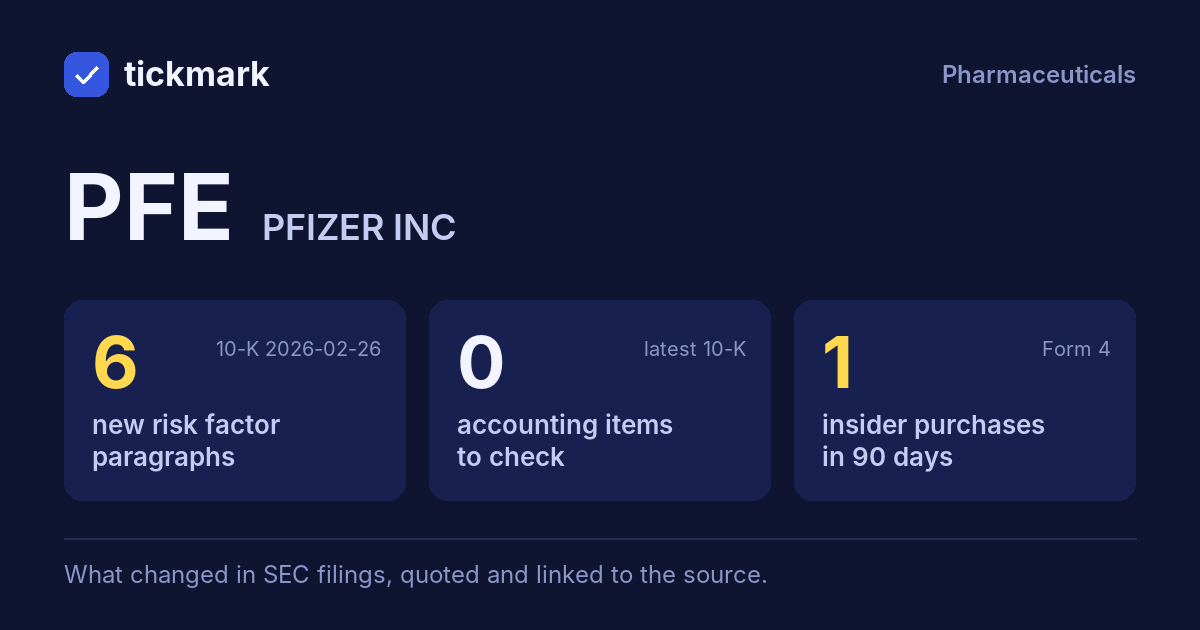
10-K 0000078003-26-000026 (2026-02-26) vs 10-K 0000078003-25-000054 (2025-02-27)
| Section | Compared text | Words now | Changed |
|---|
| Risk Factors | Item 1A | 12,525 |
15.8% |
| MD&A | Item 7 | 14,840 |
28.8% |
| Legal Proceedings | Item 3 | 677 |
12.1% |
| Accounting Policies | Item 8, Note 1 – Basis of Presentation and Significant Accounting Policies | 9,638 |
35.4% |
The redline: what was cut and what was added
In each section, the paragraph that changed most, marked against last year's 10-K:
cut words struck through, new words highlighted and underlined.
MD&A 510 words changed in this paragraph; it is 45% similar to last year's version.
Regulatory Environment/Pricing and Access––Government and Other Payor Group Pressures––The pricing of medicines and vaccines by pharmaceutical manufacturers and the cost of healthcare, which includes medicines, vaccines, medical services and hospital services, continues to be important to payors, governments, patients, and other stakeholders. Federal and state governments and private third-party payors in the U.S. continue to take action to manage the utilization and cost of drugs, including increasingly employing formularies to control costs and encourage utilization of certain drugs, including through the use of deductibles, utilization management tools, cost sharing or formulary placement. We consider a number of factors impacting the pricing of our medicines and vaccines. Within the U.S., we often engage with and receive feedback from patients, doctors and healthcare plans. We also often provide significant discounts from the list price to insurers, including PBMs and MCOs. The price that patients pay in the U.S. for prescribed medicines and vaccines is ultimately set by healthcare providers and insurers, including government healthcare programs. Governments globally, as well as private third-party payors in the U.S., may use a variety of measures to control costs, including, among others, legislative or regulatory pricing reforms, drug formularies (including tiering and utilization management tools), cross country collaboration and procurement, price cuts, mandatory rebates, health technology assessments, forced localization as a condition of market access, “international reference pricing” (i.e., the practice of a country linking its regulated medicine prices to those of other countries), quality consistency evaluation processes and volume-based procurement. We anticipate that these and similar initiatives will continue to increase pricing and access pressures globally. In the U.S., we expect to see continued focus by the U.S. government on regulating drug pricing and access to medicine. The drug pricing provisions of the IRA are being implemented over the next several years. In August 2023, CMS published the first ten medicines subject to the MDPNP, which requires manufacturers of select drugs to engage in a process with the federal government to set new Medicare prices which would go into effect in 2026. Eliquis was among the first ten medicines subject to MDPNP. In August 2024, the government released the new Medicare price for Eliquis, which, effective January 1, 2026, will be required to be offered to all Medicare beneficiaries and to covered entities participating in the 340B Program that dispense Eliquis to a Medicare beneficiary if that maximum fair price is lower than the discounted price such entities are offered under the 340B Program ceiling price calculation. The Eliquis Medicare price is factored into our long-term financial planning, in accordance with our standard financial reporting and forecasting protocols. On January 17, 2025, CMS announced the selection of another 15 drugs from Medicare Part D for the maximum fair price, with prices to be set and effective on January 1, 2027. Ibrance and Xtandi were included in the list of 15 drugs selected. Another 15 drugs from Medicare Part B or Medicare Part D will be selected by February 1, 2026, for the maximum price to be set and in effect by January 1, 2028. It is possible that more of our products could be selected in future years, which could, among other things, lead to lower revenues prior to expiry of intellectual property protections. We continue to evaluate the impact of the IRA on our business, operations and financial condition and results as the full effect of the IRA on our business and the pharmaceutical industry remains uncertain. The IRA made significant changes to the Medicare Part D benefit design, which will impact Pfizer revenues in 2025, including: an expected favorable impact from the $2,000 annual out-of-pocket cap and new Prescription Payment Plan, more than offset by an expected unfavorable impact from the sunsetting of the Coverage Gap Discount Program and the addition of new manufacturer discounts in the initial and catastrophic coverage phases. We anticipate a net unfavorable impact to revenue in 2025 of approximately $1 billion, year-over-year, related to the Medicare Part D Redesign changes that take effect in 2025. We expect these changes will more acutely impact our higher-priced medicines as they are expected to reach catastrophic coverage earlier in the year. In addition, changes to the MDRP or the 340B Program, including legal or legislative developments at the federal or state level with respect to the 340B Program, could
Source: Item 7, 10-K 0000078003-26-000026 vs Item 7, 10-K 0000078003-25-000054
Risk Factors 258 words changed in this paragraph; it is 45% similar to last year's version.
AI AI, including machine learning and generative AI, is increasingly being used in the biopharmaceutical and global healthcare industries. We have begun deploying AI in various parts of our internal and external operations, including in R&D, and continue to explore further use cases for AI, and our investments in AI may not yield anticipated benefits. As with many developing technologies, AI presents risks and challenges. For example, algorithms existing regulatory frameworks governing the use, development, and deployment of AI, including regulatory guidance on the use of AI in medical products, remain uncertain and subject to significant change. New regulatory requirements could impose significant compliance costs, limit our ability to deploy AI, require changes to our practices (including documentation, risk management, testing, or transparency measures), or increase litigation and enforcement risk. In addition, AI may be flawed used by payors to limit access to care or trained to deny prior authorization requests, which could impact Pfizer’s business results. Further, AI technology itself can give rise to risks. Generative AI output is probabilistic in nature and may not be reproducible or generate consistent results over time. AI can generate outputs that are false, misleading, incomplete, or inconsistent, and may be difficult to monitor, explain, or reproduce. AI performance may also degrade over time due to changes in inputs, data drift, updates by vendors, or adversarial manipulation. AI design or training may be flawed, including as a result of external vendors or others training AI models on content without the necessary intellectual property rights or other legal rights or permissions; permissions or using data sets that may not be appropriate for the intended use, of poor quality, contain biased information, or that become corrupted during a cyber-attack; and flawed or inappropriate or controversial data practices by data scientists, engineers, and end-users could impair results. If the outputs output that AI produces or assists in producing are is deficient or inaccurate, we could be subjected to competitive harm, regulatory scrutiny, potential legal liability and brand or reputational harm. Furthermore, The use of AI may lead to the release of confidential information which may impact our ability to realize the benefits of our data, including intellectual property.
Source: Item 1A, 10-K 0000078003-26-000026 vs Item 1A, 10-K 0000078003-25-000054
Accounting Policies 116 words changed in this paragraph; it is 57% similar to last year's version.
We recognize the tax benefit from an uncertain tax position only if it is more likely than not that the tax position, based on its technical merits, will be sustained upon examination by the taxing authority. The tax benefits recognized in the financial statements from such a position are measured based on the largest benefit that has a greater than 50 percent likelihood of being realized upon ultimate resolution. We regularly monitor our position and subsequently recognize the unrecognized tax benefit: (i) if there are changes in tax law, analogous case law or there is new information that sufficiently raise the likelihood of prevailing on the technical merits of the position to “more likely than not”; (ii) if the statute of limitations expires; or (iii) if there is a completion of an audit resulting in a favorable settlement of that tax year with the appropriate agency. Liabilities for uncertain tax positions are classified as current only when we expect to pay cash within the next 12 months. Interest and penalties, if any, are recorded in Provision/(benefit) for taxes on income and are classified on our consolidated balance sheet with the related tax liability.
Source: Item 8, Note 1 – Basis of Presentation and Significant Accounting Policies, 10-K 0000078003-26-000026 vs Item 8, Note 1 – Basis of Presentation and Significant Accounting Policies, 10-K 0000078003-25-000054
Legal Proceedings 59 words changed in this paragraph; it is 73% similar to last year's version.
Name Age Position Michael McDermott 60 Chief Global Supply and Quality Officer, Executive Vice President since January 2025. Chief Global Supply Officer, Executive Vice President from 2022 until December 2024. President of Pfizer Global Supply from 2018 until 2021. Vice President of Pfizer Global Supply from 2014 until 2018. Vice President of the Biotechnology Unit from 2012 until 2014. Payal Sahni 50 51 Chief People Experience Officer, Executive Vice President since January 2022. Chief Human Resources Officer, Executive Vice President from June 2020 to December 2021. From May 2016 until June 2020 served as Senior Vice President of Human Resources for multiple operating units. Vice President of Human Resources, Vaccines, Oncology & Consumer from 2015 until 2016. Ms. Sahni has served in a number of positions in the Human Resources organization with increasing responsibility since joining Pfizer in 1997.
Source: Item 3, 10-K 0000078003-26-000026 vs Item 3, 10-K 0000078003-25-000054
Every change, by type
Sentences and paragraphs of PFE's Risk Factors and MD&A, 10-K 2026-02-26 against 10-K 2025-02-27.
Each links to the text at sec.gov.
Quiet changes are sentences kept from last year with one to four words changed, at least one of them a hedge, a modal or a qualifier
(may, could, will, not, significant, material…). A year or date rolling forward is not counted.
The full word list
adverse, adversely, all, although, anticipate, anticipates, any, approximately, believe, believes, can, cannot, certain, could, expect, expects, generally, however, if, intend, intends, largely, likely, many, material, materially, may, might, most, must, never, no, not, possible, primarily, probable, should, significant, significantly, some, substantial, substantially, unlikely, will, would
AddedRisk Factors
Some payers are directing beneficiaries to third-party patient assistance programs, rather than covering certain treatments. In other instances, insurers disallow manufacturers’ co-pay assistance from counting toward reaching the deductible or out-of-pocket maximum. Both approaches can delay access to treatment or result in treatment abandonment. Further, consumers are facing responsibility for a larger portion of their prescription costs, or administrative hurdles to access, and may favor lower-cost, or generic alternatives, or seek direct-to-consumer medications outside of insurance plans.
Read it in 10-K 2026-02-26 at sec.gov ↗
AddedRisk Factors
Several manufacturers, including Pfizer, have signed voluntary agreements with the Trump Administration designed to ensure U.S. patients pay lower prices for their prescription medicines. This may impact the competitive environment, including pricing dynamics for any of our current or potential future products, as well as contracting with payers.
Read it in 10-K 2026-02-26 at sec.gov ↗
AddedRisk Factors
In the U.S., pharmaceutical product pricing is subject to government and public scrutiny and calls for reform, and, as a result, many of our products are subject to increasing pricing pressures. We expect to see continued focus by the U.S. government on regulating pricing and access to medicine. For example, in May and July 2025, the Trump Administration issued the MFN Initiatives and, in September 2025, we announced an agreement with the Trump Administration in which we voluntarily agreed to implement measures designed to make certain drug prices for U.S. patients more comparable to those in other developed countries (the MFN Agreement). We are also participating in the TrumpRx.gov platform, which allows U.S. patients to purchase certain medicines at significant discounts to current retail prices. These discounts may adversely affect revenue generated from participating drugs. Further, we face risks and uncertainties associated with the MFN Agreement, including the possibility of, among other things, unfavorable impacts to pricing and access. The MFN Agreement and broader U.S. policy efforts to implement measures designed to make certain drug prices for U.S. patients more comparable to those in other developed countries is subject to risks and uncertainties and could, among other things, negatively impact our pricing strategies, product demand or access, or competitive positioning across global markets, and may adversely affect revenues in certain markets.
Read it in 10-K 2026-02-26 at sec.gov ↗
AddedRisk Factors
•Regulatory decisions or feedback could impact the future development of our product candidates, including our vaccine candidates such as our next generation pneumococcal conjugate vaccine candidate.
Read it in 10-K 2026-02-26 at sec.gov ↗
AddedRisk Factors
•We may experience increasing inconsistencies and unexpected changes in the evaluations and determinations made by the FDA during the process of applying for marketing approvals of our products due to reductions in workforce, personnel movements, and policy changes.
Read it in 10-K 2026-02-26 at sec.gov ↗
AddedRisk Factors
may also lead to the unauthorized release of confidential or proprietary information which may impact our ability to realize the benefits of our data, including intellectual property. Further, reliance on third-party AI tools or services that incorporate AI may expose our organization to compliance gaps that are outside of our control. In addition, we could face risks related to our reliance on a small number of AI models or service providers.
Read it in 10-K 2026-02-26 at sec.gov ↗
RemovedRisk Factors
The terms of our EUA for Comirnaty require that we conduct post-observational studies to evaluate the association between the Pfizer-BioNTech COVID-19 Vaccine (Original monovalent), Pfizer-BioNTech COVID-19 Vaccine, Bivalent, and the Pfizer-BioNTech COVID-19 Vaccine (2023-2024 Formula), and a pre-specified list of adverse events of special interest, including myocarditis and pericarditis, along with deaths and hospitalizations, and severe COVID-19. The required study populations include individuals specified in our September 2023 authorization letter (reissued) as well as populations of interest, such as healthcare workers, pregnant women, immunocompromised individuals and subpopulations with specific comorbidities. Additionally, in relation to the FDA approval for Comirnaty, we are required to complete certain post marketing study requirements and commitments through 2024 and beyond.
Read it in 10-K 2025-02-27 at sec.gov ↗
RemovedRisk Factors
In connection with the resolution of a U.S. government investigation concerning independent copay assistance organizations that provide financial assistance to Medicare patients, in 2018, we entered into a Corporate Integrity Agreement with the Office of the Inspector General of the HHS (OIG), which expired in May 2023. Pfizer submitted its final annual report in October 2023 and the OIG officially closed the matter in January 2025.
Read it in 10-K 2025-02-27 at sec.gov ↗
RewordedRisk Factors
Our future results could be adversely affected by changes in laws, regulations or policies, or their interpretation, including, among others, new or changes in accounting standards, tariffs, tax laws and regulations internationally and in the U.S., including, without limitation, the IRA, and the OBBBA, which is still subject to further guidance; the adoption of global minimum taxation requirements outside the U.S. generally effective in most jurisdictions since January 1, 2024 2024; government cost-cutting measures and related impacts on, among other matters, government staffing, resources and ability to timely review and process regulatory or other submissions; restrictions related to certain data transfers, including data security, data localization and cross border data transfer regulations, and transactions involving certain countries; and potential changes to existing tax laws, tariffs, competition laws, privacy laws and environmental laws or changes to other laws, regulations and policies in the U.S., including by the U.S.
Read it in 10-K 2026-02-26 at sec.gov ↗
RewordedRisk Factors
We face risks and uncertainties related to our COVID-19 products, including Comirnaty and Paxlovid or any potential future COVID-19 vaccines, treatments or combinations, including, among others, the risk that as the market for COVID-19 products remains endemic and seasonal, seasonal and/or COVID-19 infection rates do not follow prior patterns, demand for our COVID-19 products has and may continue to be reduced or not meet expectations, which has and may continue to lead to reduced revenues, excess inventory or other unanticipated charges; risks related to our ability to develop develop, receive regulatory approval for, and commercialize variant adapted vaccines, combinations and/or treatments; uncertainties related to recommendations and coverage for, and the public’s adherence to, vaccines, boosters, treatments or combinations; combinations, including uncertainties related to the potential impact of narrowing recommended patient populations; risks related to our ability to accurately predict revenue for Comirnaty and Paxlovid or any potential future COVID-19 vaccines or treatments; whether and when EUA or biologics license or drug applications or amendments to any such applications may be filed in particular jurisdictions for Paxlovid or Comirnaty or any other potential vaccine or vaccine candidates or product candidates, including those related to potential future annual boosters, re-vaccinations, or vaccines in additional populations, and if obtained, whether or when such EUA or licenses, or existing EUAs, will expire expire, terminate or terminate; be revoked; whether and when additional supply or purchase agreements will be reached or existing agreements will be modified; potential third-party royalties or other claims related to Comirnaty or Paxlovid; and the other risks and uncertainties discussed throughout this Item 1A.
Read it in 10-K 2026-02-26 at sec.gov ↗
RewordedRisk Factors
Our future results could be adversely affected by new or changes in U.S. and international governmental regulations that mandate price controls, use international reference pricing, including MFN, increase required rebates, establish mandatory CMMI pilots (which are models designed to test certain payment and delivery systems to determine whether they result in cost savings), create coverage criteria, or limit patient access to our products.
Read it in 10-K 2026-02-26 at sec.gov ↗
RewordedRisk Factors
Other U.S. federal or state legislative or regulatory action and/or policy efforts could adversely affect our business, including, among others, general budget control actions, changes in patent laws, the importation of prescription drugs to the U.S. at prices that are regulated by foreign governments, revisions to reimbursement of biopharmaceuticals under government programs that could reference international prices or require new discounts, including through a CMMI demonstration, the FDA's recently adopted policy of disclosing Complete Response Letters for unapproved drug candidates and the attendant risk of disclosure of trade secrets or confidential commercial information, limitations on interactions with healthcare professionals and other industry stakeholders, restrictions on pharmaceutical advertising, or the use of comparative effectiveness methodologies that could be implemented in a manner that focuses primarily on cost differences and minimizes the therapeutic differences among pharmaceutical products and restricts access to innovative medicines.
Read it in 10-K 2026-02-26 at sec.gov ↗
RewordedRisk Factors
We anticipate a more significant impact reduction of reduced revenues revenue from patent-based or regulatory exclusivity expiries in 2026 through 2030 as several of our in-line products experience these expirations. expirations, with the rate of the reduction of revenues from patent-based or regulatory exclusivity expiries expected to significantly accelerate over the next few years.
Read it in 10-K 2026-02-26 at sec.gov ↗
RewordedRisk Factors
While additional patent-based or regulatory exclusivity expiries will continue, we expect a moderate impact of reduced revenues due to patent expiries in 2025 and We anticipate a more significant impact reduction of reduced revenues revenue from patent-based or regulatory exclusivity expiries in 2026 through 2030 as several of our in-line products experience these expirations.
Read it in 10-K 2026-02-26 at sec.gov ↗
RewordedRisk Factors
With this guidance, which included an Following issuance of updated guidance on acceptable intake level limits for N-nitroso-varenicline, we have started making N-nitroso-varenicline by regulatory submissions to potentially enable authorities, in 2025, Chantix to return returned to market in the U.S. and in certain international markets.
Read it in 10-K 2026-02-26 at sec.gov ↗
RewordedRisk Factors
For example, algorithms AI design or training may be flawed flawed, including as a result of external vendors or trained others training AI models on content without the necessary intellectual property rights or other legal rights or permissions; permissions or using data sets that may not be appropriate for the intended use, of poor quality, contain biased information, or that become corrupted during a cyber-attack; and flawed or inappropriate or controversial data practices by data scientists, engineers, and end-users could impair results.
Read it in 10-K 2026-02-26 at sec.gov ↗
RewordedRisk Factors
We expect additional drug cost containment efforts at both the federal and state levels. levels, as evidenced by the MFN Initiatives and the December 2025 issue by HHS of proposed rules for mandatory CMMI pilots which could require additional price concessions.
Read it in 10-K 2026-02-26 at sec.gov ↗
RewordedRisk Factors
Additionally, in the EU, the EC proposed European Parliament and the European Council reached an agreement in December 2025 on the EU Pharma Package – the largest reform of EU pharmaceutical legislation the EU’s Pharmaceutical Legislation in 20 years.
Read it in 10-K 2026-02-26 at sec.gov ↗
RewordedRisk Factors
Another 15 drugs from Medicare Part B or Medicare Part D will be were selected by February 1, on January 27, 2026, for the maximum price Maximum Fair Price to be set and in effect by effective on January 1, 2028.
Read it in 10-K 2026-02-26 at sec.gov ↗
RewordedRisk Factors
We For example, we financed a portion of the transaction acquisitions of Seagen and Metsera with the proceeds from the $31 billion issuance of long-term debt issued in May 2023, debt, plus additional short-term indebtedness issued prior to the acquisition. such acquisitions.
Read it in 10-K 2026-02-26 at sec.gov ↗
Quiet changesRisk Factors
For example, in 2021, Pfizer recalled all lots of Chantix due to the presence of a nitrosamine, N-nitroso-varenicline, at or above the acceptable intake limits communicated by various regulatory authorities.
Read it in 10-K 2026-02-26 at sec.gov ↗
Quiet changesRisk Factors
In August 2024, the government released the new Medicare price for Eliquis, which will become became effective January 1, 2026.
Read it in 10-K 2026-02-26 at sec.gov ↗
Quiet changesRisk Factors
Any significant additional efforts at the U.S. federal or state levels to reform the healthcare system by changing the way healthcare is provided or funded could have a material impact on us.
Read it in 10-K 2026-02-26 at sec.gov ↗
Quiet changesRisk Factors
In addition, certain governments and the public expect companies like us to report on our business practices with respect to human rights, responsible sourcing and environmental impact, as well as the actions of our third-party contractors and suppliers around the world.
Read it in 10-K 2026-02-26 at sec.gov ↗
AddedMD&A
•In the fourth quarter of 2023, we announced that we launched a multi-year, enterprise-wide cost realignment program that aims to realign our costs with our longer-term revenue expectations. In the second quarter of 2025, we identified additional productivity opportunities to further reduce costs primarily in SI&A, driven in large part by enhanced digital enablement, including automation and AI, and simplification of business processes.
Read it in 10-K 2026-02-26 at sec.gov ↗
AddedMD&A
•In connection with our efforts to simplify the structure and sharpen the focus of our R&D organization, in the first quarter of 2025, we expanded this program after having identified additional opportunities to drive improvements in productivity and operational efficiencies through enhanced digital enablement, including automation and AI, and simplification of business processes.
Read it in 10-K 2026-02-26 at sec.gov ↗
AddedMD&A
Agreement with the U.S. Government––In September 2025, we announced an agreement with the Trump Administration in which we voluntarily agreed to implement measures designed to make certain drug prices for U.S. patients more comparable to those in other developed countries and also allow U.S. patients to purchase certain medicines at significant discounts to current retail prices. The September 2025 agreement also provides a three-year grace period during which time our products will not face Section 232 tariffs, provided the Company further invests in manufacturing in the U.S. Pfizer is now in the process of entering into binding final agreements to implement these arrangements. See the Item 1. Business––Pricing Pressures and Managed Care Organizations and ––Government Regulation and Price Constraints sections for additional information.
Read it in 10-K 2026-02-26 at sec.gov ↗
AddedMD&A
Policy/Regulatory Environment––New and potential policy, regulatory or other changes from the U.S. Presidential administration, Congress and states, including, among others, increased or new regulatory requirements, including heightened requirements for licensure, changes, delays or failure to receive recommendations, reimbursement and regulatory approvals and coverage for our vaccines and medicines could have a material adverse effect on our business, earnings, cash flows, liquidity and financial guidance.
Read it in 10-K 2026-02-26 at sec.gov ↗
AddedMD&A
continuous decline in vaccination rates due to additional changes in vaccination recommendations, and the expected impact has been incorporated in our 2026 financial guidance. See Item 1A. Risk Factors—U.S. Healthcare Regulation for a description of certain risks and uncertainties that could impact revenue from our portfolio of vaccines.
Read it in 10-K 2026-02-26 at sec.gov ↗
AddedMD&A
For the provisional amounts recognized for the Metsera assets acquired and liabilities assumed as of the acquisition date, see Note 2A. The estimated values are not yet finalized and are subject to change, which could be significant. We will finalize the amounts recognized as we obtain the information necessary to complete the analyses. We expect to finalize the amounts of assets acquired and liabilities assumed as soon as possible but no later than one year from the acquisition date.
Read it in 10-K 2026-02-26 at sec.gov ↗
AddedMD&A
2025 v. 2024The following provides an analysis of the worldwide change in Total revenues by geographic areas from 2024 to 2025: (MILLIONS) Worldwide U.S. International Operational growth/(decline): Worldwide declines from Paxlovid $ (3,346) $ (2,725) $ (622) Worldwide declines from Comirnaty (1,051) (341) (710) Worldwide growth from the Vyndaqel family, Eliquis, Padcev, Lorbrena, Abrysvo, Nurtec ODT/Vydura, Xtandi and the Prevnar family, partially offset by worldwide declines from Ibrance, Adcetris and Xeljanz 2,154 854 1,299 Growth in oncology biosimilars, largely due to favorable net price in the U.S. 266 286 (20) Other operational factors, net 682 312 371 Operational growth/(decline), net (1,295) (1,613) 318 Favorable impact of foreign exchange 247 — 247 Total revenues increase/(decrease) $ (1,048) $ (1,613) $ 565
Read it in 10-K 2026-02-26 at sec.gov ↗
AddedMD&A
Ibrance $4,122 U.S. $2,710 $2,849 (5) Declines primarily driven by lower net price in the U.S. largely due to the impact of higher manufacturer discounts resulting from the IRA Medicare Part D Redesign, as well as generic entry in certain international markets, partially offset by improved patient affordability and improved market share supported by new clinical data, both in the U.S., as well as a favorable adjustment of rebate accruals for international markets related to prior periods recorded in 2025.
Read it in 10-K 2026-02-26 at sec.gov ↗
AddedMD&A
Down 59% • lower COVID-19 infections across U.S. and international markets and lower international government purchases;
Read it in 10-K 2026-02-26 at sec.gov ↗
AddedMD&A
• favorable adjustments of rebate accruals related to prior periods, as well as higher net price in the U.S. following transition from the U.S. government agreement.
Read it in 10-K 2026-02-26 at sec.gov ↗
AddedMD&A
Xtandi $2,194 U.S. $2,194 $2,039 8 Growth mainly driven by strong demand, in part due to improved patient affordability in the U.S., partially offset by unfavorable buying patterns and lower net price partly due to the impact of higher manufacturer discounts resulting from the IRA Medicare Part D Redesign.
Read it in 10-K 2026-02-26 at sec.gov ↗
AddedMD&A
Padcev $1,940 U.S. $1,902 $1,561 22 Growth primarily driven by increased market share in first line locally advanced or metastatic urothelial cancer (la/mUC), as well as by a one-time favorable impact associated with transition to a wholesaler distribution model in the U.S.
Read it in 10-K 2026-02-26 at sec.gov ↗
RemovedMD&A
In the first quarter of 2024, we reclassified royalty income (substantially all of which is related to our Biopharma segment) from Other (income)/deductions––net and began presenting Royalty revenues as a separate line item within Total revenues in our consolidated statements of operations. Prior-period amounts have been recast to conform to the current presentation.
Read it in 10-K 2025-02-27 at sec.gov ↗
RemovedMD&A
•transitioned the Pfizer U.S. Oncology commercial organization and the global Oncology marketing organization, which were part of the former Pfizer Oncology Division, into the Pfizer U.S. Commercial Division, which now focuses on the commercialization of Pfizer’s entire product portfolio in the U.S. and is led by the Chief U.S. Commercial Officer, Executive Vice President; and
Read it in 10-K 2025-02-27 at sec.gov ↗
RemovedMD&A
•combined our global ORD and PRD organizations to form a single Pfizer R&D organization that is responsible for all R&D activities across all therapeutic areas.
Read it in 10-K 2025-02-27 at sec.gov ↗
RemovedMD&A
have a material impact on our business. See the Item 1. Business––Pricing Pressures and Managed Care Organizations and ––Government Regulation and Price Constraints and the Item 1A. Risk Factors––Pricing and Reimbursement sections.
Read it in 10-K 2025-02-27 at sec.gov ↗
RemovedMD&A
Voluntary Withdrawal of Oxbryta––See the Product Developments section within MD&A.
Read it in 10-K 2025-02-27 at sec.gov ↗
RemovedMD&A
Israel/Hamas Conflict––Our local operations have been impacted by the armed conflict between Israel and Hamas that began on October 7, 2023. For the years ended December 31, 2024 and 2023, the business of our Israeli subsidiary represented less than 1% of our consolidated revenues and assets. We are closely monitoring developments in this conflict, including evaluating potential impacts to our business, customers, suppliers, employees, and operations in Israel and elsewhere in the Middle East that may impact global operations. At this time, longer term impacts from these events to the Company are uncertain and subject to change.
Read it in 10-K 2025-02-27 at sec.gov ↗
RemovedMD&A
Russia/Ukraine Conflict––Our local operations have been impacted by the armed conflict between Russia and Ukraine. For the years ended December 31, 2024 and 2023, the business of our Russia and Ukraine subsidiaries represented less than 1% of our consolidated revenues and assets. While we are monitoring the effects of the conflict between Russia and Ukraine, the situation continues to evolve and the long-term implications, including the broader economic consequences of the conflict, potential additional sanctions, and actions by our customers or suppliers (including financial institutions) are difficult to predict at this time.
Read it in 10-K 2025-02-27 at sec.gov ↗
RemovedMD&A
For information on risks associated with these conflicts, see the Item 1A. Risk Factors—Global Operations section.
Read it in 10-K 2025-02-27 at sec.gov ↗
RemovedMD&A
2024 v. 2023The following provides an analysis of the worldwide change in Total revenues by geographic areas from 2023 to 2024:
Read it in 10-K 2025-02-27 at sec.gov ↗
RemovedMD&A
Increase in revenues from legacy Seagen, which was acquired in December 2023 3,223 3,071 153
Read it in 10-K 2025-02-27 at sec.gov ↗
RemovedMD&A
Worldwide growth from the Vyndaqel family, Eliquis, Xtandi and Nurtec ODT/Vydura, partially offset by declines from Xeljanz, Ibrance, Abrysvo, Inlyta and the Prevnar family 2,403 1,770 633
Read it in 10-K 2025-02-27 at sec.gov ↗
RemovedMD&A
Decline in oncology biosimilars, largely due to lower net price in the U.S. (362) (338) (24)
Read it in 10-K 2025-02-27 at sec.gov ↗
RewordedMD&A
PRODUCT/CANDIDATE PROPOSED DISEASE AREA LATE-STAGE CLINICAL PROGRAMS FOR ADDITIONAL USES AND DOSAGE FORMS Ibrance (palbociclib)(a) ER+/HER2+ metastatic breast cancer FOR IN-LINE AND IN-REGISTRATION PRODUCTS Talzenna (talazoparib) Combination with Xtandi (enzalutamide) for DNA Damage Repair-deficient mCSPC FOR IN-LINE AND IN-REGISTRATION PRODUCTS Litfulo (ritlecitinib) Vitiligo Elrexfio (elranatamab) Multiple myeloma double-class exposed Newly diagnosed multiple myeloma post-transplant maintenance Newly diagnosed multiple myeloma transplant-ineligible 2nd line + line+ relapsed refractory multiple myeloma Eliquis (apixaban)(b) Venous thromboembolism (pediatric) Padcev (enfortumab vedotin)(c) Cisplatin-ineligible/decline muscle-invasive bladder cancer vedotin-ejfv)(a) Cisplatin-eligible muscle-invasive bladder cancer Tukysa (tucatinib) (tucatinib)(b) HER2+ adjuvant breast cancer 2nd line/3rd line HER2+ metastatic breast cancer 1st line HER2+ maintenance metastatic breast cancer 1st line HER2+ metastatic colorectal cancer Hympavzi Hemophilia (pediatric) (marstacimab-hncq) Hemophilia (inhibitor cohort) Nurtec (rimegepant) Menstrually-related migraine NEW DRUG CANDIDATES IN LATE-STAGE DEVELOPMENT PF-06425090 (vaccine) Immunization to prevent primary clostridioides difficile infection sasanlimab (PF-06801591) Combination with Bacillus Calmette-Guerin for non-muscle-invasive bladder cancer VLA15 (PF-07307405) vaccine(d) vaccine(c) Immunization to prevent Lyme disease vepdegestrant (PF-07850327)(e) Breast cancer metastatic - 2nd line ER+/HER2- inclacumab (PF-07940370) Sickle cell disease Ibrance + vepdegestrant(e) ER+/HER2- metastatic breast cancer dazukibart (PF-06823859) Dermatomyositis, polymyositis disitamab vedotin(f) vedotin(d) 1st line HER2 (≥IHC1+) metastatic urothelial cancer sigvotatug vedotin (PF-08046047) 2nd line+ metastatic non-small cell lung cancer NSCLC 1st line metastatic NSCLC (tumor proportion score high) osivelotor (PF-07940367) Sickle cell disease atirmociclib (PF-07220060) 2nd line metastatic breast cancer SCD ibuzatrelvir (PF-07817883) COVID-19 infection mevrometostat (PF-06821497) + enzalutamide 1st line/2nd line metastatic castration resistant prostate cancer post-Abiraterone mevrometostat (PF-06821497) + enzalutamide 1st line metastatic castration resistant prostate cancer neoadjuvant hormonal therapy naïve 1st line metastatic castration sensitive prostate cancer neoadjuvant hormonal therapy naïve atirmociclib (PF-07220060) 1st line HR+/HER2- metastatic breast cancer PF-08046054 2nd line+ NSCLC prifetrastat (PF-07248144) 2nd line/3rd line HR+/HER2- metastatic breast cancer MET-097i (PF-08653944) Chronic weight management PF-08634404 1st line metastatic colorectal cancer 1st line NSCLC (squamous) 1st line NSCLC (non-squamous) PF-07831694 vaccine Immunization to prevent Clostridioides difficile (C. difficile) - updated formulation PF-06760805 vaccine Immunization to prevent invasive group B streptococcus infection (maternal) sasanlimab (PF-06801591)(e) Combination with Bacillus Calmette-Guerin for high-risk non-muscle invasive bladder cancer
Read it in 10-K 2026-02-26 at sec.gov ↗
RewordedMD&A
Income from Continuing Operations Before Provision/(Benefit) for Taxes on Income––The increase decrease in Income from continuing operations before provision/(benefit) for taxes on income of $7.0 billion, $503 million, to $7.5 billion in 2025 from $8.0 billion in 2024 from $1.1 billion in 2023, 2024, was primarily attributable due to (i) a decrease higher intangible asset impairment charges in 2025, (ii) an increase in Acquired in-process research and development expenses, (iii) net losses on equity securities in 2025 versus net gains on equity securities in 2024 and (iv) lower revenues, partially offset by (v) decreases in Cost of Sales, (ii) higher revenues SI&A, and (iii) a decrease in Restructuring charges and certain acquisition-related costs, partially offset by (iv) higher net interest expense, (v) and (vi) net periodic benefit costs credits associated with pension and other postretirement plans incurred in 2024 2025 versus net periodic benefit credits costs in 2023, (vi) lower net gains on equity securities and (vii) an increase in Amortization of intangible assets. 2024.
Read it in 10-K 2026-02-26 at sec.gov ↗
RewordedMD&A
(b)The short-term incentive plans for substantially all non-sales-force employees worldwide are funded from a pool based on our performance, measured in significant part versus One of the three budgeted financial metrics, one of which, for beginning with the 2024 2025 performance year, was is Adjusted diluted EPS income (as defined for annual incentive compensation purposes), which is derived from Adjusted income and accounted accounts for 40% of the bonus pool funding tied to financial performance.
Read it in 10-K 2026-02-26 at sec.gov ↗
RewordedMD&A
Vyndaqel family $5,451 $6,380 U.S. $3,834 $3,547 $1,863 90 8 Growth largely primarily driven by strong demand with continuing uptake in patient diagnosis, diagnosis primarily in the U.S. and certain international developed markets, as well as increased improved patient affordability in the U.S., partially offset by lower net price in the U.S. mostly due to the impact of higher manufacturer discounts resulting from the IRA Medicare Part D Redesign as well as new payer contracts with reduced pricing.
Read it in 10-K 2026-02-26 at sec.gov ↗
RewordedMD&A
Restructuring charges/(credits) and charges/(credits), inventory write-offs, implementation costs and additional depreciation—asset restructuring(d) (134) (90) (187) (116) — 2,213 1,554 Certain asset impairments(e) — — (3,295) 3,295 (4,940) 4,940 (Gains)/losses on equity securities(e) securities — — 1,008 (1,008) (67) 67 Actuarial valuation and other pension and postretirement plan (gains)/losses — — (579) 579 320 (320) Other 44 (13) (445) (32) (32) (1,150) (f) 430 1,223 Income tax provision—non-GAAP items (3,035) (2,962) Non-GAAP Adjusted $ 16,420 15,141 $ 14,617 13,642 $ 1,031 827 $ 17,716 $3.11 18,406 $3.22
Read it in 10-K 2026-02-26 at sec.gov ↗
RewordedMD&A
Investing activities $ 2,652 (1,351) $2,652 $(32,278) $ (15,783) The change was driven mainly by $43.4 $6.9 billion cash paid in 2023 for the acquisition of Seagen, Metsera, net of cash acquired (see Note 2A) acquired, and $7.0 $0.7 billion of lower proceeds from the partial sales remaining sale of our investment in Haleon in 2025 compared with the portion sold in 2024, partially offset by $16.3 a $3.8 billion greater increase in net purchases of proceeds from short-term investments in 2024. investments.
Read it in 10-K 2026-02-26 at sec.gov ↗
RewordedMD&A
Financing activities $ (17,140) (10,304) $(17,140) $26,066 $ (14,834) The change was driven mostly mainly by $30.8 $9.7 billion of proceeds received from the issuance of long-term debt and a $1.9 billion decrease in May of 2023 for the acquisition of Seagen and $12.6 billion greater net repayments of short-term borrowings short term borrowings, partially offset by a $4.5 billion increase in 2024. repayments of long-term debt.
Read it in 10-K 2026-02-26 at sec.gov ↗
RewordedMD&A
(operationally) • The decrease in Cost of sales as a $771 million percentage of revenues was primarily due to the factors mentioned above, and also partially offset by the non-recurrence of the Paxlovid favorable final adjustment of $771 million recorded in the first quarter of 2024 to the estimated non-cash Paxlovid revenue reversal of $3.5 billion recorded in the fourth quarter of 2023; and 2023.
Read it in 10-K 2026-02-26 at sec.gov ↗
RewordedMD&A
The bonus (b)The short-term incentive plans for substantially all non-sales-force employees worldwide are funded from a pool funding is largely based on our performance, measured in significant part versus three budgeted financial performance, metrics, as measured by three metrics, modified by well as performance against certain of our non-financial pipeline metrics, and may be further modified by our Compensation Committee’s assessment of other factors.
Read it in 10-K 2026-02-26 at sec.gov ↗
RewordedMD&A
Year Ended December 31, % Change (MILLIONS) 2025 2024 2023 2022 25/24 24/23 23/22 Cost of sales $ 16,067 $ 17,851 $ 24,954 $ 34,344 (10) (28) (27) Percentage of Total revenues 25.7 % 28.1 % 41.9 % 33.9 % Selling, informational and administrative expenses 13,794 14,730 14,771 13,677 (6) — 8 Research and development expenses 10,437 10,822 10,679 11,428 (4) 1 (7) Acquired in-process research and development expenses 1,613 108 194 953 * (44) (80) Amortization of intangible assets 4,874 5,286 4,733 3,609 (8) 12 31 Restructuring charges and certain acquisition-related 1,550 2,419 2,943 1,375 (36) (18) * costs Other (income)/deductions—net 6,724 4,388 222 1,062 53 * (79)
Read it in 10-K 2026-02-26 at sec.gov ↗
RewordedMD&A
Total Revenues––Total revenues increased $4.1 decreased $1.0 billion, or 7%, 2%, to $62.6 billion in 2025 from $63.6 billion in 2024 from $59.6 billion in 2023, 2024, reflecting an operational increase decrease of $4.4 $1.3 billion, or 7%, 2%, partially offset by an unfavorable a favorable impact of foreign exchange of $349 million, or approximately 1%. $247 million.
Read it in 10-K 2026-02-26 at sec.gov ↗
RewordedMD&A
Governments globally, as well as private third-party payors in the U.S., may use a variety of measures to control costs, including, among others, legislative or regulatory pricing reforms, drug formularies (including tiering and utilization management tools), cross country collaboration and procurement, price cuts, mandatory rebates, health technology assessments, forced localization as a condition of market access, “international reference pricing” (i.e., the practice of a country linking its regulated medicine prices to those of other countries), quality consistency evaluation processes and volume-based procurement.
Read it in 10-K 2026-02-26 at sec.gov ↗
Quiet changesMD&A
The table below generally includes filing and approval milestones for products that have occurred in the last twelve months and generally do does not include approvals that may have occurred prior to that time.
Read it in 10-K 2026-02-26 at sec.gov ↗
Quiet changesMD&A
Legal charges to resolve litigation are also related to specific cases, which are facts and circumstances specific and, in some cases, may also be the result of litigation matters at acquired companies that were inestimable, not probable or unresolved at the date of acquisition, or legal matters generally related to divested products or businesses.
Read it in 10-K 2026-02-26 at sec.gov ↗