Screener / SEC EDGAR /CIK 0001618673 /10-K filed Aug 12, 2026, compared with Aug 13, 2025 /Numbers from the XBRL of the 10-Ks
NYSE Consumer staples · Groceries, General Line

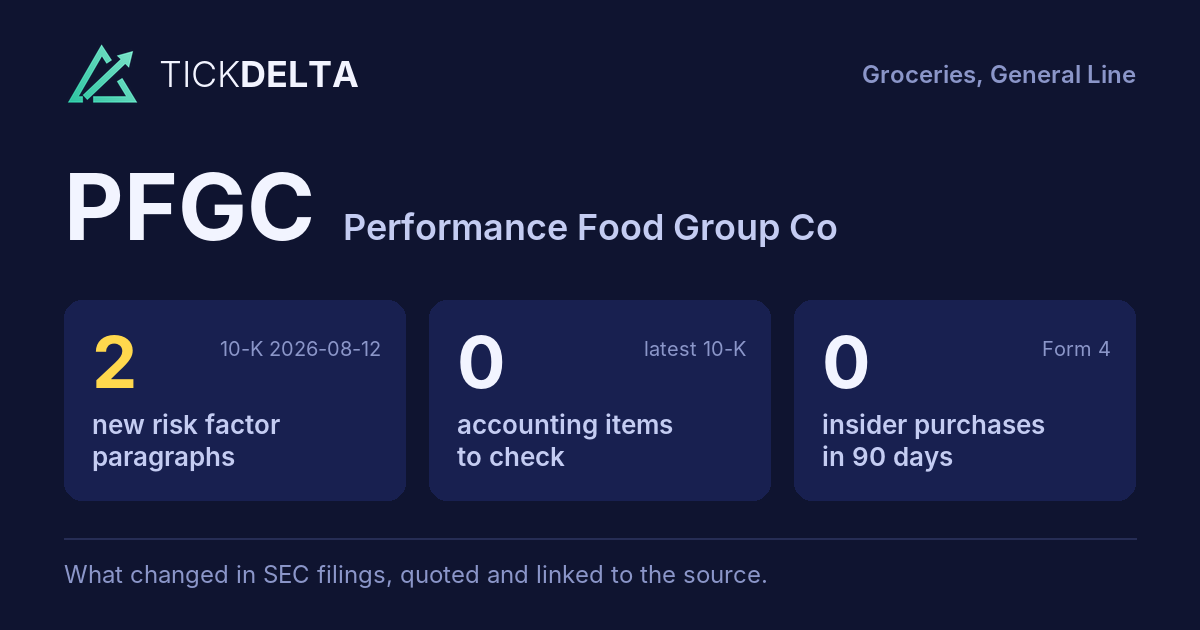
Performance Food Group Co PFGC

Compare with peers Embed
The 10-K against last year's

108 changes: 2 added, 16 removed, 86 reworded, 4 quiet changes

10-K Aug 12, 2026 vs Aug 13, 2025

10-K 0001193125-26-346886 (Aug 12, 2026) vs 10-K 0001618673-25-000012 (Aug 13, 2025)

Every paragraph, and how much of it changed

One bar per paragraph, in the order of the 10-K. Height and colour show the share of its words not in the closest paragraph a year earlier; the tallest bars are new paragraphs.

Risk Factors

98 paragraphs · 2 new · 47 reworded · 14 gone · 10-K Aug 12, 2026 against Aug 13, 2025
New paragraph Reworded (5% of its words or more) Same or nearly
Paragraph 17 · 48% changed Every version of it
Distributors have traditionally generated a significant percentage of their gross margins from rebates and promotional allowances incentives paid by their suppliers. Promotional allowances Rebates and promotional incentives are payments from suppliers based upon the efficiencies that the distributor provides to its suppliers through purchasing scale and through marketing and merchandising expertise. Promotional allowances are a standard practice among suppliers to distributors and represent a significant source of profitability for us and our competitors. Any change in such practices that results in the reduction or elimination of promotional allowances could be disruptive to us and the industry as a whole and could have a material adverse effect on our business, financial condition, or results of operations.
Paragraph 54 · 42% changed Every version of it
We have and are continuing to incorporate AI, including machine learning, into certain of our operations, such as sales, support and supply chain operations, and may in the future incorporate AI into more of our operations, with the intent to enhance their operation and effectiveness. Flaws, breaches or malfunctions in these systems could lead to operational disruptions, data loss, or erroneous decision-making, impacting our operations, financial condition and reputation. Legal challenges may arise, including or as a result of cybersecurity incidents, non-compliance with data protection regulations, and lack of transparency relating to the use of AI. The legal and regulatory landscape and industry standards surrounding AI technologies is rapidly evolving and remains uncertain, and compliance may impose significant operational costs and may limit our ability to develop, deploy or use AI technologies. Furthermore, the rapid evolution and increasing deployment of AI systems could both intensify our cybersecurity risks, such as data breaches and unauthorized access, and introduce new risks, leading to financial losses, legal liabilities, and reputational damage.
Paragraph 22 · 37% changed Every version of it
From time to time, we may enter into arrangements derivative instruments to manage our exposure to fuel costs. costs, including costless collars or swaps. Such arrangements, derivatives, however, may not be effective and may result in us paying higher than market costs for a portion of our fuel. In addition, the use of such arrangements derivatives may expose us to the risk that our counterparties fail to perform their obligations, which could result in financial losses. Furthermore, while we have been successful in the past in implementing fuel surcharges to offset fuel cost increases, we may not be able to do so in the future. To the extent increasing fuel expenses are not able to be offset by (i) diesel fuel surcharges (which are generally recognized on a one-month lag following changes in fuel prices) and/or (ii) gains on derivative instruments, prolonged high fuel prices could adversely affect our business, financial condition, or results of operations.
Paragraph 53 · 33% changed Every version of it
We have incorporated, and are continuing to incorporate incorporate, AI, including machine learning, into certain of our operations, such as including sales, support and supply chain operations, and may in the future incorporate AI into more of our operations, with the intent to enhance their operation operation, efficiency and effectiveness. Flaws, breaches or malfunctions in these systems systems, including the associated input data and assumptions, or insufficient or inadequate human oversight could lead to operational disruptions, data loss, or erroneous decision-making, impacting our operations, business, financial condition and reputation. Additionally, the use of AI tools by our employees and/or third parties engaged by us may result in the exposure of our confidential information, including material non-public information, trade secrets, or personal information to unauthorized third parties, including our competitors. Further, we may not be able to control how any third-party AI technologies that we use are developed or maintained, or how data we input is used or disclosed, even where we have contractual protections with respect to these matters. Legal challenges may arise, including or as a result of cybersecurity incidents, non-compliance with data protection regulations, and lack of transparency relating to the use of AI. The legal and regulatory landscape and industry standards surrounding AI technologies is rapidly evolving and remains uncertain, and compliance may impose significant operational costs and may limit our ability to develop, deploy or use AI technologies. Furthermore, the rapid evolution and increasing deployment of AI systems could both intensify our cybersecurity risks, such as data breaches and unauthorized access, and introduce new risks, leading to financial losses, legal liabilities, and reputational damage.
Paragraph 60 · 31% changed Every version of it
Data Privacy: There are new and emerging data privacy laws, as well as frequent updates and changes to existing data privacy laws, in the jurisdictions in which we operate. Given the complexity of these laws and the requirements they place on businesses regarding the collection, storage, handling, use, disclosure, transfer and security of personal data, it is important for us to understand their impact and respond accordingly. Failure to comply with applicable data privacy laws can and regulations, or to implement required changes in a timely manner, could result in substantial fines or penalties, legal liability government investigations, private litigation, mandated remediation, and reputational damage. Several U.S. states have enacted (and additional U.S. states are considering enacting) stringent consumer privacy laws, which laws that may impose varying standards and requirements on our data collection, use and processing activities. Continued state by state introduction processing, including notice, consent, access/deletion, and opt-out mechanisms. Ongoing state-by-state enactment and amendment of privacy laws can be expected to may lead to significantly greater compliance complexity in our compliance requirements, and the risk of inconsistent obligations across jurisdictions, which could result in increase the likelihood of regulatory inquiries or enforcement and complaints from data subjects or action from regulators. claims by private plaintiffs. If we do not provide sufficient resources to be able to respond, adapt and implement the necessary requirements to respond to the various forthcoming changes, which could include required changes – including any future federal data privacy requirements, our reputation could be adversely impacted and requirements – we could face experience, among other things, reputational harm, constraints in certain data uses, increased compliance and vendor management costs, and exposure to regulatory fines levied by regulators, or other penalties, any of which could have an adverse effect on adversely affect our business. business, financial condition or results of operations.
Paragraph 27 · 30% changed Every version of it
In connection with our acquisition of businesses in the future, if any, we may decide to consolidate the operations of any acquired business with our existing operations or make other changes with respect to the acquired business, which could result in special charges or expenses. Our results of operations also may be adversely affected by expenses we incur in making acquisitions, by amortization of acquisition-related intangible assets with definite lives and by additional depreciation attributable to acquired assets. Moreover, in connection with contemplated or completed acquisitions, we may incur related asset impairment charges that reduce our profitability.
Paragraph 45 · 28% changed Every version of it
These uses give rise to cybersecurity risks, including security breaches, espionage, system disruption, theft, and inadvertent release of information. Our business involves the storage and transmission of numerous classes of sensitive or confidential information and intellectual property, including customers’ and suppliers’ personal information, private information about employees, and financial and strategic information about us and our business partners. We have implemented measures to prevent security breaches and prevent or mitigate other cybersecurity incidents. However, we and our third-party providers experience cybersecurity incidents of varying degrees from time-to-time, including ransomware ransomware, ransom-related extortion, and phishing attacks, as well as distributed denial of service attacks, social engineering attacks and the theft of data. To date, interruption of our information technology networks and systems and unauthorized access to or theft of data have been infrequent and have not had a material impact on our operations. However, because cyber-attacks are increasingly sophisticated and more frequent, including through the use of AI by threat actors, our preventative measures and incident response efforts may not be entirely effective. In addition, cyber criminals are increasing their attacks on individual employees with business email compromise scams designed to trick victims into transferring sensitive data or funds, or steal credentials that compromise information systems. Moreover, as AI continues to evolve, malicious actors could use AI continue to enhance the sophistication and coordination of their attacks, which could pose significant challenges to our security defense. These and other operational risks may also be heightened due to a portion of our employees, and the employees of our customers, suppliers and business partners, working remotely or using personal devices due to challenges associated with managing remote computing assets and security vulnerabilities that are present in many non-corporate and home networks. There can be no assurance that our operations will not be materially adversely impacted in the future, and there is a risk that we may incur significant costs in protecting against or remediating cyberattacks or other cyber incidents, especially if the amount of insurance coverage we maintain is not sufficient to cover claims or liabilities relating to an incident. The theft, destruction, loss, misappropriation, release of sensitive or confidential information or intellectual property, or interference with our information technology systems or the technology systems of third parties on which we rely, including our third-party service providers, suppliers, and customers, could result in business disruption, a disruption in our supply chain, or reduced customer orders, negative publicity, brand damage, violation of data and other privacy laws, loss of customers, potential liability, and remediation costs, which could materially adversely affect our business, financial condition, or results of operations.
Paragraph 46 · 25% changed Every version of it
These uses give rise to cybersecurity risks, including security breaches, espionage, system disruption, theft, and inadvertent release increase the use of information. Our business involves the storage and transmission of numerous classes of sensitive or confidential information and intellectual property, including customers’ and suppliers’ personal information, private information about employees, and financial and strategic information about us and our business partners. We have implemented measures to prevent security breaches and prevent or mitigate other cybersecurity incidents. However, we and our third-party providers experience cybersecurity incidents of varying degrees from time-to-time, including ransomware and phishing attacks, as well as distributed denial of service attacks, social engineering attacks and the theft of data. To date, interruption of our information technology networks and systems and unauthorized access to or theft of data have been infrequent and have not had a material impact on our operations. However, because cyber-attacks are increasingly sophisticated and more frequent, our preventative measures and incident response efforts may not be entirely effective. In addition, cyber criminals are increasing their attacks on individual employees with business email compromise scams designed to trick victims into transferring sensitive data or funds, or steal credentials that compromise information systems. Moreover, as AI continues to evolve, malicious actors could use AI to enhance the sophistication and coordination of their attacks, which could pose significant challenges to our security defense. These and other operational risks may also be heightened due to a portion of our employees, and the employees of our customers, suppliers and business partners, working remotely or using personal devices due to challenges associated with managing remote computing assets and security vulnerabilities that are present in many non-corporate and home networks. There can be no assurance that our operations will not be materially adversely impacted in the future, and there is a risk that we may incur significant costs in protecting against or remediating cyberattacks or other cyber incidents, especially if the amount of insurance coverage we maintain is not sufficient to cover claims or liabilities relating to an incident. The theft, destruction, loss, misappropriation, release of sensitive or confidential information or intellectual property, or interference with our information technology systems or the technology systems of third parties on which we rely, including our third-party service providers, suppliers, and customers, could result in business disruption, a disruption in our supply chain, or reduced customer orders, negative publicity, brand damage, violation of data and other privacy laws, loss of customers, potential liability, and remediation costs, which could materially adversely affect our business, financial condition, or results of operations.

MD&A

83 paragraphs · 0 new · 57 reworded · 2 gone · 10-K Aug 12, 2026 against Aug 13, 2025
New paragraph Reworded (5% of its words or more) Same or nearly
Paragraph 7 · 45% changed
Our business, our industry and the economy are influenced by subject to a number of general macroeconomic factors, including, but not limited to, reduced demand for our products related to unfavorable macroeconomic conditions triggered by developments beyond our control, including which can result in reduced demand for our products. The Company and our industry may face challenges related to geopolitical dynamics and other events that trigger events, which can drive economic volatility volatility, market uncertainty, inflationary pressure, supply chain disruptions, or lower disposable incomes, negatively affect affecting consumer confidence and discretionary spending. We continue to actively monitor the impacts of the evolving macroeconomic and geopolitical landscape, including rapidly evolving dynamic tariff and global trade policies, recovery of any potential tariff refunds, and recent geopolitical events (including the ongoing conflicts in Ukraine and the Middle East), on all aspects of our business. The Company and Although we saw little impact from tariffs on our industry may face challenges related to uncertain economic conditions and heightened uncertainty in the financial markets, inflationary pressure, an uncertain political environment, supply chain disruptions, and lower disposable incomes due to macroeconomic conditions. Although results during fiscal 2026, rapidly evolving tariff and global trade policies caused increased and geopolitical dynamics continued to cause uncertainty throughout fiscal 2026. Additionally, recent hostilities and geopolitical tensions, such as the conflict in the second half Middle East, contributed to significantly higher fuel prices in fiscal 2026. To the extent increasing fuel expenses are not able to be offset by (i) diesel fuel surcharges (which are generally recognized on a one-month lag following changes in fuel prices) and/or (ii) gains on derivative instruments, prolonged high fuel prices could adversely affect our business, financial condition, or results of fiscal 2025, we saw little operations. Further, sustained macroeconomic challenges, whether due to tariffs, rising fuel prices, or otherwise, have in the past and could in the future negatively affect consumer discretionary spending decisions within our customers’ establishments, which could negatively impact our sales and profitability. For further information on the risks posed to our results in fiscal 2025. However, the extent and duration business, please see Item 1A. Risk Factors of the tariffs and the resulting future impact on general economic conditions and our future financial position, liquidity, and results of operations remains uncertain. Sustained macroeconomic this Form 10-K.
Paragraph 35 · 42% changed
Gross profit increased $839.5 $674.0 million, or 12.8%, 9.1%, in fiscal 2025 2026 compared to fiscal 2024. The increase in gross profit was 2025 primarily driven by recent acquisitions, including the Cheney Brothers Acquisition, cost of goods sold optimization through procurement efficiencies, as well as a favorable shift in the due to growth and mix of cases sold, including growth in the independent channel. Independent customers typically receive more services from us, cost more to serve, and pay a channel, which generates higher gross profit per case than other customers. due to additional services provided, acquisitions, including the Cheney Brothers Acquisition, and vendor rebates and promotional incentives.
Paragraph 62 · 40% changed
Cash used in investing activities totaled $3,089.0 million in fiscal 2025 compared to $682.7 million in fiscal 2024. These investments consisted primarily of net cash paid for recent acquisitions of $2,596.4 million and $307.7 million for fiscal years 2025 and 2024, respectively, along with capital purchases of property, plant, and equipment of $506.0 million and $395.6 million for fiscal years 2025 and 2024, respectively. In fiscal 2025, purchases of property, plant, and equipment primarily consisted of outlays for warehouse improvements and expansions, warehouse equipment, transportation equipment, and information technology. The following table presents the capital purchases of property, plant, and equipment by segment.
Paragraph 45 · 36% changed
Net sales for Convenience increased $330.5 million, $1.5 billion, or 1.4%, 5.9%, from fiscal 2024 2025 to fiscal 2025. The increase in net sales for Convenience was 2026 driven primarily by higher selling prices per case volume growth due to continued inflation, the addition of new chain customers and an acquisition completed in the fourth quarter of fiscal 2025, 2025 and year-over-year inflation in selling price per case, partially offset by a mix shift from cigarettes to alternative nicotine products. Total Convenience cases sold increased 4.8% in fiscal 2026 compared to the prior fiscal year. Securing new chain customers resulted in an organic case volume growth increase of 0.6%. 4.5% in Convenience cases sold in fiscal 2026 compared to the prior fiscal year.
Paragraph 69 · 36% changed
Total assets for Specialty increased $67.8 $36.7 million from $1,519.1 million as of June 29, 2024 to $1,586.9 million as of June 28, 2025. During this time period, the segment increased its inventory due 2025 to advanced purchases to take advantage $1,623.6 million as of preferred pricing, increased its June 27, 2026, primarily driven by increases in accounts receivable, and increased its partially offset by decreases in property, plant, and equipment through additional transportation equipment under finance leases. These increases were partially offset by a decrease due to normal depreciation and decreases in intangible right-of-use assets due to normal amortization.
Paragraph 46 · 34% changed
Adjusted EBITDA for Convenience increased $43.7 $68.1 million, or 12.0%, 16.7%, from fiscal 2024 2025 to fiscal 2025 2026 as a result of an increase in gross profit, partially offset by an increase in operating expenses. Gross profit contributing to Convenience’s Adjusted EBITDA increased $68.1 $115.7 million, or 4.3%, 7.0%, for fiscal 2025 2026 compared to the prior fiscal year primarily due to growth in cases sold, vendor rebates and promotional incentives, inventory holding gains gains, and pricing improvement income earned from procurement efficiencies. manufacturers for distribution and related services. Operating expenses impacting Convenience’s Adjusted EBITDA, increased $22.8 $48.9 million, or 1.9%, 3.9%, for fiscal 2025 2026 compared to the prior fiscal year primarily as a result of a $15.1 $27.7 million increase in personnel expenses related to wages, salaries, salaries and benefits, a $9.7 benefits to support case volume growth from the addition of new chain customers, an $8.9 million increase in insurance expense, fuel expense due to higher fuel prices and miles driven as a $4.9 result of new business, and $7.4 million increase in outbound freight expense. This increase in additional operating expenses was partially offset by a $8.0 million decrease as the result of an acquisition completed in fuel expense compared to the prior fourth quarter of fiscal year. 2025.
Paragraph 36 · 33% changed
Operating expenses increased $849.6 $602.8 million, or 14.8%, 9.1%, for fiscal 2025 2026 compared to fiscal 2024. The increase in operating expenses was 2025 primarily driven by recent a $227.3 million increase in personnel expenses related to salaries and wages, commissions, and benefits, additional operating expenses as a result of acquisitions, including $156.4 million related to the Cheney Brothers Acquisition, a $191.4 million increase in personnel expenses primarily related to wages and salaries, commissions, and benefits, a $53.5 $57.1 million increase in depreciation and amortization expense mainly driven by an increase in transportation equipment and facilities under finance leases, a $34.3 $47.6 million increase in fuel expense due to higher fuel prices and miles driven as a result of new business, $20.2 million in legal and professional fees incurred in connection with shareholder activism and outside services primarily related to recent acquisitions, the clean team agreement with US Foods Holding Corp., and a $28.0 $13.3 million increase in insurance expense primarily related to auto insurance and workers’ compensation and vehicle liability compared to the prior year. These increases were partially offset by a $31.9 million decrease in fuel expenses primarily due to lower fuel prices for fiscal 2025 compared to the prior fiscal year. compensation.
Paragraph 48 · 30% changed
Net sales for Specialty increased $115.2 $151.6 million, or 2.4%, 3.1%, from fiscal 2024 2025 to fiscal 2025. The 2026 primarily driven by an increase in net sales was driven primarily selling price per case due to inflation as well as changes in channel mix, with growth in all channels except theater. Specialty cases sold decreased 0.6% in fiscal 2026 compared to the prior year period due to declines in the theater and value stores channels, partially offset by growth in the vending channel vending, retail, campus, and an acquisition in the second quarter of fiscal 2024. Total organic case volume growth for Specialty for fiscal 2025 was 1.4%, as growth in the vending, office coffee service, and value channels was partially offset by declines in theater cases sold compared to the prior fiscal year. service channels.

A paragraph is matched with the one last year that shares the most of its words; under half in common makes it new. The paragraphs shown are the 8 reworded the most in each section.

The paragraph that changed most in each section

The redline

Marked against last year's 10-K: cut words struck through, new words highlighted.

MD&A296 words changed in this paragraph; it is 35% similar to last year's version.
Our business, our industry and the economy are influenced by subject to a number of general macroeconomic factors, including, but not limited to, reduced demand for our products related to unfavorable macroeconomic conditions triggered by developments beyond our control, including which can result in reduced demand for our products. The Company and our industry may face challenges related to geopolitical dynamics and other events that trigger events, which can drive economic volatility volatility, market uncertainty, inflationary pressure, supply chain disruptions, or lower disposable incomes, negatively affect affecting consumer confidence and discretionary spending. We continue to actively monitor the impacts of the evolving macroeconomic and geopolitical landscape, including rapidly evolving dynamic tariff and global trade policies, recovery of any potential tariff refunds, and recent geopolitical events (including the ongoing conflicts in Ukraine and the Middle East), on all aspects of our business. The Company and Although we saw little impact from tariffs on our industry may face challenges related to uncertain economic conditions and heightened uncertainty in the financial markets, inflationary pressure, an uncertain political environment, supply chain disruptions, and lower disposable incomes due to macroeconomic conditions. Although results during fiscal 2026, rapidly evolving tariff and global trade policies caused increased and geopolitical dynamics continued to cause uncertainty throughout fiscal 2026. Additionally, recent hostilities and geopolitical tensions, such as the conflict in the second half Middle East, contributed to significantly higher fuel prices in fiscal 2026. To the extent increasing fuel expenses are not able to be offset by (i) diesel fuel surcharges (which are generally recognized on a one-month lag following changes in fuel prices) and/or (ii) gains on derivative instruments, prolonged high fuel prices could adversely affect our business, financial condition, or results of fiscal 2025, we saw little operations. Further, sustained macroeconomic challenges, whether due to tariffs, rising fuel prices, or otherwise, have in the past and could in the future negatively affect consumer discretionary spending decisions within our customers’ establishments, which could negatively impact our sales and profitability. For further information on the risks posed to our results in fiscal 2025. However, the extent and duration business, please see Item 1A. Risk Factors of the tariffs and the resulting future impact on general economic conditions and our future financial position, liquidity, and results of operations remains uncertain. Sustained macroeconomic this Form 10-K.

Source: Item 7, 10-K 0001193125-26-346886 vs Item 7, 10-K 0001618673-25-000012

Legal Proceedings258 words changed in this paragraph; it is 31% similar to last year's version.
JUUL Labs, Inc. Marketing Sales Practices, and Products Liability Litigation. In October 2019, a Multidistrict Litigation action (“MDL”) was initiated in order to centralize litigation against JUUL Labs, Inc. (“JUUL”) and other parties in connection with JUUL’s e-cigarettes and related devices and components in the United States District Court for the Northern District of California. On March 11, 2020, counsel for plaintiffs and the Plaintiffs’ Steering Committee filed a Master Complaint in the MDL ("Master Complaint") naming, among several other entities and individuals including JUUL, Altria Group, Inc., Philip Morris USA, Inc., Altria Client Services LLC, Altria Group Distribution Company, Altria Enterprises LLC, certain members of management and/or individual investors in JUUL, various e-liquid manufacturers, and various retailers, including the Company’s subsidiaries Eby-Brown Company LLC (“Eby-Brown”) and Core-Mark Holding Company, Inc. (“Core-Mark”), as defendants. The Master Complaint also named additional distributors of JUUL products (collectively with Eby-Brown and Core-Mark, the “Distributor Defendants”). The Master Complaint contains various state law claims and alleges that the Distributor Defendants: (i) failed to disclose JUUL’s nicotine contents or the risks associated; (ii) pushed a product designed for a youth market; (iii) engaged with JUUL in planning and marketing its product in a manner designed to maximize the flow of JUUL products; (iv) met with JUUL management in San Francisco, California to further these business dealings; and (v) received incentives and business development funds for marketing and efficient sales. JUUL and Eby-Brown are parties to a Domestic Wholesale Distribution Agreement dated March 10, 2020 (the "Distribution Agreement"), and JUUL has agreed to defend and indemnify Eby-Brown under the terms of that agreement and is paying Eby-Brown’s outside counsel fees directly. In addition, Core-Mark and JUUL have entered into a Defense and Indemnity Agreement dated March 8, 2021 (the "Defense Agreement") pursuant to which JUUL has agreed to defend and indemnify Core-Mark, and JUUL is paying Core-Mark’s outside counsel fees directly.

Source: Item 3, via Note 15 – Commitments and Contingencies, 10-K 0001193125-26-346886 vs Item 3, via Note 15 – Commitments and Contingencies, 10-K 0001618673-25-000012

Accounting Policies252 words changed in this paragraph; it is 46% similar to last year's version.
Our business, our industry and the economy are influenced by subject to a number of general macroeconomic factors, including, but not limited to, reduced demand for our products related to unfavorable macroeconomic conditions triggered by developments beyond our control, including which can result in reduced demand for our products. The Company and our industry may face challenges related to geopolitical dynamics and other events that trigger events, which can drive economic volatility volatility, market uncertainty, inflationary pressure, supply chain disruptions, or lower disposable incomes, negatively affect affecting consumer confidence and discretionary spending. We continue to actively monitor the impacts of the evolving macroeconomic and geopolitical landscape, including rapidly evolving dynamic tariff and global trade policies, recovery of any potential tariff refunds, and recent geopolitical events (including the ongoing conflicts in Ukraine and the Middle East), on all aspects of our business. The Company and Although we saw little impact from tariffs on our industry may face challenges related to uncertain economic conditions and heightened uncertainty in the financial markets, inflationary pressure, an uncertain political environment, supply chain disruptions, and lower disposable incomes due to macroeconomic conditions. Although results during fiscal 2026, rapidly evolving tariff and global trade policies caused increased and geopolitical dynamics continued to cause uncertainty throughout fiscal 2026. Additionally, recent hostilities and geopolitical tensions, such as the conflict in the second half of fiscal 2025, we saw little impact Middle East, contributed to our results significantly higher fuel prices in fiscal 2025. However, 2026. To the extent and duration of the tariffs and the resulting future impact increasing fuel expenses are not able to be offset by (i) diesel fuel surcharges (which are generally recognized on general economic conditions and a one-month lag following changes in fuel prices) and/or (ii) gains on derivative instruments, prolonged high fuel prices could adversely affect our future business, financial position, liquidity, and condition, or results of operations remains uncertain. Sustained operations. Further, sustained macroeconomic challenges, whether due to tariffs tariffs, rising fuel prices, or otherwise, have in the past and could in the future negatively affect consumer discretionary spending decisions within our customers’ establishments, which could negatively impact our sales and profitability.

Source: Item 8, Note 2 – Summary of Significant Accounting Policies and Estimates, 10-K 0001193125-26-346886 vs Item 8, Note 2 – Summary of Significant Accounting Policies and Estimates, 10-K 0001618673-25-000012

Risk Factors233 words changed in this paragraph; it is 63% similar to last year's version.
These uses give rise to cybersecurity risks, including security breaches, espionage, system disruption, theft, and inadvertent release of information. Our business involves the storage and transmission of numerous classes of sensitive or confidential information and intellectual property, including customers’ and suppliers’ personal information, private information about employees, and financial and strategic information about us and our business partners. We have implemented measures to prevent security breaches and prevent or mitigate other cybersecurity incidents. However, we and our third-party providers experience cybersecurity incidents of varying degrees from time-to-time, including ransomware ransomware, ransom-related extortion, and phishing attacks, as well as distributed denial of service attacks, social engineering attacks and the theft of data. To date, interruption of our information technology networks and systems and unauthorized access to or theft of data have been infrequent and have not had a material impact on our operations. However, because cyber-attacks are increasingly sophisticated and more frequent, including through the use of AI by threat actors, our preventative measures and incident response efforts may not be entirely effective. In addition, cyber criminals are increasing their attacks on individual employees with business email compromise scams designed to trick victims into transferring sensitive data or funds, or steal credentials that compromise information systems. Moreover, as AI continues to evolve, malicious actors could use AI continue to enhance the sophistication and coordination of their attacks, which could pose significant challenges to our security defense. These and other operational risks may also be heightened due to a portion of our employees, and the employees of our customers, suppliers and business partners, working remotely or using personal devices due to challenges associated with managing remote computing assets and security vulnerabilities that are present in many non-corporate and home networks. There can be no assurance that our operations will not be materially adversely impacted in the future, and there is a risk that we may incur significant costs in protecting against or remediating cyberattacks or other cyber incidents, especially if the amount of insurance coverage we maintain is not sufficient to cover claims or liabilities relating to an incident. The theft, destruction, loss, misappropriation, release of sensitive or confidential information or intellectual property, or interference with our information technology systems or the technology systems of third parties on which we rely, including our third-party service providers, suppliers, and customers, could result in business disruption, a disruption in our supply chain, or reduced customer orders, negative publicity, brand damage, violation of data and other privacy laws, loss of customers, potential liability, and remediation costs, which could materially adversely affect our business, financial condition, or results of operations.

Source: Item 1A, 10-K 0001193125-26-346886 vs Item 1A, 10-K 0001618673-25-000012

Sentences and paragraphs added, removed or reworded

Every change, by type

Sentences and paragraphs of PFGC's Risk Factors and MD&A, 10-K Aug 12, 2026 against 10-K Aug 13, 2025. Each links to the text at sec.gov.

Quiet changes are sentences kept from last year with one to four words changed, at least one of them a hedge, a modal or a qualifier (may, could, will, not, significant, material…). A year or date rolling forward is not counted.

The full word list

adverse, adversely, all, although, anticipate, anticipates, any, approximately, believe, believes, can, cannot, certain, could, expect, expects, generally, however, if, intend, intends, largely, likely, many, material, materially, may, might, most, must, never, no, not, possible, primarily, probable, should, significant, significantly, some, substantial, substantially, unlikely, will, would

AddedRisk Factors
currently extended for the remittance of taxes that we collect on their behalf. If these excise taxes are substantially increased, or credit terms are substantially reduced, it could have a material adverse effect on our business, financial condition, and results of operations.
Read it in 10-K Aug 12, 2026 at sec.gov
AddedRisk Factors
payments on our indebtedness would result in an event of default under the agreement governing such indebtedness, which may result in the acceleration of some or all of our outstanding indebtedness.
Read it in 10-K Aug 12, 2026 at sec.gov
RemovedRisk Factors
challenges could negatively affect consumer discretionary spending decisions within our customers’ establishments, which could negatively impact our sales. Such conditions and high levels of uncertainty make it difficult to predict when, or if, a recession may occur.
Read it in 10-K Aug 13, 2025 at sec.gov
RemovedRisk Factors
In addition, compliance with current and future environmental laws and regulations relating to carbon emissions and the effects of global climate change can be expected to have a significant impact on our transportation costs, which could have a material adverse effect on our business, financial condition, or results of operations.
Read it in 10-K Aug 13, 2025 at sec.gov
RemovedRisk Factors
Publicly traded companies are increasingly subject to campaigns by activist shareholders advocating corporate actions such as operational, governance or management changes, sales of assets or entire segments, or business combination transactions. Activist shareholders could seek to engage in proxy solicitations, advance shareholder proposals, or otherwise attempt to assert influence on our board of directors and management. Additionally, we could be the target of an unsolicited bid by an activist, strategic buyer, or competitor. An unsolicited bid could also adversely impact our ability to recruit and retain employees and our ability to enter into agreements with potential business partners. Such events could result in substantial costs and divert management's and our board's attention and resources and cause fluctuations in our stock price based on temporary or speculative market perceptions or other factors that do not necessarily reflect the underlying fundamentals or prospects of our business. On August 7, 2025, the Chief Executive Officer of US Foods Holding Corp. issued public statements indicating interest in information sharing with us to explore regulatory considerations and potential synergies related to a potential business combination.
Read it in 10-K Aug 13, 2025 at sec.gov
Show the other 36
RemovedRisk Factors
We may be unable to effectively and efficiently execute our integration plan, and the anticipated synergies and other benefits of the Cheney Brothers Acquisition may not be realized or may not be realized within the expected timeframe.
Read it in 10-K Aug 13, 2025 at sec.gov
RemovedRisk Factors
Achieving the anticipated benefits of the Cheney Brothers Acquisition is subject to a number of uncertainties, including whether Cheney Brothers, can be integrated with our business in an efficient and effective manner. If we are unable to achieve our integration objectives within the anticipated timeframe, or at all, the expected benefits, including synergies, cost savings and operational efficiencies, may not be realized fully, or at all, or may take longer to realize than expected and the value of our common stock may be adversely affected. Additionally, as a result of the Cheney Brothers Acquisition, rating agencies may take negative actions against our credit ratings, which may increase our financing costs, including in connection with the financing of the Cheney Brothers Acquisition.
Read it in 10-K Aug 13, 2025 at sec.gov
RemovedRisk Factors
The integration of Cheney Brothers with our existing business will be a complex, costly and time-consuming process that may involve material challenges, including, without limitation:
Read it in 10-K Aug 13, 2025 at sec.gov
RewordedRisk Factors
These conditions include labor shortages, work slowdowns, work interruptions, strikes or other job actions by employees of suppliers, government shutdowns, severe weather conditions, crop and other agricultural conditions, flooding, product or raw material scarcity, tariff and global trade policies, water shortages, transportation interruptions, unavailability of fuel or increases in fuel costs, competitive demands, contamination with mold, bacteria or other contaminants, pandemics, natural disasters pandemics or other catastrophic events, human or animal disease outbreaks, including the outbreak of e. coli or similar food borne illnesses illnesses, natural disasters or other catastrophic events, including acts of terrorism, international hostilities, hostilities (including the ongoing conflicts in Ukraine and the Middle East), civil insurrection, and social unrest.
Read it in 10-K Aug 12, 2026 at sec.gov
RewordedRisk Factors
In addition, from time to time we establish have previously established and publicly announce goals announced goals, commitments and commitments targets related to corporate social responsibility sustainability matters, including those related to reducing our impact on GHG emissions, which we may change in the environment. future.
Read it in 10-K Aug 12, 2026 at sec.gov
RewordedRisk Factors
Additionally, laws and regulations may be enacted, whether due to changes in consumer eating habits may result in the enactment of laws and regulations or otherwise, that affect the ingredients and nutritional content of our food products, products or laws and regulations requiring require us to make additional disclosures regarding the ingredients and nutritional content of our food products.
Read it in 10-K Aug 12, 2026 at sec.gov
RewordedRisk Factors
Failure to comply with applicable data privacy laws can and regulations, or to implement required changes in a timely manner, could result in substantial fines or penalties, legal liability government investigations, private litigation, mandated remediation, and reputational damage.
Read it in 10-K Aug 12, 2026 at sec.gov
RewordedRisk Factors
The products we distribute or manufacture may be subject to product recalls, including voluntary recalls or withdrawals, if they are alleged to cause injury or injury, illness (including food-borne illness such as e. coli, bovine spongiform, spongiform encephalopathy, hepatitis A, trichinosis, listeria, or salmonella) or death, alleged to be associated with known human allergens or pathogens, or if they are alleged to have been mislabeled, misbranded, improperly stored, contaminated or adulterated or to otherwise be in violation of governmental regulations.
Read it in 10-K Aug 12, 2026 at sec.gov
RewordedRisk Factors
Promotional allowances Rebates and promotional incentives are payments from suppliers based upon the efficiencies that the distributor provides to its suppliers through purchasing scale and through marketing and merchandising expertise.
Read it in 10-K Aug 12, 2026 at sec.gov
RewordedRisk Factors
Our business could be negatively impacted by reduced demand for our products related to unfavorable macroeconomic conditions triggered by developments beyond our control, including geopolitical events, events (including the ongoing conflicts in Ukraine and the Middle East), trade policies (including tariff increases), tariffs), health crises (including pandemics and epidemics), increases in fuel costs, and other events that trigger economic volatility.
Read it in 10-K Aug 12, 2026 at sec.gov
RewordedRisk Factors
We rely on software and other technology systems, some of which are managed by third-party service providers, providers (including cloud computing platform providers), to manage significant aspects of our business, including making purchases, processing orders, orders and customer payments, managing our warehouses, loading trucks in the most efficient manner, and optimizing the use of storage space. space, and assessing customer credit.
Read it in 10-K Aug 12, 2026 at sec.gov
RewordedRisk Factors
If there is any future product withdrawal withdrawal, whether as a result of injury, illness, death or otherwise that results in substantial and unexpected expenditures, destruction of product inventory, damage to our reputation, or lost sales because of the unavailability of the product for a period of time, time or customer concerns or dissatisfaction, our business, financial condition, or results of operations may be materially adversely affected.
Read it in 10-K Aug 12, 2026 at sec.gov
RewordedRisk Factors
Our inability to obtain adequate supplies of foodservice and related products as a result of any of the foregoing factors or otherwise could mean that we may not be able to fulfill our obligations to our customers and, as a result, our customers may turn to other distributors. distributors, which could have a material adverse effect on our business, financial condition, or results of operations.
Read it in 10-K Aug 12, 2026 at sec.gov
RewordedRisk Factors
If we do not have adequate insurance or contractual indemnification available, available (or if such indemnitor is unable to fulfill its indemnity obligations for whatever reason), the liability relating to defective products or claims could materially adversely affect our business, financial condition, or results of operations.
Read it in 10-K Aug 12, 2026 at sec.gov
RewordedRisk Factors
Flaws, breaches or malfunctions in these systems systems, including the associated input data and assumptions, or insufficient or inadequate human oversight could lead to operational disruptions, data loss, or erroneous decision-making, impacting our operations, business, financial condition and reputation.
Read it in 10-K Aug 12, 2026 at sec.gov
Quiet changesRisk Factors
If these GPOs are able to add a significant number of our customers as members, we may be forced to lower the prices we charge these customers in order to retain their business, which would could negatively affect our business, financial condition, or results of operations.
Read it in 10-K Aug 12, 2026 at sec.gov
Quiet changesRisk Factors
These low profit margins tend to increase the volatility of our reported net income since any a decline in our net sales or increase in our costs that is small relative to our total net sales or costs could have a material impact on our net income.
Read it in 10-K Aug 12, 2026 at sec.gov
RemovedMD&A
On October 8, 2024, the Company acquired Cheney Bros., Inc. (“Cheney Brothers”), expanding our Foodservice operations in the Southeastern portion of the United States. Refer to Note 4. Business Combinations within the Notes to Consolidated Financial Statements included in Item 8 for additional details regarding the acquisition of Cheney Brothers.
Read it in 10-K Aug 13, 2025 at sec.gov
RemovedMD&A
challenges, whether due to tariffs or otherwise, could negatively affect consumer discretionary spending decisions within our customers’ establishments, which could negatively impact our sales and profitability.
Read it in 10-K Aug 13, 2025 at sec.gov
RewordedMD&A
Our Specialty segment distributes candy, snacks, beverages, and beverages as well as fresh and frozen perishable foods and other food non-food items nationally to vending, vending and office coffee service, theater, retail, service distributors as well as direct to consumer locations, including retailers, entertainment venues, and other channels theaters, and utilizes provides small parcel “pick and pack” capabilities, including fulfillment of ambient, frozen, fresh and temperature sensitive items, utilizing third-party carriers to deliver direct to consumers for our supplier partners and to our customers whose order sizes are too small to be served effectively by our truck fleet network.
Read it in 10-K Aug 12, 2026 at sec.gov
RewordedMD&A
Operating expenses impacting Convenience’s Adjusted EBITDA, increased $22.8 $48.9 million, or 1.9%, 3.9%, for fiscal 2025 2026 compared to the prior fiscal year primarily as a result of a $15.1 $27.7 million increase in personnel expenses related to wages, salaries, salaries and benefits, a $9.7 benefits to support case volume growth from the addition of new chain customers, an $8.9 million increase in insurance expense, fuel expense due to higher fuel prices and miles driven as a $4.9 result of new business, and $7.4 million increase in outbound freight expense. additional operating expenses as the result of an acquisition completed in the fourth quarter of fiscal 2025.
Read it in 10-K Aug 12, 2026 at sec.gov
RewordedMD&A
(3)Includes a $3.8 million gain on the sale of a Foodservice warehouse facility for in fiscal year 2025 and an $8.1 million gain on the sale of a Foodservice warehouse facility for in fiscal year 2024, as well as amounts related to favorable and unfavorable leases, certain litigation-related accruals, severance, professional fees related to the modification of debt, franchise tax expense, gains and losses on disposals of fixed assets, foreign currency transaction gains and losses, insurance proceeds due to hurricane and other weather related weather-related events, foreign currency transaction gains favorable and losses, gains and losses on disposals of other fixed assets, unfavorable leases, and other adjustments permitted by our ABL Facility.
Read it in 10-K Aug 12, 2026 at sec.gov
RewordedMD&A
Operating expenses impacting Convenience’s Specialty’s Adjusted EBITDA, EBITDA increased $22.8 $19.1 million, or 1.9%, for 3.6%, in fiscal 2025 2026 compared to the prior fiscal year primarily as due to a result of a $15.1 $8.8 million increase in personnel expenses related to wages, salaries, wages and benefits, a $9.7 million increase in insurance expense, and a $4.9 $5.3 million increase in outbound freight expense. expense primarily from small parcel volume, and a $2.4 million increase in fuel expense primarily due to higher fuel prices.
Read it in 10-K Aug 12, 2026 at sec.gov
RewordedMD&A
The increase Gross profit contributing to Foodservice’s Adjusted EBITDA increased $500.9 million, or 10.2% in gross profit was driven by recent fiscal 2026 compared to the prior fiscal year primarily due to acquisitions, including the Cheney Brothers Acquisition, growth in cases sold, and a favorable shift in the mix of cases sold, and growth in cases sold, including more Performance Brands products sold to our independent customers.
Read it in 10-K Aug 12, 2026 at sec.gov
RewordedMD&A
For a comparison of our consolidated results of operations, segment results and financial position for fiscal years 2024 2025 and 2023, 2024, see Item 7 of Part II, “Management’s Discussion and Analysis of Financial Condition and Results of Operations” of our Annual Report on Form 10-K for the fiscal year ended June 29, 2024, 28, 2025, filed with the SEC on August 14, 2024, which remains materially consistent with the recast prior period results disclosed herein reflecting the updates made to our reportable segments in the third quarter of fiscal 2025 discussed below. 13, 2025.
Read it in 10-K Aug 12, 2026 at sec.gov
RewordedMD&A
(1)Includes increases in the last-in-first-out (“LIFO”) reserve of $4.4 million for Foodservice and $96.7 million for Convenience for fiscal 2026 compared to increases of $6.6 million for Foodservice and $81.5 million for Convenience for fiscal 2025 compared to and increases of $3.8 million for Foodservice and $58.5 million for Convenience for fiscal 2024 and a decrease of $19.2 million for Foodservice and an increase of $58.4 million for Convenience for fiscal 2023. 2024.
Read it in 10-K Aug 12, 2026 at sec.gov
RewordedMD&A
Total assets for Foodservice increased $4,218.7 $693.0 million from $7,052.4 million as of June 29, 2024 to $11,271.1 million $11.3 billion as of June 28, 2025, 2025 to $12.0 billion as of June 27, 2026, primarily due to recent acquisitions within the segment as well as an increase segment, increases in inventory, and increases in property, plant, and equipment through additional transportation equipment under finance leases.
Read it in 10-K Aug 12, 2026 at sec.gov
RewordedMD&A
The Company and our industry may face challenges related to uncertain geopolitical dynamics and other events, which can drive economic conditions and heightened uncertainty in the financial markets, volatility, market uncertainty, inflationary pressure, an uncertain political environment, supply chain disruptions, and or lower disposable incomes due to macroeconomic conditions. incomes, negatively affecting consumer confidence and discretionary spending.
Read it in 10-K Aug 12, 2026 at sec.gov
RewordedMD&A
The effective tax rate differed from the prior year primarily due to an increase in benefit from stock-based compensation and an increase a decrease in income tax credits net of valuation allowance established, partially offset by an increase in non-deductible expenses state income tax credits and an increase in state taxes as a percentage of income. favorable tax planning initiatives.
Read it in 10-K Aug 12, 2026 at sec.gov
RewordedMD&A
The increase in net sales was driven by recent acquisitions, including the Cheney (the “Cheney Brothers Acquisition, an increase in cases sold, including a favorable shift in mix of cases sold, Acquisition”), and an increase in selling price per case as a result of inflation.
Read it in 10-K Aug 12, 2026 at sec.gov
RewordedMD&A
References to “fiscal 2026” are to the 52-week period ended June 27, 2026, references to “fiscal 2025” are to the 52-week period ended June 28, 2025, and references to “fiscal 2024” are to the 52-week period ended June 29, 2024, and references to “fiscal 2023” are to the 52-week period ended July 1, 2023. 2024.
Read it in 10-K Aug 12, 2026 at sec.gov
Quiet changesMD&A
We do not have any off-balance sheet arrangements that have or are reasonably likely to have a material current or future effect on our financial condition, changes in financial condition, revenues or expenses, results of operations, liquidity, capital expenditures or capital resources.
Read it in 10-K Aug 12, 2026 at sec.gov

Sources

The two latest 10-Ks on EDGAR, section by section. Each change links to the text at sec.gov.

Also

New risk factors: paragraphs with nothing like them last year, quoted in full.

Work with it

Excel workbook · CSV. Google Sheet that stays up to date: paste =IMPORTDATA("https://tickdelta.com/company/PFGC/export.csv") into a cell.

Next:Related parties
Esc

Type a ticker such as AAPL, a name, an investor such as Buffett, or a topic such as tariffs. ↑ ↓ to move, Enter to open.