Form 10-K
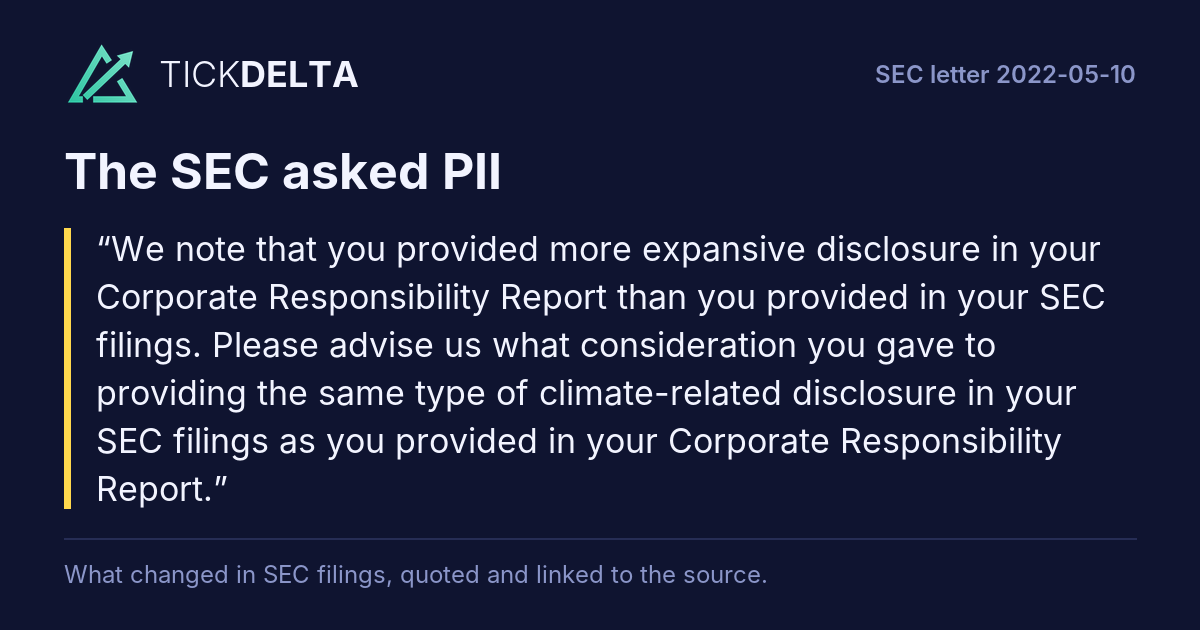
We note that you provided more expansive disclosure in your Corporate Responsibility Report than you provided in your SEC filings. Please advise us what consideration you gave to providing the same type of climate-related disclosure in your SEC filings as you provided in your Corporate Responsibility Report.
We provide disclosure in our SEC filings to satisfy our obligations under the federal securities laws to provide “material” information to our shareholders and the investing public. Separately, we provide information on our website and in various other public disclosures, including our Polaris Geared for Good Corporate Responsibility ESG Report (“CRR”), regarding our environmental, social and governance (“ESG”) initiatives, to address evolving stakeholder expectations, even when such information is not “material” under the federal securities laws and is beyond the scope of the informationRead in the replyRest of the answer
required to be disclosed in our filings with the SEC. We note in particular the statement on page 12 of our CRR that it reports on topics relevant to stakeholders across our value chain, as identified during our 2019 ESG materiality assessment and our 2021 stakeholder engagement, rather than topics considered material for SEC reporting purposes. However, should topics in our CRR meet the general standards of “materiality” under the federal securities laws and such disclosure is required for SEC reporting, we would include the material information about those topics in our SEC filings.
When considering whether to include climate-related information in our filings with the SEC, the Company takes into account applicable SEC rules and regulations, including Item 101, Item 103, Item 105 and Item 303 of Regulation S-K, as well as the SEC’s Compliance and Disclosure Interpretations, available guidance from the Staff (including the SEC’s 2010 Commission Guidance Regarding Disclosure Related to Climate Change) and applicable standards of materiality.
Finally, as it pertains to this Comment No. 1 and the other comments and responses below, we acknowledge our obligation to continuously review these matters as part of our ongoing disclosure controls and procedures and disclose climate-change related matters in our SEC filings to the extent we determine it is material. At the same time, we appreciate the interest many of our stakeholders have in climate-related information, and we expect to continue providing information about climate change and other ESG topics, which do not rise to the level of materiality required for SEC reporting, through various public disclosures, including our website and CRR.
It appears that you have identified your “electrification strategy” as a transition risk related to climate change. Tell us how you considered providing expanded disclosure regarding the factors that may affect your intention to bring additional electrification to your powersports vehicle portfolio (e.g., the availability of necessary materials, the pace of technological changes, etc.) and the potential effect onRest of the question
your business, financial condition, and results of operations. In addition, describe other transition risks related to climate change you have considered, such as those related to your environmental policies, and how you considered addressing them in your Form 10-K.
Our standard procedures for preparing our annual report on Form 10-K and quarterly reports on Form 10-Q include a process to identify and consider risks that may affect our business, financial condition, and results of operations. This process includes analyzing risks identified through our enterprise risk management program and reviewing information provided by our business and corporate functions.Read in the replyRest of the answer
This process is designed to identify significant risks facing the Company, which are then evaluated for potential disclosure in light of their materiality and the applicable disclosure requirements.
In connection with preparing the Form 10-K, climate change was not identified as being reasonably expected to have a material effect on the Company’s business, operating results or financial condition. With respect to potential new regulations relating to climate change, the Company did not identify any current legislative or regulatory developments as being reasonably expected to have a material effect on the Company’s business, operating results or financial condition. The Company continues to monitor and assess climate-related risks and new regulations relating to climate change.
With respect to our electrification strategy, the Company flagged for investors that if the Company is unable to develop new, innovative products, such as electric vehicles, the Company may be unable to compete effectively to satisfy the needs and preferences of our customers. As provided in the “Market and Competitive” Risk Factor included in the Form 10-K:
“If we are unable to continue to enhance existing products and develop and market new or enhanced products that respond to customer needs and preferences, we may experience a decrease in demand for our products and our business could suffer.”
This Risk Factor encompasses an innovation risk related to the Company’s ability to execute on its electrification initiative to position the Company to meet customer demand and to be a leader in powersports electrification. The discussion around electrification is not related to climate change risk but rather the potential inability to move quickly enough in research and development to meet customer expectations and demand. While we understand that certain customers’ preference for electrification may in part be inspired by climate considerations, we understand demand for electrification to be driven by a variety of reasons, including demand for less maintenance and quiet operation.
First report after the company's reply of Jun 2, 2022: 10-Q filed Jul 26, 2022 ↗, against the 10-Q filed Apr 26, 2022 ↗.
Tickdelta does not hold the text of both reports, so they are not compared here.
Disclose any material litigation risks related to climate change and explain the potential impact to the company.
We review pending and threatened litigation in connection with our SEC filings at least quarterly. To this end, we regularly monitor litigation risks and trends potentially material to our business and as part of our quarterly disclosure process, legal and finance personnel discuss pending litigation matters internally and determine if disclosure is necessary.Read in the reply
The Company respectfully advises the Staff that it has not been and is currently not subject to any material climate change-related litigation, and that it believes that its current disclosures around legal proceedings to be sufficient.
First report after the company's reply of Jun 2, 2022: 10-Q filed Jul 26, 2022 ↗, against the 10-Q filed Apr 26, 2022 ↗.
Tickdelta does not hold the text of both reports, so they are not compared here.
It appears you have identified climate-related projects in your Corporate Responsibility Report such as on-site projects meant to reduce GHG emissions from your operations and increase the use of renewable sources of energy. You also describe your plan to replace older elements of the vehicle fleet for your Transamerican Auto Parts business with up-todate and efficient technology.Rest of the question
Tell us how you considered providing disclosure regarding past and future capital expenditures for climate-related projects. Include quantitative information for the periods covered by your Form 10-K and for future periods as part of your response.
In assessing the materiality of climate-related project costs for our SEC filings, the Company first identifies the main intent of each project and then, if it is decided that the main purpose of the project is climate-related, it is determined whether the related costs of such projects are reasonably likely to result in a material impact to the Company’s financial condition or results of operations. For reference, the Company had aggregate capital expenditures of $1.2 billion between fiscal year 2017 and fiscal year 2021.Read in the replyRest of the answer
For that period, less than 0.1% of total capital expenditures were deemed to have a main purpose that was climate-related and we do not believe any currently planned projects will incur significant costs, individually or in the aggregate. For these reasons, the Company believes that the costs related to its climate-related projects have not and are not reasonably likely to result in a material impact to the Company’s financial condition or results of operations. As such, the Company believes disclosure in SEC filings is not required at this time. To enable understanding of the Company’s efforts towards ESG, the Company discusses climate related efforts in its CRR.
More specifically, as it relates to projects described in the Company’s 2021 CRR, the Company implemented a variety of projects which had positive climate-related impacts across six areas: GHG emissions, energy efficiency, renewable energy, water, waste, and air emissions. These projects all had a business operations purpose through which climate benefits were attained.
First report after the company's reply of Jun 2, 2022: 10-Q filed Jul 26, 2022 ↗, against the 10-Q filed Apr 26, 2022 ↗.
Tickdelta does not hold the text of both reports, so they are not compared here.
We note your disclosure regarding unfavorable weather, including conditions caused in part by climate change. If material, discuss the physical effects of climate change on your operations and results in more detail, such as the potential for indirect weather-related impacts that have affected or may affect your suppliers.Rest of the question
Also, tell us how you considered providing disclosure addressing weather-related damages to your property or operations and any weather-related impacts on the cost or availability of insurance. Your response should include quantitative information for each of the periods for which financial statements are presented in your most recent Form 10-K and explain whether changes are expected in future periods.
In the Management Discussion and Analysis (“MD&A) section of our Form 10-K, we discuss matters that have had or are reasonably likely to have a material impact on the Company’s financial condition or results of operation. The Company notes that it includes disclosure about the risks related to weather conditions, whether related to climate change or not, because our products are enjoyed outdoors and variations in weather may negatively impact demand for and sales of our products.Read in the replyRest of the answer
(See “Risk Factors – Operational Risks – Weather conditions may reduce demand and negatively impact net sales and production of certain of our products.”)
In assessing the materiality of physical effects that may have resulted from climate change, the Company determines whether the related costs of such effects are reasonably likely to result in a material impact to the Company’s financial condition or results of operations. Weather can have a short-term impact on the Company’s sales, as discussed in our Risk Factor referenced above; however, while customer behavior patterns are difficult to conclusively rationalize, we do not believe that weather had a material impact on 2021 sales. From time to time, weather does impact sales in a given quarter or annual sales for a seasonal business model, and weather and natural disasters can impact our suppliers and at times create supply chain inefficiencies causing additional cost. In summary, weather is amongst many factors which may impact sales and related costs, and when we believe those impacts are significant, individually or in the aggregate with other factors, we disclose them in our MD&A.
The cost of the Company’s insurance premiums is directly tied to the cost of insurance in the overall insurance market and the overall risk profile of the Company. The Company’s total property insurance cost for 2021 was approximately 0.2% of the Company’s operating expenses, and thus not material. The Company has not experienced weather-related impacts on the availability or cost of insurance, and the Company does not believe that any of its insurance costs include weather-related premiums specific to the Company’s operations. As such, the Company believes no specific disclosure on this topic was required in the Form 10-K.
First report after the company's reply of Jun 2, 2022: 10-Q filed Jul 26, 2022 ↗, against the 10-Q filed Apr 26, 2022 ↗.
Tickdelta does not hold the text of both reports, so they are not compared here.
We note the disclosure on pages 15-16 of your Form 10-K regarding compliance with laws, rules, and regulations relating to climate change, among other things. Tell us about and quantify compliance costs related to climate change for each of the periods covered by your most recent Form 10-K and whether increased amounts are expected to be incurred in future periods.
In the periods covered by our most recent Form 10-K, the Company has concluded that it has incurred less than 0.1% of total operating expenses in each year for direct costs related to compliance with each existing environmental-related or pending climate change-related law and/or regulation. These costs do not result in a material impact to the Company’s financial condition or results of operations.Read in the reply
The Company anticipates being subject to future climate change-related laws and/or regulations as countries begin to set their own climate-related commitments.Rest of the answer
Polaris cannot predict whether new laws or regulations related to climate change that may be proposed and implemented in the future could impose material costs or otherwise materially impact its business, but this remains a risk. The Company discloses this risk in the following Risk Factor included in the Form 10-K:
“Regulatory, Intellectual Property, Privacy and Cybersecurity Risks – Our business, properties, and products are subject to extensive United States, federal and state and international safety, environmental and other government regulation and any failure to comply with these regulations could harm our reputation, expose us to damages and otherwise adversely affect our business.”
The Company respectfully submits that, in its future SEC filings, it will include relevant disclosure if it believes that the compliance costs associated with any pending or existing climate change-related legislation, regulation, or international accord would be reasonably likely to have a material impact on Polaris’ business, financial condition, or results of operations.
First report after the company's reply of Jun 2, 2022: 10-Q filed Jul 26, 2022 ↗, against the 10-Q filed Apr 26, 2022 ↗.
Tickdelta does not hold the text of both reports, so they are not compared here.
You make reference to the purchase of carbon credits in your Corporate Responsibility Report. For example, we note the references to your acquisition of Tradable Renewable Energy Credits, also known as green tags. Provide us with quantitative information regarding your purchase or sale of carbon credits or offsets during the last three fiscal years and amounts budgeted for future periods.
In each of the last three fiscal years, we have purchased less than $25,000 of Tradeable Renewable Energy Credits. In 2021, our subsidiary Goupil recorded approximately $2,700,000 in CO2 credits related to its zero emissions vehicle sales that were sold to assist others in meeting the EU CO2 emissions standard.Read in the replyRest of the answer
In 2022, we have budgeted approximately $200,000 and for 2023 we have planned for approximately $100,000 for the purchase of Tradeable Renewable Energy Credits, consisting of a mix of Mexican iRecs, Polish Guarantees of Origin, and Green-e Certified RECs.
While we are evaluating the use of carbon credits and offsets to meet our climate goals, we do not expect that future purchases of carbon credits or offsets will materially affect our business, financial condition or results of operations on an annual basis.
On behalf of Polaris Inc., I thank you for your consideration of our response.
First report after the company's reply of Jun 2, 2022: 10-Q filed Jul 26, 2022 ↗, against the 10-Q filed Apr 26, 2022 ↗.
Tickdelta does not hold the text of both reports, so they are not compared here.
Your response to prior comment 2 states that climate change was not identified as being reasonably expected to have a material effect on your business, operating results, or financial condition in connection with the preparation of your Form 10-K. Please tell us about the transition risks related to climate change you identified and explain how you concluded on the materiality of the effects of climate change.
The process we use to identify and consider the materiality of climate-related transition risks is the same rigorous process we use when identifying and considering all risks that may affect our business, financial condition, and results of operations. Through this process, we have identified two key categories of potential climate-related transition risks: changes in the global regulatory environment in which we operate related to emissions; and consumer demand for electrified products.Read in the replyRest of the answer
For example, we face the potential adoption and implementation of carbon emission standards in the United States, the United Kingdom, Europe, and other countries where we do business. We manage this risk by actively considering our use of internal combustion engines, considering the emissions of our products, and investing in cost-effective electrification strategies to reduce our exposure to stricter carbon emission regulations. We also actively monitor the regulations in the jurisdictions where we do business and continuously evaluate our strategy for adapting to significant regulatory changes. Based upon our investment in our electrification strategy, we believe we could shift to lower emission products as demonstrated by our recent launch of our RANGER EV, an electric utility side-by-side vehicle, and our partnership with Zero Motorcycles, a global leader in electric motorcycle powertrains and technology.
The Company notes that it discloses risks that it considers material to its business, financial condition, or results of operations in the Risk Factors included in the Form 10-K. After evaluation, we have concluded that potential changes in the global regulatory environment related to emissions would not be different in kind or significance from other changes in the regulatory environment that we have responded to in the past and are continually addressing and that are identified in the Risk Factors in the Form 10-K. As we discussed in our response to prior comment 2, we did not identify any current legislative or regulatory developments as being reasonably expected to have a material adverse effect on our business, financial condition, or results of operations. For these reasons, we have concluded that there is no material risk to our business, financial condition, or results of operations arising from this particular climate-related transition risk at this time.
The second transition risk that we have identified is a potential change in customer demand for our products and services driven by climate-related considerations. A potential change in demand could take the form of customer preference for electrification in powersports vehicles. After evaluation, we have concluded that this potential change in customer demand for electrification would not be different in kind or significance from other drivers of customer demand that we have responded to in the past and are continually facing and that we have identified in the Risk Factors in the Form 10-K. As we noted before in response to prior comment 2, while we understand that certain customers’ preference for electrification may in part be inspired by climate considerations, we understand demand for electrification to be driven by a variety of reasons (e.g. demand for less maintenance and quiet operation). And for the reasons stated above, we believe we are well-positioned to shift our strategy and production to meet any changing customer demands. Therefore, we have also concluded that there is no material risk to our business, financial condition, or results of operations arising from this climate-related transition risk.
The Company respectfully submits that, in its future SEC filings, it will include relevant disclosure if it believes that there are climate-related transition risks that would be reasonably likely to have a material impact on Polaris’ business, financial condition, or results of operations.
First report after the company's reply of Jul 18, 2022: 10-Q filed Jul 26, 2022 ↗, against the 10-Q filed Apr 26, 2022 ↗.
Tickdelta does not hold the text of both reports, so they are not compared here.
Prior comment 5 regarding the physical effects of climate change on your operations and results is reissued in part as your response does not appear to address each element of our prior comment. Please provide us with quantitative information regarding weather-related damages to your property or operations and any weather-related impacts on the cost of insurance for each of the periods for which financial statementsRest of the question
are presented in your most recent Form 10-K and explain whether changes are expected in future periods.
The Company respectfully advises the Staff that the Company has not experienced any material weather-related damages to our properties or operations or weather-related impacts on the cost of insurance that had a material impact on Polaris’ business, financial condition, or results of operations for the three years presented in the Form 10-K. The Company’s property insurance coverage includes protection for damages at its locations, whether resulting from weather-related incidents or other causes.Read in the replyRest of the answer
For the three years presented in the Form 10-K, the Company’s deductible limit for property claims generally was a minimum of $500,000 per occurrence. As a point of reference, the Company has not experienced any property damages for more than this deductible. Since Polaris has not applied for nor received any property insurance recoveries in the past three years, weather-related or otherwise, the Company concluded that weather-related claims have not had a direct impact on the cost or availability of Polaris’ property insurance premiums and the Company has no reason to believe the cost or availability of insurance will change materially for any reasons related to climate. In each of the three years presented in the Form 10-K, the Company’s total property insurance cost has been approximately 0.2% of the Company’s operating expenses in each year, and thus not material. We believe the noted deductible level helps minimize the potential impact to the Company’s business, financial condition, or results of operations caused by any losses from damages to the Company’s property or operations. Accordingly, the Company respectfully advises the Staff that the Company has not experienced any weather-related impacts on the cost of insurance that have a material impact on Polaris’ business, financial condition, or results of operations for the three years presented in the Form 10-K. Finally, based upon our historical experience and current knowledge, we have no reason to believe that the impact of weather-related events on property, operations, or cost of insurance is expected to materially change in future periods.
On behalf of Polaris Inc., I thank you for your consideration of our response.
First report after the company's reply of Jul 18, 2022: 10-Q filed Jul 26, 2022 ↗, against the 10-Q filed Apr 26, 2022 ↗.
Tickdelta does not hold the text of both reports, so they are not compared here.
Also in this review: request for more time, May 23, 2022, closing letter, 2022-07-26