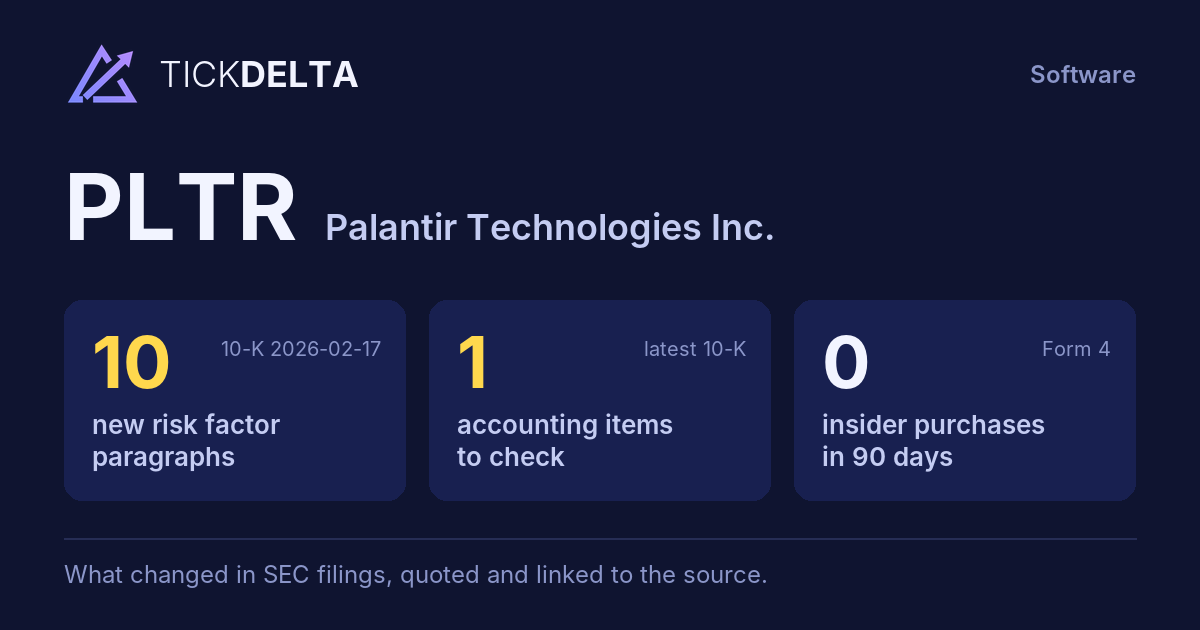
Marked against last year's 10-K:
cut words struck through, new words highlighted and underlined.
Risk Factors 288 words changed in this paragraph; it is 65% similar to last year's version.
Our platforms and services operate in conjunction with, and we are dependent upon, third-party products and components across a broad ecosystem, including our customer environments. There have been and may continue to be significant attacks on certain third-party providers, and we cannot guarantee that our or any third-party providers’ systems, networks, products, or components have not been breached or that they do not contain exploitable defects or bugs that could result in a breach of or disruption to our systems and networks or the systems and networks of third parties that support or otherwise interface with us and our platforms and services. Furthermore, changes such as configurations, updates or upgrades of third-party products or services have introduced and may in the future introduce or exacerbate vulnerabilities that may compromise our systems or those of our customers. If there is a security vulnerability, error, or other bug in one of these products or components and if there is a security exploit targeting them, we could face increased costs, claims, liability, reduced revenue, and harm to our reputation or competitive position. The natural sunsetting or phasing out of third-party products and operating systems that we use requires that our infrastructure teams reallocate time and attention to migration and updates, during which period potential security vulnerabilities could be exploited. In addition, the locations or environments in which our software is deployed have expanded, and may continue to expand, including on customer networks, on-premises at customer sites, on edge devices, on mobile devices, in data centers, in colocation spaces or in other locations or environments that we do not maintain or operate. In such locations or environments, we may not have full control over how our platforms and products are deployed, managed, or secured, our standards for information security may not be met, and our ability to deploy certain security features and controls may be limited. These locations and environments may be more vulnerable to cybersecurity attacks, phishing attacks, viruses, malware, ransomware, and hacking, or similar breaches and incidents, including those from nation-state actors or affiliated actors, and such attacks could harm our customers’ ability to operate and perform their obligations under our contracts, or result in increased costs or liabilities, a perceived or actual security breach of our platforms, or harm to our business and reputation. Moreover, if our platforms and products are not appropriately deployed, managed, and secured in these locations or environments, or such locations or environments are not appropriately secured or experience cybersecurity attacks or other security breaches or incidents, our platforms and products could be compromised, inappropriately accessed or acquired, or undergo unauthorized use, copying, and distribution, and reverse engineering of our intellectual property, which could adversely affect our business, financial condition, and results of operations. Further, certain of our platforms and services now allow customers to deploy their own applications in our environments, for example via our FedStart offering. These third-party applications have been built outside of our platforms or environments utilizing security procedures, techniques, and controls that may not meet our standards for information security, or may contain exploitable defects, errors, or bugs that could result in failures, disruptions, cybersecurity attacks, or other security breaches or incidents. Further, as we increase the number of customers we serve on our cloud environment, the likelihood increases that some usage of our products may occur that violates
Source: Item 1A, 10-K 0001321655-26-000011 vs Item 1A, 10-K 0001321655-25-000022
Legal Proceedings 229 words changed in this paragraph; it is 65% similar to last year's version.
On September 15, 2022, October 25, 2022, and November 4, 2022, putative securities class action complaints were filed in the United States District Court for the District of Colorado, captioned Cupat v. Palantir Technologies Inc., et al., Case No. 1:22-cv-02384, Allegheny County Employees’ Retirement System v. Palantir Technologies, Inc., et al., Case No. 1:22-cv-02805, and Shijun Liu, Individually and as Trustee of the Liu Family Trust 2019 v. Palantir Technologies Inc., et al., Case No. 1:22-cv-02893, respectively, naming the Company and certain current and former officers and directors as defendants. The suits allege false and misleading statements about our business and prospects, and purport to allege claims under the Securities Exchange Act of 1934, as amended (the “Exchange Act”) and the Securities Act of 1933, as amended (the “Securities Act”), and seek unspecified damages and remedies under Sections 10(b), 20(a), and 20(A) of the Exchange Act and Sections 11 and 15 of the Securities Act. These three actions subsequently were consolidated as Cupat v. Palantir Technologies Inc., et al., Lead Civil Action No. 1:22-cv-02834-CNS-SKC, consolidated with civil actions 1:22-cv-02805-CNS-SKC and 1:22-cv-02893-CNS-SKC. On March 31, 2024, the Court dismissed the Cupat matter without prejudice. On May 24, 2024, plaintiffs filed a second amended complaint. On November 21, 2022, April 4, 2025, the Court dismissed the Cupat matter with prejudice and entered judgment for the defendants on the same day. On May 2, 2025, plaintiffs filed a stockholder derivative action was filed in Notice of Appeal from the final judgment with the United States District Court of Appeals for the District of Colorado, captioned Li v. Karp, et al., Case No. 22-cv-3028 and on January 27, 2023, a stockholder derivative action was filed in the United States District Court for the District of Delaware captioned Miao v. Karp, et al., Case No. 1:23-cv-00103-MN, each against certain current and former officers and directors asserting breach of fiduciary duty and related claims relating to the allegations of the securities class action complaints and seek unspecified damages and injunctive remedies under Section 14(a) of the Exchange Act and Delaware law. On August 22, 2023, a stockholder derivative action was filed in the Court of Chancery of the State of Delaware captioned Central Laborers’ Pension Fund v. Karp, et al., Case No. 2023-0864 against certain current and former officers and directors asserting breach of fiduciary duty and related claims relating to the allegations of the securities class action complaints and seeks unspecified damages and injunctive relief under Delaware law. Because the litigation is in early stages, the Company is unable to estimate the reasonably possible loss or range of loss, if any, that may result from these matters. Tenth Circuit.
Source: Item 3, via Note 8 – Commitments and Contingencies, 10-K 0001321655-26-000011 vs Item 3, via Note 8 – Commitments and Contingencies, 10-K 0001321655-25-000022
MD&A 99 words changed in this paragraph; it is 43% similar to last year's version.
Stock-based compensation expenses increased decreased by $215.7 $7.6 million, or 45%, 1%, for the year ended December 31, 2024 2025 compared to 2023. 2024. The increase decrease was primarily driven by reductions in expense from SARs that fully vested and expensed during the acceleration of $115.8 million of expense for Market-Vesting SARs upon achieving the applicable market condition, as well as year ended December 31, 2024, partially offset by expense from new equity grants awarded since and within the year ended December 31, 2023, 2024, including grants for RSUs, P-RSUs, and SARs. These were partially offset by a reduction in expense from equity awards that became fully vested, forfeitures, and lower expense under the accelerated attribution method for RSUs granted prior to September 30, 2020, the date we completed the direct listing of our Class A common stock on the NYSE.
Source: Item 7, 10-K 0001321655-26-000011 vs Item 7, 10-K 0001321655-25-000022
Accounting Policies 66 words changed in this paragraph; it is 74% similar to last year's version.
The Company also grants awards, including RSUs, that vest upon the satisfaction of both a service condition and a performance condition. The Company determines the grant-date fair value of RSUs with both a service-based vesting condition and a performance-based vesting condition P-RSUs based on the fair value of the Company’s common stock on the grant date and records stock-based compensation expense using the accelerated attribution method over the service period. The performance-based vesting condition for the RSUs granted prior to September 30, 2020, the date the Company completed a direct listing of its Class A common stock on the New York Stock Exchange (the “Direct Listing”) was satisfied upon the occurrence of the Company’s Direct Listing. For P-RSUs granted after the Direct Listing, the Company recognizes expense for the number of P-RSUs expected to vest, determined based on the level of achievement against certain performance conditions, over the requisite service period when it is probable that the performance condition will be achieved.
Source: Item 8, Note 2 – Significant Accounting Policies, 10-K 0001321655-26-000011 vs Item 8, Note 2 – Significant Accounting Policies, 10-K 0001321655-25-000022