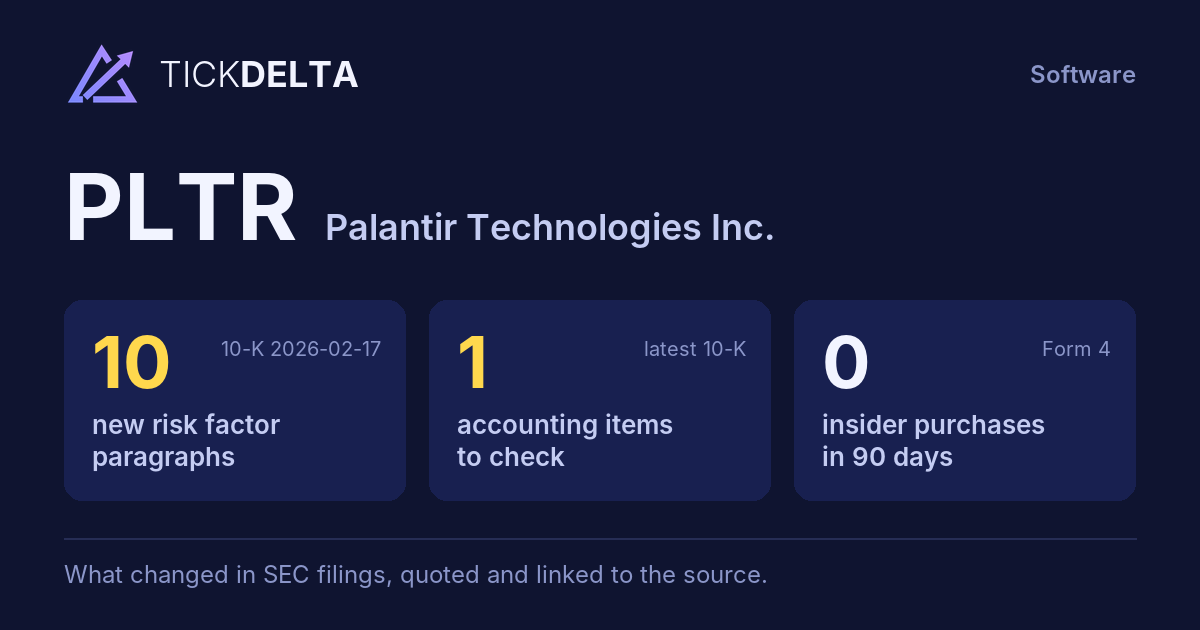
10-K 0001321655-26-000011 (2026-02-17) vs 10-K 0001321655-25-000022 (2025-02-18)
| Section | Compared text | Words now | Changed |
|---|
| Risk Factors | Item 1A | 44,409 |
12.4% |
| MD&A | Item 7 | 7,154 |
13.8% |
| Legal Proceedings | Item 3, via Note 8 – Commitments and Contingencies | 913 |
24.5% |
| Accounting Policies | Item 8, Note 2 – Significant Accounting Policies | 5,093 |
10.4% |
The redline: what was cut and what was added
In each section, the paragraph that changed most, marked against last year's 10-K:
cut words struck through, new words highlighted and underlined.
Risk Factors 288 words changed in this paragraph; it is 65% similar to last year's version.
Our platforms and services operate in conjunction with, and we are dependent upon, third-party products and components across a broad ecosystem, including our customer environments. There have been and may continue to be significant attacks on certain third-party providers, and we cannot guarantee that our or any third-party providers’ systems, networks, products, or components have not been breached or that they do not contain exploitable defects or bugs that could result in a breach of or disruption to our systems and networks or the systems and networks of third parties that support or otherwise interface with us and our platforms and services. Furthermore, changes such as configurations, updates or upgrades of third-party products or services have introduced and may in the future introduce or exacerbate vulnerabilities that may compromise our systems or those of our customers. If there is a security vulnerability, error, or other bug in one of these products or components and if there is a security exploit targeting them, we could face increased costs, claims, liability, reduced revenue, and harm to our reputation or competitive position. The natural sunsetting or phasing out of third-party products and operating systems that we use requires that our infrastructure teams reallocate time and attention to migration and updates, during which period potential security vulnerabilities could be exploited. In addition, the locations or environments in which our software is deployed have expanded, and may continue to expand, including on customer networks, on-premises at customer sites, on edge devices, on mobile devices, in data centers, in colocation spaces or in other locations or environments that we do not maintain or operate. In such locations or environments, we may not have full control over how our platforms and products are deployed, managed, or secured, our standards for information security may not be met, and our ability to deploy certain security features and controls may be limited. These locations and environments may be more vulnerable to cybersecurity attacks, phishing attacks, viruses, malware, ransomware, and hacking, or similar breaches and incidents, including those from nation-state actors or affiliated actors, and such attacks could harm our customers’ ability to operate and perform their obligations under our contracts, or result in increased costs or liabilities, a perceived or actual security breach of our platforms, or harm to our business and reputation. Moreover, if our platforms and products are not appropriately deployed, managed, and secured in these locations or environments, or such locations or environments are not appropriately secured or experience cybersecurity attacks or other security breaches or incidents, our platforms and products could be compromised, inappropriately accessed or acquired, or undergo unauthorized use, copying, and distribution, and reverse engineering of our intellectual property, which could adversely affect our business, financial condition, and results of operations. Further, certain of our platforms and services now allow customers to deploy their own applications in our environments, for example via our FedStart offering. These third-party applications have been built outside of our platforms or environments utilizing security procedures, techniques, and controls that may not meet our standards for information security, or may contain exploitable defects, errors, or bugs that could result in failures, disruptions, cybersecurity attacks, or other security breaches or incidents. Further, as we increase the number of customers we serve on our cloud environment, the likelihood increases that some usage of our products may occur that violates
Source: Item 1A, 10-K 0001321655-26-000011 vs Item 1A, 10-K 0001321655-25-000022
Legal Proceedings 229 words changed in this paragraph; it is 65% similar to last year's version.
On September 15, 2022, October 25, 2022, and November 4, 2022, putative securities class action complaints were filed in the United States District Court for the District of Colorado, captioned Cupat v. Palantir Technologies Inc., et al., Case No. 1:22-cv-02384, Allegheny County Employees’ Retirement System v. Palantir Technologies, Inc., et al., Case No. 1:22-cv-02805, and Shijun Liu, Individually and as Trustee of the Liu Family Trust 2019 v. Palantir Technologies Inc., et al., Case No. 1:22-cv-02893, respectively, naming the Company and certain current and former officers and directors as defendants. The suits allege false and misleading statements about our business and prospects, and purport to allege claims under the Securities Exchange Act of 1934, as amended (the “Exchange Act”) and the Securities Act of 1933, as amended (the “Securities Act”), and seek unspecified damages and remedies under Sections 10(b), 20(a), and 20(A) of the Exchange Act and Sections 11 and 15 of the Securities Act. These three actions subsequently were consolidated as Cupat v. Palantir Technologies Inc., et al., Lead Civil Action No. 1:22-cv-02834-CNS-SKC, consolidated with civil actions 1:22-cv-02805-CNS-SKC and 1:22-cv-02893-CNS-SKC. On March 31, 2024, the Court dismissed the Cupat matter without prejudice. On May 24, 2024, plaintiffs filed a second amended complaint. On November 21, 2022, April 4, 2025, the Court dismissed the Cupat matter with prejudice and entered judgment for the defendants on the same day. On May 2, 2025, plaintiffs filed a stockholder derivative action was filed in Notice of Appeal from the final judgment with the United States District Court of Appeals for the District of Colorado, captioned Li v. Karp, et al., Case No. 22-cv-3028 and on January 27, 2023, a stockholder derivative action was filed in the United States District Court for the District of Delaware captioned Miao v. Karp, et al., Case No. 1:23-cv-00103-MN, each against certain current and former officers and directors asserting breach of fiduciary duty and related claims relating to the allegations of the securities class action complaints and seek unspecified damages and injunctive remedies under Section 14(a) of the Exchange Act and Delaware law. On August 22, 2023, a stockholder derivative action was filed in the Court of Chancery of the State of Delaware captioned Central Laborers’ Pension Fund v. Karp, et al., Case No. 2023-0864 against certain current and former officers and directors asserting breach of fiduciary duty and related claims relating to the allegations of the securities class action complaints and seeks unspecified damages and injunctive relief under Delaware law. Because the litigation is in early stages, the Company is unable to estimate the reasonably possible loss or range of loss, if any, that may result from these matters. Tenth Circuit.
Source: Item 3, via Note 8 – Commitments and Contingencies, 10-K 0001321655-26-000011 vs Item 3, via Note 8 – Commitments and Contingencies, 10-K 0001321655-25-000022
MD&A 99 words changed in this paragraph; it is 43% similar to last year's version.
Stock-based compensation expenses increased decreased by $215.7 $7.6 million, or 45%, 1%, for the year ended December 31, 2024 2025 compared to 2023. 2024. The increase decrease was primarily driven by reductions in expense from SARs that fully vested and expensed during the acceleration of $115.8 million of expense for Market-Vesting SARs upon achieving the applicable market condition, as well as year ended December 31, 2024, partially offset by expense from new equity grants awarded since and within the year ended December 31, 2023, 2024, including grants for RSUs, P-RSUs, and SARs. These were partially offset by a reduction in expense from equity awards that became fully vested, forfeitures, and lower expense under the accelerated attribution method for RSUs granted prior to September 30, 2020, the date we completed the direct listing of our Class A common stock on the NYSE.
Source: Item 7, 10-K 0001321655-26-000011 vs Item 7, 10-K 0001321655-25-000022
Accounting Policies 66 words changed in this paragraph; it is 74% similar to last year's version.
The Company also grants awards, including RSUs, that vest upon the satisfaction of both a service condition and a performance condition. The Company determines the grant-date fair value of RSUs with both a service-based vesting condition and a performance-based vesting condition P-RSUs based on the fair value of the Company’s common stock on the grant date and records stock-based compensation expense using the accelerated attribution method over the service period. The performance-based vesting condition for the RSUs granted prior to September 30, 2020, the date the Company completed a direct listing of its Class A common stock on the New York Stock Exchange (the “Direct Listing”) was satisfied upon the occurrence of the Company’s Direct Listing. For P-RSUs granted after the Direct Listing, the Company recognizes expense for the number of P-RSUs expected to vest, determined based on the level of achievement against certain performance conditions, over the requisite service period when it is probable that the performance condition will be achieved.
Source: Item 8, Note 2 – Significant Accounting Policies, 10-K 0001321655-26-000011 vs Item 8, Note 2 – Significant Accounting Policies, 10-K 0001321655-25-000022
Every change, by type
Sentences and paragraphs of PLTR's Risk Factors and MD&A, 10-K 2026-02-17 against 10-K 2025-02-18.
Each links to the text at sec.gov.
Quiet changes are sentences kept from last year with one to four words changed, at least one of them a hedge, a modal or a qualifier
(may, could, will, not, significant, material…). A year or date rolling forward is not counted.
The full word list
adverse, adversely, all, although, anticipate, anticipates, any, approximately, believe, believes, can, cannot, certain, could, expect, expects, generally, however, if, intend, intends, largely, likely, many, material, materially, may, might, most, must, never, no, not, possible, primarily, probable, should, significant, significantly, some, substantial, substantially, unlikely, will, would
AddedRisk Factors
Our results of operations may fluctuate, in part, because of the intensive nature of our sales efforts and the length and unpredictability of our sales cycle. As part of our standard sales efforts, we invest considerable time and expense evaluating the specific organizational needs of our potential customers and educating these potential customers about the technical capabilities and value of our platforms and services. We often also provide our platforms to potential customers (including individual users
Read it in 10-K 2026-02-17 at sec.gov ↗
AddedRisk Factors
While we remain focused on operating efficiently, we anticipate that our operating expenses will continue to increase in the future. As we continue to expand our business, industry verticals, and the breadth of our operations, upgrade our infrastructure,
Read it in 10-K 2026-02-17 at sec.gov ↗
AddedRisk Factors
productivity and availability of key personnel and other employees necessary to conduct our business; and on third-party service providers who perform critical services for us, or otherwise cause operational failures due to changes in our normal business practices.
Read it in 10-K 2026-02-17 at sec.gov ↗
AddedRisk Factors
opportunities and access to a wider base of potential customers and pool of qualified subcontractor personnel that we can call upon to enhance and augment our implementation and engineering services.
Read it in 10-K 2026-02-17 at sec.gov ↗
AddedRisk Factors
Large enterprises and government entities often undertake a significant evaluation process that results in a lengthy sales cycle, in some cases over twelve months, requiring approvals of multiple management personnel and more technical personnel than
Read it in 10-K 2026-02-17 at sec.gov ↗
AddedRisk Factors
Moreover, to the extent that we do not effectively address capacity constraints, upgrade our systems as needed, and continually develop our technology and network architecture to accommodate actual and anticipated changes in technology, our business,
Read it in 10-K 2026-02-17 at sec.gov ↗
AddedRisk Factors
could also result in our having to stop using technology, branding or marks found to be in violation of a third party’s rights and any necessary rebranding could result in the loss of goodwill. We could be required to seek a license for the intellectual property, which may not be available on commercially reasonable terms or at all. Even if a license were available, we could be required to pay significant royalties, which would increase our expenses. As a result, we could be required to develop alternative non-infringing technology, branding or marks, which could require significant effort and expense. If we cannot license rights or develop technology for any infringing aspect of our business, we would be forced to limit or stop sales of one or more of our platforms or features, we could lose existing customers, and we may be unable to compete effectively. Any of these results would harm our business, financial condition, and results of operations.
Read it in 10-K 2026-02-17 at sec.gov ↗
AddedRisk Factors
In addition, our platforms integrate a wide variety of other elements, and our platforms must successfully interoperate with products from other vendors and our customers’ internally developed software. As a result, when problems occur for a customer
Read it in 10-K 2026-02-17 at sec.gov ↗
AddedRisk Factors
•changes in fiscal or contracting policies or decreases in available government funding, including as a result of efforts by the federal government to analyze and enhance its operational efficiency or enforce executive orders and other administration priorities;
Read it in 10-K 2026-02-17 at sec.gov ↗
AddedRisk Factors
thereon if the record date for determining the stockholders entitled to vote to approve such transaction occurs prior to the Final Class F Conversion Date;
Read it in 10-K 2026-02-17 at sec.gov ↗
RemovedRisk Factors
•there are no guarantees that our Share Repurchase Program (as defined below) will result in increased shareholder value; and
Read it in 10-K 2025-02-18 at sec.gov ↗
RemovedRisk Factors
In addition, if our customers do not use our platforms correctly or as intended, inadequate performance or outcomes may result. It is possible that our platforms may also be intentionally misused or abused by customers or their employees or third parties
Read it in 10-K 2025-02-18 at sec.gov ↗
RemovedRisk Factors
We expect to continue to enter into joint ventures, channel sales relationships (including original equipment manufacturer and reseller relationships), platform partnerships, and strategic alliances (including teaming agreements) as part of our long-term
Read it in 10-K 2025-02-18 at sec.gov ↗
RemovedRisk Factors
customers could be impaired until equivalent services or technology, if available, are identified, procured, and implemented, all of which may take significant time and resources, increase our costs, and could adversely affect our business. Many of these third-party providers attempt to impose limitations on their liability for such errors, disruptions, defects, performance deficiencies, or failures, and if enforceable, we may have additional liability to our customers which may not be compensated by our third-party providers which are responsible for the liability.
Read it in 10-K 2025-02-18 at sec.gov ↗
RemovedRisk Factors
protecting our intellectual property or other proprietary rights may be outweighed by the expense or distraction to our management. We may initiate claims or litigation against third parties for infringement, misappropriation, or other violation of our intellectual property or other proprietary rights or to establish the validity of our intellectual property or other proprietary rights. Any such litigation, whether or not it is resolved in our favor, could be time-consuming, result in significant expense to us and divert the efforts of our technical and management personnel. Furthermore, attempts to enforce our intellectual property rights against third parties could also provoke these third parties to assert their own intellectual property or other rights against us, or result in a holding that invalidates or narrows the scope of our rights, in whole or in part.
Read it in 10-K 2025-02-18 at sec.gov ↗
RemovedRisk Factors
operations. Moreover, the inclusion in our platforms of software or other intellectual property licensed from third parties on a nonexclusive basis could limit our ability to differentiate our platforms from products of our competitors and could inhibit our ability to provide the current level of service to existing customers.
Read it in 10-K 2025-02-18 at sec.gov ↗
RemovedRisk Factors
reputation, which could negatively affect our business, results of operations, financial condition, and growth prospects. In addition, responding to any enforcement action may result in a significant diversion of management’s attention and resources and significant defense costs and other professional fees. Our exposure for violating these laws increases as our non-U.S. presence expands and as we increase sales and operations in foreign jurisdictions.
Read it in 10-K 2025-02-18 at sec.gov ↗
RemovedRisk Factors
•changes in fiscal or contracting policies or decreases in available government funding;
Read it in 10-K 2025-02-18 at sec.gov ↗
RemovedRisk Factors
There are no guarantees that our Share Repurchase Program will result in increased shareholder value.
Read it in 10-K 2025-02-18 at sec.gov ↗
RemovedRisk Factors
In August 2023, our Board of Directors authorized a stock repurchase program of up to $1.0 billion of our outstanding shares of Class A common stock (the “Share Repurchase Program”). We have repurchased, and may continue to repurchase, shares of Class A common stock from time to time, as authorized by our Board of Directors, through open market purchases, in privately negotiated transactions or by other means, including through the use of trading plans intended to qualify under Rule 10b5-1 under the Exchange Act, in accordance with applicable securities laws and other restrictions. The timing and the amount of stock repurchases in the Share Repurchase Program will be determined by Palantir’s management, based on its evaluation of factors including business and market conditions, corporate and regulatory requirements, and other considerations.
Read it in 10-K 2025-02-18 at sec.gov ↗
RemovedRisk Factors
There are a number of ways in which the Share Repurchase Program could fail to result in enhanced shareholder value. For example, any failure to repurchase stock after we have announced our intention to do so may negatively impact our stock price. The existence of the Share Repurchase Program could also cause our stock price to trade higher than it otherwise would and could potentially reduce the market liquidity for our stock. The market price of our common stock could decline below the levels at which we repurchased shares and short-term stock price fluctuations could reduce the effectiveness of this program.
Read it in 10-K 2025-02-18 at sec.gov ↗
RemovedRisk Factors
Additionally, repurchasing our Class A common stock will reduce the amount of cash, cash equivalents and marketable securities we have available to fund working capital, capital expenditures, capital preserving investments, strategic acquisitions or business opportunities, and other general corporate purposes, and there are no guarantees that the Share Repurchase Program will result in increased shareholder value. Furthermore, the timing and amount of repurchases have been, and will in the future be, subject to liquidity, market and economic conditions, compliance with applicable legal requirements, and other relevant factors.
Read it in 10-K 2025-02-18 at sec.gov ↗
RewordedRisk Factors
Some countries and regions, including the EU, are considering or have passed legislation that imposes significant obligations in connection with privacy, data protection, and information security that could increase the cost and complexity of delivering our platforms and services, including the GDPR European General Data Protection Regulation (“GDPR”) which took effect in May 2018. 2018; the EU AIA, which entered into force in August 2024 but continues to be phased in and establishes a risk-based framework for AI systems; and the Network and Information Security Directive 2 (“NIS2”), which replaced the original NIS Directive as of October 2024, and imposes additional cybersecurity risk management and incident reporting obligations.
Read it in 10-K 2026-02-17 at sec.gov ↗
RewordedRisk Factors
If our employees are unable to obtain security clearances in a timely manner, or at all, or if our employees who hold security clearances are unable to maintain their clearances or terminate employment with us, then we may be unable to comply with relevant U.S. and international government agency requirements, or our customers requiring classified work could choose to terminate or decide not to renew one or more contracts requiring employees to obtain or maintain security clearances upon expiration.
Read it in 10-K 2026-02-17 at sec.gov ↗
RewordedRisk Factors
It is also possible that remote work arrangements may have a negative impact on our ability to recruit, train, manage, and retain employees; our operations; our information, data security and cybersecurity; consumer privacy and the risk of fraud; the execution of our business plans; our ability to maintain and strengthen our company culture; the productivity and availability of key personnel and other employees necessary to conduct our business; and on third-party service providers who perform critical services for us, or otherwise cause operational failures due to changes in our normal business practices.
Read it in 10-K 2026-02-17 at sec.gov ↗
RewordedRisk Factors
If any of these third-party services experience errors, disruptions, security issues, or other performance deficiencies, if they are updated such that our platforms become incompatible, if these services, software, or hardware fail or become unavailable due to extended outages, interruptions, defects, or otherwise, or if they are no longer available on commercially reasonable terms or prices (or at all), these issues could result in errors or defects in our platforms, cause our platforms to fail, our revenue and margins could decline, or our reputation and brand could be damaged, we could be exposed to legal or contractual liability, our expenses could increase, our ability to manage our operations could be interrupted, and our processes for managing our sales and servicing our customers could be impaired until equivalent services or technology, if available, are identified, procured, and implemented, all of which may take significant time and resources, increase our costs, and could adversely affect our business.
Read it in 10-K 2026-02-17 at sec.gov ↗
RewordedRisk Factors
Furthermore, because the interpretation and application of laws, standards, contractual obligations and other obligations relating to privacy, data protection, and information security are uncertain, these laws, standards, and contractual and other obligations may be interpreted and applied in a manner that is, or is alleged to be, inconsistent with our data management practices, our policies or procedures, or the features of our platforms, or we may simply fail to properly develop or implement our practices, policies, procedures, or features in compliance with such obligations.
Read it in 10-K 2026-02-17 at sec.gov ↗
RewordedRisk Factors
In addition, if the open source software we use is no longer maintained by the relevant open source community, then it may be more difficult to make the necessary revisions to our software, including modifications to address security vulnerabilities, which could impact our ability to mitigate cybersecurity risks or fulfill our contractual obligations to our customers.
Read it in 10-K 2026-02-17 at sec.gov ↗
RewordedRisk Factors
In addition, the trustee will vote shares of Class F common stock in accordance with the decision of a majority in number of the Founders who are then party to the Founder Voting Agreement, regardless of such Founders’ relative ownership of any class of our common stock.
Read it in 10-K 2026-02-17 at sec.gov ↗
RewordedRisk Factors
Furthermore, since 2020, we have entered into channel sales relationships and strategic alliances with various global system integrators that we believe provide us with more diverse go-to-market opportunities and access to a wider base of potential customers and pool of qualified subcontractor personnel that we can call upon to enhance and augment our implementation and engineering services.
Read it in 10-K 2026-02-17 at sec.gov ↗
RewordedRisk Factors
Additionally, post-Brexit updates to United Kingdom (“U.K.”) data protection laws and regulations, such as the Data (Use and Access) Act 2025, while largely conforming to EU GDPR standards paving the way for a 2021 European Commission adequacy determination for export of personal data from the European Economic Area to the U.K., may change over time as the U.K. and its regulator, the Information Commissioner’s Office, continue to examine its global market standing, and a formal sunset clause will necessitate a reassessment and renegotiated terms to carry the determination beyond June 2025. standing.
Read it in 10-K 2026-02-17 at sec.gov ↗
RewordedRisk Factors
Our results of operations depend on sales to enterprise customers, which make product purchasing decisions based in part or entirely on factors, or perceived factors, not directly related to the features of the platforms, including, among others, that customer’s projections of business growth, uncertainty about macroeconomic conditions (including as a result of the ongoing Russia-Ukraine conflict and related economic sanctions, the conflict resulting from Hamas’ attack on Israel, heightened Israel and the ongoing conflict in the Middle East, fluctuating interest rates, monetary policy changes, or foreign currency fluctuations), fluctuations, or the potential or actual imposition of tariffs or other impacts on trade relations), capital budgets, anticipated cost savings from the implementation of our platforms, potential preference for such customer’s internally-developed software solutions, perceptions about our business and platforms, more favorable terms offered by potential competitors, and previous technology investments.
Read it in 10-K 2026-02-17 at sec.gov ↗
RewordedRisk Factors
Further, as we increase the number of customers we serve on our cloud environment, the likelihood increases that some usage of our products may occur that violates our terms of service or is otherwise improper or perceived as improper, which could cause reputational damage and adversely affect our business, financial condition, and results of operations.
Read it in 10-K 2026-02-17 at sec.gov ↗
RewordedRisk Factors
If an actual or perceived breach of security measures, unauthorized access to our system or the systems of the third-party vendors that we rely upon, or any other cybersecurity attack, threat, or incident occurs, we may face direct or indirect liability, costs, or damages, including expenses related to responding and/or alleviating an actual or perceived breach or other incident, contract termination, our reputation in the industry and with current and potential customers may be compromised, our ability to attract new customers could be negatively affected, our management’s attention could be diverted, and our business, financial condition, and results of operations could be materially and adversely affected.
Read it in 10-K 2026-02-17 at sec.gov ↗
Quiet changesRisk Factors
Army to develop and deliver the Tactical Intelligence Targeting Access Node ground station system, the Army’s first AI-defined vehicle, which will involve involves coordination with third parties such as hardware manufacturers.
Read it in 10-K 2026-02-17 at sec.gov ↗
Quiet changesRisk Factors
We cannot yet fully assess the impact of these laws and other new laws or regulations on our business or operations, but developments regarding these and all other privacy and data protection laws and regulations around the world may require us to modify our data processing practices and policies and to incur substantial costs and expenses in an effort to maintain compliance on an ongoing basis.
Read it in 10-K 2026-02-17 at sec.gov ↗
Quiet changesRisk Factors
Additionally, while some many of our employees have returned to our offices, it could be particularly difficult to mitigate the impact of these events on our employees continuing to work remotely.
Read it in 10-K 2026-02-17 at sec.gov ↗
AddedMD&A
We have built four principal software platforms, Gotham, Foundry, Apollo, and AIP. Foundry is our foundational data operations platform, which provides the core capabilities for data management, logic authoring, systemic mapping development through our Ontology, analytics, and workflow development. AIP is our generative AI platform, which provides secure connectivity to third-party-provided LLMs, a development toolchain for building AI-powered agents and automations, an array of AI-enabled end user applications, a broad evaluations framework for governing AI workflows in production, and more. Apollo is our continuous delivery platform, enabling the orchestration of upgrades of services and assets every day to manage the underlying infrastructure that hosts our other platforms. Gotham integrates with our other platforms, as well as our broader defense offerings, to power a wide array of missions across allied defense and intelligence operations.
Read it in 10-K 2026-02-17 at sec.gov ↗
AddedMD&A
The Ontology has continuously evolved over time, serving as the heart of our platforms by activating data and analytics inside operations, enabling real-time connectivity between data, analytics, and operational teams, as well as AI. Ontology generally refers to the systematic mapping of data to meaningful context. The Palantir Ontology goes far beyond the traditional concept by integrating the elements of a decision—the data, logic, and actions—into a foundational representation of the organization, and allowing users to build interconnected workflows, turning specialized expertise into shared infrastructure to dynamically optimize decision-making across the enterprise. The Ontology can help create a shared understanding across all users in a data ecosystem regardless of technical skills, enabling organizations to scale more efficiently and rapidly.
Read it in 10-K 2026-02-17 at sec.gov ↗
AddedMD&A
Macroeconomic conditions have impacted, and may continue to adversely impact, our customers’ businesses. With economic uncertainty, we may experience additional negative impacts on new customer acquisition, customer renewals, and customer collections, among other things, which could negatively impact our business and results of operations.
Read it in 10-K 2026-02-17 at sec.gov ↗
AddedMD&A
or are noncash costs. These noncash or unallocated costs include stock-based compensation expense, research and development costs, and general and administrative costs.
Read it in 10-K 2026-02-17 at sec.gov ↗
RemovedMD&A
We have built four principal software platforms, Gotham, Foundry, Apollo, and our Artificial Intelligence Platform (“AIP”). Gotham and Foundry enable institutions to transform massive amounts of information into an integrated data asset that reflects their operations, and AIP leverages the power of our existing machine learning technologies alongside generative AI models, including large language models (“LLMs”), directly within Gotham and/or Foundry to help operationalize AI on enterprise data.
Read it in 10-K 2025-02-18 at sec.gov ↗
RemovedMD&A
Current macroeconomic conditions have impacted, and may continue to adversely impact, our customers’ businesses, particularly our early- and growth-stage customers. Relationships with early- or growth-stage customers carry inherent risks because, among other things, such customers may be unable to generate sufficient revenues or profitability or to access any necessary financing or funding in a timely manner or on favorable terms to them in the current macroeconomic environment, which has impacted, and may continue to impact, our expected revenue and collections. As a result, current macroeconomic conditions have impacted, and may continue to impact, our ability to realize the full value of our commercial contracts with such early- or growth-stage customers.
Read it in 10-K 2025-02-18 at sec.gov ↗
RemovedMD&A
the same manner as our management team. Additionally, we exclude employer payroll taxes related to stock-based compensation as it is difficult to predict and outside of our control.
Read it in 10-K 2025-02-18 at sec.gov ↗
RemovedMD&A
As of December 31, 2024, our accumulated deficit balance was $5.2 billion, and our principal sources of liquidity were cash, cash equivalents, and short-term U.S. Treasury securities totaling $5.2 billion.
Read it in 10-K 2025-02-18 at sec.gov ↗
RemovedMD&A
Deferred revenue represents billings under noncancelable contracts before the related product or service is transferred to the customer. The portion of deferred revenue that is anticipated to be recognized as revenue during the succeeding twelve-month period is recorded as deferred revenue and the remaining portion is recorded as deferred revenue, noncurrent.
Read it in 10-K 2025-02-18 at sec.gov ↗
RemovedMD&A
Customer deposits consist of amounts billed and/or paid for anticipated revenue generating activities in advance of the start of the contractual term or for the portion of a contract term that is subject to cancellation by our customers. The portion of customer deposits that is anticipated to be recognized as revenue during the succeeding twelve-month period is recorded as customer deposits and the remaining portion is recorded as customer deposits, noncurrent.
Read it in 10-K 2025-02-18 at sec.gov ↗
RemovedMD&A
Our deferred revenue and deferred revenue, noncurrent as of December 31, 2024 were $259.6 million and $39.9 million, respectively. Our customer deposits and customer deposits, noncurrent as of December 31, 2024 were $265.3 million and $1.7 million, respectively. Our deferred revenue and deferred revenue, noncurrent as of December 31, 2023 were $246.9 million and $28.0 million, respectively. Our customer deposits and customer deposits, noncurrent as of December 31, 2023 were $209.8 million and $1.5 million, respectively.
Read it in 10-K 2025-02-18 at sec.gov ↗
RewordedMD&A
The increase was primarily due to increases of $111.4 $76.4 million in payroll and other payroll-related costs, $18.3 million in marketing expenses, and $16.4 million in stock-based compensation expense and related expenses, $13.9 million in third-party cloud hosting services, and $12.9 million in payroll and other payroll-related costs. expenses.
Read it in 10-K 2026-02-17 at sec.gov ↗
RewordedMD&A
Other income (expense), net changed by $2.6 $32.2 million for the year ended December 31, 2024 2025 compared to 2023 2024 primarily due to upward adjustments in privately-held securities and lower realized losses from marketable securities, partially offset by an increase in net realized and unrealized losses from our shares held in equity on marketable securities.
Read it in 10-K 2026-02-17 at sec.gov ↗
RewordedMD&A
Sales and marketing costs primarily include salaries, stock-based compensation expense, variable compensation, including commissions, and benefits for our sales force and personnel involved in sales functions, executing on pilots, including bootcamps, and customer growth activities; as well as third-party cloud hosting services for our pilots, marketing and sales event-related costs, travel costs, and allocated overhead.
Read it in 10-K 2026-02-17 at sec.gov ↗
RewordedMD&A
Further, we may enter into future arrangements to acquire or invest in businesses, products, services, strategic partnerships, and technologies; additionally, we have, and may in the future, repurchase shares of our Class A common stock from time to time under our Share Repurchase Program. technologies.
Read it in 10-K 2026-02-17 at sec.gov ↗
RewordedMD&A
Our gross margin for the year ended December 31, 2024 decreased 2025 increased from 81% 80% for the same period in 2023 2024 to 80% as a result of the growth of cost of revenue slightly outpacing revenue growth. 82%.
Read it in 10-K 2026-02-17 at sec.gov ↗
RewordedMD&A
The increase was primarily due to increases of $111.4 million in stock-based compensation expense and related expenses, $13.9 $94.6 million in third-party cloud hosting services, $38.0 million in subcontractor expenses, $29.1 million in field-service representatives, and $12.9 $26.9 million in payroll and other payroll-related costs.
Read it in 10-K 2026-02-17 at sec.gov ↗
RewordedMD&A
The increase was primarily due to increases of $87.4 million in stock-based compensation expense and related expenses and $17.5 $35.6 million in third-party cloud hosting services. services and $19.0 million in payroll and other payroll-related costs.
Read it in 10-K 2026-02-17 at sec.gov ↗
RewordedMD&A
Sales and marketing 23 31 34 37 Research and development 12 18 18 19 General and administrative 15 20 24 31 Total operating expenses 50 69 76 87 Income (loss) from operations 32 11 5 (8) Interest income 5 7 6 1 Other income (expense), net — (1) — (12) Income (loss) before provision for income taxes 37 17 11 (19) Provision for income taxes 1 1 1 Net income (loss) 36 16 10 (20) Less:
Read it in 10-K 2026-02-17 at sec.gov ↗
RewordedMD&A
As a corporation with an international presence, we are subject to risks and uncertainties caused by significant events with macroeconomic impacts, including, but not limited to, geopolitical tensions, heightened fluctuating interest rates, monetary policy changes, and foreign currency fluctuations. fluctuations, and the potential or actual imposition of tariffs or other impacts on trade relations.
Read it in 10-K 2026-02-17 at sec.gov ↗
RewordedMD&A
The increase was primarily driven by the revenue growth of our business and timing of payments from customers, partially offset by timing of billings to vendors. customers.
Read it in 10-K 2026-02-17 at sec.gov ↗
RewordedMD&A
The following table summarizes our contractual obligations and commitments commitments, which are associated with agreements that are enforceable and legally binding, as of December 31, 2024 2025 (in thousands):
Read it in 10-K 2026-02-17 at sec.gov ↗
RewordedMD&A
Operating activities $ 2,134,473 $ 1,153,865 $ 712,183 $ 223,737 Investing activities (2,783,551) (340,655) (2,711,180) (45,427) Financing activities (26,910) 463,364 218,839 85,996 Effect of foreign exchange on cash, cash equivalents, and restricted cash 7,477 (6,745) 2,930 (3,885) Net increase (decrease) in cash, cash equivalents, and restricted cash $ (668,511) $ 1,269,829 $ (1,777,228) $ 260,421
Read it in 10-K 2026-02-17 at sec.gov ↗
Quiet changesMD&A
However, our Our current operations related to Ukraine and Israel are not material to our financial position or results of operations.
Read it in 10-K 2026-02-17 at sec.gov ↗