tickdelta
Sign in

Tickdelta is free for now. Sign up and get Pro free

← Screener

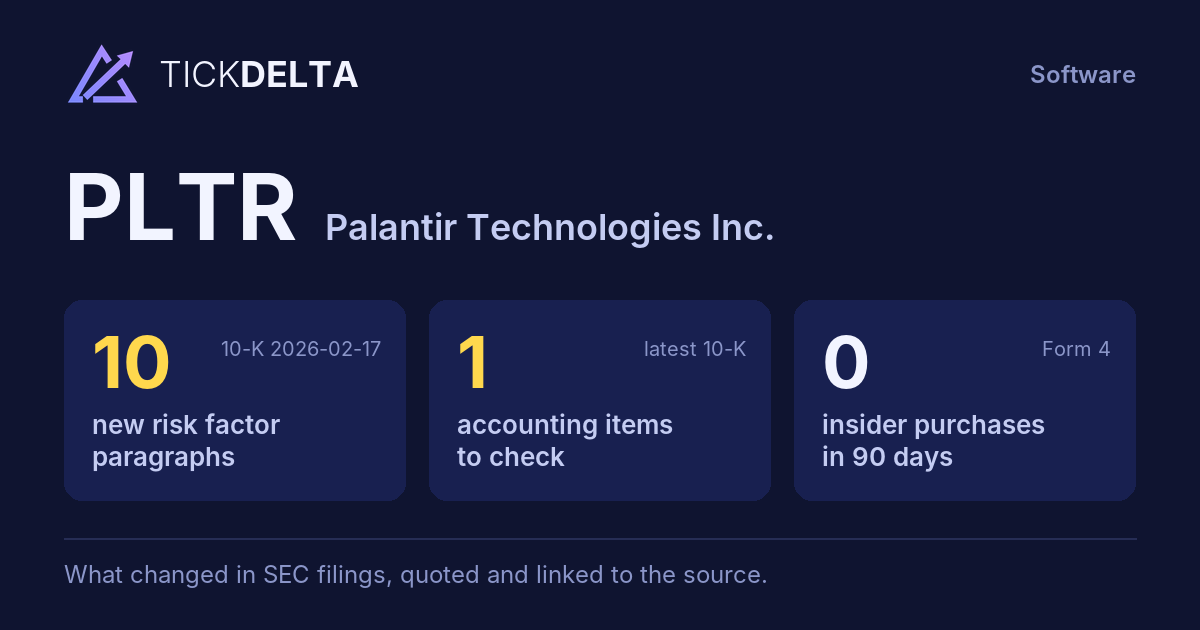
PLTRPalantir Technologies

Technology · Software · Nasdaq

We build software that empowers organizations to effectively integrate their data, decisions, and operations at scale. 10-K, Item 1

Employees
4,429
Headquarters
Aventura, FL
CEO
Alexander C. Karp
Next results
around Feb 1, 2027
Compare with peers → Embed

When the SEC's staff reviews a filing, it writes to the company with numbered questions, and the company answers each one in a letter. SEC publishes the exchange once the review is over, at least 20 business days later. Below: what the staff asked PLTR, and the company's answer to each question, quoted from the letters. A question is not an accusation; most reviews end with the company adding detail to its next filing.

Form 10-K for the Year Ended December 31, 2021

2022-08-24 to 2022-10-05 · 2 questions · 1 letter from the SEC, 2 from the company
Review closed 2022-10-05
RevenueNon-GAAP measuresResults discussion (MD&A)Liquidity and cashRussia and Ukraine
SEC asked (4)
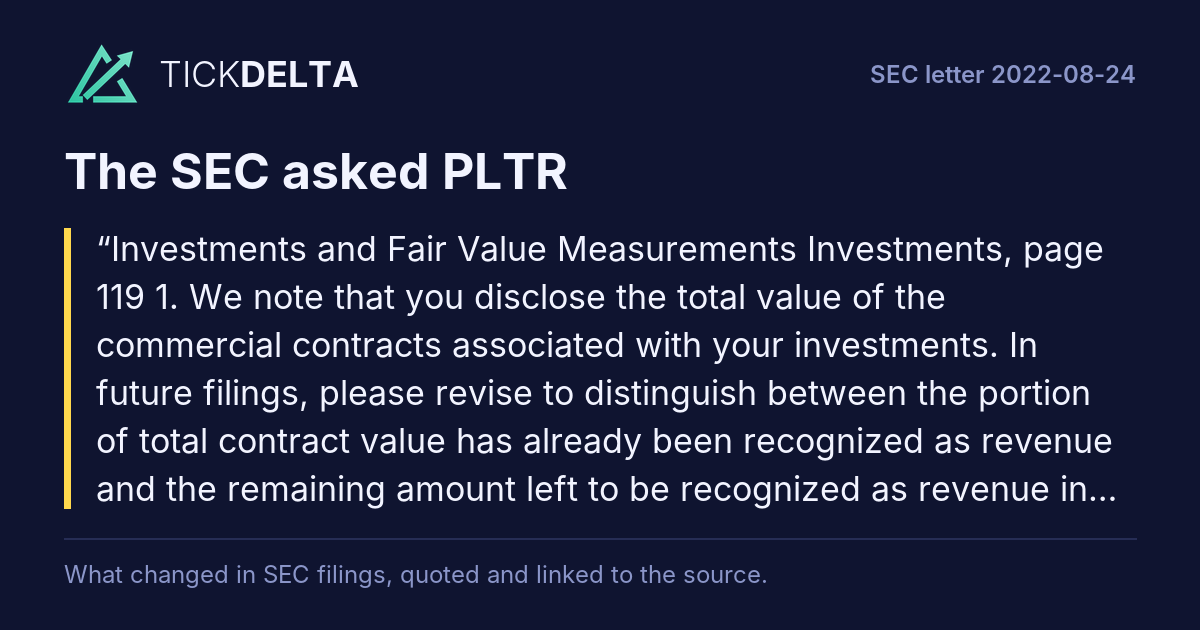
Investments and Fair Value Measurements Investments, page 119 1. We note that you disclose the total value of the commercial contracts associated with your investments. In future filings, please revise to distinguish between the portion of total contract value has already been recognized as revenue and the remaining amount left to be recognized as revenue in future periods. 2.
Rest of the question

So that we may understand you investment agreements better, please tell us more specifically how you assess the concurrent agreements under the non-monetary guidance within ASC 606. Please also tell us the relationship, if any, between the Investment Agreement and the commercial contract for access to your products and services. For example, please clarify if you are required to hold your investment in the investee for the duration of the commercial contract. Please also clarify if investees are required to continue paying for products and service if you sell your investment prior to the end of the term of the commercial contract. Management's Discussion and Analysis Russia Invasion of Ukraine, page 23 3. You disclose on page 23 that in June 2022, your CEO met with the President of Ukraine and other senior officials to discuss opening an office in Ukraine. Please ensure that future filings address your progress, if any, on opening an office in Ukraine. Your disclosures should address the materiality of any operations within Ukraine and disclose any material direct or indirect risks to your business due to having a presence in Ukraine (for example relating to security, internet accessibility or other infrastructure concerns). Please also disclose any steps you have taken or may take to address those risks. Results of Operations, page 28 4. In your August 8, 2022 Form 8-K, you disclosed downward revisions to expected revenue and adjusted income from operations for fiscal 2022. You also disclosed expectations for adjusted income from operations for the third quarter of 2022 that were approximately half of adjusted income from operations for the quarter ended June 30, 2022. Finally, we noted that you did not re-affirm your long-term annual revenue guidance of 30% or more through 2025 in that Form 8-K. It does not appear that your MD&A for the period ended June 30, 2022 sufficiently addressed these material changes in outlook. Please revise your future filings to describe, in detail, the nature of any material disruptions to your outlook and business goals. Please also revise to specifically quantify the impact of these disruptions on your results of operations and/or capital resources. Please refer to Items 303(a) and (c) of Regulation S-K.

PLTR answered
We acknowledge the Staff’s comment and respectfully advise the Staff that in future filings, we will distinguish between the portion of total contract value that has already been recognized as revenue and the remaining amount left to be recognized as revenue in future periods.

2. So that we may understand you investment agreements better, please tell us more specifically how you assess the concurrent agreements under the non-monetary guidance within ASC 606.
Rest of the answer

Please also tell us the relationship, if any, between the Investment Agreement and the commercial contract for access to your products and services. For example, please clarify if you are required to hold your investment in the investee for the duration of the commercial contract. Please also clarify if investees are required to continue paying for products and service if you sell your investment prior to the end of the term of the commercial contract.

We acknowledge the Staff’s comment and respectfully advise the Staff that the Company assessed the Investment Agreements (as defined in the Form 10-K) and commercial contracts under the noncash and consideration paid or payable to a customer guidance within ASC 606—Revenue from Contracts with Customers to determine whether and, if so, how the Investment Agreement would affect the commercial contract to provide access to our products and services to a given customer. Specifically, we have assessed whether we have met the definition of a contract as outlined in ASC 606-10-25-1 including whether the Investment Agreements and commercial contracts have commercial substance. Additionally, we have considered the guidance in ASC

606-10-32-25 to 27 in our consideration as to whether the Company’s Investment Agreements are distinct from the commercial contracts. The Investment Agreements created a binding obligation for the Company to purchase for cash, or commit to purchase for cash, shares in the Investees (as defined in the Form 10-K) in a private placement or in connection with a private investment in public equity (“PIPE”) transaction on substantially the same rights and privileges as any other third-party investors. The closing of the PIPE Investment Agreements were contingent upon the applicable closing conditions, including the successful merger of the Investee with the applicable special purpose acquisition company (“SPAC”). To the Company’s knowledge, the Company’s shares hold the same risks as with any other shareholder. The amount of cash payable by the Company per the terms of the Investment Agreements represents fair market value for the purchased shares as evidenced by the existence of other third-party investors paying the same price for the same instruments in either the PIPE or based on recent third-party investor transactions. The agreed upon prices also approximate the fair market value of the SPAC shares being publicly traded at the time of execution of the Investment

Agreements. The Company therefore concluded that the

Investment Agreements were priced at fair market value. In addition, the Company concluded that the cash consideration received from the Investee, in their capacity as a customer, in exchange for rights to our products and services approximates fair market value for those products and services determined based on estimated standalone selling prices.

The Investment Agreements do not impact the rights to our products and services provided under the commercial contracts. The

Investment Agreements and commercial contracts do not obligate the Company to hold its shares in the Investee throughout the duration of the commercial contracts1. The Investees are required to continue paying for products and services pursuant to the commercial contracts even if the Company sells its shares prior to the end of the commercial contract term (ranging from three to ten years inclusive of contractual options).

In some cases, prior to the successful merger of the Investee with the applicable SPAC, Investees had the contractual right to terminate the commercial agreement if the Company’s proposed investment was not closed. However, after closing, the sale of such purchased shares by the Company prior to the end of the term of the commercial contract would not impact the

Investees’ contractual obligations under the commercial contracts, including each Investee’s obligation to continue paying for products and services. The total value of the commercial contracts were materially in excess of the

Company’s total purchases or commitments to purchase shares under the Investment Agreements.

Therefore, based on the terms of the Investment Agreements and the enforceable rights and obligations of the commercial contracts, as well as the fact that the Company paid fair market value in cash to Investees for shares received and the customers received access to our products and services in exchange for cash consideration that approximates the fair market value for those products and services, we determined the Investment Agreements and commercial contracts should be accounted for as separate transactions.

Management’s Discussion and Analysis

Russia

Invasion of Ukraine, page 23

In one case, investors who committed to purchase shares to be issued by an Investee in a PIPE transaction, including the Company, subsequently entered into a lock-up agreement with such Investee to restrict the sale of certain of such investor’s shares in such Investee for 180 days after the issuance of such shares. Such lock-up agreements covered over 80% of the shares to be issued by such Investee in the PIPE transaction, including 50% of the shares to be purchased by the Company. Such lock-up agreement was unrelated to the Company’s commercial agreement with the Investee and no compensation was paid by the Investee to the Company or any other investors in connection with their entry into such lock-up agreement.

3. You disclose on page 23 that in June 2022, your CEO met with the President of Ukraine and other senior officials to discuss opening an office in Ukraine. Please ensure that future filings address your progress, if any, on opening an office in Ukraine. Your disclosures should address the materiality of any operations within Ukraine and disclose any material direct or indirect risks to your business due to having a presence in Ukraine (for example relating to security, internet accessibility or other infrastructure concerns). Please also disclose any steps you have taken or may take to address those risks.

We acknowledge the Staff’s comment and respectfully advise the Staff that our future filings will address, to the extent material, our operations within Ukraine, including relevant updates regarding opening an office, as well as material direct or indirect risks to our business due to having a presence in Ukraine, if any, and any steps taken to address such risks.

Results of Operations, page 28

4. In your August 8, 2022 Form 8-K, you disclosed downward revisions to expected revenue and adjusted income from operations for fiscal 2022. You also disclosed expectations for adjusted income from operations for the third quarter of 2022 that were approximately half of adjusted income from operations for the quarter ended June 30, 2022. Finally, we noted that you did not re-affirm your long-term annual revenue guidance of 30% or more through 2025 in that Form 8-K.

It does not appear that your MD&A for the period ended June 30, 2022 sufficiently addressed these material changes in outlook. Please revise your future filings to describe, in detail, the nature of any material disruptions to your outlook and business goals. Please also revise to specifically quantify the impact of these disruptions on your results of operations and/or capital resources. Please refer to Items 303(a) and (c) of Regulation

S-K.

We acknowledge the Staff’s comment and respectfully advise the Staff that the Company routinely considers Items 303(a) and (c) of Regulation S-K when updating its MD&A disclosure in its periodic reports to ensure, among other things, that its disclosure accurately reflects current period operating results as well as material trends and uncertainties.

For instance, the Company disclosed in its second quarter earnings call held on August 8, 2022 that it made downward revisions to its guidance in part due to the timing of large contracts in the U.S. government business. In its corresponding

Form 10-Q, it added disclosure to the “Our Customers” section at the forepart of the MD&A that, though the Company continues to view its U.S. government business as an important source of revenue, “large government customers in particular are generally subject to a number of uncertainties regarding budgets and spending levels, changes in timing and spending priorities, and regulatory and policy changes, which can make it difficult to predict when, or if, [the Company] will make sales to such customers or the size and scope of any contract awards.” To the extent that any disruptions have, or are reasonably likely to have, a material adverse effect on the Company’s business, financial condition and results of operations in future periods, the Company will continue to include disclosure about known trends and uncertainties related to such disruptions in future filings.

The Company further acknowledges the

Staff’s comment with respect to quantifying the impact of business disruptions to its results of operations and/or capital resources. Changes to the Company’s outlook and business goals are often due to a multitude of factors and their effects in future periods cannot always be reasonably or accurately estimated or quantified. In such instances, the Company believes that trend information is sufficiently addressed through a narrative discussion but respectfully advises the Staff that it will provide quantitative disclosure to the extent possible.

Read in the reply ↗
Comparison of the Three and Six Months Ended June 30, 2022 and 2021, page 29
SEC asked (5)
We note that in your Form 8-K dated August 8, 2022, you disclose the total percentage increase in US government revenues year over year, but not the dollar amount. At the February 2022 Morgan Stanley Technology Conference, your Chief Operating Officer expressed the Company's ambition to become the U.S. government's sixth prime contractor and first software prime contractor.
Rest of the question

This view was expressed again during the August 8, 2022 earnings call. In light of this operational goal and the fact that you have cited delays in U.S. government contract awards as a reason for material changes to your fiscal 2022 guidance, please tell us how you considered providing greater transparency to investors by disclosing total revenue from the U.S. government for each period presented.

PLTR answered
We acknowledge the Staff’s comment and respectfully advise the Staff that in future filings, the Company will provide greater transparency around U.S. government revenue by disclosing the total revenue from the U.S. government for each period presented, in addition to its current disclosure of growth in U.S. government revenue by percentage and its discussion of total government revenue in its Form 10-Q Management’s Discussion and Analysis of Financial Condition and Results of Operations. Read in the reply ↗
In its next report

First report after the company's reply of 2022-09-21: 10-Q filed 2022-11-07 ↗, against the 10-Q filed 2022-08-08 ↗.

Tickdelta does not hold the text of both reports, so they are not compared here.
Also in this review: company letter, 2022-09-02, closing letter, 2022-10-05
Form S-1

2020-07-31 to 2020-09-22 · 66 questions · 6 letters from the SEC, 5 from the company
No closing letter
Risk factorsResults discussion (MD&A)RevenueNon-GAAP measuresAcquisitionsLegal and contingenciesDebtLiquidity and cash
SEC letter of 2020-07-31 ↗ no reply letter on EDGAR (the company may have answered in an amended filing)
Cover Page
SEC asked (1)
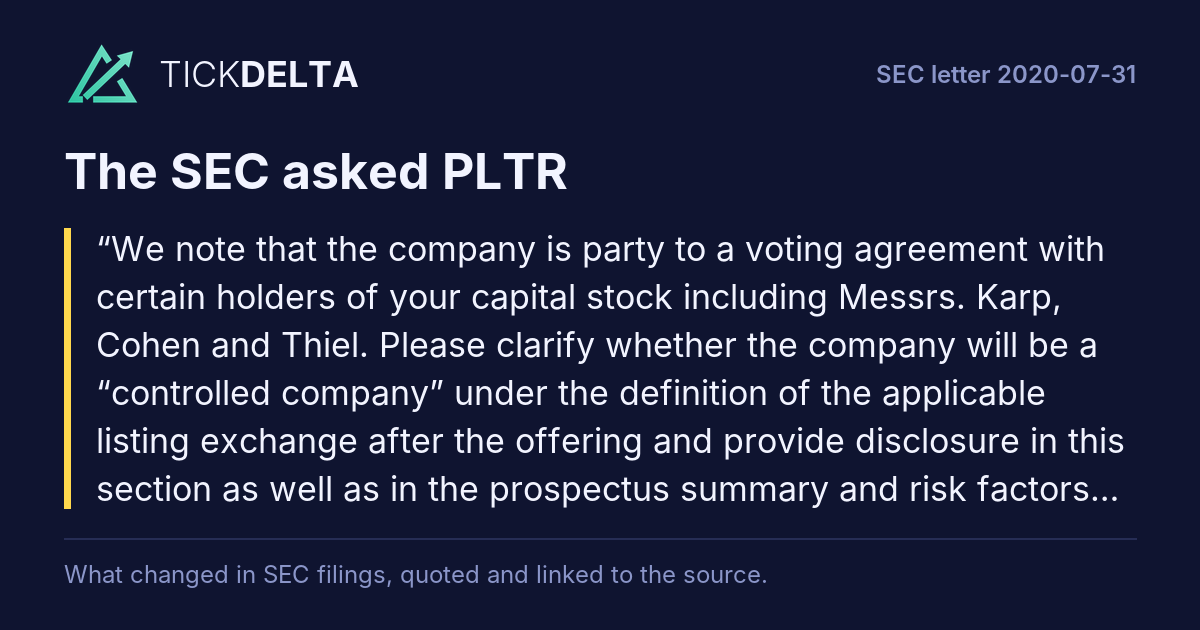
We note that the company is party to a voting agreement with certain holders of your capital stock including Messrs. Karp, Cohen and Thiel. Please clarify whether the company will be a “controlled company” under the definition of the applicable listing exchange after the offering and provide disclosure in this section as well as in the prospectus summary and risk factors sections, to the extent appropriate.
Rest of the question

Prospectus Summary, page 1

PLTR answered

No reply letter found.

Cover Page
SEC asked (2)
Please add disclosure regarding the redemptions of the Series H preferred stock. Competitive Strengths, page 6
PLTR answered

No reply letter found.

Cover Page
SEC asked (3)
We note your disclosure that your top twenty customers have been with you for an average of 6.6 years. For context, please disclose the average length of time your top three customers, which accounted for 28% of your revenue in 2019, have been with you.
PLTR answered

No reply letter found.

Risk Factors Summary, page 7
SEC asked (4)
Please clarify your statement that a limited number of customers account for a substantial portion of your revenue to disclose that three customers accounted for 28% of your revenue in 2019.
PLTR answered

No reply letter found.

Risks Related to Our Business and Industry · The recent global COVID-19 outbreak…, page 34
SEC asked (5)
Please provide examples of the negative headwinds you reference in this risk factor. We have contracts with governments…, page 39
PLTR answered

No reply letter found.

Risks Related to Our Business and Industry · The recent global COVID-19 outbreak…, page 34
SEC asked (6)
Please quantify the portion of your revenues that are subject to security restrictions. Our debt agreements contain restrictions…, page 55
PLTR answered

No reply letter found.

Risks Related to Our Business and Industry · The recent global COVID-19 outbreak…, page 34
SEC asked (7)
Please clarify the extent to which your credit facility is secured by substantially all of your assets.
PLTR answered

No reply letter found.

Risks Related to Ownership of Our Common Stock · Delaware law and provisions in our amended and restated certificate of incorporation…, page 67
SEC asked (8)
Please clarify your statement that your executive officers and directors will have the ability to significantly influence the outcome of matters requiring shareholder approval to disclose that they will have the ability to control the outcome of these matters.
PLTR answered

No reply letter found.

Management’s Discussion and Analysis of Financial Condition and Results of Operations · Overview, page 79
SEC asked (9)
Your risk factor disclosure on page 14 identifies the importance of existing customers renewing their contracts with you. Please disclose your retention rates for the periods presented and discuss any trends in retention rates for your services.
PLTR answered

No reply letter found.

Management’s Discussion and Analysis of Financial Condition and Results of Operations · Overview, page 79
SEC asked (10)
Please disclose the number of customers and average revenue from your top twenty customers for the periods presented and tell us whether your customer count includes customers in the acquire phase from whom you have yet to generate revenue. Our Business Model, page 80
PLTR answered

No reply letter found.

Management’s Discussion and Analysis of Financial Condition and Results of Operations · Overview, page 79
SEC asked (11)
Please revise to address the following: • Quantify the amount of customer acquisition and expansion related expenses recorded within cost of revenue and within sales and marketing expense; • Describe the criteria used to determine where costs for the acquire phase and the expand phase should be recorded in your Statement of Operations; and • Quantify the number of customers according to their phase (acquire, expand
Rest of the question

and scale) as of the most recent period end.

PLTR answered

No reply letter found.

Management’s Discussion and Analysis of Financial Condition and Results of Operations · Overview, page 79
SEC asked (12)
Based upon your Non-GAAP disclosures on page 170, it appears that contribution margin includes all sales and marketing expenses except stock-based compensation. Additionally, your draft disclosures on page 81 suggest that you are able to calculate contribution margin at the customer level. Please revise to explain how you allocate general sales and marketing expenses to contribution margin at the customer level.
PLTR answered

No reply letter found.

Significant Impacts of Stock-Based Compensation, page 94
SEC asked (13)
Due to the significant amount of stock-based compensation that will be recognized once the RSUs performance condition is met (i.e. upon a completion of a public listing), please move this disclosure to a more prominent position within your MD&A.
Rest of the question

For example, it could be disclosed as part of the results of operations on page 84 as a matter that could materially impact future operating performance trends or part of your discussion about key factors affecting performance on page 81. Please also revise to disclose any material assumptions used in calculating the additional stock-based compensation expense figure. Business, page 100

PLTR answered

No reply letter found.

Significant Impacts of Stock-Based Compensation, page 94
SEC asked (14)
We note that one of your commercial customers represented 15% and 12% of total revenue in 2018 and 2019, respectively. Please identify this customer and disclose the material terms of your agreement with this customer. Refer to Item 101(c)(1)(vii) of Regulation S-K.
PLTR answered

No reply letter found.

Market Opportunity, page 116
SEC asked (15)
Please disclose the third-party industry sources cited in this section. Management, page 130
PLTR answered

No reply letter found.

Market Opportunity, page 116
SEC asked (16)
Please provide the information required by Item 407 of Regulation S-K with respect to your audit committee, nominating committee and compensation committee.
PLTR answered

No reply letter found.

Certain Relationships and Related Party Transactions · Voting Agreement, page 146
SEC asked (17)
Please revise to describe all matters for which the parties to the voting agreement have agreed to vote their shares. Also, file the voting agreement and the agreement with Piazza Technologies Inc. as exhibits to your registration statement. Refer to Item 601(b)(10)(ii)(A) of Regulation S-K.
PLTR answered

No reply letter found.

Plan of Distribution, page 167
SEC asked (18)
We note that the performance-based vesting condition for your outstanding RSUs includes a public listing and the disclosure on page 150 that the public listing will result in “the vesting and settlement” of a certain number of RSUs. Please advise as to any coordination with these RSU holders to facilitate the sale of the underlying stock on Day 1 of your public listing.
PLTR answered

No reply letter found.

Non-GAAP Financial Measure, page 170
SEC asked (19)
Since you identify contribution margin as a key business and non-GAAP measure on page 11 and elsewhere, please revise to move this reconciliation to a more prominent position within the filing. For example, consider disclosing this information as part of your Management's Discussion and Analysis of Financial Condition and Results of Operations, beginning on page 79. Audited Consolidated Financial Statements 2.
Rest of the question

Significant Accounting Policies, page F-10

PLTR answered

No reply letter found.

Non-GAAP Financial Measure, page 170
SEC asked (20)
Please revise to disclose your accounting policies for sales and marketing expenses.
PLTR answered

No reply letter found.

Non-GAAP Financial Measure, page 170
SEC asked (21)
Please disclose your accounting policies with respect to incremental costs of obtaining a contract with a customer and costs incurred to fulfill a contract with a customer, and advise us. Refer to the guidance in ASC 340-40. 8. Commitments and Contingencies
PLTR answered

No reply letter found.

Contingent Compensation, page F-30
SEC asked (22)
We note that an IPO is an event that could trigger a payment under the retention plan. Please confirm, if true, that a direct listing is not considered an event that could trigger payments under the retention plan.
PLTR answered

No reply letter found.

General
SEC asked (23)
Please supplementally provide us with copies of all written communications, as defined in Rule 405 under the Securities Act, that you, or anyone authorized to do so on your behalf, present to potential investors in reliance on Section 5(d) of the Securities Act, whether or not they retain copies of the communications.
PLTR answered

No reply letter found.

General
SEC asked (24)
We note that you have not provided the location/address of your principal place of business anywhere in the filing. Please advise.
PLTR answered

No reply letter found.

General
SEC asked (25)
Please clarify whether the “brokerage transactions” referenced on the cover page are intended to be effected solely in accordance with the representations and terms set forth in the Spotify Technology N.A. no-action letter (Mar.
Rest of the question

23, 2018) (the “Spotify Letter”) or otherwise consistent with Regulation M – i.e., ordinary brokerage transactions made into an “independent market” (one not dominated or controlled by the Company/financial advisors/Registered Stockholders., and without the presence of any special selling efforts or selling methods) on the NYSE at prevailing market prices.

PLTR answered

No reply letter found.

General
SEC asked (26)
Please consider either revising or deleting the statement on page 60, which currently reads, “Additionally, because there are no underwriters, there is no underwriters’ option to purchase additional shares to help stabilize, maintain or affect the public price of our Class A common stock on the NYSE immediately after the listing” as it implies an intent to engage in unlawful price manipulation.
PLTR answered

No reply letter found.

General
SEC asked (27)
Please note that any possible selling activity by the Registered Stockholders where there is excessive compensation (i.e., “...or commissions as to particular broker-dealers may be in excess of those customary in the types of transactions involved” as stated on page 168) to be paid to broker-dealers to facilitate such selling would appear to be inconsistent with the second bullet point representation set forth in
Rest of the question

the Spotify Letter, i.e., the requirement that the ordinary brokerage transactions by the Registered Shareholders be made into an “independent market” (i.e., one not dominated or controlled by the Company/financial advisors/Registered Stockholders, and without the presence of any special selling efforts/selling methods). Please revise accordingly or, alternatively, explain how the Company/financial advisors/Registered Stockholders intend to comply with the trading restrictions in Regulation M in light of their inability to rely on the Spotify Letter.

PLTR answered

No reply letter found.

General
SEC asked (28)
Please specify when (i.e., the timing/number of days before the Opening Time) the Company and its financial advisors intend to engage in the investor-related/roadshow-like activities that are described on page 61 of the prospectus.
PLTR answered

No reply letter found.

General
SEC asked (29)
Please explain whether the sentence on page 61 of the prospectus, which currently reads, “Moreover, consistent with Regulation M and other federal securities laws applicable to our listing, we have not consulted with Registered Stockholders or other existing stockholders regarding their desire or plans to sell shares in the public market following the listing or discussed with potential investors their intentions to
Rest of the question

buy our Class A common stock in the open market,” is intended to refer to and be consistent with the representations/conditions set forth in the Spotify Letter. If the Company/financial advisor (Morgan Stanley)/Registered Stockholders, etc. intend to rely on the Spotify Letter, please explain how the disclosure, for example, on page 167 in the Plan of Distribution section (fourth paragraph), which currently reads, “Morgan Stanley is expected to provide input to the DMM...pre-listing selling and buying interest in our Class A common stock that it becomes aware of from potential investors and holders of our Class A common stock, including after consultation with certain institutional investors (which may include certain of the Registered Stockholders...),” is consistent with the representations/conditions set forth in the Spotify Letter.

PLTR answered

No reply letter found.

General
SEC asked (30)
Please clarify your disclosure on pages 61 and 168 where you state, “We have engaged Morgan Stanley...as our financial advisor. There will be no book building process..." to state that the financial advisor will not generate and record buying interest at various price ranges prior to the Opening.
Rest of the question

As the financial advisor will not engage in any “book building,” please also explain the intended scope of such “financial advisor’s consultation(s) with institutional investors,” described on those pages. Further, we note your statement on page 61 that you plan to hold an investor day. Please provide additional language to clarify whether there will be a single investor day prior to listing, or if there could be follow-up investor days. Moreover, on page 61 you state that you will “engage in certain other investor education meetings.” Please clarify the intended scope of these meetings, including whether they are follow-up meetings to answer any investors’ questions about information provided at main investor day meeting, or something more.

PLTR answered

No reply letter found.

General
SEC asked (31)
Please consider revising your references on page 167 to “orderly market” to “orderly opening” in light of your intention to engage in a direct listing. Alternatively, please specify which of the NYSE direct listing rules the Company is relying on with respect to its statement that “[t]he DMM, acting pursuant to its obligations under the rules of the NYSE, is responsible for facilitating an orderly market for our
Rest of the question

Class A common stock” as the term “market” could include the “aftermarket” period as well.

PLTR answered

No reply letter found.

SEC asked (1)
Please revise the third full paragraph on page 2 to provide more context to your statements about the growth of your revenue overtime. For example, consider disclosing your average revenue per customer and average revenue for your top twenty customers for 2018 so that investors can compare them to the figures you provide for 2019.
PLTR answered
to the Staff’s comment, the Company has revised the disclosure on page 2 of the Registration

Statement to disclose its average revenue per customer and average revenue from its top twenty customers in 2018. Read in the reply ↗
SEC asked (2)
We note your response to prior comment 1. We continue to believe that the summary section should be balanced to include a discussion of the substantial payments to your existing stockholders related to the redemptions of the Series H preferred stock. Please revise. Risk Factors Following our listing, sales of substantial amounts of our Class A common stock in the public markets or the perception...., page 67
PLTR answered
to the Staff’s comment, the Company has revised the disclosure on page 2 of the Registration Statement to disclose the amounts paid in redemption of the Company’s Series H redeemable convertible preferred stock in 2019.

Risk Factors

Following our listing, sales of substantial amounts of our Class A common stock in the public markets or the perception...., page 67 Read in the reply ↗
SEC asked (3)
We note your response to prior comment 18. Disclose if the company intends on sharing a fair value estimate of the class A common stock with the RSU holders who plan to sell shares on Day 1 of trading so that they may plan on how many shares they would have to sell in order to cover their anticipated tax liability. If so, please disclose this fair value determination.
PLTR answered
The Company respectfully advises the Staff that RSU holders who plan to sell shares on Day 1 of trading will not receive a fair value estimate of the class A common stock prior to such time. The number of shares that will need to be sold to cover the tax withholding and remittance obligations of RSU holders will be a function of the number of shares that will vest and settle in connection with the public listing and the RSU holder’s applicable tax rate.
Rest of the answer

The tax liability will be determined based on the average sales price of all such shares that are sold on the first trading day and as a result, will not be determinable until the close of trading on that day.

Read in the reply ↗
Management's Discussion and Analysis of Financial Condition and Results of Operations · Our Business Model, page 86
SEC asked (4)
We note your responses to prior comments 11 and 12. Please disclose, either here or on page 91, how you determine contribution margin by customer. For example, as noted in your response, please address how you allocate sales and marketing and cost of sales expenses that are not specific to a customer account.
PLTR answered
to the Staff’s comment, the Company has revised the disclosure on pages 95 to 96 of the

Registration Statement to disclose the method by which contribution margin by customer is calculated. Read in the reply ↗
Audited Financial Statements · Consolidated Balance Sheets, page F-3
SEC asked (5)
Please present a pro forma balance sheet alongside your most recent historic balance sheet to give effect to the Capital Stock Conversion and all other changes in capitalization that will occur in connection with your direct listing on the NYSE as described on page 77. General
PLTR answered
to the Staff’s comment, the Company has revised the disclosure on pages F-3 to F-4 of the Registration Statement to include a pro forma balance sheet that gives effect to the Capital Stock Conversion and all other changes in capitalization that will occur in connection with the Company’s direct listing on the NYSE. Read in the reply ↗
Audited Financial Statements · Consolidated Balance Sheets, page F-3
SEC asked (6)
We have reviewed but are unable to agree with your responses to prior comments 29 and 30 regarding the scope and application of the March 23, 2018 no-action letter for Spotify Technology, S.A. However, there may be other ways to ensure compliance with Regulation M, depending on the specific facts and circumstances.
Rest of the question

For example, from our discussion on this matter, we understand that you have represented that the relevant parties (including any persons acting on behalf of such parties) each will endeavor to conduct their activities in a manner that will not violate Regulation M or the other antimanipulation and antifraud provisions, such as sections 9(a) and 10(b), or Rule 10b-5.

PLTR answered
The Company respectfully acknowledges the Staff’s Comment. The Company acknowledges that the Staff disagrees with the Company’s responses to comments 29 and 30 in the Staff’s letter dated July 31, 2020 that the activities described in such responses would be “in accordance with the representations and terms set forth in” the

Spotify Technology, S.A. no-action letter (Mar. 23, 2018) (the “Spotify Letter”). However, as further acknowledged by the Staff, compliance with the Spotify Letter is not required.
Rest of the answer

Rather, as the Staff indicates in this Comment, the Company will endeavor, and it is the Company’s understanding that its financial advisors and any affiliated persons each will endeavor, to conduct their activities in a manner that will not violate the applicable provisions of Regulation M (to the extent that Regulation M applies to such activities) or the other anti-manipulation and antifraud provisions of the U.S. securities laws, including, for example, Sections 9(a) and 10(b) of the Securities

Exchange Act of 1934, as amended, and Rule 10b-5 thereunder.

Read in the reply ↗
Risks Related to Ownership of Our Class A Common Stock · Our amended and restated bylaws..., page 68
SEC asked
We note that your forum selection provision identifies a federal or state court located within the State of Delaware as the exclusive forum for certain litigation. Please disclose whether this provision applies to actions arising under the Exchange Act.
Rest of the question

Please also state that there is uncertainty as to whether a court would enforce such provision and state that investors cannot waive compliance with the federal securities laws and the rules and regulations thereunder. In that regard, we note that Section 22 of the Securities Act creates concurrent jurisdiction for federal and state courts over all suits brought to enforce any duty or liability created by the Securities Act or the rules and regulations thereunder.

PLTR answered
The Company has revised the disclosure on page 68 of the Registration Statement to address the Staff’s comment. Read in the reply ↗
SEC letter of 2020-09-22 ↗ no reply letter on EDGAR (the company may have answered in an amended filing)
Cover Page
SEC asked (1)
Please clarify that the Voting Agreement permits the Founders to control 86.58% of the voting power if they agree to designate their holdings as Stockholder Party Excluded Shares.
PLTR answered

No reply letter found.

Prospectus Summary, page 1
SEC asked (2)
Please revise the table on page 10 to make clear in each scenario that in addition to withdrawing or being removed from the Founders Agreement it also covers the scenario where each Founders’ shares are designated Stockholder Party Excluded Shares.
PLTR answered

No reply letter found.

Risk Factors · The Ownership Threshold that must be met on any applicable record date..., page 80
SEC asked (3)
Please revise this risk factor to clarify that due to the broad definition of Corporation Equity Securities, the Company may issue a new class of stock worth only a nominal amount, and thereby allow any remaining Founder to have a nominal economic interest in the Company yet still maintain control over any voting decisions.
PLTR answered

No reply letter found.

Principal and Registered Stockholders, page 211
SEC asked (4)
Please add a footnote to the Founders total voting interest stating that if all the Founders are in agreement they control 86.58% of the voting power.
PLTR answered

No reply letter found.

SEC letter of 2020-09-22 ↗ no reply letter on EDGAR (the company may have answered in an amended filing)
Cover Page
SEC asked (1)
Please disclose the current voting power of the Class A common stock holders. Prospectus Summary, page 1
PLTR answered

No reply letter found.

Cover Page
SEC asked (2)
Please clarify whether the process of designating shares as Stockholder Party Excluded Shares only applies to Class A or Class B acquired in the future or to existing holdings currently subject to the Voting Agreement.
PLTR answered

No reply letter found.

Cover Page
SEC asked (3)
Please clarify whether the Stockholder Party Excluded Shares could be Corporation Equity Securities that the Founders currently own or only securities they acquire in the future. Please add a column to the table on pages 9-10 that shows the approximate ownership threshold percentage of the total amount of securities outstanding as this disclosure is material to understanding how small these amounts are compared to
Rest of the question

your total equity.

PLTR answered

No reply letter found.

Cover Page
SEC asked (4)
Please disclose that you are employing a novel capital structure with three classes of common stock and that your capital structure is novel because it permits your Founders to maintain a controlling interest in the Company even if they significantly decrease their economic stake in the Company. Further, clarify why the Company has chosen this novel and complex “tricapital” structure.
Rest of the question

In this regard, we note your statement at the bottom of page 8 that the multi-class structure was employed to provide stability in the composition of the Board and to maintain your existing founder control structure which could presumably have been accomplished using a traditional dual class structure. Risk Factors, page 17

PLTR answered

No reply letter found.

Cover Page
SEC asked (5)
Please add a separate risk factor that specifically illustrates the risk that if the company issues additional Class A common stock in the future, Class A common stockholders will have their voting power diluted to a greater extent than the Founders’ as a result of the Class F common shares.
Rest of the question

Please disclose that it may be very difficult for the Class A common stock holders to ever determine their voting power because of the unique features of your capital structure, in particular the variable voting rights of the Class F and the ability of the Founders to unilaterally adjust their total voting power through the process of designating shares as Stockholder Party Excluded Shares. Risks Related to the Multiple Class Structure of our Common Stock... The Ownership Threshold that must be met on any applicable record date..., page 78

PLTR answered

No reply letter found.

Cover Page
SEC asked (6)
Please revise this risk factor to disclose that the definition of “Corporation Equity Securities” is very broad and the Company could potentially take steps in the future to effectively decrease the Ownership Threshold.
Rest of the question

For example, we note the potential for the creation of a new class of non-voting equity security that could qualify as Corporation Equity Security and count towards the Ownership Threshold if held by the Founders which would further increase the divergence between their economic power and voting power.

PLTR answered

No reply letter found.

Description of Capital Stock, page 215
SEC asked (7)
We note your amended and restated certificate of incorporation provides for permitted transfer of your Class B common stock that do not result in the automatic conversion of these shares into Class A common stock. Please clarify and include additional disclosure to the extent that these transfers could have any intended or unintended consequences different than in a typical dual class structure.
PLTR answered

No reply letter found.

Plan of Distribution, page 239
SEC asked (8)
Please disclose that the Founders will not be involved in the DMM’s process to establish the opening public price, including any decision regarding the timing of the opening trade.
PLTR answered

No reply letter found.

Plan of Distribution, page 239
SEC asked (9)
Please revise to disclose that the Company and the financial advisors will conduct their activities consistent with the requirements of Regulation M.
PLTR answered

No reply letter found.

Cover Page
SEC asked (1)
Please clearly state that the company’s capital structure involving the Class F shares differs from the typical multi-class capital structure. Elsewhere in the prospectus, provide a discussion of the key differences between the variable voting stock and a typical multiclass structure and the objectives of using the Class F arrangement.
Rest of the question

For example, the fact that the Founders can sell a significant portion of their underlying shares and still maintain their 49.999999% voting power appears to be a significant difference from a typical multiclass structure.

PLTR answered
On behalf of our client, Palantir Technologies Inc. (“Palantir” or the “Company”), we submit this letter in response to comments from the staff (the “Staff”) of the Securities and Exchange Commission (the “Commission”) contained in its letters dated September 22, 2020, relating to the above referenced Amendments

No. 3, 4 and 5 to Registration Statement on Form S-1. We are concurrently submitting via EDGAR this letter and have publicly filed Amendment No.
Rest of the answer

6 to Registration Statement on Form S-1 (the

“Registration Statement”).

The Company respectfully advises the Staff that it believes that each of the comments from the Staff has been addressed in the above-referenced Registration Statement.

*****

Page

Read in the reply ↗
Cover Page
SEC asked (2)
Please revise the sentence on the cover page that states the Founders may, in certain circumstances, have voting power that, in the aggregate, exceeds 49.999999% to clarify that such circumstances may occur in the future.
PLTR answered

No numbered answer found in the reply. Read the reply ↗

Prospectus Summary, page 1
SEC asked (3)
Please include an illustrative graph or table with specific scenarios of how control of the company could fluctuate and under what circumstances the Founders may increase their voting power above 49.999999%. Your disclosure should depict scenarios involving the operation of the Founder Voting Agreement and the Designated Founders’ Excluded Shares.
Rest of the question

Include disclosure about what happens when it disappears and the voting agreement dissolves. Provide examples.

PLTR answered

No numbered answer found in the reply. Read the reply ↗

Prospectus Summary, page 1
SEC asked (4)
With respect to the Corporate Equity Securities and the minimum threshold please provide an example of what happens if someone leaves based upon current numbers as the disclosure about ratable does not fully illustrate the impact if someone like Thiel leaves.
PLTR answered

No numbered answer found in the reply. Read the reply ↗

Prospectus Summary, page 1
SEC asked (5)
Please disclose that you are employing a novel capital structure with three classes of common stock.
PLTR answered

No numbered answer found in the reply. Read the reply ↗

Risk Factors, page 16
SEC asked (6)
Please add a separate section on risks of the Class F shares and your multi-class structure. Please revise the risk factors that address multiple risks to describe those risks in separate risk factors.
PLTR answered

No numbered answer found in the reply. Read the reply ↗

Risk Factors, page 16
SEC asked (7)
Provide a risk factor that thoroughly addresses the potential risks and conflicts of interest presented by the ability of the Founders to retain 49.9% of the voting power while reducing, potentially significantly, their economic interest in the company’s shares.
PLTR answered

No numbered answer found in the reply. Read the reply ↗

Risk Factors, page 16
SEC asked (8)
Provide a risk factor that thoroughly addresses the potential risks and conflicts of interest
PLTR answered

No numbered answer found in the reply. Read the reply ↗

Risk Factors, page 16
SEC asked (9)
Please add a statement that the issuance of additional shares will cause the Founder’s voting interest to increase and further dilute the voting interest of other shares and provide an example. Also, disclose that issuing new shares dilutes existing holders more than in a typical dual class structure.
PLTR answered

No numbered answer found in the reply. Read the reply ↗

Risks Related to Ownership of Our Class A Common Stock · As a result of future issuances of our common stock..., page 77
SEC asked (10)
Please revise the disclosure in this risk factor to clearly identify the number of shares by your Founders and their affiliates that will be available for resale on the first day of trading.
PLTR answered

No numbered answer found in the reply. Read the reply ↗

Principal and Registered Stockholders, page 205
SEC asked (11)
Please revise the beneficial ownership table to show the total voting power of all executive officers and directors as a group at 50.8%, Founders at 49.9% including the Class F and 37.9% without the Class F and Mr. Thiel at 13.4%.
PLTR answered

No numbered answer found in the reply. Read the reply ↗

Description of Capital Stock, page 211
SEC asked (12)
Clarify the following aspects of the Class F shares and voting arrangements, providing quantitative examples where possible. • Clarify how a Founder’s additional acquisitions of securities will impact its total voting power. For instance, may a Founder vote any newly acquired shares such that the Founders’ total voting power will exceed 49.9%?
Rest of the question

• Disclose the number of shares that the Founders and Approved Affiliates hold in relation to the minimum ownership threshold of 100 million Corporation Equity Securities, or explain how many shares the Founders and Approved Affiliates would need to divest to convert the Class F shares into only having 10 votes per share. Also, clearly describe the formula for determining the number of Corporation Equity Securities and the Ownership Threshold under the various scenarios listed on page 212. • Clearly state that the 14% of voting power represented by Mr. Thiel’s Excluded Shares effectively operates as a partial veto on the votes cast by the other two Founders. Explain that in the event Mr. Thiel provides voting instructions that are contrary to those provided by the other Founders, 14% of the voting power will be cast in accordance with Mr. Thiel’s instructions and the remaining 35.9% will be voted in accordance with the other Founders’ voting instructions. Also make clear, if true, that any Excluded Shares will not result in the Founders’ having voting power that exceeds 49.9%. • Quantify how the economic ownership of the Founders and their affiliates differs from their voting power.

PLTR answered

No numbered answer found in the reply. Read the reply ↗

Anti-Takover Provisions, page 218
SEC asked (13)
Disclose the potential anti-takeover effect of the provision in the Founder Voting Agreement that allows for any founder to withdraw from the agreement unilaterally and at any time. For example, disclose that the founders may elect to accumulate additional control of the company by having one or two founders withdraw from the Founder Voting Agreement and then aggregating those founders’ shares with the remaining
Rest of the question

49.999999% voting power derived from the Class F shares. Please also supplement your risk factor discussion with this disclosure.

PLTR answered

No numbered answer found in the reply. Read the reply ↗

Plan of Distribution, page 234
SEC asked (14)
Please revise to disclose that the Company and the financial advisors will conduct activities consistent with the requirements of Regulation M.
PLTR answered

No numbered answer found in the reply. Read the reply ↗

Exhibits
SEC asked (15)
Please file the voting trust agreement as an exhibit to your registration statement.
PLTR answered

No numbered answer found in the reply. Read the reply ↗

Also in this review: company letter, 2020-09-14, company letter, 2020-09-22

1 other letter: notices that a filing will not be reviewed, requests to declare a registration effective, and the like
  • 2020-09-22 · SEC: letter · Palantir Technologies Inc. · Amendment No. 3 to Registration Statement on Form S-1 ·...

From the SEC's correspondence on EDGAR: staff letters (form UPLOAD) and company letters (form CORRESP), 16 letters filed since 2020-07-31. Questions and answers are matched by their numbers; topics come from words in each question. The reports are compared word for word (same form, before the first SEC letter against the first report after the company's reply). No AI.

Work on PLTR in a spreadsheet: Excel workbook (a sheet per section, ten years by column, charts, links to the filings) · CSV. For a Google Sheet that stays up to date, paste =IMPORTDATA("https://tickdelta.com/company/PLTR/export.csv") into a cell.