Paragraph 28 · 40% changed
Every version of it
Screener
/
SEC EDGAR
/CIK 0001022408
/10-K filed May 28, 2026, compared with May 22, 2025
/Numbers from the XBRL of the 10-Ks
Nasdaq
Industrials · Computers & Peripheral Equipment & Software
Eplus Inc PLUS
The 10-K against last year's
168 changes: 17 added, 36 removed, 113 reworded, 2 quiet changes
10-K May 28, 2026 vs May 22, 2025
Risk Factors
12.8%
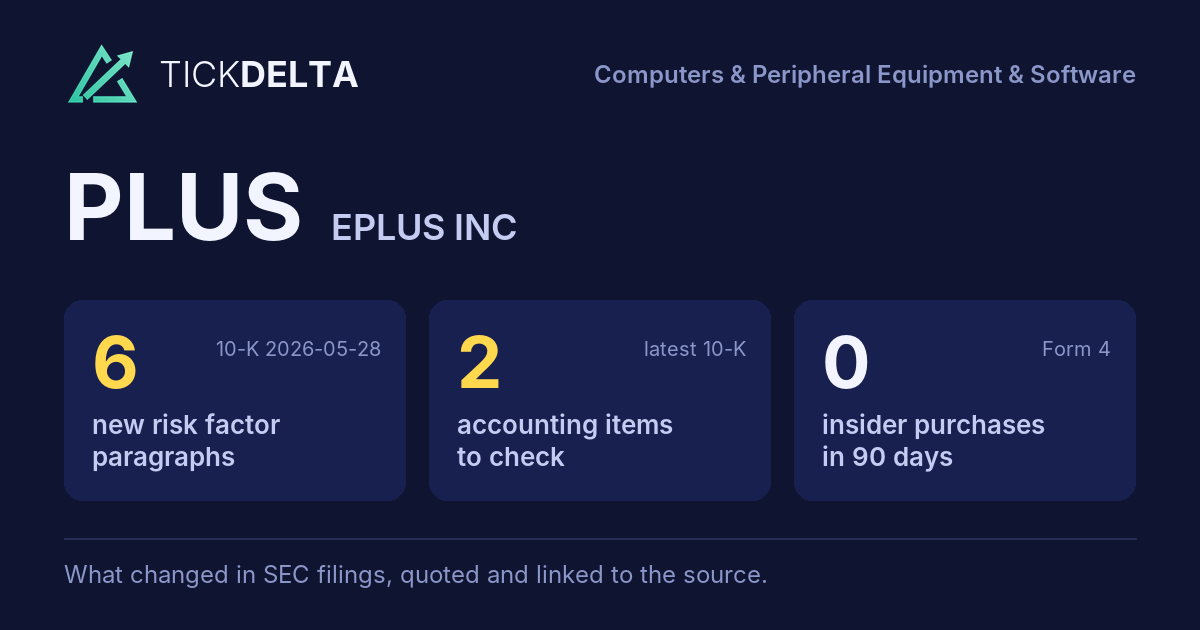
of the text changed · 9,027 words now · 6 new paragraphs, 10 gone
MD&A
35.9%
of the text changed · 8,899 words now · 11 new paragraphs, 26 gone
Legal Proceedings
0.0%
of the text changed · 205 words now
Accounting Policies
15.6%
of the text changed · 4,231 words now
10-K 0001140361-26-023171 (May 28, 2026) vs 10-K 0001140361-25-020204 (May 22, 2025)
Every paragraph, and how much of it changed
One bar per paragraph, in the order of the 10-K. Height and colour show the share of its words not in the closest paragraph a year earlier; the tallest bars are new paragraphs.
Risk Factors
95 paragraphs · 6 new · 33 reworded · 10 gone · 10-K May 28, 2026 against May 22, 2025
New paragraph
Reworded (5% of its words or more)
Same or nearly
Paragraph 90 · 33% changed
Every version of it
There can be no assurance that we will continue to repurchase any of declare and pay dividends to our common stock under our share repurchase program. stockholders.
Paragraph 13 · 18% changed
Every version of it
As we do not stock inventory that is not related to an order we have received from our customers, we depend upon the supply of products available from our vendors to fulfill orders from our customers on a timely basis. Supply chain issues, including a shortage of IT products and available services, may increase prices and affect demand by our customers.
Paragraph 72 · 18% changed
Every version of it
Our contracts may not protect us against the risks inherent in our business including, but not limited to, rapid price increases and resulting order cancellations, warranties, limitations of liability, indemnification obligations, human resources and subcontractor-related claims, patent and product liability, regulatory and compliance obligations, data security and privacy, and financing activities. Also, we face pressure from our customers for competitive pricing and contract terms. In addition, order cancellations by our customers may result from product constraints, or other economic concerns. While we may mitigate risk through our contracts, if orders are cancelled by our customers, we may have an increased risk of dispute resulting in non-payment. Such disputes may be complicated by novel legal arguments relating to contract enforceability, such as the application of force majeure, impossibility or impracticability of performance, and frustration of purpose. Despite the non-recourse nature of the loans financing certain of our activities, non-recourse lenders may file suit if the underlying transaction turns out poorly for the lenders. We are currently experiencing an increase in federal contract terminations, some arising from the mission of the DOGE. While most of these contracts were sold to a lender, we may be subject to claims and the cost of defending such claims due to the nature of our business.
Paragraph 1 · 17% changed
Every version of it
Many factors could adversely affect our business, results of operations and cash flows, some of which are beyond our control. The following is a description of some important factors that may cause our business prospects, results of operations and cash flows in future periods to differ materially from those currently expected or desired. References to past events are provided by way of example only and are not intended to be a complete listing or a representation as to whether or not such factors have occurred in the past or their likelihood of occurring in the future. Factors not currently known to us or that we currently deem to be immaterial may also materially and adversely affect our business, results of operations and cash flows.
Paragraph 11 · 13% changed
Every version of it
A substantial portion of our revenue within our technology business segments depends on a small number of key vendors. Products manufactured by Cisco Systems represented approximately 29%, 32%, 44%, and 40% 44% of net sales of our combined technology business segments for the years ended March 31, 2026, 2025, and 2024, and 2023, respectively. Products manufactured by NetApp, Hewlett Packard Enterprise, Juniper Networks, Dell EMC, Dell, and Arista Networks, collectively represented approximately 23% to 25% 28% of net sales of our combined technology business segments for the last three years. We may also be adversely affected by consolidation among our vendors, such as Hewlett Packard Enterprise’s proposed acquisition of Juniper Networks. vendors.
Paragraph 43 · 11% changed
Every version of it
We depend heavily upon the accuracy and reliability of our IT, telecommunication, cybersecurity, and other platforms which are used for customer management, sales, distribution, marketing, purchasing, inventory management, order processing and fulfillment, customer service and general accounting functions. We must continually maintain, secure, and improve our systems. We may not properly select or implement software which may result in the lack of data integrity within or between systems, increase our costs or impair our control environment or may lead to other negative impacts on our business or results. We may need to implement new software, or update existing software and processes, to be compliant with rapidly evolving regulation, regulations, including data privacy laws, which may incur costs and impact data integrity. As we increasingly rely on cloud-based enterprise applications to support critical business functions, our operational performance depends in part on the availability, reliability, and proper integration of these externally hosted systems. The protections we have in place address a variety of threats to our information technology systems, both internal and external, including human error. Inadequate security practices or design of our IT systems, or IT systems from third parties which we utilize, or third-party service providers’ failure to provide adequate services could result in the disclosure of sensitive or confidential information or personal information or cause other business interruptions that could damage our reputation and disrupt our business. Inadequate design or interruption of our information systems, telecommunications systems or power failures could have a material adverse effect on our business, our reputation, financial condition, cash flows, or results of operations. The current product constraints may increase our costs or cause a delay in purchasing IT products needed to support our internal infrastructure or operations, resulting in an impact on our technology operations and availability of our IT systems, which could result in an adverse effect on our operations and financial results.
Paragraph 68 · 11% changed
Every version of it
Cloud offerings may influence our customers to move workloads to cloud providers, which may reduce the procurement of products and alter or reduce services from us. Changes in the IT industry may also affect the demand for our advanced professional and managed services. These ‘as a service’ offerings in many cases are recorded on a net basis which results in a reduction of net sales and an increase in gross margin, or on a ratable basis. Over the past several years, we have seen a significant increase in gross billings recorded on a net basis and a ratable basis due to the industry shift to ‘as a service’ offerings. In addition, these ‘as a service’ offerings that are billed over time decrease the demand for financing these types of transactions and do not provide post contract revenue opportunities due to the intangible nature of the offering as well as similar other software offerings. We have invested a significant amount of capital in our strategy to provide certain products and services, and this strategy may adversely impact our financial position due to competition or changes in the industry or improper focus or selection of the products and services we decide to offer. If we fail to react in a timely manner to such changes, such as generative AI, AI or insufficient memory capacity, our results of operations may be adversely affected. Our sales can be dependent on demand for specific product categories, and any change in demand for, or supply of, such products could have a material adverse effect on our results of operations.
Paragraph 28 · 40% changed
Every version of it
10-K May 22, 2025We depend on having creditworthy customers to avoid an adverse impact on our operating results and financial condition.
10-K May 28, 2026
Any financial losses of our customers that inhibit their ability to pay us may have an adverse impact on our operating results and financial condition.
Paragraph 90 · 33% changed
Every version of it
10-K May 22, 2025
There can be no assurance that we will continue to repurchase any of our common stock under our share repurchase program.
10-K May 28, 2026
There can be no assurance that we will continue to declare and pay dividends to our common stockholders.
Paragraph 13 · 18% changed
Every version of it
10-K May 22, 2025
As we do not stock inventory that is not related to an order we have received from our customers, we depend upon the supply of products available from our vendors to fulfill orders from our customers on a timely basis.
10-K May 28, 2026
As we do not stock inventory that is not related to an order we have received from our customers, we depend upon the supply of products available from our vendors to fulfill orders from our customers on a timely basis. Supply chain issues, including a shortage of IT products and available services, may increase prices and affect demand by our customers.
Paragraph 72 · 18% changed
Every version of it
10-K May 22, 2025
Our contracts may not protect us against the risks inherent in our business including, but not limited to, warranties, limitations of liability, indemnification obligations, human resources and subcontractor-related claims, patent and product liability, regulatory and compliance obligations, data security and privacy, and financing activities. Also, we face pressure from our customers for competitive pricing and contract terms. In addition, order cancellations by our customers may result from product constraints, or other economic concerns. While we may mitigate risk through our contracts, if orders are cancelled by our customers, we may have an increased risk of dispute resulting in non-payment. Such disputes may be complicated by novel legal arguments relating to contract enforceability, such as the application of force majeure, impossibility or impracticability of performance, and frustration of purpose. Despite the non-recourse nature of the loans financing certain of our activities, non-recourse lenders may file suit if the underlying transaction turns out poorly for the lenders. We are currently experiencing an increase in federal contract terminations, some arising from the mission of the DOGE. While most of these contracts were sold to a lender, we may be subject to claims and the cost of defending such claims due to the nature of our business.
10-K May 28, 2026
Our contracts may not protect us against the risks inherent in our business including, but not limited to, rapid price increases and resulting order cancellations, warranties, limitations of liability, indemnification obligations, human resources and subcontractor-related claims, patent and product liability, regulatory and compliance obligations, data security and privacy, and financing activities. Also, we face pressure from our customers for competitive pricing and contract terms. In addition, order cancellations by our customers may result from product constraints, or other economic concerns. While we may mitigate risk through our contracts, if orders are cancelled by our customers, we may have an increased risk of dispute resulting in non-payment. Such disputes may be complicated by novel legal arguments relating to contract enforceability, such as the application of force majeure, impossibility or impracticability of performance, and frustration of purpose.
Paragraph 1 · 17% changed
Every version of it
10-K May 22, 2025
Many factors could adversely affect our business, results of operations and cash flows, some of which are beyond our control. The following is a description of some important factors that may cause our business prospects, results of operations and cash flows in future periods to differ materially from those currently expected or desired. Factors not currently known to us or that we currently deem to be immaterial may also materially and adversely affect our business, results of operations and cash flows.
10-K May 28, 2026
Many factors could adversely affect our business, results of operations and cash flows, some of which are beyond our control. The following is a description of some important factors that may cause our business prospects, results of operations and cash flows in future periods to differ materially from those currently expected or desired. References to past events are provided by way of example only and are not intended to be a complete listing or a representation as to whether or not such factors have occurred in the past or their likelihood of occurring in the future. Factors not currently known to us or that we currently deem to be immaterial may also materially and adversely affect our business, results of operations and cash flows.
Paragraph 11 · 13% changed
Every version of it
10-K May 22, 2025
A substantial portion of our revenue within our technology business segments depends on a small number of key vendors. Products manufactured by Cisco Systems represented approximately 32%, 44%, and 40% of net sales of our combined technology business segments for the years ended March 31, 2025, 2024, and 2023, respectively. Products manufactured by NetApp, Hewlett Packard Enterprise, Juniper Networks, Dell EMC, and Arista Networks, collectively represented approximately 23% to 25% of net sales of our combined technology business segments for the last three years. We may also be adversely affected by consolidation among our vendors, such as Hewlett Packard Enterprise’s proposed acquisition of Juniper Networks.
10-K May 28, 2026
A substantial portion of our revenue depends on a small number of key vendors. Products manufactured by Cisco Systems represented approximately 29%, 32%, and 44% of net sales for the years ended March 31, 2026, 2025, and 2024, respectively. Products manufactured by NetApp, Hewlett Packard Enterprise, Juniper Networks, Dell, and Arista Networks, collectively represented approximately 23% to 28% of net sales for the last three years. We may also be adversely affected by consolidation among our vendors.
Paragraph 43 · 11% changed
Every version of it
10-K May 22, 2025
We depend heavily upon the accuracy and reliability of our IT, telecommunication, cybersecurity, and other platforms which are used for customer management, sales, distribution, marketing, purchasing, inventory management, order processing and fulfillment, customer service and general accounting functions. We must continually maintain, secure, and improve our systems. We may not properly select or implement software which may result in the lack of data integrity within or between systems, increase our costs or impair our control environment or may lead to other negative impacts on our business or results. We may need to implement new software, or update existing software and processes, to be compliant with rapidly evolving regulation, including data privacy laws, which may incur costs and impact data integrity. The protections we have in place address a variety of threats to our information technology systems, both internal and external, including human error. Inadequate security practices or design of our IT systems, or IT systems from third parties which we utilize, or third-party service providers’ failure to provide adequate services could result in the disclosure of sensitive or confidential information or personal information or cause other business interruptions that could damage our reputation and disrupt our business. Inadequate design or interruption of our information systems, telecommunications systems or power failures could have a material adverse effect on our business, our reputation, financial condition, cash flows, or results of operations.
10-K May 28, 2026
We depend heavily upon the accuracy and reliability of our IT, telecommunication, cybersecurity, and other platforms which are used for customer management, sales, distribution, marketing, purchasing, inventory management, order processing and fulfillment, customer service and general accounting functions. We must continually maintain, secure, and improve our systems. We may not properly select or implement software which may result in the lack of data integrity within or between systems, increase our costs or impair our control environment or may lead to other negative impacts on our business or results. We may need to implement new software, or update existing software and processes, to be compliant with rapidly evolving regulations, including data privacy laws, which may incur costs and impact data integrity. As we increasingly rely on cloud-based enterprise applications to support critical business functions, our operational performance depends in part on the availability, reliability, and proper integration of these externally hosted systems. The protections we have in place address a variety of threats to our information technology systems, both internal and external, including human error. Inadequate security practices or design of our IT systems, or IT systems from third parties which we utilize, or third-party service providers’ failure to provide adequate services could result in the disclosure of sensitive or confidential information or personal information or cause other business interruptions that could damage our reputation and disrupt our business. Inadequate design or interruption of our information systems, telecommunications systems or power failures could have a material adverse effect on our business, our reputation, financial condition, cash flows, or results of operations. The current product constraints may increase our costs or cause a delay in purchasing IT products needed to support our internal infrastructure or operations, resulting in an impact on our technology operations and availability of our IT systems, which could result in an adverse effect on our operations and financial results.
Paragraph 68 · 11% changed
Every version of it
10-K May 22, 2025
Cloud offerings may influence our customers to move workloads to cloud providers, which may reduce the procurement of products and services from us. Changes in the IT industry may also affect the demand for our advanced professional and managed services. These ‘as a service’ offerings in many cases are recorded on a net basis which results in a reduction of net sales and an increase in gross margin, or on a ratable basis. Over the past several years, we have seen a significant increase in gross billings recorded on a net basis and a ratable basis due to the industry shift to ‘as a service’ offerings. In addition, these ‘as a service’ offerings that are billed over time decrease the demand for financing these types of transactions and do not provide post contract revenue opportunities due to the intangible nature of the offering as well as similar other software offerings. We have invested a significant amount of capital in our strategy to provide certain products and services, and this strategy may adversely impact our financial position due to competition or changes in the industry or improper focus or selection of the products and services we decide to offer. If we fail to react in a timely manner to such changes, such as generative AI, our results of operations may be adversely affected. Our sales can be dependent on demand for specific product categories, and any change in demand for, or supply of, such products could have a material adverse effect on our results of operations.
10-K May 28, 2026
Cloud offerings may influence our customers to move workloads to cloud providers, which may reduce the procurement of products and alter or reduce services from us. Changes in the IT industry may also affect the demand for our advanced professional and managed services. These ‘as a service’ offerings in many cases are recorded on a net basis which results in a reduction of net sales and an increase in gross margin, or on a ratable basis. Over the past several years, we have seen a significant increase in gross billings recorded on a net basis and a ratable basis due to the industry shift to ‘as a service’ offerings. We have invested a significant amount of capital in our strategy to provide certain products and services, and this strategy may adversely impact our financial position due to competition or changes in the industry or improper focus or selection of the products and services we decide to offer. If we fail to react in a timely manner to such changes, such as generative AI or insufficient memory capacity, our results of operations may be adversely affected. Our sales can be dependent on demand for specific product categories, and any change in demand for, or supply of, such products could have a material adverse effect on our results of operations.
MD&A
129 paragraphs · 11 new · 82 reworded · 26 gone · 10-K May 28, 2026 against May 22, 2025
New paragraph
Reworded (5% of its words or more)
Same or nearly
Paragraph 89 · 48% changed
During the year ended March 31, 2025, 2026, we used $128.9 $4.4 million in through investing activities, activities of continuing operations consisting primarily of purchases of property and equipment, offset by proceeds from sale of property and equipment. We also provided $164.2 million through investing activities of discontinued operations, consisting of $124.9 initial net cash proceeds of $156.7 million for received by us in connection with the acquisition closing of Bailiwick the Sale Transaction in June 2025 and $6.6 $7.5 million for purchases that was received by us in March 2026 upon settlement of property, equipment, and operating lease equipment, partially offset by $2.7 the final purchase price adjustment in the Sale Transaction. Our initial net cash proceeds of $156.7 million of proceeds from the sale Sale Transaction consisted of property, equipment, and operating lease equipment. cash proceeds of $180.1 million less cash transferred with HoldCo of $23.4 million.
Paragraph 43 · 48% changed
Paragraph 35 · 46% changed
Salaries and benefits, including variable compensation and share-based compensation for the year ended March 31, 2025, 2026, increased $21.5 million $33.2 million, compared to the prior fiscal year, primarily due to an increases in variable compensation commensurate with the increase of $24.2 million in our gross profit and secondarily due to additional salaries and benefits, mainly driven by increased headcount, offset by a decrease benefits due to our acquisition of $2.9 million in variable compensation. Our technology business segments had a total of 2,166 employees as of March 31, 2025, an increase of 300 from 1,866 employees as of March 31, 2024. We added 441 employees Bailiwick on August 19, 2024 from our acquisition of Bailiwick. In total, we increased the number of customer-facing employees in the technology business by 272 employees as of March 31, 2025, compared to the year ended March 31, 2024. Our increase in customer-facing employees consists of an increase of 277 professional and managed services and technical support personnel, partially offset by a decrease of 5 in sales and marketing personnel.
Paragraph 3 · 43% changed
We have revised our results to reflect the correction of certain misstatements in previously issued financial statements for fiscal years ended March 31, 2024 and March 31, 2025, which we determined are not material either individually or in aggregate. Please refer to Note 9, “Notes Payable and Credit Facility” 2, “Revision of Previously Issued Consolidated Financial Statements” in the Notes to the Consolidated Financial Statements included in Part II, Item 8 of this Annual Report on Form 10-K for additional information concerning our WFCDF Credit Facility. 10-K.
Paragraph 21 · 40% changed
We use Adjusted EBITDA, Adjusted EBITDA margin, Non-GAAP: net earnings from continuing operations and Non-GAAP: net earnings from continuing operations per common share - diluted as a supplemental measure measures of our performance to gain insight into our operating performance and performance trends. We believe that the exclusion of other income in calculating Adjusted EBITDA and Adjusted EBITDA margin provides these measures provide management and investors with a useful measure for period-to-period comparisons of our business and operating results by excluding items that management believes are not reflective of our underlying operating performance. Accordingly, we believe that Adjusted EBITDA and Adjusted EBITDA margin such non-GAAP financial measures provide useful information to investors and others in understanding and evaluating our operating results. However, our use Please see footnotes (1) and (2) of Adjusted EBITDA and Adjusted EBITDA margin as analytical tools has limitations, and you should not consider them in isolation or as substitutes the tables below for analysis of our financial results as reported under US GAAP. In addition, other companies, including companies in our industry, might calculate Adjusted EBITDA and Adjusted EBITDA margin or similarly titled measures differently, which may reduce their usefulness as comparative measures. more information.
Paragraph 34 · 38% changed
Selling, general, and administrative expenses: administrative: Selling, general, and administrative expenses for the year ended March 31, 2025, for our technology business segments, 2026, increased $36.7 million, compared to the year ended March 31, 2024, mainly due to increases in salaries and benefits. prior fiscal year.
Paragraph 69 · 37% changed
Managed services segment gross margin for the year ended March 31, 2025, 2026, decreased by 110 10 basis points, compared to from the year ended March 31, 2024, prior fiscal year, mainly driven by a decrease in gross margin from our managed services offerings due to higher increased third-party costs incurred for cloud services. costs.
Paragraph 56 · 37% changed
Paragraph 89 · 48% changed
10-K May 22, 2025
During the year ended March 31, 2025, we used $128.9 million in investing activities, consisting of $124.9 million for the acquisition of Bailiwick and $6.6 million for purchases of property, equipment, and operating lease equipment, partially offset by $2.7 million of proceeds from the sale of property, equipment, and operating lease equipment.
10-K May 28, 2026
During the year ended March 31, 2026, we used $4.4 million through investing activities of continuing operations consisting primarily of purchases of property and equipment, offset by proceeds from sale of property and equipment. We also provided $164.2 million through investing activities of discontinued operations, consisting of initial net cash proceeds of $156.7 million received by us in connection with the closing of the Sale Transaction in June 2025 and $7.5 million that was received by us in March 2026 upon settlement of the final purchase price adjustment in the Sale Transaction. Our initial net cash proceeds of $156.7 million from the Sale Transaction consisted of cash proceeds of $180.1 million less cash transferred with HoldCo of $23.4 million.
Paragraph 43 · 48% changed
10-K May 22, 2025Net earnings: Net earnings for the year ended March 31, 2025, were $108.0 million, a decrease of $7.8 million, as compared to $115.8 million in the prior fiscal year. The decrease in net earnings was due to a decrease in operating profits from our technology business, offset by an increase in other income, driven by increased interest income, an increase in operating profits from our financing business segment, and a decrease in provision for income taxes.
10-K May 28, 2026
Net earnings from discontinued operations, net of tax: Net earnings from discontinued operations, net of tax, for the year ended March 31, 2026, was $8.5 million consisting of $11.8 million in earnings before tax, offset by $3.2 million in income tax expense. Our earnings from discontinued operations before tax for the year ended March 31, 2026 includes a $3.8 million gain from the sale of our domestic financing business in the Sale Transaction and $7.9 million in earnings before the Sale Transaction. Our earnings before the Sale Transaction includes a $2.3 million loss to settle a legal matter related to our discontinued operations. We had net earnings from discontinued operations, net of tax, of $28.1 million in the prior fiscal year, consisting of $38.0 million in earnings before income tax, offset by $9.9 million in income tax expense.
Paragraph 35 · 46% changed
10-K May 22, 2025
Salaries and benefits, including variable compensation for the year ended March 31, 2025, increased $21.5 million compared to the prior fiscal year, due to an increase of $24.2 million in salaries and benefits, mainly driven by increased headcount, offset by a decrease of $2.9 million in variable compensation. Our technology business segments had a total of 2,166 employees as of March 31, 2025, an increase of 300 from 1,866 employees as of March 31, 2024. We added 441 employees on August 19, 2024 from our acquisition of Bailiwick. In total, we increased the number of customer-facing employees in the technology business by 272 employees as of March 31, 2025, compared to the year ended March 31, 2024. Our increase in customer-facing employees consists of an increase of 277 professional and managed services and technical support personnel, partially offset by a decrease of 5 in sales and marketing personnel.
10-K May 28, 2026
Salaries and benefits, including variable compensation and share-based compensation for the year ended March 31, 2026, increased $33.2 million, compared to the prior fiscal year, primarily due to increases in variable compensation commensurate with the increase in our gross profit and secondarily due to additional salaries and benefits due to our acquisition of Bailiwick on August 19, 2024.
Paragraph 3 · 43% changed
10-K May 22, 2025
Please refer to Note 9, “Notes Payable and Credit Facility” in the Notes to the Consolidated Financial Statements included in Part II, Item 8 of this Annual Report on Form 10-K for additional information concerning our WFCDF Credit Facility.
10-K May 28, 2026
We have revised our results to reflect the correction of certain misstatements in previously issued financial statements for fiscal years ended March 31, 2024 and March 31, 2025, which we determined are not material either individually or in aggregate. Please refer to Note 2, “Revision of Previously Issued Consolidated Financial Statements” in the Notes to the Consolidated Financial Statements included in Part II, Item 8 of this Annual Report on Form 10-K.
Paragraph 21 · 40% changed
10-K May 22, 2025
We use Adjusted EBITDA as a supplemental measure of our performance to gain insight into our operating performance and performance trends. We believe that the exclusion of other income in calculating Adjusted EBITDA and Adjusted EBITDA margin provides management and investors a useful measure for period-to-period comparisons of our business and operating results by excluding items that management believes are not reflective of our underlying operating performance. Accordingly, we believe that Adjusted EBITDA and Adjusted EBITDA margin provide useful information to investors and others in understanding and evaluating our operating results. However, our use of Adjusted EBITDA and Adjusted EBITDA margin as analytical tools has limitations, and you should not consider them in isolation or as substitutes for analysis of our financial results as reported under US GAAP. In addition, other companies, including companies in our industry, might calculate Adjusted EBITDA and Adjusted EBITDA margin or similarly titled measures differently, which may reduce their usefulness as comparative measures.
10-K May 28, 2026
We use Adjusted EBITDA, Adjusted EBITDA margin, Non-GAAP: net earnings from continuing operations and Non-GAAP: net earnings from continuing operations per common share - diluted as supplemental measures of our performance to gain insight into our operating performance and performance trends. We believe that these measures provide management and investors with a useful measure for period-to-period comparisons of our business and operating results by excluding items that management believes are not reflective of our underlying operating performance. Accordingly, we believe that such non-GAAP financial measures provide useful information to investors and others in understanding and evaluating our operating results. Please see footnotes (1) and (2) of the tables below for more information.
Paragraph 34 · 38% changed
10-K May 22, 2025
Selling, general, and administrative expenses: Selling, general, and administrative expenses for the year ended March 31, 2025, for our technology business segments, increased compared to the year ended March 31, 2024, mainly due to increases in salaries and benefits.
10-K May 28, 2026
Selling, general, and administrative: Selling, general, and administrative expenses for the year ended March 31, 2026, increased $36.7 million, compared to the prior fiscal year.
Paragraph 69 · 37% changed
10-K May 22, 2025
Managed services segment margin for the year ended March 31, 2025, decreased by 110 basis points, compared to the year ended March 31, 2024, due to higher third-party costs incurred for cloud services.
10-K May 28, 2026
Managed services segment gross margin for the year ended March 31, 2026, decreased by 10 basis points, from the prior fiscal year, mainly driven by a decrease in gross margin from our managed services offerings due to increased third-party costs.
Paragraph 56 · 37% changed
10-K May 22, 2025Net earnings: Net earnings for the year ended March 31, 2025, were $108.0 million, a decrease of $7.8 million, as compared to $115.8 million in the prior fiscal year. The decrease in net earnings was due to a decrease in operating profits from our technology business, offset by an increase in other income, driven by increased interest income, an increase in operating profits from our financing business segment, and a decrease in provision for income taxes.
10-K May 28, 2026
Net earnings from discontinued operations, net of tax: Net earnings from discontinued operations, net of tax, for the year ended March 31, 2025, was $28.1 million, as compared to $20.7 million in the prior fiscal year. The net earnings increase was due to the increase in operating profits.
A paragraph is matched with the one last year that shares the most of its words; under half in common makes it new. The paragraphs shown are the 8 reworded the most in each section.
The paragraph that changed most in each section
The redline
Marked against last year's 10-K: cut words struck through, new words highlighted.
MD&A181 words changed in this paragraph; it is 33% similar to last year's version.
Source: Item 7, 10-K 0001140361-26-023171 vs Item 7, 10-K 0001140361-25-020204
Risk Factors147 words changed in this paragraph; it is 37% similar to last year's version.
Source: Item 1A, 10-K 0001140361-26-023171 vs Item 1A, 10-K 0001140361-25-020204
Accounting Policies88 words changed in this paragraph; it is 40% similar to last year's version.
Source: 10-K text, Note 1 – ORGANIZATION AND SUMMARY OF SIGNIFICANT ACCOUNTING POLICIES, 10-K 0001140361-26-023171 vs 10-K text, Note 1 – ORGANIZATION AND SUMMARY OF SIGNIFICANT ACCOUNTING POLICIES, 10-K 0001140361-25-020204
Sentences and paragraphs added, removed or reworded
Every change, by type
Sentences and paragraphs of PLUS's Risk Factors and MD&A, 10-K May 28, 2026 against 10-K May 22, 2025. Each links to the text at sec.gov.
Quiet changes are sentences kept from last year with one to four words changed, at least one of them a hedge, a modal or a qualifier (may, could, will, not, significant, material…). A year or date rolling forward is not counted.
The full word list
adverse, adversely, all, although, anticipate, anticipates, any, approximately, believe, believes, can, cannot, certain, could, expect, expects, generally, however, if, intend, intends, largely, likely, many, material, materially, may, might, most, must, never, no, not, possible, primarily, probable, should, significant, significantly, some, substantial, substantially, unlikely, will, would
AddedRisk Factors
Our customers may experience financial losses and may be unable to pay us for their purchases or multi-year agreements (such as maintenance or software subscription agreements) or repayment may be extended by our customers or us. Economic slowdowns or recessions could lead to our customers’ financial losses and may adversely affect our business, results of operations and cash flows.
Read it in 10-K May 28, 2026 at sec.gov
AddedRisk Factors
We are increasingly utilizing AI in our business, including interactions with our employees, customers, and vendors and in the hardware, software, and services we consume, and we also plan to further invest resources to embed AI capabilities throughout our operations and enterprise to drive scale and efficiency. As with many innovations, AI presents risks and challenges that could affect its adoption and usage, and therefore our business. If we are unable to effectively and timely capitalize on the opportunities made available by the adoption of AI to drive our scale and efficiency, our business, results of operations, or cash flows could be adversely impacted. Further, the responsible development and deployment of AI requires ongoing investment in research, development and governance, which could adversely affect our results of operations or cash flows.
Read it in 10-K May 28, 2026 at sec.gov
AddedRisk Factors
We may not achieve the operational and financial results that we anticipated after completing the sale of our financing business.
Read it in 10-K May 28, 2026 at sec.gov
AddedRisk Factors
Our operational and financial profile has changed as a result of completing the sale of our financing business to Marlin Leasing Corporation (d/b/a PEAC Solutions) on June 30, 2025 pursuant to the Membership Interest Purchase Agreement. As a result, our diversification of revenue sources will be reduced, and our results of operations, cash flows, working capital and financing requirements may be subject to increased volatility and greater risk as a result of our business being concentrated solely as a provider of technology solutions through our product, professional services, and managed services segments. The anticipated benefits to us from the sale of the financing business are based on a number of assumptions, some of which may prove incorrect. Any such incorrect assumption could result in some or all of the anticipated benefits not being realized and adversely affecting our business, results of operations or financial condition. Further, our ability to receive the additional Contingent Consideration (as defined in Note 16, “Fair Value Measurements”) contemplated by the Membership Interest Purchase Agreement is based on the post-Closing performance of the HoldCo Group, as operated by PEAC Solutions, and, as a result, we may not receive some or all of the Contingent Consideration as we currently expect.
Read it in 10-K May 28, 2026 at sec.gov
AddedRisk Factors
Further, new technology offerings and developments may disrupt the provision of our services and could adversely affect us. For example, the increase in demand for servers, chips and equipment to support the surge in AI usage, has created an industry wide shortage in the availability of memory and computer storage at an enterprise level, which may impact our ability to deliver these solutions if we do not identify opportunities when needed to reclaim sufficient memory capacity.
Read it in 10-K May 28, 2026 at sec.gov
AddedRisk Factors
• the inability to conclude that our internal controls over financial reporting are effective;
Read it in 10-K May 28, 2026 at sec.gov
RemovedRisk Factors
RemovedRisk Factors
Show the other 57
RemovedRisk Factors
RemovedRisk Factors
RemovedRisk Factors
RemovedRisk Factors
RemovedRisk Factors
RemovedRisk Factors
RemovedRisk Factors
RemovedRisk Factors
RewordedRisk Factors
Manufacturing interruptions or delays, including as a result of the financial instability or bankruptcy of manufacturers, changes to or the addition of trade laws, duties or tariffs, political or social unrest, energy market disruption, scarcity and price volatility of critical minerals and other materials, international conflicts, financial instability or bankruptcy of vendors, currency translation losses, significant labor disputes such as strikes, natural disasters, political or social unrest, international conflicts, pandemics, other public health crises, or other adverse events affecting any aspect of our vendors’ business, could disrupt our supply chain.
Read it in 10-K May 28, 2026 at sec.gov
RewordedRisk Factors
Some of these challenges include our ability to increase the total number of users of our services, services and adapt to meet changes in our markets markets, particularly our ability to develop, deploy and competitive developments, or continue to update our technology to enhance the features and functionality of our suite of products. monetize AI enabled solutions.
Read it in 10-K May 28, 2026 at sec.gov
RewordedRisk Factors
RewordedRisk Factors
RewordedRisk Factors
There can be no assurance that we will continue to repurchase any of declare and pay dividends to our common stock under our share repurchase program. stockholders.
Read it in 10-K May 28, 2026 at sec.gov
RewordedRisk Factors
There can be no assurance that we will continue to repurchase shares declare and issue dividends for holders of our common stock and, therefore, the future realization of a gain on our shareholders’ stockholders’ investment will depend entirely on the appreciation of the price of our common stock, stock and/or share repurchases, which may never occur.
Read it in 10-K May 28, 2026 at sec.gov
RewordedRisk Factors
On both March 31, 2026, and March 31, 2025, and March 31, 2024, our accounts receivable-trade balance included a concentration of approximately 36% and 17% of invoices due from Verizon Communications Inc. Inc., respectively.
Read it in 10-K May 28, 2026 at sec.gov
RewordedRisk Factors
Products manufactured by Cisco Systems represented approximately 29%, 32%, 44%, and 40% 44% of net sales of our combined technology business segments for the years ended March 31, 2026, 2025, and 2024, and 2023, respectively.
Read it in 10-K May 28, 2026 at sec.gov
RewordedRisk Factors
RewordedRisk Factors
We may also be adversely affected by consolidation among our vendors, such as Hewlett Packard Enterprise’s proposed acquisition of Juniper Networks. vendors.
Read it in 10-K May 28, 2026 at sec.gov
RewordedRisk Factors
Products manufactured by NetApp, Hewlett Packard Enterprise, Juniper Networks, Dell EMC, Dell, and Arista Networks, collectively represented approximately 23% to 25% 28% of net sales of our combined technology business segments for the last three years.
Read it in 10-K May 28, 2026 at sec.gov
RewordedRisk Factors
We receive payments and credits from vendors, including consideration pursuant to volume incentive programs, shared support programs, and shared marketing expense programs, and early pay discounts. programs.
Read it in 10-K May 28, 2026 at sec.gov
AddedMD&A
AI continues to be a transformative force and a demand driver, particularly for our core products. Across industries, our customers are using AI to enhance their decision making, automate tasks, and drive both growth and efficiency. Through assessments, bespoke workshops and labs and consulting engagements, we deliver actionable outcomes for our customer organizations by using IT and consulting solutions to enhance their decision making, automate tasks and drive business agility and innovation.
Read it in 10-K May 28, 2026 at sec.gov
AddedMD&A
On June 30, 2025, we completed the sale of 100% of the membership interests of Expo Holdings, LLC, a Delaware limited liability company and our wholly-owned subsidiary (“HoldCo”), to Marlin Leasing Corporation, a Delaware corporation (d/b/a PEAC Solutions) pursuant to the terms of the Membership Interest Purchase Agreement, dated June 20, 2025 (the “Sale Transaction”). By selling HoldCo, together with its U.S. subsidiaries, we sold our domestic financing business that comprised most of our financing business segment, which is a business that finances information technology equipment, software and related services for customers. We continue to own the international entities in the financing business. This divestiture positions us to focus on being a technology solutions provider and represents a strategic shift in our operations. As a result of the Sale Transaction, we determined that the domestic financing business that was sold met the definition of discontinued operations. Consequently, for all periods presented in these financial statements, we are retrospectively presenting the results of our domestic financing business as discontinued operations. In our audited consolidated balance sheets for all periods, we present the assets and liabilities of our domestic financing business as assets and liabilities of discontinued operations. In our audited consolidated statements of operations for all periods, we present the operating results of our domestic financing business in earnings from discontinued operations. After the Sale Transaction, our remaining three reportable segments are product, professional services, and managed services, which we formerly referred to collectively as our technology business. Please refer to Note 5, “Discontinued Operations” in the Notes to the Consolidated Financial Statements included in Part II, Item 8 of this Annual Report on Form 10-K for additional information.
Read it in 10-K May 28, 2026 at sec.gov
AddedMD&A
There is a worldwide shortage of memory chips due to the demand for AI-ready products, which is also causing rapid price increases across many IT products. Like others, we may experience ongoing supply constraints for memory chips that may affect lead times for delivery of products, our having to carry more inventory for longer periods, costs of products for us and our customers, vendor return and cancellation policies, and our ability to meet customer demands. We continue to work closely with our vendors to mitigate disruptions outside our control. Despite these actions, we believe extended lead times and price increases will likely persist for at least the next few quarters.
Read it in 10-K May 28, 2026 at sec.gov
AddedMD&A
The IT industry continues to shift from upfront, product-based purchasing toward subscription and consumption-based (“ratable”) models, driven by increased adoption of cloud computing, software-as-a-service (“SaaS”), and as-a-service infrastructure offerings. This transition is changing customer buying behavior, elongating revenue recognition periods and increasing revenues recognized on a net basis, and increasing the importance of recurring revenue streams, while also placing greater emphasis on lifecycle management, financing capabilities, and vendor-aligned service delivery.
Read it in 10-K May 28, 2026 at sec.gov
AddedMD&A
Following the divestiture of our domestic financing business in the Sale Transaction, we organize our business into three reportable segments (which we formerly referred to collectively as the technology business):
Read it in 10-K May 28, 2026 at sec.gov
AddedMD&A
Our other category consists of the international entities of our financing business that we retained after selling our domestic financing business.
Read it in 10-K May 28, 2026 at sec.gov
AddedMD&A
A summary of dividend activity for our common stock for the year ended March 31, 2026 is as follows:
Read it in 10-K May 28, 2026 at sec.gov
AddedMD&A
Dividend amount Declaration date Record date Payment date $0.25 August 7, 2025 August 26, 2025 September 17, 2025 $0.25 November 6, 2025 November 25, 2025 December 17, 2025 $0.25 February 4, 2026 February 24, 2026 March 18, 2026
Read it in 10-K May 28, 2026 at sec.gov
AddedMD&A
On May 28, 2026, we announced that our Board declared a quarterly dividend. The quarterly cash dividend of $0.27 per common share will be paid on June 30, 2026, to stockholders of record as of the close of business on June 17, 2026.
Read it in 10-K May 28, 2026 at sec.gov
AddedMD&A
The payment of any future dividends will be at the discretion of our Board and will depend upon our results of operations, financial condition, business prospects, capital requirements, contractual restrictions (including in current or future agreements governing our indebtedness), restrictions imposed by applicable law, tax considerations and other factors that our Board deems relevant.
Read it in 10-K May 28, 2026 at sec.gov
AddedMD&A
Our quarterly results of operations are susceptible to fluctuations for several reasons, including, but not limited to currency fluctuations, reduction in IT spending by our customers and potential customers, shortages of products from our vendors, the timing and mix of specific transactions, the reduction of vendor incentive programs, and other factors.
Read it in 10-K May 28, 2026 at sec.gov
RemovedMD&A
RemovedMD&A
RemovedMD&A
RemovedMD&A
RemovedMD&A
RemovedMD&A
RemovedMD&A
RemovedMD&A
RemovedMD&A
RemovedMD&A
RemovedMD&A
RemovedMD&A
RewordedMD&A
Salaries and benefits, including variable compensation and share-based compensation for the year ended March 31, 2025, 2026, increased $21.5 million $33.2 million, compared to the prior fiscal year, primarily due to an increases in variable compensation commensurate with the increase of $24.2 million in our gross profit and secondarily due to additional salaries and benefits, mainly driven by increased headcount, offset by a decrease benefits due to our acquisition of $2.9 million in variable compensation. Bailiwick on August 19, 2024.
Read it in 10-K May 28, 2026 at sec.gov
RewordedMD&A
Net earnings from continuing operations per common share - diluted $ 4.05 $ 4.33 $ 4.48 4.71 $2.87 $3.64 Share-based compensation 0.27 0.27 0.21 expense 0.33 0.28 0.25 Acquisition related expenses - 0.03 - - Acquisition related amortization expense 0.56 0.54 0.40 0.26 Other (income) expense—net (income), net (0.20) (0.07) 0.08 (0.17) (0.04) Tax benefit (expense) (benefit) on restricted stock (0.01) (0.02) (0.01) (0.01) Total non-GAAP adjustments - net of tax 0.62 0.59 0.54 0.68 0.66 0.60 Non-GAAP:
Read it in 10-K May 28, 2026 at sec.gov
RewordedMD&A
Product segment gross margin for the year ended March 31, 2025, increased 2026, decreased by 210 20 basis points compared to points, from the prior fiscal year ended March 31, 2024, due to a shift in product mix resulting in and a higher lower proportion of our sales that were sales of third-party maintenance and subscriptions which are recorded on a net basis basis, partially offset by lower margins to certain enterprise customers. an increase in vendor consideration.
Read it in 10-K May 28, 2026 at sec.gov
RewordedMD&A
During the year ended March 31, 2025, 2026, we used $128.9 $4.4 million in through investing activities, activities of continuing operations consisting primarily of $124.9 million for the acquisition of Bailiwick and $6.6 million for purchases of property, property and equipment, and operating lease equipment, partially offset by $2.7 million of proceeds from the sale of property, equipment, property and operating lease equipment.
Read it in 10-K May 28, 2026 at sec.gov
RewordedMD&A
Managed services segment gross margin for the year ended March 31, 2025, 2026, decreased by 110 10 basis points, compared to from the year ended March 31, 2024, prior fiscal year, mainly driven by a decrease in gross margin from our managed services offerings due to higher increased third-party costs incurred for cloud services. costs.
Read it in 10-K May 28, 2026 at sec.gov
RewordedMD&A
During the year ended March 31, 2025, our combined technology business segments provided $313.9 2026, we used $117.4 million from through operating activities of continuing operations primarily due to net earnings increases in accounts receivable and inventory and decreases in accounts receivable and inventory, payable, partially offset by increases in deferred costs. net earnings.
Read it in 10-K May 28, 2026 at sec.gov
RewordedMD&A
Earnings from continuing operations before tax $ 148,839 $ 161,093 $ 162,974 173,438 $106,124 $135,238 Share-based compensation 9,996 9,731 7,824 12,134 10,502 9,471 Acquisition related expenses - 1,072 - - Acquisition related amortization expense 20,625 19,929 15,180 9,411 Other (income) expense—net (7,426) (2,836) 3,188 (income), net (7,293) (6,438) (1,432) Non-GAAP:
Read it in 10-K May 28, 2026 at sec.gov
RewordedMD&A
During the year ended March 31, 2025, we used $128.9 $130.2 million in investing activities, activities of continuing operations, consisting of $124.9 million for the acquisition of Bailiwick and $6.6 $5.3 million for purchases of property, equipment, property and operating lease equipment, partially offset by $2.7 million of proceeds from the sale of property, equipment, and operating lease equipment.
Read it in 10-K May 28, 2026 at sec.gov
RewordedMD&A
Overall, gross margins were up by 270 margin decreased 40 basis points year over year to 27.5%, 25.2%, primarily due to higher lower product margins margin led by a shift in product mix towards as well as a lower percentage of sales of third-party maintenance and subscriptions that are recognized on a net basis, partially offset by lower services margins. basis.
Read it in 10-K May 28, 2026 at sec.gov
RewordedMD&A
Provision for income taxes 40,861 45,317 43,618 49,318 29,685 37,911 Share-based compensation 2,742 2,772 2,104 3,490 2,992 2,698 Acquisition related expenses - 300 - - Acquisition related amortization expense 5,934 5,495 4,306 2,527 Other (income) expense—net (1,990) (831) 950 (income), net (2,043) (1,788) (448) Tax benefit (expense) on restricted stock 136 527 277 267 Non-GAAP:
Read it in 10-K May 28, 2026 at sec.gov
RewordedMD&A
RewordedMD&A
Our effective provision for income tax rate taxes was lower $49.3 million for the year ended March 31, 2025, 2026, as compared to $29.7 million in the year ended March 31, 2024, primarily due to lower state taxes. prior fiscal year.
Read it in 10-K May 28, 2026 at sec.gov
Quiet changesMD&A
We believe the following key factors are impacting may impact our business performance and our ability to achieve business results:
Read it in 10-K May 28, 2026 at sec.gov
Quiet changesMD&A
We finance most certain purchases of products for sale to our customers through the floor plan facility.
Read it in 10-K May 28, 2026 at sec.gov
Sources
The two latest 10-Ks on EDGAR, section by section. Each change links to the text at sec.gov.
Also
New risk factors: paragraphs with nothing like them last year, quoted in full.
Work with it
Excel workbook · CSV. Google Sheet that stays up to date: paste =IMPORTDATA("https://tickdelta.com/company/PLUS/export.csv") into a cell.