Form 10-K
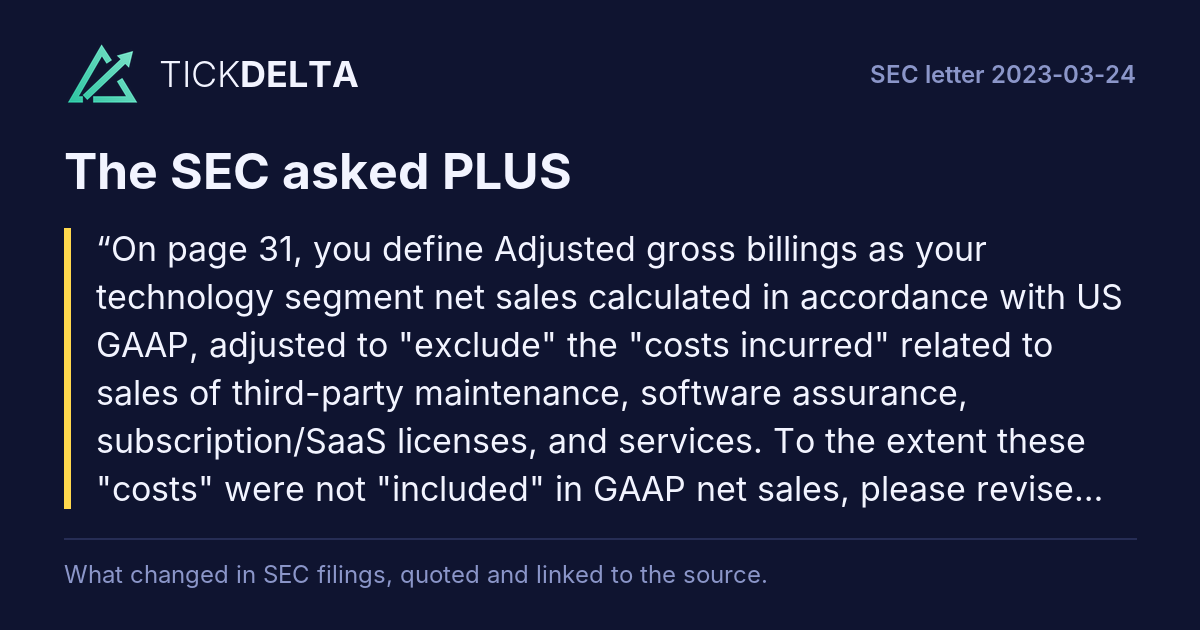
On page 31, you define Adjusted gross billings as your technology segment net sales calculated in accordance with US GAAP, adjusted to "exclude" the "costs incurred" related to sales of third-party maintenance, software assurance, subscription/SaaS licenses, and services.Rest of the question
To the extent these "costs" were not "included" in GAAP net sales, please revise the definition to state, if true, that the measure "adds" such amounts to net sales. To the extent these "costs" were not "incurred" in your statements of operations, revise to characterize them as other than costs (e.g., expenditures). In addition, you disclose the reason management uses this measure. Please tell us and revise to disclose substantive usefulness to investors. Refer to Item 10(e)(1)(i)(C) of Regulation S-K. Finally, please tell us your consideration of Non-GAAP C&DI 100.04, and specifically bullet point two, in presenting this measure. In this regard, it appears the measure you present as billings includes amounts that will never be recognized as revenue.
The costs associated with sales of third-party maintenance, software assurance, subscription/SaaS licenses, and services are for costs incurred that were included in the calculation of net sales, as these transactions are presented within net sales on a net basis. In our prior reconciliation of ‘Adjusted gross billings’ as a non-GAAP metric, we adjusted for these costs by adding them to net sales, as such costs are excluded from net sales.Read in the reply
As the Staff noted in its question, we disclose the meaningfulness of this metric to management in the Form 10-K.Rest of the answer
In our upcoming Form 10-K for the fiscal year ended March 31, 2023 to be filed next month and on a go-forward basis, we will revise our disclosure to affirmatively indicate our belief that such metric will aid investors in better understanding our business, specifically “as a operational metric of our performance to gain insight into the volume of business generated by our technology segment, and to analyze the changes to our accounts receivable and accounts payable.”
As noted by the Staff in this comment letter, we reviewed this matter again taking into consideration (i) the Non-GAAP
C&DI 100.04, including the second bullet, which in relevant part addresses the situation when an issuer presents a measure of revenue on a gross basis when net presentation is required by GAAP and (ii) the Staff’s comment in its letter regarding ‘Adjusted gross billings’ including amounts that will never be recognized as revenue. As a result of this review and the Staff’s comments, we will change Adjusted gross billings to an operational measure rather than a non-GAAP metric. Accordingly, we will revise this approach based on the Staff’s recent correspondence in our upcoming Form 10-K for the fiscal year ended March 31, 2023, to be filed next month and on a go-forward basis. The Company will further rename “Adjusted gross billings” to “Gross billings”.
The Company will include a definition of how this operational metric is determined, which will be consistent with the definition below:
Gross billings are the total dollar value of customer purchases of goods and services including shipping charges during the period, net of customer returns and credit memos, sales or other taxes.
Due to such non-GAAP metric no longer being presented, the Company will no longer provide a reconciliation between
Gross billings and net sales. The Company believes that this updated definition and presentation will further clarify that Gross billings is an operational measure and is not intended or meant to be used as a non-GAAP measure of revenue referred to in bullet point 2 of Non-GAAP C&DI 100.04.
First report after the company's reply of Apr 21, 2023: 10-K filed May 25, 2023 ↗, against the 10-K filed May 26, 2022 ↗.
Tickdelta does not hold the text of both reports, so they are not compared here.
A significant portion of your results of operations disclosure is dedicated to stating, in narrative text form, dollar and percentage changes in accounts, some of which is already included in tables. In addition, while you discuss certain factors to which changes are attributable, you do not quantify a large number of these factors nor analyze the underlying business reasons for the changes and some of the factorsRest of the question
appear nonsubstantive. For example, on page 31 you state the increase in net sales was driven by higher product and service revenues. On page 36 you state Technology segment net sales increased due to an increase in net sales to your customers in various industries and that gross profit increased due to higher margins. We believe your disclosures could be improved by: • relying on the use of tables to present dollar and percentage changes in accounts, rather than including such information in narrative text form; • using tables to list, quantify, and sum all of the material individual factors to which changes in accounts are attributable; • refocusing the narrative text portion of the disclosure on analysis of the underlying business reasons for the individual factors in the tables above; • ensuring that all material factors are quantified and analyzed; and • quantifying the effects of changes in both price and volume on revenues and expense categories, where appropriate.
In response to the first four bullets from the question above, in future filings, beginning with our Form 10-K for the fiscal year ended March 31, 2023 to be filed next month, the Company will revise its results of operations disclosure within its management’s discussion and analysis to address the Staff’s suggested improvements noted above.Read in the reply
Summarized below is a revised results of operations disclosure for the year ended March 31, 2022, compared to the year ended March 31, 2021, which we will include in our Form 10-K for the year ended March 31, 2023.
RESULTS OF OPERATIONS
The Year EndedRest of the answer
March 31, 2022, Compared to the Year Ended March 31, 2021
TECHNOLOGY SEGMENT
The results of operations for our technology segment for the years ended March 31, 2022, and 2021 were as follows (in thousands):
Year Ended March 31,
2022
2021
Change
Net sales
Product
$ 1,492,411
$ 1,305,789
$ 186,622
14.3%
Services
240,625
202,165
38,460
19.0%
Total
1,733,036
1,507,954
225,082
14.9%
Cost of sales
1,175,789
1,036,627
139,162
13.4%
149,094
125,092
24,002
19.2%
1,324,883
1,161,719
163,164
14.0%
Gross profit
408,153
346,235
61,918
17.9%
Selling, general, and administrative
283,690
256,210
27,480
10.7%
Depreciation and amortization
14,535
13,839
696
5.0%
Interest and financing costs
928
521
407
78.1%
Operating expenses
299,153
270,570
28,583
10.6%
Operating income
$ 109,000
$ 75,665
$ 33,335
44.1%
Gross billings
$ 2,625,749
$ 2,271,836
$ 353,913
15.6%
Adjusted EBITDA
$ 131,353
$ 97,219
$ 34,134
35.1%
Net sales by customer end market:
Telecom, Media & Entertainment
$ 502,405
$ 371,912
$ 130,493
Healthcare
270,481
200,067
70,414
35.2%
Technology
250,485
251,683
(1,198)
(0.5%)
SLED
241,769
245,919
(4,150)
(1.7%)
Financial Services
155,160
198,761
(43,601)
(21.9%)
All others
312,733
239,611
73,122
30.5%
$ 1,733,036
$ 1,507,954
$ 225,082
Net sales by vendor:
Cisco Systems
$ 672,821
$ 537,041
$ 135,780
25.3%
Dell EMC
148,782
107,336
41,446
38.6%
Juniper Networks
92,965
91,946
1,019
1.1%
NetApp
91,948
58,020
33,928
58.5%
HP Inc. & HPE
56,171
59,838
(3,667)
(6.1%)
Arista Networks
44,280
51,789
(7,509)
(14.5%)
626,069
601,984
24,085
4.0%
Net sales: Net sales for the year ended March 31, 2022, increased due to an increase in customer demand, primarily from customers in telecom, media and entertainment and healthcare industries, partially offset by a decrease in net sales to customers in the financial services sector. These changes were driven by changes in customer buying cycles, and the timing of specific IT related initiatives by customers during the year, rather than the acquisition or loss of a customer or set of customers.
Our net sales by customer end market have remained consistent with the prior year, with over 80% of our sales being generated from customers within the five end markets specified in the table above. Our net sales by vendor are primarily derived from our top six suppliers, which, when combined, was a fairly constant percentage of 60% or more of our net sales for the years ended March 31, 2022, and 2021.
Gross billings to our customers increased due to organic customer demand as well as our acquisition of Systems
Management and Planning, Inc. (“SMP”) in December 2020.
Cost of sales: The increase in cost of sales for the year ended March 31, 2022 was due to the increase in demand for both product and services. Cost of product increased slightly less than the increase in product sales due to a change in product sales mix, as a greater portion of our transaction volume consisted of sales of third-party maintenance, software assurance, subscription/SaaS licenses, and services, for which the revenues and cost of sales are presented on a net basis. Overall, cost of services generally increased consistent with the increase in sales.
Gross profit: Gross profit increased for the 2022 fiscal year due to the increase in customer demand as well as higher margins. Gross margin on product sales increased 60 basis points to 21.2% due to a shift in product mix to a greater proportion of sales of third-party maintenance, software assurance, subscription/SaaS licenses, and services which are presented on a net basis. Also contributing to the increase in gross margin on product sales was higher vendor incentives which as a percentage of net sales for the year ended March 31, 2022 increased by 20 basis points.
Gross margin on services decreased 10 basis points to 38.0% for the year ended March 31, 2022, due to a slight decrease in professional services gross margin from a change in the mix of professional services rendered during the year, as compared to the prior year.
Selling, general, and administrative expenses: Selling, general, and administrative expenses increased for the 2022 fiscal year mainly due to an increase in salaries and benefits.
Salaries and benefits, including variable compensation, increased $24.1 million or 10.9% to $245.9 million, compared to
$221.8 million during the prior year, due to $14.2 million of additional variable compensation resulting from the increase in gross profit and $9.9 million due to higher salary and benefits expense. Our technology segment had 1,543 employees as of
March 31, 2022, which is an increase of 17, or 1.1%, from 1,526 on March 31, 2021.
General and administrative expenses increased $3.8 million, or 11.1%, to $37.6 million during the year ended March 31,
2022, compared to $33.9 million the prior year. Contributing to the year over year increase in general and administrative expenses were increases in travel and entertainment, and software, subscription, and maintenance expenses of $2.5 million.
Depreciation and amortization expense: Depreciation and amortization expense increased for the year ended March 31, 2022, due to an increase in amortization of customer relationships as a result of the SMP acquisition in December 2020.
Interest and financing costs: Interest and financing costs increased for the year ended March 31, 2022 due to higher borrowings outstanding during the year under our Wells Fargo credit facility.
FINANCING SEGMENT
The results of operations for our financing segment for the years ended March 31, 2022, and 2021 were as follows (in
Portfolio earnings
$ 17,764
$ 16,486
$ 1,278
7.8%
Transactional gains
18,181
14,506
3,675
Post-contract earnings
50,495
23,771
26,724
112.4%
Other
1,543
5,606
(4,063)
(72.5%)
87,983
60,369
27,614
45.7%
35,154
13,050
22,104
169.4%
52,829
47,319
5,510
11.6%
13,427
15,053
(1,626)
(10.8%)
111
112
(1)
(0.9%)
975
1,484
(509)
(34.3%)
14,513
16,649
(2,136)
(12.8%)
$ 38,316
$ 30,670
$ 7,646
24.9%
$ 38,651
$ 31,026
$ 7,625
24.6%
Net sales: For the year ended March 31, 2022, net sales increased due to higher post contract earnings and transactional gains, offset slightly by a decrease in other financing revenues. Post-contract revenue increased due to an increase of $22.8 million from proceeds from early lease buyouts and sales of off-lease equipment, as we had a few large customer driven transactions in fiscal year 2022. Portfolio revenue increased due to increases in operating lease income offset by decreased sales-type lease earnings over the prior fiscal year.
Other financing revenues decreased due to lower profit recognized from signing new lease extensions with customers where the prior lease was classified as an operating lease and the new modified lease was determined to be a sales-type lease.
Transactional gains increased due to higher volume of financing receivables sold. Total proceeds from sales of financing receivables were $855.1 million and $364.0 million for the years ended March 31, 2022, and 2021, respectively.
Cost of sales: Cost of sales for the year ended March 31,
2022 increased due to an increase of $18.2 million in the cost of equipment from early lease buyouts and off-lease equipment and an increase in operating lease depreciation of $3.7 million.
general, and administrative expenses decreased in the 2022 fiscal year due to a reduction in our reserve for credit losses by $1.2 million, and salaries and benefits of $0.6 million. Our financing segment employed 34 people as of March 31, 2022 and 2021. Certain support functions for the financing segment are shared resources with the technology segment.
costs decreased due to lower borrowings during the year. Our total notes payable for the financing segment decreased as of March 31, 2022, to $21.2 million from $56.1 million for the prior year. Our weighted average interest rate for our non-recourse notes payable was 3.59% as of March 31, 2022, compared to 3.35% for March 31, 2021.
CONSOLIDATED
Other income: Other income and expense during the year ended March 31, 2022, netted to an expense of $0.4 million and included foreign exchange rate loss of $0.5 million. Other income and expense during the year ended March 31, 2021, was income of $0.6 million and included foreign exchange rate gain of $0.5 million and interest income of $0.1 million.
Income taxes: Our effective income tax rates for the years ended March 31, 2022, and 2021 were 28.1% and 30.4%, respectively. The decrease in our effective income tax rate year over year is primarily due to prior year unfavorable adjustments to the federal benefit from state taxes and non-deductible executive compensation.
Net earnings: Net earnings were $105.6 million for the year ended March 31, 2022, an increase of 41.9% or $31.2 million as compared to $74.4 million in the prior fiscal year. The net earnings increase was due primarily to the increase in operating profits from our technology segment, and a lower income tax rate in the current year compared to the year ended March 31, 2021.
Basic and fully diluted earnings per common share for the year ended March 31, 2022, were $3.96 and $3.93, respectively, and both increased 41.9% over the prior year. Basic and fully diluted earnings per common share were $2.79 and $2.77, respectively, for the year ended March 31, 2021.
Weighted average common shares outstanding used in the calculation of basic and diluted earnings per common share were
26.6 million and 26.9 million, respectively, for year ended March 31, 2022. Weighted average common shares outstanding used in the calculation of basic and diluted earnings per common share were 26.7 million and 26.8 million, respectively, for the year ended March 31, 2021.
* * *
In response to the Staff’s question about quantifying the effects of changes in both price and volume on revenue and expense categories, we advise the Staff that we will quantify changes in price and volume when determinable and when such change is a material contributing factor. Throughout fiscal year 2022, we received many notices of price increases from manufacturers which we resell to our customers, and experienced increases in the volume of goods sold. Inflation was particularly prevalent across the U.S. and globally during this time. Generally, we pass price increases to our customers. In addition, our costs of goods from manufacturers may vary by customer; therefore, quantification of price increase versus volume is often not determinable for us.
First report after the company's reply of Apr 21, 2023: 10-K filed May 25, 2023 ↗, against the 10-K filed May 26, 2022 ↗.
Tickdelta does not hold the text of both reports, so they are not compared here.
You disaggregate Technology segment revenue by customer end market and vendor. With respect to the disclosure requirements of ASC 606-10-50-5, please tell us how you considered the guidance in paragraphs ASC 606-10-55-89 through 55-91 in selecting the appropriate categories to use to disaggregate revenue.Rest of the question
In this regard, we note from your disclosure on page 22 that over the past several years you have seen an industry shift to "as a service" offerings and from your disclosure on page F-15 that you recognize certain revenue over time.
In selecting the appropriate categories to use to disaggregate revenue in accordance with ASC 606-10-50-5, we relied on the information provided in our earnings releases, investor presentations as well as information regularly reviewed by our chief operating decision maker.Read in the reply
In reaching this conclusion, the Company evaluated the examples in ASC 606-10-55-91. The following summarizes the
Company’s evaluation of each example:
a. Type of good or service (for example, major product lines)
The Company has a broad range of product offerings that continually adapt and change.Rest of the answer
Further, the
Company believes that its customers view technology purchases as integrated solutions, rather than discrete product and service categories. The Company’s products generally have similar characteristics in that they are used to provide technology solutions to their end-user customers. Demand risks for these products also have similar characteristics in that they are impacted by macro-economic factors such as general business and governmental spending, gross domestic product growth and other broad measures of economic activity. The Company generally does not enter fulfillment contracts with customers for specific product categories, and instead sells items on an individual purchase order and transactional basis. In addition, our product portfolios have similar working capital profiles in terms of both payment terms and credit terms. For these reasons, the Company does not believe that any specific product categories deviate sufficiently from the rest of the population on how the nature, amount, timing and uncertainty of revenue and cash flows may be affected by economic factors for a separate depiction to provide value to the users of our financials.
b. Geographical region (for example, country or region)
The Company disaggregates revenue into United States and non-United States. The Company believes further disaggregation of revenue by international country would not be meaningful due to the significant number of international countries that the Company delivers to and that changes in a specific international country do not generally have a material impact on the
Company’s consolidated revenues.
c. Market or type of customer (for example, government and nongovernment customers)
The Company disaggregates revenue by customer end market.
d. Type of contract (for example, fixed-price and time-and-materials contracts)
The Company’s product sales are predominantly done an individual purchase order and transactional basis, rather than pursuant to short-term or long-term contracts. While the Company’s service revenues include fixed price, time and materials and longer-term contracts, we concluded that are no unique factors that would result in a significant difference in the nature, amount, timing, and uncertainty of revenues and cash flows related to the type of contract.
e. Contract duration (for example, short-term and long-term contracts)
This item is generally not applicable to the Company as it sells to its customers on an individual purchase order and transactional basis, rather than pursuant to short-term and long-term contracts. While a portion of our service revenues are generated from contracts with terms longer than 1 year, we concluded that a breakout of our revenues by contract duration was not meaningful.
f. Timing of transfer of goods or services (for example, revenue from goods or services transferred to customers at a point in time and revenue from goods or services transferred over time)
The Company acknowledges the Staff’s comment that the Company discusses changes in product mix including “as a service” offerings. These transactions are presented within product sales on a net basis at the point that our customer and vendor accept the terms and conditions of the arrangement. Our product sales are recognized at a point in time, while our service revenues are over time. In future filings, the Company will disaggregate revenue by timing of revenue recognition. Below please find an example of how the Company intends to present this tabular disclosure in the future for revenue from contracts with customers within our Technology segment (in thousands).
Transferred at a point in time as principal
$1,342,799
$1,174,582
Transferred at a point in time as agent
134,669
107,357
Transferred over time
Revenue from contracts with customers
$1,718,093
$1,484,104
The Company will also disclose that all revenue from contracts with customers within our financing segment are transferred at a point in time as principal.
g. Sales channels (for example, goods sold directly to consumers and goods sold through intermediaries)
The Company sells products directly to customers. There are no factors noted related to sales channels that would result in a material impact on the nature, amount, timing and uncertainty of revenue and cash flows that may be affected by economic factors.
First report after the company's reply of Apr 21, 2023: 10-K filed May 25, 2023 ↗, against the 10-K filed May 26, 2022 ↗.
Tickdelta does not hold the text of both reports, so they are not compared here.
We note your response to comment one, including your plan to present gross billings as a metric rather than a non-GAAP financial measure. Please revise your definition to explain that gross billings includes the gross transaction values for certain sales transactions that you recognize on a net basis and, therefore, includes amounts that will not be recognized as revenue.
In response to the above comment, in future filings, beginning with our Form 10-K for the fiscal year ended March 31, 2023, to be filed today, the Company will include the following definition of how gross billings as an operational metric is determined:Read in the reply
ePlus inc. 13595 Dulles Technology Drive Herndon, VA 20171 (703) 984-8400 www.eplus.com
Gross billings are the total dollar value of customer purchases of goods and services including shipping charges during the period, net of customer returns and credit memos, sales, or other taxes.Rest of the answer
Gross billings include the transaction values for certain sales transactions that are recognized on a net basis, and, therefore, includes amounts that will not be recognized as revenue.
First report after the company's reply of May 24, 2023: 10-K filed May 25, 2023 ↗, against the 10-K filed May 26, 2022 ↗.
Tickdelta does not hold the text of both reports, so they are not compared here.
We note your response to comment two. While you quantify sales by customer end market and vendor for the technology segment and appear to focus on such in your disclosure, your narrative does not appear to explain "why" changes occured other than what appears to be a more general reference to buying cycles and timing of IT initiatives.Rest of the question
We note from your fourth quarter earnings call that you experienced strong growth trends in your services business, which includes a wide range of professional and managed services, staffing, logistics and help desk services. However, your proposed revised disclosure does not speak to this factor. We also note from the call that "annuity quality" services tend to have higher margins and more predictable financial performance, which you consider a positive trend. Finally, we note from the call that product gross margin increased 20 basis points to 22.8%, while service gross margin decreased 390 basis points to 35.3%, reflecting lower professional service margins due to higher costs. Therefore, we continue to believe you should attempt to further discuss the key drivers of changes in your results in a way you believe will allow investors to best understand the business as seen through the eyes of management. Additionally, we note from your response that you experienced price inflation on purchases of products which are resold. Please expand your discussion to identify if inflation was a contributing factor in recording higher product revenues and clarify the resulting impact, if quantifiable.
In future filings, beginning with our Form 10-K for the fiscal year ended March 31, 2023, to be filed today, the Company will further update its disclosure within Item 7. Management’s Discussion and Analysis of Financial Condition and Results of Operations to address several of the Staff’s suggestions regarding expanded narrative disclosure.Read in the reply
Buying Cycles and Timing of IT Initiatives
With respect to the first point raised by the Staff to provide further explanation of why changes occurred in sales in the Technology segment, we respectfully advise the Staff that the changes we reported inRest of the answer
our net sales within our Technology segment are primarily due to changes that we experience in customer demand that occur due to regular buying cycles as customers have their scheduled purchases of equipment and services to maintain their IT systems, as well as specific IT projects that are initiated by our customers based on their own business and operational needs.
Management believes it is important for both the Company and investors to understand the demand by customer industry and as such will continue to include a breakdown of the net sales by customer industry. Further, to align our disclosures in our filings with comments from management in earnings calls and other communications, we will replace the breakdown of net sales by manufacturer in our disaggregation of revenue disclosure within the segment footnote with a breakdown of net sales by type of product.
Technology Service Revenue
In response to the Staff’s comment, we have updated the narrative disclosure for net sales for the full fiscal year ended March 31, 2022, to incorporate disclosure regarding the contribution and growth of the Company’s services business. In addition, we will add to Item 7 of the Form 10-K the following definitions and use these terms consistently, including in our future earnings releases and earnings conference calls. We will also further clarify and distinguish our revenue categories in Item 1 of the Form 10-K.
Technology segment revenue generally falls into the following three categories:
- Product revenue: Revenue generated from the sale of third-party hardware, perpetual and subscription software, maintenance, software assurance, and services.
- Professional services: Revenue generated from our advanced professional services that are performed under time & materials, fixed fee, or milestone contracts. Professional services include cloud consulting, staff augmentation services, and project management services.
- Managed services: Revenue generated from our advanced managed services that include managing various aspects of our customers’ environments and are billed in regular intervals over a contract term, usually between three to five years. Managed services include security solutions, storage-as-a-service, cloud hosted services, cloud managed services, and service desk.
Product and Service Gross Margin
In response to the Staff’s comment, we updated the narrative disclosure to discuss the reason for the change of product gross margin and service gross margin; however, we note that the information presented below differs from the basis point changes referenced in the Staff’s comment, as those changes related to only the three months ended March
31, 2022, and not the full year, as presented below.
Product Inflation
Finally, while we have updated our disclosure to include that price inflation is a contributing factor to the increase in net sales, we are unable to quantify the impact of inflation due to the factors outlined in the April 21, 2023, Response Letter.
* * * * *
Set forth below are the select sections of our Technology segment results of operations disclosure for the year ended March 31, 2022, compared to the year ended March 31, 2021, which includes the updates highlighted above in response to the Staff’s comments. This updated disclosure will be included in our Form 10-K for the year ended March 31, 2023, to be filed today.
RESULTS OF OPERATIONS
The Year Ended March 31, 2022, Compared to the Year Ended March 31, 2021
TECHNOLOGY SEGMENT
The results of operations for our technology segment for the years ended March 31, 2022, and 2021, were as follows (in thousands):
Year Ended March 31,
2022
2021
Change
Net sales
Product
$ 1,492,411
$ 1,305,789
$ 186,622
14.3%
Services
240,625
202,165
38,460
19.0%
Total
1,733,036
1,507,954
225,082
14.9%
Cost of sales
1,175,789
1,036,627
139,162
13.4%
149,094
125,092
24,002
19.2%
1,324,883
1,161,719
163,164
14.0%
Gross profit
408,153
346,235
61,918
17.9%
Selling, general, and administrative
283,690
256,210
27,480
10.7%
Depreciation and amortization
14,535
13,839
696
5.0%
Interest and financing costs
928
521
407
78.1%
Operating expenses
299,153
270,570
28,583
10.6%
Operating income
$ 109,000
$ 75,665
$ 33,335
44.1%
Gross billings
$ 2,625,749
$ 2,71,836
$ 353,913
15.6%
Adjusted EBITDA
$ 131,353
$ 97,219
$ 34,134
35.1%
Net sales by customer end market:
Telecom, Media & Entertainment
$ 502,405
$ 371,912
$ 130,493
Healthcare
270,481
200,067
70,414
35.2%
Technology
250,485
251,683
(1,198)
(0.5%)
SLED
241,769
245,919
(4,150)
(1.7%)
Financial Services
155,160
198,761
(43,601)
(21.9%)
All others
312,733
239,611
73,122
30.5%
$ 1,733,036
$ 1,507,954
$ 225,082
Net sales by type:
Data Center / Cloud
$ 581,113
$ 516,930
$ 64,183
12.4%
Networking
611,488
510,205
101,283
19.9%
Security
158,927
155,186
3,741
2.4%
Collaboration
57,244
47,504
9,740
20.5%
Other
83,639
75,964
7,675
10.1% ePlus Services
Net sales: Net sales for the year ended March 31, 2022, increased due to an increase in customer demand, primarily from customers in telecom, media and entertainment and healthcare industries, partially offset by a decrease in net sales to customers in the financial services sector. These changes were driven by growth in product sales in collaboration and networking, and third party maintenance and artificial intelligence included in the other category in the table above, which management, based on its industry knowledge, generally attributed to hybrid work models having become the prominent operating model for most of our customers. Timing of purchases by our existing customers are determined by their buying cycle and the timing of their specific IT related initiatives throughout the year.
Also contributing to the increase in net sales were increases in the cost of equipment we incurred from our suppliers due, in part, to inflation, which we typically pass on to our customers. Service revenues increased due to higher demand for both professional and managed services.
Our net sales by customer end market have remained consistent with the prior year, with over 80% of our sales being generated from customers within the five end markets specified in the table above.
Gross billings to our customers increased due to organic customer demand as well as our acquisition of Systems Management and Planning, Inc. (“SMP”) in December 2020, rather than acquisition or loss of a specific customer or set of customers.
Cost of sales: The increase in cost of sales for the year ended March 31, 2022, was due to the increase in demand for both product and services. Cost of product increased slightly less than the increase in product sales due to a change in product sales mix, as a greater portion of our transaction volume consisted of sales of third-party maintenance, software assurance, subscription/SaaS licenses, and services, for which the revenues and cost of sales are presented on a net basis. Overall, cost of services increased 19.2%, consistent with the 19.0% increase in sales.
Gross profit: Gross profit increased for the 2022 fiscal year due to the increase in customer demand as well as higher margins. Gross margin in the Technology segment increased 60 basis points to 23.6%.
Gross margin on product sales increased 60 basis points to 21.2% due to a shift in product mix to a greater proportion of sales of third-party maintenance, software assurance, subscription/SaaS licenses, and services. Also contributing to the increase in product margins was higher vendor incentives earned, which increased $9.0 million in fiscal year 2022.
Service margin decreased 10 basis points to 38.0% for the year ended March 31, 2022, due to changes in the mix of services provided. The service margin decline was comprised of a 90 basis points improvement from managed services, due to ongoing growth and scale in this offering, offset by a 100 basis points decline from professional services due to higher third party costs.
Should the Staff have any questions, please contact me at (703) 984-8040. We note that our responses involve proposed changes in the Company’s next Annual Report on Form 10-K, which we expect to file today, May 24, 2023.
First report after the company's reply of May 24, 2023: 10-K filed May 25, 2023 ↗, against the 10-K filed May 26, 2022 ↗.
Tickdelta does not hold the text of both reports, so they are not compared here.
Also in this review: request for more time, Apr 3, 2023, closing letter, 2023-06-13