Form 10-K for the Year Ended December 31, 2022
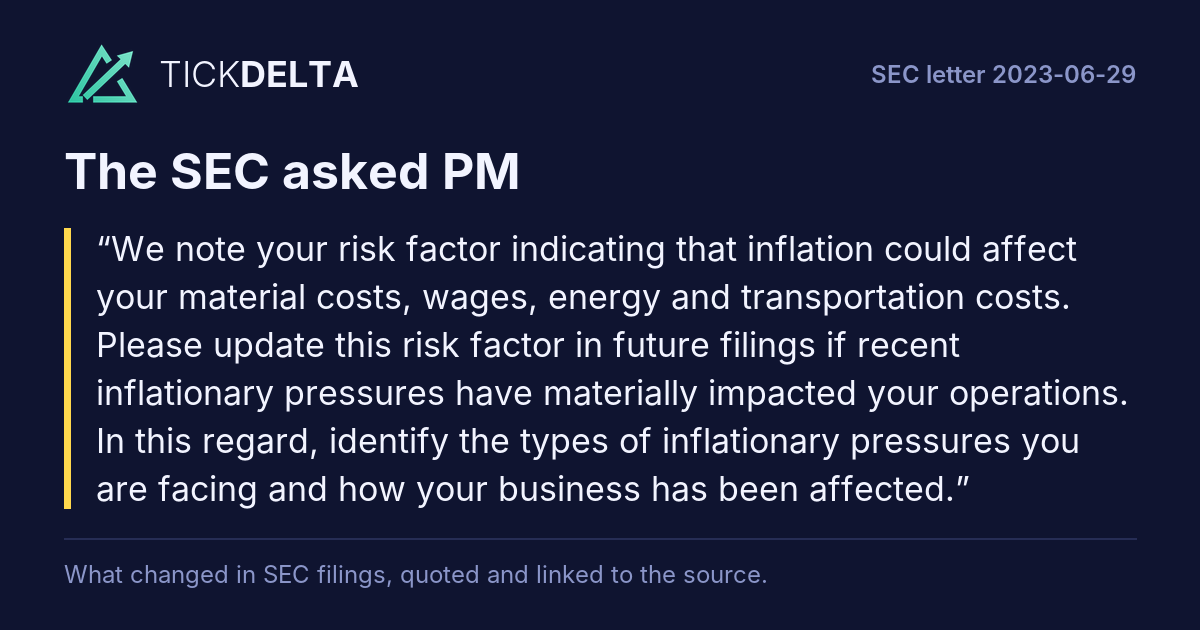
We note your risk factor indicating that inflation could affect your material costs, wages, energy and transportation costs. Please update this risk factor in future filings if recent inflationary pressures have materially impacted your operations. In this regard, identify the types of inflationary pressures you are facing and how your business has been affected.
We acknowledge the Staff’s comment and respectfully note that we have experienced and disclosed inflationary pressures in our Form 10-K, including: growing pressures on the cost of certain direct materials, wages, energy, transportation, and logistics as well as an increased cost of capital due to interest rate increases driven by the response to increased inflation.Read in the reply ↗Rest of the answer
While the net result of the inflationary impacts and our efforts to mitigate these impacts were not material to the Company during the covered periods, in future filings the Company will update its risk factors to describe the material impact of inflationary pressures on the Company’s operations, if any, including by identifying the types of any such inflationary pressures and how the business may have been affected.
First report after the company's reply of 2023-07-12: 10-Q filed 2023-07-27 ↗, against the 10-Q filed 2023-04-26 ↗.
Tickdelta does not hold the text of both reports, so they are not compared here.
We note your statement that following the deconsolidation of RBH, you continue to report the volume of brands sold by RBH in which other PMI subsidiaries own the trademark. Please revise to quantify the amounts of volume of RBH included in your tables.
As discussed in Item 8, Note 18. Contingencies - CCAA Proceedings and Stay of Tobacco-Related Cases Pending in Canada - of our 2022 Form 10-K, our subsidiary, Rothmans, Benson & Hedges Inc. (“RBH”), sought protection in the Ontario Superior Court of Justice under the Companies’ Creditors Arrangement Act (“CCAA”) on March 22, 2019. CCAA is a Canadian federal law that permits a Canadian business to restructure its affairs while carrying on its business in the ordinary course.Read in the reply ↗Rest of the answer
As a result, RBH's financial results have been deconsolidated from our consolidated financial statements since March 22, 2019.
Following the deconsolidation of RBH, we have continued to report the volume and corresponding revenues (primarily royalty revenues) of brands sold by RBH for which other PMI subsidiaries are the trademark owners. These include HEETS, Next, Philip Morris and Rooftop.
The volume of these brands sold by RBH is not significant to the volume of the consolidated Company (i.e., cigarettes and heated tobacco units combined). Specifically, the volume of these brands sold by RBH represented approximately 0.4%, 0.5% and 0.5% of our total consolidated cigarettes and heated tobacco units volume for the years ended 2022, 2021 and 2020, respectively. For this reason, we respectfully believe that separate disclosure of the unit volume of these brands sold by RBH in our tabular disclosure or as a footnote to our tabular disclosure is not warranted. Going forward, we will continue to monitor the significance of this volume to the consolidated Company to determine whether additional disclosures should be provided.
In future filings, we will expand the disclosure referenced by the Staff to include the language underlined below:
Following the deconsolidation of our Canadian subsidiary, we continue to report the volume and corresponding royalty revenues of brands sold by RBH for which other PMI subsidiaries are the trademark owners. These include HEETS, Next, Philip Morris and Rooftop. The volume and corresponding royalty revenues for these brands sold by RBH were not material to the Company for all periods presented.
First report after the company's reply of 2023-07-12: 10-Q filed 2023-07-27 ↗, against the 10-Q filed 2023-04-26 ↗.
Tickdelta does not hold the text of both reports, so they are not compared here.
Your disclosure indicates that you have faced significant inflationary forces and that such inflationary pressures are growing and could continue in upcoming quarters. In this regard, please disclose any known trends or uncertainties that have had or are reasonably likely to have a material impact on your cash flows, liquidity, capital resources, cash requirements, financial position, or results of operationsRest of the question
arising from, related to, or caused by inflation. Trends or uncertainties may include the combined impact of inflation on cost of sales, gross profit, inventory and taxes.
We acknowledge the Staff’s comment and in future filings, the Company will include additional disclosures regarding the principal factors contributing to inflationary pressures and the resulting impact to the Company if there are any known trends or uncertainties that have had or are reasonably likely to have a material impact on our financial results which have not been previously disclosed.
As we have previously reported, our 2022 financial results were impacted by inflationary forces, despite specific actions taken to mitigate them.Read in the reply ↗Rest of the answer
Such forces principally consisted of the inflationary pressures described in the Form 10-K and our response to Comment 1. While we expect certain inflationary elements to ease over the course of the year, we anticipate that our 2023 results will likely continue to be impacted by inflationary forces (particularly related to tobacco leaf given the impact of longer inventory durations and higher prices of direct materials, as discussed below in our response to Comment 4), which in the aggregate could be material to our business and financial results.
While the net result of the inflationary impacts and our mitigation efforts were not material to the Company's financial results during the covered periods, as noted above, additional disclosures will be included in future filings to the extent any of the above items or other known trends or uncertainties have had or are reasonably likely to have a material impact on our financial results.
First report after the company's reply of 2023-07-12: 10-Q filed 2023-07-27 ↗, against the 10-Q filed 2023-04-26 ↗.
Tickdelta does not hold the text of both reports, so they are not compared here.
In a related matter, please expand your disclosure in future filings to identify the principal factors contributing to the inflationary pressures you have experienced and clarify the resulting impact to the company. In addition, update your disclosure in future filings to identify actions planned or taken, if any, to mitigate inflationary pressures.
We acknowledge the Staff’s comment and respectfully advise the Staff that, in future filings, the Company will include appropriate additional disclosures regarding the principal factors contributing to inflationary pressures and clarify the resulting impact to the Company including actions planned or taken to mitigate inflationary pressures.Read in the reply ↗Rest of the answer
To illustrate, below is an example of how we are planning to disclose such impacts in our upcoming filings:
Inflationary impacts driven by higher wages have resulted from merit increases that reflect local inflation as we continuously evaluate our compensation and benefit offerings to be competitive with the current market. Increased transportation costs resulted from increased shipping rates for all modes of transportation (air, ocean and inland) due to ocean and air capacity constraints. Increases in cost of sales resulted from higher cost of direct materials due to the pass on of energy, transportation, labor and commodity price increases from suppliers as well as increases in utility costs, including gas and electricity prices, primarily in Europe resulting from the war in Ukraine. Raw materials such as tobacco leaf have longer inventory durations which resulted in insignificant inflationary impacts to our cost of sales in 2022; however tobacco leaf purchases in both 2022 and 2023 have been at higher prices due to inflationary impacts on fertilizer prices and labor costs, thus resulting in increases in the cost of inventory with corresponding impacts on our financial results expected in 2023. In addition, our cash flow from operations was impacted by the net working capital investment related to the procurement of tobacco leaf inventory and higher cost of direct materials, which is expected to continue in 2023.
Mitigation efforts have included (i) indexation clauses related to commodity costs and energy pricing within contracts, (ii) tactical inventory purchases, (iii) identification of new suppliers in different geographical locations for incremental sourcing, (iv) increasing tobacco leaf inventory durations to secure additional volumes at favorable prices, (v) optimizing the mix of tobacco leaf origins and suppliers, (vi) continuous evaluation of shipping routes and methods of shipment, (vii) supplier negotiations, (viii) variable contract durations for energy costs, (ix) hedging strategies, and (x) other pricing, productivity and procurement initiatives.
First report after the company's reply of 2023-07-12: 10-Q filed 2023-07-27 ↗, against the 10-Q filed 2023-04-26 ↗.
Tickdelta does not hold the text of both reports, so they are not compared here.
We note your presentation of revenues, including excise taxes on the face of your statement of earnings. We also note that you have elected to present revenue on net basis of these excise taxes. Please tell us why you believe the gross presentation of revenues does not represent a non-GAAP measure.
We acknowledge the Staff’s comment and note that, as disclosed in Item 8, Note 2. Summary of Significant Accounting Policies of our Form 10-K, we have elected to present revenues on a net of excise tax basis by excluding excise taxes collected from customers from the measurement of the transaction price.Read in the reply ↗Rest of the answer
Excise taxes and related revenues, including excise taxes on the face of the statement of earnings, are presented in accordance with our interpretation of the SEC rules stated in Item 10(e)(5) of Regulation S-K and Item 5-03 of Regulation S-X, pursuant to which we believe that the gross presentation of revenues does not represent a non-GAAP financial measure.
Regulation S-K Item 10(e)(5) states that “non-GAAP financial measures exclude financial measures required to be disclosed by GAAP, [SEC] rules, or a system of regulation of a government or governmental authority or self-regulatory organization that is applicable to the registrant.” Additionally, for the purpose of the presentation of revenues in PMI’s Consolidated Statements of Earnings, we have considered the guidance provided in Regulation S-X Item 5-03(1) “Net sales and gross revenues” which states: “If the total of sales and revenues reported under this caption includes excise taxes in an amount equal to 1 percent or more of such total, the amount of such excise taxes shall be shown on the face of the statement parenthetically or otherwise”.
We interpret Regulation S-X Item 5-03(1) to require the presentation of gross revenue, necessitating the presentation of excise taxes on the face of the statement of earnings. We also believe that including excise taxes within the statement promotes comparability with other filers from excise paying industries.
We respectfully note that revenues including excise taxes are not used by management as a non-GAAP measure to evaluate PMI’s financial performance or as a metric used in determining management compensation. Consequently, we believe that Regulation S-K Item 10(e)(1)(i)(C) does not apply, which states “[t]he registrant must include the following in the filing: [a] statement disclosing the reasons why the registrant's management believes that presentation of the non-GAAP financial measure provides useful information to investors regarding the registrant's financial condition and results of operations.”
In consideration of the above, we believe that revenues including excise taxes is not a non-GAAP measure. This measure is added to the face of the statement of earnings to comply with the SEC excise taxes disclosure regulations and to promote transparent disclosure and comparability with other filers from excise paying industries.
Notwithstanding the above, in accordance with the Staff's comment, in future filings we will remove revenues including excise taxes from the face of the statement of earnings and present excise taxes parenthetically or in a footnote to the statement of earnings.
First report after the company's reply of 2023-07-12: 10-Q filed 2023-07-27 ↗, against the 10-Q filed 2023-04-26 ↗.
Tickdelta does not hold the text of both reports, so they are not compared here.
You disclose that inventories are stated at the lower of cost or market. Please clarify if you recognize inventory at the lower of cost or market, or the lower of cost or net realizable value, and revise your disclosures accordingly. See ASC 330-10-351B and ASC 905-330-30-1.
We acknowledge the Staff's comment and confirm that our inventories are stated at the lower of cost or net realizable value in accordance with ASC 330-10-35-1B. The Company will revise its disclosure in future periodic reports, beginning with our Form 10-K for the fiscal year ending December 31, 2023. Read in the reply ↗
First report after the company's reply of 2023-07-12: 10-Q filed 2023-07-27 ↗, against the 10-Q filed 2023-04-26 ↗.
Tickdelta does not hold the text of both reports, so they are not compared here.
Also in this review: closing letter, 2023-07-13