Form 10-K for the Fiscal Year Ended December 31, 2017
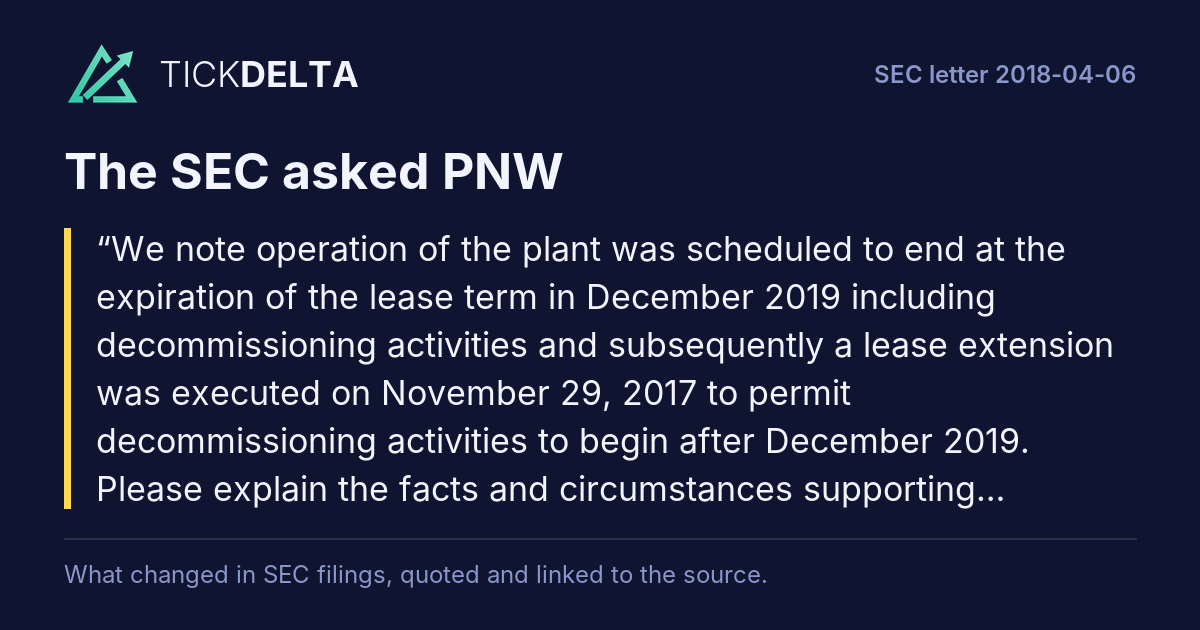
We note operation of the plant was scheduled to end at the expiration of the lease term in December 2019 including decommissioning activities and subsequently a lease extension was executed on November 29, 2017 to permit decommissioning activities to begin after December 2019. Please explain the facts and circumstances supporting reclassification of your interest in the plant to a regulatory asset.Rest of the question
Further please tell us your consideration of modifying the remaining depreciable life of the plant in accordance with ASC 360-10-35.
Arizona Public Service Company (“APS”) is a cost-based rate-regulated utility and applies ASC 980 to its regulated operations. As a regulated electric utility, APS’s depreciable plant lives are set by the regulator during a rate case to determine electric customers’ utility rates. In the case of APS’s power plants (including the Navajo Plant), the regulator responsible for setting such rates is the Arizona Corporation Commission (the “ACC”). APS’s most recent rate case was filed on June 1, 2016, and a settlement agreement with a majority of the stakeholders was signed on March 27, 2017.Read in the reply ↗Rest of the answer
The ACC approved the settlement agreement without material modifications on August 15, 2017. See “Retail Rate Case Filing with the Arizona Corporation Commission” on page 112 of the Company’s Annual Report on Form 10K for the year ended December 31, 2017 for more details.
On February 13, 2017, the co-owners of the Navajo Plant voted not to pursue continued operation of the plant beyond December 2019, the expiration of the then-current lease term, and to pursue a new lease or lease extension with the Navajo Nation that would allow decommissioning activities to begin after December 2019 instead of 2017. Subsequent to the February 13, 2017 co-owners’ vote, various stakeholders including regulators, tribal representatives and others interested in the continued operation of the plant met to determine if an alternate solution could be reached that would permit continued operation of the plant beyond 2019. While the lease was extended to provide for decommissioning activities to start after 2019 and discussions are ongoing regarding continued operation of the plant, no viable path forward was identified that was acceptable to all the stakeholders. Based on these events, during the second quarter of 2017, APS believed it was probable that the Navajo Plant would shut down substantially before its previously assumed life of 2026. APS believes this probable early retirement of the Navajo Plant qualified as a plant abandonment pursuant to ASC 980-360, which requires plant abandonments to be reclassified out of plant in service.
As a result, during the second quarter of 2017, APS reclassified the net book value of the Navajo Plant from plant in service to a regulatory asset based on our belief that APS will be allowed recovery of and a return on the remaining net book value.
In our prior rate case described above, the ACC allowed recovery of and a return on the early retirement of Unit 2 at our Cholla coal plant establishing regulatory precedent regarding cost recovery of plant abandonments. APS believes it will be allowed recovery of the net book value of the Navajo Plant, in addition to a return on its investment.
As part of the rate case filing, APS evaluated, but did not propose changes to the depreciable life of the Navajo Plant. At the time of the filing, APS believed that the existing Navajo Plant lease, which was scheduled to expire at the end of 2019, would be renewed or extended and that the plant would continue operating until 2026. The ACC approved depreciation rates (and the amounts to be collected from customers) based on that assumption. When the life assumption was changed, APS reclassified the property, plant and equipment to a regulatory asset, consistent with abandonment accounting. Consistent with ASC 980, APS is amortizing the regulatory asset based on the ratemaking treatment, which reflects a 2026 end of life assumption.
Should you require further clarification of the matters discussed in this letter, please contact me at (602) 250-3800.
First report after the company's reply of 2018-04-16: 10-Q filed 2018-05-02 ↗, against the 10-Q filed 2017-11-03 ↗.
Tickdelta does not hold the text of both reports, so they are not compared here.
Also in this review: closing letter, 2018-04-20