Form 10-K for the Fiscal Year Ended December 31, 2016
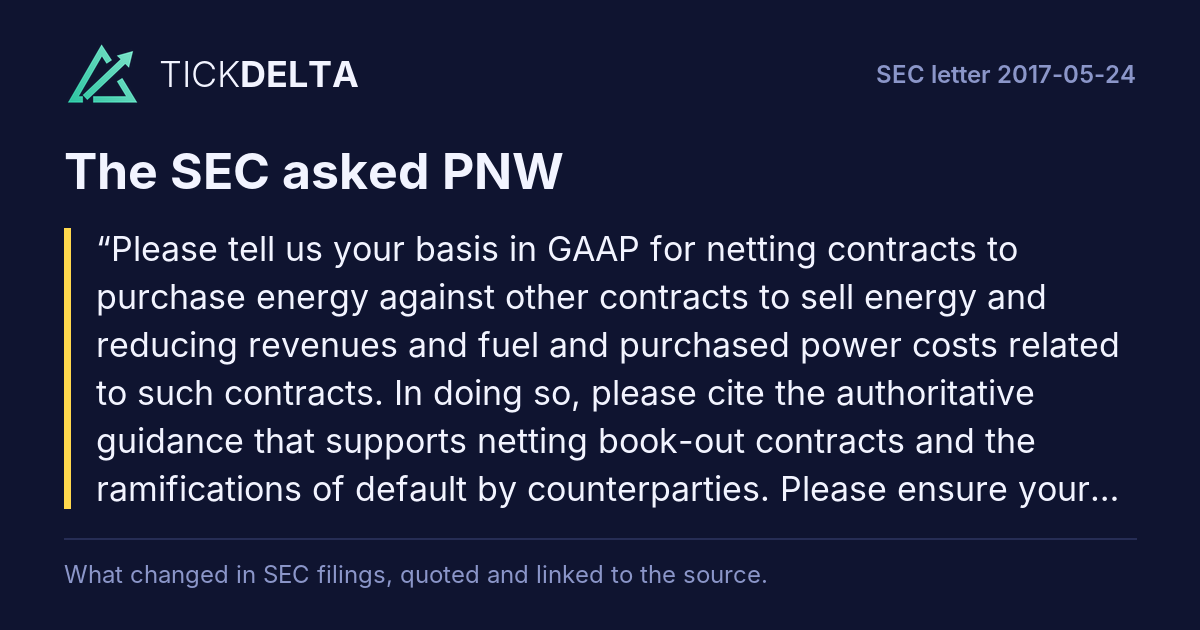
Please tell us your basis in GAAP for netting contracts to purchase energy against other contracts to sell energy and reducing revenues and fuel and purchased power costs related to such contracts. In doing so, please cite the authoritative guidance that supports netting book-out contracts and the ramifications of default by counterparties.Rest of the question
Please ensure your response provides detailed information to support your accounting policy.
In the electricity business, some derivative contracts to purchase electricity are settled by netting them against other derivative contracts to sell electricity. This is referred to as a book-out and usually occurs in contracts that have the same delivery terms. A book-out is a form of net settlement. When there are purchases and sales of power for delivery at the same time and delivery point, there is no physical movement by the purchaser or seller of the energy.Read in the reply ↗Rest of the answer
Our accounting policy for these net-settled derivatives is to present these transactions on a net basis in the income statement as required by ASC 815-10-55-62 (formerly EITF 03-11). We have consistently presented these transactions on a net basis in our income statement since we adopted EITF 03-11 in 2003. This presentation is consistent with industry practice.
ASC 815-10-55-62 states that determining whether realized gains and losses on physically settled derivative instruments not held for trading purposes should be reported gross or net in the income statement is a matter of judgment that depends on the relevant facts and circumstances. This guidance further states that the consideration of the facts and circumstances should be made in the context of the various activities of the entity rather than based solely on the terms of the individual contracts. Considerations include the economic substance of the transaction and the gross versus net reporting indicators in FASB ASC Subtopic 605-45 on principal agent considerations.
In the electricity industry, a book-out transaction is a form of net settlement. In forming our judgment about the application of the above guidance, we concluded that presenting these contracts on a gross basis in the income statement would artificially inflate revenues and expenses. The economic substance of the transactions is a net settlement of the contracts. Because physical movement of the power between the purchaser and the seller in these transactions does not occur, we believe that book-out transactions are required to be presented net under the guidance in ASC 815-10-55-62.
With respect to the ramifications of default by counterparties, under ASC 815-10-55-62, credit risk is one consideration to be used in exercising judgment in determining whether revenues should be reported gross or net in the income statement. We believe the nature of our transacting activity outweighs the counterparty credit risk, and net presentation in the income statement is appropriate.
Should you require further clarification of the matters discussed in this letter, please contact me at (602) 250-3800.
First report after the company's reply of 2017-06-07: 10-Q filed 2017-08-03 ↗, against the 10-Q filed 2017-05-02 ↗.
Tickdelta does not hold the text of both reports, so they are not compared here.
Also in this review: closing letter, 2017-06-23