Rest of the answer
activities from which it may earn revenue and incur expenses; specifically U.S. OmniPod, International OmniPod, Drug Delivery, and Neighborhood Diabetes (Neighborhood) defined as follows:
OmniPod – U.S.
The Company is engaged in the development, manufacture and sale of the OmniPod System, an innovative, discreet and easy-to-use continuous insulin delivery system for people with insulin-dependent diabetes. The Company began commercial sale of the OmniPod System in the United States in 2005 and sells the OmniPod System in the United States through direct sales to customers and through distribution partners.
OmniPod – International
The OmniPod System is currently available in multiple countries in Europe and in Canada. In Europe, the OmniPod System is sold through an exclusive distribution partner, Ypsomed Distribution AG. In July 2015, the Company executed an asset purchase agreement with GlaxoSmithKline whereby the Company acquired assets associated with the Canadian distribution of the Company’s products and the Company assumed the distribution, sales, marketing, training and support activities for the OmniPod system in Canada.
Drug Delivery
The Company partners with global pharmaceutical and biotechnology companies to tailor the OmniPod technology platform for the subcutaneous delivery of pharmaceuticals.
Neighborhood
The Company acquired Neighborhood, a distributor of medical supplies for the treatment of diabetes, in June 2011. The main operations of the distribution business included order intake, customer support, sales, distribution and billing. The acquisition provided the Company with additional products, customers and bandwidth in these areas. This expertise was strategic to the Company as it was anticipating the launch of its second generation OmniPod and believed the additional infrastructure was needed to support a successful launch. As further outlined in our response to question #13 below, the acquisition of Neighborhood had specific benefits that supported the core OmniPod business.
Availability and Utilization of Discrete Financial Information
As of December 31, 2015, revenue was measured and reported for U.S. OmniPod, International OmniPod, Drug Delivery, and Neighborhood. A measure of profit by component is not made available to, nor used by, the Chief Operating Decision Maker (CODM, as identified below) or his direct reports. The only discrete financial information at the component level that is reviewed by the CODM and direct reports is revenue (see separate discussion of Neighborhood results provided to Chief Financial Officer (CFO) below).
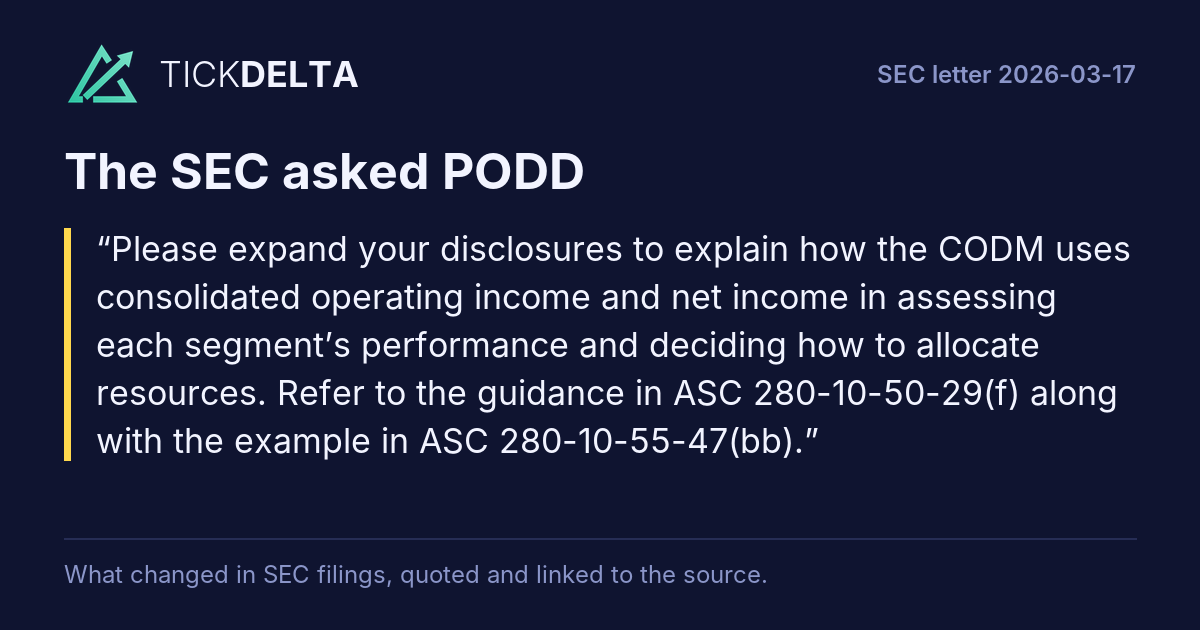
While the CODM and direct reports are provided with revenue for each component as noted above, the consolidated income statement is used by the CODM and direct reports to manage and assess the performance of the business. Specifically, the CODM utilizes consolidated revenue, gross margin, operating expenses and earnings before interest and taxes (EBIT) as key performance indicators. Decisions are made and resources are allocated based on consolidated operating results and non-financial information as discussed in the sections below.
Evaluation of Management Reporting Structure
Identification of Chief Operating Decision Maker
In order to properly identify segment management, we first identified our CODM. The Chief Executive Officer (CEO) has the overall responsibility of making managerial decisions for the Company and is considered the CODM. This conclusion was reached based on the fact that the CEO is the key operating decision maker for the Company and is the individual that allocates resources and assesses the operating results of the Company. The CEO views the Company as a consolidated organization focused on the manufacture and distribution of medical devices for subcutaneous drug delivery. Key operating decisions are made to drive the consolidated results of the organization.
Primary areas of focus for the CEO during 2015 included: 1) putting in place an effective team to capitalize on current opportunities, 2) improving product quality and positioning the current products for greater adoption, and 3) establishing product development roadmaps for the business to drive long-term growth. The ultimate goal was to maximize revenue and profits through the marketing and distribution of medical devices for subcutaneous drug delivery for diabetes and other medical needs utilizing the Company’s core OmniPod technology. Resource allocation decisions are made by the CEO utilizing consolidated financial results and other operational information. While there are separate components that constitute a business, those components simply represent ways in which the underlying technology is penetrating the market. In this regard, the allocation of resources is primarily based on improvement to the core technology and manufacturing capacity. For example, from a research and development standpoint, research and development is viewed as a shared service given that projects generally benefit multiple components as the same platform technology is utilized for subcutaneous drug delivery. Current projects which are aimed to benefit the organization include Bluetooth technology, mobile applications, and various types and sizes of pods that can handle different applications such as concentrated insulin or that can be used with other pharmaceuticals. As another example, from a commercial standpoint, decisions are made by the CEO leveraging know-how across the consolidated business regarding channel, pricing, and market access strategies.
Given this view, the CEO primarily focuses on consolidated results when assessing performance. While he is presented with revenue by component, the overall focus is market penetration and enhancements to the underlying device and, as such, while the component revenues are viewed as an indicator of market penetration, overall consolidated revenue is driving decision making. The CEO’s view of the business and his view that the Company had previously realized the synergies that were available from Neighborhood, were contributing factors driving the decision to pursue the divestiture of Neighborhood, which was sold to Liberty Medical LLC in February 2016, as it was no longer a significant growth driver for the consolidated business.
The Company has noted the following verifiable evidence that operating decisions are made at the consolidated level rather than the component level:
The Company’s annual performance-based cash bonus plan is based on consolidated results, specifically revenue and operating profitability (i.e. EBIT). It should be noted that the percentage of the portion of the bonus related to consolidated operating profitability is at the discretion of the Compensation Committee of the Board of Directors (BOD) (e.g. it is not automatically approved). Separate from corporate financial results, each individual of the executive team has a portion of their bonus (20%) that is contingent upon their achievement of personal goals set by the CODM. As of December 31, 2015, the only individual that had a portion of their bonus related to component performance was the President, Drug Delivery, and that was based on revenue growth and represented only approximately 5% of his bonus. While that portion of the bonus was based on component revenue growth, component operating profitability was not measured nor evaluated as a factor in his performance.
The BOD is provided with consolidated operating results; they are not provided with component-level information other than revenue.
The CODM is the sole key decision maker and authority over key operating business decisions is not delegated further.
A budget by department (based on the matrix organization structure discussed below) is generated solely to control spend at the functional level and to identify managers to oversee the budget allocated to those departments. Budgets are not generated nor managed at a business component level. The departments are viewed as corporate functions and a discrete measure of profit is not generated or reviewed for the departments.
In discussing the business on earnings calls, in press releases and SEC documents, the Company discusses revenue by component and consolidated revenue, gross margin and operating profitability. The Company does not discuss any discrete financial information for each component beyond revenue.
Identification of Segment Management
The Company evaluated its reporting structure for the purposes of identifying segment management under ASC 280 as of December 31, 2015.
The Company’s reporting structure is based on a matrix organization, under which the direct reports of the CODM are primarily responsible for functional departments, including sales and marketing, manufacturing and operations, research and development, quality and regulatory affairs, finance, legal, information technology and human resources. These individuals support the consolidated organization.
The following were the key positions within the executive team and direct reports of the CEO as of December 31, 2015:
The CEO was responsible for making final, overall managerial decisions for the consolidated Company.
The CFO oversaw the financial and IT related decisions for the business. The CFO also provided direct oversight to the General Manager of Neighborhood.
The Chief Commercial Officer (CCO) oversaw worldwide OmniPod revenue, as well as global selling and marketing initiatives. The CCO was also responsible for all OmniPod and Neighborhood customer service and reimbursement activities.
The President, Drug Delivery, oversaw the commercial development of the non-diabetes drug delivery component, including drug delivery revenue as well as selling and marketing efforts to leverage the OmniPod technology across new markets and increase market share.
The General Counsel oversaw legal and corporate compliance matters.
The EVP of Human Resources oversaw all HR, compensation, and benefit matters.
The VP, Advanced Technology & Engineering, oversaw all research and development (R&D) initiatives (e.g. OmniPod and non-diabetes drug delivery products).
The VP, Global Manufacturing and Operations, oversaw all Company-wide production, distribution, purchasing, and facilities related matters.
The VP, Quality Assurance and Regulatory Affairs, oversaw product quality and regulatory matters for all products sold by Insulet.
The VP, Investor Relations and Corporate Communications, oversaw communications between the Company and financial community and other parties as required.
Of the individuals noted above, three individuals that reported to the CODM were responsible for specific aspects of certain components of the business:
Chief Financial Officer
Beginning in mid-2015, the VP/General Manager of Neighborhood reported to the CFO. The VP/General Manager of Neighborhood did not report to the CODM before or after this change. The CFO began to oversee the VP/General Manager of Neighborhood after a decision by the CEO to explore/evaluate potential strategic opportunities for Neighborhood (see response to question #13 below). Since the time Neighborhood was acquired in 2011, a discrete measurement of component profit was available; however, this information was not shared or discussed with the CODM. Certain discrete financial information for Neighborhood was shared with the CFO starting in mid-2015 and was compiled for the purposes of evaluating strategic alternatives for the business. This information was not used by the CFO to assess the performance of the business, make key operating decisions, or allocate resources.
We have concluded that the VP/General Manager of Neighborhood did not meet the definition of a segment manager since he was not directly accountable to and did not discuss operating activities and financial results for Neighborhood with the CODM. We have also concluded that the CFO did not meet the definition of a segment manager since he did not manage the operating activities or review the financial results of Neighborhood other than to evaluate strategic alternatives for the business as discussed above.
Chief Commercial Officer
The CCO oversaw the commercial development of the OmniPod business globally (i.e. U.S. and International). The CCO was responsible for global OmniPod revenue as well as selling and marketing efforts of the OmniPod business, including managing customer service, identifying new patients and markets and driving revenue growth. The CCO was not responsible for the other operating functions that support the OmniPod business, such as manufacturing and distribution (managed by the VP, Global Manufacturing and Operations), research and development (managed by the VP of Advanced Technology and Engineering), regulatory matters (managed by the VP, Quality Assurance and Regulatory Affairs) or personnel matters (managed by the EVP of Human Resources) and was not evaluated based on the operating performance of the OmniPod business. The Company does not prepare discrete information for the OmniPod component beyond revenue, which was the only component information provided to and reviewed by the CCO.
Based on these considerations, we have concluded that the CCO did not meet the definition of a segment manager as she was not directly accountable for the operations of any business component, performance was not assessed based on financial performance for any individual business component and she did not review a discrete measure of profit for any business component.
President, Drug Delivery
The President, Drug Delivery, oversees the non-diabetes drug delivery product sales as well as commercial development of Drug Delivery opportunities; therefore he has a high level of responsibility over the Drug Delivery product line. His responsibility is primarily to manage the Company’s existing Drug Delivery relationships and explore new Drug Delivery opportunities and is not responsible for other operating functions of the Drug Delivery business, such as manufacturing and distribution (managed by VP Global Manufacturing), R&D (managed by VP of Advanced Tech), regulatory matters (managed by VP Quality Assurance and Regulatory Affairs) or personnel matters (EVP of Human Resources) and is not evaluated based on the operating performance of the Drug Delivery business outside of revenue growth. The Company does not prepare discrete financial information for the component beyond revenue, which is the only component information provided to and reviewed by the President, Drug Delivery.
Based on these considerations, we have concluded that the President, Drug Delivery did not meet the definition of a segment manager as he was not directly accountable for the operations of any business component, performance was not assessed based on financial performance for any individual business component (outside of revenue) and he did not review a discrete measure of profit for any business component.
The remaining executives, other than the CEO, oversaw functional areas across the organization such as human resources, manufacturing and supply chain operations, quality, legal, regulatory affairs and research and development, which do not represent components of the organization or potential operating segments. Therefore, these individuals did not meet the definition of a segment manager.
Conclusion
Based on our assessment, we have concluded that the Company’s CODM represents the sole segment manager within the organization. The CODM bases key operating decisions and the allocation of resources on the evaluation of the consolidated business as described in the sections above. A discrete measure of component profitability is not made available to the CODM nor any of his direct reports to assess the performance of the business. Therefore, the Company has a single reporting unit.