Screener / SEC EDGAR /CIK 0001530950 /10-K filed Nov 21, 2025, compared with Nov 15, 2024 /Numbers from the XBRL of the 10-Ks
NYSE Consumer staples · Packaged Foods

Post Holdings, Inc. POST

Compare with peers Embed
SEC comment letters, last 20 years

2 reviews of POST's filings by SEC staff

UPLOAD and CORRESP
Reviews 2 latest letter Feb 20, 2025
Questions asked 13 each answered in the company's own letter
No closing letter 0 reviews without a letter saying the staff completed it

When the SEC's staff reviews a filing, it writes to the company with numbered questions, and the company answers each one in a letter. SEC publishes the exchange once the review is over, at least 20 business days later. A question is not an accusation; most reviews end with the company adding detail to its next filing.

How the reviews went

Every review on EDGAR, from the first staff letter to the letter that closes it

  1. 1. Staff letters 3 UPLOAD
  2. 2. Questions in them 13 numbered comments
  3. 3. Company replies 3 CORRESP
  4. 4. Reviews closed 2 of 2 closing letter

Half the closed reviews took 82 days or less from the first letter to the closing letter.

Form 10-K for the Fiscal Year Ended September 30, 2024

2025-02-20 to 2025-03-10 · 2 questions · 1 letter from the SEC, 1 from the company
Review closed 2025-03-10
Non-GAAP measuresSegments
Note 20 - Stock-based Compensation · Stock Options, page 100
SEC asked (1)
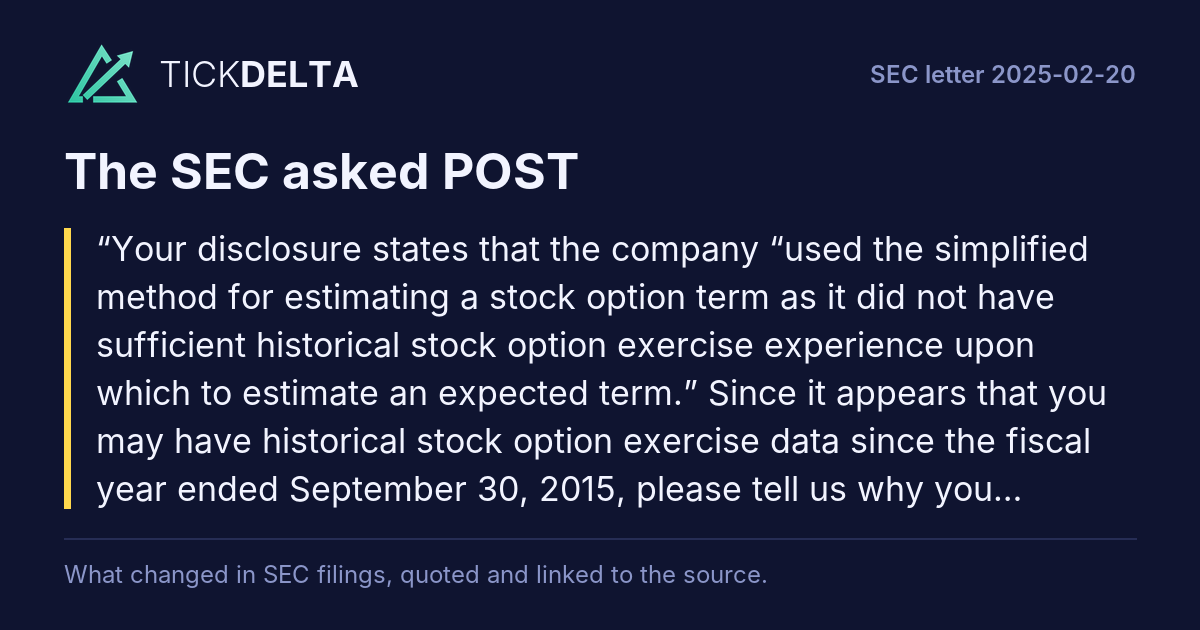
Your disclosure states that the company “used the simplified method for estimating a stock option term as it did not have sufficient historical stock option exercise experience upon which to estimate an expected term.” Since it appears that you may have historical stock option exercise data since the fiscal year ended September 30, 2015, please tell us why you believe it is appropriate to apply the simplified
Rest of the question

approach to determine the expected term of stock options. Refer to Question 6 of SAB Topic 14.D.2.

POST answered
Since its inception in 2012 through the fiscal year ended September 30, 2020, Post from time to time awarded stock options as a form of stock-based employee compensation under its long-term incentive plans. During this period, the Company considered both Accounting Standards Codification (“ASC”) Topic 718 and Staff Accounting Bulletin (“SAB”) Topic 14.D.2 to determine whether it had sufficient historical exercise data to provide a reasonable basis upon which to estimate the expected term for its stock options.

Since its inception in 2012 and prior to its most recent stock option grant in
Rest of the answer

November 2019, the Company had approximately 3.9 million stock option award exercises. Of these stock option award exercises, 3.15 million, or 82%, related to its former Chief Executive Officer (“CEO”), who has since the Company’s inception served as its Chairman of the Board of Directors. The compensation strategy for the Company’s former CEO was comprised solely of several stock option grants that were issued under agreements with terms, including exercise restrictions, that varied significantly from those of the Company’s standard form stock option agreement. As such, the Company concluded that the exercise patterns of the former CEO were not indicative of the exercise patterns of other stock option holders.

Of the remaining 0.75 million stock option award exercises, 0.7 million related to two former employees, both of whom were terminated from the Company and for which their stock option award agreements were modified to accelerate vesting, which modified the awards’ exercisable term. The remaining 0.05 million stock option award exercises related to two employees whose employment relationship with the Company was also modified. As such, the Company concluded that these exercise patterns were not indicative of the exercise patterns of other stock option holders. Therefore, the Company determined it did not have sufficient historical exercise data to provide a reasonable basis upon which to estimate the expected term and utilized the simplified method to estimate the expected term for its stock option awards.

Subsequent to the fiscal year ended September 30, 2020, the Company discontinued the use of stock options as a form of stock-based employee compensation. The Company believes it has since experienced a more normalized pattern of employee stock option award exercises. Should the Company resume issuing stock options as a form of stock-based employee compensation in the future, it would evaluate this period of historical exercise data in accordance with ASC Topic 718 and SAB Topic 14.D.2 when estimating the expected term for any such stock option awards.

Read in the reply
In its next report

First report after the company's reply of Feb 28, 2025: 10-Q filed May 9, 2025 ↗, against the 10-Q filed Feb 7, 2025 ↗.

Tickdelta does not hold the text of both reports, so they are not compared here.

Exhibit 99.1 · Reconciliation of Segment Profit to Adjusted EBITDA, page 15
SEC asked (2)
Please revise future filings to remove the total column of your reconciliation since consolidated segment profit would not be considered the most directly comparable GAAP financial measure to consolidated Adjusted EBITDA. Refer to Item 10(e)(1)(i)(B) of Regulation S-K.
POST answered
The Company respectfully acknowledges the Staff’s comment and confirms that, when presented in future filings, it will revise the reconciliation accordingly.
Read in the reply
In its next report

First report after the company's reply of Feb 28, 2025: 10-Q filed May 9, 2025 ↗, against the 10-Q filed Feb 7, 2025 ↗.

Tickdelta does not hold the text of both reports, so they are not compared here.

Also in this review: closing letter, 2025-03-10
Form 10-K

2022-07-01 to 2022-09-21 · 11 questions · 2 letters from the SEC, 2 from the company
Review closed 2022-09-21
ClimateResults discussion (MD&A)Risk factorsLegal and contingencies
After reviewing your response to these comments, we may have additional comments. General
SEC asked (1)
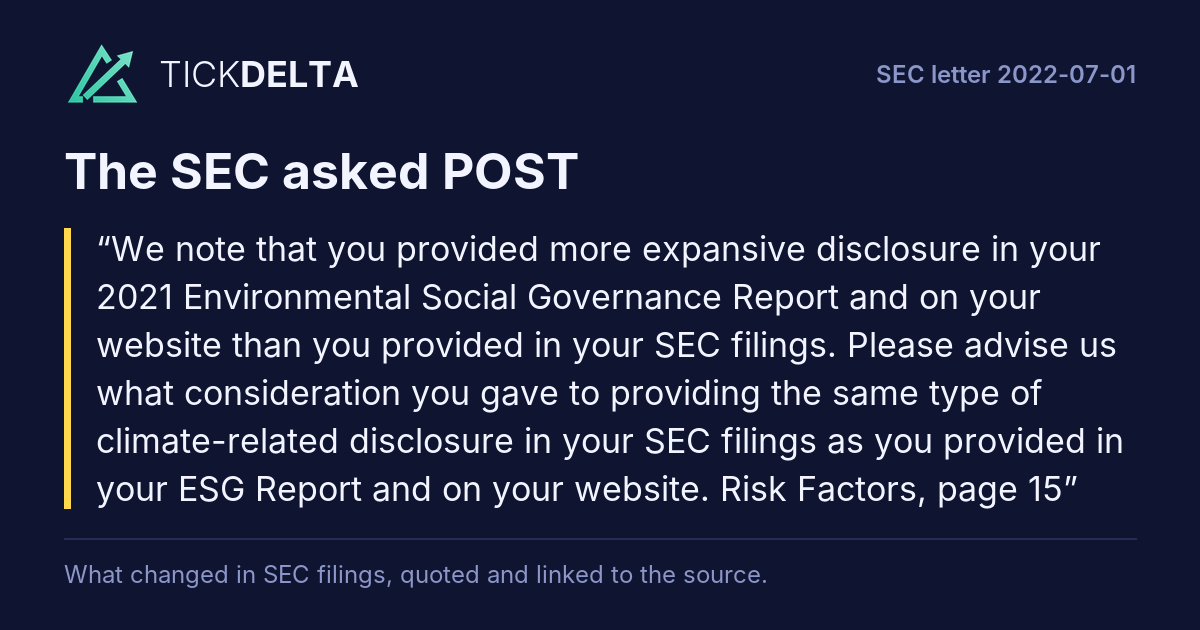
We note that you provided more expansive disclosure in your 2021 Environmental Social Governance Report and on your website than you provided in your SEC filings. Please advise us what consideration you gave to providing the same type of climate-related disclosure in your SEC filings as you provided in your ESG Report and on your website. Risk Factors, page 15
POST answered
As a consumer packaged goods holding company with businesses operating in the center-of-the-store, refrigerated, foodservice and food ingredient categories, we have stakeholders interested in a wide variety of matters related to our businesses. Such stakeholders include, among others, our employees, customers, consumers, suppliers, capital providers and investors.

The disclosures we provide in our SEC filings are primarily to satisfy our obligations under the securities laws and provide information that is “material” to our shareholders and the investing public.
Rest of the answer

In evaluating such disclosures, we assess applicable disclosure requirements under the United States (the “U.S”) securities laws and regulations and interpretations thereof, as well as additional factors such as the nature of the information, the context of the communication and the information that is available at the time of the communication. For example, while not included in our 2021 Form 10-K, our definitive proxy statement for our 2022 annual shareholders’ meeting filed on December 6, 2021 provided disclosure regarding our environmental sustainability goals and initiatives, since we believe this information may be useful to some of our shareholders in their assessment of management’s and the Board of Directors’ leadership of our Company.

We provide information on our website and in various other public disclosures, including in our 2021 Environmental, Social and Governance Report (the “ESG Report”), that may be useful or of interest to our different stakeholders for a variety of reasons even when such information may not have a material effect on our business or operating results. When we identify information included on our website or in the ESG Report that meets the standards of materiality under the securities laws, we include the material information in our SEC filings. For example, while our specific ESG goals and initiatives may not be material for SEC reporting purposes, we recognize that climate change could have an adverse impact on our business as disclosed in our risk factors disclosure in our 2021 Form 10-K on page 23 under the risk factor “Climate change, or legal or market measures to address climate change, may negatively affect our businesses, reputation and operations.”

Even though we determined that the information in our ESG Report, including our ESG initiatives and goals, was not material for purposes of our 2021 Form 10-K, we acknowledge the general effects of climate change as well as the public interest in the topic, which is one of the reasons that we disclose information about climate change and other related topics on our website, in the ESG Report and in other public disclosures.

We acknowledge our obligation to continuously review these matters as part of our ongoing disclosure controls and procedures and to disclose climate change related matters in our SEC filings to the extent we determine that such disclosure is required.

Read in the reply
In its next report

First report after the company's reply of Jul 15, 2022: 10-Q filed Aug 5, 2022 ↗, against the 10-Q filed May 6, 2022 ↗.

Tickdelta does not hold the text of both reports, so they are not compared here.

After reviewing your response to these comments, we may have additional comments. General
SEC asked (2)
Disclose the material effects of transition risks related to climate change that may affect your business, financial condition, and results of operations, such as policy and regulatory changes that could impose operational and compliance burdens, market trends that may alter business opportunities, credit risks, or technological changes.
POST answered
Post maintains a global risk and opportunity assessment process based upon the recommendations of the Task Force on Climate-Related Financial Disclosures. Through this process, Post evaluates and monitors transition risks related to climate change, which may include policy and regulatory changes that could impose operational and compliance burdens, market trends that may alter business opportunities, credit risks and technological changes.

With regard to policy and regulatory changes, the risks most directly relevant to our business, carbon pricing and greenhouse gas (“GHG”) emissions
Rest of the answer

reporting obligations, have not had a material impact on our operations for the periods covered by our 2021 Form 10-K. Specifically, our manufacturing operations in the United Kingdom (the “UK”) participate in the UK Emissions Trading Scheme, and for the periods covered by our 2021 Form 10-K, the financial impact of our participation in this program was not material (approximately $1.4 million, $0.8 million and $0.8 million in fiscal years 2021, 2020 and 2019, respectively). While we continue to monitor for new or changing carbon pricing programs that may impact our business, we do not currently expect the impacts of carbon pricing programs to be material to us in the future. However, we acknowledge that as additional carbon pricing programs become applicable to us, such risks could become more significant to our business. For this reason, we include disclosure in our risk factors regarding the potential for climate change to increase our input costs in our risk factor “Increased input costs, including costs for freight, raw materials, energy and other supplies, or limited availability of such inputs could negatively impact our businesses, financial condition, results of operations and cash flows” on page 17 of our 2021 Form 10-K and in our risk factor “Climate change, or legal or market measures to address climate change, may negatively affect our businesses, reputation and operations” on page 23 of our 2021 Form 10-K. Similarly, while Post is required to track and report GHG emissions as part of state and/or federal requirements, we do not track these costs separately as we consider them to be routine, non-incremental costs of doing business.

With regard to market trends, Post acknowledges the potential for these factors to have an impact on its businesses. Specifically, under our risk factor “We must identify changing consumer and customer preferences and behaviors and develop and offer products to meet these preferences and behaviors” on page 18 of our 2021 Form 10-K, we discuss the need to identify changing consumer preferences and behaviors, including certain preferences regarding environmental, social and governance (“ESG”) matters.

With regard to credit risks, we acknowledge that financial markets are increasingly considering and trying to price the climate change exposure of listed companies, which could potentially adversely impact the creditworthiness of a company. Post engages with capital providers directly on ESG topics to understand and manage any potential credit risks, and to date, we have not identified climate change as having an impact on our ability to access credit markets.

With regard to technological risks, Post evaluates the availability, viability and return on investment of technological improvements and innovations. We acknowledge the potential for such technological investments to increase our input costs and refer to our risk factor “Increased input costs, including costs for freight, raw materials, energy and other supplies, or limited availability of such inputs could negatively impact our businesses, financial condition, results of operations and cash flows” on page 17 of our 2021 Form 10-K for a discussion of the potential impacts of increasing costs on us. We also acknowledge the risks related to technology failures under the risk factor “Technology failures, cybersecurity incidents or breaches of our data privacy protections could disrupt our operations and negatively impact our businesses” on page 31 of our 2021 Form 10-K. We respectfully believe that climate change transition considerations are not the only source of these types of risk and our risk factors disclosure adequately describes the risks presented by each of these factors.

As we recognize that this is a dynamic and evolving topic, we will continue to monitor the potential effects of transition risks related to climate change and, if such risks are considered likely to have a material effect on our business, financial condition or results of operations, will evaluate updating our disclosures in future SEC filings as appropriate if circumstances change.

Read in the reply
In its next report

First report after the company's reply of Jul 15, 2022: 10-Q filed Aug 5, 2022 ↗, against the 10-Q filed May 6, 2022 ↗.

Tickdelta does not hold the text of both reports, so they are not compared here.

After reviewing your response to these comments, we may have additional comments. General
SEC asked (3)
Disclose any material litigation risks related to climate change and explain the potential impact to the company.
POST answered
We regularly review, including in consultation with our internal cross-functional disclosure committee, litigation matters in connection with our reporting process for our SEC filings to identify any material pending or threatened litigation matters. With regard to material pending litigation matters, we include disclosure in our Forms 10-K and Forms 10-Q as is required by Item 103 of Regulation S-K.
Rest of the answer

As part of our review process, we have not identified any climate change related litigation pending as of our most recent Form 10-Q filed on May 6, 2022.

While we have no indication that our industry is susceptible to significant litigation related to climate change, we acknowledge the potential for climate change litigation to have an adverse impact on our business and refer the Staff to our risk factors disclosure on page 33 of our 2021 Form 10-K under the risk factor “We are subject to environmental laws and regulations that can impose significant costs and expose us to potential financial liabilities” and page 31 of our 2021 Form 10-K under the risk factor “Pending and future litigation may impair our reputation or cause us to incur significant costs.” We respectfully believe these risk factors set forth the risks related to climate change litigation to our Company.

We will continue to monitor for climate change related litigation risks and will evaluate revising our disclosures in future SEC filings as appropriate if circumstances change.

Read in the reply
In its next report

First report after the company's reply of Jul 15, 2022: 10-Q filed Aug 5, 2022 ↗, against the 10-Q filed May 6, 2022 ↗.

Tickdelta does not hold the text of both reports, so they are not compared here.

Management's Discussion and Analysis of Financial Condition and Results of Operations, page
SEC asked (4)
Revise your disclosure to identify any material past and/or future capital expenditures for climate-related projects. Please include quantitative information for the periods covered by your Form 10-K and for future periods as part of your response.
POST answered
We advise the Staff that, to date, we have not incurred material capital expenditures for climate-related projects. Our annual Form 10-K preparation process includes a robust review of applicable disclosure standards, and through that process, we concluded that our capital investments in climate-related projects for the periods covered by our 2021 Form 10-K have not materially impacted and are not expected to materially impact our results of operations or financial condition.
Rest of the answer

We assess materiality of investments in climate-related projects for purposes of disclosure within our Forms 10-K relative to our overall annual capital expenditures.

To determine whether our investments in climate-related projects have had or are expected to have a material impact on our results of operations or financial condition, we consider required capital expenditures necessary to meet current or upcoming climate-related regulations or that are required in response to damage from climate-related events as well as voluntary capital expenditures which continuously modernize our facilities and may reduce the climate-related impacts of our operations. Capital expenditures for climate-related projects mandated by regulatory requirements and voluntary climate-related capital expenditures during the periods covered by our 2021 Form 10-K were not material and represented less than 1% of our annual capital expenditures for such periods.

As part of our annual capital planning process, we evaluate any pending or potential climate-related regulations related to the industry and geographies in which we operate. We do not believe these investments will significantly differ from, nor will they be materially incremental to, investments we make in the normal course of our business.

We acknowledge that this is a dynamic and evolving area and will continue to monitor our climate-related capital investments. In the future, if climate-related capital investments, either mandated by regulatory requirements or made voluntarily, become material, we will evaluate the proper disclosure of such investments in our SEC filings.

Read in the reply
In its next report

First report after the company's reply of Jul 15, 2022: 10-Q filed Aug 5, 2022 ↗, against the 10-Q filed May 6, 2022 ↗.

Tickdelta does not hold the text of both reports, so they are not compared here.

Management's Discussion and Analysis of Financial Condition and Results of Operations, page
SEC asked (5)
To the extent material, discuss the indirect consequences of climate-related regulation or business trends, such as the following: • decreased demand for goods that produce significant greenhouse gas emissions or are related to carbon-based energy sources; • increased demand for goods that result in lower emissions than competing products; • increased competition to develop innovative new products that result in
Rest of the question

lower emissions; • increased demand for generation and transmission of energy from alternative energy sources; and • any anticipated reputational risks resulting from operations or products that produce material greenhouse gas emissions.

POST answered
Consumer Demand for Goods (Decreased Demand for Goods that Produce Significant GHG Emissions or are Related to Carbon-Based Energy Sources; and Increased Demand for Goods that Result in Lower Emissions than Competing Products) and Increased Competition to Develop Innovative New Products that Result in Lower Emissions – As a consumer packaged goods company, we recognize the importance of understanding, and offering products to meet, consumer preferences.
Rest of the answer

In our risk factors disclosure on page 18 of our 2021 Form 10-K under the risk factor “We must identify changing consumer and customer preferences and behaviors and develop and offer products to meet these preferences and behaviors,” we discuss this risk in detail and identify the various factors that may impact consumer buying decisions, including consumer awareness and attention to certain ESG topics. However, while we believe that ESG considerations sometimes impact consumer buying decisions, to date, we have not identified demand trends related to such considerations. In addition, in our risk factors disclosure on page 18 of our 2021 Form 10-K under the risk factor “We operate in categories with strong competition,” we identify competition in the categories in which we operate as being based on, among other factors, our ability to identify and satisfy dynamic, emerging consumer preferences. We closely monitor our direct peers and their product portfolios and, to date, have not identified competitive pressures resulting from lower emission goods. We are working to develop products and brands that have a reduced impact on climate change. To date, sales of these products have been minimal. Because we acknowledge that this is a dynamic and evolving area, we will continue to monitor consumer demand trends and competition from lower emission goods and will evaluate updating our future SEC filings as appropriate if circumstances change.

Alternative Energy Source Demand – Post has a process to evaluate on a site-by-site basis the current and projected availability of alternative energy sources. Through this process, Post has identified five of its manufacturing locations with currently viable alternative energy source options available and is pursuing projects at those locations. We currently do not expect that such projects will result in incremental capital or operating costs to us. However, we acknowledge the potential for our costs to increase as we continue to explore, identify and implement alternative energy sources across our Company. Specifically, in our risk factors disclosure on page 23 of our 2021 Form 10-K under the risk factor “Climate change, or legal or market measures to address climate change, may negatively affect our businesses, reputation and operation,” we discuss the potential for increases in our costs as a result of additional requirements to reduce or mitigate the effects of GHG emissions. In addition, in our risk factors disclosure on page 17 of our 2021 Form 10-K under our risk factor “Increased input costs, including costs for freight, raw materials, energy and other supplies, or limited availability of such inputs could negatively impact our businesses, financial condition, results of operations and cash flows,” we discuss the potential for our input costs to increase, which could result from changing governmental regulations or programs or alternative energy sourcing. Because we acknowledge that this is a dynamic and evolving area, we will continue to monitor the availability of alternative energy sources and will evaluate updating our future SEC filings as appropriate if circumstances change.

Reputational Risks – We acknowledge that our reputation is critical to the success of our business and the risk that our reputation could be impaired as a result of the perception that we have acted in an irresponsible manner. In our risk factors disclosure on page 19 of our 2021 Form 10-K under the risk factor “Our results may be adversely impacted if consumers do not maintain favorable perceptions of our brands,” we discuss the importance of maintaining and continually enhancing the value of our brands and identify that such value could be impaired as a result of consumer perception that we have acted irresponsibly. In addition, in our risk factors disclosure on page 23 of our 2021 Form 10-K under the risk factor “Climate change, or legal or market measures to address climate change, may negatively affect our businesses, reputation and operations,” we identify that our businesses could be adversely affected if we are unable to effectively address increased concerns from stakeholders on climate change.

In our ESG Report, we undertake to respond to the moral and economic imperatives created by the impact we have on our environment. As a general matter, we believe that our stakeholders have been supportive of our ESG initiatives. In addition, we engage with various stakeholders on ESG topics. While we have not identified any reputational concerns resulting from climate change, we acknowledge that this is a dynamic and evolving area, will continue to monitor this topic and will evaluate updating our disclosures in our future SEC filings as appropriate if circumstances change.

Read in the reply
In its next report

First report after the company's reply of Jul 15, 2022: 10-Q filed Aug 5, 2022 ↗, against the 10-Q filed May 6, 2022 ↗.

Tickdelta does not hold the text of both reports, so they are not compared here.

Management's Discussion and Analysis of Financial Condition and Results of Operations, page
SEC asked (6)
If material, discuss the physical effects of climate change on your operations and results. This disclosure may include the following: • quantification of material weather-related damages to your property or operations; • potential for indirect weather-related impacts that have affected or may affect your major customers; and • any weather-related impacts on the cost or availability of insurance.
Rest of the question

Include quantitative information for each of your last three fiscal years as part of your response and tell us whether changes are expected in future periods.

POST answered
Direct Weather-Related Damages – Post has not experienced any material weather-related property damage within the last three fiscal years, with management estimating that such damage in the last three fiscal years was less than 1% of the cost of goods sold for each respective fiscal year. In isolated instances, some of our facilities have sustained minor damage from weather-related incidents, including, as examples only, hail damage to roofs and frozen pipes, the costs of which were substantially below our applicable insurance deductibles for such incidents.
Rest of the answer

In addition, on occasion, some of our facilities have experienced temporary weather-related impacts on production, including, as examples only, modified production schedules due to snow and ice storms. Management estimates that the impact of these isolated situations for the last three fiscal years was not material and has been less than 1% of the cost of goods sold for each respective fiscal year. While we acknowledge the potential for weather-related events to damage our property, and we note our risk factors disclosure on page 23 of our 2021 Form 10-K under the risk factor “Climate change, or legal or market measures to address climate change, may negatively affect our businesses, reputation and operations,” which discusses this risk, we currently do not expect the impact of these direct weather-related events to be material in future periods. We acknowledge that this is an area requiring ongoing review, and we will continue to monitor for such weather-related events and will evaluate including disclosures in our future SEC filings as appropriate if circumstances change.

Indirect Weather-Related Impacts Affecting Major Customers – Our major customers include grocery stores, mass merchandise customers, convenience stores, foodservice distributors, restaurant chains and eCommerce. Our major customers have broad geographic footprints that are inherently susceptible to occasional weather-related impacts, including, as examples only, snow and ice storms. Such situations, when they occur, tend to be isolated and temporary in nature. In connection with our annual and quarterly SEC reporting, we have a robust disclosure committee review process that is intended to identify material events impacting our businesses, including weather-related events, and no such material weather-related events were identified in the periods covered by our 2021 Form 10-K. We acknowledge that ongoing monitoring of indirect weather-related impacts to our business is required, and we will evaluate including disclosures in future SEC filings as appropriate if weather-related events materially impacting our business occur.

Weather-Related Impacts on the Cost or Availability of Insurance – As discussed under “Direct Weather-Related Damages” above, Post has not experienced any material weather-related property damage within the last three fiscal years, and weather-related events have not impacted the availability of insurance to Post. Our property insurance premiums have increased, by less than 0.3% of cost of goods sold during the fiscal years covered by our 2021 Form 10-K, due to general insurance market conditions and Post-specific property losses unrelated to weather, including, as examples only, equipment and facility fires. We currently do not expect to experience material weather-related impacts on the cost or availability of insurance in the future, but we acknowledge that this is a dynamic and changing area, will continue to monitor for such an impact and will evaluate including disclosures as appropriate in our future SEC filings if circumstances change.

Read in the reply
In its next report

First report after the company's reply of Jul 15, 2022: 10-Q filed Aug 5, 2022 ↗, against the 10-Q filed May 6, 2022 ↗.

Tickdelta does not hold the text of both reports, so they are not compared here.

Management's Discussion and Analysis of Financial Condition and Results of Operations, page
SEC asked (7)
We note your disclosure on page 33 of your Form 10-K stating that you may be required to incur additional costs to comply with more stringent environmental laws and regulations. Tell us about and quantify any compliance costs related to climate change for the last three fiscal years and explain whether increased amounts are expected to be incurred in future periods.
POST answered
We believe that carbon pricing, which we discuss in response to Comment 2 above, is our most relevant compliance cost related to climate change, and it has not had a material impact on our operations for the periods covered by our 2021 Form 10-K. Specifically, our manufacturing operations in the UK participate in the UK Emissions Trading Scheme, and for the periods covered by our 2021 Form 10-K, the financial impact of our participation in this program was approximately $1.4 million, $0.8 million and $0.8 million in fiscal years 2021, 2020 and 2019, respectively.
Rest of the answer

Additional information about our carbon credit purchases is set forth in our response to Comment 8 below. While we continue to monitor for new or changing carbon pricing programs that may impact our business, we currently do not expect the impacts of carbon pricing programs to be material to us in the future. We acknowledge that this is a dynamic and evolving area, will continue to monitor for material impacts to us and will evaluate updating our disclosures in our future SEC filings as appropriate if circumstances change.

Post also is required to disclose GHG emissions data to federal and state agencies. Post tracks emissions data comprehensively across its operations; however, we do not separately track the cost of this data collection and reporting as we consider those activities as part of our routine day-to-day business activities. We acknowledge the evolving regulatory landscape in this area, which could potentially result in increased compliance costs in future periods. We will continue to monitor the new and changing regulatory requirements in this area for material impacts to us and will evaluate updating our disclosures in our future SEC filings as appropriate if circumstances change.

Read in the reply
In its next report

First report after the company's reply of Jul 15, 2022: 10-Q filed Aug 5, 2022 ↗, against the 10-Q filed May 6, 2022 ↗.

Tickdelta does not hold the text of both reports, so they are not compared here.

Management's Discussion and Analysis of Financial Condition and Results of Operations, page
SEC asked (8)
If material, provide disclosure about your purchase or sale of carbon credits or offsets and any material effects on your business, financial condition, and results of operations. Provide us with quantitative information regarding your purchase or sale of carbon credits or offsets during the last three fiscal years and amounts budgeted for future periods.
Rest of the question

We remind you that the company and its management are responsible for the accuracy and adequacy of their disclosures, notwithstanding any review, comments, action or absence of action by the staff.

POST answered
Post has not sold carbon credits or offsets and does not plan to do so. We have voluntarily purchased carbon credits in the U.S. In the UK, we have purchased carbon credits because of our participation in the UK Emissions Trading Scheme. Collectively, our purchases of carbon credits have not been financially material in any of the last three fiscal years (approximately $1.4 million, $0.8 million and $0.8 million in fiscal years 2021, 2020 and 2019, respectively) and currently are not expected to be material in the future.
Rest of the answer

We acknowledge that this is a dynamic and changing area, and we will continue to monitor for material impacts to us and will evaluate updating our disclosures in our future SEC filings as appropriate if circumstances change.

Read in the reply
In its next report

First report after the company's reply of Jul 15, 2022: 10-Q filed Aug 5, 2022 ↗, against the 10-Q filed May 6, 2022 ↗.

Tickdelta does not hold the text of both reports, so they are not compared here.

Risk Factors, page 15
SEC asked (1)
We note your response to prior comment 2 regarding the transition risks related to climate change. As it relates to market trends, you note disclosure that refers to environmental concerns regarding packaging, but it is not clear how you considered providing disclosure regarding the processes through which your products are manufactured.
Rest of the question

Tell us how you considered providing disclosure regarding this transition risk and its effects on your business, financial condition, and results of operations. In this regard, it appears that you are implementing projects to improve efficiency, such as the projects in bran and rice manufacturing that seek to increase production capacity without any increase in energy usage, as discussed in your ESG Report. Also, as your response appears to state that climate change transition considerations are a source of technological risk, tell us how your disclosure addresses climate change in this context.

POST answered
As previously discussed in our response to prior comment 1 in the Prior Response Letter, the disclosures we provide in our SEC filings are primarily to satisfy our obligations under the securities laws and provide information that is “material” to our shareholders and the investing public. Our annual Form 10-K preparation process includes a robust review of applicable disclosure standards, as well as a process by which we consider, evaluate and incorporate information from each of our businesses.
Rest of the answer

We also have an internal cross-functional disclosure committee that reviews and provides feedback on our disclosures.

We respectfully refer the Staff to our response to prior comment 4 in the Prior Response Letter, wherein we stated that capital expenditures for climate-related projects mandated by regulatory requirements and voluntary climate-related capital expenditures during the periods covered by the 2021 Form 10-K were not material and represented less than 1% of our annual capital expenditures for such periods. In addition, we stated that, as part of our annual capital planning process, we evaluate any pending or potential climate-related regulations related to the industry and geographies in which we operate, and we do not believe these investments will significantly differ from, nor will they be materially incremental to, investments we make in the normal course of our business. On this basis, we do not believe that further disclosure regarding transition risks for the processes through which our products are manufactured is warranted. However, we do acknowledge that this is a dynamic and evolving area, and we will continue to monitor these risks and will evaluate updating our future SEC filings as appropriate if circumstances change.

Similarly, with regard to the projects in bran and rice manufacturing referenced in our 2021 Environmental, Social and Governance Report (the “2021 ESG Report”), while these projects have a benefit from an environmental perspective, such projects were not undertaken for such purpose. As stated in the 2021 ESG Report, these bran and rice manufacturing projects were implemented to increase production capacity and reduce system bottlenecks. As a result, we do not believe that these projects, or other similar projects, pertain to climate change transition risk during the periods covered by the 2021 Form 10-K.

With regard to technological risks, we referenced two risk factors from the 2021 Form 10-K in our response to prior comment 2 in the Prior Response Letter, which discuss in detail the technological risks that we face. We respectfully advise the Staff that our technological risks are affected by a multitude of factors. While there may be transition risks related to climate change in the area of technology, we have not determined such risks to be separate and distinct from the overall risks related to technology for which disclosure has been made in the 2021 Form 10-K. As we recognize that this is a dynamic and evolving topic, we will continue to monitor the potential effects of transition risks related to climate change in the area of technology, and if such risks are considered likely to have a material effect on our business, financial condition or results of operations and are determined to be separate and distinct from other technological risks we face in our business, we will evaluate updating our disclosures in future SEC filings as appropriate if circumstances change.

Read in the reply
In its next report

First report after the company's reply of Aug 23, 2022: 10-K filed Nov 17, 2022 ↗.

No earlier 10-K before the SEC's letter is in Tickdelta, so there is nothing to compare with.

Management's Discussion and Analysis of Financial Condition and Results of Operations, page
SEC asked (2)
Your response to 5 acknowledges the potential for costs to increase as you continue to explore, identify, and implement alternative energy sources and cites disclosure in your Form 10-K. However, it does not appear that disclosure addresses the potential for your input costs to increase from alternative energy sourcing.
Rest of the question

Please clarify where this disclosure is provided in your Form 10-K or revise to include language similar to that in your response.

POST answered
As previously mentioned in our response to prior comment 5 in the Prior Response Letter under “Alternative Energy Source Demand,” we acknowledge the potential for our costs to increase due to alternative energy sourcing. In the risk factor “Increased input costs, including costs for freight, raw materials, energy and other supplies, or limited availability of such inputs could negatively impact our businesses, financial condition, results of operations and cash flows” on page 17 of the 2021 Form 10-K, we discuss the potential for our energy costs to increase due to factors beyond our control,
Rest of the answer

naming some of the more significant factors that could cause such costs to increase.

We respectively advise the Staff that our input costs may increase due to a multitude of factors. As further discussed in our response to prior comment 5 in the Prior Response Letter under “Alternative Energy Source Demand,” we currently do not expect the alternative energy projects that we are currently pursuing to result in incremental capital or operating costs to us. In addition, we further explained in our response to prior comment 4 in the Prior Response Letter that, as part of our annual capital planning process, we evaluate any pending or potential climate-related regulations related to the industry and geographies in which we operate, which would include the need for alternative energy sourcing, and we do not believe these investments in alternative energy projects will significantly differ from, nor will they be materially incremental to, investments we make in the normal course of our business. As a result, the Company does not believe that the risk for input costs to rise due to alternative energy sources is individually material, such that it would need to be separately identified, or materially different from the overall risks related to our input costs for which disclosure has been made, in the 2021 Form 10-K.

Because we acknowledge that this is a dynamic and evolving area, we will continue to monitor the availability and costs of alternative energy sources and will evaluate updating our future SEC filings to specifically name actual or potential increases in energy costs from converting to alternative energy sourcing as appropriate if circumstances change.

Read in the reply
In its next report

First report after the company's reply of Aug 23, 2022: 10-K filed Nov 17, 2022 ↗.

No earlier 10-K before the SEC's letter is in Tickdelta, so there is nothing to compare with.

Management's Discussion and Analysis of Financial Condition and Results of Operations, page
SEC asked (3)
In response to prior comment 5, you refer to disclosure in your Form 10-K which states that the "perception of a failure to act responsibly with respect to the environment can lead to adverse publicity, which could damage our reputation." However, it does not appear that this disclosure adequately describes the consequences of this risk (i.e., the manner in which your businesses could be adversely affected if you
Rest of the question

are unable to effectively address increased concerns from stakeholders on climate change). Please revise your disclosure to provide this type of information.

POST answered
We respectfully advise the Staff that, as explained at the beginning of our Risk Factors section on page 15 of the 2021 Form 10-K, many of the risks discussed in the Risk Factors section are interrelated. In the risk factor “Climate change, or legal or market measures to address climate change, may negatively affect our businesses, reputation and operations” on page 23 of the 2021 Form 10-K, we explain that “our businesses could be adversely affected if we are unable to effectively address increased concerns from the media, shareholders and other stakeholders on climate change.” In the risk
Rest of the answer

factor “We must identify changing consumer and customer preferences and behaviors and develop and offer products to meet these preferences and behaviors” on page 18 of the 2021 Form 10-K, we discuss the need to identify and meet changing consumer and customer preferences, including certain preferences on environmental, social and governance (“ESG”) topics, and explain that any significant changes in consumer or customer preferences and behaviors and our inability to anticipate or react to such changes could result in reduced demand for our products, which could negatively impact our businesses, financial condition, results of operations and cash flows. However, as we explained in our response to prior comment 5 in the Prior Response Letter under “Consumer Demand for Goods . . . ,” while we believe ESG considerations sometimes impact consumer buying decisions, to date, we have not identified demand trends related to such considerations. In addition, in our risk factor “Our results may be adversely impacted if consumers do not maintain favorable perceptions of our brands” on page 19 of the 2021 Form 10-K, we discuss the potential for an adverse impact to our businesses if consumers do not maintain favorable perceptions of our brands, including as a result of the perception that we have acted irresponsibly. As a result, we respectfully believe that our risk factors in the 2021 Form 10-K adequately address the reputational risks related to climate change. Nevertheless, if circumstances change, in future SEC filings, we will consider adding detail under our specific climate change risk factor as to how our businesses could be adversely impacted if we are unable to address climate change concerns from stakeholders.

Read in the reply
In its next report

First report after the company's reply of Aug 23, 2022: 10-K filed Nov 17, 2022 ↗.

No earlier 10-K before the SEC's letter is in Tickdelta, so there is nothing to compare with.

Also in this review: closing letter, 2022-09-21

From the SEC's correspondence on EDGAR: staff letters (form UPLOAD) and company letters (form CORRESP), 8 letters filed since 2022-07-01. Questions and answers are matched by their numbers; topics come from words in each question. The reports are compared word for word (same form, before the first SEC letter against the first report after the company's reply). No AI.

Sources

The SEC's correspondence on EDGAR: staff letters (form UPLOAD) and company letters (form CORRESP), matched question by question. No AI.

Also

Filings: the letters in the filing list.

Work with it

Excel workbook · CSV. Google Sheet that stays up to date: paste =IMPORTDATA("https://tickdelta.com/company/POST/export.csv") into a cell.

Next in Owners and insiders:Insider trades
Esc

Type a ticker such as AAPL, a name, an investor such as Buffett, or a topic such as tariffs. ↑ ↓ to move, Enter to open.