The Company provides below the additional clarifying information that the Staff has requested for each of the elements of the foregoing comment.
A. The Proxy Statement does not require financial information relating to the Silverback acquisition.
On December 22, 2016, the Staff confirmed in a letter from Patrick Gilmore, Associate Chief Accountant, that the Company would not be required to provide financial information under Rule 3-05 of Regulation S-X with respect to the acquisition.
Rest of the answer
The Staff’s letter was issued in response to the Company’s letter, dated December 9, 2016, requesting a waiver from an otherwise anomalous result under Rule 3-05. While the Company’s letter was focused on its financial statement obligations in connection with its post-closing Current Report on Form 8-K relating to the Silverback acquisition, the requested waiver also extended to any financial statements that could otherwise be required in a resale registration statement for the shares issued in the related private placements or in the Proxy Statement. Copies of the Company’s letter and the Staff’s letter are attached hereto as Exhibit A.
The Company respectfully submits that this is an independently sufficient basis for excluding financial information relating to the Silverback acquisition from the Proxy Statement. However, the Company also submits that, based on the specific facts and circumstances of the acquisition, Schedule 14A does not require the additional information referenced in the foregoing comment.
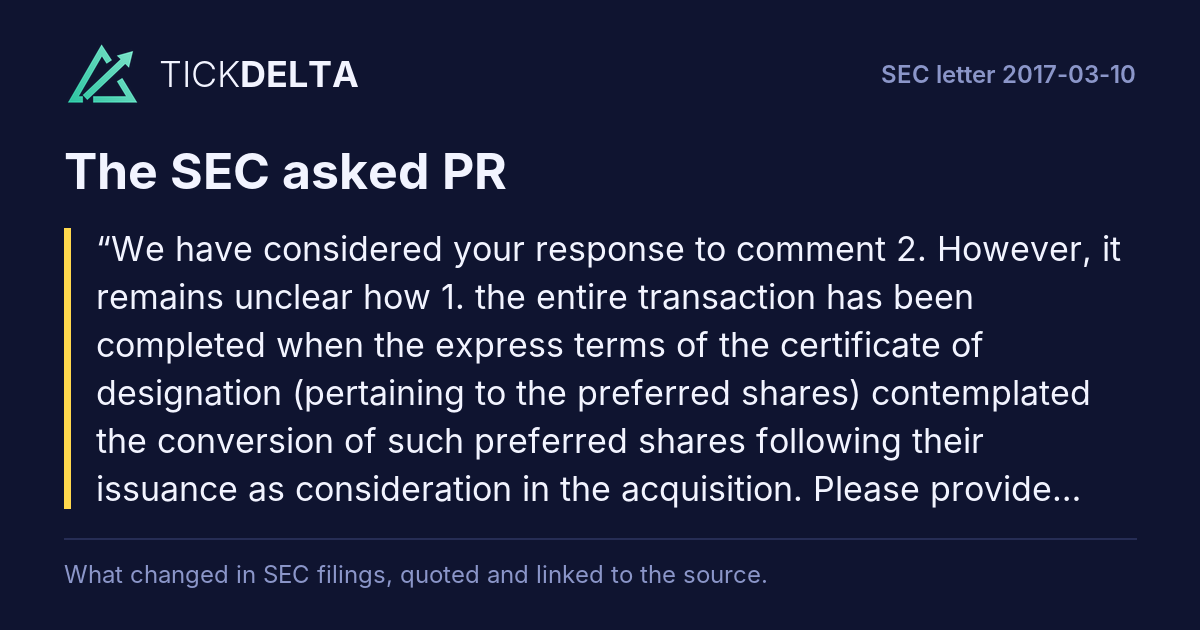
B. The Silverback acquisition was completed on December 28, 2016, irrespective of the conversion mechanism in the certificate of designation relating to the Series B Preferred Stock issued to partially fund the acquisition.
The Company respectfully submits that the stockholder vote on the issuance of Class A Common Stock upon the conversion of the Series B Preferred Stock is a separate matter from the Silverback acquisition and should not be considered a part of the Silverback acquisition transaction. The outcome of the stockholder vote on the conversion of the Series B Preferred Stock (either for or against) will have no impact on the completed Silverback acquisition transaction, which closed on December 28, 2016. Whether or not the shares of Series B Preferred Stock are ultimately converted into shares of Class A Common Stock, the Silverback acquisition transaction, and its funding, are already complete in all respects. The Company’s stockholders will not vote on whether to approve that transaction, and the Company is neither required, nor does it intend, to solicit the approval of its stockholders to determine whether the acquisition will occur. As of the closing date of the Silverback acquisition, the Company irrevocably became the legal owner of all right, title and interest in and to the acquired assets without regard to any future events or contingencies.
C. The information contemplated by Item 14 of Schedule 14A is inapplicable to the decision to be made by the stockholders on the NASDAQ Proposal, and the inclusion of such information in the Proxy Statement may instead cause confusion.
As discussed above, the approval of, or failure to approve, the NASDAQ Proposal by the Company’s stockholders can have no effect on the already consummated Silverback acquisition. The information contemplated by Item 14 of Schedule 14A, therefore, is not relevant to the decision now before the Company’s stockholders (whether or not the Series B Preferred Stock will be converted into Class A Common Stock or remain outstanding), and its inclusion in the Proxy Statement may instead cause confusion about the nature of the NASDAQ Proposal and mislead stockholders to believe that a vote against the NASDAQ Proposal is a vote against the consummation of the Silverback acquisition. The Company is, however, willing to provide any additional information that the Staff believes would assist stockholders in evaluating the impact of the vote on the NASDAQ Proposal on the Company and their interests therein. In particular, the Company would propose including expanded disclosure in the Proxy Statement regarding (i) the dilutive impact of a conversion of the Series B Preferred Stock on the voting interests of the holders of Class A Common Stock and/or (ii) the potential cost of a later redemption of the Series B Preferred Stock if the Company elects to redeem the outstanding shares on or after December 28, 2019.
D. None of Note A, Item 14(a)(3) or Item 14(b)(10) to Schedule 14A are implicated based on the specific facts and circumstances present here.
(i) The already completed Silverback transaction was in no way conditioned upon the conversion of the shares of Series B Preferred Stock that were issued in connection with the acquisition.
Note A to Schedule 14A provides that, when a solicitation on one matter implicates another matter for which Schedule 14A requires separate disclosure, the proxy statement must include the information for the other matter:
A. Where any item calls for information with respect to any matter to be acted upon and such matter involves other matters with respect to which information is called for by other items of this schedule, the information called for by such other items also shall be given. For example, where a solicitation of security holders is for the purpose of approving the authorization of additional securities which are to be used to acquire another specified company, and the registrants’ security holders will not have a separate opportunity to vote upon the transaction, the solicitation to authorize the securities is also a solicitation with respect to the acquisition. Under those facts, information required by Items 11, 13 and 14 shall be furnished.
In particular, as indicated above, Note A provides that a solicitation to authorize the issuance of additional securities is also a solicitation with respect to an acquisition “where a solicitation of security holders is for the purpose of approving the authorization of additional securities [i] which are to be used to acquire another specified company, and [ii] the registrants’ security holders will not have a separate opportunity to vote upon the transaction.”
This example contained within Note A is wholly inapplicable to the specific facts and circumstances present with respect to the Company’s completed Silverback acquisition:
· The Company is not seeking approval for an issuance of shares “to be used to acquire another specified company.” The Silverback acquisition occurred on December 28, 2016, as discussed above. As a result, the acquisition is already complete. It has occurred irrespective of the outcome of any future stockholder vote regarding convertibility of the Series B Preferred Stock. The stockholder vote can have no effect — and will have no effect — on whether the acquisition will occur. As a result, the conversion of the preferred shares into common shares, if approved by the Company’s stockholders, is an event wholly unrelated to the occurrence of the Silverback acquisition itself.
· Unlike the example given in Note A, the fact that the Company’s security holders will not have a separate opportunity to vote upon the Silverback acquisition is not relevant here because (i) the conversion shares are already authorized for issuance and (ii) the occurrence of the acquisition is in no way conditioned or dependent upon an affirmative vote of the stockholders on an ancillary matter constituting a direct or indirect condition precedent to the completion of the Silverback acquisition. As a result, the Company’s solicitation for approval of the issuance of common shares upon the conversion of the preferred shares is not a solicitation with respect to the Silverback acquisition and is neither similar nor analogous to the example given in Note A.
As described above, the Company had the authority to issue the shares of Class A Common Stock and Series B Preferred Stock and to complete the Silverback acquisition without any stockholder approval. In that respect, the vote on the conversion of the Series B Preferred Stock (the NASDAQ Proposal) is fundamentally different from the example described in Note A to Schedule 14A. In that example, stockholder approval of the increase in authorized securities was needed to complete the acquisition as structured and if the stockholders had failed to approve the authorization of additional securities the acquisition could not have been completed as structured. Here, the Company had a sufficient number of authorized shares of common stock and preferred stock to effect the private placement of the Class A Common Stock and Series B Preferred Stock in connection with the Silverback acquisition and did not need stockholder approval, under its certificate of incorporation, Delaware law, NASDAQ rules or otherwise, to issue those securities in connection with the Silverback acquisition.
The NASDAQ Proposal instead relates to a separate matter: the stockholders’ right under NASDAQ rules to decide whether those authorized shares of Common Stock will now be issued in conversion of the Series B Preferred Stock or whether the Series B Preferred Stock will remain outstanding. Although the Staff correctly notes that the certificate of designation for the Series B Preferred Stock contemplates the conversion of the issued shares, the Company respectfully submits that the certificate of designation in no way requires that conversion to occur either as a condition precedent or as a condition subsequent to the completed acquisition. Indeed, the certificate of designation expressly contemplates that the shares of Series B Preferred Stock may never be converted and may instead remain outstanding as preferred equity interests in perpetuity or until their redemption at the Company’s option on or after December 28, 2019. As noted in our letter dated February 21, 2017, the Company has included expanded disclosure in the Proxy Statement describing the treatment of the Series B Preferred Stock in the event that the NASDAQ Proposal is not approved at the special meeting. Please see pages 2, 42, 44 and 45 of the Proxy Statement.
This is a critical distinction that makes each of Note A, Item 14(a)(3) and Item 14(b)(10) inapplicable to the present circumstances. The conversion of the Series B Preferred Stock is contingent on the outcome of the NASDAQ Proposal, but the Company’s entitlement to retain the proceeds from their issuance is not. Whether or not the shares of Series B Preferred Stock are ultimately converted into shares of Class A Common Stock, the Silverback acquisition transaction, and its funding, are complete and the stockholders of the Company have no say in that transaction.
Because the conversion of the Series B Preferred Stock is distinct and separate from the Silverback acquisition transaction, the stockholder vote on the NASDAQ Proposal is not an action taken with respect to an acquisition of the assets of a business, and Item 14(a)(3) of Schedule 14A is therefore inapplicable. As a result, the Proxy Statement is not required to comply with Item 14 of Schedule 14A and the information contemplated by Item 14(b), including the pro forma information specified in Item 14(b)(10), does not need to be included.
(ii) The Company had multiple alternatives for completing the transaction without the private placement of the Series B Preferred Stock.
The Staff has also asked us to consider how the Silverback acquisition transaction could have been completed in the absence of the private placement of the Series B Preferred Stock, which provided approximately $380 million of proceeds used for the Silverback acquisition. The Company advises the Staff that the Company’s management and board of directors considered, and could have pursued, multiple other alternatives for the financing of the Silverback acquisition.
At the time the acquisition agreement for the Silverback transaction was assigned to the Company, the Company had approximately $200 million of available borrowing capacity under its revolving credit facility, and the Company was able to increase the borrowing base under that facility by an additional $50 million in connection with the closing of the Silverback acquisition. In addition, the Company had more than $100 million of cash on hand as of the closing of the Silverback acquisition. The Company considered using, and could have elected to use, all or part of that available borrowing capacity and cash on hand to fund the Silverback acquisition.
In addition, the Company considered using, and could have elected to use, available debt or equity financing. In that respect, we note that, based on prevailing market conditions, the Company could easily have issued debt securities in the private placement market, in which the Company’s industry peers have, in the aggregate, conducted private placements of more than $12.4 billion of debt securities in the last six months. See Exhibit B.
However, the Company’s management and board of directors ultimately determined that funding the purchase price for the Silverback acquisition with equity financing would provide the most efficient capital allocation for the Company and, although they considered the issuance of convertible and non-convertible preferred equity instruments to either Riverstone funds or other unaffiliated investors, elected in their good faith business judgment to fund the Silverback acquisition through the issuance of Series B Preferred Stock to Riverstone because they believed it offered the most favorable pricing for the Company. As discussed above, however, this approach was neither the only funding option available for the Silverback acquisition nor the only one the Company was willing to pursue.
E. Conclusion
For the reasons set forth above and in our letter dated February 21, 2017, the Company believes that the information required by Item 14 of Schedule 14A is inapplicable to the decision to be made by the Company’s stockholders at the special meeting, and may in fact cause confusion regarding the nature of the NASDAQ Proposal.
If the Staff has any questions or requires any additional information with respect to the foregoing, or does not agree with our position, we would appreciate the opportunity to discuss this with the Staff by phone. You may contact me by phone at (720) 439-2102 or by e-mail at [email protected] or our counsel, Bill Finnegan, at (713) 546-7410 or by e-mail at [email protected]. We appreciate your review of this letter.