Screener / SEC EDGAR /CIK 0001046568 /10-K filed Feb 19, 2026, compared with Feb 18, 2025 /Numbers from the XBRL of the 10-Ks
Nasdaq Consumer discretionary · Educational Services

PERDOCEO EDUCATION Corp PRDO

Compare with peers Embed
SEC comment letters, last 20 years

2 reviews of PRDO's filings by SEC staff

UPLOAD and CORRESP
Reviews 2 latest letter Mar 18, 2019
Questions asked 7 each answered in the company's own letter
No closing letter 0 reviews without a letter saying the staff completed it

When the SEC's staff reviews a filing, it writes to the company with numbered questions, and the company answers each one in a letter. SEC publishes the exchange once the review is over, at least 20 business days later. A question is not an accusation; most reviews end with the company adding detail to its next filing.

How the reviews went

Every review on EDGAR, from the first staff letter to the letter that closes it

  1. 1. Staff letters 2 UPLOAD
  2. 2. Questions in them 7 numbered comments
  3. 3. Company replies 4 CORRESP
  4. 4. Reviews closed 2 of 2 closing letter

Half the closed reviews took 52 days or less from the first letter to the closing letter.

Form 10-K for the Year Ended December 31, 2018

2019-03-18 to 2019-04-01 · 2 questions · 1 letter from the SEC, 1 from the company
Review closed 2019-04-01
Results discussion (MD&A)Non-GAAP measuresLiquidity and cash
Management's Discussion and Analysis of Financial Condition and Results of Operations · 2019 Outlook, page 48
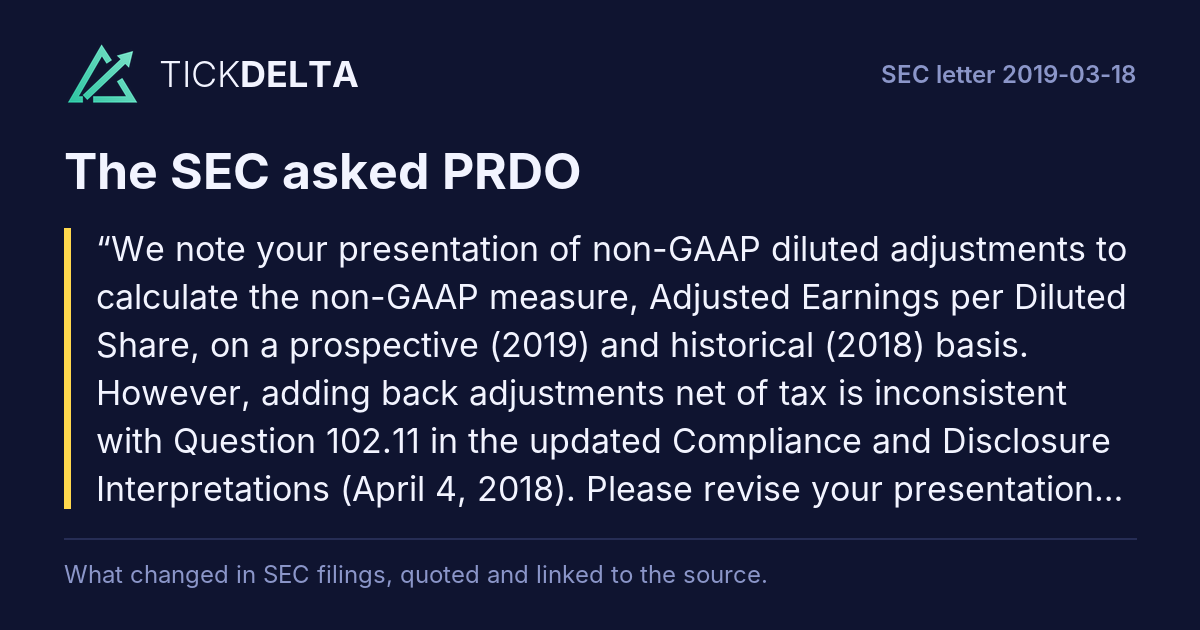
SEC asked (1)
We note your presentation of non-GAAP diluted adjustments to calculate the non-GAAP measure, Adjusted Earnings per Diluted Share, on a prospective (2019) and historical (2018) basis. However, adding back adjustments net of tax is inconsistent with Question 102.11 in the updated Compliance and Disclosure Interpretations (April 4, 2018). Please revise your presentation accordingly.
Rest of the question

Further comply with this comment in your non- GAAP presentations in Item 2.02 of your Form 8-K.

PRDO answered
We respectfully acknowledge the Staff’s comment and reference to Question 102.11 in the updated Compliance and Disclosure Interpretations.

In future filings the Company will revise its presentation related to adjustments added back for purposes of the Adjusted Earnings per Diluted Share non-GAAP measure. The Company will present the adjustments on a gross basis and the related income tax adjustment separately. The Company will also adjust its presentation to be consistent with this in its future Item 2.02 Form 8-K filings.
Rest of the answer

Please see below for an example of a revised presentation of Adjusted Earnings per Diluted Share utilizing reported numbers for the year ended December 31, 2018. We intend to use a comparable presentation in future filings.

For the Year Ended

December 31, 2018

Reported Earnings Per Diluted Share

$

0.77

Pre-tax adjustments included in operating expenses:

Unused space charges (1)

0.12

Severance and related costs, net of cancellations

(2)

0.02

Significant legal settlements (3)

0.20

Total pre-tax adjustments

0.34

Tax effect of adjustments (4)

(0.06

)

Total adjustments after tax

0.28

Adjusted Earnings Per Diluted Share

1.05

(1)

Unused space charges include initial charges representing the net present value of remaining lease obligations for vacated space less an estimated amount for sublease income. Subsequently, as early lease terminations or subleases occur, or as assumptions are otherwise adjusted, these unused space charges are increased or decreased. These subsequent adjustments are also included in the amounts presented.

Severance and related costs, net of cancellations, include charges related to significant restructuring actions. These restructuring charges do not regularly occur and are not considered part of ongoing operating results.

(3)

Significant legal settlements include $9.6 million and $5.0 million related to the Surrett matter and the agreements with multiple attorneys general to resolve the multi-state inquiry, respectively.

(4)

The tax effect of adjustments was calculated by multiplying the pre-tax adjustments with a tax rate of 25%.

This tax rate reflects federal and state taxable jurisdictions as well as the nature of the adjustments. Also, $5.0 million of pre-tax adjustments related to significant legal settlements were not deductible for tax purposes and therefore do not include a tax effect.

Read in the reply
In its next report

First report after the company's reply of Mar 29, 2019: 10-Q filed May 8, 2019 ↗, against the 10-Q filed Nov 1, 2018 ↗.

Tickdelta does not hold the text of both reports, so they are not compared here.

Year Ended December 31, 2018 as Compared to the Year Ended December 31, 2017 · General and Administrative Expense, page 50
SEC asked (2)
We note you reference to “significant legal settlements” in your MD&A discussion and its impact on your adjusted operating income and quarterly financial results in Note 19. In future filings, please provide a more transparent discussion, in quantified detail, of the impact of significant legal settlements and related circumstances on your results of operations and liquidity for all periods presented.
PRDO answered
We respectfully acknowledge the Staff’s comment and in future filings the Company will expand its discussion of significant legal settlements to provide additional quantified detail regarding the impact on its results of operations and liquidity for all periods presented.
Read in the reply
In its next report

First report after the company's reply of Mar 29, 2019: 10-Q filed May 8, 2019 ↗, against the 10-Q filed Nov 1, 2018 ↗.

Tickdelta does not hold the text of both reports, so they are not compared here.

Also in this review: closing letter, 2019-04-01
Form 10-K

2014-12-09 to 2015-01-30 · 5 questions · 1 letter from the SEC, 3 from the company
Review closed 2015-01-30
RevenueDebtLiquidity and cash
Summary of Significant Accounting Policies · g. Revenue Recognition, page 96
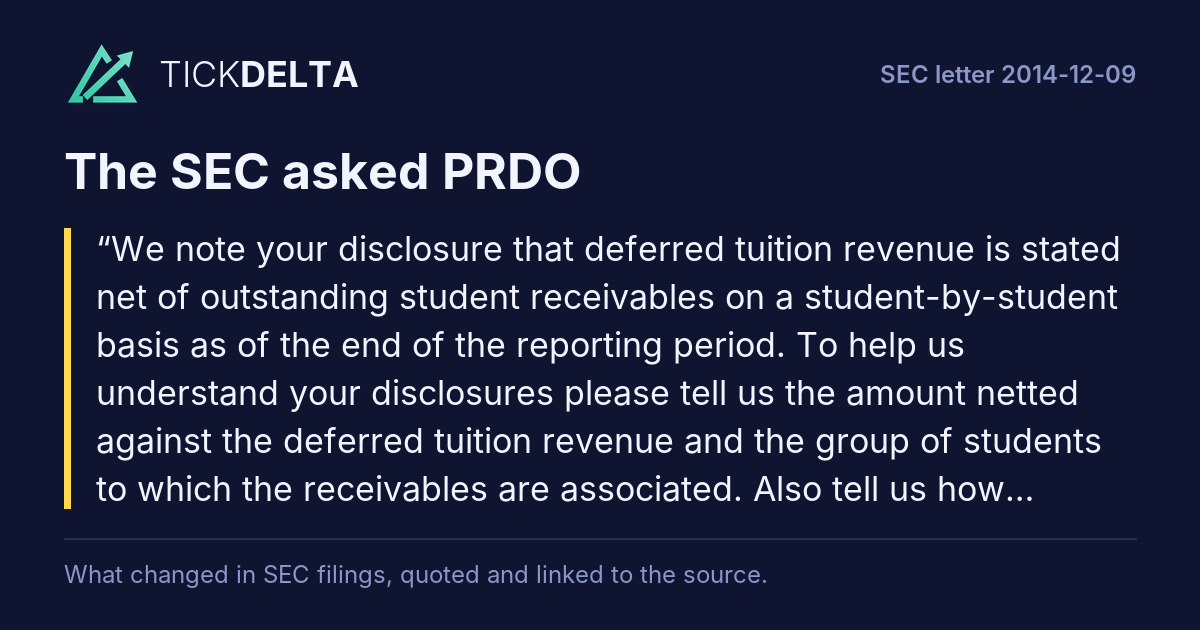
SEC asked (1)
We note your disclosure that deferred tuition revenue is stated net of outstanding student receivables on a student-by-student basis as of the end of the reporting period. To help us understand your disclosures please tell us the amount netted against the deferred tuition revenue and the group of students to which the receivables are associated.
Rest of the question

Also tell us how these student receivables differ from those presented as captions within current and non-current assets.

PRDO answered
In accordance with CEC’s tuition billing policy, the tuition charge for each term is billed in full to a student’s account, with an equivalent offsetting liability amount recorded as deferred revenue, on the first day of a student’s term and/or program. The accounts receivable balance decreases as payments are made, and the deferred revenue balance decreases as tuition is earned over the course of the term.

Our tuition billing policy results in the recording of gross accounts receivable and gross deferred revenue in full on the first day of the term.
Rest of the answer

These gross recorded amounts are adjusted such that only (i) earned receivables and (ii) deferred revenue liabilities for cash received in excess of amounts earned are reflected on our consolidated balance sheet, each student’s accounts receivable balance is offset against his/her deferred revenue balance at the end of each reporting period. If a student’s current accounts receivable balance exceeds his/her ending deferred revenue balance, because revenue earned exceeds payments received, we recognize that student as being in a net earned accounts receivable position. However, if a student’s gross ending deferred revenue balance exceeds his/her current accounts receivable balance, because cash receipts exceed revenue earned, we recognize that student as being in a net deferred revenue position. This process is performed for each student such that each student’s net accounts receivable or net deferred revenue balance is properly recorded as an asset or liability on the balance sheet.

The earned accounts receivable balance represents a true receivable of cumulative tuition earnings to date for which cash has not been collected. The deferred revenue balance represents cash collected from, or on behalf of, students for services that we have not yet performed, and revenue we have not yet earned.

The process to offset the accounts receivable balance with the deferred revenue balance is performed on a student by student basis for each student that is currently attending one of our institutions to accurately reflect the net position for each student and for the consolidated entity. Currently, students that are no longer attending one of our institutions (i.e., withdrawn or graduated students) would no longer have a deferred revenue balance at the end of the reported period, so their entire accounts receivable balance would be reported as accounts receivable within our consolidated balance sheet.

Subsequent to the response provided below for comment 2, for students that have withdrawn from one of our institutions, we will continue to perform this offsetting process in order to appropriately reflect the net balance as either accounts receivable or deferred revenue.

Once the offsetting process is complete and student balances are appropriately classified as either accounts receivable or deferred revenue, we further identify the non-current portion of the balance for those students in an earned accounts receivable position. On a student by student basis, the portion of the accounts receivable balance which is due greater than one year from the balance sheet date is classified within non-current assets on our consolidated balance sheet.

Please see the table below for the amount of the offsetting entries recorded to reflect our earned student accounts receivable balances and deferred revenue balances for continuing operations as of December 31, 2013 and 2012. The amounts represented below are for those schools that were reflected within continuing operations as of

December 31, 2013.

As of December 31,

Read in the reply
In its next report

First report after the company's reply of Jan 8, 2015: 10-K filed Mar 3, 2015 ↗, against the 10-K filed Feb 27, 2014 ↗.

Tickdelta does not hold the text of both reports, so they are not compared here.

Summary of Significant Accounting Policies · g. Revenue Recognition, page 96
SEC asked (2)
We note that once the student withdraws you recognize as revenue the portion of deferred revenue you are entitled to retain with a corresponding charge to bad debt expense for any amount deemed to be uncollectible.
Rest of the question

It appears to us that on the day the student withdraws from a course and you are required to return the Title IV funds, you should reassess your revenue recognition policy to determine whether collectability continues to be reasonably assured. If collectability is not reasonably assured; it appears that you should recognize revenue on a cash basis. In this regard, tell us about your historical collection experience with students who become responsible for tuition and related fees due to withdrawal or loss of financial aid eligibility.

PRDO answered
As stated in our 2013 Form 10-K and consistent with our response provided to the Staff on January 28, 2011 related to a prior review of our filings by the SEC, if a student withdraws from one of our institutions prior to the completion of the academic term or program period, we refund the portion of tuition and registration fees already paid that, pursuant to our refund policy and applicable federal and state law and accrediting agency standards, we are not entitled to retain.
Rest of the answer

Generally, the amount to be refunded to a student is calculated based upon the period of time the student has attended classes and the amount of tuition and registration fees paid by the student as of their withdrawal date. These refunds typically reduce deferred tuition revenue and cash on our consolidated balance sheets as we do not recognize tuition revenue in our consolidated statements of (loss) income and comprehensive (loss) income until the related refund provisions have lapsed. The portion of previously unrecognized revenue we are entitled to retain upon a student’s withdrawal (under the terms of the existing contract) is immediately recognized as revenue at the time of withdrawal. As part of our reassessment of revenue recognition, we believe we have been able to reliably estimate the uncollectable amount based on historical collection experience on a portfolio basis. As a result, we have recorded a charge to bad debt expense to recognize such amounts. It is important to note that a significant portion of this revenue recognized upon withdrawal represents the acceleration of true deferred revenue (i.e. where cash has already been received from the student). The effect of this policy is that the net amount recognized at the time of withdrawal and related reassessment is for an amount for which collectability is reasonably assured. As further described below, the net amounts recognized in earnings upon withdrawal in excess of cash already received have not been material historically.

As we noted in our letter provided to the Staff on January 28, 2011, we acknowledged then and continue to acknowledge that an alternative accounting approach relating to students who have withdrawn would be to recognize previously unrecognized revenue on a cash basis based on a view that the reassessment of the “reasonably assured” condition must be done at the individual student level as opposed to a portfolio approach. Under that method, it would be difficult to meet the condition. Based on the observations of industry practice, including views expressed by the Staff, we have made the determination to modify our policy to record revenue using the alternative approach. Therefore, we will prospectively record revenue for students who withdraw prior to graduation on a cash basis. As a result, the Company intends to record an adjustment to the financial statements for the year ending December 31, 2014 for students who have withdrawn. The estimated amount to be recorded as a result of this change in methodology to our 2014 financial statements is a reversal of revenue of approximately $10 million from continuing operations (approximately 1% of revenue) and approximately $7 million of bad debt expense, resulting in a net impact to operating loss from continuing operations of $3 million (approximately 5% of operating loss). Loss from discontinued operations will be impacted by approximately $1 million or 2%. We view these adjustments as not material.

Additionally, we analyzed the impact of this change in methodology for the years ended December 31, 2013 and 2012 assuming the cash basis approach had been used for withdrawals. Given our practice of reserving for student balances based on historical collection experience, the impact to the Company’s financial statements was immaterial, representing approximately $12.2 million or

1.2% of revenue and approximately $1.8 million or 0.8% of operating loss for the year ended December 31, 2013 and approximately $17.5 million or 1.3% of revenue and approximately $3.7 million or 1.9% of operating loss for the year ended

December 31, 2012. In evaluating the materiality of both the 2014 adjustment and prior years’ differences, the Company considered both the qualitative and quantitative factors as noted in the SEC Staff Guidance (i.e. SAB No. 99 Topic

1M – Materiality and SAB No. 108 Topic N – Considering the Effects of Prior Year Misstatements when Quantifying Misstatements in the Current Year Financial Statements). These differences were concluded to be immaterial.

Read in the reply
In its next report

First report after the company's reply of Jan 8, 2015: 10-K filed Mar 3, 2015 ↗, against the 10-K filed Feb 27, 2014 ↗.

Tickdelta does not hold the text of both reports, so they are not compared here.

h. Cash and cash equivalents, page 97
SEC asked (3)
Please refer to Rule 5-02 of Regulation S-X and tell us how you considered presenting or disclosing restricted cash associated with the company’s participation in programs administrated by the Department of Education and Department of Defense.
PRDO answered
In accordance with Rule 5-02 of Regulation S-X, we do not present cash associated with our participation in programs administered by the

Department of Education (“ED”) and the Department of Defense (“DoD”) as restricted cash because we do not draw down funds from ED or DoD until restrictions have lapsed. As a result, cash received from ED or DoD is included as unrestricted cash on our consolidated balance sheets.
Read in the reply
In its next report

First report after the company's reply of Jan 8, 2015: 10-K filed Mar 3, 2015 ↗, against the 10-K filed Feb 27, 2014 ↗.

Tickdelta does not hold the text of both reports, so they are not compared here.

i. Student Receivables, page 97
SEC asked (4)
You disclose that student receivables are reported net of allowance for doubtful accounts and net of deferred tuition revenue. On the face of the consolidated balance sheet, your caption for student receivables includes a disclosure of the netted allowance for doubtful accounts but does not disclose the netted deferred tuition revenue.
Rest of the question

Please tell us the amount of deferred tuition revenue netted and also tell us how this deferred tuition revenue differs from the amounts presented in the separate caption within the liability section.

PRDO answered
Please see response to comment 1 above as our process of recording student accounts receivable and the associated deferred revenue are interrelated.
Read in the reply
In its next report

First report after the company's reply of Jan 8, 2015: 10-K filed Mar 3, 2015 ↗, against the 10-K filed Feb 27, 2014 ↗.

Tickdelta does not hold the text of both reports, so they are not compared here.

ED Inquiry and HCM1 Status, page 123
SEC asked (5)
We note your disclosure regarding the change from the “advance” method of payment of Title IV Program funds to cash monitoring status (referred to as Heightened Cash Monitoring 1, or HCM1, status). Please disclose what impact this change has had, if material, on your liquidity and capital resources.
PRDO answered
In December 2011, ED moved all of the Company’s institutions from the “advance” method of payment of Title IV Program funds to cash monitoring status (referred to as Heightened Cash Monitoring 1, or HCM1, status). As disclosed within the Company’s Annual Report on Form 10-K for the year ended December 31, 2013, the Company’s practices prior to this change substantially conformed to the requirements of this more restrictive method of drawing down students’ Title IV Program funds.
Rest of the answer

In other words, the Company did not historically draw down Title IV funds until all restrictions had lapsed and each individual student had been approved for payment by ED and billed by CEC, which are the primary restrictions imposed by HCM1 status. The change to HCM1 status did require an additional 24-hour delay between submission of the request of funds and the actual drawdown of funds. Despite the additional 24 hour delay, the change to HCM1 status did not have a material impact to the Company’s liquidity or capital resources as the Company did not substantially change any of its business or operational practices.

* * * *

In connection with responding to your comments and with this submission, we hereby acknowledge that the Company is responsible for the adequacy and accuracy of the disclosure in the filings; Staff comments or changes to disclosure in response to Staff comments do not foreclose the Commission from taking any action with respect to the filings; and the Company may not assert Staff comments as a defense in any proceeding initiated by the Commission or any person under the federal securities laws of the United States.

Read in the reply
In its next report

First report after the company's reply of Jan 8, 2015: 10-K filed Mar 3, 2015 ↗, against the 10-K filed Feb 27, 2014 ↗.

Tickdelta does not hold the text of both reports, so they are not compared here.

Also in this review: request for more time, Dec 16, 2014, company letter, Jan 21, 2015, company letter, Jan 29, 2015, closing letter, 2015-01-30

From the SEC's correspondence on EDGAR: staff letters (form UPLOAD) and company letters (form CORRESP), 9 letters filed since 2014-12-09. Questions and answers are matched by their numbers; topics come from words in each question. The reports are compared word for word (same form, before the first SEC letter against the first report after the company's reply). No AI.

Sources

The SEC's correspondence on EDGAR: staff letters (form UPLOAD) and company letters (form CORRESP), matched question by question. No AI.

Also

Filings: the letters in the filing list.

Work with it

Excel workbook · CSV. Google Sheet that stays up to date: paste =IMPORTDATA("https://tickdelta.com/company/PRDO/export.csv") into a cell.

Next in Owners and insiders:Insider trades
Esc

Type a ticker such as AAPL, a name, an investor such as Buffett, or a topic such as tariffs. ↑ ↓ to move, Enter to open.