Form 10-K for the Year Ended December 31, 2020
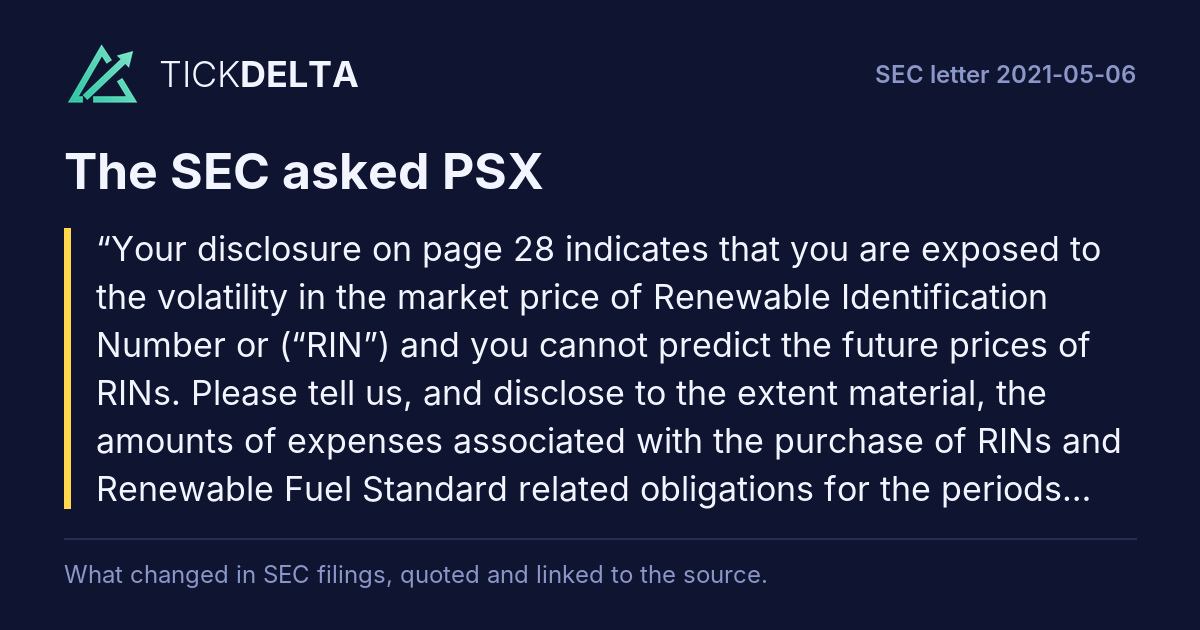
Your disclosure on page 28 indicates that you are exposed to the volatility in the market price of Renewable Identification Number or (“RIN”) and you cannot predict the future prices of RINs. Please tell us, and disclose to the extent material, the amounts of expenses associated with the purchase of RINs and Renewable Fuel Standard related obligations for the periods presented and explain the fluctuations betweenRest of the question
periods.
We are required to purchase RINs in the open market to satisfy the portion of our obligation under the Renewable Fuel Standard (RFS) that is not fulfilled by blending renewable fuels into the motor fuels we produce. We incurred expenses associated with our obligation to purchase RINs in the open market to comply with the RFS for our wholly owned refineries of $342 million, $111 million and $182 million for the years ended December 31, 2020, 2019 and 2018, respectively. These expenses are included in the “Purchased crude oil and products” line item on our consolidated statement of operations.Read in the reply ↗Rest of the answer
Our jointly owned refineries also incurred expenses associated with the purchase of RINs in the open market, of which our share was $133 million, $74 million and $102 million for the years ended December 31, 2020, 2019 and 2018, respectively. These expenses are included in the “Equity in earnings of affiliates” line item on our consolidated statement of operations.
For wholly owned refineries, the increase in these expenses in 2020, compared with 2019, was primarily due to higher weighted average RIN prices and reduced blending activities, partially offset by lower production. The decrease in these expenses in 2019, compared with 2018, was primarily due to lower weighted average RIN prices, partially offset by higher production and reduced blending activities. In addition, the lower expense in 2019 reflects the benefit of retroactive small refinery exemptions granted to one of our refineries.
For jointly owned refineries, the increase in these expenses in 2020, compared with 2019, was primarily due to higher weighted average RIN prices, partially offset by lower production. The decrease in these expenses in 2019, compared with 2018, was primarily due to lower weighted average RIN prices, partially offset by higher production.
We acknowledge the Staff’s comment and we will include a disclosure similar to the following in our future Form 10-K filings in Management’s Discussion and Analysis of Financial Condition and Results of Operations. In addition, we will explain fluctuations in the disclosed amounts between periods if these fluctuations have a material impact on a financial statement line item.
We are required to purchase RINs in the open market to satisfy the portion of our obligation under the Renewable Fuel Standard (RFS) that is not fulfilled by blending renewable fuels into the motor fuels we produce. For the years ended December 31, 2020, 2019 and 2018, we incurred expenses of $342 million, $111 million and $182 million, respectively, associated with our obligation to purchase RINs in the open market to comply with the RFS for our wholly owned refineries. These expenses are included in the “Purchased crude oil and products” line item on our consolidated statement of operations. Our jointly owned refineries also incurred expenses associated with the purchase of RINs in the open market, of which our share was $133 million, $74 million and $102 million for the years ended December 31, 2020, 2019 and 2018, respectively. These expenses are included in the “Equity in earnings of affiliates” line item on our consolidated statement of operations. The amount of these expenses and fluctuations between periods is primarily driven by the market price of RINs, refinery production and blending activities.
First report after the company's reply of 2021-06-04: 10-Q filed 2021-08-03 ↗, against the 10-Q filed 2021-04-30 ↗.
Tickdelta does not hold the text of both reports, so they are not compared here.
We note you disclose and discuss realized refining margins and realized marketing fuel margins as non-GAAP financial measures and that you reconcile these non-GAAP financial measures to income (loss) before income taxes.Rest of the question
Please tell us why you have reconciled to income (loss) before income taxes as opposed to a fully burdened gross profit, which appears to represent the most directly comparable GAAP financial measure. Refer to Item 10(e)(1)(i)(B) of Regulation S-K.
We note that Question 104.03 of the Staff’s Compliance & Disclosure Interpretations on the use of non-GAAP financial measures highlights that segment measures that are adjusted to include amounts excluded from, or to exclude amounts included in, the measure reported to the chief operating decision maker (CODM) are considered non-GAAP financial measures and subject to Item 10(e) of Regulation S-K.Read in the reply ↗Rest of the answer
Based on this guidance, we concluded that “realized refining margins” and “realized marketing fuel margins” are non-GAAP measures for purposes of reporting segment performance as they include adjustments to our measure of segment profit disclosed in our financial statements. We then evaluated the most directly comparable GAAP measure to which we should reconcile “realized refining margins” and “realized marketing fuel margins” to comply with Item 10(e)(1)(i)(B) of Regulation S-K. As part of this evaluation, we considered the adopting release of Item 10(e), Exchange Act Release No. 47226, in which the Staff noted that “it is most appropriate to provide registrants with the flexibility to best make the determination as to which is the most directly comparable GAAP financial measure calculated and presented in accordance with GAAP.” We believe the most directly comparable GAAP financial measure, in accordance with Item 10(e)(1)(i)(B) of Regulation S-K and the Staff’s interpretive guidance, at the segment level is segment “income (loss) before income taxes,” because this is the financial measure our CODM uses to allocate resources to and assess performance of our operating segments and the segment profit measure we are required to disclose in accordance with ASC 280, Segment Reporting.
In addition, we note that ASC 280 does not require a determination or calculation of fully burdened segment gross profit unless it is the segment measure used by the CODM to allocate resources and assess performance. Further, we note that reconciling these non-GAAP financial measures to a fully burdened gross profit would require us to calculate, report and maintain a segment performance measure that our CODM does not currently utilize to allocate resources and assess performance.
If you have any additional questions or comments, please contact the undersigned.
First report after the company's reply of 2021-06-04: 10-Q filed 2021-08-03 ↗, against the 10-Q filed 2021-04-30 ↗.
Tickdelta does not hold the text of both reports, so they are not compared here.
Also in this review: request for more time, 2021-05-13, closing letter, 2021-06-16