Screener / SEC EDGAR /CIK 0000078239 /10-K filed Mar 31, 2026, compared with Apr 1, 2025 /Numbers from the XBRL of the 10-Ks
NYSE Consumer discretionary · Apparel

PVH Corp. PVH

Compare with peers Embed
SEC comment letters, last 20 years

2 reviews of PVH's filings by SEC staff

UPLOAD and CORRESP
Reviews 2 latest letter Jun 15, 2018
Questions asked 4 each answered in the company's own letter
No closing letter 0 reviews without a letter saying the staff completed it

When the SEC's staff reviews a filing, it writes to the company with numbered questions, and the company answers each one in a letter. SEC publishes the exchange once the review is over, at least 20 business days later. A question is not an accusation; most reviews end with the company adding detail to its next filing.

How the reviews went

Every review on EDGAR, from the first staff letter to the letter that closes it

  1. 1. Staff letters 2 UPLOAD
  2. 2. Questions in them 4 numbered comments
  3. 3. Company replies 2 CORRESP
  4. 4. Reviews closed 2 of 2 closing letter

Half the closed reviews took 41 days or less from the first letter to the closing letter.

Form 10-K

2018-06-15 to 2018-07-10 · 2 questions · 1 letter from the SEC, 1 from the company
Review closed 2018-07-10
Operations · Market Risk, page 46
SEC asked (1)
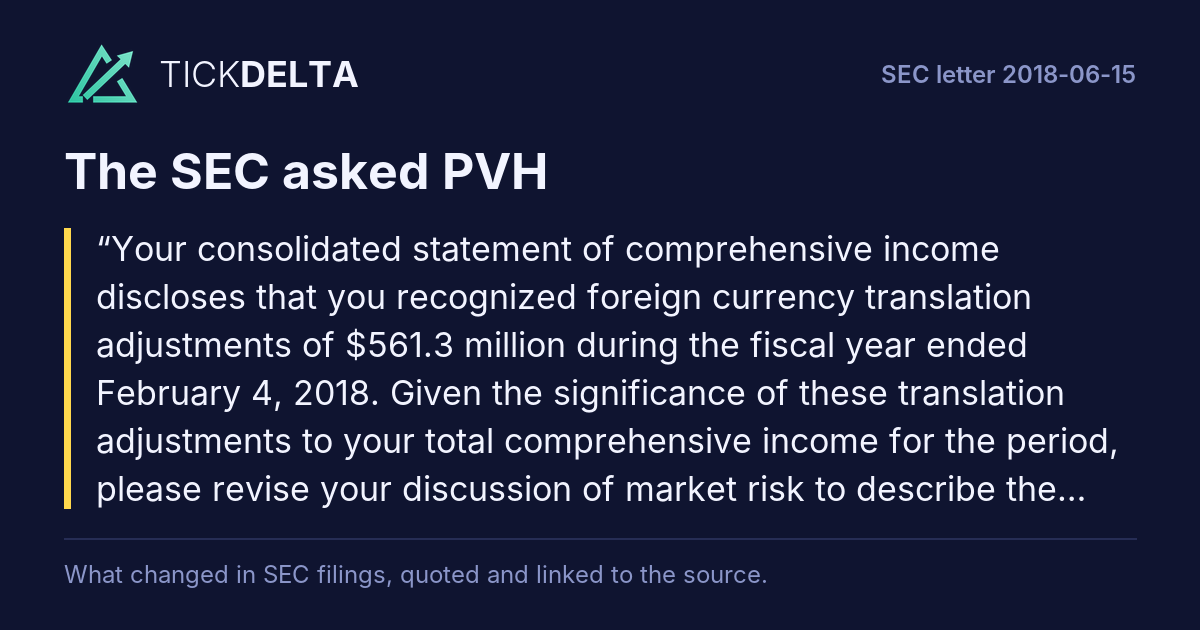
Your consolidated statement of comprehensive income discloses that you recognized foreign currency translation adjustments of $561.3 million during the fiscal year ended February 4, 2018. Given the significance of these translation adjustments to your total comprehensive income for the period, please revise your discussion of market risk to describe the specific changes in foreign currencies that resulted in these
Rest of the question

significant foreign currency translation adjustments during the period. Refer to the guidance in Rule 3-05(b) of Regulation S-K.

PVH answered
We will expand our disclosure in Quantitative and Qualitative Disclosures About Market Risk to include a discussion of the specific changes in foreign currency exchange rates that resulted in significant foreign currency translation adjustments during the period, as applicable. Set forth below is how our Market Risk disclosure included in Management's Discussion and Analysis of Financial Condition and Results of Operations in our Annual Report on Form 10-K for the Fiscal Year Ended February 4, 2018 would have appeared if we had included our proposed expanded disclosure.
Rest of the answer

The underlined language has been added to address the Staff's comment. These additional disclosures will be included in future filings beginning with our Form 10-Q for the quarterly period ended August 5, 2018.

“Financial instruments held by us as of February 4, 2018 include cash and cash equivalents, short-term borrowings, long-term debt, foreign currency forward exchange contracts and interest rate swap agreements. Note 11, “Fair Value Measurements,” in the Notes to Consolidated Financial Statements included in Item 8 of this report outlines the fair value of our financial instruments as of February 4, 2018. Cash and cash equivalents held by us are affected by short-term interest rates, which are currently low. Due to the currently low rates of return we are receiving on our cash and cash equivalents, the potential for a significant decrease in short-term interest rates is low and, therefore, a further decrease would not have a material impact on our interest income. However, there is potential for a more significant increase in short-term interest rates, which could have a more material impact on our interest income. Given our balance of cash and cash equivalents at February 4, 2018, the effect of a 10 basis point change in short-term interest rates on our interest income would be approximately $500,000 annually. Borrowings under our 2016 facilities bear interest at a rate equal to an applicable margin plus a variable rate. As such, our 2016 facilities expose us to market risk for changes in interest rates. We have entered into interest rate swap agreements for the intended purpose of reducing our exposure to interest rate volatility. As of February 4, 2018, after taking into account the effect of our interest rate swap agreement that was in effect as of such date, approximately 60% of our long-term debt was at a fixed interest rate, with the remainder at variable interest rates. Given our debt position at February 4, 2018, the effect of a 10 basis point change in interest rates on our variable interest expense would be approximately $1 million annually. Please refer to the section entitled “Liquidity and Capital Resources” above for further discussion of our credit facilities and interest rate swap agreements.

Our Calvin Klein and Tommy Hilfiger businesses each have substantial international components that expose us to significant foreign exchange risk. Our Heritage Brands business also has international components, but those components are not significant to the business. Approximately 50% of our $8.9 billion of revenue in 2017 was generated outside of the United States. Changes in exchange rates between the United States dollar and other currencies can impact our financial results in two ways: a translational impact and a transactional impact.

The translational impact refers to the impact that changes in exchange rates can have on our results of operations and financial position. The functional currencies of our foreign subsidiaries are generally the applicable local currencies. Our consolidated financial statements are presented in United States dollars. The results of operations in local foreign currencies are translated into United States dollars using an average exchange rate over the representative period and the assets and liabilities in local foreign currencies are translated into United States dollars using the closing exchange rate at the balance sheet date. Foreign exchange differences that arise from the translation of our foreign subsidiaries’ assets and liabilities into United States dollars are recorded as foreign currency translation adjustments in other comprehensive income (loss). Accordingly, our reported results of operations and other comprehensive income (loss) will be unfavorably impacted during times of a strengthening United States dollar, particularly against the euro, the Brazilian real, the Japanese yen, the Korean won, the British pound sterling, the Canadian dollar, the Mexican peso, the Indian rupee, the Russian ruble and the Chinese yuan renminbi, and favorably impacted during times of a weakening United States dollar against those currencies.

In 2017, we recognized favorable foreign currency translation adjustments of $561 million within other comprehensive income, principally driven by a weakening of the United States dollar against the euro of 17%. Our foreign currency translation adjustments recorded in other comprehensive income (loss) are significantly impacted by the substantial amount of goodwill and other intangible assets denominated in the euro, which represented 36% of our $7.6 billion total goodwill and other intangible assets as of February 4, 2018. This translational impact was partially mitigated by the change in the fair value of our net investment hedges discussed below.

A transactional impact on financial results is common for apparel companies operating outside the United States that purchase goods in United States dollars, as is the case with most of our foreign operations. As with translation, our results of operations will be impacted as fluctuations of the United States dollar change the local currency value of inventory, which results in a change in the cost of goods in local currency when the goods are sold. We also have exposure to changes in foreign currency exchange rates related to certain intercompany transactions and SG&A expenses. We currently use and plan to continue to use foreign currency forward exchange contracts or other derivative instruments to mitigate the cash flow or market value risks associated with these inventory and intercompany transactions, but we are unable to entirely eliminate these risks. The foreign currency forward exchange contracts cover at least 70% of the projected inventory purchases in United States dollars by our foreign subsidiaries.

Given our foreign currency forward exchange contracts outstanding at February 4, 2018, the effect of a 10% change in foreign currency exchange rates against the United States dollar would result in a change in the fair value of these contracts of approximately $100 million. Any change in the fair value of these contracts would be substantially offset by a change in the fair value of the underlying hedged items.

As a result of the weakening of the United States dollar during 2017 against certain foreign currencies, particularly the euro and the Chinese yuan renminbi, we expect an increase in revenue and net income in 2018 as compared to 2017 due to the foreign exchange impact of approximately $230 million and $40 million, respectively, based on current exchange rates.

In order to mitigate a portion of our exposure to changes in foreign currency exchange rates related to the value of our investments in foreign subsidiaries denominated in the euro, we designated the carrying amount of our €950 million aggregate principal amount of euro-denominated senior notes that we had issued in the United States as net investment hedges of our investments in certain of our foreign subsidiaries that use the euro as their functional currency. The effect of a 10% change in the euro against the United States dollar would result in a change in the fair value of the net investment hedges of approximately $120 million. Any change in the fair value of the net investment hedges would be more than offset by a change in the value of our investments in certain of our European subsidiaries. Additionally, during times of a weakening United States dollar against the euro, we would be required to use a greater amount of our cash flows from operations to pay interest and make long-term debt repayments on our euro-denominated senior notes.

Included in the calculations of expense and liabilities for our pension plans are various assumptions, including return on assets, discount rates, mortality rates and future compensation increases. Actual results could differ from these assumptions, which would require adjustments to our balance sheet and could result in volatility in our future pension expense. Holding all other assumptions constant, a 1% change in the assumed rate of return on assets would result in a change to 2018 net benefit cost related to the pension plans of approximately $6 million. Likewise, a 0.25% change in the assumed discount rate would result in a change to 2018 net benefit cost of approximately $31 million.”

Read in the reply
In its next report

First report after the company's reply of Jun 28, 2018: 10-Q filed Sep 7, 2018 ↗, against the 10-Q filed Jun 11, 2018 ↗.

Tickdelta does not hold the text of both reports, so they are not compared here.

Consolidated Balance Sheets, page F-4
SEC asked (2)
Your consolidated balance sheets indicate that your accrued expenses totaled $923.1 million and $832.4 million or approximately 49% and 53% of your total current liabilities at February 4, 2018 and January 29, 2017, respectively. Please revise your balance sheets or the notes to your financial statements to separately disclose any items included in this caption that exceed 5% of your total current liabilities.
Rest of the question

Refer to the guidance outlined in Rule 5-02(20) of Regulation S-X. In addition, to the extent that your other long-term liabilities include any items that exceed 5% of your total liabilities, please revise your balance sheets or the notes to the financial statements to separately disclose these items. Refer to the guidance in Rule 5-02(24) of Regulation S-X.

PVH answered
Our accrued expenses balances as of February 4, 2018 and January 29, 2017 included the following items in excess of 5% of total current liabilities: i) incentive compensation accruals of $108.9 million and $96.1 million, respectively, and ii) wholesale sales allowance accruals of $113.7 million as of January 29, 2017. We disclosed these amounts in Note 21 to our financial statements, Other Comments, along with the wholesale sales allowance accruals as of February 4, 2018 of $78.1 million, which was less than 5% of total current liabilities but was included for comparative purposes.
Rest of the answer

Within our other liabilities balances as of February 4, 2018 and January 29, 2017, only deferred tax liabilities of $663.0 million and $877.7 million, respectively, were in excess of 5% of total liabilities. These deferred tax liability balances were disclosed separately within the other liabilities caption on our consolidated balance sheets.

We will continue to monitor accrued expenses and other liabilities and disclose items within those captions that exceed 5% of total current liabilities and 5% of total liabilities, respectively, as required by Rule 5-02 of Regulation S-X.

Read in the reply
In its next report

First report after the company's reply of Jun 28, 2018: 10-Q filed Sep 7, 2018 ↗, against the 10-Q filed Jun 11, 2018 ↗.

Tickdelta does not hold the text of both reports, so they are not compared here.

Also in this review: closing letter, 2018-07-10
Form 10-K

2017-07-11 to 2017-08-21 · 2 questions · 1 letter from the SEC, 1 from the company
Review closed 2017-08-21
SegmentsResults discussion (MD&A)Income taxes
Results of Operations · Income Taxes, page 36
SEC asked (1)
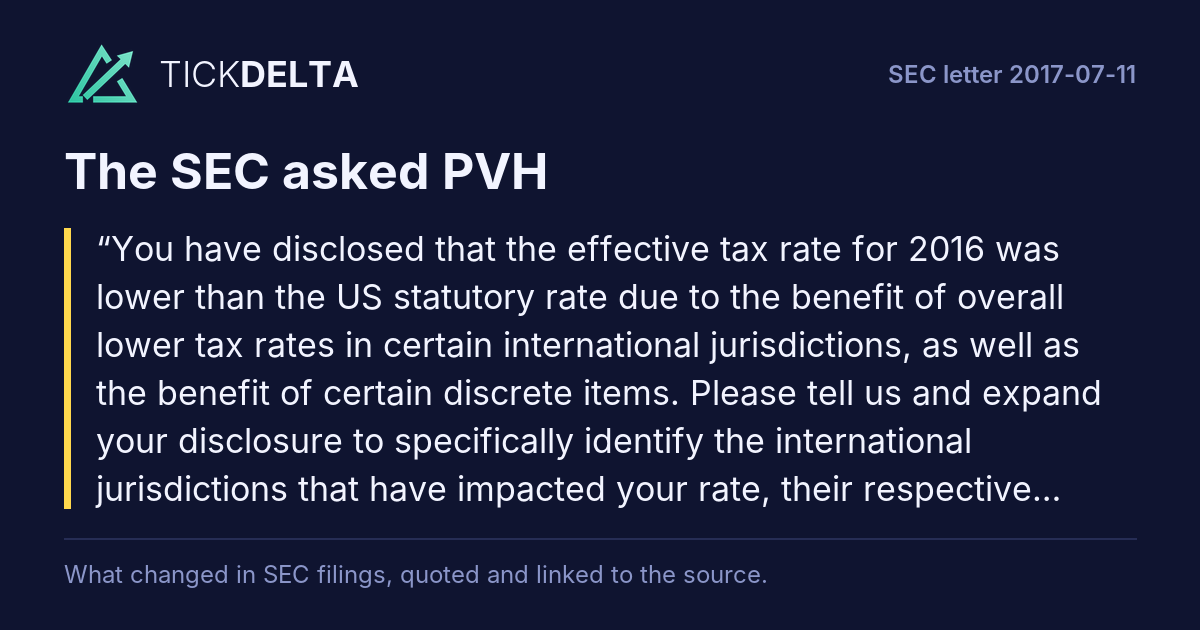
You have disclosed that the effective tax rate for 2016 was lower than the US statutory rate due to the benefit of overall lower tax rates in certain international jurisdictions, as well as the benefit of certain discrete items.
Rest of the question

Please tell us and expand your disclosure to specifically identify the international jurisdictions that have impacted your rate, their respective statutory tax rates and any expectations about trends in these jurisdictions that may impact your current or future tax expense. Please also quantify any significant items that have impacted your income tax expense and expand your disclosure in management’s discussion and analysis to describe any expectations about trends that may impact your current or future tax expense. Please refer to Item 303(a)(3) of Regulation S-K and SEC Release No. 33-8350. Notes to Consolidated Financial statements 10. Segment Data, page F-49

PVH answered
In future filings beginning with our Form 10-Q for the quarterly period ended July 30, 2017, we will expand our disclosure in Management’s Discussion and Analysis of Financial Condition and Results of Operations (“MD&A”) to discuss how our effective tax rate was impacted and may be impacted in the future by the statutory tax rates of the international jurisdictions where we file tax returns. Additionally, we will quantify the impact of any significant items that impact our income tax expense and discuss our expectations, if any, about trends that may impact our current or future tax expense.
Rest of the answer

Set forth below is how our tax disclosure included in MD&A in our Annual Report on Form 10-K for the Fiscal Year Ended January 29, 2017 (the “2016 10-K”) would have appeared if we had included our proposed expanded disclosure. The underlined language has been added; there would have been no other changes.

“Income Taxes

Income tax expense was as follows:

2016

2015

2014

(Dollars in millions)

Income tax expense (benefit)

$

125

(48

)

Income tax expense (benefit) as a % of pre-tax income

18.6

%

11.6

(12.1

)%

The effective income tax rate for 2016 was 18.6% compared with 11.6% in 2015 and (12.1)% in 2014. The volatility in our effective income tax rate in the last three years is due in large part to adjustments to our liabilities for uncertain tax positions. Please see Note 9, “Income Taxes,” in the Notes to Consolidated Financial Statements included in Item 8 of this report for additional information related to uncertain tax positions.

We file income tax returns in more than 40 international jurisdictions each year. All of the international jurisdictions in which we file tax returns, with the exception of Japan, have lower statutory tax rates than the United States statutory tax rate. A substantial amount of our earnings come from our international operations, largely attributable to earnings in the Netherlands, Hong Kong, China, Korea and Canada. The lower statutory income tax rates in these jurisdictions, as compared to the United States statutory rate, coupled with special rates levied on income from certain of our jurisdictional activities, significantly reduce our consolidated effective income tax rate.

The effective income tax rate for 2016 was lower than the United States statutory rate due to the benefit of overall lower tax rates in certain international jurisdictions where we file tax returns. Also contributing to the lower effective income tax rate for 2016 was the benefit of discrete items, including the lower tax rate applicable to the pre-tax gain recorded to write-up our existing equity investment in TH China to fair value that resulted in a 5.7% benefit to our effective income tax rate.

The effective income tax rate for 2015 was lower than the United States statutory rate principally due to the benefit of lower tax rates in certain international jurisdictions where we file tax returns and the benefits primarily related to the favorable resolution of uncertain tax positions and the impact of tax law and tax rate changes on deferred taxes, as well as the expiration of the statute of limitations related to other uncertain tax positions.

The effective income tax rate in 2014 was a benefit to income principally due to a reduction of $94 million in our estimate for uncertain tax positions, which provided a 24% benefit to our tax rate. This benefit resulted from the favorable resolutions of uncertain tax positions in certain international jurisdictions, as well as the expiration of the statute of limitations related to other uncertain tax positions.

We currently expect that our effective income tax rate in 2017 will be approximately 17%, which is lower than the United States statutory rate, principally due to the benefit of overall lower tax rates in certain international jurisdictions where we file tax returns. Our current expectation that the effective income tax rate in 2017 will decrease compared to 2016 is primarily due to an anticipated favorable change in our uncertain tax positions activity and faster growth in our international pre-tax earnings as compared to our domestic pre-tax earnings. Absent changes to the United States statutory rate, we currently expect the tax rates in the international jurisdictions, particularly in the Netherlands, Hong Kong, China, Korea and Canada, will continue to be lower than the United States statutory rate as a result of lower statutory rates and the benefit of special rates levied on income from certain jurisdictional activities. We expect to benefit from these special rates until 2023.

Our tax rate is affected by many factors, including the mix of international and domestic pre-tax earnings, discrete events arising from specific transactions, and audits by tax authorities or the receipt of new information, any of which can cause us to change our estimate for uncertain tax positions.”

Notes to Consolidated Financial Statements

10. Segment Data, page F-49

Read in the reply
In its next report

First report after the company's reply of Jul 25, 2017: 10-Q filed Aug 31, 2017 ↗, against the 10-Q filed Jun 5, 2017 ↗.

Tickdelta does not hold the text of both reports, so they are not compared here.

Results of Operations · Income Taxes, page 36
SEC asked (2)
We note on page 1, you discuss your product assortment, including dress shirts, neckwear, sportswear, jeanswear, performance apparel, intimate apparel, underwear, swim products, handbags, accessories, footwear and other related products.
Rest of the question

We also note other disclosure and commentary related to product assortment in your filings and public information, such as reference to “…strong growth across all divisions, particularly in men’s and women’s jeans and women’s sportswear…” in your earnings transcript for the quarter ended April 30, 2017. Please tell us how you have considered providing disclosures related to your products as required by ASC 280-10-50-40.

PVH answered
On page 1 of our 2016 10-K, we discuss our product assortment to help investors understand the breadth of the product offerings that we design and market across our multiple brands, which we sell in multiple channels of distribution and geographies. From time to time, we make references to the performance of product categories, which are specific to a certain brand, channel of distribution, or geography, but we do not look at product categories across the Company as a whole.
Rest of the answer

These references to product categories are intended to further enhance the discussion of our businesses with information we feel may be useful to investors. In the excerpt from our earnings transcript for the quarter ended April 30, 2017 noted above, we were referring to the growth in our wholesale order book for the Tommy Hilfiger brand in Europe, which reflects our customers’ ordering activity and not the current nor future period reported revenue.

In our segment disclosures, we separately present net sales, royalty revenue and advertising and other revenue for each of our reportable segments. In considering the requirements under ASC 280-10-50-40 to report revenues from external customers for each product and service or group of similar products and services, we have considered all product sales (net sales), royalty revenue and advertising and other revenue as our products and services. Royalty revenue and advertising and other revenue are principally derived from licensing and similar arrangements and we consider these revenue components each to be a group of similar services under ASC 280-10-50-40.

Our net sales are derived from sales of products through our wholesale and retail distribution channels. While we can collect gross sales data by product category, certain of our sales allowances, discounts, and other incentives, which have a material dilutive impact to our gross sales, are not agreed upon with our customers at the product category level. Thus, we are not able to summarize our net sales from external customers for each product or group of similar products in accordance with ASC 280-10-50-40 in a consistent manner, as would be required in order to include a disclosure on a United States GAAP basis in our Segment Data footnote.

We will add the following disclosure in future filings in order to address the Staff’s comment: “The Company’s net sales are derived from sales of products through its wholesale and retail distribution channels. The Company has not disclosed net sales by product category as it is impracticable to do so.”

Read in the reply
In its next report

First report after the company's reply of Jul 25, 2017: 10-Q filed Aug 31, 2017 ↗, against the 10-Q filed Jun 5, 2017 ↗.

Tickdelta does not hold the text of both reports, so they are not compared here.

Also in this review: closing letter, 2017-08-21

Letters without questions

Other letters

UPLOAD and CORRESP
4 other letters: notices that a filing will not be reviewed, requests to declare a registration effective, and the like

From the SEC's correspondence on EDGAR: staff letters (form UPLOAD) and company letters (form CORRESP), 10 letters filed since 2015-06-22. Questions and answers are matched by their numbers; topics come from words in each question. The reports are compared word for word (same form, before the first SEC letter against the first report after the company's reply). No AI.

Sources

The SEC's correspondence on EDGAR: staff letters (form UPLOAD) and company letters (form CORRESP), matched question by question. No AI.

Also

Filings: the letters in the filing list.

Work with it

Excel workbook · CSV. Google Sheet that stays up to date: paste =IMPORTDATA("https://tickdelta.com/company/PVH/export.csv") into a cell.

Next in Owners and insiders:Insider trades
Esc

Type a ticker such as AAPL, a name, an investor such as Buffett, or a topic such as tariffs. ↑ ↓ to move, Enter to open.