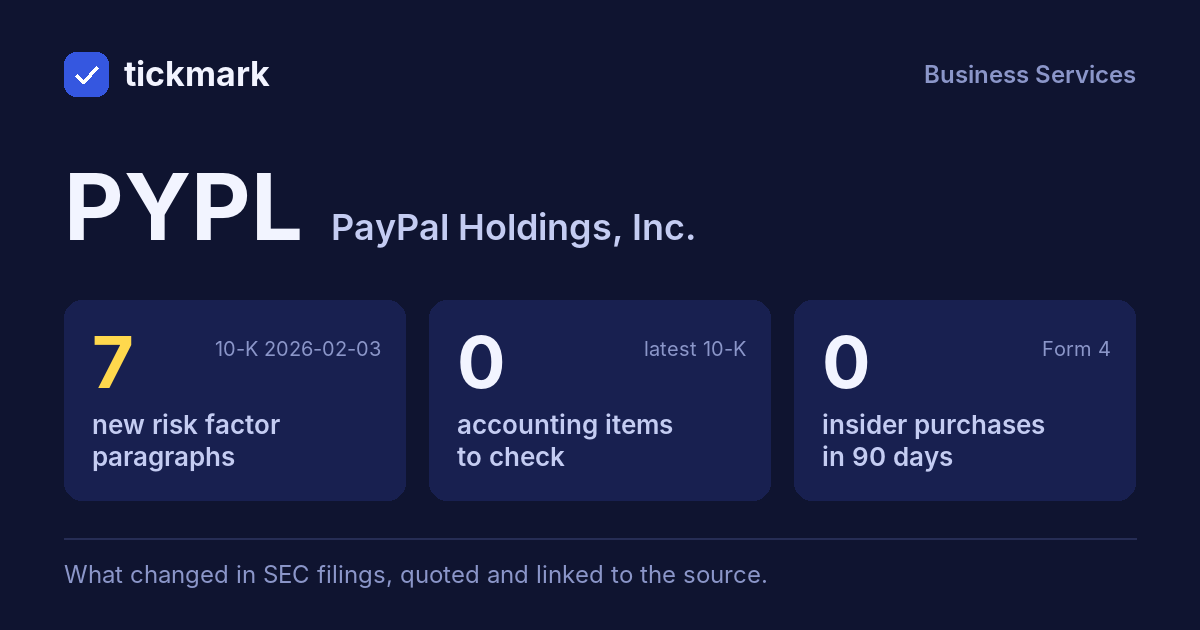
Marked against last year's 10-K:
cut words struck through, new words highlighted and underlined.
Risk Factors 229 words changed in this paragraph; it is 53% similar to last year's version.
We expect to continue to consider and evaluate a wide array of potential strategic transactions as part of our overall business strategy, including business combinations, acquisitions, and dispositions of certain businesses, technologies, services, products, and other assets; strategic investments; and commercial and strategic partnerships (collectively, “strategic transactions”). At any given time, we may be engaged in discussions or negotiations with respect to one or more strategic transactions, any of which could, individually or in the aggregate, be material to our financial condition and results of operations. There can be no assurance that we will be successful in identifying, negotiating, consummating and consummating, or integrating suitable transaction opportunities. Strategic transactions may involve additional significant challenges, uncertainties, and risks, including challenges of obtaining regulatory or other approvals, integrating new employees, products, systems, technologies, operations, and business cultures; challenges associated with operating acquired businesses in markets or business areas in which we may have limited or no experience; disruption of our ongoing operations and diversion of our management’s attention; inadequate data security, cybersecurity, or operational and information technology resilience; failure to identify, or our underestimation of, commitments, liabilities, deficiencies and other risks associated with acquired businesses or assets; potential exposure to new or incremental risks associated with acquired businesses and entities, strategic investments or other strategic transactions, including potential new or increased regulatory oversight and uncertain or evolving legal, regulatory, and compliance requirements, particularly with respect to companies in new or developing businesses or industries; challenges associated with dispositions of business or operations, including disruption to other parts of our business, potential loss of employees or customers, the transfer of technology and/or certain intellectual property rights to third-party purchasers, or exposure to unanticipated liabilities or ongoing obligations to us following any such dispositions; failure of the transaction to advance our business strategy or for its anticipated benefits to materialize; potential impairment of goodwill or other acquisition-related intangible assets; and the potential for our acquisitions to result in dilutive issuances of our equity securities or the incurrence of significant additional debt. Strategic transactions are inherently risky, may not be successful, and may harm our business, results of operations, and financial condition.
Source: Item 1A, 10-K 0001633917-26-000024 vs Item 1A, 10-K 0001633917-25-000019
Accounting Policies 181 words changed in this paragraph; it is 34% similar to last year's version.
In December 2023, September 2025, the FASB issued ASU 2023-09, Income Taxes (Topic 740): 2025-06, Intangibles - Goodwill and Other - Internal-Use Software (Subtopic 350-40): Targeted Improvements to Income Tax Disclosures. the Accounting for Internal-Use Software. The amended guidance enhances income tax disclosures primarily modernizes the accounting for costs related to the effective tax rate reconciliation internal-use software to more closely align with current software development methods. The guidance removes references to project stages and income taxes paid information. This guidance requires disclosure of specific categories in the effective tax rate reconciliation and further information on reconciling items meeting a quantitative threshold. In addition, the amended guidance requires disaggregating income taxes paid (net of refunds received) by federal, state, and foreign taxes. It also requires disaggregating individual jurisdictions in which income taxes paid (net of refunds received) is equal clarifies when we are required to or greater than 5 percent of total income taxes paid (net of refunds received). start capitalizing eligible costs. The amended new guidance is effective for annual periods fiscal years beginning after December 15, 2024. 2027, and interim periods within those fiscal years, with early adoption permitted. The guidance can be applied either prospectively on a prospective basis, a modified basis for in-process projects, or retrospectively. a retrospective basis. We are evaluating the impact this amended guidance may have on the notes to our consolidated financial statements.
Source: 10-K text, Note 1 – OVERVIEW AND SUMMARY OF SIGNIFICANT ACCOUNTING POLICIES, 10-K 0001633917-26-000024 vs 10-K text, Note 1 – OVERVIEW AND SUMMARY OF SIGNIFICANT ACCOUNTING POLICIES, 10-K 0001633917-25-000019
MD&A 119 words changed in this paragraph; it is 38% similar to last year's version.
Transaction revenues grew $2.0 billion, $956 million, or 7%, 3%, in 2024 2025 compared to 2023 2024. The increase in 2025 was driven primarily by an increase in revenues of approximately $1.3 billion, $0.5 billion, $740 million and $0.2 billion $340 million in revenue from our Braintree, core PayPal, PayPal and Venmo products and services, respectively, which resulted from was largely driven by growth in TPV and number of payment transactions, and an increase of approximately $150 million in revenue from Braintree products and services, predominantly attributable to growth in TPV despite a decline in the number of payment transactions. transactions over the same period. The increase in TPV for Braintree products and services despite a decline in the number of payment transactions is due to our strategic shift as we focus on profitable growth. Transaction revenues in 2025 were also impacted by approximately $210 million of unfavorable impact from hedging activities resulting from losses in 2025 compared to gains in 2024.
Source: Item 7, 10-K 0001633917-26-000024 vs Item 7, 10-K 0001633917-25-000019
Legal Proceedings 82 words changed in this paragraph; it is 75% similar to last year's version.
In addition to the protections afforded by applicable law, we provide consumers and merchants with protection programs for certain purchase transactions completed on our payments platform. Our protection programs help protect both consumers and merchants from financial loss resulting from, among other things, counterparty non-performance. These programs are designed to promote confidence on the part of both consumers, who will be reimbursed in certain circumstances, such as not receiving their purchased eligible item in the condition significantly as described, as well as merchants, who will receive payment in certain circumstances, such as establishing proof of shipment or delivery of an eligible item to the customer. These protection programs are considered assurance-type warranties under applicable accounting standards for which we estimate and record associated costs within the allowance for transaction losses. Our protection programs may result in transaction negative customer balances when there are insufficient funds in a customer’s PayPal account to cover charges applied for merchant-related chargebacks within the scope of our protection programs. Negative customer balances can also occur from bank returns and reversals due to insufficient funding sources. The allowance for negative customer balances represents our estimate of current expected credit losses during the period the payment transaction is completed. on negative customer balances.
Source: Item 3, via Note 13 – COMMITMENTS AND CONTINGENCIES, 10-K 0001633917-26-000024 vs Item 3, via Note 13 – COMMITMENTS AND CONTINGENCIES, 10-K 0001633917-25-000019