tickdelta
Sign in

Tickdelta is free for now. Sign up and get Pro free

← Screener

PYPLPayPal

Financials · Business Services · Nasdaq

At PayPal Holdings, Inc., our mission is to revolutionize commerce globally. 10-K, Item 1

Employees
23,800
Headquarters
San Jose, CA
Next results
around Feb 2, 2027
Compare with peers → Embed

When the SEC's staff reviews a filing, it writes to the company with numbered questions, and the company answers each one in a letter. SEC publishes the exchange once the review is over, at least 20 business days later. Below: what the staff asked PYPL, and the company's answer to each question, quoted from the letters. A question is not an accusation; most reviews end with the company adding detail to its next filing.

Form 10-K

2025-05-05 to 2025-08-05 · 5 questions · 3 letters from the SEC, 3 from the company
Review closed 2025-08-05
RevenueResults discussion (MD&A)SegmentsLegal and contingencies
Note 13 - Commitments and Contingencies · Protection Programs, page 110
SEC asked
We note your reconciliation of the changes in the allowance for transaction losses and negative customer balances, which you consider to be assurance-type warranties, includes reconciling items "provision," "realized losses," and "recoveries." Please revise your tabular reconciliation to include the reconciling items specified by ASC 460-10-50-8c.
PYPL answered
Our protection programs comprise (1) our purchase protection program that protects buyers who did not receive their item from a seller or received the item, but it was not the item they ordered and (2) our seller protection program protecting merchants when buyers claim that the transaction was unauthorized, or they did not receive the item. Our protection program disclosures within Note 13, Commitments and Contingencies, comprise both the allowance for transaction losses and the allowance for negative customer balances.
Rest of the answer

The allowance for transaction losses represents an accumulation of the estimated amounts of probable transaction losses as of the reporting date for losses arising from completing customer transactions, such as chargebacks for unauthorized credit card use and merchant-related chargebacks due to non-delivery or unsatisfactory delivery of purchased items, purchase protection program claims, and account takeovers. Negative customer balances occur primarily when there are insufficient funds in a customer’s PayPal account to cover charges applied for bank returns and reversals, debit card transactions, and merchant-related chargebacks due to non-delivery or unsatisfactory delivery of purchased items, which are generally within the scope of our protection programs. Negative customer balances are financing receivables subject to ASC 326-20, Financial Instruments – Credit Losses Measured at Amortized Cost. The allowance for negative customer balances is an estimate of expected credit losses based on historical trends involving collection and write-off patterns, internal factors including our experience with similar cases, other known facts and circumstances, and reasonable and supportable macroeconomic forecasts, as appropriate.

The allowance for transaction losses and the allowance for negative customer balances both relate to our protection programs and are interconnected such that we believe the users of our financial statements benefit from the combined disclosure of these allowances to understand the impact of our protection programs. For example, assume a buyer purchases an item from a seller. PayPal processes the transaction and the item is eligible for purchase protection. We estimate the probable transaction losses from our protection programs in our allowance for transaction losses. If the buyer submits an “Item Not Received” claim and the seller is not protected under our seller protection program as they cannot provide proof of shipment or delivery, PayPal will process a chargeback. Chargebacks often create negative customer balances when the merchant/seller has insufficient funds in their PayPal account to cover the chargeback. Upon a negative customer balance being recognized, the estimated losses are subsequently recognized in our allowance for negative customer balances. Alternatively, if the seller in this example could provide proof of shipment or delivery, they would be protected under the seller protection program and the negative customer balance would not occur.

To illustrate the linkage further, a substantial portion of transaction losses are initially recognized in the allowance for transaction losses and then subsequently recognized in the allowance for negative customer balances. We estimate probable losses related to our protection programs in our allowance for transaction losses and as those losses materialize as negative customer balances, they are recognized in our allowance for negative customer balances. We believe that disclosing the allowances separately would not provide investors with a useful or complete view of our losses related to our protection programs.

Based on the interconnectedness of the allowance for transaction losses and the allowance for negative customer balances and their linkage to our protection programs, we present the reconciliation of the activity in aggregate. Given that the allowance for negative customer balances was $256 million and $218 million at December 31, 2024 and 2023, respectively, and the allowance for transaction losses was not material at $86 million and $64 million at December 31, 2024 and 2023, respectively, we applied the rollforward disclosure guidance within ASC 326-20-50-13 (“CECL rollforward”) as required for the allowance for negative customer balances to the aggregate of both allowances. Disclosure requirements within ASC 460-10-50-8c (“product warranty reconciliation”) are relatively similar to the CECL rollforward guidance. However, the product warranty reconciliation requires a reconciling item that is not required for the CECL rollforward and vice versa. The product warranty reconciliation requires the aggregate changes in the liability for accruals related to preexisting warranties (including adjustments related to changes in estimates) to be separately presented as a reconciling item; however, we present preexisting warranties within our provision reconciling line as discussed further below. The CECL rollforward requires recoveries which are not relevant for the product warranty reconciliation. Apart from those differences in requirements, the reconciling items required for the product warranty reconciliation are similar to those for the CECL rollforward. Accordingly, we present the aggregate changes in the liability for accruals related to product warranties issued during the reporting period within the provision line and aggregate reductions in that liability for payments made under the product warranties in the realized losses line.

We do not believe the adjustment for preexisting warranties is a meaningful reconciling item for our protection programs, and it is not material. Our protection programs have a short duration of 180 days from the transaction date and our account takeover protection, which is our protection provided for unauthorized transactions, has a duration of 60 days from the account statement date. Additionally, the majority of protection program losses relate to chargebacks and occur within 60 days from the transaction date. Changes to our estimate for preexisting warranties would primarily represent the estimate of probable losses that converted to a negative balance in a subsequent reporting period and migrated from the allowance for transaction losses to the allowance for negative customer balances.

To further enhance the usefulness of our disclosure, in future filings we will expand upon the interconnectedness of the allowances and add footnotes to our rollforward disclosure to enhance the description of the reconciling items. Specifically, we plan to add a footnote to the provisions line to explain that the provision includes adjustments for preexisting warranties (including changes in estimates) and a footnote to the recoveries line to explain that recoveries are only relevant for our allowance for negative customer balances, and as such, there are no recoveries related to the allowance for transaction losses. Further, we will update the reconciling line “realized losses” to “realized losses and charge-offs.” A revised disclosure is presented below:

NOTE 13—COMMITMENTS AND CONTINGENCIES

PROTECTION PROGRAMS

In addition to the protections afforded by applicable law, we provide consumers and merchants with protection programs for certain purchase transactions completed on our payments platform. Our protection programs help protect both consumers and merchants from financial loss resulting from, among other things, counterparty non-performance. These programs are designed to promote confidence on the part of both consumers, who will be reimbursed in certain circumstances, such as not receiving their purchased item in the condition significantly as described, as well as merchants, who will receive payment in certain circumstances, such as establishing proof of shipment or delivery of an item to the customer. These protection programs are considered assurance-type warranties under applicable accounting standards for which we estimate associated costs within the allowance for transaction losses. Our protection programs often result in negative customer balances when there are insufficient funds in a customer’s PayPal account to cover charges applied for merchant-related chargebacks within the scope of our protection programs. Negative customer balances can also occur from bank returns and reversals due to insufficient funding sources. The allowance for negative customer balances represents our estimate of current expected credit losses on negative customer balances.

At December 31, 2024 and 2023, the allowance for transaction losses was $86 million and $64 million, respectively. The allowance for negative customer balances was $256 million and $218 million at December 31, 2024 and 2023, respectively. The following table shows changes in the allowance for transaction losses and negative customer balances related to our protection programs for the years ended December 31, 2024 and 2023:

As of December 31,

2024 2023

(In millions)

Beginning balance $ 282 $ 278

Provision1

1,114 1,192

Realized losses and charge-offs (1,218) (1,313)

Recoveries2

164 125

Ending balance $ 342 $ 282

1.Changes in estimates for prior period provision related to the allowance for transaction losses are not material and are aggregated with current period provisions.

2.Recoveries are only relevant for the allowance for negative customer balances.

Read in the reply ↗
In its next report

First report after the company's reply of 2025-05-16: 10-Q filed 2025-07-29 ↗, against the 10-Q filed 2025-04-29 ↗.

Tickdelta does not hold the text of both reports, so they are not compared here.
MD&A · Net Revenue Analysis, page 36
SEC asked (1)
Regarding your disclosure of total payment volume (TPV) metrics in quarterly earnings presentations, you state in response to prior comment 1 TPV does not directly relate to transaction revenues as TPV includes payment transactions processed on our payments platform that do not earn revenue. However, in MD&A you typically attribute changes in revenues to changes in TPV.
Rest of the question

Please advise or revise your MD&A disclosure accordingly.

PYPL answered
We acknowledge the Staff’s comment and provide the following additional details to our response to prior comment 1. In our prior response, we explained that TPV does not directly relate to transaction revenues. We disclose in our MD&A that transaction revenue growth is typically correlated with TPV growth and that management uses TPV to gain insight into the scale and strength of our payments platform, the engagement level of our customers, and underlying activity and trends which may be indicators of current and future performance.
Rest of the answer

Under ASC 606-10-55-90, an entity should consider how information about the entity’s revenue has been presented for other purposes. TPV is used to assess scale and relevance of our payments platform and not to reflect revenue. Given the absence of a direct relationship between TPV and transaction revenues, we do not believe that our presentation of TPV constitutes information about our revenues presented for other purposes.

Although the relationship between TPV and transaction revenues is not always direct and absolute, there is a positive correlation between TPV and transaction revenues. In accordance with Item 303 of SEC Regulation S-K, within MD&A we describe the underlying reasons for material changes in our results of operations in both quantitative and qualitative terms. In periods when the growth in the scale of our platform is determined to be the material driver of transaction revenues for that period, we reference the increase in TPV to explain the qualitative reasons underlying the growth in revenue.

In future MD&A disclosures in our Form 10-Q and 10-K filings, we will clarify that TPV does not always have a direct and absolute relationship with transaction revenues. Please refer to a revised version of relevant disclosure in our Form 10-K for Fiscal Year Ended December 31, 2024 as an example:

Transaction revenues grew $2.0 billion, or 7%, in 2024 compared to 2023 driven primarily by an increase in revenues of approximately $1.3 billion, $0.5 billion, and $0.2 billion from our Braintree, core PayPal, and Venmo products and services, respectively, which is largely associated with growth in TPV and the number of payment transactions.

Read in the reply ↗
In its next report

First report after the company's reply of 2025-06-24: 10-Q filed 2025-07-29 ↗, against the 10-Q filed 2025-04-29 ↗.

Tickdelta does not hold the text of both reports, so they are not compared here.

Note 2 - Revenue · Disaggregation of Revenue, page 76
SEC asked (2)
We note your response to prior comment 1. Please tell us whether your CODM regularly reviews transaction revenue by product when evaluating the financial performance of your operating/reporting segment. If so, please tell us how you considered ASC 606-10-55-90b. If not, tell us how the CODM makes performance or resource allocation decisions within the segment.
PYPL answered
Our Chief Operating Decision Maker (CODM) evaluates performance and allocates resources using consolidated operating results and does not evaluate performance or make decisions on the basis of separate products. Our CODM regularly receives financial information which generally includes consolidated metrics, metrics to track the success of our strategic imperatives (such as TPV and TPV growth, monthly active account (MAA) growth, and monthly debit card users as a percentage of MAAs), and revenue information, TPV, and take rate percentage for our customer businesses (i.e., Consumer Group, Small
Rest of the answer

Business & Financial Services (“SMB”), and Large Enterprise). In our prior response, we explained how business decisions must be evaluated based on their overall contribution to the company’s consolidated results due to the interconnected nature of our customer-focused business units and the interdependency of our products to drive increased customer engagement and facilitate the flywheel effect across our platform. We do not believe that revenue information alone is sufficient for the CODM to make decisions about allocating resources and assessing performance. Revenue information below consolidated totals, which may include product, customer, key initiative or geographic information, are provided to the CODM to explain key drivers and contributions to consolidated revenue fluctuations period over period.

In Q1 2025, at our Investor Day on February 25, 2025, PayPal introduced our strategic imperatives driving focused execution in 2025: win checkout, scale omni, grow Venmo, and accelerate SMB. The strategic initiatives aim to drive durable profitable consolidated growth (i.e., consolidated non-GAAP transaction margin dollars and non-GAAP EPS). Our strategic initiatives are intended to accelerate consolidated profitable growth across our payments platform and across all products, as we operate as a dual-sided network where strategic, interconnected business decisions focus on both sides of the platform and strategies aimed at our consumer business generally impact our merchant business and vice versa.

We have considered ASC 606-10-55-90 when analyzing how information about our revenue has been presented for other purposes, including our CODM’s evaluation of financial performance of our operating segment, when selecting the type of categories to use for revenue disaggregation. The guidance does not require disaggregation of revenue definitively when information about our revenue is presented for other purposes, but rather, that we analyze any revenue information presented for other purposes to determine if those categories are affected differently by economic factors to achieve the objective in ASC 606-10-50-5 for disaggregating revenue.

As noted in our prior response, the nature of each product within transaction revenues is payment processing, and these products broadly share similar characteristics, share substantially the same nature, timing of revenue recognition, uncertainty of future cash flows, and contract structure, and are similarly impacted by economic factors. While we offer a wide range of products on our payments platform to meet the diverse needs of our customers, the nature of each product offering in transaction revenues is transaction processing. We earn transaction revenues primarily from fees paid by our customers to receive payments on our payments platform. In a typical transaction only the merchant (party receiving funds) pays a fee, and the standard payment flow is free for consumers. Accordingly, the majority of PayPal’s transaction revenue is derived from merchant accounts, but purchases are primarily initiated by consumer activity. The majority of transaction revenue we generate across our products is dependent on consumer spending on goods and services and consumers choosing to transact at the merchants we serve. Changes in economic conditions or shifts in discretionary versus non-discretionary spending patterns generally have the potential to impact all our products similarly. Given that approximately 60% of Large Enterprise merchant accounts and 40% of SMB merchant accounts have more than one product, economic factors often manifest similarly across merchants and products. Since economic factors impact all our products similarly and the uncertainty of future cash flows may be significantly impacted by geographic region, we disclose revenue by geographic region. Transaction revenue is earned from contracts with customers that are defined at the transaction level and do not extend beyond the service already provided. Revenue within this category arises from a single performance obligation, which is satisfied at the point in time a transaction is completed on our platform. The nature, the uncertainty of revenue and cash flows, the timing of revenue recognition, and the contract structure do not significantly differ between our products within transaction revenue. As such, we have concluded that the products within transaction revenues do not require disclosure of disaggregated revenue categories according to ASC 606-10-50-5.

Read in the reply ↗
In its next report

First report after the company's reply of 2025-06-24: 10-Q filed 2025-07-29 ↗, against the 10-Q filed 2025-04-29 ↗.

Tickdelta does not hold the text of both reports, so they are not compared here.

Note 2 - Revenue · Disaggregation of Revenue, page 76
SEC asked (3)
In your response to prior comment 1 you state you may provide product-specific revenue information when useful to explain consolidated results (e.g., the Xoom negative revenue trend in Q1 2024). In addition to the previously cited example, we note the following: • In your Q1 2025 earnings release you cite progress across branded checkout, PSP, omnichannel, and Venmo as contributing to your results, • In prepared
Rest of the question

remarks during the related earnings call, you cite 20% revenue growth for Venmo, • On slide 8 of the earnings presentation, you cite growth in branded checkout and Venmo offsetting lower Braintree revenue, • In your Q1 2025 Form 10-Q, you quantify the change in Braintree revenue (- $200m) and Venmo/PayPal revenue (+$170m), and • In your 2024 Form 10-K, you quantify the change in Braintree revenue ($+1.3b), core PayPal (+$0.5b), and Venmo (+$0.2b). While you have not provided this information for all products on a consistent basis nor provided actual revenue amounts, you have nonetheless disclosed transaction product-specific revenue information outside the financial statements and determined it useful in explaining results, which under ASC 606-10-55-90a is a factor that must be considered when selecting disaggregation categories. Please advise. Regarding the above referenced Xoom negative revenue trend in Q1 2024 and the decline in Braintree revenue and increase in Venmo/PayPal revenue in Q1 2025, please explain to us why you believe these are not examples of transaction revenue products being differently affected by economic factors and, therefore, subject to different uncertainty than other products comprising transaction revenue. Refer to ASC 606-10-50-5.

PYPL answered
As discussed in our response to question 2 above, the nature of each product within transaction revenues is payment processing, and these products broadly share similar characteristics and are similarly impacted by economic factors. In determining the appropriate categories for disaggregating revenue, we considered how revenue information is presented for other purposes, including earnings calls and investor presentations, in accordance with ASC 606-10-55-90a.
Rest of the answer

References to individual revenue components in MD&A and outside our financial statements are provided to give context to our investors and insight into how material changes in that period contribute to the performance of our consolidated revenues. In certain cases, we provided this information in compliance with Item 303 of SEC Regulation S-K, which requires us to describe the underlying reasons for material changes in our results of operations in both quantitative and qualitative terms. Revenue information is provided predominantly to update investors on our strategic initiatives and give insight into the impact that management’s strategy to drive consolidated profitable growth (i.e., our consolidated non-GAAP transaction margin dollars and non-GAAP EPS) may have on consolidated revenues in certain periods. Product-specific revenue is primarily impacted by the Company’s strategic decisions and not impacted differently by economic factors. Explanations of product-specific revenue variances, such as the examples cited for Braintree, Xoom, and Venmo, are not primarily related to economic factors, but rather to changes in management’s focus to drive profitable growth across our entire suite of products. Management’s strategic imperatives focus on accelerating profitable growth and may be executed through pricing model changes, cost reductions, and product innovation and refinements. The Company does not intend to provide product-specific revenue information for all products on a consistent basis. Additionally, such information is limited to relative indicators such as directional revenue trends or revenue growth percentages, and the Company has not and does not intend to provide total revenue amounts by product.

We have concluded that the presentation of certain product-specific revenue information to explain our consolidated results and the presentation of our strategic imperatives to explain how we plan to drive profitable growth does not signify or imply that the associated products carry materially different risks, or that they differ significantly in terms of nature, amount, timing or uncertainty of revenues and cash flows. The nature of each product within transaction revenues is payment processing, and these products broadly share similar characteristics and are similarly impacted by economic factors. As such, we have concluded that the products within transaction revenues do not meet the disaggregated revenue disclosure requirements according to ASC 606-10-50-5.

We regularly evaluate the requirements of ASC 606 to determine the appropriate level of revenue disaggregation. If in the future our products become distinctly affected by unique economic factors, or if the nature, amount, timing, or uncertainty of revenues and cash flows materially diverge, we will update our disclosures accordingly.

Read in the reply ↗
In its next report

First report after the company's reply of 2025-06-24: 10-Q filed 2025-07-29 ↗, against the 10-Q filed 2025-04-29 ↗.

Tickdelta does not hold the text of both reports, so they are not compared here.

Note 2 - Revenue · Disaggregation of Revenue, page 76
SEC asked
We note your response to comment 2. In response to our comment asking whether your CODM regularly reviews transaction revenue by product, at the end of the first paragraph you state “Revenue information...[provided to the CODM] may include product...information.” Please directly tell us whether it does or does not include transaction revenue by product.
Rest of the question

In the first sentence of that paragraph, you state the "CODM...does not evaluate performance or make decisions on the basis of separate products.” Please clarify whether this means solely on the basis of separate products or that the CODM does not review product revenue at all when evaluating the performance of your operating/reporting segment.

PYPL answered
The financial information provided to our Chief Operating Decision Maker (CODM) includes additional product revenue information, typically presented to provide further granularity on our customer business (i.e., Consumer Group, Small Business & Financial Services (“SMB”), and Large Enterprise) revenue fluctuations, given that our products often span across our customer businesses, or to provide oversight on the performance of our strategic initiatives, as explained in our prior response to comment 2 and comment 3.
Rest of the answer

Our CODM does not evaluate performance or make decisions solely on the basis of separate products.

We have considered ASC 606-10-55-90 when analyzing how information about our revenue has been presented for other purposes, including our CODM’s evaluation of financial performance of our operating segment, to select the type of categories used for revenue disaggregation. The guidance does not require disaggregation of revenue definitively when information about our revenue is presented for other purposes, but rather, requires that we analyze any revenue information presented for other purposes to determine if those categories are affected differently by economic factors to achieve the objective in ASC 606-10-50-5 for disaggregating revenue. The products within transaction revenues pertain to payment processing, and these products share similar nature, timing of revenue recognition, uncertainty of future cash flows, and contract structure, and are similarly impacted by economic factors. As such, we have concluded that the products within transaction revenues do not require disclosure of disaggregated revenue categories according to ASC 606-10-50-5.

Read in the reply ↗
In its next report

First report after the company's reply of 2025-07-24: 10-Q filed 2025-07-29 ↗, against the 10-Q filed 2025-04-29 ↗.

Tickdelta does not hold the text of both reports, so they are not compared here.

Also in this review: closing letter, 2025-08-05
Schedule 14A

2022-09-19 to 2022-11-14 · 3 questions · 1 letter from the SEC, 1 from the company
Review closed 2022-11-14
Controls
Definitive Proxy Statement on Schedule 14A filed June 2, 2022 · General
SEC asked (1)
Please expand your discussion of the reasons you believe that your leadership structure is appropriate, addressing your specific characteristics or circumstances. In your discussion, please also address the circumstances under which you would consider having the Chair and CEO roles filled by a single individual, when shareholders would be notified of any such change, and whether you will seek prior input from
Rest of the question

shareholders.

PYPL answered
As discussed in the Proxy Statement, our Board of Directors (the “Board”) has determined that the roles of Chair and CEO should be held by separate individuals to enhance the Board’s oversight of management and to allow the CEO to focus primarily on management responsibilities. The Company has an independent Chair and believes our current Board leadership structure provides effective and independent oversight of management and the Company.

While it is our belief that the Company’s disclosures in the Proxy Statement comply with all applicable rules and regulations, including Item 407(h) of
Rest of the answer

Regulation S-K, in light of the Staff’s comment, we will continue to evaluate, and appropriately expand, the discussion about our leadership structure in future proxy statements.

Read in the reply ↗
Definitive Proxy Statement on Schedule 14A filed June 2, 2022 · General
SEC asked (2)
Please expand upon the role that your Independent Chair plays in the leadership of the board. For example, please enhance your disclosure to address whether or not your Independent Chair may: • represent the board in communications with shareholders and other stakeholders; • require board consideration of, and/or override your CEO on, any risk matters; or • provide input on design of the board itself.
PYPL answered
Currently, the Proxy Statement includes a section titled “Robust Independent Chair Responsibilities” that provides a description of the role of our independent Chair. Consistent with our response to comment 1 above, we will carefully consider the Staff’s comments as we evaluate additional enhancements to our disclosures about the role of our independent Chair in future proxy statements. Read in the reply ↗
Definitive Proxy Statement on Schedule 14A filed June 2, 2022 · General
SEC asked (3)
Please expand upon how your board administers its risk oversight function. For example, please disclose: • the timeframe over which you evaluate risks (e.g., short-term, intermediate-term, or long-term) and how you apply different oversight standards based upon the immediacy of the risk assessed; • whether you consult with outside advisors and experts to anticipate future threats and trends, and how often you
Rest of the question

re-assess your risk environment; • how the board interacts with management to address existing risks and identify significant emerging risks; and • how your risk oversight process aligns with your disclosure controls and procedures.

PYPL answered
The Proxy Statement currently includes a section titled “Risk Oversight,” which provides a description of the Board’s role in our risk oversight, how the Board and its committees administer risk oversight, and the relationship between the Board and management in risk oversight. For example, the Proxy Statement states that “[t]he Board is responsible for overall risk assessment and management oversight. The Board executes its responsibility as a group and through its committees, which regularly report to the full Board.
Rest of the answer

In addition to their ongoing oversight responsibilities, throughout 2021, the Board and its committees regularly reviewed and discussed with management the continued impact of the COVID-19 pandemic on our employees, customers and communities. As part of these reviews, the Board considered management’s ongoing strategies and initiatives to respond to and mitigate the adverse effects of the pandemic, including creating and expanding employee initiatives and other relief efforts.” The Proxy Statement also describes the duties of the Audit, Risk and Compliance Committee (“ARC”), which is primarily responsible for oversight of the Company’s risk framework, as well as the risk oversight responsibilities of the Compensation Committee and Governance Committee relating to their respective focus areas.

As noted in our responses to comments 1 and 2 above, we will carefully consider the Staff’s comments and provide expanded disclosure about how our Board administers its risk oversight function in future proxy statements.

Read in the reply ↗

Also in this review: closing letter, 2022-11-14

Form 10-K

2019-06-10 to 2019-07-24 · 3 questions · 2 letters from the SEC, 2 from the company
Review closed 2019-07-24
Russia and UkraineRevenue
Our business is subject to extensive government regulation...., Page 19 · Economic and Trade Sanctions, page 22
SEC asked (1)
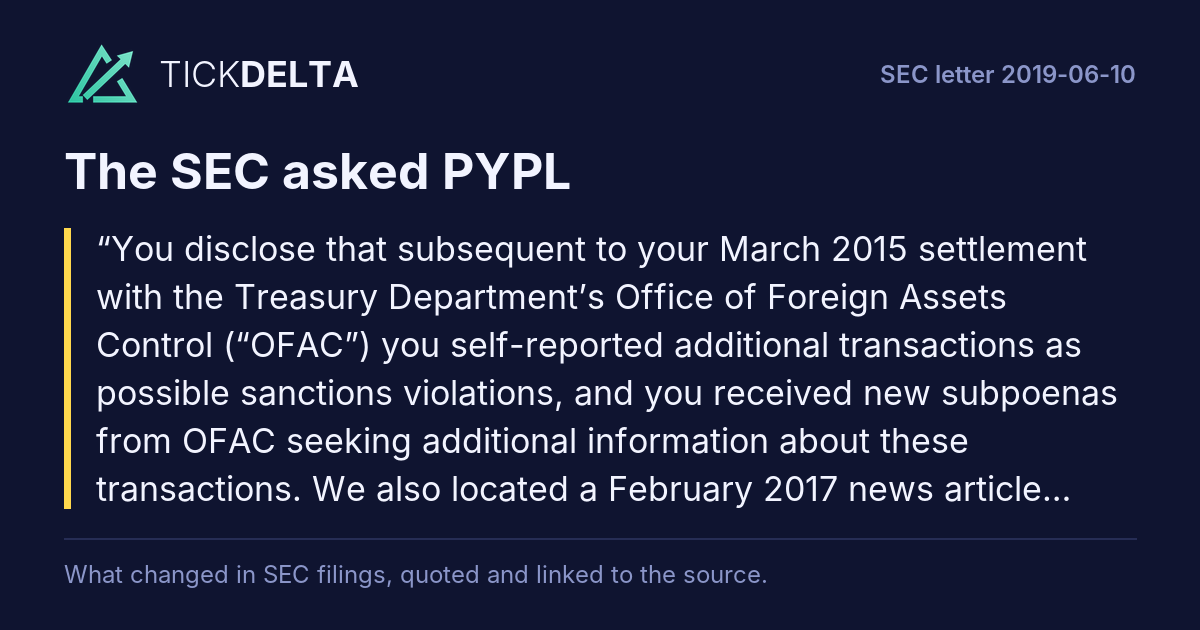
You disclose that subsequent to your March 2015 settlement with the Treasury Department’s Office of Foreign Assets Control (“OFAC”) you self-reported additional transactions as possible sanctions violations, and you received new subpoenas from OFAC seeking additional information about these transactions.
Rest of the question

We also located a February 2017 news article reporting that you received subpoenas from the Justice Department for potential violations of U.S. sanctions. Please describe these transactions to us, including the countries involved. Please also discuss the potential for reputational harm from these transactions. In this regard, we note that the news article reports that your shares had recently dropped 2.8%.

PYPL answered
As mentioned in the Form 10‑K, since March 2015, the date of the Company’s settlement with OFAC regarding possible violations arising from our sanctions compliance practices between 2009 and 2013, we have self-reported to OFAC certain transactions that were inadvertently processed but subsequently identified as possible violations of U.S. economic and trade sanctions.
Rest of the answer

These self-reported transactions involved payments that were processed by PayPal or its subsidiaries that were in possible violation of certain country-based comprehensive OFAC sanctions, as well as certain list-based OFAC sanctions. The Company processed these payments due to human errors or technical issues involving the Company’s OFAC real-time screening system, which we have expended significant resources to address and rectify. As we do not know if OFAC may ultimately treat any of the noted transactions as potential violations, we do not know what, if any, reputational harm may result from these transactions. As further information regarding this matter becomes available, the Company will continue to assess its obligations under SEC rules and provide additional disclosures as necessary.

We note that your letter references “a February 2017 news article reporting that [PayPal] received subpoenas from the Justice Department for potential violations of U.S. sanctions.” We believe this is a reference to the Department of Justice investigation disclosed in our Annual Report on Form 10‑K for the fiscal year ended December 31, 2016, in which we noted: “We have received subpoenas from the U.S. Department of Justice (“DOJ”) seeking the production of certain information related to our historical anti-money laundering program. We are cooperating with the DOJ in providing information in response to the subpoenas.” In our Quarterly Report on Form 10‑Q for the third quarter of 2018, we noted that “[w]e have been informed by the DOJ that based on the information available to them, they have closed their investigation of the Company.” As we disclosed, this investigation related to our anti-money laundering program, not potential violations of U.S. sanctions.

Read in the reply ↗
In its next report

First report after the company's reply of 2019-06-21: 10-Q filed 2019-07-25 ↗, against the 10-Q filed 2019-04-25 ↗.

Tickdelta does not hold the text of both reports, so they are not compared here.

Financial Statements for the Year Ended December 31, 2018 · Note 11 - Loans and Interest Receivable, page 102
SEC asked (2)
We note your disclosure that you accounted for the sale of your U.S. consumer credit receivables portfolio as a sale. You also disclose at the bottom of page 102 that you concluded your continuing involvement in the revenue share arrangement does not invalidate this determination. Please tell us in reasonable detail the specific nature of your continuing involvement in the transferred assets.
Rest of the question

Please also tell us how you concluded you met the conditions for sale accounting, and tell us the specific accounting literature you relied upon in reaching your conclusion.

PYPL answered
In July 2018, we completed the sale of our U.S. consumer credit receivables portfolio (the “Sale Date Loans”) to Synchrony Bank. Simultaneous with the completion of that sale, we entered into an amended commercial arrangement with Synchrony Bank (the “Program Agreement”). Under the Program Agreement, Synchrony will also own all new U.S. consumer receivables generated through our PayPal Credit (“PPC”) products.
Rest of the answer

The combination of the Sale Date Loans and new receivables are referred to as the “Receivables Portfolio.” Also, under the Program Agreement, PayPal receives a share of the ongoing income (“revenue share”) generated from the Receivables Portfolio over a ten-year term. In addition, PayPal performed interim servicing for the Receivables Portfolio through a transition period which ended in June 2019, after which Synchrony will take over the servicing of the Receivables Portfolio. These interim servicing activities were solely to facilitate an orderly transition of the servicing activities of the Receivables Portfolio from PayPal to Synchrony.

Our continuing involvement pertains primarily to the interim servicing activities we perform and the revenue share that we earn under the Program Agreement noted above. These interim servicing activities and promotion of the PPC products are incidental to the Sale Date Loans and do not enable PayPal to maintain control over the Sale Date Loans after the sale. The amount that we earn pursuant to the Program Agreement revenue share is based on the net economics of the Receivables Portfolio during each measurement period.

Upon completion of the sale of the Sale Date Loans, Synchrony Bank is both the legal owner of the accounts and the associated credit receivables. On that basis, we evaluated the existing loans as of the date of the transaction for sale accounting treatment under ASC 860‑10‑40‑5. The key components of our evaluation are as follows:

a.

The sale must result in legal isolation of the receivables from PayPal, even in the event of bankruptcy or receivership.

We concluded that the Sale Date Loans were legally isolated from PayPal, even in the event of PayPal’s bankruptcy or receivership. To confirm this conclusion, we obtained a legal true‑sale‑at‑law “would” level opinion from outside legal counsel in each relevant jurisdiction which included confirmation that the sale resulted in legal isolation of the Sale Date Loans from PayPal. In connection with the delivery of these opinions, outside legal counsel reviewed, among other things, the purchase and sale agreements as well as the Program Agreement terms inclusive of the revenue share terms. Therefore, we believe this ASC 860 criteria has been met.

b.

Synchrony must have the right to pledge or exchange the transferred assets.

Under the Program Agreement, Synchrony has the full contractual right and title associated with the Sale Date Loans and no provisions therein constrain Synchrony’s ability to pledge or exchange the Sale Date Loans. In addition, even if Synchrony were to pledge or exchange the Sale Date Loans, Synchrony would continue to owe income to PayPal under the Program Agreement and they would be responsible for servicing the Receivables Portfolio. We do not believe that these obligations would constrain Synchrony from monetizing the acquired Sale Date Loans. Further, there are no conditions that both constrain Synchrony from taking advantage of the right to pledge or exchange the assets or provide a more than trivial benefit to PayPal in such an arrangement. Therefore, we believe this ASC 860 criteria has been met.

c.

PayPal must not maintain effective control over the assets.

Under the Program Agreement, PayPal does not have the ability to repurchase or own the Sale Date Loans at, prior, or subsequent to the end of the ten‑year term of the agreement, nor does PayPal maintain the unilateral ability to cause Synchrony to return specific Sale Date Loans. There were no other terms present which could result in PayPal maintaining effective control over the Sale Date Loans. Therefore, we believe this ASC 860 criteria has been met.

Based on our assessment that all criteria under ASC 860‑10‑40‑5 required to account for a transfer of assets as a sale were met, we concluded the sale of the Sale Date Loans should be accounted for as a sale.

Read in the reply ↗
In its next report

First report after the company's reply of 2019-06-21: 10-Q filed 2019-07-25 ↗, against the 10-Q filed 2019-04-25 ↗.

Tickdelta does not hold the text of both reports, so they are not compared here.

Economic and Trade Sanctions, page 22
SEC asked
We note your response to comment number 1. As requested, please tell us the countries involved in the transactions that you self-reported to the Treasury Department’s Office of Foreign Assets Control.
PYPL answered
As described in our June 21, 2019 response to comment number 1 (our “Prior Response”), we have self-reported to the Treasury Department’s Office of Foreign Assets Control (“OFAC”) certain transactions that were inadvertently processed but subsequently identified as possible violations of U.S. economic and trade sanctions. In response to your comment and further to our discussions with the Staff, we respectfully advise the Staff that the self-reported transactions involved certain countries subject to U.S.
Rest of the answer

economic sanctions at the time of the transactions, including North Korea, Iran, Sudan and Syria (the “Reported Countries”).

The self-reported transactions involving the Reported Countries occurred between 2013 and 2016. The transactions did not involve the governments of North Korea, Iran, Sudan, or Syria. Rather, the transactions generally involved non-sanctioned parties and a reference to a Reported Country (e.g., a good that originated in or was for the benefit of an individual in a Reported Country). In aggregate, the transactions are negligible and de minimis in nature, both in terms of total volume and dollar value, and we believe that the associated revenue derived from PayPal’s processing of the self-reported transactions represented less than 0.0001% of total revenue derived from PayPal’s worldwide processing of transactions on behalf of all customers during the period when such transactions were processed.

In addition, the Company does not maintain direct contacts with the Reported Countries and has no business operations, subsidiaries, affiliates, assets or liabilities in such countries. Moreover, the Company maintains extensive policies, procedures, programs and controls in its commitment to comply with all applicable laws and regulations, including U.S. economic sanctions enforced by OFAC. For example, PayPal prohibits access to its website from countries subject to comprehensive sanctions and does not allow people or entities in such countries to register for PayPal accounts. We also block IP addresses known to be associated with persons in comprehensively sanctioned countries and devote significant resources to avoid doing business with and to prevent the processing of payments to or from such countries.

Based on the de minimis nature of the self-reported transactions, as well as our ongoing efforts to comply with applicable U.S. economic and trade sanctions, PayPal does not regard such contacts as material to a reasonable investor in making an investment decision. As a result, the Company does not believe, nor is it aware of any indications, that any of the self-reported transactions involving the Reported Countries are reasonably likely to affect the Company’s reputation and share value or to be viewed by investors as quantitatively or qualitatively material in making an investment decision. However, as noted in our Prior Response, we do not know if OFAC may ultimately treat any of the self-reported transactions as potential violations, and accordingly, we ultimately do not know what, if any, reputational harm may result from these transactions.

Read in the reply ↗
In its next report

First report after the company's reply of 2019-07-16: 10-Q filed 2019-07-25 ↗, against the 10-Q filed 2019-04-25 ↗.

Tickdelta does not hold the text of both reports, so they are not compared here.

Also in this review: closing letter, 2019-07-24

Form 10-K

2018-08-24 to 2018-11-08 · 3 questions · 1 letter from the SEC, 1 from the company
Review closed 2018-11-08
RevenueGoodwill and impairmentAcquisitionsPensions
Note 2 – Revenue · Transaction Revenue, page 10
SEC asked (1)
We note you have determined that your transaction revenue represents a single performance obligation. Please tell us each promised good or service you have identified in these arrangements. In addition, provide us your analysis regarding how you determined that all goods and services in these arrangements should be combined. Reference 606-10-25-19 through 22.
PYPL answered
PayPal’s service enables our customers to send and receive payments. We earn transaction revenues primarily from fees charged to our customers on an individual transaction basis. When we enable our customers to send or receive a payment, we perform multiple activities to provide our service:

•

Identification of the sender’s payment funding source and payment authorization;

Processing a payment through an external payment network, where applicable;

Identification of sender and receiver holding currency, and currency conversion, where applicable; and

Delivery of funds to the receiver.

We
Rest of the answer

also provide our customers with protection programs on substantially all transactions completed through our Payments Platform. These protection programs are assurance-type warranties and do not provide an additional service to the customer. In addition, general customer support is available to all customers, is not customized to any specific contract, and is immaterial in the context of the contract. The activities within the service enabling our customers to send or receive a payment do not individually provide a benefit to the customer, and therefore, are not distinct per ASC 606-10-25-20. Further, we only perform these activities as a combined service.

While the activities noted above do not comprise individual services, we also considered the guidance in ASC 606-10-25-21 to determine whether the individual activities are distinct within the context of the contract. The criteria are as follows:

a.

Significant integration: Each of the individual activities performed to enable a payment transaction is an input that is integrated by PayPal to produce the combined output of sending or receiving a payment on behalf of a customer. PayPal manages and coordinates the various activities and assumes the risk associated with integration.

b.

Modification or customization of other services in the contract: The individual activities in the contract do not modify or customize the other activities in the contract.

c.

Highly dependent or highly interrelated: Each activity is highly dependent on and highly interrelated with the other activities promised in the contract. A payment would not be able to be sent or received on our Payments Platform unless each of these activities are provided. Our customers cannot choose to purchase one activity among those listed without impacting the ability to transfer the activity, nor do we offer the individual activities separately to our customers.

Based on the assessment above, we have concluded that the service we perform enabling customers to send and receive funds in a payment transaction is a single performance obligation in accordance with ASC 606-10-25-22.

In limited circumstances, we have customized customer agreements that may contain additional services such as marketing deliverables, daily ACH transfers to a third-party bank account, or additional merchant reporting. These incremental services are immaterial in the context of the contract and thus we have not assessed whether they are performance obligations per ASC 606-10-25-16A.

Read in the reply ↗
In its next report

First report after the company's reply of 2018-09-07: 10-Q filed 2018-10-23 ↗, against the 10-Q filed 2018-07-26 ↗.

Tickdelta does not hold the text of both reports, so they are not compared here.

Note 2 – Revenue · Transaction Revenue, page 10
SEC asked (2)
Your disclosure indicates that transaction fees collected from your customers are recognized as revenue on a gross basis because you are the principal in respect of processing payments. Please describe the services provided by each party involved in the payment processing transaction and tell us how you determined you control each service before it is transferred to the customer.
Rest of the question

Reference ASC 606-10-55-36 through 40.

PYPL answered
As described above in our response to comment 1, when PayPal provides the combined service enabling our customers to send and receive payments, we are the principal for each transaction and record fees earned on a gross basis as part of transaction revenues. We respectfully advise the Staff that in certain payment processing services, we act in the capacity as an agent, such as the initiation for a payment through our gateway services. In these transactions, fees are recognized on a net basis and presented as other value added services revenue.
Rest of the answer

For the purposes of this response, we will focus our comments on the activities related to revenue recognized on a gross basis.

Our transaction fee revenue is predominantly earned from merchants with whom we directly enter into contracts and agree to provide the service that enables their customers to transact with them. In this scenario, the merchant is our customer as PayPal charges the merchant the fees associated with the transaction, and the merchant is the beneficiary of a received payment. From our customer’s perspective, the arrangement providing the ability to send or receive a payment is with PayPal, and the remediation of any service issues related to the payment is the responsibility of PayPal.

When PayPal enables a customer to send or receive a payment, the parties involved in the payment processing transaction will vary depending on the sender’s funding source. The recipient of a purchase transaction, who is our customer, is not aware of the sender’s funding source (i.e., whether a transaction has been funded by a sender’s PayPal account, bank account or a credit/debit card) and the settlement of cash with the customer is not dependent on PayPal’s receipt of a sender’s funds. Further, the fees we negotiate with our customers are not impacted by the sender’s funding source. When our customers receive funds into their PayPal account, they can then determine whether to spend those funds with other merchants that accept PayPal, transfer them to another PayPal account, or exit the funds from PayPal. These events are considered separate transactions that may or may not be monetized.

For transactions funded with a customer’s PayPal account balance, there are no external vendors directly involved in completing the transaction. For transactions funded with credit or debit cards that require processing through the card payment networks or transactions funded directly from a sender’s bank account, PayPal enters into contracts with acquirer partners and payment processors to fulfill this portion of our service. PayPal has full discretion in selecting the acquirers and payment processors, and can direct which acquiring partner is utilized in a payment transaction. Our customers are not a party to these contracts and PayPal can change vendors at any time without notice or approval from our customers. From an acquirer’s or payment processor’s perspective, it is PayPal’s obligation to pay all transaction processing fees.

Because other parties are involved in certain transactions, we also evaluated the criteria in ASC 606-10-55-37A. The contracts with our acquirer partner and payment processing vendors provide us the right to access and direct their services when required to complete a payment transaction. Further, these activities are combined to enable our customers to send or receive funds in a payment transaction. Therefore, PayPal has determined it is the principal of each transaction.

We assessed the indicators in ASC 606-10-55-39 to support our conclusion as follows:

Fulfillment: In a payment transaction, PayPal is responsible for fulfilling the service that enables our customers to send or receive a payment on our Payments Platform. We utilize our internal risk capabilities to authorize a payment at the time of the transaction, and in many cases make the funds available to the merchant before we receive the funds from the funding source used. PayPal assumes all responsibility, liability, risk of loss, and other risk exposure with respect to our customers that make payment transactions on our Payments Platform. As PayPal is responsible for fulfilling the promise to send and/or deliver a payment, our assessment of fulfillment supports our conclusion that PayPal is acting as a principal.

Inventory risk: This indicator is not applicable for PayPal because a payment processing service does not lend itself to general inventory risk or physical risk of loss.

Pricing: PayPal has full latitude in the pricing we establish with our customers and this pricing is independent of our cost structure. Our agreements with acquirer partners and payment processors do not define or place limitations on the pricing that we may charge our customers. Our ability to establish pricing supports our conclusion that PayPal is acting as a principal.

Read in the reply ↗
In its next report

First report after the company's reply of 2018-09-07: 10-Q filed 2018-10-23 ↗, against the 10-Q filed 2018-07-26 ↗.

Tickdelta does not hold the text of both reports, so they are not compared here.

Note 17 – Restructuring, page 33
SEC asked (3)
We note the restructuring charges in the first half of 2018 include charges related to your decision to wind down TIO’s operations. We also note your disclosures about the intangible assets and net assets recognized in July 2017 upon acquisition of this business and the $30 million impairment of customer related intangible assets recognized during the fourth quarter of 2017 upon the suspension of TIO’s operations.
Rest of the question

In light of your decision to wind down TIO’s operations, please tell us how you considered whether any of the remaining tangible and intangible assets of this business may be impaired. We may have further comment after reviewing your response.

PYPL answered
As previously disclosed in note 3 to the Form 10-K, the allocation of TIO Networks’ (“TIO”) purchase consideration resulted in technology and customer-related intangible assets of approximately $66 million, net tangible assets of approximately $2 million, and initial goodwill of approximately $170 million. In the fourth quarter of 2017, PayPal discovered security vulnerabilities on the TIO platform that were determined to have existed prior to acquisition. As a result, PayPal made the decision to suspend the majority of TIO’s operations during the fourth quarter of 2017.
Rest of the answer

The decision to wind-down TIO’s operations and exit certain TIO employees was made in the first quarter of 2018.

PayPal determined that TIO’s operations were integrated into and operate within PayPal’s broader operations, and therefore, did not represent a separate reporting unit. At the time PayPal suspended and decided to wind down the majority of TIO’s operations, in accordance with ASC 350-20-35, PayPal evaluated whether or not an impairment of goodwill had been triggered at the reporting unit level. PayPal determined that it was not more likely than not that the suspension of TIO services reduced the reporting unit’s fair value below its carrying amount, and thus, in accordance with ASC 350-20-35-3D, the first and second steps of the goodwill impairment test were deemed unnecessary.

Other intangible assets acquired were either tested for recoverability under ASC 360 or assessed for a measurement period adjustment under the provisions of ASC 805 as part of the decision to suspend and wind-down operations. PayPal applied the guidance in ASC 360-10-35 to evaluate the customer-related intangible assets acquired, which represented $45 million of the identifiable intangible assets recorded. The suspension of services was deemed to be a significant adverse change, which resulted in the inability to generate operating revenues for the suspended service distribution channels, as well as the potential loss of returning customer volumes – thus constituting an indicator of impairment under Step 1. PayPal concluded that directly associated undiscounted cash flows over the remaining useful life of approximately 5 years were below the relevant asset groups’ carrying values, and thus were not recoverable under Step 2. Based on the guidance for measurement of an impairment charge, PayPal concluded that an impairment of approximately $30 million, representing the amount by which carrying value of the customer-related intangible assets exceeded their fair value, should be recorded during the fourth quarter of 2017.

No additional tangible or intangible assets were determined to be impaired or subject to a measurement period adjustment under the provisions of ASC 805. In addition, the useful life for all remaining TIO intangibles was revised to align with the remaining contracts that continue through the second quarter of 2019. The remaining net carrying value of TIO’s customer-related and technology intangibles as of June 30, 2018 was $17 million.

Read in the reply ↗
In its next report

First report after the company's reply of 2018-09-07: 10-Q filed 2018-10-23 ↗, against the 10-Q filed 2018-07-26 ↗.

Tickdelta does not hold the text of both reports, so they are not compared here.

Also in this review: closing letter, 2018-11-08

1 other letter: notices that a filing will not be reviewed, requests to declare a registration effective, and the like
  • 2018-10-23 · PYPL: letter · Supplemental submission – · Form 10-K for Fiscal Year Ended December 31, 2017 · Filed...

From the SEC's correspondence on EDGAR: staff letters (form UPLOAD) and company letters (form CORRESP), 19 letters filed since 2018-08-24. Questions and answers are matched by their numbers; topics come from words in each question. The reports are compared word for word (same form, before the first SEC letter against the first report after the company's reply). No AI.

Work on PYPL in a spreadsheet: Excel workbook (a sheet per section, ten years by column, charts, links to the filings) · CSV. For a Google Sheet that stays up to date, paste =IMPORTDATA("https://tickdelta.com/company/PYPL/export.csv") into a cell.