Form 10-K
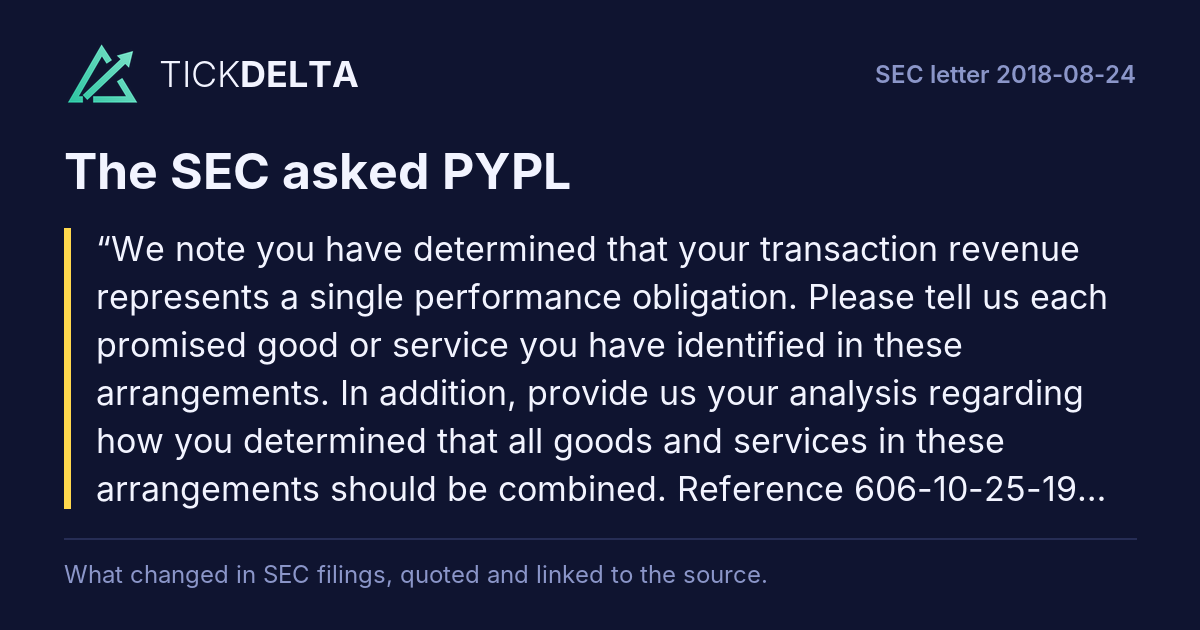
We note you have determined that your transaction revenue represents a single performance obligation. Please tell us each promised good or service you have identified in these arrangements. In addition, provide us your analysis regarding how you determined that all goods and services in these arrangements should be combined. Reference 606-10-25-19 through 22.
PayPal’s service enables our customers to send and receive payments. We earn transaction revenues primarily from fees charged to our customers on an individual transaction basis. When we enable our customers to send or receive a payment, we perform multiple activities to provide our service:
•
Identification of the sender’s payment funding source and payment authorization;
Processing a payment through an external payment network, where applicable;
Identification of sender and receiver holding currency, and currency conversion, where applicable; and
Delivery of funds to the receiver.
WeRead in the reply ↗Rest of the answer
also provide our customers with protection programs on substantially all transactions completed through our Payments Platform. These protection programs are assurance-type warranties and do not provide an additional service to the customer. In addition, general customer support is available to all customers, is not customized to any specific contract, and is immaterial in the context of the contract. The activities within the service enabling our customers to send or receive a payment do not individually provide a benefit to the customer, and therefore, are not distinct per ASC 606-10-25-20. Further, we only perform these activities as a combined service.
While the activities noted above do not comprise individual services, we also considered the guidance in ASC 606-10-25-21 to determine whether the individual activities are distinct within the context of the contract. The criteria are as follows:
a.
Significant integration: Each of the individual activities performed to enable a payment transaction is an input that is integrated by PayPal to produce the combined output of sending or receiving a payment on behalf of a customer. PayPal manages and coordinates the various activities and assumes the risk associated with integration.
b.
Modification or customization of other services in the contract: The individual activities in the contract do not modify or customize the other activities in the contract.
c.
Highly dependent or highly interrelated: Each activity is highly dependent on and highly interrelated with the other activities promised in the contract. A payment would not be able to be sent or received on our Payments Platform unless each of these activities are provided. Our customers cannot choose to purchase one activity among those listed without impacting the ability to transfer the activity, nor do we offer the individual activities separately to our customers.
Based on the assessment above, we have concluded that the service we perform enabling customers to send and receive funds in a payment transaction is a single performance obligation in accordance with ASC 606-10-25-22.
In limited circumstances, we have customized customer agreements that may contain additional services such as marketing deliverables, daily ACH transfers to a third-party bank account, or additional merchant reporting. These incremental services are immaterial in the context of the contract and thus we have not assessed whether they are performance obligations per ASC 606-10-25-16A.
First report after the company's reply of 2018-09-07: 10-Q filed 2018-10-23 ↗, against the 10-Q filed 2018-07-26 ↗.
Tickdelta does not hold the text of both reports, so they are not compared here.
Your disclosure indicates that transaction fees collected from your customers are recognized as revenue on a gross basis because you are the principal in respect of processing payments. Please describe the services provided by each party involved in the payment processing transaction and tell us how you determined you control each service before it is transferred to the customer.Rest of the question
Reference ASC 606-10-55-36 through 40.
As described above in our response to comment 1, when PayPal provides the combined service enabling our customers to send and receive payments, we are the principal for each transaction and record fees earned on a gross basis as part of transaction revenues. We respectfully advise the Staff that in certain payment processing services, we act in the capacity as an agent, such as the initiation for a payment through our gateway services. In these transactions, fees are recognized on a net basis and presented as other value added services revenue.Read in the reply ↗Rest of the answer
For the purposes of this response, we will focus our comments on the activities related to revenue recognized on a gross basis.
Our transaction fee revenue is predominantly earned from merchants with whom we directly enter into contracts and agree to provide the service that enables their customers to transact with them. In this scenario, the merchant is our customer as PayPal charges the merchant the fees associated with the transaction, and the merchant is the beneficiary of a received payment. From our customer’s perspective, the arrangement providing the ability to send or receive a payment is with PayPal, and the remediation of any service issues related to the payment is the responsibility of PayPal.
When PayPal enables a customer to send or receive a payment, the parties involved in the payment processing transaction will vary depending on the sender’s funding source. The recipient of a purchase transaction, who is our customer, is not aware of the sender’s funding source (i.e., whether a transaction has been funded by a sender’s PayPal account, bank account or a credit/debit card) and the settlement of cash with the customer is not dependent on PayPal’s receipt of a sender’s funds. Further, the fees we negotiate with our customers are not impacted by the sender’s funding source. When our customers receive funds into their PayPal account, they can then determine whether to spend those funds with other merchants that accept PayPal, transfer them to another PayPal account, or exit the funds from PayPal. These events are considered separate transactions that may or may not be monetized.
For transactions funded with a customer’s PayPal account balance, there are no external vendors directly involved in completing the transaction. For transactions funded with credit or debit cards that require processing through the card payment networks or transactions funded directly from a sender’s bank account, PayPal enters into contracts with acquirer partners and payment processors to fulfill this portion of our service. PayPal has full discretion in selecting the acquirers and payment processors, and can direct which acquiring partner is utilized in a payment transaction. Our customers are not a party to these contracts and PayPal can change vendors at any time without notice or approval from our customers. From an acquirer’s or payment processor’s perspective, it is PayPal’s obligation to pay all transaction processing fees.
Because other parties are involved in certain transactions, we also evaluated the criteria in ASC 606-10-55-37A. The contracts with our acquirer partner and payment processing vendors provide us the right to access and direct their services when required to complete a payment transaction. Further, these activities are combined to enable our customers to send or receive funds in a payment transaction. Therefore, PayPal has determined it is the principal of each transaction.
We assessed the indicators in ASC 606-10-55-39 to support our conclusion as follows:
Fulfillment: In a payment transaction, PayPal is responsible for fulfilling the service that enables our customers to send or receive a payment on our Payments Platform. We utilize our internal risk capabilities to authorize a payment at the time of the transaction, and in many cases make the funds available to the merchant before we receive the funds from the funding source used. PayPal assumes all responsibility, liability, risk of loss, and other risk exposure with respect to our customers that make payment transactions on our Payments Platform. As PayPal is responsible for fulfilling the promise to send and/or deliver a payment, our assessment of fulfillment supports our conclusion that PayPal is acting as a principal.
Inventory risk: This indicator is not applicable for PayPal because a payment processing service does not lend itself to general inventory risk or physical risk of loss.
Pricing: PayPal has full latitude in the pricing we establish with our customers and this pricing is independent of our cost structure. Our agreements with acquirer partners and payment processors do not define or place limitations on the pricing that we may charge our customers. Our ability to establish pricing supports our conclusion that PayPal is acting as a principal.
First report after the company's reply of 2018-09-07: 10-Q filed 2018-10-23 ↗, against the 10-Q filed 2018-07-26 ↗.
Tickdelta does not hold the text of both reports, so they are not compared here.
We note the restructuring charges in the first half of 2018 include charges related to your decision to wind down TIO’s operations. We also note your disclosures about the intangible assets and net assets recognized in July 2017 upon acquisition of this business and the $30 million impairment of customer related intangible assets recognized during the fourth quarter of 2017 upon the suspension of TIO’s operations.Rest of the question
In light of your decision to wind down TIO’s operations, please tell us how you considered whether any of the remaining tangible and intangible assets of this business may be impaired. We may have further comment after reviewing your response.
As previously disclosed in note 3 to the Form 10-K, the allocation of TIO Networks’ (“TIO”) purchase consideration resulted in technology and customer-related intangible assets of approximately $66 million, net tangible assets of approximately $2 million, and initial goodwill of approximately $170 million. In the fourth quarter of 2017, PayPal discovered security vulnerabilities on the TIO platform that were determined to have existed prior to acquisition. As a result, PayPal made the decision to suspend the majority of TIO’s operations during the fourth quarter of 2017.Read in the reply ↗Rest of the answer
The decision to wind-down TIO’s operations and exit certain TIO employees was made in the first quarter of 2018.
PayPal determined that TIO’s operations were integrated into and operate within PayPal’s broader operations, and therefore, did not represent a separate reporting unit. At the time PayPal suspended and decided to wind down the majority of TIO’s operations, in accordance with ASC 350-20-35, PayPal evaluated whether or not an impairment of goodwill had been triggered at the reporting unit level. PayPal determined that it was not more likely than not that the suspension of TIO services reduced the reporting unit’s fair value below its carrying amount, and thus, in accordance with ASC 350-20-35-3D, the first and second steps of the goodwill impairment test were deemed unnecessary.
Other intangible assets acquired were either tested for recoverability under ASC 360 or assessed for a measurement period adjustment under the provisions of ASC 805 as part of the decision to suspend and wind-down operations. PayPal applied the guidance in ASC 360-10-35 to evaluate the customer-related intangible assets acquired, which represented $45 million of the identifiable intangible assets recorded. The suspension of services was deemed to be a significant adverse change, which resulted in the inability to generate operating revenues for the suspended service distribution channels, as well as the potential loss of returning customer volumes – thus constituting an indicator of impairment under Step 1. PayPal concluded that directly associated undiscounted cash flows over the remaining useful life of approximately 5 years were below the relevant asset groups’ carrying values, and thus were not recoverable under Step 2. Based on the guidance for measurement of an impairment charge, PayPal concluded that an impairment of approximately $30 million, representing the amount by which carrying value of the customer-related intangible assets exceeded their fair value, should be recorded during the fourth quarter of 2017.
No additional tangible or intangible assets were determined to be impaired or subject to a measurement period adjustment under the provisions of ASC 805. In addition, the useful life for all remaining TIO intangibles was revised to align with the remaining contracts that continue through the second quarter of 2019. The remaining net carrying value of TIO’s customer-related and technology intangibles as of June 30, 2018 was $17 million.
First report after the company's reply of 2018-09-07: 10-Q filed 2018-10-23 ↗, against the 10-Q filed 2018-07-26 ↗.
Tickdelta does not hold the text of both reports, so they are not compared here.
Also in this review: closing letter, 2018-11-08