Added10-Q Oct 23, 2026 vs 10-K Feb 25, 2026
• Exposure to partner and customer-related risks in scaling business operations.
Each branch is a paragraph in Risk Factors with nothing like it in the 10-K filed Feb 26, 2025. A box jumps to the paragraph as filed, below.
12 paragraphs in Risk Factors of the 10-K filed Feb 25, 2026 with nothing like them in the 10-K filed Feb 26, 2025. Quoted exactly. Paragraphs that were only edited are under 10-K change.
•Any inability to comply with the Nasdaq Global Select Market (“Nasdaq”) continued listing standards.
•Complexity of financial transactions and the associated accounting and financial reporting requirements.
On July 17, 2025, we entered into the PowerCo Amendment and a statement of work outlining the scope and responsibilities of the joint scale-up team. PowerCo has agreed that it will contribute up to $130.7 million for the Project over the next two years, subject to the completion of certain technical milestones and other Project goals by the joint scale-up team. As part of the PowerCo Amendment, the terms of the PowerCo IP License Agreement have been amended to provide PowerCo the right to produce up to an additional 5 GWh of QS battery cell technology based on QSE-5 annually, including for customers outside the Volkswagen Group, bringing the potential maximum production by PowerCo under the PowerCo IP License Agreement to 85 GWh annually.
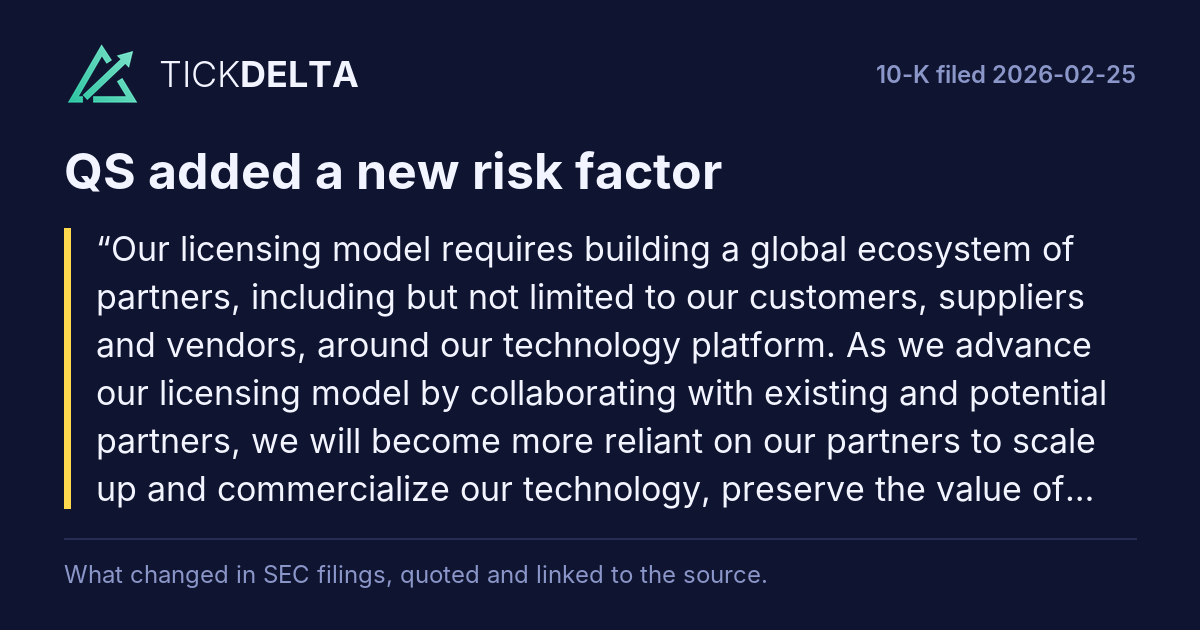
Our licensing model requires building a global ecosystem of partners, including but not limited to our customers, suppliers and vendors, around our technology platform. As we advance our licensing model by collaborating with existing and potential partners, we will become more reliant on our partners to scale up and commercialize our technology, preserve the value of our license, and will also limit our ability to retain direct control over decisions around manufacturing and commercializing our technology. As our partners and customers continue to execute their respective business plans alongside us, there are inherent risks associated with their ability to meet manufacturing timelines, manage labor relations, and sustain supplier and customer relationships that will increasingly be outside of our control. Furthermore, we might not be able to obtain strict exclusivity with our partners and customers, which could enable them to work directly with other partners, customers and third parties, limiting our ability to continue or extend existing collaborations and potentially reducing our anticipated revenue from royalty payments or other similar financial arrangements. These factors could result in a material adverse effect on our business and financial results.
Our ability to successfully pursue new markets and applications is uncertain, and failure to do so could adversely affect our business, financial condition and results of operations.
Our long‑term growth strategy depends in part on our ability to expand beyond our initial target markets and successfully commercialize our solid‑state battery technology across additional vehicle platforms, customers, and end markets. These efforts require us to identify attractive new markets and applications, demonstrate the performance, reliability and cost competitiveness of our technology for such use cases, and convert potential customers into meaningful commercial relationships and orders. There can be no assurance that our technology will be successful in these new markets or that we will be able to penetrate such new markets at all.
Pursuing new markets involves significant challenges and risks, including the need to adapt our technology to different performance requirements, qualification standards, regulatory regimes, and customer expectations, as well as the potential need for additional investment in development, manufacturing capabilities, and commercial infrastructure. We may also face increased customer testing and validation requirements, and greater competitive pressures in markets where we have limited operating history or brand recognition. If we are unable to successfully address these challenges, we may not be able to achieve our expected growth objectives.
Our success in expanding into new markets also depends on our ability to establish and maintain commercial relationships, which may include new and existing strategic partners, licensees, or other collaborators. There can be no assurance that we will be able to identify and establish relationships and arrangements with partners in such new markets. In addition, these new and existing relationships may require significant management attention and resources and may expose us to operational, financial, or reputational risks.
If we fail to successfully pursue and penetrate new markets, or if our efforts to do so result in higher costs, delays, or lower‑than‑expected returns, our business, financial condition, results of operations, and prospects could be materially and adversely affected.
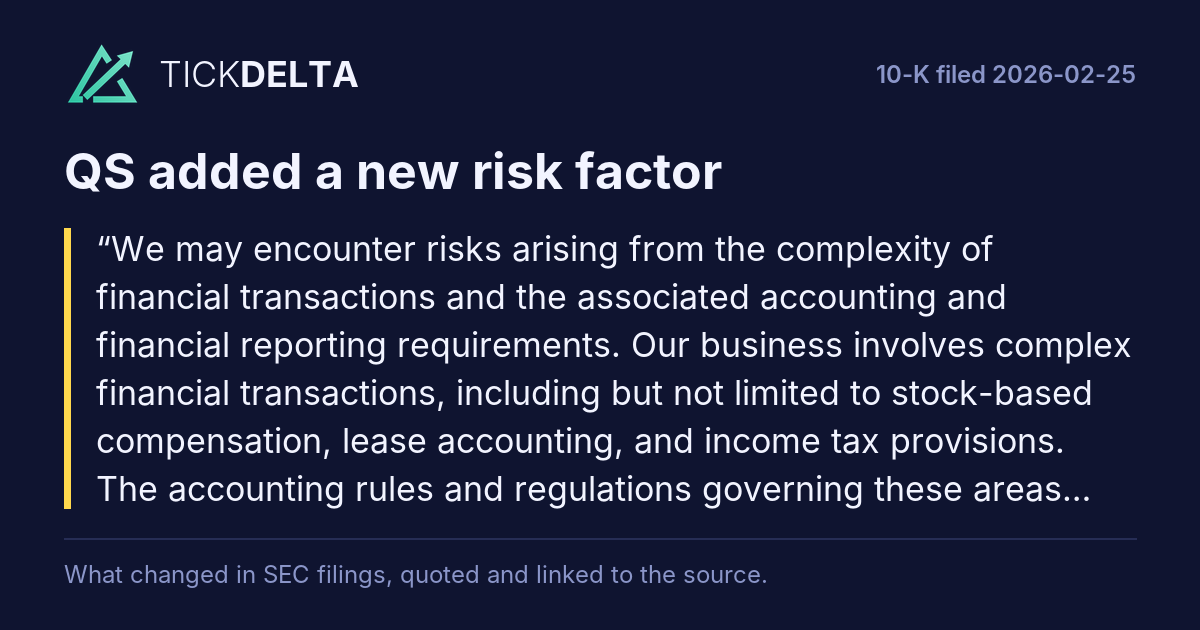
We may encounter risks arising from the complexity of financial transactions and the associated accounting and financial reporting requirements.
Our business involves complex financial transactions, including but not limited to stock-based compensation, lease accounting, and income tax provisions. The accounting rules and regulations governing these areas are frequently changing and require significant judgment in their application. As our operations grow in scale and complexity, the risk of material errors or omissions in our financial statements increases. For example, in July 2025, we amended the Collaboration Agreement with the goal of funding certain part of the research and development under the PowerCo Collaboration Agreement. The arrangement involved complex accounting judgments under U.S. GAAP, including classification of payments received from PowerCo with no contractually stated repayment terms as a liability, as well as derecognition of the liability to shareholders’ equity upon extinguishment, driven by the significant related party relationship with Volkswagen Group, which creates a presumption of a repayment obligation.
Failure to properly interpret or apply accounting standards could result in restatements of prior financial statements, regulatory scrutiny, loss of investor confidence, or reputational harm. Additionally, maintaining compliance with these complex accounting requirements requires significant internal resources, including skilled personnel and robust systems. Any failure in our internal controls over financial reporting could adversely impact our ability to produce accurate and timely financial statements.
New in the latest 10-Q
2 paragraphs in the 10-Q filed Oct 23, 2026 with nothing like them in the 10-Q filed Jul 24, 2026 (at least half the words must differ; new numbers alone do not count). Quoted exactly, grouped by the item heading above them. This is text that changed, not a judgement of how serious it is.
In October 2026, the Company and PowerCo further amended the PowerCo Collaboration Agreement to, among other things, remove transition payments due from PowerCo in the aggregate of $7.0 million, reducing the maximum amount the Company can receive under the current PowerCo Collaboration Agreement, and enter into negotiations for a revised scope of work and payments. During this negotiation period, PowerCo will not make milestone payments under the July 2026 Amendment.
Read in the 10-Q
The foregoing description of the Amendment does not purport to be complete and is qualified in its entirety by reference to the full text of the Amendment attached hereto as Exhibit 10.2.
Read in the 10-Q
Item 1A of the 10-Q filed Oct 23, 2026 against Item 1A of the 10-K filed Feb 25, 2026.
A 10-Q repeats only the risks that changed, so a 10-K paragraph that is missing from it is not counted as removed.
Added is a paragraph with nothing like it in the 10-K, Reworded a sentence that is in both with several words changed,
Quiet changes a sentence in both where one to four words changed and one is a hedge or a modal
(cut words struck through, new words highlighted).
Text on the page, not a score; each links to the filing at sec.gov.
The first 16 of 57 are shown (at most 12 of each type).
Two-word phrases in Risk Factors of the 10-K filed Feb 25, 2026 that are in none of the 1 earlier 10-Ks stored, back to Feb 26, 2025
Used at least twice, small words left out. Counted, not picked: a phrase can be new because the company renamed something.
2 paragraphs of last year's Risk Factors with nothing like them now. The longest are quoted.
Item 1A of each 10-K and 10-Q on EDGAR, quoted exactly. Each paragraph links to the filing at sec.gov.
10-K change: what was reworded or cut, section by section.
Excel workbook · CSV. Google Sheet that stays up to date: paste =IMPORTDATA("https://tickdelta.com/company/QS/export.csv") into a cell.