Paragraph 13 · 49% changed
Every version of it
Screener
/
SEC EDGAR
/CIK 0001410384
/10-K filed Feb 11, 2026, compared with Feb 12, 2025
/Numbers from the XBRL of the 10-Ks
NYSE
Technology · Software
Q2 Holdings, Inc. QTWO
The 10-K against last year's
146 changes: 19 added, 12 removed, 112 reworded, 3 quiet changes
10-K Feb 11, 2026 vs Feb 12, 2025
Risk Factors
11.0%
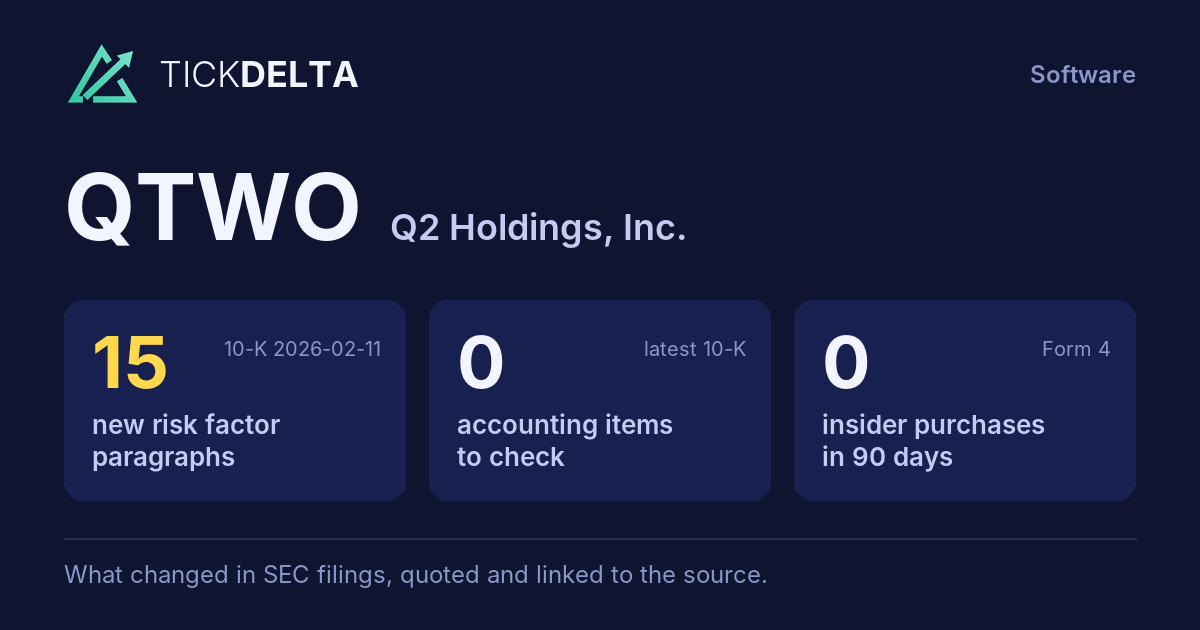
of the text changed · 25,399 words now · 15 new paragraphs, 10 gone
MD&A
18.9%
of the text changed · 12,063 words now · 4 new paragraphs, 2 gone
Legal Proceedings
30.0%
of the text changed · 474 words now
Accounting Policies
6.9%
of the text changed · 6,254 words now
10-K 0001410384-26-000006 (Feb 11, 2026) vs 10-K 0001410384-25-000010 (Feb 12, 2025)
Every paragraph, and how much of it changed
One bar per paragraph, in the order of the 10-K. Height and colour show the share of its words not in the closest paragraph a year earlier; the tallest bars are new paragraphs.
Risk Factors
256 paragraphs · 15 new · 54 reworded · 10 gone · 10-K Feb 11, 2026 against Feb 12, 2025
New paragraph
Reworded (5% of its words or more)
Same or nearly
Paragraph 94 · 37% changed
Every version of it
We currently incorporate AI capabilities into certain of our select solutions, and we are making investments and anticipate further utilization of AI in our solutions in the future. As with many emerging technologies, AI presents risks, challenges, challenges and unintended consequences related to its development, adoption and use that could adversely affect our business. AI algorithms and training methodologies may create accuracy issues, unintended biases and other unexpected outcomes. Ineffective or inadequate AI development or deployment practices by us or others could result in incidents that impair the accuracy and acceptance of AI-based solutions or cause harm to individuals or customers, creating perceived or actual technical, legal, compliance, privacy, security and ethical risks, which could subject us to competitive harm, regulatory action, legal liability, liability and brand or reputational harm. These incidents could include explainability risk whereby our potential inability to interpret, articulate, or justify the decision-making processes of AI models, compounded by challenges in achieving replicability of outcomes due to the adaptive nature of AI learning, where identical inputs may not always yield repeatable or consistent outputs, may lead to concerns about trust, regulatory compliance and accountability. If we enable or offer AI-based solutions that are controversial because of their impact on human rights, privacy, employment, or other social, economic, or political issues, or which contain errors or bias or infringe upon the rights of third parties, we may experience competitive, brand or reputational harm or legal or regulatory action. Further, incorporating AI into our solutions may increase our risk of litigation and risk of non-compliance, as AI is an emerging technology for which the legal and regulatory landscape is not fully developed. The legal and regulatory landscape for AI is emerging and evolving rapidly, and what they ultimately will become remains uncertain, and our obligation to comply with them could entail significant costs, negatively affect our business or entirely limit our ability to incorporate certain AI capabilities into our solutions.
Paragraph 76 · 36% changed
Every version of it
We have and may continue to face unexpected implementation challenges related to the complexity of our customers' implementation and integration requirements, particularly implementations for larger customers with more complex requirements in their hardware, software and network infrastructure needs. Our implementation expenses increase when customers have unexpected data, hardware or software technology challenges, or complex or unanticipated business or regulatory requirements. In addition, our customers in some cases may require complex acceptance testing related to the implementation of our solutions. Implementations often involve integration with or conversion of customers off of systems and services of third parties over which we do not have control. We may also face experience implementation challenges if we fail to accurately forecast inefficiencies, delays, or provision increased costs associated with the necessary time and resources, including qualified talent, particularly following periods introduction or expansion of increased sales success new delivery tools, automation, or restructurings impacting our implementation teams. Implementation delays may require us to delay revenue recognition under the related customer agreement longer than expected. Further, because we do not fully control our customers’ implementation schedules, if our customers do not allocate the internal resources necessary to meet implementation timelines or if there are unanticipated implementation delays or difficulties, our revenue recognition may be delayed. Losses of End Users or any difficulties or longer implementation processes, AI-assisted capabilities, including risks related to the timing and predictability of sales of our solutions, could cause customers to delay adoption, performance, training, change management, or forgo future purchases of our solutions. integration with existing processes.
Paragraph 77 · 34% changed
Every version of it
Paragraph 53 · 34% changed
Every version of it
Paragraph 65 · 30% changed
Every version of it
Since our inception, our business has experienced high growth, which has resulted in large increases in our number of employees, expansion of the types of solutions we sell and the customers we sell them to, significant increases in the number of End Users accessing and using our solutions, expansion to international locations and international customers, expansion of our infrastructure, enhancement of our internal systems and other significant changes and additional complexities. We intend to further expand our overall business, customer base, and number of employees. The growth in our business, our management of a growing international workforce and customer base and the stress of such growth on our internal controls and systems generally requires substantial management effort, infrastructure and operational capabilities. To support our growth, we must continue to improve our management's resources and operational and financial controls and systems, and these improvements may increase our expenses more than anticipated and result in a more complex business, and our failure to timely and effectively implement these improvements could have an adverse effect on our operations and financial results. In addition, selling our solutions to larger customers and the increased breadth of our solution offerings and the types of customers we serve may result in greater uncertainty and variability in our business and sales results. We also will have to anticipate the necessary expansion of our relationship management, implementation, customer service and other personnel to support our growth and maintain high levels of customer service and satisfaction, particularly as we sell to larger customers that have heightened levels of complexity in their hardware, software and network infrastructure needs and as we sell a broader range of solutions to a broader and larger set of customers. Our success will depend on our ability to plan for and manage this growth effectively and to address challenges to our growth model resulting from rapid changes in economic conditions. If we fail to anticipate and manage our growth or are unable to provide high levels of system performance and customer service, our reputation, as well as our business, results of operations and financial condition, could be harmed.
Paragraph 39 · 30% changed
Every version of it
Paragraph 38 · 26% changed
Every version of it
Recent economic pressures from elevated and fluctuating interest rates, inflationary pressures, instability in the banking and financial services sectors and slowdowns in the economy, financial markets and credit markets have had and could continue to have an impact on account holders or End Users of our solutions, our customers' prospects and our business sales cycles, and our customers' or prospective customers' spending decisions. Downturns in the financial services industry and unfavorable economic conditions affecting the regions in which our customers or prospective customers are concentrated or particular segments of customers or prospective customers on which we focus, including the Alt-FI and FinTech sectors, have and may continue to cause our customers or prospective customers to delay or reduce their spending on solutions such as ours or seek to terminate or renegotiate their contracts with us, including in either case as a result of insolvency or bankruptcy. A significant portion of our revenues is derived from financial institutions, and in particular RCFIs, and we have been and may continue to be impacted by challenges in the economic environment and financial services industry. Some financial institutions have in the past experienced significant pressure due to economic uncertainty, liquidity concerns and increased regulatory scrutiny. In recent years, many financial institutions have merged or been acquired, and periodically during downturns a limited number of financial institutions have failed, creating market disruption and uncertainty within the financial services industry, in particular among RCFIs. The actions taken by such institutions to address potential liquidity concerns have resulted in certain institutions incurring substantial costs that have negatively impacted, and may continue to negatively impact, their profitability and could lead to further market instability or bank failures. Additionally, regulatory changes aimed at stabilizing the financial system could impose new burdens, further straining the profitability of these institutions and potentially leading to a contraction in economic activities. Market conditions, including deteriorating performance of certain loan portfolios, including commercial real estate loan portfolios, capital constraints, and fluctuating levels of direct losses and charge-offs for some financial institutions, have also caused and may continue to cause financial institutions to reduce lending activity as they seek to increase their reserves to maintain better liquidity. Additionally, banking regulators, as well as increasingly cautious investors, have increased scrutiny of commercial real estate lending. This heightened attention may compel financial institutions with substantial commercial real estate loan portfolios to adopt more stringent underwriting standards, enhance internal controls, bolster risk management policies, conduct more rigorous portfolio stress testing, and maintain higher reserve levels. While the U.S. government has taken measures to strengthen public confidence in the banking system and protect depositors, such steps may be insufficient to resolve the volatility in the financial markets and reduce the risk of additional bank failures. It is possible these conditions may persist, deteriorate or reoccur, and longer term, failures and consolidations are likely to continue, and there are very few new financial institutions being created. Further, if our customers merge with or are acquired by other entities that have in-house developed solutions or that are not our customers or use fewer of our solutions, our customers may
Paragraph 13 · 49% changed
Every version of it
10-K Feb 12, 2025•the development of our solutions and changes to the market for our solutions compared to our expectations;
10-K Feb 11, 2026
•development of our AI strategies and solutions, changes to the market for our solutions and regulatory specifications and functionality required by our customers and relevant governmental authorities;
Paragraph 94 · 37% changed
Every version of it
10-K Feb 12, 2025
We currently incorporate AI capabilities into certain of our solutions, and we are making investments and anticipate further utilization of AI in our solutions in the future. As with many emerging technologies, AI presents risks, challenges, and unintended consequences related to its development, adoption and use that could adversely affect our business. AI algorithms and training methodologies may create accuracy issues, unintended biases and other unexpected outcomes. Ineffective or inadequate AI development or deployment practices by us or others could result in incidents that impair the accuracy and acceptance of AI-based solutions or cause harm to individuals or customers, creating perceived or actual technical, legal, compliance, privacy, security and ethical risks, which could subject us to competitive harm, regulatory action, legal liability, and brand or reputational harm. These incidents could include explainability risk whereby our potential inability to interpret, articulate, or justify the decision-making processes of AI models, compounded by challenges in achieving replicability of outcomes due to the adaptive nature of AI learning, where identical inputs may not always yield repeatable or consistent outputs, may lead to concerns about trust, regulatory compliance and accountability. If we enable or offer AI-based solutions that are controversial because of their impact on human rights, privacy, employment, or other social, economic, or political issues, or which contain errors or bias or infringe upon the rights of third parties, we may experience competitive, brand or reputational harm or legal or regulatory action. Further, incorporating AI into our solutions may increase our risk of litigation and risk of non-compliance, as AI is an emerging technology for which the legal and regulatory landscape is not fully developed. The legal and regulatory landscape for AI is emerging and evolving rapidly, and what they ultimately will become remains uncertain, and our obligation to comply with them could entail significant costs, negatively affect our business or entirely limit our ability to incorporate certain AI capabilities into our solutions.
10-K Feb 11, 2026
We currently incorporate AI capabilities into select solutions, and we are making investments and anticipate further utilization of AI in our solutions in the future. As with many emerging technologies, AI presents risks, challenges and unintended consequences related to its development, adoption and use that could adversely affect our business. AI algorithms and training methodologies may create accuracy issues, unintended biases and other unexpected outcomes. Ineffective or inadequate AI development or deployment practices by us or others could result in incidents that impair the accuracy and acceptance of AI-based solutions or cause harm to individuals or customers, creating perceived or actual technical, legal, compliance, privacy, security and ethical risks, which could subject us to competitive harm, regulatory action, legal liability and
Paragraph 76 · 36% changed
Every version of it
10-K Feb 12, 2025
We have and may continue to face unexpected implementation challenges related to the complexity of our customers' implementation and integration requirements, particularly implementations for larger customers with more complex requirements in their hardware, software and network infrastructure needs. Our implementation expenses increase when customers have unexpected data, hardware or software technology challenges, or complex or unanticipated business or regulatory requirements. In addition, our customers in some cases may require complex acceptance testing related to the implementation of our solutions. Implementations often involve integration with or conversion of customers off of systems and services of third parties over which we do not have control. We may also face implementation challenges if we fail to accurately forecast or provision the necessary time and resources, including qualified talent, particularly following periods of increased sales success or restructurings impacting our implementation teams. Implementation delays may require us to delay revenue recognition under the related customer agreement longer than expected. Further, because we do not fully control our customers’ implementation schedules, if our customers do not allocate the internal resources necessary to meet implementation timelines or if there are unanticipated implementation delays or difficulties, our revenue recognition may be delayed. Losses of End Users or any difficulties or longer implementation processes, including risks related to the timing and predictability of sales of our solutions, could cause customers to delay or forgo future purchases of our solutions.
10-K Feb 11, 2026
We have and may continue to face unexpected implementation challenges related to the complexity of our customers' implementation and integration requirements, particularly implementations for larger customers with more complex requirements in their hardware, software and network infrastructure needs. Our implementation expenses increase when customers have unexpected data, hardware or software technology challenges, or complex or unanticipated business or regulatory requirements. In addition, our customers in some cases may require complex acceptance testing related to the implementation of our solutions. Implementations often involve integration with or conversion of customers off of systems and services of third parties over which we do not have control. We may also experience implementation inefficiencies, delays, or increased costs associated with the introduction or expansion of new delivery tools, automation, or AI-assisted capabilities, including risks related to adoption, performance, training, change management, or integration with existing processes.
Paragraph 77 · 34% changed
Every version of it
10-K Feb 12, 2025We have and may continue to face unexpected implementation challenges related to the complexity of our customers' implementation and integration requirements, particularly implementations for larger customers with more complex requirements in their hardware, software and network infrastructure needs. Our implementation expenses increase when customers have unexpected data, hardware or software technology challenges, or complex or unanticipated business or regulatory requirements. In addition, our customers in some cases may require complex acceptance testing related to the implementation of our solutions. Implementations often involve integration with or conversion of customers off of systems and services of third parties over which we do not have control. We may also face implementation challenges if we fail to accurately forecast or provision the necessary time and resources, including qualified talent, particularly following periods of increased sales success or restructurings impacting our implementation teams. Implementation delays may require us to delay revenue recognition under the related customer agreement longer than expected. Further, because we do not fully control our customers’ implementation schedules, if our customers do not allocate the internal resources necessary to meet implementation timelines or if there are unanticipated implementation delays or difficulties, our revenue recognition may be delayed. Losses of End Users or any difficulties or longer implementation processes, including risks related to the timing and predictability of sales of our solutions, could cause customers to delay or forgo future purchases of our solutions.
10-K Feb 11, 2026
We may also face implementation challenges if we fail to accurately forecast or provision the necessary time and resources, including qualified talent, particularly following periods of increased sales success or restructurings impacting our implementation teams. Implementation delays may require us to delay revenue recognition under the related customer agreement longer than expected. Further, because we do not fully control our customers’ implementation schedules, if our customers do not allocate the internal resources necessary to meet implementation timelines or if there are unanticipated implementation delays or difficulties, our revenue recognition may be delayed. In addition, implementations that rely on third-party vendors, service providers, or payment networks may be subject to delays, errors, or performance issues outside of our control, which could further increase costs, require rework, or delay customer acceptance and revenue recognition.
Paragraph 53 · 34% changed
Every version of it
10-K Feb 12, 2025Moreover, software development is time-consuming, expensive, complex and requires regular maintenance. Unforeseen difficulties can arise. If we do not complete our periodic maintenance according to schedule or if customers are otherwise dissatisfied with the frequency or duration of our maintenance services, customers could elect not to renew, or delay or withhold payment to us or cause us to issue credits, make refunds or pay penalties. Because our solutions are often customized and deployed on a customer-by-customer basis, rather than through a multi-tenant SaaS method of distribution, applying bug fixes, upgrades or other maintenance services may require updating each instance of our solutions, including a variety of different versions of our solutions. This could be time consuming and cause us to incur significant expense and may require the involvement of our customers, which potentially increases the technical delivery risk. We might also encounter technical obstacles, and it is possible that we discover problems that prevent our solutions from operating properly. As a result of the complexity of our solutions and the complex needs of our customers, our customers depend on our technical resources to develop reliable and secure solutions and to resolve any technical issues relating to our solutions. Our ability to deliver our solutions is dependent on our software development lifecycle management processes, including with respect to our change management processes, which impact our ability to effectively develop our solutions and to identify, track, test, manage and implement changes to our solutions. As a result, our solutions require an ongoing commitment of significant resources to maintain and enhance them and to develop new solutions in order to keep pace with continuing changes in information technology, emerging cybersecurity risks and threats, evolving industry and regulatory standards and changing preferences of our customers. If our solutions do not function reliably or fail to achieve customer expectations in terms of performance, customers could seek to cancel their agreements with us and assert liability claims against us, which could damage our reputation, impair our ability to attract or maintain customers, harm our results of operations or have an adverse impact on our financial performance.
10-K Feb 11, 2026
solutions is dependent on our software development lifecycle management processes, including with respect to our change management processes, which impact our ability to effectively develop our solutions and to identify, track, test, manage and implement changes to our solutions. As a result, our solutions require an ongoing commitment of significant resources to maintain and enhance them and to develop new solutions in order to keep pace with continuing changes in information technology, emerging cybersecurity risks and threats, evolving industry and regulatory standards and changing preferences of our customers. If our solutions do not function reliably or fail to achieve customer expectations in terms of performance, customers could seek to cancel their agreements with us and assert liability claims against us, which could damage our reputation, impair our ability to attract or maintain customers, harm our results of operations or have an adverse impact on our financial performance.
Paragraph 65 · 30% changed
Every version of it
10-K Feb 12, 2025
Since our inception, our business has experienced high growth, which has resulted in large increases in our number of employees, expansion of the types of solutions we sell and the customers we sell them to, significant increases in the number of End Users accessing and using our solutions, expansion to international locations and international customers, expansion of our infrastructure, enhancement of our internal systems and other significant changes and additional complexities. We intend to further expand our overall business, customer base, and number of employees. The growth in our business, our management of a growing international workforce and customer base and the stress of such growth on our internal controls and systems generally requires substantial management effort, infrastructure and operational capabilities. To support our growth, we must continue to improve our management's resources and operational and financial controls and systems, and these improvements may increase our expenses more than anticipated and result in a more complex business, and our failure to timely and effectively implement these improvements could have an adverse effect on our operations and financial results. In addition, selling our solutions to larger customers and the increased breadth of our solution offerings and the types of customers we serve may result in greater uncertainty and variability in our business and sales results. We also will have to anticipate the necessary expansion of our relationship management, implementation, customer service and other personnel to support our growth and maintain high levels of customer service and satisfaction, particularly as we sell to larger customers that have heightened levels of complexity in their hardware, software and network infrastructure needs and as we sell a broader range of solutions to a broader and larger set of customers. Our success will depend on our ability to plan for and manage this growth effectively and to address challenges to our growth model resulting from rapid changes in economic conditions. If we fail to anticipate and manage our growth or are unable to provide high levels of system performance and customer service, our reputation, as well as our business, results of operations and financial condition, could be harmed.
10-K Feb 11, 2026
Since our inception, our business has experienced high growth, which has resulted in large increases in our number of employees, expansion of the types of solutions we sell and the customers we sell them to, significant increases in the number of End Users accessing and using our solutions, expansion to international locations and international customers, expansion of our infrastructure, enhancement of our internal systems and other significant changes and additional complexities. We intend to further expand our overall business, customer base, and number of employees. The growth in our business, our management of a growing international workforce and customer base and the stress of such growth on our internal controls and systems generally requires substantial management effort, infrastructure and operational capabilities. To support our growth, we must continue to improve our management's resources and operational and financial controls and systems, and these improvements may increase our expenses more than anticipated and result in a more complex business, and our failure to timely and
Paragraph 39 · 30% changed
Every version of it
10-K Feb 12, 2025Recent economic pressures from elevated and fluctuating interest rates, inflationary pressures, instability in the banking and financial services sectors and slowdowns in the economy, financial markets and credit markets have had and could continue to have an impact on account holders or End Users of our solutions, our customers' prospects and our business sales cycles, and our customers' or prospective customers' spending decisions. Downturns in the financial services industry and unfavorable economic conditions affecting the regions in which our customers or prospective customers are concentrated or particular segments of customers or prospective customers on which we focus, including the Alt-FI and FinTech sectors, have and may continue to cause our customers or prospective customers to delay or reduce their spending on solutions such as ours or seek to terminate or renegotiate their contracts with us, including in either case as a result of insolvency or bankruptcy. A significant portion of our revenues is derived from financial institutions, and in particular RCFIs, and we have been and may continue to be impacted by challenges in the economic environment and financial services industry. Some financial institutions have in the past experienced significant pressure due to economic uncertainty, liquidity concerns and increased regulatory scrutiny. In recent years, many financial institutions have merged or been acquired, and periodically during downturns a limited number of financial institutions have failed, creating market disruption and uncertainty within the financial services industry, in particular among RCFIs. The actions taken by such institutions to address potential liquidity concerns have resulted in certain institutions incurring substantial costs that have negatively impacted, and may continue to negatively impact, their profitability and could lead to further market instability or bank failures. Additionally, regulatory changes aimed at stabilizing the financial system could impose new burdens, further straining the profitability of these institutions and potentially leading to a contraction in economic activities. Market conditions, including deteriorating performance of certain loan portfolios, including commercial real estate loan portfolios, capital constraints, and fluctuating levels of direct losses and charge-offs for some financial institutions, have also caused and may continue to cause financial institutions to reduce lending activity as they seek to increase their reserves to maintain better liquidity. Additionally, banking regulators, as well as increasingly cautious investors, have increased scrutiny of commercial real estate lending. This heightened attention may compel financial institutions with substantial commercial real estate loan portfolios to adopt more stringent underwriting standards, enhance internal controls, bolster risk management policies, conduct more rigorous portfolio stress testing, and maintain higher reserve levels. While the U.S. government has taken measures to strengthen public confidence in the banking system and protect depositors, such steps may be insufficient to resolve the volatility in the financial markets and reduce the risk of additional bank failures. It is possible these conditions may persist, deteriorate or reoccur, and longer term, failures and consolidations are likely to continue, and there are very few new financial institutions being created. Further, if our customers merge with or are acquired by other entities that have in-house developed solutions or that are not our customers or use fewer of our solutions, our customers may
10-K Feb 11, 2026
could impose new burdens, further straining the profitability of these institutions and potentially leading to a contraction in economic activities. Market conditions, including deteriorating performance of certain loan portfolios, including commercial real estate loan portfolios, capital constraints, and fluctuating levels of direct losses and charge-offs for some financial institutions, have also caused and may continue to cause financial institutions to reduce lending activity as they seek to increase their reserves to maintain better liquidity. Additionally, banking regulators, as well as increasingly cautious investors, have increased scrutiny of commercial real estate lending. This heightened attention may compel financial institutions with substantial commercial real estate loan portfolios to adopt more stringent underwriting standards, enhance internal controls, bolster risk management policies, conduct more rigorous portfolio stress testing, and maintain higher reserve levels. While the U.S. government has taken measures to strengthen public confidence in the banking system and protect depositors, such steps may be insufficient to resolve the volatility in the financial markets and reduce the risk of additional bank failures. It is possible these conditions may persist, deteriorate or reoccur, and longer term, failures and consolidations are likely to continue, and there are very few new financial institutions being created. Further, if our customers merge with or are acquired by other entities that have in-house developed solutions or that are not our customers or use fewer of our solutions, our customers may discontinue, reduce or change the terms of their use of our solutions. It is also possible that the larger financial institutions that result from mergers or consolidations, including large scale core migrations leading to industry consolidation, could have greater leverage in negotiating terms with us or could decide to replace some or all of our solutions. Financial institutions increasingly face competition from non-depository institutions or other innovative products or emerging technologies, such as cryptocurrencies, stablecoin or deposit tokenization, which may reduce the number of End Users, or log-ins or transactions using their more traditional financial services. Any of these developments could have an adverse effect on our business, results of operations and financial condition.
Paragraph 38 · 26% changed
Every version of it
10-K Feb 12, 2025
Recent economic pressures from elevated and fluctuating interest rates, inflationary pressures, instability in the banking and financial services sectors and slowdowns in the economy, financial markets and credit markets have had and could continue to have an impact on account holders or End Users of our solutions, our customers' prospects and our business sales cycles, and our customers' or prospective customers' spending decisions. Downturns in the financial services industry and unfavorable economic conditions affecting the regions in which our customers or prospective customers are concentrated or particular segments of customers or prospective customers on which we focus, including the Alt-FI and FinTech sectors, have and may continue to cause our customers or prospective customers to delay or reduce their spending on solutions such as ours or seek to terminate or renegotiate their contracts with us, including in either case as a result of insolvency or bankruptcy. A significant portion of our revenues is derived from financial institutions, and in particular RCFIs, and we have been and may continue to be impacted by challenges in the economic environment and financial services industry. Some financial institutions have in the past experienced significant pressure due to economic uncertainty, liquidity concerns and increased regulatory scrutiny. In recent years, many financial institutions have merged or been acquired, and periodically during downturns a limited number of financial institutions have failed, creating market disruption and uncertainty within the financial services industry, in particular among RCFIs. The actions taken by such institutions to address potential liquidity concerns have resulted in certain institutions incurring substantial costs that have negatively impacted, and may continue to negatively impact, their profitability and could lead to further market instability or bank failures. Additionally, regulatory changes aimed at stabilizing the financial system could impose new burdens, further straining the profitability of these institutions and potentially leading to a contraction in economic activities. Market conditions, including deteriorating performance of certain loan portfolios, including commercial real estate loan portfolios, capital constraints, and fluctuating levels of direct losses and charge-offs for some financial institutions, have also caused and may continue to cause financial institutions to reduce lending activity as they seek to increase their reserves to maintain better liquidity. Additionally, banking regulators, as well as increasingly cautious investors, have increased scrutiny of commercial real estate lending. This heightened attention may compel financial institutions with substantial commercial real estate loan portfolios to adopt more stringent underwriting standards, enhance internal controls, bolster risk management policies, conduct more rigorous portfolio stress testing, and maintain higher reserve levels. While the U.S. government has taken measures to strengthen public confidence in the banking system and protect depositors, such steps may be insufficient to resolve the volatility in the financial markets and reduce the risk of additional bank failures. It is possible these conditions may persist, deteriorate or reoccur, and longer term, failures and consolidations are likely to continue, and there are very few new financial institutions being created. Further, if our customers merge with or are acquired by other entities that have in-house developed solutions or that are not our customers or use fewer of our solutions, our customers may
10-K Feb 11, 2026
Recent economic pressures from fluctuating interest rates, inflationary pressures, instability in the banking and financial services sectors and slowdowns in the economy, financial markets and credit markets have had and could continue to have an impact on account holders or End Users of our solutions, our customers' prospects and our business sales cycles, and our customers' or prospective customers' spending decisions. Downturns in the financial services industry and unfavorable economic conditions affecting the regions in which our customers or prospective customers are concentrated or particular segments of customers or prospective customers on which we focus, including the Alt-FI and FinTech sectors, have and may continue to cause our customers or prospective customers to delay or reduce their spending on solutions such as ours or seek to terminate or renegotiate their contracts with us, including in either case as a result of insolvency or bankruptcy. A significant portion of our revenues is derived from financial institutions, and in particular RCFIs, and we have been and may continue to be impacted by challenges in the economic environment and financial services industry. Some financial institutions have in the past experienced significant pressure due to economic uncertainty, liquidity concerns and increased regulatory scrutiny. In recent years, many financial institutions have merged or been acquired, and periodically during downturns a limited number of financial institutions have failed, creating market disruption and uncertainty within the financial services industry, in particular among RCFIs. The actions taken by such institutions to address potential liquidity concerns have resulted in certain institutions incurring substantial costs that have negatively impacted, and may continue to negatively impact, their profitability and could lead to further market instability or bank failures. Additionally, regulatory changes aimed at stabilizing the financial system
MD&A
128 paragraphs · 4 new · 66 reworded · 2 gone · 10-K Feb 11, 2026 against Feb 12, 2025
New paragraph
Reworded (5% of its words or more)
Same or nearly
Paragraph 3 · 48% changed
We are a leading provider of digital solutions to financial institutions, financial technology companies, or FinTechs, and alternative finance companies, or Alt-FIs, seeking to incorporate banking into their customer engagement and servicing strategies. Our solutions transform the ways in which financial institutions and other financial services providers engage with account holders and retail and commercial End Users. Digital financial services are highly regulated, subject to extensive and evolving supervisory, consumer protection, privacy and third‑party risk management requirements, and security is paramount, as providers must protect sensitive financial data and funds and defend against continually evolving cyber threats and fraud. Providers must also manage significant technical and operational complexity to deliver consistent, compliant experiences across channels, devices and third‑party integrations while integrating with core systems, legacy infrastructure and multiple third‑party service providers, all while maintaining high availability and resiliency. We deliver these solutions through a unified, cloud-based software platform purpose-built for the complex, regulated financial services industry, enabling scalable and highly configurable digital financial experiences. Our solutions comprise a broad and deep portfolio of digital banking solutions, offerings, digital lending and relationship pricing solutions, Q2 Innovation Studio, risk and Helix. fraud solutions, Q2 Innovation Studio leverages Q2's open technology platform to enable a partnership ecosystem, allowing the design, development, and distribution of innovative products, services, features, and integrations on Q2's digital banking platform. Helix serves as a cloud-native core and banking as a service, or BaaS, solution. We purpose-build our platforms and solutions to enable success for our customers and partners by allowing them to digitize their operations and offerings, differentiate their digital brands, integrate traditional and emerging financial services, and ultimately, enhance their End-User acquisition, engagement and retention and improve their operational efficiencies and profitability. Helix.
Paragraph 24 · 43% changed
Year Ended December 31, 2025 2024 2023 2022 Revenue: GAAP operating loss revenue $ (42,263) $ (86,057) $ (104,761) 794,809 $696,464 $624,624 Deferred revenue reduction from purchase accounting — — 344 644 Stock-based compensation 89,215 79,188 65,157 Transaction-related costs — 24 1,194 Amortization of acquired technology 22,016 23,402 22,690 Amortization of acquired intangibles 16,979 20,667 18,248 Lease and other restructuring charges 9,517 12,092 13,225 Total Non-GAAP operating income revenue $ 95,464 $ 49,660 $ 16,397 794,809 $696,464 $624,968
Paragraph 32 · 39% changed
The following table presents our revenues a reconciliation of GAAP operating income (loss) to non-GAAP operating income for each of the periods indicated (dollars in (in thousands):
Paragraph 116 · 39% changed
Total provision for income taxes increased decreased by $4.1 $5.0 million from $3.6 million for the year ended December 31, 2023 to $7.7 million for the year ended December 31, 2024. The increase in the tax expense 2024 to $2.7 million for the year ended December 31, 2024 related to the operations of the business 2025. The decrease in expense was primarily driven by a $2.5 million decrease in state income taxes, a $1.5 million decrease in foreign income taxes and an increase a $1.0 million decrease in uncertain tax positions related to various states. federal income taxes.
Paragraph 114 · 38% changed
Total other income (expense), income, net decreased increased by $12.8 $3.4 million or 52.9% 30.0% from $24.2 million for the year ended December 31, 2023 to $11.4 million for the year ended December 31, 2024. 2024 to $14.8 million for the year ended December 31, 2025. The decrease increase was primarily due to a $19.9 million gain driven by interest income earned from the partial repurchase of the 2026 Notes and the 2025 Notes during the three months ended March 31, 2023, partially offset by a $5.7 million increase increased balances in income from our cash, cash equivalents and investments in during the current period, a $0.5 million loss realized on investments recognized, a $0.4 million increase from lower losses on foreign currency translation and a $0.4 million increase from lower interest expense in partially offset by expenses associated with the current period compared to the prior year period. Company's Revolving Credit Agreement.
Paragraph 107 · 37% changed
Paragraph 113 · 34% changed
Lease and other restructuring charges decreased by $3.3 $3.8 million, or 30.5%, 49.8%, from $11.0 million for the year ended December 31, 2023 to $7.6 million for the year ended December 31, 2024. 2024 to $3.8 million for the year ended December 31, 2025. The net decrease in lease and other restructuring charges was primarily attributable to from a net $3.0 $2.5 million decrease related to updated assessments and ongoing expenses of previously vacated facilities, including a $1.4 million reversal of a previously accrued lease restructuring liability which was recorded in the associated impairment year-ended December 31, 2025. The reversal was made in conjunction with the Company's decision during the year to reoccupy a part of the right of use asset and a $0.2 facility lease which it previously vacated for sublease. Additionally, there was a $1.2 million decrease related to lower in severance and other related compensation charges associated with restructuring or eliminating certain positions in connection with initiatives intended to align our resources to the portions of our business that we believe will drive the most long-term value. positions.
Paragraph 108 · 33% changed
Paragraph 3 · 48% changed
10-K Feb 12, 2025
We are a leading provider of digital solutions to financial institutions, financial technology companies, or FinTechs, and alternative finance companies, or Alt-FIs, seeking to incorporate banking into their customer engagement and servicing strategies. Our solutions transform the ways in which financial institutions and other financial services providers engage with End Users. Our solutions comprise a broad and deep portfolio of digital banking solutions, digital lending and relationship pricing solutions, Q2 Innovation Studio, and Helix. Q2 Innovation Studio leverages Q2's open technology platform to enable a partnership ecosystem, allowing the design, development, and distribution of innovative products, services, features, and integrations on Q2's digital banking platform. Helix serves as a cloud-native core and banking as a service, or BaaS, solution. We purpose-build our platforms and solutions to enable success for our customers and partners by allowing them to digitize their operations and offerings, differentiate their digital brands, integrate traditional and emerging financial services, and ultimately, enhance their End-User acquisition, engagement and retention and improve their operational efficiencies and profitability.
10-K Feb 11, 2026
We are a leading provider of digital solutions to financial institutions, financial technology companies, or FinTechs, and alternative finance companies, or Alt-FIs, seeking to incorporate banking into their customer engagement and servicing strategies. Our solutions transform the ways in which financial institutions and other financial services providers engage with account holders and retail and commercial End Users. Digital financial services are highly regulated, subject to extensive and evolving supervisory, consumer protection, privacy and third‑party risk management requirements, and security is paramount, as providers must protect sensitive financial data and funds and defend against continually evolving cyber threats and fraud. Providers must also manage significant technical and operational complexity to deliver consistent, compliant experiences across channels, devices and third‑party integrations while integrating with core systems, legacy infrastructure and multiple third‑party service providers, all while maintaining high availability and resiliency. We deliver these solutions through a unified, cloud-based software platform purpose-built for the complex, regulated financial services industry, enabling scalable and highly configurable digital financial experiences. Our solutions comprise a broad and deep portfolio of digital banking offerings, digital lending and relationship pricing solutions, risk and fraud solutions, Q2 Innovation Studio and Helix.
Paragraph 24 · 43% changed
10-K Feb 12, 2025
Year Ended December 31, 2024 2023 2022 GAAP operating loss $ (42,263) $ (86,057) $ (104,761) Deferred revenue reduction from purchase accounting — 344 644 Stock-based compensation 89,215 79,188 65,157 Transaction-related costs — 24 1,194 Amortization of acquired technology 22,016 23,402 22,690 Amortization of acquired intangibles 16,979 20,667 18,248 Lease and other restructuring charges 9,517 12,092 13,225 Non-GAAP operating income $ 95,464 $ 49,660 $ 16,397
10-K Feb 11, 2026
Year Ended December 31, 2025 2024 2023 Revenue: GAAP revenue $ 794,809 $696,464 $624,624 Deferred revenue reduction from purchase accounting — — 344 Total Non-GAAP revenue $ 794,809 $696,464 $624,968
Paragraph 32 · 39% changed
10-K Feb 12, 2025
The following table presents our revenues for each of the periods indicated (dollars in thousands):
10-K Feb 11, 2026
The following table presents a reconciliation of GAAP operating income (loss) to non-GAAP operating income for each of the periods indicated (in thousands):
Paragraph 116 · 39% changed
10-K Feb 12, 2025
Total provision for income taxes increased by $4.1 million from $3.6 million for the year ended December 31, 2023 to $7.7 million for the year ended December 31, 2024. The increase in the tax expense for the year ended December 31, 2024 related to the operations of the business and an increase in uncertain tax positions related to various states.
10-K Feb 11, 2026
Total provision for income taxes decreased by $5.0 million from $7.7 million for the year ended December 31, 2024 to $2.7 million for the year ended December 31, 2025. The decrease in expense was primarily driven by a $2.5 million decrease in state income taxes, a $1.5 million decrease in foreign income taxes and a $1.0 million decrease in federal income taxes.
Paragraph 114 · 38% changed
10-K Feb 12, 2025
Total other income (expense), net decreased by $12.8 million or 52.9% from $24.2 million for the year ended December 31, 2023 to $11.4 million for the year ended December 31, 2024. The decrease was primarily due to a $19.9 million gain from the partial repurchase of the 2026 Notes and the 2025 Notes during the three months ended March 31, 2023, partially offset by a $5.7 million increase in income from cash, cash equivalents and investments in the current period, a $0.5 million loss realized on investments recognized, a $0.4 million increase from lower losses on foreign currency translation and a $0.4 million increase from lower interest expense in the current period compared to the prior year period.
10-K Feb 11, 2026
Total other income, net increased by $3.4 million or 30.0% from $11.4 million for the year ended December 31, 2024 to $14.8 million for the year ended December 31, 2025. The increase was primarily driven by interest income earned from increased balances in our cash, cash equivalents and investments during the current period, partially offset by expenses associated with the Company's Revolving Credit Agreement.
Paragraph 107 · 37% changed
10-K Feb 12, 2025Research and development expenses increased by $5.9 million, or 4.3%, from $137.3 million for the year ended December 31, 2023 to $143.2 million for the year ended December 31, 2024. This increase was primarily attributable to a $2.4 million increase from lower capitalization of software development costs, a $2.3 million increase in personnel costs as a result of the growth in our research and development organization to support continued enhancements to our solutions and a $1.0 million increase in travel-related and other discretionary expenses.
10-K Feb 11, 2026
General and administrative expenses increased by $2.6 million, or 2.1%, from $122.9 million for the year ended December 31, 2024 to $125.5 million for the year ended December 31, 2025. The increase in general and administrative expenses was primarily attributable to a $1.8 million non-recurring legal settlement charge related to certain litigation as discussed in Note 8 - Commitments and Contingencies and a $0.8 million net increase in software and other discretionary expenses.
Paragraph 113 · 34% changed
10-K Feb 12, 2025
Lease and other restructuring charges decreased by $3.3 million, or 30.5%, from $11.0 million for the year ended December 31, 2023 to $7.6 million for the year ended December 31, 2024. The decrease in lease and other restructuring charges was primarily attributable to a net $3.0 million decrease related to updated assessments and ongoing expenses of previously vacated facilities, including the associated impairment of the right of use asset and a $0.2 million decrease related to lower severance and other related compensation charges associated with eliminating certain positions in connection with initiatives intended to align our resources to the portions of our business that we believe will drive the most long-term value.
10-K Feb 11, 2026
Lease and other restructuring charges decreased by $3.8 million, or 49.8%, from $7.6 million for the year ended December 31, 2024 to $3.8 million for the year ended December 31, 2025. The net decrease in lease and other restructuring charges was primarily from a $2.5 million decrease related to updated assessments and ongoing expenses of previously vacated facilities, including a $1.4 million reversal of a previously accrued lease restructuring liability which was recorded in the year-ended December 31, 2025. The reversal was made in conjunction with the Company's decision during the year to reoccupy a part of a facility lease which it previously vacated for sublease. Additionally, there was a $1.2 million decrease in severance charges associated with restructuring or eliminating certain positions.
Paragraph 108 · 33% changed
10-K Feb 12, 2025General and administrative expenses consist primarily of salaries, stock-based compensation and other personnel-related costs of our administrative, finance and accounting, information systems, compliance and security, legal, human resources employees and certain members of our executive team. General and administrative expenses also include costs to comply with regulations governing public companies and financial institutions, third-party legal fees, investor relations activities and costs to comply with Section 404 of the Sarbanes-Oxley Act, or SOX. Over the long term, we anticipate that general and administrative expenses will continue to increase in absolute dollars as we continue to incur both increased external audit fees as well as additional spending to ensure continued regulatory and SOX compliance. We expect such expenses to decline as a percentage of our revenues over the longer term as our revenues grow and we realize cost efficiencies in the business.
10-K Feb 11, 2026
We expect to continue to incur incremental expenses associated with the growth of our business and compliance requirements associated with operating as a regulated, public company. Over the long term, we anticipate that general and administrative expenses will continue to increase in absolute dollars as we continue to incur both increased external audit fees as well as additional spending to ensure continued regulatory and SOX compliance. We expect such expenses to decline as a percentage of our revenues over the longer term as our revenues grow and we realize cost efficiencies in the business.
A paragraph is matched with the one last year that shares the most of its words; under half in common makes it new. The paragraphs shown are the 8 reworded the most in each section.
The paragraph that changed most in each section
The redline
Marked against last year's 10-K: cut words struck through, new words highlighted.
Risk Factors341 words changed in this paragraph; it is 76% similar to last year's version.
Our customers and prospective customers are highly regulated and may be required to comply with stringent regulations in connection with subscribing to, implementing and using our solutions. As a provider of technology to financial institutions, we are examined on a periodic basis by various regulatory agencies and required to review our third-party suppliers and partners. The stringency of our third-party review is based on criticality criteria. The examination handbook and other guidance issued by the Federal Financial Institutions Examination Council, or FFIEC, FFIEC govern the examination of our operations and include a review of our systems and data center and technical infrastructure, management, financial condition, development activities and our support and delivery capabilities. If deficiencies are identified, customers may choose to terminate or reduce their relationships with us. In addition, while much of our operations are not directly subject to the same regulations applicable to financial institutions or our bank partners, we are generally obligated to our customers to provide software solutions and maintain internal systems and processes that comply with federal, state and other regulations applicable to them. In particular, as a result of obligations under our customer agreements, we are required to comply with certain provisions of the Gramm-Leach-Bliley Act related to the privacy of consumer information and may be subject to other privacy and data security laws because of the solutions we provide. In addition, numerous regulations have been proposed and are still being written to implement the Dodd-Frank Act, including requirements for enhanced due diligence of the internal systems and processes of companies like ours by their financial institution customers. In October 2024, the CFPB issued a rule pursuant to section Section 1033 of the Dodd-Frank Act that requires would require banks and other financial institutions to share certain customer account data securely with consumers and authorized third parties upon consumer request by giving them control over their personal financial data while promoting transparency, data portability, and competition in the financial sector. Institutions must comply by set dates based on their size starting in 2026. request. In general, larger financial institutions are subject to more stringent regulations and as a result, as we sell our solutions to larger financial institutions, we will become obligated to meet more stringent regulatory standards, including more in-depth due diligence. Certain of our solutions are designed to be highly configurable by our customers and their ability to perform as intended can be affected by the manner in which our customers use or configure the solutions. To the extent we do not adequately train our customers to properly use such highly configurable solutions and advise them of the associated risks, or to the extent our customers do not follow our training, our customers may use them incorrectly or in a manner that violates the law or causes harm to our customers or their End Users. Regulatory scrutiny of BaaS solutions has recently increased and may require us to devote significant resources to enhancing relevant policies, procedures and operations related to our Helix solutions, and the failure to satisfy such increased scrutiny may cause regulators to take action against us. Furthermore, regulatory scrutiny of BaaS solutions extends directly to middleware providers, which, in certain circumstances, may result in our customers bearing accountability for our compliance and risk management, including with respect to penalties, fines, and other measures that bank regulatory agencies take in the event of non-compliant activity or risks that are not well controlled. Additionally, regulatory agencies have expressed increased interest in the use of automated and data-driven tools in financial services. Changes in supervisory expectations or enforcement approaches related to such tools could require additional compliance investments or operational adjustments and may adversely affect our business. In July 2024, 2025, the FDIC released GENIUS Act, which established a notice of proposed rulemaking (the "NPR") to revise regulations related to brokered deposits, revising the "deposit broker" definition and proposing to eliminate the "exclusive deposit placement arrangement exception," among other changes. Elimination of the "exclusive deposit placement arrangement exception" as proposed in the NPR would require our customers to reevaluate their current classification of certain BaaS deposits and could require our customers to reclassify those as brokered deposits framework for regulating stablecoins, was signed into law and may also require impact our customers prospects' and customers' operations. Financial services providers and their solutions are subject to reclassify certain BaaS deposits as brokered deposits. As FinTechs extensive and financial institutions face increased complex regulations and oversight by federal, state and other regulatory scrutiny, their scrutiny of our services will likely increase and our inability to satisfactorily respond to partner demands could result in those partners moving to different solutions. If we have to make authorities. New regulations or changes to our internal processes existing regulations may create uncertainty or additional cost for financial services providers as they adjust their operations and solutions compliance efforts. Changes to regulations or new regulations may also encourage the adoption and prevalence of new financial products and services from non-depository institutions, such as a result of these regulatory changes, we could be required to invest substantial time and funds and divert time and resources from other corporate purposes to remedy any identified deficiency. cryptocurrencies or stablecoin, which may compete with their more traditional financial services.
Source: Item 1A, 10-K 0001410384-26-000006 vs Item 1A, 10-K 0001410384-25-000010
MD&A236 words changed in this paragraph; it is 66% similar to last year's version.
We believe that our ability to retain our customers and expand their use of our products and services over time is an indicator of the stability of our revenue base and the long-term value of our customer relationships. One of the ways we assess our performance in this area is through our net revenue retention rate and subscription net revenue retention rate, or collectively our net revenue retention rates. We calculate our net revenue retention rate as the total revenues in a calendar year, excluding any revenues from acquired customers during such year, from customers who were implemented on any of our solutions as of December 31 of the prior year, expressed as a percentage of the total revenues during the prior year from the same group of customers. Similarly, we calculate our subscription net revenue retention rate as total subscription revenues in a calendar year from customers who were implemented on any of our solutions as of December 31 of the prior year, expressed as a percentage of total subscription revenues for the prior year from the same group of customers. Our net revenue retention rates provide insight into the impact on current year revenues of: the number of new customers implemented on any of our solutions during the prior year; the timing of our implementation of those new customers in the prior year; growth in the number of End Users on such solutions and changes in their usage of such solutions; and sales of new products and services to our existing customers during the current year, excluding any products or services resulting from businesses acquired during such year and customer attrition. The most significant drivers of changes in our net revenue retention rates each year have historically been the number of new customers in the prior year and the timing of our implementation of those new customers. The timing of our implementation of new customers in the prior year is significant because we do not start recognizing revenues from new customers until they are implemented. As an example, if implementations are weighted more heavily in the first or second half of the prior year, both our net revenue retention rate and subscription net revenue retention rate will be lower or higher, respectively, in the subsequent year. Our use of net revenue retention rate and subscription net revenue retention rate have limitations as analytical tools, and investors should not consider them in isolation. Other companies in our industry may calculate net revenue retention rates differently, which reduces their usefulness as a comparative measure. Our net revenue retention rate was 109%, 108% and 110% for the years ended December 31, 2024, 2023 and 2022, respectively, and our subscription net revenue retention rate was 114%, 112% and 115% for the years ended December 31, 2024, 2023 and 2022, respectively.
Source: Item 7, 10-K 0001410384-26-000006 vs Item 7, 10-K 0001410384-25-000010
Accounting Policies140 words changed in this paragraph; it is 36% similar to last year's version.
The dilutive impact of the 2026 convertible senior notes was calculated using the if-converted method. When considering the interest expense, tax effected using the combined federal and blended state rate of 24.9 %, conversion of the 2026 convertible senior notes would have resulted in earnings per share that were higher than basic earnings per share, and therefore the 2026 convertible senior notes were antidilutive for the year ended December 31, 2025 and are excluded above. Due to a net losses loss, basic and diluted loss per share were the same for each of the years ended December 31, 2024, 2023 2024 and 2022, basic and diluted loss per share were the same, 2023, as the effect of all potentially dilutive securities would have been anti-dilutive. The following table sets forth the anti-dilutive common share equivalents for the periods listed: Year ended December 31, 2024 2023 2022 ──────────────────────────────────────────────────────────────────────────────────────────────────────────────────────────────────────────────────────────────────────────── Stock options, restricted stock units, market stock units and performance stock units 4,590 4,776 3,667 Shares issuable pursuant to the ESPP 68 102 85 Shares related to convertible notes 4,793 5,042 6,256 9,451 9,920 10,008
Source: 10-K text, Note 2 – Summary of Significant Accounting Policies, 10-K 0001410384-26-000006 vs 10-K text, Note 2 – Summary of Significant Accounting Policies, 10-K 0001410384-25-000010
Legal Proceedings88 words changed in this paragraph; it is 67% similar to last year's version.
During the third quarter second half of 2024, 2025, the Company incurred contractual severance-related expenses for the departure of an executive officer. Additionally, during the second half of 2024, the Company incurred contractual severance-related charges for organizational changes intended to enable the Company to scale the business more efficiently officers that are included within lease and other restructuring charges on the consolidated statements of comprehensive loss. income (loss). The severance charges relating to the executive departure departures are anticipated to be paid out over the 18 months following the executive's departure, executives' departures, consistent with previously disclosed employment arrangements. The remaining severance-related charges associated with organizational changes were substantially paid out in fiscal year 2024. During 2024 2025 cash payments of $1.0 $ 0.8 million were made for the incurred costs. costs in 2025 and for the previous year's executive departure. The remaining liability related to these and prior year's charges is included in accrued compensation on the consolidated balance sheets in the amount of $0.9 $ 1.8 million and $ 0.9 million as of December 31, 2024. 2025 and 2024, respectively.
Source: Item 3, via Note 11 – Commitments and Contingencies, 10-K 0001410384-26-000006 vs Item 3, via Note 11 – Commitments and Contingencies, 10-K 0001410384-25-000010
Sentences and paragraphs added, removed or reworded
Every change, by type
Sentences and paragraphs of QTWO's Risk Factors and MD&A, 10-K Feb 11, 2026 against 10-K Feb 12, 2025. Each links to the text at sec.gov.
Quiet changes are sentences kept from last year with one to four words changed, at least one of them a hedge, a modal or a qualifier (may, could, will, not, significant, material…). A year or date rolling forward is not counted.
The full word list
adverse, adversely, all, although, anticipate, anticipates, any, approximately, believe, believes, can, cannot, certain, could, expect, expects, generally, however, if, intend, intends, largely, likely, many, material, materially, may, might, most, must, never, no, not, possible, primarily, probable, should, significant, significantly, some, substantial, substantially, unlikely, will, would
AddedRisk Factors
•increased regulatory scrutiny and evolving requirements for money movement services and the resulting potential higher costs, increased complexity and limitations on offerings;
Read it in 10-K Feb 11, 2026 at sec.gov
AddedRisk Factors
In addition, the imposition by the U.S. of additional tariffs on a broad range of imports from multiple countries, and the potential for further expansion of such tariffs, including retaliatory tariffs being imposed by foreign countries, has introduced uncertainty into the global trade environment. Although our operations do not involve the direct purchase of significant volumes of goods or raw materials from outside the U.S., and we do not manufacture or inventory physical products, these trade measures may indirectly affect our business. For example, continued or escalating tariffs may contribute to inflationary pressures or impact the cost structures of our third-party service providers, cloud infrastructure partners, or customers, which could affect demand for our solutions and services or increase our cost of service delivery over time. To date, these developments have not had a material impact on our operations or financial performance. However, we continue to monitor the evolving trade landscape, including any additional tariffs or retaliatory measures that may arise, given the potential for broader macroeconomic implications and downstream effects on the financial services industry.
Read it in 10-K Feb 11, 2026 at sec.gov
AddedRisk Factors
Our ability to operate effectively depends, in part, on the availability, security, and resilience of these third-party platforms and the providers' continued compliance with applicable contractual, legal, and regulatory requirements. Disruptions, outages, cyber incidents, data loss, or other security events affecting our third-party public cloud service providers could impair our ability to access critical systems or data, interrupt customer services, or result in the unauthorized access to or disclosure of sensitive information. In addition, changes in a provider's business, financial condition, service offerings, or contractual terms, or a decision by a provider to limit or discontinue services, could require us to incur additional costs or transition to alternative solutions, which may be time-consuming and complex. Additionally, heightened supervisory expectations or new regulatory requirements may require us to enhance governance, monitoring, contractual protections, or contingency planning related to these arrangements, which could increase costs or limit flexibility in how we use such services.
Read it in 10-K Feb 11, 2026 at sec.gov
AddedRisk Factors
A disruption at a key vendor, such as a third-party public cloud service provider, third-party Internet service provider, software update distributor or cybersecurity firm, could impair our systems or our clients' ability to access our platforms. Because certain cloud and hosting services are provided by a limited number of large providers, an extended or widespread outage at a major provider could have a disproportionate impact on our operations, even if the outage is not specific to our systems. In such circumstances, our ability to implement timely workarounds or migrate affected workloads may be constrained, which could increase the duration or severity of operational disruption. Major global outages caused by faulty updates from a cybersecurity vendor have historically resulted in widespread service interruptions across multiple industries. A similar event affecting our vendors could cause outages in client-facing applications, transaction processing delays or data access issues, which could damage client confidence, lead to contractual penalties, and adversely affect our financial performance.
Read it in 10-K Feb 11, 2026 at sec.gov
AddedRisk Factors
Additionally, AI model health presents a growing risk to our business and operations. As we develop, test, deploy and operate AI models that are integrated with or support our products and services, these models must remain compliant with evolving regulatory and model risk management requirements and fit for purpose over time. Gaps in security, evaluation rigor, repeatability, or traceability could produce biased or inaccurate outputs, trigger regulatory scrutiny, harm customers or erode trust. Weak governance, documentation or monitoring could further limit our ability to explain model behavior, demonstrate compliance or respond effectively to incidents, which could adversely affect our financial condition and reputation.
Read it in 10-K Feb 11, 2026 at sec.gov
AddedRisk Factors
Additionally, AI, including generative AI and autonomous decisioning technologies, is evolving rapidly and may significantly alter how financial technology products and services are developed, distributed and consumed. AI-enabled offerings may reduce demand for our products and services, compress pricing, weaken customer relationships or shift value creation away from regulated financial institutions toward technology providers.
Read it in 10-K Feb 11, 2026 at sec.gov
AddedRisk Factors
As FinTechs and financial institutions face increased regulatory scrutiny, their scrutiny of our services will likely increase and our inability to satisfactorily respond to partner demands could result in those partners moving to different solutions. If we have to make changes to our internal processes and solutions as a result of these regulatory changes, we could be required to invest substantial time and funds and divert time and resources from other corporate purposes to remedy any identified deficiency.
Read it in 10-K Feb 11, 2026 at sec.gov
AddedRisk Factors
Increased focus on money movement activities may subject us to additional operational, compliance and reputational risks.
Read it in 10-K Feb 11, 2026 at sec.gov
Show the other 47
AddedRisk Factors
We provide a range of money movement services, including electronic payments, funds transfers and other transaction processing activities, that are subject to extensive and evolving regulatory, supervisory and operational requirements. Regulatory authorities and industry participants have placed increased emphasis on the safety, integrity and oversight of money movement activities, including with respect to fraud prevention, transaction monitoring, consumer protection, operational resilience and third-party dependencies.
Read it in 10-K Feb 11, 2026 at sec.gov
AddedRisk Factors
Heightened supervisory expectations or enforcement activity in this area may result in additional examinations, information requests or changes in applicable rules, guidance or industry standards. Compliance with evolving requirements may require enhancements to systems, controls, staffing or processes, increase operational complexity or costs, or limit the products or services we are able to offer. In addition, disruptions, delays, errors or fraudulent activity affecting money movement transactions, whether arising from internal processes, third-party service providers or external events, could result in customer harm, financial losses, remediation obligations or reputational damage. Although we maintain policies, procedures, and controls designed to support the effective operation and oversight of our money movement activities, including fraud detection and transaction monitoring, there can be no assurance that these measures will be sufficient to address all risks or evolving regulatory expectations. Any of the foregoing could adversely affect our business, financial condition or results of operations.
Read it in 10-K Feb 11, 2026 at sec.gov
AddedRisk Factors
Additionally, the Dodd-Frank Act granted the CFPB authority to promulgate rules and interpret certain federal consumer financial protection laws, some of which apply to the solutions we offer. While the CFPB has not disclosed the substance or timing of the anticipated interim final rule, these developments introduce uncertainty regarding the scope, timing, and implementation of the Section 1033 requirements and could affect financial institutions and service providers subject to the rule.
Read it in 10-K Feb 11, 2026 at sec.gov
AddedRisk Factors
In response to this evolving regulatory landscape, we continuously monitor developments in data privacy, cybersecurity, and information security laws, regulations, and supervisory guidance and seek to integrate applicable changes and emerging standards into the design, development, and ongoing enhancement of our solutions. However, the pace and complexity of regulatory change may require ongoing product modifications and operational adjustments, and we may not be able to anticipate or address all regulatory expectations in a timely or cost-effective manner.
Read it in 10-K Feb 11, 2026 at sec.gov
RemovedRisk Factors
RemovedRisk Factors
RemovedRisk Factors
RemovedRisk Factors
RemovedRisk Factors
RemovedRisk Factors
RemovedRisk Factors
RemovedRisk Factors
RemovedRisk Factors
RemovedRisk Factors
RewordedRisk Factors
Failure to comply with laws concerning applicable privacy, data protection and or information security laws and requirements, whether due to our own controls, third-party service providers or evolving regulatory expectations, could result in enforcement action actions against us, including fines, penalties, remediation obligations, reduced demand for our solutions, imprisonment of company officials and public censure, claims for damages by customers, End Users and other affected individuals, damage to our reputation and loss of goodwill (both in relation to existing customers and End Users and prospective customers and End Users), any of which could have a material adverse effect on materially adversely affect our operations, business, results of operations and financial performance and business. condition.
Read it in 10-K Feb 11, 2026 at sec.gov
RewordedRisk Factors
RewordedRisk Factors
In October 2024, the CFPB issued a rule pursuant to section Section 1033 of the Dodd-Frank Act that requires would require banks and other financial institutions to share certain customer account data securely with consumers and authorized third parties upon consumer request by giving them control over their personal financial data while promoting transparency, data portability, and competition in the financial sector. request.
Read it in 10-K Feb 11, 2026 at sec.gov
RewordedRisk Factors
Our indebtedness under our convertible notes may impair our ability to obtain additional financing in the future for general corporate purposes, including working capital, capital expenditures, repurchases of our common stock under our Repurchase Program, potential acquisitions and strategic transactions, and a portion of our cash flows from operations balances may have to be dedicated to repaying the principal of the 2026 Notes in 2026 and the principal of the 2025 Notes in 2025, or earlier if necessary. 2026.
Read it in 10-K Feb 11, 2026 at sec.gov
RewordedRisk Factors
Additionally, if governmental agencies or private organizations began to impose taxes, fees or other charges for accessing the Internet or commerce conducted via Internet, characterize the types and quality of services and products, or restrict the exchange of information over the Internet, we may experience reduced growth of our business, a general decline in the use of the Internet by financial services providers, or their End Users, or diminished viability of our solutions and our customers' ability to use our solutions could be significantly restricted.
Read it in 10-K Feb 11, 2026 at sec.gov
RewordedRisk Factors
We incurred net losses of $38.5 million, $65.4 million and $109.0 $65.4 million for the years ended December 31, 2024, 2023 2024 and 2022, respectively. 2023, respectively, and net income of $52.0 million for the year ended December 31, 2025.
Read it in 10-K Feb 11, 2026 at sec.gov
RewordedRisk Factors
A claim brought against us that is uninsured or underinsured could result in unanticipated costs and impact our liquidity, thereby reducing our operating results and impacting our financial condition, leading analysts and investors to reduce their confidence and expectations which may reduce the trading price of our stock. condition.
Read it in 10-K Feb 11, 2026 at sec.gov
RewordedRisk Factors
Uncertain economic and geopolitical conditions may also adversely affect disrupt supply chains, including third parties with which we have entered into relationships and upon which we depend in order to grow our business, such as technology vendors and third-party public cloud service providers. providers, which could lead to payment delays and failures to settle financial transactions.
Read it in 10-K Feb 11, 2026 at sec.gov
RewordedRisk Factors
We have incurred losses from operations in each period many periods since our inception in 2005, except for 2010 when we recognized a gain on the sale of a subsidiary. 2005.
Read it in 10-K Feb 11, 2026 at sec.gov
RewordedRisk Factors
Additionally, we may experience challenges related to implementing and maintaining AI tools, such as developing and maintaining appropriate datasets for such support and internal controls related to their use. use as well as active management of infrastructure and related costs as AI capabilities increase in the industry.
Read it in 10-K Feb 11, 2026 at sec.gov
RewordedRisk Factors
To support our growth, we must continue to improve our management's resources and operational and financial controls and systems, and these improvements may increase our expenses more than anticipated and result in a more complex business, and our failure to timely and effectively implement these improvements could have an adverse effect on our operations and financial results.
Read it in 10-K Feb 11, 2026 at sec.gov
RewordedRisk Factors
We are currently in the process of migrating have migrated the hosting of a significant portion of the computing, storage and processing of our digital banking platform solutions from our third-party data centers to third-party public cloud service providers.
Read it in 10-K Feb 11, 2026 at sec.gov
Quiet changesRisk Factors
We currently incorporate AI capabilities into certain of our select solutions, and we are making investments and anticipate further utilization of AI in our solutions in the future.
Read it in 10-K Feb 11, 2026 at sec.gov
Quiet changesRisk Factors
If any of the conditional conversion features of any series of our convertible notes is triggered, our financial condition and operating results may be adversely affected which could decrease the trading price of our common stock.
Read it in 10-K Feb 11, 2026 at sec.gov
AddedMD&A
In October 2025, our Board of Directors authorized a share repurchase program, or the Repurchase Program, that authorizes us to repurchase up to $150.0 million of our common stock. The Repurchase Program permits shares of common stock to be repurchased from time to time at management's discretion, through open market purchases or privately negotiated transactions, including accelerated share repurchase transactions, block trades or pursuant to Rule 10b5-1 trading plans. The timing and number of shares of common stock repurchased will depend on a variety of factors, including but not limited to the market price of our common stock, general business and market conditions, alternative investment opportunities and funding considerations. The Repurchase Program does not obligate us to repurchase any specific number or dollar amount of shares and has no expiration date. The Repurchase Program may be modified, suspended or terminated by our Board of Directors at any time.
Read it in 10-K Feb 11, 2026 at sec.gov
AddedMD&A
We track Customer Accounts across key solutions to provide insight into the scale, breadth and mix of our contractual customer relationships across our portfolio of solutions. A Customer Account represents an organization or business entity with a contractual commitment for a specific Q2 solution, whether or not that solution is live, as of the last day of the reporting period presented. Because many customers have contractual commitments for multiple solutions, a single customer may be represented across multiple offerings, and as a result, Customer Accounts by solution overlap and do not represent unique customers when aggregated. Customer Account totals are presented as approximate figures, rounded to the nearest increment of 50, due to the complexity of multi-solution customer relationships and overlapping contractual arrangements. These figures are intended to provide directional insight into the breadth and mix of our customer relationships rather than precise customer counts. Customer Account levels may vary over time based on the timing of new customer agreements, expansion of existing customer relationships into additional solutions, customer attrition and consolidation activity among our customers. In particular, merger and acquisition activity within our customer base may result in a reduction in the number of Customer Accounts for certain solutions, including in cases where we continue to serve the combined organization and retain the underlying contractual relationships, End Users, and associated revenues. As of December 31, 2025, we had the following approximate, Customer Account totals across our key solutions (rounded to the nearest increment of 50), reflecting solution-specific contractual relationships that may include multiple Customer Accounts associated with a single customer:
Read it in 10-K Feb 11, 2026 at sec.gov
AddedMD&A
•Non-recurring legal settlements. We exclude certain legal settlement costs that we deem not to be in the ordinary course of our business operations ("non-recurring legal settlements"). In March 2025, the Company entered into a settlement agreement to settle a dispute with a former commercial real estate broker related to commissions for the lease of its current headquarters, pursuant to which the Company paid $1.8 million to settle the matter in full. We believe excluding this amount from our non-GAAP financial measures provides meaningful insight and allows users of our financial statements to better review and understand the historical and current results of our continuing operations, and also facilitates comparisons to our historical results and results to peer companies, both with and without such adjustments.
Read it in 10-K Feb 11, 2026 at sec.gov
AddedMD&A
We have observed improved subscription bookings and associated revenue primarily from our digital banking solutions from both new customers and expansions with existing customers. For the years ended December 31, 2025 and December 31, 2024, our subscription revenue growth was 17% and 16%, respectively, as compared to the prior year periods, and we expect subscription revenue will continue to increase as a percentage of total revenue.
Read it in 10-K Feb 11, 2026 at sec.gov
RemovedMD&A
RemovedMD&A
RewordedMD&A
This increase was primarily attributable to a $9.2 million increase in personnel costs, including an increase in the number of personnel who provide implementation and customer support services and maintain our third-party data centers and other technical infrastructure, an $8.8 $13.4 million net increase in co-location facility, hardware and software costs, third-party public cloud service provider costs and depreciation of our data center assets software costs resulting from the increased infrastructure necessary to support growing customer activity, activity and migration to third-party public cloud service providers, a $6.1 $6.7 million increase from the amortization of capitalized software development and capitalized implementation services, a $3.5 $2.1 million net increase in personnel costs, a $2.0 million increase in overhead costs and other discretionary expenses and a $1.2 million net increase in third-party costs related to intellectual property included in our solutions and transaction processing costs and a $2.0 million increase in overhead costs and other discretionary expenses, costs, partially offset by a $4.8 $1.3 million decrease as a result of higher capitalized implementation costs, a $3.4 million decrease in services, primarily in pass-through fees costs and a $1.4 $1.0 million decrease in amortization of acquired customer technology resulting from assets that became was fully amortized. amortized during the year.
Read it in 10-K Feb 11, 2026 at sec.gov
RewordedMD&A
This increase was primarily attributable to a $2.4 million increase from lower capitalization of software development costs, a $2.3 $5.6 million increase in personnel costs as a result of the growth in our research and development organization to support continued enhancements to our solutions and solutions, a $1.0 $3.1 million increase in travel-related and other discretionary expenses. expenses, a $2.0 million increase from lower capitalization of software development and implementation services costs and a $0.4 million increase due to an impairment loss related to capitalized software development costs from certain software assets that are no longer expected to be recoverable.
Read it in 10-K Feb 11, 2026 at sec.gov
RewordedMD&A
For the year ended December 31, 2024, 2025, net cash provided by used in financing activities was $13.3 $189.0 million, consisting of $14.3 $191.0 million repayment of the 2025 Notes and $5.0 million of share repurchases under the Repurchase Program authorized by the Board of Directors in October 2025, partially offset by $7.0 million of cash received from exercises of stock options and contributions to our ESPP for the purchase of our common stock, partially offset by $0.9 million from payments for debt issuance costs related to the Revolving Credit Agreement. stock.
Read it in 10-K Feb 11, 2026 at sec.gov
RewordedMD&A
The primary drivers of cash outflows in operating assets and liabilities were a $31.9 $27.9 million cash outflow resulting from a gross increase in deferred solution costs primarily from annual commission payments and deferred implementation costs from both new customers and existing customer expansions and a $12.0 $9.9 million increase in prepaid and other current assets related accounts receivable due to the timing of various prepaid expenses, most notably a payroll date occurring at the very end of the quarter, annual billings, partially offset by a $28.9 $16.8 million cash inflow resulting from an increase in deferred revenue due to the timing of annual billings and deposits received from customers prior to the recognition of revenue from those related payments.
Read it in 10-K Feb 11, 2026 at sec.gov
RewordedMD&A
RewordedMD&A
Our net revenue retention rates provide insight into the impact on current year revenues of: the number of new customers implemented on any of our solutions during the prior year; the timing of our implementation of those new customers in the prior year; growth in the number of End Users on such solutions and changes in their usage of such solutions; and sales of new products and services to our existing customers during the current year, excluding any products or services resulting from businesses acquired during such year and customer attrition.
Read it in 10-K Feb 11, 2026 at sec.gov
RewordedMD&A
Cost of revenues also includes third-party public cloud service providers, the direct costs of bill-pay and other third-party intellectual property included in our solutions, third-party public cloud service providers, the amortization of deferred solution and services costs, amortization of certain software development costs, co-location facility costs and depreciation of our data center assets, debit card related pass-through fees, third-party public cloud service providers, an allocation of general overhead costs, the amortization of acquired technology intangibles intangibles, referral fees, co-location facility costs and referral fees. depreciation of our data center assets.
Read it in 10-K Feb 11, 2026 at sec.gov
RewordedMD&A
Net loss income (loss) $ 52,008 $ (38,536) $ (65,384) $ (108,983) Deferred revenue reduction from purchase accounting — — 344 644 Stock-based compensation 86,949 89,215 79,188 65,157 Transaction-related costs 166 — 24 1,194 Depreciation and amortization 53,424 68,809 71,707 61,659 Lease and other restructuring charges 4,478 9,517 12,092 13,225 Non-recurring legal settlements 1,750 — — Provision for income taxes 2,717 7,676 3,562 2,908 Gain on extinguishment of debt — — (19,869) — Interest and other (income) expense, income, net (14,978) (11,343) (4,724) 1,087 Adjusted EBITDA $ 186,514 $ 125,338 $ 76,940 $ 36,891
Read it in 10-K Feb 11, 2026 at sec.gov
RewordedMD&A
This increase in revenue was primarily attributable to a $77.7 $95.0 million increase in subscription revenue from the sale of additional solutions to new and existing customers and growth in usage from new and expansions with existing customers and customers, a $3.1 $2.1 million increase in transactional revenue from usage of our solutions, partially offset by solutions and a decrease of $8.9 $1.2 million increase in services and other revenue from declines in professional and discretionary services and Helix related pass-through revenue.
Read it in 10-K Feb 11, 2026 at sec.gov
RewordedMD&A
We intend to continue to increase our investments in our implementation and customer support teams and technology infrastructure to serve our customers and support our growth as we continue the recently completed migration of a significant portion of the computing, storage and processing of our digital banking platform solutions from our third-party data centers to third-party public cloud service providers.
Read it in 10-K Feb 11, 2026 at sec.gov
RewordedMD&A
RewordedMD&A
Year Ended December 31, 2025 2024 2023 2022 GAAP operating loss income (loss) $ 39,897 $ (42,263) $ (86,057) $ (104,761) Deferred revenue reduction from purchase accounting — — 344 644 Stock-based compensation 86,949 89,215 79,188 65,157 Transaction-related costs 166 — 24 1,194 Amortization of acquired technology 21,049 22,016 23,402 22,690 Amortization of acquired intangibles 93 16,979 20,667 18,248 Lease and other restructuring charges 4,478 9,517 12,092 13,225 Non-recurring legal settlements 1,750 — — Non-GAAP operating income $ 154,382 $ 95,464 $ 49,660 $ 16,397
Read it in 10-K Feb 11, 2026 at sec.gov
Quiet changesMD&A
General and administrative expenses consist primarily of salaries and other personnel-related costs, including employee benefits, bonuses and stock-based compensation, of our administrative, finance and accounting, information systems, compliance and security, legal, human resources employees and certain members the majority of our executive team.
Read it in 10-K Feb 11, 2026 at sec.gov
Sources
The two latest 10-Ks on EDGAR, section by section. Each change links to the text at sec.gov.
Also
New risk factors: paragraphs with nothing like them last year, quoted in full.
Work with it
Excel workbook · CSV. Google Sheet that stays up to date: paste =IMPORTDATA("https://tickdelta.com/company/QTWO/export.csv") into a cell.