Reinsurance Group Of America Inc RGA
New risk paragraphs, branching off last year
Each branch is a paragraph in Risk Factors with nothing like it in the 10-K filed Feb 21, 2025. A box jumps to the paragraph as filed, below.
Paragraphs with nothing like them in last year's 10-K
8 paragraphs in Risk Factors of the 10-K filed Feb 20, 2026 with nothing like them in the 10-K filed Feb 21, 2025. Quoted exactly. Paragraphs that were only edited are under 10-K change.
We have made, and may in the future make, acquisitions, either of selected blocks of business or other companies, such as our reinsurance transaction with subsidiaries of Equitable Holdings, Inc. that closed on July 31, 2025. In connection with these transactions our employees, outside consultants and legal advisors evaluated important and complex actuarial, investment, business, finance, tax, accounting, legal and regulatory issues. Our due diligence efforts may not have been complete or accurate and may not have identified all relevant facts, which could prevent us from realizing the anticipated benefits of any such transaction. To the extent that our assumptions about a transaction prove to be materially inaccurate, our counterparties to those transactions do not meet their obligations to us, or we experience difficulty in integrating the risks assumed, our business, financial condition and results of operations could be adversely affected.
The development and adoption of artificial intelligence and its use and anticipated use by us or by third parties on whom we rely, may increase the operational risks discussed above or create new operational risks that we are not currently anticipating, which may otherwise adversely impact us.
Artificial intelligence technologies offer potential benefits in areas such as customer service personalization and process automation, and we use, and expect to increasingly use, artificial intelligence to help deliver products and services and support critical functions. We also expect third parties on whom we rely to do the same. While we maintain processes to evaluate, manage and oversee risks related to the use of these artificial intelligence systems, they are developed, designed, and operated outside of our direct control. There are significant risks involved in developing and deploying artificial intelligence and there can be no assurance that using artificial intelligence will benefit our operations. Our efforts to integrate artificial intelligence technologies into our operations may result in unanticipated consequences and complications, and if we do not successfully implement artificial intelligence technologies, this could result in legal and regulatory risk, and otherwise adversely affect us. Moreover, artificial intelligence may be misused by us or by third-party service providers, and that risk is increased by the relative newness of the technology, and the speed at which it is being adopted. Such misuse could expose us to legal or regulatory risk, damage customer relationships or cause reputational harm.
Further, if these systems fail, are compromised, or operate in ways that are inconsistent with our expectations, we could experience operational disruptions, incur liabilities, or suffer regulatory or reputational harm. Additionally, our ability to continue to develop and efficiently deploy artificial intelligence technologies depends on our ability to attract and retain skilled talent as well as access to specific third-party equipment and other physical infrastructure, such as processing hardware and network capacity, for which we cannot control the availability or pricing, especially in a highly competitive environment.
In addition, the legal and regulatory framework with respect to artificial intelligence is evolving and remains uncertain. We expect that additional laws, regulations, and policies related to artificial intelligence will be enacted, and existing laws and regulations may be interpreted in new ways, which could affect our operations. Further, there is uncertainty regarding the impact of state laws related to artificial intelligence as the result of an executive order issued by the current presidential administration in December 2025, which directs federal regulators to challenge and preempt state laws that the administration views as obstructive to artificial intelligence innovation. If we are unable to use artificial intelligence technology in our operations as a result of such legal restrictions, or if regulations on artificial intelligence require additional compliance or reporting obligations, our business operations in certain regions could be adversely impacted. Further, any failure or perceived failure by us to comply with legal requirements related to artificial intelligence could result in proceedings, investigations or actions against us, and which may otherwise adversely impact us.
There has been increased scrutiny, including from U.S. state and foreign regulators, regarding the use of “big data” techniques, including machine learning. For instance, the New York State Department of Financial Services (“NYDFS”) Part 500 Cybersecurity Regulation (the “Cybersecurity Regulation”) applies to us because one of our insurance subsidiaries is licensed in New York. Additionally, the Cybersecurity Regulation also applies to many of our clients. The Cybersecurity
We include equity and alternative assets (including private equity, hedge funds and real estate joint ventures) in our portfolio constructions, as these asset classes can provide an increase in returns over longer periods of time, aligning with the long-term nature of certain of our liabilities. Private debt and equity investments and real estate joint ventures have less price transparency than publicly traded securities. As these investments typically do not trade on public markets and indications of realizable market value may not be readily available, valuations can be infrequent or more volatile.
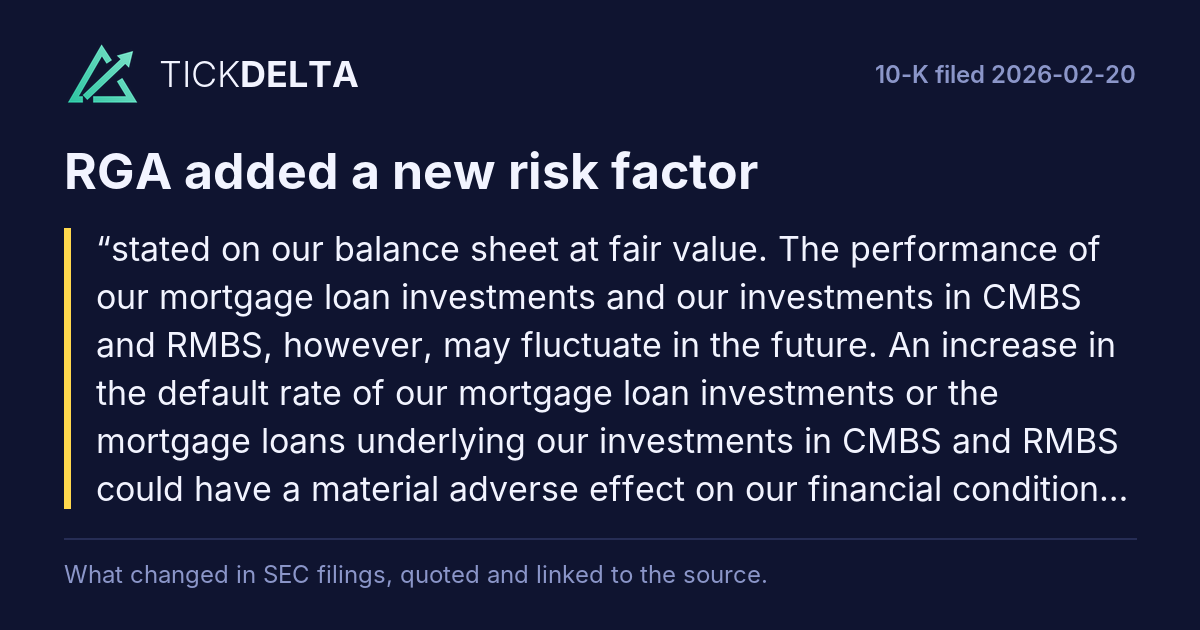
stated on our balance sheet at fair value. The performance of our mortgage loan investments and our investments in CMBS and RMBS, however, may fluctuate in the future. An increase in the default rate of our mortgage loan investments or the mortgage loans underlying our investments in CMBS and RMBS could have a material adverse effect on our financial condition or results of operations.
Paragraphs in the 10-Q filed Nov 6, 2026 that were not in the one before
New in the latest 10-Q
21 paragraphs in the 10-Q filed Nov 6, 2026 with nothing like them in the 10-Q filed Aug 7, 2026 (at least half the words must differ; new numbers alone do not count). Quoted exactly, grouped by the item heading above them. This is text that changed, not a judgement of how serious it is.
10-Q
(2)These AOCI components are included in the computation of net periodic benefit costs.
Read in the 10-Q
Significant assumptions used to compute the liability for future policy benefits for the Traditional business include mortality, morbidity, lapse rates and discount rates (both accretion and current). During the third quarter of 2026, the Company completed its annual assumptions review, which resulted in no change in the Company’s total liability for future policy benefits for its Traditional business. The 2025 annual assumptions review resulted in an $ 183 million increase in the Company’s liability for future policy benefits for its Traditional business, primarily as a result of updating the mortality and lapse assumptions used to measure the liability for future policy benefits.
Read in the 10-Q
Significant assumptions used to compute the liability for future policy benefits for the Financial Solutions business include mortality, morbidity, lapse rates and discount rates (both accretion and current). During the third quarter of 2026 and 2025, the Company completed its annual assumptions review, which resulted in a $ 17 million increase and $ 24 million decrease in the Company’s liability for future policy benefits for its Financial Solutions business, respectively, as a result of updating the lapse and mortality assumptions used to measure the liability for future policy benefits.
Read in the 10-Q
The Company’s $ 400 million 3.95 % Senior Debentures due 2026 matured and were paid in full on September 15, 2026.
Read in the 10-Q
The Company’s annual assumptions review, completed in the third quarter of 2026, did not have a material impact on the Company’s pre-tax income. The 2025 pre-tax loss was primarily due to updated mortality assumptions in the U.K.
Read in the 10-Q
Show the other 16
• The completion of the Company’s annual assumption review during the third quarter of 2026 did not have an impact on the results for the current period. The 2025 assumption update resulted in a loss of $149 million. See Note 4 - “Future Policy Benefits” for additional information.
Read in the 10-Q
• Unrealized gains due to changes in fair value of funds withheld embedded derivative associated with reinsurance agreements written on a modified coinsurance basis and certain agreements written on a coinsurance basis.
Read in the 10-Q
Nine months ended September 30, 2026 compared to nine months ended September 30, 2025
Read in the 10-Q
• The completion of the Company’s annual assumption review during the third quarter of 2026 did not have an impact on the consolidated results for the current period. The 2025 assumption update resulted in a loss of $149 million. See Note 4 - “Future Policy Benefits” for additional information.
Read in the 10-Q
Nine months ended September 30, 2026 compared to nine months ended September 30, 2025
Read in the 10-Q
• The completion of the Company’s annual assumption review during the third quarter of 2026 did not have an impact on the consolidated results for the current period. The 2025 assumption update resulted in a loss of $149 million. See Note 4 - “Future Policy Benefits” for additional information.
Read in the 10-Q
Nine months ended September 30, 2026 compared to nine months ended September 30, 2025
Read in the 10-Q
• The increase in net premiums was primarily due to single-premium PRT transactions executed in the current quarter which is offset by an associated increase in reserves reflected in adjusted claims and other policy benefits.
Read in the 10-Q
• During the three months ended September 30, 2026, the Company completed its annual assumptions review resulting in net unfavorable assumptions updates totaling $8 million, primarily due to updated mortality assumptions. See Note 4 - “Future Policy Benefits” for additional information.
Read in the 10-Q
Nine months ended September 30, 2026 compared to nine months ended September 30, 2025
Read in the 10-Q
Nine months ended September 30, 2026 compared to nine months ended September 30, 2025
Read in the 10-Q
• During the three months ended September 30, 2026, the Company completed its annual assumptions review resulting in net unfavorable assumptions updates totaling $31 million, primarily due to updated mortality assumptions. The 2025 annual assumption update resulted in a loss of $222 million primarily due to updated mortality assumptions in the U.K. to reflect deterioration in mortality improvements and ongoing challenges within the healthcare system. See Note 4 - “Future Policy Benefits” for additional information.
Read in the 10-Q
• There were no changes to the segment actuarial assumptions as a result of the Company’s 2026 annual assumptions review completed in the third quarter. The 2025 annual assumptions update resulted in a gain of $24 million, primarily due to updated longevity based mortality in the U.K. See Note 4 - “Future Policy Benefits” for additional information.
Read in the 10-Q
Nine months ended September 30, 2026 compared to nine months ended September 30, 2025
Read in the 10-Q
The Company’s $400 million 3.95% Senior Debentures due 2026 matured and were paid in full on September 15, 2026.
Read in the 10-Q
and cash equivalents as well as its current sources of liquidity are adequate to meet its cash requirements for the next twelve months.
Read in the 10-Q
The 10-Q's risk factors against the 10-K
Item 1A of the 10-Q filed Nov 6, 2026 against Item 1A of the 10-K filed Feb 20, 2026.
A 10-Q repeats only the risks that changed, so a 10-K paragraph that is missing from it is not counted as removed.
Added is a paragraph with nothing like it in the 10-K, Reworded a sentence that is in both with several words changed,
Quiet changes a sentence in both where one to four words changed and one is a hedge or a modal
(cut words struck through, new words highlighted).
Text on the page, not a score; each links to the filing at sec.gov.
What the 10-Q itself says about its risk factors:There have been no material changes from the risk factors previously disclosed in the 2025 Annual Report.
Read in the 10-Q
1 paragraph in the 10-Q's Item 1A, and none of them adds, rewords or quietly edits a paragraph of the 10-K's.
Phrases used for the first time
Two-word phrases in Risk Factors of the 10-K filed Feb 20, 2026 that are in none of the 1 earlier 10-Ks stored, back to Feb 21, 2025
Where each one is used
- insurance subsidiaries: Our insurance subsidiaries are highly regulated, and changes in these regulations could negatively affect our business.
- intelligence technologies: Our business is highly dependent upon the effective operation of our information security systems. The failure of our information security systems or disaster recovery capabilities for any reason could cause significant interruptions in our operations and result in a failure to maintain the security,...
- expected experience: We regularly review our reserves and associated assumptions as well as actual compared to expected experience as part of our ongoing assessment of our business performance and risks. If we determine that our reserves are insufficient to cover actual or expected policy and contract benefits and claims as a result of...
- reputational harm: market trends or to differentiate our products and services may affect our ability to grow or maintain our current position in the industry. Federal and state regulators are increasing their scrutiny of insurers’ underwriting, and pricing practices, including the use of artificial intelligence, predictive models,...
- due diligence: Our business exposes us to mortality, morbidity, lapse and other risks. Our risk analysis and underwriting processes are designed with the objective of controlling the quality of the business and establishing appropriate pricing for the risks we assume. Among other things, these processes rely heavily on our...
- assumption updates: We regularly review our reserves and associated assumptions as well as actual compared to expected experience as part of our ongoing assessment of our business performance and risks. If we determine that our reserves are insufficient to cover actual or expected policy and contract benefits and claims as a result of...
- income statement: We regularly review our reserves and associated assumptions as well as actual compared to expected experience as part of our ongoing assessment of our business performance and risks. If we determine that our reserves are insufficient to cover actual or expected policy and contract benefits and claims as a result of...
- statement volatility: We regularly review our reserves and associated assumptions as well as actual compared to expected experience as part of our ongoing assessment of our business performance and risks. If we determine that our reserves are insufficient to cover actual or expected policy and contract benefits and claims as a result of...
Used at least twice, small words left out. Counted, not picked: a phrase can be new because the company renamed something.
What was taken out
4 paragraphs of last year's Risk Factors with nothing like them now. The longest are quoted.
Sources
Item 1A of each 10-K and 10-Q on EDGAR, quoted exactly. Each paragraph links to the filing at sec.gov.
Also
10-K change: what was reworded or cut, section by section.
Work with it
Excel workbook · CSV. Google Sheet that stays up to date: paste =IMPORTDATA("https://tickdelta.com/company/RGA/export.csv") into a cell.