Screener / SEC EDGAR /CIK 0001528849 /10-K filed Apr 1, 2026, compared with Apr 2, 2025 /Numbers from the XBRL of the 10-Ks
NYSE Consumer discretionary · Furniture Stores

RH RH

Compare with peers Embed
SEC comment letters, last 20 years

9 reviews of RH's filings by SEC staff

UPLOAD and CORRESP
Reviews 9 latest letter Jan 19, 2023
Questions asked 198 each answered in the company's own letter
No closing letter 2 reviews without a letter saying the staff completed it

When the SEC's staff reviews a filing, it writes to the company with numbered questions, and the company answers each one in a letter. SEC publishes the exchange once the review is over, at least 20 business days later. A question is not an accusation; most reviews end with the company adding detail to its next filing.

How the reviews went

Every review on EDGAR, from the first staff letter to the letter that closes it

  1. 1. Staff letters 20 UPLOAD
  2. 2. Questions in them 198 numbered comments
  3. 3. Company replies 16 CORRESP
  4. 4. Reviews closed 7 of 9 closing letter

Half the closed reviews took 30 days or less from the first letter to the closing letter.

Form 10-K

2023-01-19 to 2023-02-13 · 3 questions · 1 letter from the SEC, 1 from the company
Review closed 2023-02-13
Income taxesDebtNon-GAAP measuresResults discussion (MD&A)
Item 8. Financial Statements and Supplementary Data · Consolidated Statements of Income, page 89
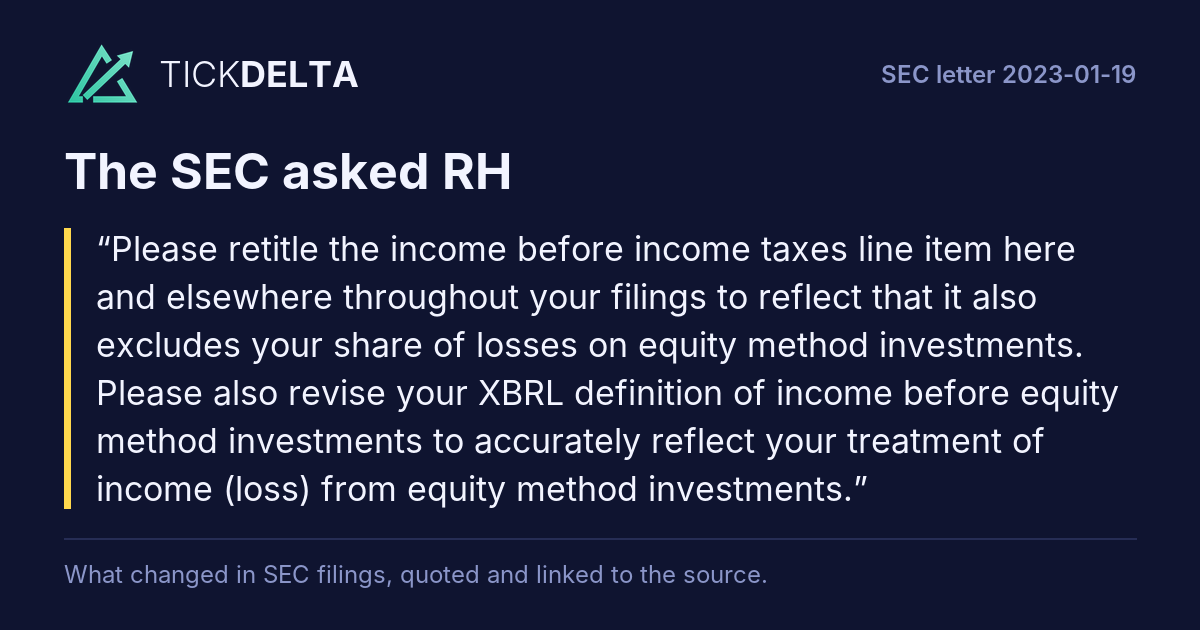
SEC asked (1)
Please retitle the income before income taxes line item here and elsewhere throughout your filings to reflect that it also excludes your share of losses on equity method investments. Please also revise your XBRL definition of income before equity method investments to accurately reflect your treatment of income (loss) from equity method investments.
RH answered
The Company acknowledges the Staff’s comment, and in future filings, including in connection with the Restatement Filings (as described in response to Comment 2 below), the Company will retitle the income before income taxes line item throughout its filings to reflect that such line item also excludes equity method investments. In addition, in future filings, the Company will revise the XBRL definition of income before equity method investments to accurately reflect the treatment of income (loss) from equity method investments.
Read in the reply
In its next report

First report after the company's reply of Feb 2, 2023: 10-K filed Mar 29, 2023 ↗, against the 10-K filed Mar 30, 2022 ↗.

Tickdelta does not hold the text of both reports, so they are not compared here.

Notes to Condensed Consolidated Financial Statements (Unaudited) · Note 13 - Net Income per Share, page 29
SEC asked (2)
It appears that you excluded the loss on extinguishment of debt in determining the net income available to common stockholders used in calculating your basic net income per share for the nine months ended October 29, 2022. Please tell us the authoritative accounting literature you relied upon to support your calculation.
RH answered
In response to the Staff’s comments on our Form 10-Q for Fiscal Quarter Ended October 29, 2022, we have identified an error in the reporting of basic and diluted net income per share. In particular, the Company has determined that the loss on extinguishment of debt was incorrectly added back in determining net income available to common stockholders in the calculation of basic and diluted net income per share in the Condensed Consolidated Statements of Income for the three month, three and six month, and nine month periods ended April 30, 2022, July 30, 2022 and October 29, 2022,
Rest of the answer

respectively, which were included in the Company’s previously issued unaudited Condensed Consolidated Financial Statements as of and for the periods ended April 30, 2022, July 30, 2022 and October 29, 2022, respectively, included in the Company’s quarterly reports on Form 10-Q filed with the SEC on June 3, 2022, September 8, 2022, and December 8, 2022, respectively (collectively, the “Prior Financial Statements”). In addition, the Company has determined that the calculation of weighted-average diluted shares used in the determination of the Company’s diluted net income per share during certain of the financial periods within the Prior Financial Statements incorrectly included certain anti-dilutive shares related to a portion of the Company’s convertible senior notes.

The unintentional errors in the Prior Financial Statements related to the calculation of basic and diluted net income per share occurred due to an incorrect application of authoritative accounting guidance related to the extinguishment of a portion of the Company’s convertible senior notes and its effect on the Company’s net income per share calculations. The errors were initially made upon the Company’s adoption of Accounting Standards Update 2020-06—Accounting for Convertible Instruments and Contracts in an Entity’s Own Equity in the first quarter of fiscal 2022 with respect to the extinguishment of convertible senior notes that also occurred in the first quarter. The Company extinguished additional portions of its convertible senior notes in the second quarter of fiscal 2022 for which the guidance was also incorrectly applied.

The Company has determined that the errors are material to the Prior Financial Statements in accordance with the guidance contained in Staff Accounting Bulletins (“SAB”) Topic 1.M (SAB 99).

The Company plans to report under Item 4.02 on Form 8-K (the “8-K”) that the Prior Financial Statements should no longer be relied upon due to these unintentional errors identified therein, and that a restatement of the Prior Financial Statements is required to correct such errors. The Company additionally intends to file amendments to its previously filed Quarterly Reports on Form 10-Q for the three months ended April 30, 2022, the three and six months ended July 30, 2022 and the three and nine months ended October 29, 2022 in order to correct the errors (the “Restatement Filings”).

Read in the reply
In its next report

First report after the company's reply of Feb 2, 2023: 10-K filed Mar 29, 2023 ↗, against the 10-K filed Mar 30, 2022 ↗.

Tickdelta does not hold the text of both reports, so they are not compared here.

Item 2. Management's Discussion and Analysis of Financial Condition and Results of Operations · Reconciliation of GAAP Net Income to Adjusted Net Income, page 43
SEC asked (3)
You state that your non-GAAP adjustments for the impact of income tax items for both the three and nine months ended October 29, 2022 are based on an adjusted tax rate of 0.0%, which represents your expected cash tax liability associated with anticipated fiscal 2022 results.
Rest of the question

For both the three and nine months ended October 29, 2022, your non- GAAP tax adjustments to arrive at adjusted net income (a performance measure) remove your entire GAAP income tax expense (benefit) and appear to change your basis of accounting for taxes to a cash basis, resulting in the presentation of an individually tailored measure. Please remove these non-GAAP tax adjustments and include current and deferred income tax expense commensurate with the non-GAAP measure of profitability. Also, clearly explain how the revised tax adjustments were computed. Refer to Questions 100.04 and 102.11 of the Non-GAAP Financial Measures Compliance and Disclosure Interpretations.

RH answered
The Company acknowledges the Staff’s comment, and in future filings, including in connection with the Restatement Filings, the Company will revise the adjustments for the impact of income tax items previously reported in the Prior Financial Statements by applying an adjusted effective tax rate to each quarterly period that removes the impact of identified material non-recurring and other items that we do not consider representative of our underlying operating performance in order to present current and deferred income tax expense commensurate with the non-GAAP measurement of
Rest of the answer

profitability.

If you require additional information or have any questions about this letter, please call me at (415) 924-1005.

Read in the reply
In its next report

First report after the company's reply of Feb 2, 2023: 10-K filed Mar 29, 2023 ↗, against the 10-K filed Mar 30, 2022 ↗.

Tickdelta does not hold the text of both reports, so they are not compared here.

Also in this review: closing letter, 2023-02-13

Form 10-K for the Fiscal Year Ended January 30, 2021

2021-09-30 to 2021-11-22 · 2 questions · 1 letter from the SEC, 2 from the company
Review closed 2021-11-22
Liquidity and cashNon-GAAP measuresDebtLeases
How We Assess the Performance of Our Business · Free Cash Flow, page 59
SEC asked (1)
Please tell us and disclose why free cash flow is increased for the non-cash accretion of a debt discount upon settlement of the debt and why you believe presenting a non-GAAP liquidity measure with this non-cash adjustment provides useful information to investors. Refer to Items 10(e)(1)(i)(C) and (D) of Regulation S-K.
RH answered
The Company advises the Staff that it does not only view free cash flow as a liquidity measure, but also as an indicator of operating performance, and that the Company’s intention is to present it as such. The Company has consistently noted, in its discussion of free cash flow, that free cash flow provides meaningful supplemental information for investors regarding the performance of the Company’s business and facilitates a meaningful evaluation of operating results on a comparable basis with historical results.
Rest of the answer

The Company believes that investors also use this financial measure as an indicator of the performance of the Company’s operations.

The Company advises the Staff that, as discussed in its Form 10-K within Item 8—Financial Statements and Supplementary Data, Note 12—Convertible Senior Notes, its convertible senior notes due 2019 (the “2019 Notes”), convertible senior notes due 2020 (the “2020 Notes”), convertible senior notes due 2023 (the “2023 Notes”) and convertible senior notes due 2024 (the “2024 Notes”) will be settled, at its election, in cash, shares of the Company’s common stock, or a combination of cash and shares of the Company’s common stock.

With respect to settlements upon maturity of the 2020 Notes and 2019 Notes (collectively, the “Notes”) in fiscal 2020 and fiscal 2019, respectively, the Company elected to settle using a combination of cash and shares of common stock. A portion of the cash used to repay these settlements represented the amount of the Notes attributable to the debt discount upon issuance. In accordance with ASC 230-10-45-17(d), this portion of the cash settlement payment was presented as an operating cash outflow, and thus a free cash outflow.

In addition, during fiscal 2021, a number of the holders of the 2023 Notes and 2024 Notes have elected to exercise the early conversion option per the respective terms of the related agreements governing such convertible notes, and the Company has elected to settle such conversions using a combination settlement comprised of cash equal to the principal amount of the 2023 Notes and 2024 Notes subject to early conversion and shares of the Company’s common stock for the remaining conversion value.

It is difficult for the Company to predict the extent to which holders of these convertible notes will elect early conversion from quarter to quarter. The amount of these early note conversions have varied, and may continue to vary, substantially from period to period, and, as a result, the Company believes that it is useful to the Company’s senior leadership team and investors to present a cash flow measure in a manner that excludes the impact of the cash settlement portion for the conversion of these convertible notes attributable to the debt discount upon issuance. The Company believes that this presentation enhances the usefulness of the free cash flow measure as an indicator of performance of its business, comparability of this measure with its historical results and comparability of this measure with similar measures used by other companies.

For these reasons, the Company believes that (i) the presentation of free cash flow with this adjustment is a useful performance indicator; (ii) this manner of presentation is consistent with investor expectations; and (iii) it is appropriate to exclude from free cash flow the portion of the settlement payments attributable to the debt discount due to the nature of the core business operations of the Company.

Nevertheless, the Company acknowledges that the current definition of this measure within the Form 10-K filing is captioned as “Free cash flow” rather than as “Adjusted free cash flow.” In future filings, the Company will no longer report a free cash flow measurement but will instead report “Adjusted free cash flow” and will clearly identify the measurement as an “adjusted” measurement.

In addition, in future filings the Company will explain the reason that the “adjusted free cash flow” measure does not reflect any reduction for cash settlements of the Company’s debt obligations, as well as caution readers that such measure does not represent the residual cash flow available for discretionary expenditures.

Read in the reply
In its next report

First report after the company's reply of Oct 15, 2021: 10-Q filed Dec 9, 2021 ↗, against the 10-Q filed Sep 9, 2021 ↗.

Tickdelta does not hold the text of both reports, so they are not compared here.

Item 8. Financial Statements and Supplementary Data · Consolidated Statements of Cash Flows, page 93
SEC asked (2)
Please tell us whether the activity included in the landlord assets under construction-net of tenant allowances line item relates only to capital amounts contributed by you toward the construction of the leased asset prior to lease commencement, when you are not the deemed owner for accounting purposes during the construction period. If other activity is included, please explain.
Rest of the question

Also, tell us separately for each period presented the amount of activity included in this line item related to each lease type (operating or finance lease). Finally, tell us in detail separately for each lease type how you concluded the related activity included in this line item represented an operating cash flow and the specific accounting guidance you are relying upon.

RH answered
The Company confirms to the Staff that the activity included in the Landlord assets under construction—net of tenant allowances line item only includes capital amounts contributed by the Company toward the construction of lessor assets subject to the lease prior to lease commencement, when the Company is not the deemed owner for accounting purposes during the construction period, net of tenant allowances received from the landlord during the construction period.

For each period presented, the amounts included in this line item represent the Company’s capital activity associated with
Rest of the answer

construction of lessor assets subject to the lease. Lessee payments for these assets are considered prepaid rent (based on the guidance in ASC 842-40-55-4). Payments made prior to lease commencement are presented in the consolidated statement of cash flows based upon the expected classification of the lease. The classification of such costs in this line item is based on the following accounting policy.

At construction commencement, the Company determines the expected lease classification that will ultimately be concluded at lease commencement in accordance with ASC 842-10-25. Based on the expected lease classification, the presentation of capital amounts contributed by the Company toward the construction of lessor assets subject to the lease prior to lease commencement in the consolidated statement of cash flows is as follows:

● Operating lease—classified as operating activities, consistent with ASC 842-20-45-5. This guidance states that payments arising from operating leases are classified as operating activities in the consolidated statement of cash flows. Therefore, even if the payment is made before a right-of-use asset and lease liability are recognized, the Company concludes that the payment is classified as operating activities because it ultimately arises from an operating lease.

● Finance lease—classified as investing activities, consistent with the guidance in ASC 230-10-45-13. ASC 842-20-45-5 provides guidance for payments that are deemed principal payments and interest payments (i.e., it only provides guidance for repayments of a recognized lease liability). This is in contrast to the ASC 842 guidance for operating leases which simply provides guidance for all payments related to operating leases (i.e., it does not specify that the payment has to be for a recognized lease liability). Therefore, since a lease liability is not recognized prior to lease commencement, the Company considered the guidance in ASC 230. Specifically ASC 230-10-45-13c states that payments at the time of purchase or soon before or after purchase to acquire property, plant, and equipment or other productive assets should be classified as investing. Based on this guidance, the Company concludes that these payments are classified as investing activities in the consolidated statement of cash flows since they were made to acquire a productive asset (i.e., a right-of-use asset) which is akin to ownership of a Company-owned productive asset.

● Lease Classification is Uncertain—to the extent that a reliable estimate of lease classification cannot be made at construction commencement, the Company classifies these payments as operating activities in the consolidated statement of cash flows. Key assumptions which are subject to uncertainty in estimating lease classification include the projected incremental borrowing rate and the projected construction cost. The Company believes this classification of payments is consistent with the guidance in ASC 230 which suggests a bias toward operating activities absent clear support for an alternative.

As a result, the amounts included in the Landlord assets under construction—net of tenant allowances line item represent leases expected to be classified as operating leases or leases where expected lease classification is uncertain at construction commencement.

If you require additional information or have any questions about this letter, please call me at (415) 924-1005.

Read in the reply
In its next report

First report after the company's reply of Oct 15, 2021: 10-Q filed Dec 9, 2021 ↗, against the 10-Q filed Sep 9, 2021 ↗.

Tickdelta does not hold the text of both reports, so they are not compared here.

Also in this review: company letter, Nov 19, 2021, closing letter, 2021-11-22

Form 10-K

2019-07-24 to 2019-08-06 · 4 questions · 1 letter from the SEC, 1 from the company
Review closed 2019-08-06
Non-GAAP measuresGoodwill and impairmentDebtRevenueResults discussion (MD&A)Risk factorsChinaControls
Item 6. Selected Consolidated Financial Data · Other Financial and Operating Data, page 37
SEC asked (1)
We note your calculation of EBITDA in footnote (5) on pages 40-41 contains adjustments for items other than interest, taxes, depreciation and amortization. Specifically, you also adjust for goodwill and tradename impairment and loss on extinguishment of debt. If you present a similar measure in future filings, please ensure that measures calculated differently from EBITDA are not characterized as EBITDA.
Rest of the question

Refer to Question 103.01 of the Compliance and Disclosure Interpretations Non-GAAP Financial Measures updated April 4, 2018. Similar changes should be made to your earnings release.

RH answered
The Company acknowledges the

Staff’s comment, and in future filings, the Company’s presentation of EBITDA will adhere to the definition of EBITDA as described in Item 10(e)(1)(ii)(A) of Regulation S-K. Any adjustments outside the scope of such definitional guidance will be addressed within the definition of a different measure such as Adjusted EBITDA.
Read in the reply
In its next report

First report after the company's reply of Jul 29, 2019: 10-Q filed Sep 11, 2019 ↗, against the 10-Q filed Jun 13, 2019 ↗.

Tickdelta does not hold the text of both reports, so they are not compared here.

Operations · General, page 42
SEC asked (2)
We reference your risk factor disclosure on page 14 regarding the 25% increase in tariffs on merchandise imported from China and that your sales may fall in response to price increases. We also note that 41% and 46% of your total dollar volume purchases were sourced from China in fiscal 2018 and 2017, respectively, as described in the second paragraph on page 6.
Rest of the question

When considering the requirements of Item 303(a)(3)(ii) of Regulation S-K., please tell us how you concluded you did not need to describe trends or uncertainties related to these tariffs that have had or that you reasonably expect will have a material favorable or unfavorable impact on net sales or revenues or income from continuing operations, or any material changes in the relationship between costs and revenues. Please address your disclosures in both your Form 10-K and in your May 4, 2019 Form 10-Q. In your response, please separately address your analysis of the 10% tariff that was effective as of September 24, 2018 and the 25% tariff on goods shipped on or after May 10, 2019.

RH answered
The Company believes that the disclosures regarding the potential risks related to tariffs included in its Form

10-K and Form 10-Q adequately convey the potential for adverse impact as a result of the tariffs applicable with respect to the Company’s products that are sourced from China. The Company has taken a number of actions to mitigate the impact of the China tariffs generally including both the initial 10% tariffs imposed in September, 2018 as well as the increase in China tariffs imposed in May, 2019.

At the time the 10% tariffs became effective on September 24, 2018, the Company
Rest of the answer

adopted a number of mitigation measures including:

•

Negotiation of product cost reductions with vendors that manufacture tariff-impacted merchandise in China, and,

Increases in the selling prices to consumers with respect to tariff-impacted merchandise.

The combination of the product cost reductions and the increases in our selling prices was designed to mitigate the potential impact of the 10% tariff on the Company’s product margins on tariff-impacted goods. While we recognize that there is a potential risk that sales volume could be negatively impacted as a result of such increases in selling prices to consumers, the Company has not identified discernable trends related to the 10% tariffs and the Company’s mitigation measures.

With regard to the increase in tariffs to the 25% rate on goods shipped on or after May 10, 2019, this change took effect after our first quarter ending May 4, 2019 and as a result had no impact on the quarter. The Company has also adopted mitigation measures with respect to such increased tariffs consistent with the measures taken related to the 10% tariff, but it is still too early to predict the outcome of such increase in tariffs or the mitigation measures adopted by the Company in response to such increases in tariffs.

Respectfully, the Company believes that the Management’s Discussion and Analysis (“MD&A”) in the above referenced Form 10-K and Form 10-Q is accurate and complete for these purposes and that no specific additional discussion of tariffs was required at the time in connection with such disclosures in order to address a known trend or uncertainty within the meaning contemplated by Item 303 of Regulation S-K. The Company believes that the risk factor language on the subject matter of tariffs was appropriately comprehensive and the Company submits that it does not individually address its various risks factors in each instance within the MD&A portions of its SEC filings. Rather, the Company addresses and discusses risk factors within the MD&A section on a case by case basis as warranted, including consideration of the extent to which they may or could have a material impact on the Company.

The Company acknowledges the Staff’s comment, however, and confirms to the Staff that we will continue to monitor the impact tariffs have on the Company’s operating results and, if the Company identifies trends or uncertainties related to tariffs in future reporting periods, it will provide appropriate additional discussion of such trends or uncertainties in the MD&A portion of the corresponding SEC filings.

Read in the reply
General
SEC asked (3)
We note your Amendment No. 1 to Form 10-K filed May 31, 2019 includes updates to Item 9B in relation to your restated credit agreement and second lien credit agreement entered into on May 31, 2019. Please file an amended Form 10-K to set forth the complete text of Item 9B. Refer to Exchange Act Rule 12b-15.
Rest of the question

Additionally, we note that your amended Form 10-K did not include all of the certifications specified by Items 601(B)(31) and (B)(32) of Regulation S-K. Please ensure that your amended Form 10-K includes all required certifications.

RH answered
The Company acknowledges the Staff’s comment, and in response has provided Item 9B in its entirety in Amendment No. 2, which consolidates all of the Item 9B disclosure as previously provided in the Form 10-K filed on March 29, 2019 and as provided in Amendment No. 1 to the Form 10-K filed on May 31, 2019. In addition, the Company has included with Amendment No. 2 all of the certifications specified by Items 601(B)(31) and

(B)(32) of Regulation S-K, as requested.
Read in the reply
In its next report

First report after the company's reply of Jul 29, 2019: 10-Q filed Sep 11, 2019 ↗, against the 10-Q filed Jun 13, 2019 ↗.

Tickdelta does not hold the text of both reports, so they are not compared here.

Note 1 - The Company · Revisions, page 8
SEC asked (4)
We note your disclosure regarding the errors in your financial statements for the year ended February 3, 2018 and quarterly period ended May 4, 2019, respectively. In light of the fact that you identified multiple errors within a relatively short period of time, please tell us whether management reconsidered the adequacy of its previous conclusion regarding the effectiveness of internal control over financial
Rest of the question

reporting and disclosure controls and procedures. As part of your response, please describe to us the deficiencies in controls that resulted in these errors. To the extent management maintains its conclusion that internal controls and disclosure controls and procedures were effective, despite the errors, please tell us the basis for management’s conclusion. We remind you that the company and its management are responsible for the accuracy and adequacy of their disclosures, notwithstanding any review, comments, action or absence of action by the staff.

RH answered
The Company reconsidered the adequacy of its previous conclusion regarding the effectiveness of its internal control over financial reporting

(“ICFR”) and disclosure controls and procedures (“DC&P”) as a result of the accounting errors described in Note 1 of the Form 10-Q for quarterly period ended May 4, 2019 in the year ending February 1, 2020 (fiscal 2019).
Rest of the answer

Set forth below is a summary of the considerations undertaken by management to assess the severity of the control deficiencies and management’s conclusions regarding the effectiveness of the

Company’s ICFR and DC&P.

As disclosed in Note 1 of the Form 10-Q for quarterly period ended May 4, 2019, the Company revised its accompanying unaudited interim financial statements due to the identification of the following errors:

Equity reclassification related to the Company’s retirement of treasury stock which impacted the quarterly and year-end reporting periods of the fiscal year ended February 3, 2018 (fiscal 2017) and the first and second quarterly reporting periods of the fiscal year ended February 2, 2019 (fiscal 2018), as first reported in the third quarter of fiscal 2018 Form 10-Q;

Misstatements related to an exited lease which impacted the fourth quarter of fiscal 2017 and the first quarter of fiscal 2018 ended May 5, 2018, as first reported in the first quarter of fiscal 2019 Form 10-Q; and

Cash flow reclassification related to the Company’s unpaid capital expenditures which impacted the quarterly and year-end reporting periods of fiscal 2018, as first reported in the first quarter of fiscal 2019 Form 10-Q.

In connection with the identification of these errors, management performed an assessment of the materiality of these misstatements in accordance with ASC 250-10-S99. Based on the results of this assessment, these errors were not considered to be material to any of the previously issued financial statements either individually or in the aggregate.

The Company also performed an analysis to determine the impact of the errors on management’s assessment of the effectiveness of its ICFR and DC&P as of February 2, 2019 (fiscal 2018) and as of May 4, 2019 (first quarter of fiscal 2019). This analysis included consideration of the nature and cause of the deficiency, the impact to the consolidated financial statements and the potential aggregation of the deficiencies to determine whether these deficiencies constitute a material weakness in internal control over financial reporting.

Such assessments considered both qualitative and quantitative factors in accordance with SEC Release

No. 33-8810, Section II, B1 to determine whether there was a reasonable possibility that a material misstatement would not be prevented or detected on a timely basis, including consideration of how the applicable internal controls or compensating controls would have identified each such misstatement if the amounts involved were material.

The Company evaluated the severity of the deficiencies and concluded that the deficiencies did not indicate a material weakness in internal controls and were not indicative of a broader or systemic issue with the Company’s ICFR or DC&P. As a result, the Company reconsidered and reaffirmed its previous conclusions that it maintained effective internal control over financial reporting and disclosure controls and procedures.

The following presents a summary of the above mentioned errors and the Company’s assessment of controls:

Treasury stock

The Company retired treasury stock in the first quarter of fiscal 2017 for the first time since inception. The

Company identified in the third quarter of fiscal 2018 that, due to a lack of precision in the design of the related control activity to review the presentation requirements over the cost of treasury stock upon retirement, the Company did not correctly reclassify the cost associated with the share repurchases of $19.5 million from the treasury share line item to either (1) retained earnings or (2) an allocation between retained earnings and additional paid-in capital. The Company disclosed this revision upon identification of the error in Note 1 of the Form 10-Q for the quarterly period ended November 3, 2018. The

Company also disclosed this revision in the fiscal 2018 Form 10-K and the Form 10-Q for the quarterly period ended May 4, 2019 and plans to continue to disclose this revision in the Form 10-Q for the quarterly period ended August 3, 2019 in order to effect the revision for all comparative periods.

At the time that the deficiency was identified in the third quarter of fiscal 2018, the Company evaluated the magnitude of the potential misstatement that could have resulted from the deficiency based on quantitative and qualitative factors. As a result of this assessment, the Company concluded the magnitude of the potential misstatement was not material based on consideration of the following:

This deficiency would only result in reclassification between two line items within equity;

There would be no impact on key performance metrics; and

There would be no impact on any other compliance requirement, including: state laws, Company corporate by-laws, debt covenants, and the ability to pay dividends.

Based on the analysis above, management concluded that the deficiency represents a significant deficiency in internal control over financial reporting and maintained its conclusion that internal controls and disclosure controls and procedures were effective.

The Company completed a second treasury stock retirement in the fourth quarter of fiscal 2018 and increased the precision of its control activity to include accounting for the retirement of treasury stock. Upon retirement, management correctly recorded the cost of the treasury stock and also concluded the design and operation of the revised control activity was effective. Therefore, management concluded that this control deficiency was remediated by the end of its fiscal year 2018.

Distribution center closure

The Company ceased operations at one of its distribution center facilities in the fourth quarter of fiscal 2017.

The Company identified in the first quarter of fiscal 2019 that, due to a deficiency in the related control over the identification of the unit of account in accounting for exited location, in connection with the computation of the transaction the

Company understated its exit and disposal costs by $2.1 million. While the previous conclusions and interpretations of exit and disposal obligations were based on accounting literature research, after additional research and consideration of the relevant facts, management identified that the conclusions were not in accordance with accounting principles generally accepted in the United States of America (“US GAAP”) and therefore the understatement was an error.

The Company evaluated the magnitude of the potential misstatement that could have resulted from the deficiency based on quantitative and qualitative factors. As a result of this assessment, the Company concluded the magnitude of the potential misstatement was not material based on consideration of the following:

The magnitude of the potential misstatement is below management’s quantitative materiality thresholds for the impacted periods; and

There would be no material impact on any key performance metrics.

While the error was not material and therefore is considered to not warrant revision individually, the Company reported the revision in Note 1 of the Form 10-Q for quarterly period ended May 4, 2019 in connection with the modified retrospective application of ASC 842 Leases as further discussed in Note 2 of the Form 10-Q.

Based on the analysis above, management concluded that the deficiency represents a deficiency in internal controls and maintains its conclusion that internal controls and disclosure controls and procedures were effective.

Cash flow: Unpaid capital expenditures

In connection with the preparation of the consolidated statement of cash flows for the first quarter of fiscal

2018, the Company incorrectly computed the change in accrued capital expenditures for the period. The Company identified in the first quarter of fiscal 2019 that this error was carried forward to each of the subsequent reporting periods in fiscal

2018 resulting in a misclassification between operating and investing cash flows. The miscalculation was due to a deficiency in the design of controls over the review of hard-coded inputs within the cash flow calculations which resulted in an incorrect classification between operating and investing cash flows of $9.2 million.

The Company evaluated the magnitude of the potential misstatement that could have resulted from the deficiency to the interim and annual financial statements and evaluated the materiality based on quantitative and qualitative factors. As a result of this assessment, the Company concluded the magnitude of the potential misstatement was not material based on consideration of the following:

This deficiency would only result in reclassification between two line items within the cash flow statement and would not change total cash flows;

The magnitude of the potential misstatement does not flip any cash flow activities between “provided by” or “used in” and does not affect any trends;

The deficiency would not impact earnings or debt covenants; and

There would be no impact on key performance metrics or the Company’s guidance.

internal controls and maintains its conclusion that internal controls and disclosure controls and procedures were effective.

As noted above, the Company concluded that none of the control deficiencies discussed above constitute a material weakness. In addition to the individual assessment of deficiencies in controls, the Company assessed the aggregation of all known deficiencies that were unremediated as of February 2, 2019 and May 4, 2019. In light of the multiple errors identified within a relatively short period of time, the Company reconsidered the adequacy of its previous conclusion regarding the effectiveness of internal control over financial reporting and disclosure controls and procedures, as described below.

The Company aggregated all known unremediated deficiencies by significant accounts or disclosures, relevant assertion, business unit or component, business process, and component of internal control. The deficiencies described above occurred in different business processes and do not affect the same accounts or disclosures. Additionally, of the deficiencies that resulted in an error requiring revision, only the cash flow control deficiency noted above was not remediated as of February 2, 2019 and May 4, 2019, and there were no other unremediated control deficiencies impacting the cash flow statement or presentation and disclosure assertion to aggregate with this deficiency at fiscal year end 2018 or the end of the first quarter of fiscal 2019. These deficiencies do not have similar root causes with each other, nor with any of the other control deficiencies that were not remediated at the time. Accordingly, the Company maintains its conclusion that the combination of all deficiencies does not indicate ineffective internal control over financial reporting or disclosure controls and procedures.

The Company assessed whether situations existed that might indicate a material weakness in internal control over financial reporting. Such assessment included, without limitation, that there was no identification of fraud on the part of senior management, there was no restatement of previously issued financial statements for a material misstatement nor could the errors have risen to a level such that there was a material misstatement, and there was not ineffective oversight by the Company’s Audit Committee. The Company further considered whether any of these deficiencies might prevent prudent officials in the conduct of their owns affairs from concluding that they have reasonable assurance that transactions are recorded as necessary to permit the preparation of financial statements in conformity with US GAAP.

Based on the considerations outlined above, the Company concluded that the deficiencies, or combination of deficiencies, did not indicate a reasonable possibility that a material misstatement would not be prevented or detected on a timely basis in the Company’s consolidated financial statements.

In evaluating our disclosure controls and procedures following the identification of the matters noted above, management, including our Chief Executive Officer and Chief Financial Officer, concluded that despite these deficiencies, our system of internal control was designed and operating effectively, for all relevant periods, to provide reasonable assurance that information required to be disclosed by us were recorded, processed, summarized and reported within the time periods specified in the SEC’s rules and forms.

Management also assessed the related control enhancements made to internal control over financial reporting since the identification of the deficiencies discussed above and concluded that none of these enhancements resulted in a material change to the Company’s internal control over financial reporting during fiscal 2018 or the first quarter of fiscal 2019.

The conclusions reached above with respect to the errors and control deficiencies were discussed with the Company’s Audit Committee of the

Board of Directors prior to the filing of the Company’s Form 10-K for the year ended February 2, 2019 and prior to the filing of the Company’s Form 10-Q for the period ended May 4, 2019. In weighing all of the factors explained above, and the reconsideration of the adequacy of the Company’s previous conclusions, management continues to believe that the Company’s ICFR and DC&P were effective as of February 2, 2019 and as of May 4, 2019.

If you require additional information or have any questions about this letter, please call me at (917) 882-5454.
Read in the reply
In its next report

First report after the company's reply of Jul 29, 2019: 10-Q filed Sep 11, 2019 ↗, against the 10-Q filed Jun 13, 2019 ↗.

Tickdelta does not hold the text of both reports, so they are not compared here.

Also in this review: closing letter, 2019-08-06

Form 10-K for the Fiscal Year Ended January 28, 2017

2017-09-20 to 2018-02-26 · 25 questions · 4 letters from the SEC, 5 from the company
Review closed 2018-02-26
SegmentsGoodwill and impairmentResults discussion (MD&A)RevenueCritical estimatesLiquidity and cashIncome taxesAcquisitionsInventoryControlsNon-GAAP measures
Management’s Discussion and Analysis of Financial Condition and Results of Operations · Factors Affecting Our Results of Operations, page 38
SEC asked (1)
We note the discussion of the impact on your fiscal 2016 results from the transition to a membership model, here and throughout your filing. We have the following comments:  Please explain to us in more detail how you assess the impact on your revenue from this transition.
Rest of the question

In doing so, tell us whether you previously tracked the revenue resulting from promotional events and whether you compared this to the revenue generated from RH Members or otherwise how you compared revenues generated year-over-year to conclude that the move to a membership model had a negative impact on the timing of your revenue recognition in fiscal 2016. If you make a similar disclosure in future filings, please revise to better explain this matter to your investors.  We note your disclosure that product margins declined due to the higher discount rate offered through the RH Members Program versus your promotional cadence in fiscal 2015. We further note the analyses of gross profit in your fiscal 2017 Forms 10-Q does not provide a similar disclosure stating that product margins declined due to the higher discount rate offered through the RH Members Program versus your previous promotional model. Since the RH Members Program was implemented in March 2016, please tell us why your interim 2017 gross profit was not negatively impacted by the membership program when compared to periods in 2016 that applied the promotional model. Please revise future filings to better explain why the membership program appears to be affecting your gross profit differently in 2017 than it did in 2016, or tell us why such disclosure is not material to understanding your results.

RH answered
The Company advises the Staff that the following non-GAAP metrics are reviewed by the

CODM:

Non-GAAP

Metric

Frequency of

Reporting to the CODM

Description

Level of

Reporting

Adjusted Net Income

Quarterly or As Requested

Net income adjusted for the impact of certain non-recurring and other items that we do not consider representative of our underlying operating performance.
Rest of the answer

Such metric is reviewed on an adjusted basis in order to have comparable financial results to analyze changes in the underlying business from quarter to quarter.

Consolidated

Adjusted Operating Income

Operating income adjusted for the impact of certain non-recurring and other items that we do not consider representative of our underlying operating performance. Such metric is reviewed on an adjusted basis in order to have comparable financial results to analyze changes in the underlying business from quarter to quarter.

RH Segment

Waterworks

Adjusted EBITDA

Earnings before interest, tax, depreciation and amortization on an adjusted basis. Such metric is reviewed on an adjusted basis in order to have comparable financial results to analyze changes in the underlying business from quarter to quarter.

Individual Store P&L Statements

Monthly

Retail 4-wall contribution; revenue from websites and Source Books are not allocated to individual store P&Ls, nor are any corporate allocations of expense.

Stores within RH Segment

Demand Merchandise Margin & Shipped Merchandise Margin

Daily

Merchandise margin for demand (orders placed) and shipped sales.

Demand Merchandise Margin = average-weighted cost / demand

Shipped Merchandise Margin = average-weighted cost / shipped sales

The above metrics are not the same as the metrics reported externally as “gross margin” as these non-GAAP merchandise margin metrics do not reflect all costs that are taken into account when determining GAAP gross margin.

RH Core

RH B&C + Teen

RH Outlet

RH Contract

RH Hospitality

These non-GAAP metrics are determined using the following components, which are defined internally as follows:

Demand: orders placed; excludes cancellations, exchanges and returns.

Shipped sales: orders shipped; excludes revenue deferral, cancellations, returns and certain discounts.

Average-weighted cost: product cost paid to vendors and estimated duty and freight costs; excludes other significant costs such as COGS deferral, purchase price variance adjustments, and various inventory adjustments such as LCM, obsolescence and actual inbound freight costs.

For each non-GAAP metric identified above, please tell us whether the metric is ever presented to your Board of Directors or investors, and if so, tell us how often the metric is presented.

Response:

The metrics from the above listing that are regularly presented to our Board of Directors are Adjusted Net Income and Adjusted EBITDA, both of which are presented quarterly on a consolidated basis for the Company. Occasionally in the past the Board of Directors was presented with the merchandise margin metrics, however, this metric has not been provided to the Board of Directors since

October 2016.

The metrics from the above listing that are regularly presented to our investors within our Form 8-K, Form 10-Q or Form 10-K filings are Adjusted Net Income and Adjusted Operating Income. Adjusted Net Income is presented quarterly on a consolidated basis for the Company. Adjusted Operating Income is presented quarterly for the RH Segment, Waterworks and on a consolidated basis for the Company.

Historically, we disclosed Adjusted EBITDA to investors as part of our periodic reports and earnings releases during the first several years after our initial public offering through the filing of our first quarter fiscal year 2014 Form 10-Q.

For each non-GAAP metric identified above, please tell us in more detail how you determined the metric did not constitute discrete financial information used by the CODM to allocate resources and assess the performance of the RH operating segment. Please note that ASC 280 does not require such financial information to include all expenses, to be on a GAAP basis, or to be “complete discrete financial information” as referenced in your prior response. To assist us in understanding your response, please tell us in detail how you applied ASC 280 to conclude that the RH segment is a single operating segment rather than components of the RH segment representing multiple operating segments.

Response:

The Company acknowledges the

Staff’s comment and confirms to the Staff that discrete financial information is available to the CODM at the individual store level via the monthly individual store P&L statements. As of January 28, 2017, the RH Segment had 98 store locations for which the CODM received individual store P&L statements. Decisions made by the CODM to assess performance and allocate resources using the individual store P&L statements are based on assessments made for a single store location, and are not indicative of decisions made for the entire store fleet.

Similarly, merchandise margin metrics do not constitute discrete financial information as these metrics are not used by the CODM to assess the performance and make resource allocation decisions of the RH operating segment, as described in ASC 280. Instead, as described below, such metrics are used to make merchandise pricing decisions and guide current efforts to improve cash flow across the business.

If not addressed in your response to the bullet points above, please clearly explain to us how the CEO uses the component-level non-GAAP metrics that were referenced in your response to comment 5 in our letter dated September 20, 2017 to make decisions.

Response:

Although the financial metrics mentioned above are available for components of the Company’s operating segments, such metrics are not used to allocate resources or assess performance of a component. Rather, the metrics are used primarily to (1) make strategic operating decisions at individual retail 4-wall locations, (2) make merchandise pricing decisions and (3) guide current efforts to improve cash flow across the business.

For example, following the recent opening of a new Design Gallery, the Company tracked the actual sales performance of such new Design Gallery and its operating results versus expectations based on historical store level financial results. As a result of the review of such information by the CODM and RH management team, certain strategic operating decisions were adjusted for the Gallery in order to increase its operational effectiveness, including (1) modification of the store operating hours, (2) changes to the level of store associate staffing requirements during the business day and (3) changes to the valet parking offered at the Gallery.

Further, review of the merchandise margin metrics helps to inform the management team’s merchandise pricing decisions and to support the Company’s current efforts to generate more cash flow in its business through strategies including rationalizing SKU count and reducing overall levels of inventory by selling slower moving, discontinued and other inventory through markdowns and through the outlet channel. Analysis of these metrics similarly helps to improve our initiatives to optimize the Company’s distribution network and improve our distribution and delivery of merchandise. By utilizing such metrics to inform operational decisions about the business, the CODM and management expect that these improvements will result in operational efficiencies in the handling and transportation of merchandise and will enable us to achieve greater efficiency and lower requirements for carrying inventory to meet customer demand.

Read in the reply
In its next report

First report after the company's reply of Jan 16, 2018: 10-K filed Mar 29, 2018 ↗, against the 10-K filed Mar 29, 2017 ↗.

Tickdelta does not hold the text of both reports, so they are not compared here.

Fiscal 2016 Compared to Fiscal 2015 · Gross profit, page 44
SEC asked (2)
In the last paragraph on this page, you mention several reasons for the 4% decline in the RH segment gross margin. You indicate the decrease is primarily due to the change from a promotional model to a membership model. Please tell us whether any of the other factors you identify as contributing to this decline in gross margin had a significant impact on the change in RH segment gross margin.
Rest of the question

If other factors also had a significant impact on the change in RH segment gross margin, please revise future filings to clarify the relative impact of each significant factor.

RH answered
During fiscal 2013, the Company commenced certain aspects of the real estate transformation that it is currently pursuing. One element of this transformation strategy includes the elimination of legacy stores in areas 1) that were not identified as long term strategic markets, 2) where multiple locations existed in one broader geographic market or 3) where there was a store adjacent to the location of a new Design Gallery location. This strategy has resulted in the closure of 19 RH Segment legacy locations from the beginning of fiscal 2013 to the end of fiscal 2016.
Rest of the answer

The Company intends to transition substantially all legacy galleries, which have nominal remaining investments, to larger format Design Galleries as part of its real estate transformation. The remaining legacy stores have generally been closed concurrently with the opening of a new Design Gallery in the same market.

As indicated in the

Company’s response to comment 1 above, discrete financial information is available at the individual store level via the monthly individual store P&L statements. Such information is used to review the operating performance of the individual stores and make strategic operating decisions. For example, the performance of the newly opened large format Design Galleries are reviewed monthly on an individual store basis by the Chief Real Estate and Development Officer, as well as by other members of the RH leadership team, and the real estate team to evaluate the performance of the Company’s real estate strategy and the success of specific initiatives. Based on the strong financial performance of the Company and favorable real estate economics, management has not identified any indicators of impairment for its individual store locations during the last three fiscal years.

During fiscal 2016 and fiscal 2017, certain business decisions were made by the Company which resulted in management’s review of specific Gallery locations and product lines for impairment. The below examples represent such decisions and the resulting impairment charges recorded, as applicable.

Toronto Gallery – During the first quarter of fiscal 2017, the Company committed to a plan to sell the building and land at one of its owned retail Galleries, resulting in a reclassification of building and land from property and equipment to asset held for sale on the consolidated balance sheets as of April 29, 2017. The Company performed an assessment and determined that based on management’s best estimate, the selling price of the building and land would be greater than the current net book value of the asset, which was $8.2 million as of April 29, 2017. As a result, no impairment charge was recorded during the three months ended April 29, 2017. In May 2017, the Company completed the sale of the building and land for approximately $10.2 million.

RH Contemporary Art Gallery – During the fourth quarter of fiscal 2016, the Company initiated and executed a plan to integrate the

RH Contemporary Art (“RHCA”) product line into the broader RH platform and no longer operated RHCA as a separate division. As a result, the Company incurred restructuring related costs, including loss on disposal of capitalized property and equipment of $5.5 million. Such impairment was equivalent to the net book value of the related assets at the time the decision was made to integrate RHCA. Due to the nature of the decision and the immediate impairment, the assets were not classified as held and used.

* * * * * *

The Company hereby acknowledges that:

the Company is responsible for the adequacy and accuracy of the disclosure in the filings;

Staff comments or changes to disclosure in response to Staff comments do not foreclose the SEC from taking any action with respect to the filings; and the Company may not assert Staff comments as a defense in any proceeding initiated by the SEC or any person under the federal securities laws of the United States.

If you require additional information or have any questions about this letter, please call me at (415)

945-4573.

Read in the reply
In its next report

First report after the company's reply of Jan 16, 2018: 10-K filed Mar 29, 2018 ↗, against the 10-K filed Mar 29, 2017 ↗.

Tickdelta does not hold the text of both reports, so they are not compared here.

Income tax expense, page 45
SEC asked (3)
We note that you did not disclose any analysis explaining why your effective tax rate changed from year to year. Notwithstanding the fact that your effective tax rate changed 2.3%, we note from your tax rate reconciliation at the top of page 91 that there were several significant and offsetting items that impacted your effective tax rate in fiscal 2016.
Rest of the question

Please revise future filings, including Forms 10-Q, to disclose management’s insight into the significant underlying factors that materially impact your effective tax rate. We remind you that one of the objectives of MD&A is to provide investors with insight into the potential variability of your results so they can ascertain the likelihood that past performance is indicative of future performance.

RH answered

No numbered answer found in the reply. Read the reply ↗

In its next report

First report after the company's reply of Jan 16, 2018: 10-K filed Mar 29, 2018 ↗, against the 10-K filed Mar 29, 2017 ↗.

Tickdelta does not hold the text of both reports, so they are not compared here.

Critical Accounting Policies and Estimates · Merchandise Inventories, page 57
SEC asked (4)
Please explain to us in more detail what led to the impairments of inventory associated with RH Contemporary Art and RH Kitchen that you discuss on page 34. In this regard, explain to us how the decisions to integrate the RH Contemporary Art platform into the RH platform, and the alignment of RH Kitchen with the Waterworks Kitchen product line strategy, impacted management’s judgments and assumptions about the net
Rest of the question

realizable value of inventory. Given your recent impairments, please tell us what consideration you gave to providing additional quantitative or qualitative disclosures to convey to investors the risks associated with the realizability of your inventory and the likelihood as to whether additional charges may need to be recorded, particularly as it relates to any remaining RH Contemporary Art and RH Kitchen inventory. We believe such information gives a reader greater insight into the quality and variability of information regarding results of operations. Refer to Item 303(a)(3)(ii) of Regulation S-K as well as SEC Release No. 33-8350.

RH answered

No numbered answer found in the reply. Read the reply ↗

In its next report

First report after the company's reply of Jan 16, 2018: 10-K filed Mar 29, 2018 ↗, against the 10-K filed Mar 29, 2017 ↗.

Tickdelta does not hold the text of both reports, so they are not compared here.

Impairment of Goodwill and Long-Lived Assets , page 58
SEC asked (5)
We note your disclosure in the fourth paragraph under this heading. Please tell us whether your disclosure is intended to convey that discrete financial information is not prepared and regularly reviewed by segment management for business units one level below your operating segments.
Rest of the question

Alternatively, if your disclosure is intended to convey that discrete financial information is prepared and regularly reviewed by segment management for components of an operating segment and these components are aggregated and deemed a single reporting unit, please revise your disclosure to better clarify to your investors the degree of judgment and assumption involved in this aspect of your accounting policy.

RH answered

No numbered answer found in the reply. Read the reply ↗

In its next report

First report after the company's reply of Jan 16, 2018: 10-K filed Mar 29, 2018 ↗, against the 10-K filed Mar 29, 2017 ↗.

Tickdelta does not hold the text of both reports, so they are not compared here.

Impairment of Goodwill and Long-Lived Assets , page 58
SEC asked (6)
We note your statements that the fair value of each of your reporting units exceeded its carrying value as of January 28, 2017 and that you do not anticipate any material impairment charges in the near term. Please explain these statements to us in more detail in light of the operating loss recorded at the Waterworks reporting unit in fiscal 2016 and the quarter ended April 29, 2017.
Rest of the question

As part of your response, please tell us the percentage by which the fair value of the Waterworks reporting unit exceeded its carrying value as of the most recent impairment test. Also tell us whether the continued operating loss in the first quarter of fiscal 2017 triggered an interim goodwill impairment test. Refer to ASC 350-20-35-30. If Waterworks continues to incur operating losses, please revise your disclosure in future filings to better explain this matter to your investors.

RH answered

No numbered answer found in the reply. Read the reply ↗

In its next report

First report after the company's reply of Jan 16, 2018: 10-K filed Mar 29, 2018 ↗, against the 10-K filed Mar 29, 2017 ↗.

Tickdelta does not hold the text of both reports, so they are not compared here.

Impairment of Goodwill and Long-Lived Assets , page 58
SEC asked (7)
We note your disclosure concerning long-lived assets at the top of page 59. Please explain to us in more detail how you determined you have two asset groups consisting of RH Segment and Waterworks. Also describe in more detail why the cash flows of each individual store and the assets contained within it are no longer considered independent of the cash flows of other stores.
Rest of the question

In this regard, it appears you previously tested longlived assets for impairment at the individual store level. Please refer to ASC 360-10-3523 through ASC 360-10-35-25 and Example 4 of ASC 360 -10-55-35 for guidance. Stock-Based Compensation, page 60

RH answered

No numbered answer found in the reply. Read the reply ↗

In its next report

First report after the company's reply of Jan 16, 2018: 10-K filed Mar 29, 2018 ↗, against the 10-K filed Mar 29, 2017 ↗.

Tickdelta does not hold the text of both reports, so they are not compared here.

Impairment of Goodwill and Long-Lived Assets , page 58
SEC asked (8)
Explain to us why you believe it is appropriate to continue to use the simplified method to estimate the expected term of your option awards. Please also tell us when you expect sufficient historical information to be available in order to determine the expected life assumptions. Refer to SAB Topic 14.D.2.
RH answered

No numbered answer found in the reply. Read the reply ↗

In its next report

First report after the company's reply of Jan 16, 2018: 10-K filed Mar 29, 2018 ↗, against the 10-K filed Mar 29, 2017 ↗.

Tickdelta does not hold the text of both reports, so they are not compared here.

Note 3. Significant Accounting Policies · Revisions, page 68
SEC asked (9)
Explain to us in more detail the nature of the error you disclose in your financial statements. In doing so, explain to us how you misapplied the literature under ASC 210 and how this led you to incorrectly report negative cash balances.
RH answered

No numbered answer found in the reply. Read the reply ↗

In its next report

First report after the company's reply of Jan 16, 2018: 10-K filed Mar 29, 2018 ↗, against the 10-K filed Mar 29, 2017 ↗.

Tickdelta does not hold the text of both reports, so they are not compared here.

Note 4 – Business Combination, page 81
SEC asked (10)
We note your disclosure that after the transaction, and giving effect to equity interests acquired by management in the business, you own in excess of 90% of the total equity interest in Waterworks. Please tell us how this statement satisfies the disclosure requirement of ASC 805-10-50-2(c) since it appears to include equity interests acquired by management.
Rest of the question

Also tell us the percentage of voting equity interests that you own in Waterworks, and separately the percentage of voting equity interests that management owns in Waterworks. Please revise future filings to clarify the meaning of this disclosure.

RH answered

No numbered answer found in the reply. Read the reply ↗

In its next report

First report after the company's reply of Jan 16, 2018: 10-K filed Mar 29, 2018 ↗, against the 10-K filed Mar 29, 2017 ↗.

Tickdelta does not hold the text of both reports, so they are not compared here.

Note 4 – Business Combination, page 81
SEC asked (11)
We note your statement that pro forma results of the acquired business have not been presented as the results were not considered material to your consolidated financial statements and would not have been material had the acquisition occurred at the beginning of fiscal 2016.
Rest of the question

Given the significant decline in your net income in fiscal 2016, please tell us in more detail how you concluded the actual net income/loss contributed by Waterworks subsequent to the acquisition and the pro forma net income/loss for fiscal 2016 were not material to disclose in response to ASC 805-10-50-2(h). We note your disclosure in Note 20 that Waterworks had a segment operating loss of $2.4 million, and we note your consolidated net income was $5.4 million.

RH answered

No numbered answer found in the reply. Read the reply ↗

In its next report

First report after the company's reply of Jan 16, 2018: 10-K filed Mar 29, 2018 ↗, against the 10-K filed Mar 29, 2017 ↗.

Tickdelta does not hold the text of both reports, so they are not compared here.

Note 13 – Income Taxes, page 90
SEC asked (12)
Please disclose pretax income between domestic and foreign operations as contemplated by Rule 4-08(h) of Regulation S-X.
RH answered

No numbered answer found in the reply. Read the reply ↗

In its next report

First report after the company's reply of Jan 16, 2018: 10-K filed Mar 29, 2018 ↗, against the 10-K filed Mar 29, 2017 ↗.

Tickdelta does not hold the text of both reports, so they are not compared here.

Note 13 – Income Taxes, page 90
SEC asked (13)
We note your tax rate reconciliation at the top of page 91 contains an adjusting item titled “Tax rate adjustments.” As the title of this adjustment appears somewhat generic, and since this adjustment appears significant when compared to your statutory and effective tax rates and the other adjusting items in this table, please tell us in reasonable detail what this line item represents, and revise future filings to
Rest of the question

clarify this matter to your investors.

RH answered

No numbered answer found in the reply. Read the reply ↗

In its next report

First report after the company's reply of Jan 16, 2018: 10-K filed Mar 29, 2018 ↗, against the 10-K filed Mar 29, 2017 ↗.

Tickdelta does not hold the text of both reports, so they are not compared here.

Note 16 – Stock-based Compensation · 2012 Stock Incentive Plan—Restricted Stock Awards, page 95
SEC asked (14)
Explain to us how you calculated the intrinsic value of your restricted stock awards. Also, clarify for us why the intrinsic value is reflected in the “cancelled” line of the table.
RH answered

No numbered answer found in the reply. Read the reply ↗

In its next report

First report after the company's reply of Jan 16, 2018: 10-K filed Mar 29, 2018 ↗, against the 10-K filed Mar 29, 2017 ↗.

Tickdelta does not hold the text of both reports, so they are not compared here.

Note 20 – Segment Reporting, page 98
SEC asked (15)
We note you recognize revenue from selling memberships. Please revise to provide disclosure of membership revenue, or advise us why this disclosure is unnecessary. Refer to ASC 280-10-50-40. If membership revenue is not separately disclosed because it is immaterial, please revise future filings in an appropriate location to disclose this fact to your investors.
Rest of the question

We believe this provides important information to your investors given the discussion throughout your filing of your move to a membership model.

RH answered

No numbered answer found in the reply. Read the reply ↗

In its next report

First report after the company's reply of Jan 16, 2018: 10-K filed Mar 29, 2018 ↗, against the 10-K filed Mar 29, 2017 ↗.

Tickdelta does not hold the text of both reports, so they are not compared here.

Item 9A Controls and Procedures, page 102
SEC asked (16)
Regarding the accounting error you disclose in the notes to your consolidated financial statements on page 68, please provide us with a detailed explanation of how you considered the identification and correction of this error in your evaluation of internal control over financial reporting and disclosure controls and procedures.
Rest of the question

In doing so, please tell us how you evaluated the control deficiency(s) that led to this error, whether this control deficiency(s) posed a substantial risk of a material restatement, and the reason(s) for your conclusion.

RH answered

No numbered answer found in the reply. Read the reply ↗

In its next report

First report after the company's reply of Jan 16, 2018: 10-K filed Mar 29, 2018 ↗, against the 10-K filed Mar 29, 2017 ↗.

Tickdelta does not hold the text of both reports, so they are not compared here.

Operations · Basis of Presentation and Results of Operations page 27
SEC asked (17)
We note your RH membership program recently completed its one year anniversary in March 2017. Please address the following matters:  Tell us whether management tracks metrics related to the program, such as renewal rates and number of members by reporting period. If so, tell us how you considered disclosing these metrics to investors.
Rest of the question

In this regard, it appears this additional information would provide investors with enhanced transparency of the membership program and its impact on your results.  Explain to us the rationale for including membership revenue in comparable brand revenue growth. In doing so, tell us how you considered whether or how membership fee revenue could impact trends in comparable brand revenue growth.

RH answered

No numbered answer found in the reply. Read the reply ↗

In its next report

First report after the company's reply of Jan 16, 2018: 10-K filed Mar 29, 2018 ↗, against the 10-K filed Mar 29, 2017 ↗.

Tickdelta does not hold the text of both reports, so they are not compared here.

Management’s Discussion and Analysis of Financial Condition and Results of Operations · Factors Affecting Our Results of Operations, page 38
SEC asked (1)
We have read your response to comment 1. Please address the following:  It appears from your response that there are three reasons why you believe the move to a membership model had a negative impact on the timing of your revenue recognition in fiscal 2016: you experienced a decline in overall sales volumes; you experienced a lengthening of the time period between providing a quote for an item and the closing of
Rest of the question

the sale; and the membership fee revenue, which is intended to partially offset the higher discount received by members as compared to the promotional discount offered in previous years, is recognized ratably over a one year period while the discount is recognized at the time of each sale. As all of these factors were not clear to us from the disclosures in your Form 10-K, please revise your upcoming Form 10-K to address these factors more transparently when you analyze the decline in RH Segment net revenue from fiscal 2015 to fiscal 2016.  We note the longer selling cycle negatively impacted your revenues during the early period of adoption of the membership program. Tell us whether this longer selling cycle has continued to date and what impact it is having on revenues. If applicable, explain how you considered disclosing this information to investors within your 2017 quarterly periodic reports and what efforts you are undertaking to remediate longer selling cycles under the new membership model.  We note you track the percentage of revenue that is generated from sales to RH Members. Please tell us the percentage of revenue generated from sales to RH Members and the percentage of revenue from sales to non-members during each of fiscal 2016 and the interim period ended July 29, 2017. To the extent that you are experiencing different trends in revenue or gross profit from members and nonmembers, please tell us how you considered discussing and quantifying these trends in MD&A. We remind you that your MD&A disclosure should include a robust discussion of known trends or uncertainties that you reasonably expect have had, or will have, a material impact on your sales.  Please tell us why management separately tracks revenue generated from sales to RH Members and why this information would not be useful to an investor. It appears that the difference in discounts received by members and non-members could drive differences in sales volumes for these two types of customers, and that if different groups of customers are experiencing differing trends in prices paid or quantities purchased this could be material to an investor’s understanding of changes in your revenue. Refer to Item 303(a)(3)(ii) and (a)(3)(iii) of Regulation S-K and SEC Release No. 33-8350.  The comments made by management on the fiscal 2017 second quarter earnings call appear to indicate that you have re-implemented the traditional promotional model for at least part of your business where non-members making smaller purchases may be reducing their purchases rather than buying a membership. It appears this was done to address a decline in non-member sales volume as you did not want to lose those sales. Please explain to us in more detail what necessitated this change and how you considered disclosing this information to your investors as part of your analysis of results. As part of your response, tell us whether the decline in non-member sales volume had a significant impact on your revenue and whether reinstituting promotions had a significant impact on your revenue.

RH answered
The

Company acknowledges the Staff’s comment and confirms that we will address the Staff’s comment in our upcoming Form 10-K, as requested, in terms of providing more disclosure of the specific factors affecting the decline in RH Segment net revenue from fiscal 2015 to fiscal 2016.

We note the longer selling cycle negatively impacted your revenues during the early period of adoption of the membership program. Tell us whether this longer selling cycle has continued to date and what impact it is having on revenues.
Rest of the answer

If applicable, explain how you considered disclosing this information to investors within your 2017 quarterly periodic reports and what efforts you are undertaking to remediate longer selling cycles under the new membership model.

Response:

We respectfully advise the Staff that we continue to believe that the change to a membership model has increased the selling cycle for many of our customers. We believe that under our prior promotional model, customer decisions were often made in haste and transactions closed more quickly due to a sense of urgency related to deadlines for discount and promotional programs which typically had an expiration date.

Confidential Treatment Requested by RH. The text indicated within brackets [* *] has been omitted and provided separately to the SEC pursuant to a request for confidential treatment under Rule 83.

Although we believe that this shift to a longer selling cycle had a negative impact on sales in the first year of adoption of the membership program in comparison to the old model in prior periods, we do not expect the impact to continue in future comparable time periods. In addition, we believe that the shift to a membership model has positively impacted the financial results of our business. Specifically, we believe some of the other benefits include:

Customer experience has improved. Our interior design professionals can now work with customers based on their timeline and project deadlines, as opposed to our prior promotional calendar. This may lead to larger overall sales transactions for individual customer design projects.

Lower cancellations and returns. We believe the shift to a membership model has also resulted in positive trends, including lower rates of cancelled orders and returns.

Improved operational costs. The volume of sales, orders and shipments in our business under the prior promotional model was characterized by large spikes in customer orders based upon promotional events followed by lower orders and sales after the end of an event. This buying pattern also affected numerous other aspects of our business including staffing and costs. We required enhanced staffing to service the increased number of customers during peak sales events. Likewise, significant fluctuations in sales had downstream implications for our supply chain related to merchandise orders, manufacturing and production, shipment to our distribution centers and final delivery to our customers. All of these aspects of our operations are experiencing improved efficiencies as a result of the membership model whereby sales are more evenly distributed throughout the year as opposed to the peaks and valleys of orders and sales under the prior model.

Finally, now that we have calendared the first full year operating under our membership model, some of the initial impacts of the membership model to our business and results of operations will be different going forward. In some respects, we believe there was a one-time shift in customer orders based on shifting from promotional sales to membership-based sales. Once that shift occurred, a steady cadence of buying patterns has developed and, as a result, there is much less of an interim change in sales results in the second year of the membership program since the prior-year and the current-year sales are both now membership-driven.

Because we are now in the second year of the membership program, we do not believe that the longer selling cycle has resulted in any negative sales trends in the current year compared to the previous year. However, we will include additional disclosure in future filings to the extent that any sales trends resulting from the membership program have a meaningful impact on our business.

Confidential Treatment Requested by RH. The text indicated within brackets [* *] has been omitted and provided separately to the SEC pursuant to a request for confidential treatment under Rule 83.

We note you track the percentage of revenue that is generated from sales to RH Members. Please tell us the percentage of revenue generated from sales to RH Members and the percentage of revenue from sales to non-members during each of fiscal 2016 and the interim period ended July 29, 2017. To the extent that you are experiencing different trends in revenue or gross profit from members and nonmembers, please tell us how you considered discussing and quantifying these trends in MD&A. We remind you that your MD&A disclosure should include a robust discussion of known trends or uncertainties that you reasonably expect have had, or will have, a material impact on your sales.

Response:

We respectfully advise the Staff that we have been tracking the percentage of revenue that is generated from sales to RH Members since the inception of the program. The RH Members program, including the discount rate and $100 annual fee, was designed to maximize potential enrollment based on prior customer behavior and transaction data. Specifically, we sought to ensure that the fee was low enough relative to our average order values that almost all of our sales would fall under this program.

Sales to RH Members now represent approximately 95% of our core RH business. Our core RH business does not include sales generated via Outlet, Contract or Waterworks, and does not include shipping income. Our core RH business represented approximately 65% of total net revenues for the first half of fiscal 2017.

Core RH Business - % of Membership

Revenue

Fiscal Quarter

Percentage

Q2 2016

86.5

%

Q3 2016

91.4

Q4 2016

90.3

Q1 2017

94.2

Q2 2017

95.4

We respectfully advise the Staff that because the percentage of sales to RH Members is the vast majority of our core RH business and is performing as expected, we do not spend time analyzing the 5% that represents sales to non-members. We also do not track the overall profitability of sales broken out by members and non-members.

Confidential Treatment Requested by RH. The text indicated within brackets [* *] has been omitted and provided separately to the SEC pursuant to a request for confidential treatment under Rule 83.

However, we do analyze and assess the performance of our product categories. Some of our smaller ticket businesses, such as textiles and décor items, have not performed as well as other larger ticket product categories under the RH Members program. We believe this is due to the fact that the $100 annual fee is too high relative to the ticket value of these smaller items when making a single product purchase. Accordingly, we have begun to test certain promotions for specific categories to learn how the performance may be improved under our new model. While these smaller promotional events or offers have provided an opportunity for management to learn more about how we might complement the RH Members program with other activities in the future, they are not material to our overall Company performance. As a result, we do not believe that the performance in such product categories is at this time a known trend or uncertainty that we reasonably expect has had, or will have, a material impact on our sales. Nevertheless, in the event we do experience known trends or uncertainties in our business related to the membership model in future periods that have a material impact on sales, we will include a discussion of such matters in connection with Item 303 disclosure pursuant to Regulation S-K.

Please tell us why management separately tracks revenue generated from sales to RH Members and why this information would not be useful to an investor. It appears that the difference in discounts received by members and non-members could drive differences in sales volumes for these two types of customers, and that if different groups of customers are experiencing differing trends in prices paid or quantities purchased this could be material to an investor’s understanding of changes in your revenue. Refer to Item 303(a)(3)(ii) and (a)(3)(iii) of Regulation S-K and SEC Release

No. 33-8350.

Response:

As discussed above, we have been tracking the percentage of revenue that is generated from sales to RH Members since the inception of the program in order to gauge the success of our program design.

We respectfully advise the Staff that because the percentage of sales to RH

Members is now the vast majority of our core RH business and is performing as expected, we do not spend time analyzing the 5% of the business that represents sales to non-members. We also do not track the overall profitability of sales broken out by members and non-members.

However, we do believe that the percentage of revenue generated by RH Members could be a meaningful metric for investors to better understand the composition of our sales to members and non-members. Accordingly, we will include the following disclosure in our Report on Form 10-Q to be filed for the quarterly period ended October 28, 2017: “As of October 28, 2017 we had approximately 380,000 members which drove approximately 95% of sales of our core RH business during the three months ended October 28, 2017.”

Confidential Treatment Requested by RH. The text indicated within brackets [* *] has been omitted and provided separately to the SEC pursuant to a request for confidential treatment under Rule 83.

The comments made by management on the fiscal 2017 second quarter earnings call appear to indicate that you have re-implemented the traditional promotional model for at least part of your business where non-members making smaller purchases may be reducing their purchases rather than buying a membership. It appears this was done to address a decline in non-member sales volume as you did not want to lose those sales. Please explain to us in more detail what necessitated this change and how you considered disclosing this information to your investors as part of your analysis of results. As part of your response, tell us whether the decline in non-member sales volume had a significant impact on your revenue and whether reinstituting promotions had a significant impact on your revenue.

Response:

We respectfully advise the Staff that we are pleased with the performance of the RH Members program and that our goal is to maximize sales from

RH Members. However, as discussed above, some of our smaller ticket businesses, such as textiles and décor items, have not performed as well as other larger ticket product categories under the RH Members program. We believe this is due to the fact that the $100 annual fee is too high relative to the ticket value of these smaller items when making a single product purchase. Accordingly, we have begun to implement certain more traditional promotions for these limited categories to ensure that we are priced competitively during certain periods relative to other retailers.

These smaller promotional events and offers have not been significant to our overall Company performance. However, we will continue to monitor the impact of these promotional offers and other such test activities, and we will include additional disclosure and discussion in our future filings if they become meaningful factors that we believe are significantly influencing our sales trends.

Read in the reply
In its next report

First report after the company's reply of Dec 4, 2017: 10-Q filed Dec 6, 2017 ↗, against the 10-Q filed Sep 7, 2017 ↗.

Tickdelta does not hold the text of both reports, so they are not compared here.

Management’s Discussion and Analysis of Financial Condition and Results of Operations · Factors Affecting Our Results of Operations, page 38
SEC asked (2)
We have read your response to comment 2. For those factors that materially impacted your gross margin, please consider revising your future disclosure to indicate the relative significance of each material item by quantifying its impact. Quantifying the impact of material factor(s) will also mitigate the risk of disclosing an inaccurate contribution order of factors.
Rest of the question

Alternatively, please consider disclosing to your investors in an appropriate location that when you list several factors as contributing to a change in your results, those factors are listed in the order of magnitude, or otherwise providing more transparent qualitative indicators of the relative impact of each factor that you list.

RH answered
The Company acknowledges the Staff’s comment and confirms to the Staff that it will address the Staff’s comment within the Management

Discussion and Analysis section in future filings. In particular, we expect to take one or more of the actions you suggest to make our future disclosures more transparent, including (i) by indicating the relative significance of each material item by quantifying its impact to the extent that the Company is able to isolate the quantitative impact of distinct material factors that contribute to a change in gross margin, (ii) by disclosing in an appropriate
Rest of the answer

location that when we list several factors as contributing to a change in our results, those factors are listed in the order of magnitude, and/or (iii) by otherwise providing more transparent qualitative indicators of the relative impact of each factor that we list.

Read in the reply
In its next report

First report after the company's reply of Dec 4, 2017: 10-Q filed Dec 6, 2017 ↗, against the 10-Q filed Sep 7, 2017 ↗.

Tickdelta does not hold the text of both reports, so they are not compared here.

Critical Accounting Policies and Estimates · Impairment of Goodwill and Long-Lived Assets, page 58
SEC asked (3)
We note that your response to comment 5 addresses the level of information regularly reviewed by your CODM. As indicated in ASC 350-20-35-34, a reporting unit is determined by the level of discrete financial information that is available and regularly reviewed by segment management, as that term is defined in ASC 280-10-50-7.
Rest of the question

Please provide us with your analysis under ASC 280 of whether your CODM also is the segment manager for each of your operating segments or whether each operating segment has a segment manager who is directly accountable to and maintains regular contact with the CODM to discuss operating activities, financial results, forecasts, or plans for the segment. As part of your response, please tell us the title and describe the role of each of the individuals who report to your CODM.

RH answered
Our analysis included a review of the Company’s internal documentation, discussions and review of the annual budgeting process, and discussions with senior management. Through our analysis we concluded that it is the Company’s Chairman and Chief Executive Officer (“CEO”) who is responsible for management of the Company and reports directly to the Board. The CEO is responsible for all decisions regarding allocation of resources and assessment of the performance of the operating segments of the Company.

Confidential Treatment Requested by RH.
Rest of the answer

The text indicated within brackets [* *] has been omitted and provided separately to the SEC pursuant to a request for confidential treatment under Rule 83.

In May 2016, we formed the Office of the President and appointed the following three individuals to serve as Co-Presidents, each of whom reports directly to the CODM:

Karen Boone – Co-President, Chief Financial and Administrative Officer

Leads all financial and administrative functions for the Company, including strategic and financial planning, compliance, accounting, treasury, tax, internal audit, human resources, investor relations, legal and facilities. Responsibilities also include the review of financial results for all areas of the company.

Eri Chaya – Co-President, Chief Creative and Merchandise Officer and Director

Leads all creative and merchandising functions for the Company, including product development, merchandising, sourcing, inventory planning, plus the creative development and presentation of the Company’s Galleries, Source Books, websites, and marketing strategies. Responsibilities also include the financial forecast and financial results for all product categories, which includes demand, sales and non-GAAP merchandise margins.

DeMonty Price – Co-President, Chief Operating, Service and Values Officer

Leads service and operations across the

Company’s Galleries, Outlets, distribution centers, customer care centers, and home delivery network, as well as ensure a deep commitment to our values and beliefs throughout the organization. Responsibilities also include the review of historical 4-wall financial contribution for stores, including outlets, and our Contract business.

As part of its fiscal 2016 analysis, the Company considered the following questions in order to determine if the

Co-President structure had an impact on the Company’s identification of the CODM:

Did the mere existence of a management committee result in that management committee being the CODM?

Was the management committee used as a mechanism to provide input to the CEO?

Did the management committee share in the decision making authority in the Company?

Was the CEO still responsible for assessing performance and making the key operating decisions?

The three Co-Presidents have had varying access to the financial results for the operating segments and have participated in discussions regarding the operating activities, financial results, forecasts, and plans for the segments. However the three Co-Presidents were not directly accountable for the financial results, forecasts and plans of the operating segments. Such accountability has been maintained by the CEO.

Confidential Treatment Requested by RH. The text indicated within brackets [* *] has been omitted and provided separately to the SEC pursuant to a request for confidential treatment under Rule 83.

The Company concluded that even though it has established a management committee made up of the Co-Presidents, such committee is used as a mechanism to provide input to the CEO and it is the CEO who ultimately assesses performance and makes the key operating decisions. With consideration to the above and based on the relationship and interaction between the Presidents and the CEO, the Company confirmed its determination that its CEO is the CODM.

The following are other individuals who reported directly to the CODM at the time of the fiscal 2016 analysis:

David Stanchak – Chief Real Estate & Development Officer

Leads the transformation of the Company’s legacy galleries into its next generation Design Galleries and oversees real estate and store development efforts.

Brendan Sodikoff – Founder & President of RH Hospitality

Oversees the growth and implementation of the RH Hospitality business.

In addition, Peter Sallick, Waterworks’ CEO and the Waterworks segment manager, reports directly to the Company’s CEO. As part of the

Company’s segment analysis, management determined that Waterworks was a separate operating and reporting segment.

Read in the reply
In its next report

First report after the company's reply of Dec 4, 2017: 10-Q filed Dec 6, 2017 ↗, against the 10-Q filed Sep 7, 2017 ↗.

Tickdelta does not hold the text of both reports, so they are not compared here.

Critical Accounting Policies and Estimates · Impairment of Goodwill and Long-Lived Assets, page 58
SEC asked (4)
We have read your response to comment 7 and remain uncertain how you concluded your RH and Waterworks operating segments are the lowest level of identifiable cash flows. Please address the following:  Please explain to us whether or how you analyzed the amount of revenue generated from customers who shop in a RH Gallery and work with a Gallery associate to purchase merchandise either from the websites or Source
Rest of the question

Books. In other words, tell us how you concluded there was significant revenue or cash flow interdependency among the RH Galley, the websites, and your Source Books to support your multichannel strategy. If applicable, please provide a similar analysis for your Waterworks boutiques and showrooms.  Summarize for us how you analyze and forecast cash flows for business planning purposes. Further, tell us whether management forecasts cash flows at the individual store level (i.e., RH Gallery or the Waterworks showrooms) separately from the websites and Source Books. Also tell us whether store level or regional managers are given sales goals for their individual stores or regions, and if so, how revenue from websites and Source Books are allocated to individual stores or regions for purposes of determining whether such sales goals have been met.  It appears you sometimes evaluate individual Galleries or other assets for circumstances that negatively impact such Gallery’s or asset’s ability to contribute to the asset group. Please tell us in further detail what circumstances would necessitate such evaluation and how you address these situations in your impairment analysis and testing procedures.

RH answered
The process of analyzing the amount of revenue generated from customers who shop in a RH Gallery and work with a Gallery associate to purchase merchandise either from the websites or Source Books is not possible due to the interdependency between the RH Gallery, the websites and the Source Books. Such an analysis, even if possible to prepare, would not be meaningful as the Company does not manage its business based on a customer’s order method preference.
Rest of the answer

Such interdependency is due to the following examples of how orders could be placed by customers:

Example 1: A customer receives a Source Book at their home and identifies a couch that they might like to purchase. The customer orders the couch using their personal computer at home.

In this example, the sale is treated as a direct order and the sale is not

“allocated” to the RH Gallery in the market.

Example 2: A customer receives a Source Book at their home and identifies a couch that they might like to purchase. The customer visits their local RH Gallery to ask the retail sales person questions about the couch they might like to purchase (i.e. size, fabric, etc.). After having their questions answered, the customer returns home and places their order using their personal computer at home.

In this example, the sale is treated as a direct order and the sale is not “allocated” to the RH Gallery in the market, even though the customer visited the RH Gallery and obtained assistance from the retail sales person.

Example 3: A customer receives a Source Book at their home and identifies a couch that they might like to purchase. The customer visits their local RH Gallery to ask the retail sales person questions about the couch they might like to purchase (i.e. size, fabric, etc.). After having their questions answered, the customer places an order with the retail sales person at the RH

Gallery.

In this example, the sale is treated as a store sale for the RH Gallery, since the order was placed within the store location via the retail sales person.

Example 4: A customer does not receive a Source Book. The customer visits an RH Gallery and identifies a couch they might like to purchase. The customer returns home and places their order using their personal computer at home.

In this example, the sale is treated as a direct order and the sale is not “allocated” to the RH Gallery in the market, even though the customer never received a Source Book, as we have no way of knowing if that customer actually visited an RH Gallery or not.

Example 5: A customer does not receive a Source Book. The customer visits an RH Gallery and identifies a couch they might like to purchase. The customer places an order with the retail sales person at the RH Gallery.

In this example, the sale is treated as a store sale for the RH Gallery, since the order was placed within the store location via the retail sales person.

Confidential Treatment Requested by RH. The text indicated within brackets [* *] has been omitted and provided separately to the SEC pursuant to a request for confidential treatment under Rule 83.

Example 6: A customer visits the RH website and identifies a couch that they might like to purchase. The customer orders the couch using their personal computer at home.

In this example, the sale is treated as a direct order and the sale is not “allocated” to the RH Gallery in the market.

Example 7: A customer visits the RH website and identifies a couch that they might like to purchase. The customer visits their local RH Gallery to ask the retail sales person questions about the couch they might like to purchase (i.e. size, fabric, etc.). After having their questions answered, the customer returns home and places their order using their personal computer at home.

order and the sale is not “allocated” to the RH Gallery in the market, even though the customer visited the RH Gallery and obtained assistance from the retail sales person.

Example 8: A customer visits the RH website and identifies a couch that they might like to purchase. The customer visits their local RH

Gallery to ask the retail sales person questions about the couch they might like to purchase (i.e. size, fabric, etc.). After having their questions answered, the customer places an order with the retail sales person at the RH Gallery.

In this example, the sale is treated as a store sale for the RH Gallery, since the order was placed within the store location via the retail sales person.

As evidenced by the examples above, if an order is not placed in the retail store, the Company does not have the ability to

“allocate” it to a specific retail location. Customers who have or who have not received a Source Book can place orders in the retail store. Conversely, customers who have or who have not received a Source Book can also place orders via the website.

The Company believes that the examples outlined above are in fact illustrative of the purchasing patterns of many of its customers. As a result, the Company has concluded that the revenue recognized and the cash flow received from the retail stores, the websites, and the Source Books are interdependent and support the multi-channel strategy.

As Waterworks also has a multi-channel strategy (including showrooms, boutiques, sales representatives and, to a lesser extent, online), the

Company’s conclusions are consistent for the Waterworks segment due to the disparate purchasing patterns that prevail in that business as well.

Confidential Treatment Requested by RH. The text indicated within brackets [* *] has been omitted and provided separately to the SEC pursuant to a request for confidential treatment under Rule 83.

Summarize for us how you analyze and forecast cash flows for business planning purposes. Further, tell us whether management forecasts cash flows at the individual store level (i.e., RH Gallery or the Waterworks showrooms) separately from the websites and Source Books. Also tell us whether store level or regional managers are given sales goals for their individual stores or regions, and if so, how revenue from websites and Source Books are allocated to individual stores or regions for purposes of determining whether such sales goals have been met.

Response:

The Company forecasts and analyzes cash flows for RH at a consolidated level based on product categories. Our multi-channel forecast is prepared as follows:

Recurring Forecast Process

Revenue is forecasted at the consolidated level using a top-down approach by product category for the core RH business in total across the three primary channels: retail stores, web and catalog. Revenue is not forecasted for each channel, nor are channel forecasts implied or interpolated from historical data. The Company’s assessment of performance versus forecast for the core RH business does not look at which channels the revenue may have come from.

Expense forecasts are prepared by our Financial Planning team with varying levels of input from other management personnel that are involved in the specific cost centers across the Company.

Store-level revenue targets are generated by using historical trends and are independent of revenue forecasts prepared at the product category level. The store-level revenue targets are generally only used to create stretch incentive goals for the teams, which are based on store sales and payroll.

Approvals & Monitoring

The Chief Real Estate and Development Officer and his team also prepare forecasts for the new Design Gallery approvals by the Board of

Directors, which take into account expected cash flows, capital expenditures net of tenant allowances, and associated return on investment metrics, namely payback period. Cash flow forecasts are primarily driven by the assessment of the expected sales lift a new Design Gallery will have relative to the store(s) it replaces as well as the new store occupancy costs. While a sales lift may occur in the direct channels in the surrounding market area around a new Design Gallery, the analysis does not factor these potential incremental sales into the forecasts for the approval. Following the opening of new Design Galleries, the Company tracks the actual sales performance of the Gallery, operating results versus expectations and prior periods based on historical store level financial results that are published monthly.

Confidential Treatment Requested by RH. The text indicated within brackets [* *] has been omitted and provided separately to the SEC pursuant to a request for confidential treatment under Rule 83.

The channel-agnostic view of managing the business was a major shift in thinking that was led by the CEO years prior to our 2012 initial public offering. Prior to the multi-channel approach, the retail business was planned separately from the direct business (which is the structure of many traditional retailers). The Company’s view of the business is more product-centric than channel focused. When the Company stopped focusing on the individual channels and instead redirected its full attention to the product, management was able to eliminate channel conflicts leaving the Company indifferent to where the order is placed. Via the multi-channel approach, it has become easier to plan inventory purchases and drive the business at the top level, rather than in a channel-specific manner.

Full financial results for a retail store or region are not provided to the store level and regional leaders. Store level and regional leaders are only provided with “demand” and “net sales” metrics for orders that are placed in the store, as well as payroll data and targets, which are the metrics used for the retail store stretch incentive goals. Revenue from websites and Source Books are not allocated to individual stores.

Waterworks management forecasts and analyzes cash flows at the individual

Showroom and boutique level. Waterworks store and boutique level and regional managers are given sales goals for their individual locations or regions, however such sales goals do not include an allocation of revenue from the consumer (online) business.

It appears you sometimes evaluate individual Galleries or other assets for circumstances that negatively impact such Gallery’s or asset’s ability to contribute to the asset group. Please tell us in further detail what circumstances would necessitate such evaluation and how you address these situations in your impairment analysis and testing procedures.

Response:

Due to the very strong financial performance of the Company’s product centric strategy, there have been relatively few instances of the Company being required to record impairment charges in connection with specific store locations. The need to record impairment charges is typically event driven based upon an anticipated change in store configuration in a particular market. The Company evaluates results at the individual retail location level in the event the Company has opened or plans to open a new Gallery in the same market or when macro-economic matters negatively impact a specific market. Upon the Company’s review, if it is determined that there are unique circumstances associated with an individual retail location that negatively impact its ability to contribute to the asset group, management would determine if the Company should exit the leased property in advance of lease terms. Under these circumstances, management would separately assess whether a charge should be recorded for the remaining lease payments, leasehold improvements and other assets of the retail location.

Confidential Treatment Requested by RH. The text indicated within brackets [* *] has been omitted and provided separately to the SEC pursuant to a request for confidential treatment under Rule 83.

Read in the reply
In its next report

First report after the company's reply of Dec 4, 2017: 10-Q filed Dec 6, 2017 ↗, against the 10-Q filed Sep 7, 2017 ↗.

Tickdelta does not hold the text of both reports, so they are not compared here.

Operations · Basis of Presentation and Results of Operations page 27
SEC asked (5)
We have read your response to comment 17. Further, we note that revenue from the RH Members Program membership fee has not been material in relation to your overall revenue. Additionally, we note your disclosures in your Form 10-Q filing for the quarterly period ended July 29, 2017 indicate that revenue increased in part due to an increase in membership revenue and that you expect to recognize increased membership
Rest of the question

revenue in the second half of fiscal 2017. In order to provide balanced and transparent disclosure about the impact of such increased membership revenue, we believe you should clarify for your investors that membership fee revenue is immaterial as the meaning of your reference to membership revenue may be unclear. You also should more transparently convey why membership revenue increased in the historical period or is expected to increase in the future and how such increase impacts your consolidated revenue; or if such increases are immaterial, clearly state as such. For example, if revenue from goods sold to members increases because more customers become members, that would appear to be offset by a decline in revenue from non-members and not necessarily impact your total revenue.

RH answered
We respectfully confirm to the Staff that our RH Members Program membership fee has been immaterial relative to our overall revenue. We are required to defer the membership fees collected over the one year membership period. Based on this deferral of membership fee revenue, we experienced a one year “on ramp” period for membership fee revenue during the first year of operations after we introduced the membership program. This is a simple byproduct of deferring revenue for new memberships over the 12 month revenue recognition period.
Rest of the answer

As a result the deferred revenue balance was building throughout the first year of the program.

Confidential Treatment Requested by RH. The text indicated within brackets [* *] has been omitted and provided separately to the SEC pursuant to a request for confidential treatment under Rule 83.

After the one year anniversary of the launch of the membership program, we effectively lapped the first 12 month revenue recognition periods from our initial membership sales such that each month we are recognizing a portion of membership revenue from membership sales over a trailing twelve month time period. Accordingly, following the anniversary of the membership program launch, we began recognizing a larger percentage of membership fees each period relative to the prior period during the first year of the membership program.

Specifically, in our second fiscal quarter of 2017, membership fee revenue represented only [* *] million, or

[* *], of our total net revenue. However, membership fee revenue increased by [* *] million versus the prior year second quarter, which represented one point of aggregated net revenue growth in the second quarter of fiscal 2017 versus the prior period.

We will include additional disclosure in our future filings to better describe and quantify the specific impact, if any, that the membership revenue is having on our overall sales growth.

* * * * * *

The Company hereby acknowledges that:

the Company is responsible for the adequacy and accuracy of the disclosure in the filings;

Staff comments or changes to disclosure in response to Staff comments do not foreclose the SEC from taking any action with respect to the filings; and the Company may not assert Staff comments as a defense in any proceeding initiated by the SEC or any person under the federal securities laws of the United States.

If you require additional information or have any questions about this letter, please call me at (415)

945-4573.

Read in the reply
In its next report

First report after the company's reply of Dec 4, 2017: 10-Q filed Dec 6, 2017 ↗, against the 10-Q filed Sep 7, 2017 ↗.

Tickdelta does not hold the text of both reports, so they are not compared here.

SEC letter of Jan 2, 2018 ↗ no reply letter on EDGAR
Critical Accounting Policies and Estimates · Impairment of Goodwill and Long-Lived Assets, page 58
SEC asked (1)
We note your response to comment 3, along with your response to comment 5 in our letter dated September 20, 2017. We have the following comments:  You previously indicated that your CODM reviewed certain financial information for components of your RH operating segment, but such information was not prepared in accordance with GAAP.
Rest of the question

Please describe to us any non-GAAP profitability metrics that your CODM reviews for components of your RH operating segment, including describing the metric, describing the components of the operating segment for which the metric is presented, and describing how often the CODM reviews the metric. Your response should address the non-GAAP merchandise margin metric referred to in your prior responses, along with any other non-GAAP profitability metrics that your CODM reviews for components of your RH operating segment.  For each non-GAAP metric identified above, please tell us whether the metric is ever presented to your Board of Directors or investors, and if so, tell us how often the metric is presented.  For each non-GAAP metric identified above, please tell us in more detail how you determined the metric did not constitute discrete financial information used by the CODM to allocate resources and assess the performance of the RH operating segment. Please note that ASC 280 does not require such financial information to include all expenses, to be on a GAAP basis, or to be “complete discrete financial information” as referenced in your prior response. To assist us in understanding your response, please tell us in detail how you applied ASC 280 to conclude that the RH segment is a single operating segment rather than components of the RH segment representing multiple operating segments.  If not addressed in your response to the bullet points above, please clearly explain to us how the CEO uses the component-level non-GAAP metrics that were referenced in your response to comment 5 in our letter dated September 20, 2017 to make decisions.

RH answered

No reply letter found.

In its next report

First report after the SEC's letter of Jan 2, 2018: 10-K filed Mar 29, 2018 ↗, against the 10-K filed Mar 29, 2017 ↗.

Tickdelta does not hold the text of both reports, so they are not compared here.

Critical Accounting Policies and Estimates · Impairment of Goodwill and Long-Lived Assets, page 58
SEC asked (2)
We note your response to comment 4, including that you sometimes record impairment charges in connection with specific store locations. Please tell us whether you classify these long-lived assets as Held and Used, and if so, explain to us in reasonable detail your methodology for calculating Step 1 of the impairment test in accordance with ASC 360 since you do not track cash flows at the store level.
RH answered

No reply letter found.

In its next report

First report after the SEC's letter of Jan 2, 2018: 10-K filed Mar 29, 2018 ↗, against the 10-K filed Mar 29, 2017 ↗.

Tickdelta does not hold the text of both reports, so they are not compared here.

Critical Accounting Policies and Estimates · Impairment of Goodwill and Long-Lived Assets, page 58
SEC asked
We note your response to comment 2. We also note that you have discrete financial information available at the individual store level via the monthly individual store P&L reports. Please address the following comments:  Refer to the last bullet of comment 4 in your response dated December 4, 2017.
Rest of the question

There appear to be situations which could lead to impairment charges for assets at an individual retail location for reasons other than identifying a specific store for closure. For example, your response indicated that if macro-economic matters negatively impact a specific market, you would consider whether an individual store’s ability to contribute to the asset group had been negatively impacted and whether an impairment charge should be recorded. Describe to us in further detail the situation you were contemplating in that previous response and tell us how you would assess whether a store’s contribution to the asset group had been negatively impacted and what amount of impairment charge should be recorded.  In light of the fact that discrete financial information is available at the individual store level through the monthly individual store P&L statements, please explain to us in further detail how you concluded the lowest level of identifiable cash flows that are largely independent of other cash flows are the RH and Waterworks operating segments. As part of your response, please tell us whether items purchased online are ever returned to stores, and if so, whether and how that is reflected in the individual store P&L statements. Also tell us in more detail why you believe your non-store sales could not be allocated to individual stores or groups of stores in a meaningful way to create identifiable cash flows that are largely independent of the cash flows of other assets and liabilities at some level below the operating segment level. For example, it appears you could allocate non-store sales to individual stores based on the individual store closest to the delivery zip code or could allocate non-store sales within a state to the group of stores within that state.  Please tell us in more detail how you considered the applicability of Example 4 contained in ASC 360-10-55-35 and 55 -36 to your fact pattern. It appears that you open and close individual stores that are individual sources of cash flows and that these decisions are based on forecasted or actual retail store results that do not include non-store sales.

RH answered
The macroeconomic factors that we were referring to in the last bullet of comment 4 in our response dated December 4, 2017 include

(1) the negative conditions surrounding the energy and oil industries in the Houston market and (2) the unfavorable currency fluctuations in the Miami and Canada markets that impacted our results during fiscal 2015 and during the first quarter of fiscal 2016.
Rest of the answer

During such periods the RH leadership team reviewed the monthly individual store P&L statements, including the retail 4-wall contribution, for the retail galleries affected by these macroeconomic conditions to determine if such conditions negatively impacted the galleries’ ability to contribute to the asset group. The RH leadership review indicated that while the revenue growth rate of the affected galleries was lower than the growth rate of the rest of the retail fleet, such galleries were still recording revenue growth and also continued to record positive cash contribution. The RH leadership team concluded that the negative macroeconomic factors did not adversely impact the galleries’ ability to contribute to the asset group. The RH leadership team continued to monitor the affected galleries and determined that the negative impact of the macroeconomic factors was temporary in nature.

As noted in our prior response letter, the Company has not experienced negative cash contribution from any of its gallery locations in the last three fiscal years. In addition, our legacy galleries, which continue to generate positive cash contribution, have reached or are nearing the end of the lease terms and accordingly have relatively small carrying amount of long-lived assets. Our newer full line and next generation design galleries have more significant capital investments and are strategically located in geographic areas close to our customer base and are also generating positive cash contribution. As a result, for many years the Company has not experienced negative cash contribution or other financial triggers at the 4-wall level requiring us to perform a more in-depth impairment analysis.

Although the Company has not experienced negative cash contribution from any of its gallery locations in the last three years, the Company, in response to the Staff’s comment, will (i) continue to monitor cash contribution at the individual gallery level, and (ii) in the event that we identify negative cash contribution from a gallery location in future periods, we would consider this to be a trigger for a deeper analysis and review. To do so, we will perform a test for recoverability of our long-lived assets at the individual gallery level through deriving a methodology to allocate the contribution from our direct (on-line) channel and other omni-channel results from the respective surrounding geographic markets. While we do not perform this analysis today, we believe that this analysis could be prepared. Given that the direct channel is profitable and has represented between 45% and 50% of our net revenues over the last three fiscal years, management expects that such an allocation of sales would provide additional “lift” to the individual store operating results in each market, which already show profitability.

Based upon the above, the Company confirms to the Staff that we will enhance our critical accounting policies and estimates disclosure regarding impairment of long-lived assets in our upcoming Form 10-K to include the lowest level of identifiable cash flows that are largely independent of other cash flows to test long-lived assets for recoverability is at the individual gallery level, which includes direct channel results from the surrounding geographic market. For impairment testing purposes, management will derive a methodology to consider the contribution margin from direct channel sales to individual galleries if the gallery 4-wall results alone are not sufficient to recover the carrying amount of an individual gallery’s long-lived assets.

In light of the fact that discrete financial information is available at the individual store level through the monthly individual store P&L statements, please explain to us in further detail how you concluded the lowest level of identifiable cash flows that are largely independent of other cash flows are the RH and Waterworks operating segments. As part of your response, please tell us whether items purchased online are ever returned to stores, and if so, whether and how that is reflected in the individual store P&L statements. Also tell us in more detail why you believe your non-store sales could not be allocated to individual stores or groups of stores in a meaningful way to create identifiable cash flows that are largely independent of the cash flows of other assets and liabilities at some level below the operating segment level. For example, it appears you could allocate non-store sales to individual stores based on the individual store closest to the delivery zip code or could allocate non-store sales within a state to the group of stores within that state.

Response:

As noted above, we advise the Staff that we are able to perform an analysis to allocate contribution from the direct channel sales to individual gallery locations. We respectfully agree with the Staff’s point that the lowest level of identifiable cash flows that are largely independent of other cash flows is in fact at the individual gallery level. Based upon the above, the Company confirms to the Staff that we will enhance our critical accounting policies and estimates disclosure regarding impairment of long-lived assets in our upcoming Form 10-K to include the lowest level of identifiable cash flows that are largely independent of other cash flows to test long-lived assets for recoverability is at the individual gallery level. For impairment testing purposes, management will derive a methodology to consider the contribution margin from direct channel sales to individual galleries if gallery 4-wall results alone are not sufficient to recover the carrying amount of an individual gallery’s long-lived assets.

We respectfully advise the Staff that items purchased online can be returned to retail galleries, however, such returns are not currently reflected in the individual store P&L statements. Rather, the returns are credited to the original channel from which the items were purchased.

We respectfully advise the Staff that management makes strategic operating decisions for the individual gallery locations using the individual store P&L statements and the retail 4-wall contribution at each respective location. We believe that the galleries in a market area stimulate sales for the direct channel in the surrounding geographic areas. While we could have allocated sales in the direct channel to these individual galleries, we have not done so to date. Had we allocated sales of the direct channel it would have provided further cash contribution to these galleries and in that regard, we have used a more stringent operating criteria upon which to measure the success of each individual gallery.

Please tell us in more detail how you considered the applicability of Example 4 contained in ASC

360-10-55-35 and 55-36 to your fact pattern. It appears that you open and close individual stores that are individual sources of cash flows and that these decisions are based on forecasted or actual retail store results that do not include non-store sales.

Response:

As previously communicated in our response to comment 2 in our response dated January 16, 2018, our real estate transformation strategy includes the elimination of legacy galleries, typically at lease expiration, in areas (1) that were not identified as long term strategic markets, (2) where multiple locations existed in one broader geographic market or (3) where there was a gallery adjacent to the location of a new design gallery location. Legacy galleries have generally been closed concurrently with the opening of a new, larger design gallery in the same market. It is correct to assume that the Company opens and closes individual retail locations based upon the review of the monthly individual store P&L statements, as well as a review of the overall market in which a retail location operates and management’s expectations of future performance in that market.

Based on this strategy, we respectfully advise the Staff that we do not believe Example 4 contained in ASC 360-10-55-35 and 55-36 is applicable to our fact pattern.

* * * * * *

The Company hereby acknowledges that:

the Company is responsible for the adequacy and accuracy of the disclosure in the filings;

Staff comments or changes to disclosure in response to Staff comments do not foreclose the SEC from taking any action with respect to the filings; and the Company may not assert Staff comments as a defense in any proceeding initiated by the SEC or any person under the federal securities laws of the United States.

If you require additional information or have any questions about this letter, please call me at (415)

945-4573.

Read in the reply
In its next report

First report after the company's reply of Feb 12, 2018: 10-K filed Mar 29, 2018 ↗, against the 10-K filed Mar 29, 2017 ↗.

Tickdelta does not hold the text of both reports, so they are not compared here.

Also in this review: company letter, Oct 4, 2017, company letter, Oct 13, 2017, request for more time, Nov 21, 2017, closing letter, 2018-02-26

Form 10-K for the fiscal year ended January 30, 2016

2016-08-15 to 2016-09-14 · 5 questions · 1 letter from the SEC, 1 from the company
Review closed 2016-09-14
RevenueResults discussion (MD&A)DebtNon-GAAP measures
Item 1. Business · Overview, page 1
SEC asked (1)
We note your plans to migrate to larger retail spaces for your Design Galleries. In future reports, please provide more disclosure regarding your plans for the opening of additional Design Galleries. For example, please discuss how management will decide upon the timing, number and location of any additional galleries.
RH answered
The Company respectfully submits that the Company’s current disclosures to investors provide substantial visibility into the

Company’s plans and timing for the opening of future next generation Design Galleries:

•

On page 36 of the Company’s Form 10-K for the fiscal year ended January 30, 2016, the Company discloses that “we believe we have the opportunity to operate next generation Design Galleries in 60 to 70 locations in the United States and Canada.”

The Company also provides specific targets for new next generation Design Gallery openings to be opened ahead of each fiscal year and
Rest of the answer

then updates such targets based on changes in the timing for these openings, when appropriate due to new facts or circumstances. This information is typically provided to investors during Regulation FD compliant quarterly communications with investors such as during earnings calls.

¡

As an example, in communications with investors with respect to the Company’s earnings call and related communications for the third fiscal quarter of 2015, the Company had indicated its intention to open six next generation Design Galleries in fiscal 2016.

Subsequently, in connection with the Company’s earnings call and related communications to investors on March 29, 2016, the Company updated its expectations for fiscal 2016 and noted that it planned to open four next generation Design Galleries during fiscal 2016 (in Leawood, Austin, Las Vegas and Seattle) and that two of the next generation Design Galleries previously expected to be opened in fiscal 2016, at the West Palm Beach and Toronto locations, now were expected to be opened in fiscal 2017. The Company further disclosed in such earnings call video that it had seven leases signed in the pipeline for 2017 and beyond.

The Company acknowledges the Staff’s comment, however, and confirms to the Staff that it will provide disclosures either in its earnings release or its Form 10-Q and Form 10-K filings regarding current fiscal year next generation Design Gallery openings that it expects to be completed.

The Company also advises the Staff that a variety of factors impact the exact timing, number and location of specific openings of the

Company’s new next generation Design Gallery locations including securing appropriate site locations, negotiating real estate development agreements and completing land use and other permits for construction as well as timely completion of construction. Although the Company has provided disclosure in a number of its previous SEC filings regarding these factors, it undertakes that it will provide additional disclosure along the following lines in future filings:

“New next generation Design Gallery sites are identified based on a variety of factors, including timing of legacy Gallery lease expiration, availability of suitable new site locations, the negotiation of favorable economic terms to the Company for the new location as well as satisfactory and timely completion of real estate development including procurement of permits and completion of construction. The number of next generation Design

Galleries we open in any fiscal year will be highly dependent upon these variables and individual new Design Galleries may be subject to delay or postponement depending on the circumstances of specific projects.”

Read in the reply
In its next report

First report after the company's reply of Aug 26, 2016: 10-Q filed Sep 8, 2016 ↗, against the 10-Q filed Jun 9, 2016 ↗.

Tickdelta does not hold the text of both reports, so they are not compared here.

Sourcing, page 6
SEC asked (2)
In future reports, to the extent material, please discuss in more detail your relationship with the vendor who accounted for 12% of your purchase dollar volume in 2015. For example, please discuss the material terms of any contractual relationship that exists. Please refer to Item 101(c)(3) of Regulation S-K.
RH answered
The Company respectfully advises the Staff that, as disclosed in the Company’s Form 10-K for the fiscal year ended January 30, 2016, including in the Business section at page 6 and the risk factors at page 14, the Company generally transacts business with its merchandise vendors on an order-by-order basis without long-term or other contractual arrangements such as an outputs or requirements agreement. The Company generally requires these vendors to adhere to standardized supplier terms and conditions governing the Company’s purchase orders.
Rest of the answer

Consistent with such disclosure regarding the Company’s general treatment of merchandise vendors, the vendor accounting for 12% of the Company’s purchase dollar volume in 2015 does not have a long-term supply contract with the Company.

As further disclosed on page 14 of the Form 10-K for the fiscal year ended January 30, 2016, the Company from time to time will advance credit to its vendors, including with respect to payment terms, to assist a vendor in funding additional merchandise production to meet the Company’s orders or other arrangements. In particular, the vendor accounting for 12% of the

Company’s purchase dollar volume in 2015 has in the past received short-term credit from the Company and currently has issued a short-term note to the Company in the amount of $3 million in principal, the proceeds of which were used to finance a new production facility for products to be supplied to the Company. The amount of credit provided to this vendor is not material either in relation to the Company or the amount of business that this vendor transacts with the Company on an annual basis and the note is expected to be fully repaid by January, 2017.

The Company’s Form 10-K for the fiscal year ended January 30, 2016 also includes a range of risk factors related to its arrangements with vendors, including risks related to the Company’s reliance on its vendors to meet its merchandise requirements, the risks of doing business with vendors on an order-by-order basis without any long-term or other contractual assurances of continued supply, pricing or access to new products, risks related to arrangements with vendors that are generally not exclusive and other risks pertaining to the financial and operational capacity of its vendors (including the Company’s practice of providing financing or payment terms to some vendors in order to fund the capital needs of the vendor) and their ability to meet the Company’s merchandise requirements.

In particular, the Company has provided substantial disclosure on page 14 of the risk factors that its relationship with merchandise vendors is generally governed by purchase orders and the Company’s customary supplier policies (which provide standard supplier terms and conditions for all of the Company’s vendors), rather than supplier contracts, and has disclosed the risks related to doing business with its merchandise vendors without supply commitments or exclusivity. Accordingly, the Company respectfully submits that it has disclosed the key risks and terms that would be material for an investor to understand its relationship with the merchandise supplier that accounted for 12% of the Company’s purchase dollar volume in 2015. Nonetheless, the Company confirms to the Staff that to the extent it enters into a material contract with a vendor, “upon which the registrant’s business is substantially dependent, as in the case of continuing contracts to … purchase the major part of the registrant’s requirements of goods, services or raw materials” within the meaning of

Regulation S-K Item 601(b)(10)(ii)(B), then it will describe the material terms of such arrangement in future filings pursuant to the applicable requirements of Regulation S-K.

Read in the reply
Item7. Management’s Discussion and Analysis of Financial Condition and Results of Operations · Fiscal 2015 Compared to Fiscal 2014, page 41
SEC asked (3)
In your analysis of results of operations on page 41, you often attribute changes in your revenues to a combination of several different factors. For example, you disclose that net revenues increased 12.9% due to an expansion of existing product assortment, the introduction of new products and the increase in leased selling square footage.
Rest of the question

When you list multiple factors that contributed to changes in sales, in future filings please quantify, if possible, the impact of each material factor that you discuss to provide your readers with better insight into the underlying reasons behind the changes in your results.

RH answered
The Company respectfully notes that it can be difficult to quantify the separate impact of the various factors that may be contributing to changes in the Company’s revenues given that these factors may be interrelated and/or the exact cause and effect of specific revenue changes can be difficult to pinpoint.
Rest of the answer

In the case of the 12.9% increase in revenues for fiscal 2015 as compared to fiscal 2014, as a specific illustration, the Company is not able to make an exact assessment of the quantitative impact of positive factors such as the expansion of existing product assortment, the introduction of new products and the increase in leased selling square footage between the two periods. In particular, the impact of these factors overlaps to a certain degree such that changes in product assortment as well as increased selling square footage, for example, may synergistically contribute to increases in revenue on a period to period basis.

Furthermore, the Company believes that the qualitative discussion of factors contributing to the revenue increase on page

41 of the Company’s Form 10-K for the fiscal year ended January 30, 2016 provides investors with the most accurate and descriptive information available to the Company regarding the key factors contributing to the 12.9% increase in revenues.

The Company has numerous business initiatives in place at any time such that there can be many changes that drive revenue shifts on a period to period basis. As an example, changes that might have an impact on revenue on a period to period basis could include sales promotions and other pricing changes, changes in merchandise assortment, factors that impact the timing of shipment of customer orders including the level of back orders or special orders and changes in selling square footage and retail store configuration including the closing of existing legacy stores and the opening of new larger format Design

Gallery stores. SEC Interpretive Release No. 33-8350 states that companies should provide information that promotes understanding, while avoiding “unnecessary information overload for readers by not disclosing a great body of information, just because it is available, where disclosure is not required and does not promote understanding.” In the Company’s analysis of its revenue trends, any presentation that might try to quantify an isolated metric could be incomplete and may be confusing. The Company believes its balanced qualitative disclosures provide investors with a clear understanding of the material factors that have contributed to increases in revenues (the primary overlapping factors being the combination of new products and enhanced product assortments as well as the Company’s transformation of its real estate platform).

Read in the reply
In its next report

First report after the company's reply of Aug 26, 2016: 10-Q filed Sep 8, 2016 ↗, against the 10-Q filed Jun 9, 2016 ↗.

Tickdelta does not hold the text of both reports, so they are not compared here.

Notes to Consolidated Financial Statements · Note 9 - Convertible Senior Notes, page 80
SEC asked (4)
Please address the following comments related to the issuances of your 0% Convertible Senior Notes:  You disclose on pages 81 and 82 that you amortize the debt discount “over the term” of the notes. Please tell us how you determined your amortization period complies with ASC 470-20-35-13, which indicates that debt discounts and debt issuance costs should be amortized over the expected life of a similar liability
Rest of the question

that does not have an associated equity component. In doing so, tell us the expected life used to initially determine the fair value of the liability component recorded for these issuances.  We note that you do not reference the convertible notes in your net income per share footnote on page 88. Please tell us how you treat your convertible notes for net income per share purposes.

RH answered
The Company acknowledges the Staff’s question with respect to the Company’s determination of the expected life of its convertible notes (the “Notes”). On the issuance date of the Notes, the Company considered the guidance in ASC 470-20-35-13 which states that the debt discount associated with a convertible debt instrument shall be amortized over the expected life of a similar liability that does not have an associated equity component (considering the effects of embedded features other than the conversion option).
Rest of the answer

The Company also considered the guidance in ASC 470-20-35-15 which states that embedded features that are determined to be nonsubstantive should not affect the expected life of the liability component. ASC 470-20-30-30 provides further guidance on assessing whether an embedded feature should be considered substantive and states that “an embedded feature other than the conversion option shall be considered nonsubstantive if, at issuance, the entity concludes that it is probable that the embedded feature will not be exercised.”[Emphasis Added]

On issuance of the Notes the

Company identified two embedded features that may impact the expected life of the liability component. The first feature (“Feature 1”) may accelerate the repayment of the Notes in an event of default as defined in the respective indenture agreements governing the Notes. The second feature (“Feature 2”) permits the holders of the Notes to require the Company to purchase all or a portion of the Notes for cash in the event of a “fundamental change,” as defined in the respective indenture agreements governing the Notes.

At the respective issuance dates of the Notes, the Company considered the relevant triggers for Feature 1 and Feature 2 and concluded that it was probable that an event of default or a fundamental change as defined in the indentures would not occur. As a result, and consistent with the guidance in ASC 470-20-30-30, the Company concluded that both Feature 1 and 2 are nonsubstantive and therefore should not impact the expected life of the liability component. Therefore, the Company determined that the expected life of the Notes is the contractual term of the Notes for purposes of applying the requirements in ASC 470-20-35-13.

The Company will revise its disclosure in future filings as follows:

0.00% Convertible Senior Notes due 2020

“The excess of the principal amount of the liability component over its carrying amount (“debt discount”) will be amortized to interest expense using an effective interest rate of 6.47% over the expected life of the 2020 Notes.”

0.00% Convertible Senior Notes due 2019

“The excess of the principal amount of the liability component over its carrying amount (“debt discount”) will be amortized to interest expense using an effective interest rate of 4.51% over the expected life of the 2019 Notes.”

The Company acknowledges the

Staff’s question with respect to the treatment of the Notes for net income per share purposes. Upon conversion, the Notes will be settled, at the Company’s election, in cash, shares of the Company’s common stock, or a combination of cash and shares of the Company’s common stock.

Therefore, the Company considered the guidance provided in ASC 260-10-55-32 through

55-36A, which provides the framework for net income per share calculations for contracts that may be settled in stock or cash. Under this guidance, share settlement should be presumed unless past practice or a substantive stated policy provides a reasonable basis to believe the contract will be paid partially or wholly in cash.

The Company currently intends to settle the principal portion of the Notes in cash upon conversion. At issuance and for each reporting period, the Company assesses its liquidity and forecasted cash flows to confirm that the Company has the ability to do a cash settlement. Accordingly, the Company concluded it has a substantive policy that provides a reasonable basis for treating the instruments as if the principal portion of the conversion proceeds will be settled in cash. The Company applied the method for calculating diluted net income per share described in ASC 260-10-55-84 through 55-84B, whereby there is no adjustment to the numerator for the principal portion of the instrument because that portion will be presumed to be settled in cash. The value of the conversion premium, if any, would be included in diluted net income per share, using a method similar to the treasury stock method. During the reporting period, the respective conversion prices of the Notes were higher than the Company’s stock price, and accordingly, there was no conversion premium associated with the Notes and therefore no dilutive effect.

Read in the reply
In its next report

First report after the company's reply of Aug 26, 2016: 10-Q filed Sep 8, 2016 ↗, against the 10-Q filed Jun 9, 2016 ↗.

Tickdelta does not hold the text of both reports, so they are not compared here.

Notes to Consolidated Financial Statements · Note 9 - Convertible Senior Notes, page 80
SEC asked (5)
You disclose a full non-GAAP income statement on page 6 for your reconciliation of adjusted income statement items, which may be inconsistent with the updated Non- GAAP Compliance and Disclosure Interpretations issued on May 17, 2016. Please review this guidance in its entirety, particularly Question 102.10, and tell us how you will apply the guidance when preparing your next earnings release.
RH answered
In response to the Staff’s comment, the Company will modify its non-GAAP disclosures in its future earnings releases to be consistent with the updated Non-GAAP Compliance and Disclosure Interpretations issued on May 17, 2016. In particular, the Company will make the following modifications to its future earnings releases to reduce the prominence of non-GAAP financial measures as compared with its full GAAP income statement:

The “Reconciliation of Adjusted Income Statement Items” table will no longer be presented in the Company’s earnings releases;

The order of the tables presented in the
Rest of the answer

earnings release will be revised, such that the GAAP “Condensed Consolidated Statements of Operations” (page 10) will be presented as the first table, followed by the revised “Reconciliation of GAAP Net Income (Loss) to Adjusted Net Income (Loss)” table; and

The “Reconciliation of GAAP Net Income (Loss) to Adjusted Net Income (Loss)” table (page 8) will be revised to include additional descriptive line items to present clearly to investors how such line items align with the income statement items.

To assist the Staff in its review, the Company has provided below the income statement and related reconciliations from the first fiscal quarter of 2016 reflecting the modifications and revised table order the Company intends to present in its future earnings releases:

RESTORATION HARDWARE HOLDINGS, INC.

CONDENSED CONSOLIDATED STATEMENTS OF OPERATIONS

(In thousands, except share and per share amounts)

(Unaudited)

Three Months Ended

April 30,

2016

% of Net

Revenues

May 2,

2015

Net revenues

$

455,456

100.0

%

422,445

Cost of goods sold

327,981

72.0

279,027

66.1

Gross profit

127,475

28.0

143,418

33.9

Selling, general and administrative Expenses

138,950

30.5

126,389

29.9

Income (loss) from operations

(11,475

)

-2.5

17,029

4.0

Interest expense—net

10,528

2.3

5,649

1.3

Income (loss) before income taxes

(22,003

-4.8

11,380

2.7

Income tax expense (benefit)

(8,533

-1.8

4,224

1.0

Net income (loss)

(13,470

-3.0

7,156

1.7

Weighted-average shares used in computing basic net income (loss) per share

40,588,081

39,913,946

Basic net income (loss) per share

(0.33

0.18

Weighted-average shares used incomputing diluted net income (loss) per share

41,959,718

Diluted net income (loss) per share

0.17

RECONCILIATION OF GAAP NET INCOME (LOSS) TO ADJUSTED NET INCOME (LOSS)

(In thousands)

GAAP net income (loss)

Adjustments (pre-tax):

Cost of goods sold:

Legal claim [a]

7,729

1,379

Selling, general and administrative expenses:

Acquisition related costs [b]

2,069

—

Reorganization related costs [c]

1,415

972

189

Interest expense—net:

Amortization of debt discount [d]

6,442

2,702

Subtotal adjusted items

18,627

4,270

Impact of income tax on adjusted items

[e]

(7,223

(1,584

Adjusted net income (loss) [f]

(2,066

9,842

[a]

Adjustments represent the estimated cumulative impact of coupons redeemed in connection with a legal claim alleging that the Company violated California’s Song-Beverly Credit Card Act of 1971 by requesting and recording ZIP codes from customers paying with credit cards.

[b]

Represents costs incurred in connection with our acquisition of Waterworks including professional fees.

[c]

Represents costs associated with a reorganization, which include severance and related taxes.

[d]

Under GAAP, certain convertible debt instruments that may be settled in cash on conversion are required to be separately accounted for as liability and equity components of the instrument in a manner that reflects the issuer’s non-convertible debt borrowing rate. Accordingly, in accounting for GAAP purposes for the $350 million aggregate principal amount of convertible senior notes that were issued in June 2014 (the “2019 Notes”) and for the $300 million aggregate principal amount of convertible senior notes that were issued in June and July 2015 (the “2020 Notes”), we separated the 2019 Notes and 2020 Notes into liability (debt) and equity (conversion option) components and we are amortizing as debt discount an amount equal to the fair value of the equity components as interest expense on the 2019 Notes and 2020 Notes over their respective terms. The equity components represent the difference between the proceeds from the issuance of the 2019 Notes and 2020 Notes and the fair value of the liability components of the 2019 Notes and 2020 Notes, respectively. Amounts are presented net of interest capitalized for capital projects of $0.6 million and $0.5 million during the three months ended April 30, 2016 and May 2, 2015, respectively.

The adjustments for the three months ended April 30, 2016 and May 2, 2015 represent the tax effect of the adjusted items based on our effective tax rates of 38.8% and 37.1%, respectively.

[f]

Adjusted net income (loss) is a supplemental measure of financial performance that is not required by, or presented in accordance with, GAAP. We define adjusted net income (loss) as net income (loss), adjusted for the impact of certain non-recurring and other items that we do not consider representative of our ongoing operating performance. Adjusted net income (loss) is included in this press release because management believes that adjusted net income (loss) provides meaningful supplemental information for investors regarding the performance of our business and facilitates a meaningful evaluation of operating results on a comparable basis with historical results. Our management uses this non-GAAP financial measure in order to have comparable financial results to analyze changes in our underlying business from quarter to quarter.

RECONCILIATION OF DILUTED NET INCOME (LOSS) PER SHARE TO

ADJUSTED DILUTED NET INCOME (LOSS) PER SHARE

Three

Months Ended

EPS impact of adjustments (pre-tax)

[a]:

Legal claim

0.21

0.04

Amortization of debt discount

0.16

0.06

Acquisition related costs

0.05

Reorganization related costs

0.46

0.10

(0.18

(0.04

Adjusted diluted net income (loss) per share

(0.05

0.23

Refer to table titled “Reconciliation of GAAP Net Income (Loss) to Adjusted Net Income (Loss)” and the related footnotes for additional information.

Adjusted diluted net income (loss) per share is a supplemental measure of financial performance that is not required by, or presented in accordance with, GAAP. We define adjusted diluted net income (loss) per share as net income (loss), adjusted for the impact of certain non-recurring and other items that we do not consider representative of our ongoing operating performance divided by the Company’s share count. Adjusted diluted net income (loss) per share is included in this press release because management believes that adjusted diluted net income (loss) per share provides meaningful supplemental information for investors regarding the performance of our business and facilitates a meaningful evaluation of operating results on a comparable basis with historical results. Our management uses this non-GAAP financial measure in order to have comparable financial results to analyze changes in our underlying business from quarter to quarter.

RECONCILIATION OF NET INCOME (LOSS) TO OPERATING

INCOME (LOSS) AND ADJUSTED OPERATING INCOME

Operating income (loss)

8,701

1,568

Acquisition related costs [a]

Reorganization related costs [a]

Adjusted operating income

710

18,597

Operating margin [b]

Adjusted operating margin [b]

0.2

4.4

Refer to table titled “Reconciliation of GAAP Net Income (Loss) to Adjusted Net Income (Loss)” and the related footnotes for additional information.

Operating margin is defined as operating income (loss) divided by net revenues. Adjusted operating margin is defined as adjusted operating income divided by net revenues.

* * * * * *

The Company hereby acknowledges that:

the Company is responsible for the adequacy and accuracy of the disclosure in the filings;

Staff comments or changes to disclosure in response to Staff comments do not foreclose the SEC from taking any action with respect to the filings; and the Company may not assert Staff comments as a defense in any proceeding initiated by the SEC or any person under the federal securities laws of the United States.

If you require additional information or have any questions about this letter, please call me at (415) 945-4573.

Read in the reply
In its next report

First report after the company's reply of Aug 26, 2016: 10-Q filed Sep 8, 2016 ↗, against the 10-Q filed Jun 9, 2016 ↗.

Tickdelta does not hold the text of both reports, so they are not compared here.

Also in this review: closing letter, 2016-09-14

Form 10-K for the Fiscal Year Ended January 31, 2015

2015-09-21 to 2015-10-16 · 3 questions · 1 letter from the SEC, 1 from the company
Review closed 2015-10-16
RevenueResults discussion (MD&A)Leases
Item 8. Financial Statements and Supplementary Data · Notes to Consolidated Financial Statements, page 76
SEC asked (1)
You disclose on page 50 that you closed six retail stores during the fiscal year ended January 31, 2015. You also disclose on page 47 that retail store closures may lead to charges including lease termination and other exit costs.
Rest of the question

If you incurred charges related to the closure of these stores, please tell us the amount and nature of these costs for the periods presented, and how you complied with the disclosure requirements of ASC 42010-50. Additionally, please tell us what impact these store closures had on your reported results of operations for the periods presented, including but not limited to the impact on net revenue, and how you concluded no related quantification or discussion was necessary within your discussion of your results of operations in MD&A. Refer to Item 303(a)(3)(i) of Regulation S-K.

RH answered
The Company respectfully advises the Staff that it considered the requirements of ASC 420-10-50, but the closure of the six retail stores during the fiscal year ended January 31, 2015 did not result in any material lease related charges or expenses or other exit costs during the fiscal year or any interim quarterly period.

Five of the six closed stores were at or near the end of their lease term and accordingly did not result in any material asset write-offs, lease termination charges or other exit costs.
Rest of the answer

Specifically, only one of these five locations incurred a charge as calculated under ASC 420-10-50, and the amount of such charge was immaterial. The sixth location has been temporarily closed in order to be repurposed as an “RH Modern” store, which is one of the Company’s new business concepts. The repurposed store will continue under the existing lease, and as a result no lease termination charges or other exit costs have been incurred. The store will be reopened in the Fall of calendar year 2015.

As a result, the Company respectfully advises the Staff that it believes it has complied with the disclosure requirements of ASC 420-10-50.

The

Company also respectfully advises the Staff that the closure of these locations is not an “unusual or infrequent event or transaction” under Item 303(a)(3)(i) of Regulation S-K that materially affected the amount of income reported from continuing operations. To the contrary, the closure of legacy stores is part of the Company’s overall business strategy, as disclosed extensively in its SEC filings, to transition its business toward a retail store presence consisting of new larger format Gallery locations in lieu of legacy store locations.

In general, the Company experiences sales increases in markets where it opens a new larger format Gallery and closes legacy stores. In the case of the six store closures in fiscal 2014, all occurred where there were other existing or newer, larger format stores in the general market area. Two of the six store closures, in Greenwich and Atlanta, occurred at approximately the same time as the opening of a new larger format Gallery in the same market area. As described above, the store location at Beverly Boulevard in Los Angeles is being repurposed as a new RH Modern Gallery. We closed that location at the same time as we opened a new larger format Gallery nearby in Los Angeles at

Melrose Avenue. The remaining three stores were closed at the time of their respective lease expirations, and in each of these locations, we have one or more existing or newer, larger Gallery locations in close proximity to the closed store.

In each of these markets, we believe that the sales from the closed stores largely transferred to an existing or newer store in a nearby location, and more generally, to our direct business, and that the newer larger format stores have generally attracted more sales. As a result, we have not experienced sales declines either in the aggregate or in those markets. The closure of the above described locations did not have a material impact on our results of operations, including but not limited to our net revenues. Accordingly, we do not believe that there is any required incremental disclosure under Item 303(a)(3)(i) of Regulation S-K with respect to these store closures.

Read in the reply
In its next report

First report after the company's reply of Oct 5, 2015: 10-Q filed Dec 10, 2015 ↗, against the 10-Q filed Sep 10, 2015 ↗.

Tickdelta does not hold the text of both reports, so they are not compared here.

Note 3 – Significant Accounting Policies · Investments, page 79
SEC asked (2)
You disclose that realized gains and losses related to investments are included in selling, general and administrative expenses and interest income, dividends, amortization and accretion of purchase premiums and discounts on investments are included in interest expense in the consolidated statements of operations. Please tell us how your presentation complies with Rules 5-03.7 and 5-03.9 of Regulation S-X.
RH answered
The Company respectfully advises the Staff that it believes that the amounts of non-operating income and non-operating expense associated with its investment activity during fiscal 2014 were immaterial to its consolidated financial statements and that accordingly, no separate disclosure was required under Rules 5-03.7 and 5-03.9 of Regulation S-X.
Rest of the answer

Further, the Company respectfully advises the Staff that it did not have any investment related activity during fiscal 2013 and fiscal 2012.

The Company did not record any realized gains and losses related to investment activity during fiscal 2014 and as such there was no impact to the selling, general and administrative expense in the consolidated statements of operations. Further, amounts related to all other investment related activity were immaterial for fiscal 2014, as further indicated below. Therefore, the Company did not believe that other investment related activity warranted a separate line item within its consolidated statements of operations and instead included such activity within the interest expense line item in its consolidated statements of operations.

For fiscal 2014, interest income and accretion expense related to the Company’s investment activities were approximately $146,000 and approximately $113,000, respectively, which represented 0.8% and 0.6%, respectively, of interest expense. Under any comparative basis, these items are immaterial.

Inasmuch as the amounts of non-operating income and non-operating expense associated with investment activity were not material to the Company’s consolidated financial statements for fiscal 2014, the Company did not separately report such amounts within its consolidated financial statements and related footnote disclosures. The

Company believes that this presentation is in line with Rules 5-03.7 and 5-03.9 of Regulation S-X.

However, the Company acknowledges the

Staff’s comment and advises the Staff that if and when these items become material in future reporting periods, it will separately disclose the amount of non-operating income and non-operating expense associated with its investment activity and will include all such activity within interest expense or determine if investment related activity warrants a separate line item in the consolidated statements of operations in accordance with requirements of Rules 5-03.7 and 5-03.9 of Regulation

S-X in its future filings.

Read in the reply
In its next report

First report after the company's reply of Oct 5, 2015: 10-Q filed Dec 10, 2015 ↗, against the 10-Q filed Sep 10, 2015 ↗.

Tickdelta does not hold the text of both reports, so they are not compared here.

Report of Independent Registered Public Accounting Firm, page 111
SEC asked (3)
We note your auditor has included “the financial statement schedules listed in the index appearing under Item 15(a)(1)” in the scope of its report when there does not appear to be a schedule listed in Item 15(a)(1) on page 114. Please tell us whether a schedule was omitted from your Form 10-K or why this language was included in the report.
RH answered
The Company respectfully advises the Staff that no schedules were omitted in the list that appears in Item 15(a)(1) and that the reference to “the financial statement schedules” was included inadvertently in the audit opinion.

*

* * * * *

The Company hereby acknowledges that:

• the Company is responsible for the adequacy and accuracy of the disclosure in the filings;

Staff comments or changes to disclosure in response to Staff comments do not foreclose the SEC from taking any action with respect to the filings; and the Company may not assert Staff comments as a defense in any proceeding
Rest of the answer

initiated by the SEC or any person under the federal securities laws of the United States.

If you require additional information or have any questions about this letter, please call me at (415) 945-4573.

Read in the reply
In its next report

First report after the company's reply of Oct 5, 2015: 10-Q filed Dec 10, 2015 ↗, against the 10-Q filed Sep 10, 2015 ↗.

Tickdelta does not hold the text of both reports, so they are not compared here.

Also in this review: closing letter, 2015-10-16

Form 10-K for the Fiscal Year Ended February 1, 2014

2014-09-30 to 2015-03-24 · 16 questions · 3 letters from the SEC, 3 from the company
Review closed 2015-03-24
Results discussion (MD&A)RevenueNon-GAAP measuresLegal and contingenciesExecutive payKey metricsReserves and insuranceLiquidity and cash
Fiscal 2013 Compared to Fiscal 2012, page 47 · Net revenues, page 47
SEC asked (1)
We note that your Direct net revenues, which include sales through your catalogs and websites, grew by 33% from fiscal 2012 and maintained a consistent percentage of total revenues despite the reduction in the number of catalogs circulated and number of catalog pages circulated as seen at the top of page 46.
Rest of the question

Please tell us in more detail why you decided to eliminate your Fall Source Book, why the reduction in catalogs appears not to have impacted your growth in net revenues, and how you determined you did not need to explain these matters to your investors either here or in your overview of MD&A. For example, if you made this change in catalogs because you believe that changing customer trends will support continued revenue growth through website purchases with less support from catalogs, and you believe the results of fiscal 2013 supported your assumption, you should explain this to your investors. Refer to Sections III.A. and III.B. of SEC Release 33-8350.

RH answered
The Company acknowledges the Staff’s comment that it is important to clearly correlate metrics presented in the Company’s disclosures to impacts on the Company’s results of operations.

The Company respectfully submits to the Staff that given the Company’s recent results of operations, the impact of the changes in catalogs and catalog pages circulated on the Company’s results of operations during fiscal 2013 is difficult for the Company to measure or determine, and it is difficult for the Company to determine the extent to which changes in the catalog operating metrics have correlated with
Rest of the answer

the changes in revenue.

As previously disclosed, the Company has adopted in recent years a significant number of changes with respect to the catalog component of its overall strategy, including the launch of its large format Source Books as well as changes in its catalog circulation strategy. Concurrently with the evolution of the Source Book strategy, the Company’s growth strategy has also focused on the expansion of its product assortment and the transformation of its real estate, including moving from smaller legacy stores to substantially larger full line design galleries. The Company operates an integrated multi-

Confidential Treatment Requested by Restoration Hardware Holdings, Inc. The text indicated within brackets [* *] has been omitted and provided separately to the SEC pursuant to a request for confidential treatment under Rule 83.

channel business with substantial synergies between the Company’s stores, websites and its catalog. The Company believes that its customers shop across all of its channels. The change to the

Source Book strategy, the reduction in the number of catalog mailings, the expansion of the Company’s product assortment and the Company’s real estate transformation have all occurred concurrently. As a result, it is difficult to determine the impact of each contributing factor in the Company’s strategy on the increase in Direct revenue, particularly as in some areas these strategies may enhance each other’s benefits and in other areas these strategies may conflict with one another. While the Company endeavors to provide investors with balanced and informative disclosure regarding how its changes in strategy and its operating metrics impact the Company’s results of operations, the Company is in an active phase of developing its business model and it is not always possible for the Company to dissect which elements of its strategy, evolution or metrics are the drivers of current changes in the Company’s operating results.

The Company also recognizes the importance of providing investors with a balanced discussion of any operating metrics presented by the Company.

Accordingly, the Company will disclose in future filings any known trends, impacts or causal relationships that it can identify between such metrics and the Company’s operating results.

Read in the reply
In its next report

First report after the company's reply of Dec 1, 2014: 10-Q filed Dec 11, 2014 ↗, against the 10-Q filed Sep 11, 2014 ↗.

Tickdelta does not hold the text of both reports, so they are not compared here.

Fiscal 2013 Compared to Fiscal 2012, page 47 · Net revenues, page 47
SEC asked (2)
We note that your explanation of the underlying factors contributing to your increase in net revenues focuses on the introduction of new products within existing product categories and the creation of new product categories.
Rest of the question

With reference to Item 303(A)(3)(iii) of Regulation S-K, please confirm our assumption that you experienced no significant increases in the price or volume of goods sold for previously existing products or services.

RH answered
The Company acknowledges the Staff’s comment and advises the Staff that, in its future filings, the Company will include the actual dollar value of its targets versus just providing a percentage. We have included below in underlined text the additions to the disclosure that would apply to the Company’s Definitive Proxy Statement on Schedule 14A filed May 15, 2014:

Confidential Treatment Requested by Restoration Hardware Holdings, Inc.
Rest of the answer

The text indicated within brackets [* *] has been omitted and provided separately to the SEC pursuant to

Achievement Level

Bonus as a Percentage of Base

Salary

Percentage

Adjusted

EBITDA

(in millions)

Gary Friedman

Karen Boone

Ken Dunaj

0%

<$100.0

—

20%

$100.0

10%

100%

$124.1

50%

200%

$146.8

125%

For fiscal 2013, the compensation committee determined that the Company reached the 130% achievement level, or adjusted EBITDA of $131.6 million as calculated in conformity with the MIP, with respect to the Company’s financial objectives.

Read in the reply
In its next report

First report after the company's reply of Dec 1, 2014: 10-Q filed Dec 11, 2014 ↗, against the 10-Q filed Sep 11, 2014 ↗.

Tickdelta does not hold the text of both reports, so they are not compared here.

Selling, general and administration expenses, page 48
SEC asked (3)
We note your qualitative discussion of factors impacting changes in selling, general and administrative (“SG&A”) expenses from fiscal 2012 to fiscal 2013, such as employment costs, credit card fees, and occupancy costs as well as advertising and marketing costs.
Rest of the question

Please revise future filings to clarify the relative impact of each of the factors that contributed to the net change in your SG&A expenses since this is unclear from your current disclosures. In this regard, we believe that quantifying the impact of each factor that you cite provides the clearest indication of the relative significance. Please also revise future filings to disclose management’s insight into why each category of costs changed from the prior year. Refer to Section III.B. of SEC Release 33-8350.

RH answered
The Company confirms to the Staff that the reserve for the Hernandez case in the amount of $[* *] million was included in the financial statements for the year ended February 1, 2014 (“fiscal

2013”).

The Company does not believe that the reserve warranted separate disclosure based on the Company’s evaluation of the materiality of the reserve. The Company respectfully advises the Staff that the reserve had an impact of $[* *] million on fiscal 2013 reported pre-tax income of $49.1 million.
Rest of the answer

Our assessment not to disclose the reserve was largely based on the impact of such reserve compared to adjusted net income, which is the profitability measure most followed and utilized by both financial statement users and management.1 After tax, the $[* *] million reserve for fiscal 2013 represents [* *]% of adjusted net income for fiscal 2013. Based on the foregoing, as well as that such reserve represented less than 1% of SG&A expense and less than 1% of total liabilities for fiscal 2013, we concluded that the reserve was not material for disclosure purposes.

The Company also advises the Staff that the $9.2 million corresponds to the incremental costs stemming from the court’s ruling in the case, which includes a substantial attorneys’ fee award for the plaintiffs.2 The $9.2 million was in addition to the previously recorded litigation reserve of $[* *] million, such that the total Hernandez reserve was $[* *] million.

Read in the reply
In its next report

First report after the company's reply of Dec 1, 2014: 10-Q filed Dec 11, 2014 ↗, against the 10-Q filed Sep 11, 2014 ↗.

Tickdelta does not hold the text of both reports, so they are not compared here.

Item 8. Financial Statements and Supplementary Data, page 66 · Report of Independent Registered Public Accounting Firm, page 101
SEC asked (4)
Please note that Rule 2-02(a)(4) of Regulation S-X and paragraph 8 of PCAOB AU Section 508 indicate that the auditor should identify the financial statements covered by its report. Please tell us how your auditor’s report meets this requirement.
Rest of the question

In this regard, we note the reference to the financial statements listed in the index appearing under Item 15(a)(1) of your Form 10-K; however, Item 15(a)(1), which appears on page 104, does not list your consolidated statements of stockholders’ equity. Please confirm to us that these statements were included in the scope of this audit report, and tell us why these statements were not included in the list of financial statements under Item 15(a)(1). Additionally, to the extent your auditor continues to make reference to Item 15(a)(1) as opposed to listing the financial statements it has audited in its scope paragraph, please ensure that Item 15(a)(1) lists all the financial statements included in your filing to avoid confusion for your investors regarding the scope of your audit report.

RH answered
The Company acknowledges the Staff’s comment and confirms to the Staff that it will provide disclosure in MD&A in future filings in order to address known trends and uncertainties that are material to an investor’s understanding of the business taking into account both short and long-term analysis of business trends.

* * * * *

The Company hereby acknowledges that:

the Company is responsible for the adequacy and accuracy of the disclosure in the filings;

Staff comments or changes to disclosure in response to Staff comments do not foreclose the SEC from taking any action with respect to the
Rest of the answer

filings; and the Company may not assert Staff comments as a defense in any proceeding initiated by the SEC or any person under the federal securities laws of the United States.

Confidential Treatment Requested by Restoration Hardware Holdings, Inc. The text indicated within brackets [* *] has been omitted and provided separately to the SEC pursuant to

If you require additional information or have any questions about this letter, please call me at (415) 945-4573.

Read in the reply
In its next report

First report after the company's reply of Dec 1, 2014: 10-Q filed Dec 11, 2014 ↗, against the 10-Q filed Sep 11, 2014 ↗.

Tickdelta does not hold the text of both reports, so they are not compared here.

Definitive Proxy Statement on Schedule 14A Filed May 15, 2014 · Performance-Based Annual Cash Incentives, page 27
SEC asked (5)
Please expand your discussion to disclose your adjusted EBITDA objectives to be achieved for your named executive officers to earn each level of bonus under your Management Incentive Program and your actual adjusted EBITDA performance. Please refer to Item 402(b)(1)(v) of Regulation S-K.
RH answered

No numbered answer found in the reply. Read the reply ↗

In its next report

First report after the company's reply of Dec 1, 2014: 10-Q filed Dec 11, 2014 ↗, against the 10-Q filed Sep 11, 2014 ↗.

Tickdelta does not hold the text of both reports, so they are not compared here.

Long-Term Equity Incentive Compensation, page 29
SEC asked (6)
Please expand your discussion to specify the factors that were considered by the board in making the stock option grant of 1,000,000 options to Mr. Friedman.
RH answered

No numbered answer found in the reply. Read the reply ↗

In its next report

First report after the company's reply of Dec 1, 2014: 10-Q filed Dec 11, 2014 ↗, against the 10-Q filed Sep 11, 2014 ↗.

Tickdelta does not hold the text of both reports, so they are not compared here.

Item 1. Financial Statements, page 2 · Condensed Consolidated Statements of Cash Flows, page 5
SEC asked (7)
You disclose on page 11 that you repurchased shares from former employees, which were settled with the issuance of promissory notes due generally at the end of an 8-year term, which appears to represent a non-cash transaction. Please tell us how you considered ASC 230-10-50-3 through -6 as it relates to these repurchases.
RH answered

No numbered answer found in the reply. Read the reply ↗

In its next report

First report after the company's reply of Dec 1, 2014: 10-Q filed Dec 11, 2014 ↗, against the 10-Q filed Sep 11, 2014 ↗.

Tickdelta does not hold the text of both reports, so they are not compared here.

Note 13 – Commitments and Contingencies, page 12 · Contingencies, page 13
SEC asked (8)
We note your disclosure of a class action suit filed on October 21, 2008 against Restoration Hardware, Inc. We also note that during the six months ended August 2, 2014, you recorded a $9.2 million charge related to this matter.
Rest of the question

To assist us in better understanding when and why you recorded this charge, please address the following:  Tell us more about the nature and dates of significant events that occurred related to this case since its filing in October 2008.  Describe to us in detail the material development that occurred during the six months ended August 2, 2014, and explain why this triggered your recognition of the $9.2 million charge.  To assist us in understanding why this charge was not recorded earlier, describe to us in detail your ASC 450-20 loss contingency analysis related to this matter that you performed at the time you prepared your most recently filed Form 10-K, including the basis for and specific conclusions you reached.  Tell us why you didn’t believe this matter warranted separate disclosure in your most recently filed Form 10-K and how you complied with the requirements of ASC 45020-50. If the lack of disclosure was due to your assessment of immateriality, please provide us with your analysis.

RH answered

No numbered answer found in the reply. Read the reply ↗

In its next report

First report after the company's reply of Dec 1, 2014: 10-Q filed Dec 11, 2014 ↗, against the 10-Q filed Sep 11, 2014 ↗.

Tickdelta does not hold the text of both reports, so they are not compared here.

Operations, page 14 · Basis of Presentation and Results of Operations, page 15
SEC asked (9)
We note that you disclosed and analyzed the change in comparable store sales within your Form 10-K for the fiscal year ended February 1, 2014. We further note you no longer include or analyze this metric in your Form 10-Q. Please tell us why you chose to remove this metric from your filing.
Rest of the question

Additionally, if available, please tell us what the comparable store sales change was for the three and six months ended August 2, 2014, and August 3, 2013, and explain to us why this metric changed or remained stable. Please note that we consider disclosure of this metric to greatly benefit your investors since it is commonly disclosed by retailers and assists your investors in comparing you to others in your industry.

RH answered

No numbered answer found in the reply. Read the reply ↗

In its next report

First report after the company's reply of Dec 1, 2014: 10-Q filed Dec 11, 2014 ↗, against the 10-Q filed Sep 11, 2014 ↗.

Tickdelta does not hold the text of both reports, so they are not compared here.

Three Months Ended August 2, 2014 Compared to Three Months Ended August 3, 2013, page 17
SEC asked (10)
We note that your rate of growth in net revenues for both stores and direct channels as disclosed on page 15 declined for both the three and six months ended August 2, 2014 as compared to the three and six months ended August 3, 2013.
Rest of the question

For each of your analyses of changes in net revenues in MD&A for the aforementioned periods, please tell us your analysis of why this decline in the growth rate of revenues occurred and whether you have identified any known trends associated with these changes. Please also revise future filings to include similar analyses.

RH answered

No numbered answer found in the reply. Read the reply ↗

In its next report

First report after the company's reply of Dec 1, 2014: 10-Q filed Dec 11, 2014 ↗, against the 10-Q filed Sep 11, 2014 ↗.

Tickdelta does not hold the text of both reports, so they are not compared here.

Fiscal 2013 Compared to Fiscal 2012, page 47 · Net revenues, page 47
SEC asked (1)
We note your response to comment 1 in our letter dated September 30, 2014. We also note that during fiscal 2013 you consistently disclosed operating metrics for “catalogs circulated” and “catalog pages circulated” for your Direct revenue stream. We believe it is important to provide your investors with a balanced discussion of any operating metrics you present.
Rest of the question

Such a balanced discussion should clearly correlate the metric presented to its impact on your results of operations, particularly in an extreme example like this where your catalog metrics moved in the opposite direction of the related revenue stream. We believe this disclosure provides important context necessary for your investors to understand the metric. Please tell us how the disclosures in your Form 10-K met this objective. Also tell us in more detail management’s view of how you were able to increase Direct revenue by 33% in the same year that you reduced your catalogs by over 50% and why the reduction in catalogs appears to have had no impact on your revenue.

RH answered
The Company acknowledges the Staff’s comment and confirms to the Staff that it will address the Staff’s comment in future filings to the extent that the Company is able to determine where there is or is not a relationship between an operating metric and the Company’s results of operations. The Company notes that it can be difficult to determine which operating metrics over time will be the most relevant to the Company’s results of operations given the focus of the Company’s business model on high growth and numerous, concurrent and evolving business initiatives.
Rest of the answer

As a result, the

Company provides various operating metrics in its public filings and it periodically re-evaluates which operating metrics to use and disclose based in part on the predictive value of such operating metrics with respect to the Company’s operating results. However, where the Company can identify that a relationship between a particular operating metric and operating result exists or does not exist, the Company will endeavor to clearly disclose this relationship, or the inability to determine a relationship, in future filings.

Form 10-Q for the Quarterly Period Ended August 2, 2014

Notes to Condensed Consolidated Financial Statements, page 6

Note 13 – Commitments and Contingencies, page 12

Contingencies, page 13

* Confidential

Treatment Requested by Restoration Hardware Holdings, Inc. The text indicated within brackets [* *] has been omitted and provided separately to the SEC pursuant to a request for confidential treatment under Rule 83.

Read in the reply
In its next report

First report after the company's reply of Dec 29, 2014: 10-K filed Mar 27, 2015 ↗, against the 10-K filed Mar 31, 2014 ↗.

Tickdelta does not hold the text of both reports, so they are not compared here.

Definitive Proxy Statement on Schedule 14A Filed May 15, 2014 · Performance-Based Annual Cash Incentives, page 27
SEC asked (2)
We note your response to comment 5 in our letter dated September 30, 2014. We also note that you disclose your adjusted EBITDA objectives at each level as a percentage and your results as a percentage. However, you do not appear to have disclosed the actual dollar amount of your adjusted EBITDA objectives to be achieved for your named executive officers to earn each level of bonus under your Management Incentive
Rest of the question

Program and your actual dollar amount adjusted EBITDA performance. Please revise your disclosure to disclose the actual dollar amounts. Please note that under Item 402(b)(1)(v) of Regulation S-K, a filer must disclose how it determined the amount and formula for each element of compensation.

RH answered
The Company believes that adjusted net income is a useful measure of operating performance for investors because it eliminates expenses that are not reflective of the underlying business performance. As a result, the Company believes that adjusted net income provides a better comparison of the Company’s operating performance on a consistent basis from period to period and provides a more complete understanding of factors and trends affecting the Company’s business.
Rest of the answer

For these reasons, the Company believes that investors, analysts and other interested parties evaluate the Company’s business based in large part on the Company’s adjusted net income results.

Adjusted net income was particularly relevant to an assessment of the Company’s profitability for the fiscal year ended February 1, 2014 (“fiscal 2013”). In fiscal 2013, the Company recorded non-cash compensation charges of $63.2 million relating to large equity awards that were either granted at the time of the Company’s initial public offering or in connection with the reappointment of Gary Friedman as the Company’s Chairman and Chief Executive Officer, and the Company believes that these non-cash compensation charges had a significant and unrepresentative impact on the Company’s fiscal 2013 GAAP net income.

Based on the foregoing reasons, the Company does not believe that the reserve recorded for the Hernandez case for fiscal 2013 warranted separate disclosure. On an after-tax basis, the $[* *] million reserve for fiscal 2013 represents [* *]% of the Company’s adjusted net income for fiscal 2013, which the Company has concluded is not material for disclosure purposes. The Company further notes that the Hernandez reserve for fiscal 2013 represents only [* *]% of the Company’s selling, general and administrative expenses for fiscal 2013 as well as only [* *]% of the Company’s total liabilities for fiscal 2013.

* * * * * *

The Company hereby acknowledges that:

• the Company is responsible for the adequacy and accuracy of the disclosure in the filings;

Staff comments or changes to disclosure in response to Staff comments do not foreclose the SEC from taking any action with respect to the filings; and the Company may not assert Staff comments as a defense in any proceeding initiated by the SEC or any person under the federal securities laws of the United States.

* Confidential Treatment Requested by Restoration Hardware Holdings, Inc. The text indicated within brackets [* *] has been omitted and provided separately to the SEC pursuant to a request for confidential treatment under Rule 83.

If you require additional information or have any questions about this letter, please call me at (415) 945-4573.

Read in the reply
In its next report

First report after the company's reply of Dec 29, 2014: 10-K filed Mar 27, 2015 ↗, against the 10-K filed Mar 31, 2014 ↗.

Tickdelta does not hold the text of both reports, so they are not compared here.

Note 13 – Commitments and Contingencies, page 12 · Contingencies, page 13
SEC asked (3)
We note your response to comment 8 in our letter dated September 30, 2014, regarding the class action suit filed on October 21, 2008 against Restoration Hardware, Inc. Please clarify the following points:  You state that as of March 31, 2014, the filing date of the company’s Form 10-K for the fiscal year ended February 1, 2014, you had a reserve in place for the Hernandez case.
Rest of the question

Please confirm our assumption that this reserve was included in the financial statements for the year ended February 1, 2014, or explain this to us in more detail.  We note you concluded that this reserve did not warrant separate disclosure in your Form 10-K as it was less than 1% of total liabilities and SG&A expense for fiscal 2013. Please also tell us how you evaluated the materiality of this reserve in comparison to a profitability measure, such as pre-tax income, as it does not appear appropriate to limit your materiality analysis to consideration of total liabilities and SG&A expense.  Please also tell us if the $9.2 million was the total settlement amount or was incremental to the previously recorded reserve. If $9.2 million was not the total settlement amount, please tell us the total settlement amount.

RH answered

No numbered answer found in the reply. Read the reply ↗

In its next report

First report after the company's reply of Dec 29, 2014: 10-K filed Mar 27, 2015 ↗, against the 10-K filed Mar 31, 2014 ↗.

Tickdelta does not hold the text of both reports, so they are not compared here.

Operations, page 14 · Three Months Ended August 2, 2014 Compared to Three Months Ended August 3, 2013, page 17
SEC asked (4)
Your response to comment 10 in our letter dated September 30, 2014 indicates that you do not believe that you are experiencing a sustained period of slowing rates of revenue growth. However, in your response you provided substantive reasons as to why your growth in the first half of 2014 has been lower than the revenue growth you experienced in the first half of 2013.
Rest of the question

We believe that these descriptions are material to understanding your results of operations as compared to the prior period. Please revise future filings to disclose information about any significant short-term or long-term changes in your revenue growth rate similar to that provided to us in your response. We remind you that one of the principal objectives of MD&A is to give readers a view of the company through the eyes of management by providing both a short and long-term analysis of the business.

RH answered

No numbered answer found in the reply. Read the reply ↗

In its next report

First report after the company's reply of Dec 29, 2014: 10-K filed Mar 27, 2015 ↗, against the 10-K filed Mar 31, 2014 ↗.

Tickdelta does not hold the text of both reports, so they are not compared here.

SEC letter of Dec 15, 2014 ↗ no reply letter on EDGAR
Fiscal 2013 Compared to Fiscal 2012, page 47 · Net revenues, page 47
SEC asked (1)
We note your response to comment 1 in our letter dated November 14, 2014. Please confirm that in future filings that you will balance your metrics disclosures with a narrative explanation of how each operating metric relates to your results of operations. To the extent you are unable to identify a relationship between your operating metric and results of operations, please clearly disclose as such.
Rest of the question

For example, if you discuss in your upcoming Form 10-K the change in your catalogs that occurred during 2013, please clearly disclose that you cannot determine the extent to which changes in your catalogs impact your revenue.

RH answered

No reply letter found.

In its next report

First report after the SEC's letter of Dec 15, 2014: 10-K filed Mar 27, 2015 ↗, against the 10-K filed Mar 31, 2014 ↗.

Tickdelta does not hold the text of both reports, so they are not compared here.

Note 13 – Commitments and Contingencies, page 12 · Contingencies, page 13
SEC asked (2)
We note your response to comment 3 in our letter dated November 14, 2014. Please tell us in more detail why you believe investors would use adjusted net income rather than GAAP net income to assess the materiality of an item to your profitability.
Rest of the question

If you continue to believe that adjusted net income is the most appropriate profitability measure for assessing materiality, please elaborate on how you determined this reserve was not material for disclosure purposes.

RH answered

No reply letter found.

In its next report

First report after the SEC's letter of Dec 15, 2014: 10-K filed Mar 27, 2015 ↗, against the 10-K filed Mar 31, 2014 ↗.

Tickdelta does not hold the text of both reports, so they are not compared here.

Also in this review: company letter, Oct 14, 2014, closing letter, 2015-03-24

Form S-1

2012-06-18 to 2012-10-31 · 35 questions · 5 letters from the SEC, 2 from the company
No closing letter
Liquidity and cashResults discussion (MD&A)Non-GAAP measuresRevenueRisk factorsCritical estimatesIncome taxesDebt
General
SEC asked (1)
We note your indication in your cover letter and related disclosure that you believe you qualify as an “emerging growth company.” Considering it appears that the first sale of Restoration Hardware’s common equity securities pursuant to an effective registration statement occurred before December 8, 2011, we do not believe you are eligible to qualify as an emerging growth company, as defined in Section 101(d) of the
Rest of the question

Jumpstart Our Business Startups Act. In this regard, we consider you to be Restoration Hardware’s successor. Please revise your registration statement accordingly. Refer to Question 24 of the Generally Applicable Questions on Title I of the Jumpstart Our Business Startups Act.

RH answered
On behalf of Restoration Hardware Holdings, Inc. (the “Company”), we are supplementally submitting this letter in connection with the Company’s above-referenced Registration Statement in response to comment 16 issued by the staff (the “Staff”) of the Securities and Exchange Commission (the “Commission”) in its letter dated June 18, 2012. In order to facilitate the Staff’s review of the Registration Statement regarding the Company’s disclosure on stock-based compensation, the Company advises the Staff that it currently believes the estimated price range for the initial public offering (“IPO”) would reflect a market capitalization prior to the IPO of between $[ ]* and $[ ]*, the mid-point of
Rest of the letter

which equates to a market capitalization of $[ ]*. The Company has estimated the valuation range with reference to the preliminary valuation provided by certain of the underwriters. The Company has not yet finalized a stock split to determine the per share price range that will appear in the preliminary prospectus, and the Company has been advised by its underwriters that a per share price range for marketing purposes will not be established until shortly before the printing of the preliminary prospectus for the offering. However, for illustrative purposes only, the valuation range discussed above could result in an indicative price range of between $[ ]* per share to $[ ]* per share, with a mid-point of $[ ]* per share. These per share amounts are based upon an assumption that the Company would have approximately [ ]* shares of common stock outstanding upon the consummation of the offering, but the final share count based upon the stock split and per share amounts have not been determined at this time. In accordance with the Staff’s guidance, please note that that the low end and the high end of the price range actually included in the preliminary prospectus will reflect a $2.00 per share range (or a 20% range for prices over $20 per share). The estimated range mentioned above is subject to further change, which may be significant, as a result of, among other factors, changes in market conditions and subsequent developments affecting the Company. Confidential Treatment Requested by Restoration Hardware Holdings, Inc. The highlighted confidential information has been redacted pursuant to 17 CFR §200.83, and it will be provided supplementally to the Staff in hard copy only. In its comments regarding stock-based compensation, the Staff requested information about the factors underlying the significant differences between the fair values of recently granted Home Holdings, LLC (“Home Holdings”) performance-based and time-based units, and the IPO price. Accordingly, set forth below is a discussion of the valuation methodologies that were used to determine the fair value of the net equity of Home Holdings (whose sole asset on each grant date was its 100% ownership of Restoration Hardware, Inc., or “Restoration Hardware”) and a discussion of the factors underlying the differences between the net equity valuation of Home Holdings at each grant date and the estimated IPO price. Description of Home Holdings Units Awarded Since January 1, 2011 Awards granted since January 1, 2011 under the Team Resto Ownership Plan consist of the following types of Home Holdings units: (1) time-based units vesting in annual installments over a specified period; (2) performance-based units vesting based on a return on equity investment to Home Holdings’ pre-existing investors of between two times and three times such investment, with the exact range varying by individual award (the “2X—3X Performance-based Units”); and (3) other performance-based units (consisting of performance-based units vesting based on a return on equity investment of between three times and five times such investment, with the exact range varying by individual award (the “3X—5X Performance-based Units”), as well as units with vesting tied to specific metrics relating to a return on equity investment or other performance objectives as specified in the individual award). The time-based units generally vest over a period of five years, with 15% of the units vesting on the first anniversary; 15% of the units vesting on the second anniversary; 20% of the units vesting on the third anniversary; 25% of the units vesting on the fourth anniversary; and the remaining 25% of the units vesting on the fifth and final anniversary. The IPO is an event that triggers the vesting of the performance-based units, with the return on equity investment to be calculated in relation to the IPO valuation. In other words, the IPO valuation will determine the percentage of performance-based units that vest. Upon the consummation of the IPO, the 2X—3X Performance-based Units will vest to the extent the cumulative return on equity investment is greater than two times and up to and including three times the original invested capital amount, with proportional vesting in between. Similarly, the 3X—5X Performance-based Units will vest to the extent the cumulative return on equity investment is greater than three times and up to and including five times the original invested capital amount, with proportional vesting in between. For example, with an IPO valuation that results in a return on equity investment equal to four times the original invested capital amount, 100% of the 2X—3X Performance-based Units will vest, and 50% of the 3X—5X Performance-based Units will vest. In addition to the determination of the vesting amount, the intrinsic value of the Team Resto Ownership Plan units is derived from the amount of distributions that the unit holders are entitled to receive, based upon a “waterfall” distribution (i.e., the relative priority, order and preferential returns) applicable to the different classes of units of Home Holdings. In this regard, each of the units awarded under the Team Resto Ownership Plan contains a distribution threshold, which is a threshold amount of aggregate distributions that must be made to other senior classes of units before the units awarded under the Team Resto Ownership Plan are entitled to participate in distributions. By analogy, a distribution Confidential Treatment Requested by Restoration Hardware Holdings, Inc. The highlighted confidential information has been redacted pursuant to 17 CFR §200.83, and threshold is akin to an exercise price on a stock option award in that the intrinsic value of the Team Resto Ownership Plan units is derived from the amount by which the net equity value of Restoration Hardware exceeds the amount of the distribution threshold. The distribution thresholds for the Team Resto Ownership Plan awards were set at each grant date to be an amount equal to or greater than the fair value of the net equity of Home Holdings as of such grant date. The fair value of the Home Holdings net equity value was determined by the board of directors or the compensation committee (the “Board”), taking into consideration valuation analysis and reports issued by a third-party valuation firm. The following table summarizes, by grant date, the number of Team Resto Ownership Plan units granted since January 1, 2011, the distribution thresholds for each award, and the estimated fair value of the net equity of Home Holdings at the grant date. Please note that this discussion does not address the valuation of the award dated January 1, 2011, because that award was actually a modification of an existing award to amend its time-based vesting schedule, and thus it did not require the Board to establish a new distribution threshold. Description of Valuation of Home Holding’s Net Equity Value The following discussion describes the valuation that was referenced by the Board in setting the fair value of the Home Holdings net equity value and the distribution thresholds with respect to the Team Resto Ownership Plan awards granted on May 9, 2011, May 20, 2011 and September 8, 2011. Since the sole asset of Home Holdings on each grant date was common stock of Restoration Hardware, the net equity value of Home Holdings was equivalent to the net equity value of Restoration Hardware. In determining the valuation of the net equity of Restoration Hardware on May 9, 2011 and May 20, 2011, the Board referenced the analysis as of January 31, 2011 contained in a third-party valuation report. This analysis contained a combination of three valuation approaches: an income approach, which Confidential Treatment Requested by Restoration Hardware Holdings, Inc. The highlighted confidential information has been redacted pursuant to 17 CFR §200.83, and consisted of a discounted cash flow (“DCF”) analysis; and a market approach, which consisted of a guideline public company analysis and a guideline transaction analysis. The Board weighted each of the valuation approaches to determine a business enterprise value, and then deducted Restoration Hardware’s interest-bearing debt to determine the fair value of the net equity of Restoration Hardware. The Board considered whether there were any material developments between January 31, 2011 and May 9, 2011 or May 20, 2011 that would require an updated third-party valuation, and concluded that no update to the January 31, 2011 valuation was required. The income approach estimates the business enterprise value of a company by applying a risk-adjusted discount rate to estimated free operating cash flows, based on forecasted revenues and costs. The projections used for the valuation were projections of Restoration Hardware’s expected results of operations for a six-year period. After the six-year projection period, revenue growth was expected to stabilize. The projections assumed an increase in revenue of approximately [ ]%* in the fiscal year ending January 31, 2012, decreasing to a [ ]%* residual growth rate in the fiscal year ending January 31, 2017. These growth rates equate to a compound annual growth rate of approximately [ ]%* for Restoration Hardware’s fiscal year ended January 31, 2011 through January 31, 2017. The projections also assumed an increase in EBITDA as a percentage of revenue from approximately [ ]%* in the fiscal year ending January 31, 2012 to approximately January 31, 2014 and beyond. Also included in the DCF analysis was the present value of residual cash flows (assuming an annual cash flow growth rate of [ ]%*), as well as the present value of the tax savings attributable to the use of net operating loss carry-forwards. The weighted average cost of capital used as the applicable discount rate was [ ]%*. Employing these assumptions, it was determined under the income approach that the business enterprise value of Restoration Hardware was The guideline public company analysis estimated the business enterprise value of Restoration Hardware by applying multiples derived from comparable publicly traded companies to Restoration Hardware’s revenue, EBITDA and EBIT. The sample of comparable public companies consisted of companies determined to be most similar to Restoration Hardware in terms of size, type of business, financial performance and investment characteristics. Using this screening process, the following five comparable public companies were identified: Confidential Treatment Requested by Restoration Hardware Holdings, Inc. The highlighted confidential information has been redacted pursuant to 17 CFR §200.83, and From this sample of public companies, multiples of business enterprise value were calculated in relation to revenue, EBITDA, and EBIT and median multiples were calculated for the sample. In comparing Restoration Hardware’s historical size, revenue and earnings growth, scope of business and profitability to the sample, it was determined that the median revenue multiple and a [ ]%* premium to the EBITDA and EBIT multiples should be selected to calculate Restoration Hardware’s business enterprise value. Applying these multiples to Restoration Hardware’s corresponding metrics resulted in a range of business enterprise values of Restoration Hardware of between approximately $[ ]*. The lower end of the range resulted from Restoration Hardware’s historical metrics, which do not reflect the expected growth in revenue, EBIT, and EBITDA for the 2011 and 2012 fiscal years. Giving more weight to forward-looking metrics and to earnings metrics, and by adding the $15 million of cash on Restoration Hardware’s balance sheet to the weighted valuation, it was determined that the business enterprise value of Restoration Hardware under the guideline public company approach was $[ ]*. The guideline transaction analysis computed valuation multiples of revenue and EBITDA based upon the acquisition price paid in connection with Restoration Hardware’s 2008 going private transaction. Since the 2008 going private transaction was a negotiated arms-length transaction, the implied valuation multiples provide useful information about the fair market value of Restoration Hardware’s business. Under this analysis, multiples were calculated of the acquisition price in relation to trailing twelve month revenue and EBITDA as of the acquisition date, and to full-year 2008 projections of revenue and EBITDA for Restoration Hardware. Applying those multiples to Restoration Hardware’s forecasted results for its 2010 and 2011 fiscal years, it was determined that the business enterprise value of Restoration Hardware under the guideline transaction approach was The Board weighted the income approach, guideline public company analysis and guideline transaction analysis [ ] percent*, [ ] percent* and [ ] percent*, respectively, rendering a fair value of the business enterprise value of Restoration Hardware of approximately $[ ]*. In light of the fact that a number of years had passed since Restoration Hardware’s 2008 going private transaction, the lowest weighting was assigned to the guideline transaction approach. After deducting Restoration Hardware’s interest-bearing debt of $116 million, the net equity value of Restoration Hardware, Inc. was determined to be $[ ]*. The Board set the distribution threshold of the May 9, 2011 and May 20, 2011 Team Resto Ownership Plan unit awards at $[ ]*, which was equal to the fair value of the net equity of Restoration Hardware. In determining the valuation of the net equity of Restoration Hardware on September 8, 2011, the Board referenced the analysis as of September 8, 2011 contained in a third-party valuation report. This analysis contained a combination of two valuation approaches: an income approach, which consisted of a DCF analysis; and a market approach, which consisted of a guideline public company analysis and a guideline transaction analysis. The Board weighted each of the valuation approaches to determine a business enterprise value of Restoration Hardware, and then deducted Restoration Hardware’s interest-bearing debt to determine the fair value of the net equity of Restoration Hardware. Confidential Treatment Requested by Restoration Hardware Holdings, Inc. The highlighted confidential information has been redacted pursuant to 17 CFR §200.83, and The projections used for the income approach valuation were projections of Restoration Hardware’s expected results of operations for a seven-year period ended January 31, 2018. After the seven-year projection period, revenue growth was expected to stabilize. The projections assumed an increase in revenue of approximately [ ]%* in the fiscal year ending January 31, 2012, decreasing to a [ ]%* residual growth rate in the fiscal year ending January 31, 2018. These growth rates equate to a compound annual growth rate of approximately [ ]%* for the period from Restoration Hardware’s fiscal year ended January 31, 2012 through January 31, 2018. The projections also assumed an increase in EBITDA as a percentage of revenue from approximately [ ]%* in the fiscal year ending January 31, 2012 to approximately [ ]%* in the fiscal year ending January 31, 2015 and thereafter. Also included in the DCF analysis was the present value of residual cash flows (assuming an annual cash flow growth rate of [ ]%*), as well as the present value of the tax savings attributable to the use of net operating loss carry-forwards. The weighted average cost of capital used as the applicable discount rate was [ ]%*. Employing these assumptions, it was determined under the income approach that the business enterprise value of Restoration Hardware was $[ ]*. The guideline public company analysis estimated the enterprise value of Restoration Hardware by applying multiples derived from comparable publicly traded companies to Restoration Hardware’s revenue, EBITDA and EBIT. The sample of comparable public companies below remained unchanged from the January 31, 2011 valuation: From this sample of public companies, multiples of enterprise value were calculated in relation to revenue, EBITDA, and EBIT and median multiples were calculated for the sample. In comparing Restoration Hardware’s historical size, revenue and earnings growth, scope of business and profitability to the sample, it was determined that the median revenue EBITDA and EBIT multiples should be selected to calculate Restoration Hardware’s business enterprise value. Applying these multiples to Restoration Hardware’s corresponding metrics resulted in a range of business enterprise values of $[ ]*. The lower end of the range resulted from Restoration Hardware’s historical metrics, which do not reflect the expected growth in revenue, EBIT, and EBITDA for the 2011 and 2012 fiscal years. Giving more weight to forward-looking metrics and to earnings metrics, and by adding the $8.7 million of cash on Restoration Hardware’s balance sheet to the weighted valuation, it was determined that the business enterprise value of Restoration Confidential Treatment Requested by Restoration Hardware Holdings, Inc. The highlighted confidential information has been redacted pursuant to 17 CFR §200.83, and The guideline transaction analysis computed valuation multiples of revenue and EBITDA based upon the acquisition price paid in connection with Restoration Hardware’s 2008 going private transaction. Since the 2008 going private transaction was a negotiated arms-length transaction, the implied valuation multiples provide useful information about the fair market value of Restoration Hardware’s business. Under this analysis, multiples were calculated of the acquisition price in relation to trailing twelve month revenue and EBITDA as of the acquisition date, and to full-year fiscal 2008 projections of revenue and EBITDA for Restoration Hardware. Applying those multiples to Restoration Hardware’s results for its trailing twelve month period and its forecasted results for its 2011 fiscal year, it was determined that the business enterprise value of Restoration Hardware under the guideline transaction approach was The Board weighted the income approach, guideline public company analysis and guideline transaction analysis [ ] percent*, [ ] percent* and [ ] percent*, respectively, rendering a business enterprise value of Restoration Hardware of approximately $[ ]*. The weighting was changed from the January 31, 2011 valuation because the passage of time rendered the guideline transaction analysis less meaningful as an indicator or value as the other two valuation approaches. After deducting Restoration Hardware’s interest-bearing debt of $159 million, the net equity value of Restoration Hardware, Inc. was determined to be $[ ]* as of September 8, 2011. The Board set the distribution threshold of the September 8, 2011 unit awards at $[ ]*, which was above the fair value of the net equity of Restoration Hardware. The Board determined that the distribution threshold should be above the fair value of the net equity of Restoration Hardware based upon, among other considerations, the composition of the preexisting awards held by the grantees. In light of these considerations, the Board determined that a $[ ]* distribution threshold would create additional performance incentives beyond those contained in preexisting awards. Factors Underlying the Changes in Fair Value from May 2011 to September 8, 2011. The primary factor driving the increase in fair value of Restoration Hardware from $[ ]* as of May 9, 2011 and May 20, 2011 to $[ ]* as of September 8, 2011 was an increase in Restoration Hardware’s projected revenue growth, and projected improved EBITDA margins. In May 2011, near-term revenue was projected to grow at annual rates of between approximately [ ]%* and [ ]%*, slowing to [ ]%* growth in the fiscal year ended January 31, 2017 and thereafter. This equated to a compound annual growth rate of February 1, 2011 to January 31, 2017. In September 2011, near-term revenue was projected to grow at annual rates of between approximately [ ]%* and [ ]%*, slowing to [ ]%* growth in the fiscal year ended January 31, 2018 and thereafter. This equated to a compound annual growth rate of February 1, 2011 to January 31, 2018. In addition, from May 2011 to September 2011, Restoration Hardware’s projections of EBITDA significantly increased for the reasons described below. Confidential Treatment Requested by Restoration Hardware Holdings, Inc. The highlighted confidential information has been redacted pursuant to 17 CFR §200.83, and The increased projections were attributable to the successful execution of Restoration Hardware’s strategic initiatives, specifically the catalog and real estate strategies. In the Spring 2011 Home catalog, Restoration Hardware significantly increased the average page count and circulated pages, thus displaying a greater product assortment, and it reached approximately 20% more households than in Spring 2010, while reducing the number of catalog mailings in that season. By September 2011, it was apparent that the catalog strategy yielded better results than were expected in May 2011. This strategy contributed to a 36% increase in net revenues for Restoration Hardware’s direct business in the first six months of fiscal 2011 compared to the same period in the prior year. In addition, Restoration Hardware initiated its real estate strategy in June 2011 when it opened its first full line Design Gallery in Los Angeles. With the opening of the new full line Design Gallery in Los Angeles, Restoration Hardware consolidated two pre-existing stores into one full line Design Gallery, increased its retail assortment square footage by 145% and reduced its occupancy expenses significantly in that market. Early results in this store substantially exceeded management’s expectations, and by September 2011, it was apparent that the Los Angeles store had quickly become one of Restoration Hardware’s performing stores. Projections were increased to reflect the expected improved performance of the full line Design Galleries that Restoration Hardware planned to open in numerous other locations over the next few years. Factors Underlying the Difference in Distribution Threshold from September 8, 2011 and the Estimated IPO Valuation. There are multiple factors driving the increase in value of Restoration Hardware from $[ ]* as of September 8, 2011 (i.e., the distribution threshold included in the September 2011 Team Resto Ownership Plan awards) and the $[ ]* value implied by the mid-point of the IPO valuation range provided in this letter. Over 12 months have elapsed from the September 8, 2011 grant date, and Restoration Hardware’s business has developed substantially during that time period. Restoration Hardware’s results for the fiscal year ended January 31, 2012 and the six month period ended July 28, 2012 illustrate significant growth and improvement in performance from the prior periods. EBITDA grew approximately 106%, from $27.0 million in the year ended January 29, 2011 to $55.8 million in the year ended January 28, 2012, and approximately 63%, from $18.8 million in the six months ended July 30, 2011 to $30.6 million in and the six months ended July 28, 2012. Adjusted EBITDA grew approximately 95%, from $41.0 million in the year ended January 29, 2011 to $80.2 million in the year ended January 28, 2012, and approximately 26%, from $27.8 million in the six months ended July 30, 2011 to $34.9 million in and the six months ended July 28, 2012. The second quarter ended July 28, 2012 was particularly strong with EBITDA growth of approximately 54% from $17.0 million in the second quarter of 2011 to $26.3 million in the second quarter of 2012. Adjusted EBITDA grew approximately 28% from $22.4 million in the second quarter of 2011 to $28.8 million in the second quarter of 2012. Restoration Hardware’s improved performance and its outlook for future growth have been driven by its real estate strategy, its Source Book strategy, and the related increases in the product assortment being offered to customers of the brand. In addition, the timing of the IPO in the later part of 2012 is such that the valuation of the business will depend in part on expected performance of the business for 2013, which also supports an increase in valuation. Confidential Treatment Requested by Restoration Hardware Holdings, Inc. The highlighted confidential information has been redacted pursuant to 17 CFR §200.83, and In November 2011, Restoration Hardware opened its second full line Design Gallery in Houston, and the Los Angeles full line Design Gallery continues to perform well. The Company believes that the results of these two full line Design Galleries validate its real estate strategy. By offering a greater product assortment and raising the profile of the Restoration Hardware brand, Restoration Hardware increased store demand by over 90% and direct demand by over 30% in the Los Angeles market in the first full year of the Los Angeles full line Design Gallery. In the first nine months of operation of the Houston full line Design Gallery, Restoration Hardware increased store demand by over 60% and direct demand by over 50% in the Houston market. Based upon the high performance of the Houston and Los Angeles full line Design Galleries opened in 2011, the Company believes there is opportunity to significantly increase sales by continuing to transform its real estate platform from a mall-based retail footprint to a portfolio focused on full line Design Galleries. As discussed in the prospectus, Design Galleries are targeted to have approximately 21,500 square feet of selling space, which is approximately three times the selling square footage of Restoration Hardware’s average store. In addition, as demonstrated by Los Angeles and Houston, full line Design Galleries improve the performance of the direct business in the specific market where the full line Design Gallery is located. The Company has identified approximately 50 key metropolitan markets where it can open new full line Design Galleries, and the Company believes that it may double its current selling square footage in the U.S. and Canada over the next 7 to 10 years by opening full line Design Galleries in these 50 identified markets. Over the next 24 months, Restoration Hardware plans to open full line Design Galleries in Scottsdale, Boston, Greenwich (Connecticut) and Atlanta. Restoration Hardware is also actively exploring opening Design Galleries in other key markets such as New York City, Miami, Dallas and Chicago. Building upon the success of the Spring 2011 Home catalog, Restoration Hardware has pursued its Source Book catalog circulation strategy by further expanding catalog page count and circulation, as well as mailing new households. In Fall 2012, Restoration Hardware distributed a Source Book catalog with expanded page counts that presented over 85% of its product assortment at the time of publication. The Source Books also feature profiles of select artisan vendors and other compelling editorial content regarding home décor. The Source Book strategy contributed to a 41% increase in the number of catalog pages circulated and a 27% increase in net revenues for the direct business in fiscal 2011. Based upon the success of the Source Book strategy, the Company believes that there is an opportunity to further increase sales in the near term as it further implements the strategy. Accordingly Restoration Hardware expects to increase the number of catalog pages circulated in fiscal 2012 by more than 75%. The Restoration Hardware Fall 2012 Source book contains 692 pages, and it was delivered with other catalogs, including a Baby and Child catalog containing 308 pages, and a Big Style, small spaces catalog containing 156 pages. The Company expects these catalogs to further drive growth in its direct business. Confidential Treatment Requested by Restoration Hardware Holdings, Inc. The highlighted confidential information has been redacted pursuant to 17 CFR §200.83, and Successful Expansion of Product Categories and Assortments. Restoration Hardware has successfully expanded its offering across multiple categories, and it has implemented a number of initiatives in 2012, including: (i) expansion of its assortment of indoor and outdoor furniture, where Restoration Hardware continues to increase its offerings in upholstered furniture, dining and occasional; (ii) introduction of smaller home furnishings products in the “Big Style, small spaces” collection; (iii) broadening its offering of rugs; and (iv) substantially increasing the scope of the baby and child products lines. Customers have responded favorably to the greater assortment of products across multiple product categories, as demonstrated by an increase in comparable same store and direct sales. Restoration Hardware plans to continue introducing select additional new product categories, such as hard window coverings in Fall 2012 and Tabletop in 2013. As discussed above, there has been significant development of the Company’s business and validation of its strategic initiatives since September 2011. The Company’s projections have been updated to reflect the most recent performance and changes to expected growth rates. In addition, since this IPO is expected to price in the second half of 2012, institutional investors place more weight on the Company’s 2013 performance, which results in an increased valuation. Finally, the Team Resto Ownership Plan unit awards were granted when Restoration Hardware was a private company, and thus the fair value of the net equity reflected a [ ]%* liquidity discount that does not apply to the Company’s IPO. The Company believes that these factors support the increase from the $[ ]* distribution threshold set in the September 2011 awards, to an expected IPO valuation of On behalf of the Company and in accordance with Rule 83 of the Rules of Practice of the Commission (17 C.F.R. § 200.83), we request confidential treatment of this letter. Please promptly inform the undersigned of any request for the above materials or any part thereof, made pursuant to the Freedom of Information Act or otherwise so that the undersigned may substantiate the foregoing request for confidential treatment in accordance with Rule 83.

One letter for all the questions, without numbered answers. Read the reply
General
SEC asked (2)
Also, please tell us whether you relied upon Section 5(d) of the Securities Act to provide potential investors that are qualified institutional buyers or institutional accredited investors any written materials. Similarly, please also tell us whether any research reports about you have been published or distributed in reliance upon Section 2(a)(3) of the Securities Act of 1933 added by Section 105(a) of the
Rest of the question

Jumpstart Our Business Startups Act by any broker or dealer that is participating or will participate in your offering.

RH answered

See the reply above.

Prospectus Summary, page 1 · Our Company, page 1
SEC asked (3)
We note your references in this section and in the “Our Competitive Strengths” section on page 2 to market share gains and to continuing to “rapidly grow [y]our market share.” Please disclose the basis for these statements and any recent increases in market share, with a view to explaining to investors how your market share has changed in recent periods.
Rest of the question

Please also disclose the basis for your statement regarding your “superior sales growth.”

RH answered

See the reply above.

Prospectus Summary, page 1 · Our Company, page 1
SEC asked (4)
Please explain what you mean by the statement that your brand is “disrupting” the current home furnishings market and describe the impact on the home furnishings market of any such disruption. Please also provide the basis for your statement that your “ability to innovate, curate and integrate products, categories, services and businesses with a completely authentic and distinctive point of view” is “unique.”
RH answered

See the reply above.

Our Growth Strategy, page 3 · Transform Our Real Estate Platform, page 3
SEC asked (5)
Please disclose the basis for your belief that you have the opportunity to double your selling square footage in the U.S. and Canada over the next 7 to 10 years, including whether the basis for this belief is attributable to any third-party research or to management’s internal estimates. If the statement is based upon management’s belief, please include an explanation for the basis of such belief.
Rest of the question

If the information is based upon third-party research, please disclose the source of the information in your filing and provide copies of these documents to us, appropriately marked to highlight the sections relied upon and cross-referenced to your prospectus.

RH answered

See the reply above.

Expand Our Offering and Increase Our Market Share, page 3
SEC asked (6)
We note the disclosure at the top of page 4 that you plan to test “new business opportunities such as Art & Culture and Hospitality.” In an appropriate place in your prospectus, please briefly describe these lines of business.
Rest of the question

If the “Hospitality” business to which you refer on page 4 is different from the contract business that serves hospitality clients to which you refer on page 88, please differentiate as appropriate.

RH answered

See the reply above.

The Offering, page 10 · Voting Rights, page 10
SEC asked (7)
In this section or the Description of Capital Stock section, please briefly describe the circumstances in which the law requires holders of your Class A and Class B common stock to vote separately.
RH answered

See the reply above.

Capitalization, page 43
SEC asked (8)
Refer to comment 31 of your response letter dated October 21, 2011. As previously requested, please revise footnote 2 to disclose the amount of unrecognized compensation expense related to the unvested restricted shares of your common stock that will be issued under the Replacement Plan. Please separately disclose the amount of expense associated with your unvested restricted shares of Class B common stock.
RH answered

See the reply above.

Capitalization, page 43
SEC asked (9)
We note you plan to issue options to purchase shares in connection with this offering to your Co-Chief Executive Officers at an exercise price yet to be determined. Please disclose the amount of any compensation expense that will be associated with these options.
RH answered

See the reply above.

Selected Historical Consolidated Financial and Operating Data, page 47
SEC asked (10)
Refer to footnote 10 on page 49 where you state you use Adjusted EBITDA “to make budgeting decisions.” Please expand your disclosure to specify the nature of the budgets that you use Adjusted EBITDA. If you are using Adjusted EBITDA as a liquidity measure, please tell us how your presentation complies with Item 10(e) of Regulation S-K or revise as necessary.
Rest of the question

In this regard your reconciliation from EBITDA to Adjusted EBITDA includes numerous recurring items that require cash settlement.

RH answered

See the reply above.

Selected Historical Consolidated Financial and Operating Data, page 47
SEC asked (11)
Please expand your tabular presentation of Other Financial and Operating Data to include cash flows from operating, investing and financing activities for each period presented. Refer to Non-GAAP Financial Measures Compliance and Disclosure Interpretations Question 102.06.
RH answered

See the reply above.

Fiscal 2011 Compared to Fiscal 2010, page 58 · Net Revenues, page 58
SEC asked (12)
Revise your disclosure to discuss the changes in the number of your retail stores. In this regard, explain the underlying reasons for the decrease in stores.
RH answered

See the reply above.

Gross Profit, page 58
SEC asked (13)
We note the increase in your gross margin related to “improved product margins.” Revise your disclosure to explain in further detail which products exhibited better product margins. In this regard, tell us what consideration you gave to disclosing the gross margin separately for furniture and non-furniture products.
RH answered

See the reply above.

Liquidity and Capital Resources, page 64
SEC asked (14)
We note your response to comment 46 in our letter dated October 7, 2011 and your disclosure on page 64 regarding your planned capital expenditures for fiscal 2012. Please also disclose the sources(s) of such capital expenditures. Additionally, please briefly discuss the anticipated amount and source(s) of your future capital expenditures. Refer to Item 303(a)(2) of Regulation S-K.
Rest of the question

In this regard, we note your statement on page 3 that you have the opportunity to double your current selling square footage in the next 7-10 years.

RH answered

See the reply above.

Liquidity and Capital Resources, page 64
SEC asked (15)
Please expand your discussion to include the $12.4 million capital contribution adjustments to cash provided by operating activities of $17.1 million.
RH answered

See the reply above.

Stock-Based Compensation, page 71
SEC asked (16)
Refer to comments 55 and 15 of your response letters dated October 21, 2011, and December 8, 2011, respectively. We re-issue our prior comments. Further, please reconcile for us the grants of time-based and performance-based units on page 73 to the amounts disclosed in footnote 11 beginning on page F-26.
Rest of the question

Lastly, tell us why the weighted average grant date fair value of your performance-based units decreased in fiscal 2011 from fiscal 2010.

RH answered

See the reply above.

Index to Consolidated Financial Statements, page F-1
SEC asked (17)
Please update your financial statements for your first fiscal 2012 quarter. Refer to Rule 3-12 of Regulation S-X.
RH answered

See the reply above.

SEC letter of Jul 5, 2012 ↗ no reply letter on EDGAR (the company may have answered in an amended filing)
General
SEC asked (1)
In response to comment 1 of our letter dated June 18, 2012, we note that you have revised your disclosure in your amended registration statement to remove all references to your status as an emerging growth company as defined in the JOBS Act.
Rest of the question

After further consideration of the issue and without regard to your indication in your response letter that you do not believe you are a successor to Restoration Hardware, Inc., please be advised that the staff will not object if you take advantage of the provisions of the JOBS Act that are applicable to emerging growth companies, such as compliance with the scaled disclosure provisions.

RH answered

No reply letter found.

Prospectus Summary, page 1 · Principal Equity Holders, page 6
SEC asked (2)
Please also disclose in this section the fact that you plan to enter into a stockholders agreement with Home Holdings in connection with the offering that will provide for a waiver of the corporate opportunity doctrine, the nomination by Home Holdings of two directors, and the fact that no action may be taken or vote approved by the board of directors or any committee (other than the audit committee) without the
Rest of the question

affirmative vote of both directors nominated by Home Holdings.

RH answered

No reply letter found.

SEC letter of Oct 3, 2012 ↗ no reply letter on EDGAR (the company may have answered in an amended filing)
Prospectus Summary, page 1 · Summary Risk Factors, page 5
SEC asked (1)
Please include in the last summary risk factor on page 6 the fact that Mr. Friedman resigned following an investigation by your board of directors.
RH answered

No reply letter found.

Risks Related to our Business, page 18 · Our former Chairman and Co-Chief Executive Officer . . . ., page 19
SEC asked (2)
Please also disclose in this risk factor the ongoing relationship between Home Holdings, you, and Hierarchy, an entity in which Mr. Friedman will have a controlling interest.
RH answered

No reply letter found.

Liquidity and Capital Resources, page 69
SEC asked (3)
Please tell us your consideration of describing how you expect the absence of cash flows, or absence of negative cash flows, related to your transfer to Hierarchy of your apparel-related assets to impact your future liquidity and capital resources.
RH answered

No reply letter found.

Critical Accounting Policies and Estimates, page 74 · Income Taxes, page 80
SEC asked (4)
We read your disclosure on page 80 where you state, “[W]e continue to assess the need for a valuation allowance and any changes in our assessment could result in a material impact to income tax expense.” Explain to us and disclose in further detail why you have recorded a full valuation allowance against your US and Shanghai net deferred tax assets.
Rest of the question

Further, please expand your Management’s Discussion and Analysis of Financial Condition and Results of Operations to disclose the general risks that lead to the conclusion that it was more likely than not that the majority of your deferred tax benefits would not be realized as of July 28, 2012. Refer to ASC 740-10-30-5 and the requirement in Item 303(a)(3) of Regulation S-K to disclose events and uncertainties that management reasonably expects will have a material impact on results of operations. If you anticipate that it is at least reasonably possible that a change in the valuation adjustment will occur in the near term, your financial statements must disclose this possibility. Refer to ASC 275-10-50-6 through 50-15.

RH answered

No reply letter found.

Certain Relationships and Related Party Transactions, page 120 · Arrangements with Hierarchy, page 123
SEC asked (5)
Please disclose the percentage of ownership that Home Holdings will have, and which you will have the right to acquire, in Hierarchy.
RH answered

No reply letter found.

SEC letter of Oct 18, 2012 ↗ no reply letter on EDGAR (the company may have answered in an amended filing)
Supplemental Response dated October 17, 2012
SEC asked (1)
We note the disclosure under “Prospectus Summary—Recent Developments” on page 3 that you may include in a subsequent amendment regarding your partial third quarter results of operations, and it appears that the presentation of these preliminary results in isolation provides investors with an incomplete picture of your financial results.
Rest of the question

Accordingly, we have the following comments:  Please advise us why you believe that presenting your estimated increase in net revenues without providing estimated disclosure regarding changes in other financial statement line items during the same period, such as costs of goods sold or income from operations, is appropriate and does not provide investors with an incomplete picture of your results of operations.  To the extent you include disclosure regarding your estimated increases in comparable store and direct sales, please discuss the way(s) in which these results are consistent with or different from your results of operations in prior periods. Please also expand your disclosure to explain both quantitatively and qualitatively the factors that you believe have contributed to the increases in comparable store and direct sales. The nature of any unusual or non-recurring items that have impacted or are expected to impact the preliminary results should also be disclosed.  We note your statement in your proposed disclosure that “these preliminary results could change materially.” If you choose to disclose preliminary results, you should be able to assert that the actual results are not expected to vary materially from that reflected in the preliminary results. Accordingly, please remove this statement, as it implies that investors should not rely on the information presented, or explain why the presentation of this information alongside a disclaimer that the preliminary financial information could differ materially provides meaningful disclosure to investors. Please also confirm your understanding that if, prior to the effective date of your registration statement, more precise numbers become available as you conduct your financial closing procedures for the quarter ended October 27, 2012, or your financial statements for the most recent quarterly period become available, they should be included in your registration statement.

RH answered

No reply letter found.

General
SEC asked (2)
Page 6 indicates you will effectuate a stock split prior to the offering. When the terms of the stock split are finalized, please revise your entire document to give retrospective effect to the split. Further, if the application of this transaction to your financial statements will prevent your auditor from expressing an opinion on the financial statements at the time of filing, please file a draft report in the
Rest of the question

form that will be expressed at effectiveness. The draft report should be accompanied by a signed preface stating that the auditor expects to be in a position to issue the report in the form presented at effectiveness. Please note that no registration statement can be declared effective until the preface is removed and the report is finalized. Please refer to SAB Topic 4.C.

RH answered

No reply letter found.

Summary Historical Consolidated Financial and Operating Data, page 13
SEC asked (3)
We note you elected to change your accounting policy related to your stock-based compensation expense methodology. We also note you retrospectively applied the change in your financial statements. Tell us what necessitated this change in accounting principle at this time considering your initial filing of this registration statement was made on September 9, 2011.
Rest of the question

In this regard, we would like to better understand your basis in justifying this as an allowable alternative accounting principle pursuant to ASC 25010-45-2(b). Please tell us if there were other factors you considered besides the peer company analysis you recently performed. Also, please summarize for us the peer companies that use the graded vesting method. If other peer companies are using the graded vesting method, then tell us how you reasonably concluded one method is being predominately used in the industry.

RH answered

No reply letter found.

Summary Historical Consolidated Financial and Operating Data, page 13
SEC asked (4)
Notwithstanding the above comment, we note the change in accounting principle has significantly improved your net loss for the fiscal year ended January 29, 2011, and improved your net income for the year ended January 28, 2012.
Rest of the question

Please revise to prominently disclose the effects of this change in accounting principle on your net income (loss) for all periods presented in your summary historical consolidated financial and operating data on page 13 in addition to your footnote disclosure.

RH answered

No reply letter found.

Risks Related to Our Business, page 18 · We may be exposed to risks and costs . . . ., page 29
SEC asked (5)
We note your disclosure that you are not fully compliant with PCI Data Security Standards. Please disclose whether this non-compliance has resulted in financial or operational consequences imposed on you by any individual payment brands or processors. Please disclose any material costs associated with such non-compliance, including any costs associated with becoming compliant with PCI Data Security Standards.
Rest of the question

In this regard, please clarify whether you intend to become compliant with PCI Data Security Standards.

RH answered

No reply letter found.

Critical Accounting Policies and Estimates, page 74
SEC asked (6)
We read your response letter dated October 9, 2012 addressing comment 16 in our letter dated June 18, 2012. Please revise to update your disclosure regarding the factors underlying the significant differences between the fair values of your previously issued Home Holdings units and the estimated IPO price.
RH answered

No reply letter found.

Certain Relationships and Related Party Transactions, page 120 · Stockholders Agreement, page 122
SEC asked (7)
We note your disclosure that Home Holdings expects to nominate two observers to the board of directors. We also note that Mr. Friedman will have board observer rights. Please briefly describe the rights, if any afforded to board observers.
RH answered

No reply letter found.

Capitalization, page 47
SEC asked (1)
Please expand footnote (3) on page 48 to disclose, if true, that the accumulated deficit also reflects the payment of $7.0 million in management fees.
RH answered
to the Staff’s comment, we propose to revise footnote 3 on page 48 to read as follows in the final prospectus filed pursuant to Securities Act Rule

424(b):

Reflects (i) $49.7 million non-cash impact to accumulated deficit for stock-based compensation charges related to the 8,196,967 shares underlying vested options granted to our employees and advisor in conjunction with this offering, (ii) $41.2 million non-cash impact to accumulated deficit for stock-based compensation charges related to the 2,650,230 shares of common stock that will be granted and issued in respect of the acceleration of
Rest of the answer

unvested time-based units and performance-based units under the Team Resto Ownership Plan, and (iii) additional cash payments of $2.2 million to former employees that are due as a result of this stock offering and that are . Such payments related to prior periods of service of certain former employees of our Company, and (iv) the use of $7.0 million of the estimated net proceeds to pay management fees to affiliates of Catterton, Tower Three and Glenhill pursuant to the terms of the management services agreement with them.

Read in the reply
Dilution, page 49
SEC asked (2)
Please revise your table to distinguish and present a separate line for the amount of the increase in the pro forma net tangible book value per share attributable to the cash payments made by purchasers of the shares being offered as required by Item 506 of Regulation S-K.
RH answered
to the Staff’s comment, we propose to revise the dilution table on page 49 as follows in the final prospectus filed pursuant to Securities Act Rule

Assumed initial public offering price per share

$

23.00

Pro forma net tangible book value per share as of July 28, 2012 (after giving effect to the Reorganization)

2.83

Increase in pro forma tangible book value per share attributable to investors purchasing shares from us in this offering

2.51

Decrease in pro forma net tangible book value per share attributable to fees and other expenses discussed above (other than the underwriting
Rest of the answer

discount and estimated offering expenses)

(0.62

Read in the reply
Principal and Selling Stockholders, page 127
SEC asked (3)
Please identify the natural person(s) with voting and/or investment control over the shares held by Palo Alto Small Cap Master Fund, L.P., Palo Alto Fund II, L.P., and Micro Cap Partners, L.P. Please also disclose whether such person(s) are a brokerdealer or are affiliated with a broker-dealer.
RH answered
to the Staff’s comment, we propose to revise footnote 15 on page 130 as follows in the final prospectus filed pursuant to Securities Act Rule 424(b):

William Leland Edwards and Anthony Joonkyoo Yun, M.D. have voting control and investment power over shares held by Palo Alto Small Cap Master Fund, L.P., Palo Alto Fund II, L.P. and Micro Cap Partners, L.P., but disclaim beneficial ownership of such shares except to the extent of their pecuniary interest therein. Neither Mr. Edwards nor

Dr. Joonkyoo Yun is a broker-dealer or affiliated with a broker-dealer.
Rest of the answer

The address for theseis entitiesy is 470 University Ave, Palo Alto, CA 94301.

Read in the reply
Financial Statements, page F-1 · Note 10 - Pro Forma Equity and Net Income Per Share, page F-50
SEC asked (4)
We note you will use $85.7 million of the net offering proceeds to repay your revolving line of credit and term loan, and $7 million of the net offering proceeds will be used to pay a management fee. We further note that the pro forma as adjusted capitalization table on page 47 discloses a total reduction in your revolving line of credit and term loan of approximately $93.2 million.
Rest of the question

By choosing to use only $85.7 million of the offering proceeds for debt reduction, as opposed to the full amount of the net proceeds, we note you are reflecting less incremental pro forma shares. Please add a footnote disclosing the incremental pro forma share impact had you used the entire amount of offering proceeds for the repayment of your revolving line of credit and term loan. Please also revise footnote 3 on page 54.

RH answered
We respectfully submit to the Staff that a footnote to the financial statements to disclose the incremental pro forma share impact is not necessary, because the incremental impact is immaterial. After giving effect to using $7.0 million of incremental net offering proceeds to repay debt (and the issuance of an incremental 304,348 shares of common stock attributable to the debt repayment), the reported amount of pro forma basic and diluted net income per share would remain as previously reported, which is $0.63 and $0.43 for the year and six-month periods ended January 28, 2012 and July 28,
Rest of the answer

2012, respectively. However, in response to the

Staff’s comment, we propose to revise footnote 3 on page 54 as follows in the final prospectus filed pursuant to Securities Act Rule 424(b):

Pro forma net income per share gives effect to (i) the Reorganization,

(ii) the application of $85.7 million of the estimated net proceeds from the sale of common stock by us in this offering to repay a portion of the outstanding amounts under Restoration Hardware, Inc.’s revolving line of credit and term loan as if the offering and those transactions had occurred on January 30, 2011, and (iii) the issuance of 3,725,435 shares of common stock in this offering attributable to the debt repayment discussed above (and excludes the additional

1,057,174 shares of common stock being issued by us in this offering). This assumes net proceeds of this offering of $92.7 million, assuming the shares are offered at $23.00 per share, the midpoint of the estimated price range set forth on the cover of this prospectus, after deducting the underwriting discount and estimated offering expenses. If we were to use the entire $92.7 million of net offering proceeds for debt repayment, then pro forma net income per share would give effect to the issuance of an incremental 304,348 shares of common stock attributable to the debt repayment (in addition to the issuance of 3,725,435 shares of common stock previously discussed). If we were to use the entire $92.7 million of net offering proceeds for debt repayment (giving effect to the issuance of an additional 304,348 shares of common stock), pro forma basic and diluted net income per share would remain unchanged from the amounts reported in the table above.

Read in the reply

Form S-1

2011-10-07 to 2011-12-21 · 105 questions · 3 letters from the SEC, 0 from the company
No closing letter
Results discussion (MD&A)RevenueRisk factorsAcquisitionsLiquidity and cashExecutive payInventorySegmentsCritical estimatesReserves and insuranceNon-GAAP measuresIncome taxesKey metricsGoodwill and impairmentLeases
SEC letter of Oct 7, 2011 ↗ no reply letter on EDGAR (the company may have answered in an amended filing)
General
SEC asked (1)
Please revise throughout the prospectus to include all information that may not properly be excluded under Rule 430A. Please provide all information required with respect to the offering price range, underwriting discounts and the number of shares. Please allow us sufficient time to review your complete disclosure prior to any distribution of preliminary prospectuses.
Rest of the question

We may have further comments once items that are currently blank, such as portions of your capitalization and dilution tables, are completed.

RH answered

No reply letter found.

General
SEC asked (2)
All exhibits are subject to our review. Accordingly, please file or submit all of your exhibits with your next amendment, or as soon as possible. Please note that we may have comments on the legal opinion and other exhibits once they are filed. Understand that we will need adequate time to review these materials before accelerating effectiveness.
RH answered

No reply letter found.

General
SEC asked (3)
Prior to the effectiveness of the registration statement, please arrange to have FINRA call us or provide us with a letter indicating that FINRA has completed its review, including its review regarding the underwriting compensation terms and arrangements of this offering, and has no objections.
RH answered

No reply letter found.

General
SEC asked (4)
Prior to the effectiveness of the registration statement, please have a representative of the exchange on which you will be listed contact us to confirm that your common stock has been approved for listing.
RH answered

No reply letter found.

General
SEC asked (5)
Please provide us with any gatefold information such as pictures, graphics, or artwork that will be used in the prospectus.
RH answered

No reply letter found.

Prospectus Cover Page
SEC asked (6)
We note that you have listed your joint book-running managers on the cover page. Please revise to identify only the lead or managing underwriters. Refer to Item 501(b)(8)(i) of Regulation S-K. You may present other roles on the back cover page.
RH answered

No reply letter found.

Prospectus Summary, page 1
SEC asked (7)
Please revise the first paragraph under this heading to clarify that the prospectus summary highlights only the most significant or key aspects of the offering, as opposed to “some” information. Refer to the Instruction to Item 503(a) of Regulation S-K.
RH answered

No reply letter found.

Prospectus Summary, page 1
SEC asked (8)
Please revise your prospectus to minimize or eliminate duplicative disclosures. In this regard, we note that the disclosures in the “Our Competitive Strengths” and “Our Growth Strategy” sections of your prospectus summary are substantially similar to disclosures made in the “Management’s Discussion & Analysis” and “Business” sections of your prospectus.
Rest of the question

Your summary should be a brief overview of the key aspects of the offering and should avoid disclosure repeated in different sections that does not enhance the quality of the information. Refer to Item 503(a) of Regulation S-K and Note 4 to Rule 421(b) under the Securities Act.

RH answered

No reply letter found.

Prospectus Summary, page 1
SEC asked (9)
We note your references in this section and throughout your prospectus to your status and reputation as a “design authority,” a “curator of the finest historical design,” “dominant assortments” and your “unmatched combination of design, quality and value.” Your use of terms such as “authority,” “finest,” “dominant” and “unmatched,” even if stated as your belief, are not likely to be substantiated given that they are
Rest of the question

tied to subjective areas of your business. Please consider using different terms or tell us why doing so would be inappropriate.

RH answered

No reply letter found.

Our Company, page 1
SEC asked (10)
Please disclose whether the following statements are based upon management’s belief, industry data, reports/articles or any other source. If the statement is based upon management’s belief, please indicate that this is the case and include an explanation for the basis of such belief.
Rest of the question

Alternatively, if the information is based upon reports or articles please disclose the source of the information in your filing and provide copies of these documents to us, appropriately marked to highlight the sections relied upon and cross-referenced to your prospectus.  “We participate in the highly fragmented, $143 billion U.S. home furnishings market . . . .” (page 3)  “There are seven major categories in the housewares and home furnishings market, including: indoor furniture, textiles, dishes and flatware, bath, lighting, outdoor furniture, and carpets and floor coverings. Indoor furniture represented the largest percentage of the market in 2010 at 43%, or $62 billion in total sales, and textiles represented the second largest segment.” (page 82) Please also identify the third-party research firms to which you refer beginning at the bottom of page 4 and tell us supplementally whether you are affiliated with any such firm.

RH answered

No reply letter found.

Our Company, page 1
SEC asked (11)
You state here and elsewhere in your prospectus that you “distributed approximately 46.5 million catalogs and your websites logged over 12.1 million unique visits.” Elaborate upon these statements to quantify how many purchases were made via such sources in fiscal 2010 or tell us why these statistics are relevant to readers without such additional information.
RH answered

No reply letter found.

Our Company, page 1
SEC asked (12)
Please balance your disclosure in this section with the risks you disclose in the risk factors. For example, you discuss your net revenue growth and increases in EBITDA without discussing your net losses in each of the last three fiscal years. Please revise.
Rest of the question

Please also balance the description of your competitive strengths and growth strategies with equally prominent disclosure of the challenges you face and the risks and limitations that could harm your business or inhibit your strategic plan. This comment also applies to your disclosure on pages 47-48 and 77-80.

RH answered

No reply letter found.

Our Growth Strategy, page 3 · Grow our Direct-to-Consumer Business, page 3
SEC asked (13)
Please revise the first sentence to state, if true, that you plan to grow your direct business rather than you will grow your direct business, as there is no guarantee that you will be able to do so.
RH answered

No reply letter found.

Our Market, page 4
SEC asked (14)
We note your statement that “many home furnishings retailers were forced to close stores, dramatically scale back operations or lower prices” in 2007. Please balance this disclosure to acknowledge that you were also impacted by the weakening housing market, as you indicate on page 17.
Rest of the question

In doing so, clarify why you are uniquely positioned to gain market share considering this “disruption” should prove to be an opportunity available to all home furnishing retailers.

RH answered

No reply letter found.

Our Market, page 4
SEC asked (15)
We note your disclosure in the first paragraph on page 5 that you target “high income” households and that “[a]ccording to third-party research, the higher income consumer group . . . comprises 50% of the total housewares and home furnishings market sales.” Please clarify your references to “high income” and “higher income” households, with a view toward explaining to investors the consumers that you target.
RH answered

No reply letter found.

Principal Equity Holders, page 5
SEC asked (16)
Please also disclose the fact that your principal equity holders may acquire or hold interests in businesses that compete directly with you, or may pursue acquisition opportunities which are complimentary to your business, making such an acquisition unavailable to you, as you state in the last risk factor on page 32.
RH answered

No reply letter found.

Principal Equity Holders, page 5
SEC asked (17)
Please briefly describe how the Principal Equity Holders acquired their shares of common stock. Also disclose in tabular format in this subsection or under a separate heading in “Summary” any payments, compensation or the value of any equity that each of your Principal Equity Holders, directors or executive officers received or will receive in connection with the offering, including from:  dividends on your common
Rest of the question

stock;  equity awards granted or vested in connection with the offering; and  any proceeds of this offering, as you indicate on page 37.

RH answered

No reply letter found.

Summary Historical Consolidated Financial and Operating Data, page 10
SEC asked (18)
We note you are providing a supplemental performance analysis for the unaudited rolling twelve month periods ended July 30, 2010 and July 30, 2011. Please address the following:  Please expand your disclosure to explain why you have included the supplemental financial information and why the supplemental presentation is useful to investors;  Please revise page 1 and throughout your filing to give prominence to
Rest of the question

your results based on your historical financial statements. Your supplemental comparable analysis should be in addition to any analysis based on your historical audited financial statements. Note this comment also applies to your Management’s Discussion and Analysis of Financial Condition and Results of Operations disclosure beginning on page 47 and elsewhere in your filing.

RH answered

No reply letter found.

Risk Factors, page 14
SEC asked (19)
Item 503(c) states that issuers should not “present risk factors that could apply to any issuer or to any offering.” Please either eliminate such generic risks or revise them to state specific material risks to your company or to the purchasers in this offering. For example, we note that the following risk factors appear to contain generic disclosures:  “Our operations are subject to risks of natural disasters . .
Rest of the question

. .” (page 27);  “An active public market for our common stock may not develop . . . .” (page 29);  “Our stock price may be volatile or may decline . . . .” (page 29);

RH answered

No reply letter found.

Risks Related to Our Business, page 14 · Growth in our business may not be sustained, page 14
SEC asked (20)
Please remove the figures pertaining to your net revenue growth and comparable store sales increases as they mitigate the point of the risk factor, or tell us why you are not required to do so.
RH answered

No reply letter found.

Our operations have significant liquidity and capital requirements, page 18
SEC asked (21)
You indicate in your risk factor that you are dependent upon cash flows from operating activities and borrowings under the Restoration Hardware, Inc. line of credit. To provide additional context for this risk factor, please revise to state the amount outstanding and the amount currently available to you under the line of credit.
RH answered

No reply letter found.

Our operations have significant liquidity and capital requirements, page 18
SEC asked (22)
We note your statement in this risk factor that you spent approximately $8 million in capital expenditures for the first six months of 2011. However, the unaudited statement of cash flows on page F-40 lists capital expenditures of $12.1 million. Please revise or advise.
RH answered

No reply letter found.

Fluctuations in our tax obligations and effective tax rate, page 28
SEC asked (23)
We note your disclosure that transactions you have completed in the past and this offering may limit your ability to utilize your net operating loss carry-forwards. Please revise this risk factor to briefly describe the possible impact of any such limitation, including quantifiable information, if possible.
RH answered

No reply letter found.

Forward-Looking Statements and Market Data, page 35
SEC asked (24)
Many of the statements in your submission relate to present facts or conditions, rather than to historical facts or future events. In light of this, the second sentence of this section beginning “[a]ll statements other than statements of historical fact...” appears to be overly broad. Please narrow your statement accordingly or remove it.
RH answered

No reply letter found.

Forward-Looking Statements and Market Data, page 35
SEC asked (25)
We note that your disclosure in this section recites each of your previously stated risk factors. Considering that this disclosure is duplicative to your risk factor disclosure, please remove it or provide us with your analysis as to how it enhances the quality of the information provided. Refer to Note 4 to Rule 421(b) under the Securities Act.
RH answered

No reply letter found.

Use of Proceeds, page 37
SEC asked (26)
We note that your anticipated uses of proceeds are “to repay all or a portion of the outstanding amounts under the Restoration Hardware, Inc. revolving line of credit, for general corporate purposes, including working capital and capital expenditures, and to pay fees and expenses incurred in connection with this offering . . .
Rest of the question

.” Please revise your disclosure to state the approximate amount of proceeds to be used for each stated purpose. In this regard, we note that the amount of proceeds that you will use to repay amounts outstanding under the Restoration Hardware, Inc. line of credit and the amount you will use for general corporate purposes is unclear. Refer to Item 504 of Regulation S-K. Please also disclose the amount and expected use of proceeds in the event the underwriters exercise their over-allotment option.

RH answered

No reply letter found.

Use of Proceeds, page 37
SEC asked (27)
Please also disclose the maturity date of your line of credit. Refer to Instruction 4 to Item 504 of Regulation S-K.
RH answered

No reply letter found.

Capitalization, page 38
SEC asked (28)
We note that you include cash and cash equivalents as part of your capitalization total. Please revise to remove cash and cash equivalents from this total.
RH answered

No reply letter found.

Capitalization, page 38
SEC asked (29)
Please revise to present the Reorganization separately from the sale of your common stock and repayment of your revolving line of credit to enable an investor to see the individual effects on your capitalization.
RH answered

No reply letter found.

Capitalization, page 38
SEC asked (30)
Refer to footnote (2) on page 39. Please disclose the nature of the additional cash payments to former employees that are due as a result of the initial public offering and separately disclose the amounts of such payments.
RH answered

No reply letter found.

Capitalization, page 38
SEC asked (31)
Please disclose the amount of unrecognized compensation expense for the unvested restricted shares of your common stock that will be issued under the Replacement Plan.
RH answered

No reply letter found.

Selected Historical Consolidated Financial and Operating Data, page 42
SEC asked (32)
Refer to footnote (g) on page 45 where you state, “represents non-cash impact of amortizing the net fair value adjustment to inventory recorded at the Acquisition over the period of inventory turn.” We also read your disclosure on page 50 that the allocation of the purchase price had the effect of reducing the carrying value of inventory by $47.9 million.
Rest of the question

In this regard, we note you amortized this fair value adjustment as a benefit to cost of sales in the successor periods ended January 31, 2009, and January 30, 2010. Please explain to us and disclose what necessitated this significant downward fair value adjustment. Further, explain to us why a lower of cost or market adjustment was not required in the predecessor period.

RH answered

No reply letter found.

Management’s Discussion and Analysis of Financial Condition and Results of Operations, page · Overview, page 47
SEC asked (33)
Please revise to provide additional overview information that you use to determine trends and evaluate operating results that would help investors better assess your current and future prospects. Quantitative disclosure of the effects of known trends and uncertainties, including any impact on your liquidity and capital resources, should be provided if reasonably available.
Rest of the question

For example, we note your risk factor on page 17 discussing the general economic uncertainty over the last several quarters which has led to decreased discretionary spending. Please also disclose how you evaluate general macroeconomic trends, such as consumer confidence, when assessing demand for your products.

RH answered

No reply letter found.

Management’s Discussion and Analysis of Financial Condition and Results of Operations, page · Overview, page 47
SEC asked (34)
Please include a discussion of known trends, demands, commitments, events, or uncertainties that will have or are reasonably likely to have a material impact on your financial condition, operating performance, revenues or income, or result in your liquidity decreasing or increasing in any material way.
Rest of the question

For example, please discuss any material trends or uncertainties regarding your transition to your “Design Gallery” store format, your expansion into additional product categories and any potential geographic, including international, expansion. Refer to Item 303 of Regulation S-K and the Commission’s Guidance Regarding Management’s Discussion and Analysis of Financial Condition and Results of Operations, SEC Release No. 33-8350.

RH answered

No reply letter found.

Basis of Presentation and Results of Operations, page 51
SEC asked (35)
Please expand your disclosure to clarify, if true, that Home Holdings succeeded to substantially all of the business of Restoration Hardware, Inc. and Home Holdings’ own operations prior to the succession was insignificant relative to the acquired operations. Please refer to Rule 405 of Regulation C.
RH answered

No reply letter found.

Basis of Presentation and Results of Operations, page 51
SEC asked (36)
Please expand your table to include disclosure of growth in net revenues for outlets for each period presented as applicable.
RH answered

No reply letter found.

Basis of Presentation and Results of Operations, page 51
SEC asked (37)
Revise your disclosure to provide a chart which shows the number of new stores opened, maintained and closed for each fiscal period presented here and elsewhere within this section.
RH answered

No reply letter found.

Basis of Presentation and Results of Operations, page 51
SEC asked (38)
Please also disclose the net income or loss from operations for each of the periods included in this section, including the change in net income or loss and the reasons driving any material changes in net income or loss. Please also disclose the percentage increase or decrease in net income or loss for each period of comparison.
RH answered

No reply letter found.

Unaudited Pro Forma Condensed Consolidated Financial Information, page 54
SEC asked (39)
Refer to your fiscal 2008 pro forma table on page 55 and your supplemental discussion of your results for Fiscal 2009 Compared to Pro Forma 2008 beginning on page 60. Revise your disclosure to indicate the pro forma information was prepared in accordance with Article 11 of Regulation S-X.
RH answered

No reply letter found.

Unaudited Pro Forma Condensed Consolidated Financial Information, page 54
SEC asked (40)
Please disclose your basis for not giving effect to your purchase accounting adjustments for inventory and customer relationships as disclosed in footnote (a) and (d) as if the Acquisition had occurred on February 3, 2008 or revise accordingly.
RH answered

No reply letter found.

First Six Months of Fiscal 2011 Compared to First Six Months of Fiscal 2010, page 56 · Net Revenues, page 57
SEC asked (41)
Please expand your disclosure of net revenues to further explain the circumstances surrounding increases or decreases in your net sales. For example, for the first six months of fiscal 2011 compared to the first six months of fiscal 2010, please quantify to the extent practicable the increases in your net sales that were attributable to the expansion of existing product categories, the addition of new products,
Rest of the question

increased catalog page circulation and your new Design Gallery format. Please also quantify the impact on your increase in direct sales into increases (or decreases) attributable to catalog sales and website sales. Alternatively, tell us why a revision to your disclosure would not facilitate an understanding of your business.

RH answered

No reply letter found.

Gross profit, page 57
SEC asked (42)
Please revise to clarify the impact of freight costs associated with delivering merchandise to your customers on your gross profit. In this regard, we note shipping and handling fees are recognized as revenue when delivered to your customers and the costs of shipping and handling are included in cost of goods sold. If you are referring to inbound freight costs, please revise to clarify this fact.
RH answered

No reply letter found.

Fiscal 2010 Compared to Fiscal 2009, page 58 · Gross profit, page 59
SEC asked (43)
Please expand your disclosure to discuss the contribution to your gross profit derived from the decrease in your provision for sales returns relative to revenues in fiscal 2010.
RH answered

No reply letter found.

Fiscal 2009 Compared to Pro Forma 2008, page 60
SEC asked (44)
We note your Fiscal 2009 Compared to Pro Forma 2008 operating results discussion was derived from the unaudited pro forma financial information included in the filing. Please note we do not object to such a presentation if it is supplementary to a discussion based on the actual results derived from the financial statements included in your filing.
Rest of the question

Further, the supplemental pro forma presentation and discussion should be in addition to the historical discussion with no greater prominence. Please revise.

RH answered

No reply letter found.

Fiscal 2009 Compared to the 2008 Successor Period, page 62
SEC asked (45)
Please revise to include a discussion of your historical results of operations for the predecessor stub period February 3, 2008 through June 16, 2008. Please refer to Instruction 1 to Item 303(a) of Regulation S-K.
Rest of the question

We realize discussion of the stub period per se would not allow for comparisons to be made between annual periods therefore we do not object to your supplemental analysis and pro forma presentation for the year in which the acquisition took place. Your discussion of the stub period should focus on the key metrics of the period such as margin or expenses as a percentage of revenues. To the extent the stub period is subject to a seasonality factor, you should address that in your discussion. In addition, please include the predecessor period in your Cash Flow Analysis discussion beginning on page 65.

RH answered

No reply letter found.

Liquidity and Capital Resources, page 64
SEC asked (46)
We note your indication that funds generated from operations and the availability of borrowings under your line of credit or other financing arrangements will be sufficient to meet your working capital needs, anticipated capital expenditures and payments due under your revolving line of credit for the next 12 – 24 months.
Rest of the question

Please disclose your material commitments for capital expenditures as of the end of the latest fiscal period, the purpose of such commitments and the anticipated sources of funds necessary to fulfill such commitments. Please also discuss the nature of and amounts needed for future capital expenditure requirements. Please discuss any amounts you have budgeted for purposes of expanding into new product categories or geographic areas and expanding into your new Design Gallery format, as your plans disclosed elsewhere indicate, and the source(s) of liquidity you intend to use to finance such expansions.

RH answered

No reply letter found.

Cash Flow Analysis, page 65
SEC asked (47)
Please disclose the underlying reasons for changes in operating, investing and financing cash flows, including changes in identified working capital components. Refer to Item 303 of Regulation S-K and the Commission’s Guidance Regarding Management’s Discussion and Analysis of Financial Condition and Results of Operations, SEC Release No. 33-8350.
RH answered

No reply letter found.

Contractual Obligations, page 68
SEC asked (48)
We note that the table provided in this section reflects $112.1 million due under your revolving letter of credit in 2012-2013. However, in the first paragraph under “Revolving Line of Credit” on page 67 you disclose that the maturity date on your line of credit is 2016. Please revise or advise.
RH answered

No reply letter found.

Critical Accounting Policies and Estimates, page 68 · Revenue Recognition, page 69
SEC asked (49)
Please explain to us and disclose any significant variances observed with regard to your actual versus estimated shipping times for the fiscal year ended January 29, 2011, and for the six months ended July 30, 2011. In this regard, please summarize for us the results of your analysis including adjustments to revenue and deferred revenue, and explain to us the reasons for any material variances observed.
RH answered

No reply letter found.

Critical Accounting Policies and Estimates, page 68 · Revenue Recognition, page 69
SEC asked (50)
Please expand your disclosure here and elsewhere such as with regards to your discussion of the reserve for merchandise returns to discuss how accurate your estimates and assumptions have been in the past and whether they are likely to change
RH answered

No reply letter found.

in the future. Refer to the Commission’s Guidance Regarding Management’s
SEC asked (51)
Please explain to us and disclose your policy for granting merchandise returns. Further, please explain to us and disclose how accurate your historical estimates have been with respect to estimating your merchandise returns, and how variances between actual and estimated returns are tracked and reviewed by management.
RH answered

No reply letter found.

Gift Certificates and Merchandise Credits, page 69
SEC asked (52)
Please expand your disclosure for unredeemed gift certificates to indicate whether or not gift certificates are sold with expiration dates. Please explain to us and disclose how you determine when the likelihood of redemption becomes remote.
RH answered

No reply letter found.

Merchandise Inventories, page 69
SEC asked (53)
Please disclose how accurate your inventory shrinkage estimates have been in the past and the impact of any adjustments made resulting from your annual physical inventory. Also please clarify what you mean by “actual obsolescence or shrinkage estimates,” that is, explain how your estimates are actual.
RH answered

No reply letter found.

Impairment of Goodwill and Long-Lived Assets, page 70
SEC asked (54)
We note goodwill comprised approximately 24% of your total assets as of January 29, 2011. Please expand your disclosure to provide additional qualitative and quantitative factors that convey to investors the current and ongoing risks related to the recoverability of your goodwill as well as the risks that charges may need to be recorded in future periods.
Rest of the question

Please refer to Item 303 of Regulation S-K and Section V of the Commission’s Guidance Regarding Management’s Discussion and Analysis of Financial Condition and Results of Operations, SEC Release No. 33-8350. In this regard, tell us and revise your disclosure to address the following:  Percentage by which fair value of your reporting unit exceeded carrying value as of the date of the most recent test;  Description of the methods and key assumptions used and how the key assumptions were determined;  Discussion of the degree of uncertainty associated with the key assumptions. The discussion regarding uncertainty should provide specifics to the extent possible, for example: the valuation model assumes recovery from a business downturn within a defined period of time; and  Description of potential events and/or changes in circumstances that could reasonably be expected to negatively affect the key assumptions. Notwithstanding the above comment, please summarize for us your most recent goodwill impairment test which supported the carrying value of your goodwill. In this regard, we note your historical net losses for the past three fiscal years ended January 29, 2011.

RH answered

No reply letter found.

Stock-Based Compensation, page 71
SEC asked (55)
Please tell us your proposed IPO price, when you first initiated discussions with your underwriters and when the underwriters first communicated their estimated price range and amount for your common stock. Also, update your discussion on page 71 on shared based compensation, as appropriate, with respect to the factors underlying the significant differences, if any, between the fair values of your recently issued
Rest of the question

Home Holdings performance based units which you indicate will convert into shares of your common stock and the estimated IPO price, whenever available.

RH answered

No reply letter found.

Business, page 77 · Our Company, page 77
SEC asked (56)
Please revise this section to include the development of your business over the last five years, including a description of the reasons for and the acquisition of Restoration Hardware, Inc. by Home Holdings, LLC in June 2008. Refer to Item 101(a)(1) of Regulation S-K.
RH answered

No reply letter found.

Our Growth Strategy, page 79
SEC asked (57)
Please revise this section to clarify and better describe the status of your proposed business operations. For example, you state that you believe “there is substantial opportunity to continue to increase [y]our market share as more consumers are exposed to [y]our merchandise assortment” and that you “see a significant growth opportunity with [y]our full line Design Galleries” because these stores provide “an
Rest of the question

opportunity to increase sales, consolidate markets, reduce operating costs and enhance return on capital.” Please revise your disclosure to provide the status of such conversions, a more detailed time frame for these events and provide the basis for your conclusions. Please note that these are examples only.

RH answered

No reply letter found.

Our Products, page 82
SEC asked (58)
We note that your products “embody the Restoration Hardware aesthetic.” Please revise to explain what constitutes the “Restoration Hardware aesthetic.”
RH answered

No reply letter found.

Our Products, page 82
SEC asked (59)
We note the overview of your products on pages 83 and 84. Please revise to disclose your basis for or otherwise explain the following characterizations, with a view towards explaining to investors with whom you develop your products.  Carlo Bertelli as a “master atelier”;
RH answered

No reply letter found.

 Jefferson Mack as a “master blacksmith craftsman.” · Product Development, page 84
SEC asked (60)
Please provide additional disclosure regarding your product development process, including whether you design products for your collections or whether you work with vendors and artisans to identify and source already-designed products. In this regard, please explain how your “network of artisan partners” acts as an extension of your development team.
RH answered

No reply letter found.

Competition, page 91
SEC asked (61)
Please characterize as your opinion the statement that your products are “marketleading products” and your statement that your products are “superior quality products” and “highly distinctive.” Please also tell us the basis for your belief.
RH answered

No reply letter found.

Management, page 94 · Selection Arrangements, page 97
SEC asked (62)
We note your disclosure that you expect to enter into a stockholders agreement with Home Holdings in connection with this offering that will provide for the designation of directors by Home Holdings. Please confirm that you will provide additional detail regarding this agreement once it has been entered into, including a brief description of any provision providing for the designation of directors by Home Holdings.
Rest of the question

Refer to Items 401(a) and 401(b) of Regulation S-K.

RH answered

No reply letter found.

Executive Compensation, page 101 · Base Salary, page 102
SEC asked (63)
We note your discussion at the top of page 103 regarding increases in the base salaries of your named executive officers. Please briefly describe the circumstances surrounding such increases, including whether such increases were the result of an individual’s performance, increased responsibilities, or otherwise.
RH answered

No reply letter found.

Performance-Based Annual Cash Incentives, page 103
SEC asked (64)
Please expand your disclosure to disclose your adjusted EBITDA targets and to include the achievement percentage applicable to each of your named executive officers, with a view toward explaining to investors how you arrived at the amounts disclosed in the table on page 104. Refer to Item 402(b)(1)(v) of Regulation S-K.
RH answered

No reply letter found.

Performance-Based Annual Cash Incentives, page 103
SEC asked (65)
We note your disclosure in the paragraph following the table on page 104 that the compensation committee “retains wide discretion to interpret the terms of the MIP and to interpret and determine whether [y]our Adjusted EBITDA objectives have been met in any particular fiscal year.” Please provide additional disclosure as to how your committee exercises such discretion, including the factors considered by the
Rest of the question

committee in exercising any such discretion. Refer to Item 402(b)(2)(vi) of Regulation S-K.

RH answered

No reply letter found.

Compensation Committee Review of Compensation, 108
SEC asked (66)
We note that the compensation committee retained the services of Steven Hall & Partners, a compensation consultant, in connection with the committee’s review of your executive compensation. Elaborate upon what the compensation consultant’s findings were and what actions, if any, the committee took in response to such findings.
RH answered

No reply letter found.

Summary Compensation Table, page 110
SEC asked (67)
We note that this table, as well as the Grant of Plan-Based Awards table, reflect no stock awards made to Mr. Friedman, however, the disclosure on pages 105 and 106 seems to suggest otherwise. Please revise or advise.
RH answered

No reply letter found.

Certain Relationships and Related Party Transactions, page 122 · Our Policy Regarding Related Party Transactions, page 126
SEC asked (68)
We note that related party transactions will be reviewed by the audit committee of your board of directors. Please revise your disclosure to describe the standard(s) that will be applied by the audit committee in determining whether to approve a related party transaction. Within this discussion, please include the various factors to be considered by the audit committee in making their determination.
Rest of the question

Refer to Item 404(b) of Regulation S-K.

RH answered

No reply letter found.

Description of Capital Stock, page 129
SEC asked (69)
We note your statements in the first paragraph of this section that your disclosure is “a description of some of the material terms and provisions of [y]our common stock and preferred stock” and that your disclosure in this section is “not complete and is subject to, and qualified in its entirety . . . .” Please remove the qualifying language.
Rest of the question

Any summary or description of your capital stock in the prospectus is required to be materially complete.

RH answered

No reply letter found.

Other Rights, page 130
SEC asked (70)
You state that all outstanding shares are, and all shares offered pursuant to this prospectus will be, when sold, validly issued, fully paid and nonassessable. This is a legal conclusion that only counsel may make. Please revise to clarify, if true, that this is counsel’s conclusion. You should also identify counsel and refer readers to the legality opinion.
RH answered

No reply letter found.

Notes to Consolidated Financial Statements, page F-11 · Note 2 – Purchase Acquisition, page F-11
SEC asked (71)
Please describe in detail your process for identifying all acquired intangible assets. In this regard, you disclose synergies and economies of scale were expected from the business combination. Given a holding company acquired the operating company it is not clear what synergies may have been present.
Rest of the question

Explain to us in further detail and disclose the nature of these synergies and if you have experienced meaningful economies of scale subsequent to the acquisition.

RH answered

No reply letter found.

Note 3 – Significant Accounting Policies, page F-12 · Sales Return Reserve, page F-18
SEC asked (72)
Please clarify whether the reduction in sales is based on the gross profit of the related transactions or total estimated revenue related to estimated returns with a related credit to cost of sales. See FASB ASC 605-15-45-1.
RH answered

No reply letter found.

Self Insurance, page F-18
SEC asked (73)
We note you maintain insurance coverage for significant exposures. Please revise your disclosure to include a table showing year end balances of the reserve and additions, subtractions and adjustments made during the year.
RH answered

No reply letter found.

Foreign Currency Translation, page F-21
SEC asked (74)
We read your disclosure on page 16 that you purchased 84% of your merchandise from vendors located abroad in fiscal 2010. Please expand your Management’s Discussion and Analysis of Financial Condition and Results of Operations to clarify your foreign currency exposure related to your purchases of imported goods, the origin of these purchases and the amounts of any gains or losses recognized for the past three fiscal
Rest of the question

years related to foreign currency transactions. Lastly, please revise here to disclose the amounts of gains or losses related to your foreign currency transactions. Refer to FASB ASC 830-20-50.

RH answered

No reply letter found.

Note 12 – Related Party Transactions, page F-33
SEC asked (75)
Please expand your disclosure regarding the Amended and Restated Management Service Agreement to include the term of the agreement, the amount of fees payable for services in each period and the amount of fees payable in connection with an initial public offering or how such fees payable are determined in accordance with the agreement.
RH answered

No reply letter found.

Note 14 - Segment Reporting, page F-35
SEC asked (76)
Please provide the enterprise revenue disclosure as required by paragraph 40 of FASB ASC 280-10-50.
RH answered

No reply letter found.

Notes to Condensed Consolidated Financial Statements, page F-41 · Note 13 – Retail Store and Office Closures, page F-50
SEC asked (77)
Please provide the disclosures required by paragraph 1b of FASB ASC 420-10-50 as applicable.
RH answered

No reply letter found.

Note 14 – Subsequent Events, page F-50
SEC asked (78)
We note your disclosure that certain executives had loans outstanding due to the Parent to finance the purchase of units in the Parent. We further note that the loans were paid “[t]hrough reclassification . . . ” of the units.
Rest of the question

Please clarify the following regarding the units:  Please explain and provide us your journal entries to show how the loans were repaid by reclassification, that is, substituting one form of unit for another.  If the executives that repaid their loans through reclassification are forgoing distributions until their loan amounts have been effectively repaid, please clarify this fact.  If distributions are expected to be paid from the initial public offering proceeds, please state so.  To the extent that all awards will vest with an initial public offering, please clarify Please update your disclosure to state the amount of compensation charge recorded in connection with the reclassification.

RH answered

No reply letter found.

Part II. Information Not Required in Prospectus, page II-1 · Item 17. Undertakings, page II-2
SEC asked (79)
Please provide the undertakings required by Item 512(a)(5)(ii) and Item 512(a)(6) of
RH answered

No reply letter found.

SEC letter of Nov 10, 2011 ↗ no reply letter on EDGAR (the company may have answered in an amended filing)
Prospectus Summary, page 1
SEC asked (1)
We reviewed your response to comment eight in our letter dated October 7, 2011 and note that your disclosure continues to present detailed information that you appropriately present in the “Business” and “MD&A” sections of your prospectus. Please further revise your disclosure in this section to limit the information to a brief overview of the key aspects of your business and offering.
Rest of the question

Refer to Item 503(a) of Regulation S-K.

RH answered

No reply letter found.

Prospectus Summary, page 1
SEC asked (2)
We have reviewed your response to comment nine in our letter dated October 7, 2011 and note statements in your response that “the Company is positioning itself as a ‘design authority’” and that references to the company as a “design authority” in the prospectus are “intended to set forth the Company’s objectives regarding the Restoration Hardware Brand.” Please revise the prospectus to clarify, if true, that your
Rest of the question

statements regarding the company as a “design authority” and as a “curator of exceptional historical design” describe your brand objectives and intended development. In this regard, we note that the supplemental materials provided do not directly support your statements that the company is a “design authority” or operates as a “curator of exceptional historical design.”

RH answered

No reply letter found.

Prospectus Summary, page 1
SEC asked (3)
We note references throughout your prospectus to third-party sources for statistical, qualitative and comparative statements contained in your prospectus. Please provide copies of these source materials to us, appropriately marked to highlight the sections relied upon and cross-referenced to your prospectus.
RH answered

No reply letter found.

Our Company, page 3
SEC asked (4)
We note your response to comment 10 in our letter dated October 7, 2011. Please provide us with your research and explain how you arrived at the $143 billion home furnishings market figure that you disclose. We may have further comment upon reviewing your response.
RH answered

No reply letter found.

Our Company, page 3
SEC asked (5)
We note your response to comment 11 in our letter dated October 7, 2011. Please explain to us how it is “impracticable to attribute the genesis of a particular sale to any particular initiative,” as it appears that customers may separately place orders via your retail locations, catalog and online.
Rest of the question

We also note your disclosure on page 89 that sales from your direct business represented 43% of your net revenues and that sales originating in your stores represented 57%. Please revise, with a view towards explaining to investors the impact that increased web traffic and increased catalog dissemination has had on your results of operations, or explain to us why you believe such disclosure is not necessary.

RH answered

No reply letter found.

Our Company, page 3
SEC asked (6)
We note your response to comment 12 in our letter dated October 7, 2011. The description of your competitive strengths and growth strategies still appears to outweigh your disclosure of the challenges you face and the risks and limitations that could harm your business or inhibit your strategic plan. Please revise, or tell us why it is not appropriate for you to do so.
RH answered

No reply letter found.

Principal Equity Holders, page 5 · Payments to Principal Equity Holders in Connection with the Offering, page 7
SEC asked (7)
We note your response to comment 17 in our letter dated October 7, 2011. Please confirm that you will include in this section the amounts that will be received by your officers and directors due to the shares that will vest in conjunction with this offering.
Rest of the question

While it is appropriate for you to provide additional detail in the “Executive Compensation” section of the prospectus, you should also include the amounts that will be received by your officers and directors in this section of the prospectus.

RH answered

No reply letter found.

Risks Related to Our Business, page 15 · Growth in our business may not be sustained, page 15
SEC asked (8)
We note your response to comment 20 in our letter dated October 7, 2011 and the revisions to your disclosure. Please remove your statement that “[y]our net revenue for the first six months of fiscal 2011 grew substantially . . .” as it mitigates the point of the risk factor, or tell us why you are not required to do so.
RH answered

No reply letter found.

Fluctuations in our tax obligations and effective tax rate, page 29
SEC asked (9)
We note your response to comment 23 in our letter dated October 7, 2011 that you will revise this risk factor in a subsequent amendment “[t]o the extent the Company obtains additional specific, quantifiable information regarding any limitation on its ability to utilize net operating loss carry-forwards.” Please confirm that you will briefly describe in this risk factor the possible impact of any limitation on your
Rest of the question

ability to utilize your NOL carry-forwards, even if you do not obtain additional quantifiable information in future reviews of your NOL carry-forwards.

RH answered

No reply letter found.

Use of Proceeds, page 37
SEC asked (10)
We note your response to comment 27 in our letter dated October 7, 2011, however it does not appear that you have revised your disclosure accordingly. Please disclose the maturity date of your line of credit.
RH answered

No reply letter found.

Selected Historical Consolidated Financial and Operating Data, page 42
SEC asked (11)
We note your response to comment 32 in our letter dated October 7, 2011. Please expand your response supporting your adjustment of $47.9 million to the predecessor’s carrying value to derive a fair value of $160.7 million as determined by you as of the acquisition date.
Rest of the question

In this regard, please address the following in your response:  You state the relevant market participants’ perspective was oriented towards the trade name, customer base and existing selling channels and was not focused on the historical product assortment and inventory. You also state that the valuation effort assumed a material change in product assortment and a corresponding disposal of the existing inventory at noticeably discounted prices. Please tell us how this perspective and your fair value measurement assumed the highest and best use of the asset by market participants. Reference is made to FASB ASC 820-10-35-9 and 10.  Tell us the characteristics of the market participants and how the characteristics of those market participants compared to your own characteristics.  Please specifically address why a lower of cost or market adjustment was not required in the predecessor period. You refer to the prevailing adverse economic situation at the date of the acquisition as a factor in determining the fair value as significantly less than the predecessor’s carrying value. It would appear that the prevailing adverse economic situation would have also caused uncertainty with respect to the near-term price recovery of the inventory necessitating a write down by the predecessor to the lower of cost or market.

RH answered

No reply letter found.

Management’s Discussion and Analysis of Financial Condition and Results of Operations, page
SEC asked (12)
We note your responses to comments 33 and 34 in our letter dated October 7, 2011 and your additional disclosure concerning trends. Please further revise your disclosure to explain the way in which the trends identified have impacted your financial performance and management’s expectations regarding future performance.
Rest of the question

Specifically, please further discuss the overall economic trends identified on page 48 and explain how you considered these trends in stating, as you do on page 86, that the domestic housewares and home furnishings market is growing and projected to do so “at a compound annual growth rate of 3% – 4% between 2011 and 2015.”

RH answered

No reply letter found.

Basis of Presentation and Results of Operations, page 52
SEC asked (13)
We read your response to comment 36. We refer you to your risk factor disclosure on page 16 where you discuss anticipating consumer preferences. In this regard, you indicate that excess or slow moving store inventory will be sold through your outlet stores. Similarly, you state on page 50, “Changes in the mix of our products may also impact our gross profit.
Rest of the question

We review our inventory levels on an ongoing basis in order to identify slow-moving merchandise and use product markdowns and our outlet stores to efficiently sell these products.” Lastly, we also note you operate 87 retail and 10 outlet stores. Based on your disclosure it appears an investor would reasonably expect to see the change in net sales for the outlets. Please revise to separately present this information for your outlets.

RH answered

No reply letter found.

Gross profit, page 57
SEC asked (14)
We note your response to comment 43 in our letter dated October 27, 2011. You state that the discussion regarding gross profit refers to freight costs incurred in connection with shipping product to customers. If shipping costs incurred to ship products to customers is less than the shipping and handling fees charged to customers and recognized as revenue, please revise to clarify this fact.
RH answered

No reply letter found.

Critical Accounting Policies and Estimates, page 72 · Stock-Based Compensation, page 75
SEC asked (15)
We read your response to comment 55 and await your further response.
RH answered

No reply letter found.

Business, page 81 · Our Company, page 81
SEC asked (16)
We have reviewed your response to comment 56 in our letter dated October 7, 2011. Please provide additional disclosure regarding the reasons for and the acquisition of Restoration Hardware, Inc. by Home Holdings LLC in June 2008.
Rest of the question

In this regard, we note that the fact that you were able to “accelerate the pace of the transformation of [y]our business” as the result of being a private company does not provide investors with an understanding of the circumstances surrounding the acquisition. Please revise, or tell us why additional disclosure is not material to an understanding of the development of your business. Refer to Item 101(a)(1) of Regulation S-K.

RH answered

No reply letter found.

Our Growth Strategy, page 83
SEC asked (17)
We note your response to comment 57 in our letter dated October 7, 2011. Please revise your disclosure to include the basis for your conclusion that you “believe there is a substantial opportunity to continue to increase [y]our market share.” Please also disclose any recent increases in market share, with a view towards explaining to investors how your market share has changed in recent periods.
Rest of the question

Please also include an estimate as to when you expect to open the Greenwich, Connecticut and Boston Design Galleries for which you have recently signed leases.

RH answered

No reply letter found.

Our Products, page 86
SEC asked (18)
We note your response to comment 59 in our letter dated October 7, 2011. Please also remove your reference to Ben Soleimani as a “world renowned” rug merchant and designer on pages 83 and 88, or tell us why it is not appropriate for you to do so.
RH answered

No reply letter found.

Executive Compensation, page 105
SEC asked (19)
We note your response to comment 63 in our letter dated October 7, 2011 and your disclosure at the top of page 106 that your compensation committee benchmarked the compensation of your NEOs in fiscal 2011. We also note your disclosure on page 113 that your compensation consultant delivered its report to you in 2011.
Rest of the question

Please revise to clarify when you decided to benchmark your compensation, including whether you decided to benchmark compensation in the middle of fiscal 2011, retroactive to the start of the fiscal year. Please also identify which elements of compensation you benchmark and identify the benchmark. Refer to Item 402(b)(2)(vii) of Regulation S-K.

RH answered

No reply letter found.

Performance-Based Annual Cash Incentives, page 107
SEC asked (20)
We have reviewed your response to comment 64 in our letter dated October 7, 2011. Please revise your disclosure to specify your threshold, target and maximum EBITDA figures, and explain how you calculated the 2010 MIP Bonus Awards remitted to your NEOs in fiscal 2010.
Rest of the question

In this regard, we note that your statement that the compensation committee set a “target Adjusted EBITDA under the MIP of $42.0 million for 100% payout under the MIP” appears to be inconsistent with your statement that “[i]f Adjusted EBITDA target was met, but not exceeded, than 50% of the maximum bonus amount available to the named executive officer would be paid to such named executive officer.” We note that the amount awarded to Mr. Friedman appears to equate to 83% of his base salary. Please revise or advise.

RH answered

No reply letter found.

Notes to Consolidated Financial Statements, page F-11 · Note 12 – Related Party Transactions, page F-33
SEC asked (21)
We read your response to comment 75 and your revised disclosure. We assume the termination fees will be reflected in your pro forma net income per share calculations for the year ended January 29, 2011, and the six months ended July 30, 2011 on page 43 and elsewhere in your filing. If not, then please explain to us why the fees will not be included and expand your disclosure as appropriate.
Rest of the question

Further, we note you have not yet disclosed the amount of the fees due upon termination of the agreement in connection with an initial public offering. If the Amended and Restated Management Services Agreement has not been executed, please advise us or revise to disclose the fees payable.

RH answered

No reply letter found.

Note 14 - Segment Reporting, page F-35
SEC asked (22)
We read your response to comment 76. Refer to your disclosure on page 86 where you state, “We believe we are viewed as a design authority, and offer dominant merchandise assortments across a growing number of categories, including furniture, lighting, textiles, bathware, décor, outdoor and garden, as well as baby and child products.” We also note your website provides these comparable product categories.
Rest of the question

Further, for example, refer to your net revenues and gross profit discussion on page 58 where you state that the increase in sales was due primarily to your customers’ favorable reaction to new and expanded product categories and that higher freight costs resulted from a higher percentage of furniture in your product mix. In this regard, it appears your “product mix” significantly impacts your results of operations and therefore we are uncertain why an investor would not derive a meaningful benefit from such enterprise revenue disclosures. Please revise as previously requested.

RH answered

No reply letter found.

Notes to Condensed Consolidated Financial Statements, page F-41 · Note 14 – Subsequent Events, page F-50
SEC asked (23)
We read your response to comment 78 and await your further response.
RH answered

No reply letter found.

SEC letter of Dec 21, 2011 ↗ no reply letter on EDGAR (the company may have answered in an amended filing)
Prospectus Summary, page 1
SEC asked (1)
We note your response to comment three in our letter dated November 10, 2011 and the supplemental materials provided to us. The supplemental materials do not appear to support your statement at the top of page 4 that the top 20 companies comprised 30% of the home furnishings market in 2008. Based upon the supplemental materials, this figure appears to be closer to 20%. Please revise or advise.
RH answered

No reply letter found.

Our Growth Strategy, page 2
SEC asked (2)
We note your response to comment four in our letter dated November 10, 2011. Please revise your references to the $143 billion home furnishings market on pages 3 and 82 to indicate that it is your belief, based on your research, that the market for home furnishings in the U.S. is $143 billion.
Rest of the question

Please also revise your disclosure on page 85 to indicate that it is your belief that there are seven major categories in the housewares and home furnishings market.

RH answered

No reply letter found.

Executive Compensation, page 105
SEC asked (3)
We note your response to comment 19 in our letter dated November 10, 2011 and the related revisions to your disclosure. Please also disclose on page 107 where you discuss the increase in Mr. Alberini’s salary effective July 1, 2011, that this increase was due to the findings of your compensation consultant and the compensation committee’s determination that cash compensation for Mr.
Rest of the question

Alberini should be above the median, as you state on page 113.

RH answered

No reply letter found.

Letters without questions

Other letters

UPLOAD and CORRESP
5 other letters: notices that a filing will not be reviewed, requests to declare a registration effective, and the like

From the SEC's correspondence on EDGAR: staff letters (form UPLOAD) and company letters (form CORRESP), 49 letters filed since 2011-10-11. Questions and answers are matched by their numbers; topics come from words in each question. The reports are compared word for word (same form, before the first SEC letter against the first report after the company's reply). No AI.

Sources

The SEC's correspondence on EDGAR: staff letters (form UPLOAD) and company letters (form CORRESP), matched question by question. No AI.

Also

Filings: the letters in the filing list.

Work with it

Excel workbook · CSV. Google Sheet that stays up to date: paste =IMPORTDATA("https://tickdelta.com/company/RH/export.csv") into a cell.

Next in Owners and insiders:Insider trades
Esc

Type a ticker such as AAPL, a name, an investor such as Buffett, or a topic such as tariffs. ↑ ↓ to move, Enter to open.