Screener / SEC EDGAR /CIK 0000315213 /10-K filed Feb 13, 2026, compared with Feb 13, 2025 /Numbers from the XBRL of the 10-Ks
NYSE Industrials · Help Supply Services

Robert Half Inc. RHI

Compare with peers Embed
SEC comment letters, last 20 years

7 reviews of RHI's filings by SEC staff

UPLOAD and CORRESP
Reviews 7 latest letter Aug 30, 2022
Questions asked 29 each answered in the company's own letter
No closing letter 0 reviews without a letter saying the staff completed it

When the SEC's staff reviews a filing, it writes to the company with numbered questions, and the company answers each one in a letter. SEC publishes the exchange once the review is over, at least 20 business days later. A question is not an accusation; most reviews end with the company adding detail to its next filing.

How the reviews went

Every review on EDGAR, from the first staff letter to the letter that closes it

  1. 1. Staff letters 9 UPLOAD
  2. 2. Questions in them 29 numbered comments
  3. 3. Company replies 10 CORRESP
  4. 4. Reviews closed 7 of 7 closing letter

Half the closed reviews took 37 days or less from the first letter to the closing letter.

Form 10-K for the Fiscal Year Ended December 31, 2021

2022-08-30 to 2022-09-26 · 3 questions · 1 letter from the SEC, 1 from the company
Review closed 2022-09-26
Results discussion (MD&A)Non-GAAP measuresRevenueSegmentsLiquidity and cash
Management's Discussion and Analysis of Financial Condition and Results of Operations, page
SEC asked (1)
We note your non-GAAP disclosures, specifically the reconciliation of the non-GAAP adjusted summary of operations to the reported summary of operations for the years ended December 31, 2021 and 2020. Item 10(e)(1)(i)(A) of Regulation S-K requires that when a registrant presents a non-GAAP measure it must present the most directly comparable GAAP measure with equal or greater prominence.
Rest of the question

You present a full income statement to reconcile your non-GAAP measures. Please tell us your consideration of Question 102.10 of the Compliance and Disclosure Interpretations on Non-GAAP Financial Measures and Item 10(e)(1)(i)(A) of Regulation S-K. This comment also applies to your Form 10-Q and Item 2.02 Form 8-K for the fiscal quarter ended June 30, 2022.

RHI answered
In assessing prominence in consideration of Item 10(e)(1)(i)(A), we considered the order of presentation, degree of emphasis, style of presentation, and volume of disclosures in the Form 10-K, Form 10-Q, and Form 8-K. While GAAP and non-GAAP measures are both presented, non-GAAP measures are presented in the section titled "Non-GAAP Financial Measures" and GAAP results are presented before non-GAAP measures.
Rest of the answer

Our non-GAAP measure of combined segment income is related to the adjustments required for non-GAAP gross margin and non-GAAP selling, general and administrative expense and we believe that understanding the relationship of these measures to each other is important to understanding the overall reason for presenting these non-GAAP measures and how management uses these measures to assess the results of the business.

In respectful consideration of the Staff's comment and the guidance in Question 102.10, in future filings, the Company will present separately the reconciliation of each non-GAAP measure for adjusted gross margin and adjusted selling, general and administrative expense and will remove the adjusted summary of operations.

Securities and Exchange Commission

Please see Exhibit A using the Form 10-K for the fiscal year ended December 31, 2021, as an example of how we plan to present this information prospectively.

Read in the reply
In its next report

First report after the company's reply of Sep 13, 2022: 10-Q filed Oct 28, 2022 ↗, against the 10-Q filed Aug 3, 2022 ↗.

Tickdelta does not hold the text of both reports, so they are not compared here.

Management's Discussion and Analysis of Financial Condition and Results of Operations, page
SEC asked (2)
Your results of operations year-to-year comparison identifies key drivers for revenue growth in each of the reportable segments without quantifying the impact of each. Please quantify the change for each of the factors that you cite. Refer to Item 303(b) of Regulation S-K.
RHI answered
The Company respectfully acknowledges the Staff's comment, and in future filings the Company proposes to supplement its disclosures to quantify the impact of the underlying factors for material changes to revenues, by reportable segment, pursuant to the guidance included in Item 303(b) of Regulation S-K.

Please see Exhibit B using the Form 10-K for the fiscal year ended December 31, 2021, as a guide to how such disclosures would read in future filings with the Commission.
Read in the reply
In its next report

First report after the company's reply of Sep 13, 2022: 10-Q filed Oct 28, 2022 ↗, against the 10-Q filed Aug 3, 2022 ↗.

Tickdelta does not hold the text of both reports, so they are not compared here.

Consolidated Statements of Cash Flows, page 30
SEC asked (3)
Please tell us why you classify capitalized cloud computing implementation costs as operating cash flows referencing authoritative literature that supports the classification. We remind you that the company and its management are responsible for the accuracy and adequacy of their disclosures, notwithstanding any review, comments, action or absence of action by the staff.
RHI answered
to the Staff's comments, changes to presentation as illustrated in the Exhibits will be made prospectively beginning in our Form 10-Q for the quarterly period ended September 30, 2022.
Read in the reply
In its next report

First report after the company's reply of Sep 13, 2022: 10-Q filed Oct 28, 2022 ↗, against the 10-Q filed Aug 3, 2022 ↗.

Tickdelta does not hold the text of both reports, so they are not compared here.

Also in this review: closing letter, 2022-09-26

Form 10-K for the Fiscal Year Ended December 31, 2019

2020-09-03 to 2020-10-28 · 6 questions · 2 letters from the SEC, 3 from the company
Review closed 2020-10-28
Liquidity and cashResults discussion (MD&A)
Item 8. Financial Statements and Supplementary Data · Consolidated Statements of Cash Flows, page 25
SEC asked (1)
Please tell us in detail and disclose what the cash activity represents in the payments for and redemptions from employee deferred compensation plans cash flows line items, the type of entity with which these transactions are occurring (e.g., rabbi trust) and the types of securities being bought and sold.
Rest of the question

If the cash activity in either of these line items includes more than just buying and selling securities, please explain. Also, explain how any cash and cash equivalents included in deferred compensation plan assets at each balance sheet date are treated in your statements of cash flows. Tell us whether you or plan participants direct the investments (i.e., buying, selling or rebalancing the securities) and the frequency with which these transactions occur. Finally, tell us your basis in GAAP for classifying the cash activity in each of these line items as investing cash flows, rather than operating cash flows. Refer to ASC 230-10-45, including paragraph 45-19.

RHI answered
to the Staff's comment, in future filings the Company will update the investing activity in the Consolidate Statements of Cash Flows with new descriptions to more clearly state the nature of the activity:

•Purchase of investments held in rabbi trusts

•Proceeds from sale of investments held in rabbi trusts

Investments in the DSSP rabbi trust are directed by the Company. The Company has directed the Trustee to invest the assets of the trust to correspond with the plan participants’ selections from pre-approved funds within their record-keeping accounts.
Rest of the answer

Such transactions occur in the normal course as employees make adjustments to their record-keeping accounts. Investments in the DCP rabbi trust are directed by the Trustee in accordance with the Company’s investment policy, which is structured to offset changes in the related deferred compensation liability, and investment changes occur infrequently.

ASC 230-10-45-6 states that “Not all investments that qualify are required to be treated as cash equivalents. An entity shall establish a policy concerning which short-term, highly liquid investments that satisfy the definition of cash equivalents are treated as cash equivalents. For example, an entity having banking operations might decide that all investments that qualify except for those purchased for its trading account will be treated as cash equivalents, while an entity whose operations consist largely of investing in short-term, highly liquid investments might decide that all those items will be treated as investments rather than cash equivalents.”

Consistent with this guidance, the Company’s accounting policy is that all instruments held in rabbi trusts for purposes of satisfying deferred compensation plan obligations, inclusive of money market funds, are classified as investments. Money market funds held for purposes of general treasury operations are considered cash equivalents. In response to the Staff's comment, in future filings the Company will enhance its policy disclosures to clarify this position as follows:

“Cash and Cash Equivalents. The Company considers all highly liquid investments with a maturity at the date of purchase of three months or less as cash equivalents. This includes money market funds that meet the requirements to be treated as cash equivalents. However, money market funds held in rabbi trusts that are being used as investments to satisfy the Company’s obligations under its deferred compensation plans are treated as investments and recorded in other current assets.”

In accordance with ASC 230-10-45-19, the nature and purpose for which the securities in the two trusts were acquired are consistent with the classification as an investing activity rather than as an operating activity. The Company’s investment strategy is not to actively buy and sell securities with the objective of generating profits on short-term differences in market prices; accordingly, the Company believes that classification of the purchases and sales of these securities as investing activities in the statement of cash flows is the most appropriate presentation. The evaluation of the nature and purpose of the investment is performed separately from the related deferred compensation liability. Although payments under the deferred compensation plans are ultimately an operating activity (and are presented as such in the Company’s Consolidated Statements of Cash Flows), the Company views its investment in securities within the trusts as a vehicle to support its ability to pay such deferred compensation amounts in the future as described in further detail above.

Accordingly, the Company disclosed that the securities are related to satisfying its liabilities under the deferred compensation plans. It is not the objective of the Company to increase its earnings associated with these investments.

Read in the reply
In its next report

First report after the company's reply of Sep 17, 2020: 10-Q filed Nov 2, 2020 ↗, against the 10-Q filed Aug 3, 2020 ↗.

Tickdelta does not hold the text of both reports, so they are not compared here.

Note A - Summary of Significant Accounting Policies · Fair Value of Financial Instruments, page 27
SEC asked (2)
Please quantify and show us as of each balance sheet date the composition of the underlying assets that comprise your deferred compensation plan assets disclosed on page 31. Also, revise your fair value disclosures to provide more detailed information related to the underlying assets. Refer to ASC 820-10-50-2(a), ASC 820-10-50-2B and ASC 82010-55-100.
RHI answered
to the Staff's comment, in future filings the Company will add language to Note D: Other Current Assets to clarify the underlying nature of its deferred compensation plan assets as follows: “The Company holds publicly traded mutual funds and money market funds to help satisfy the Company’s liabilities under its deferred compensation plans, which are carried at fair value based on quoted market prices in active markets for identical assets (level 1) with gains and losses recorded in income.”

We also will add a table to Note A – Summary of Significant Accounting Policies, Fair Value of
Rest of the answer

Financial Instruments, which disaggregates our rabbi trust assets based on the nature, characteristics and risks of the investments, thereby presenting publicly traded mutual funds and money market funds as separate line items, consistent with the disaggregation presented above. Please see the table below using the Form 10-K for the fiscal year ended December 31, 2019, as a representation of how we plan on displaying this information.

Fair Value Measurements Using

Balance at December 31, 2019 Quoted Prices in Active Markets for Identical Assets (Level 1) Significant Other Observable Inputs (Level 2) Significant Unobservable Inputs (Level 3)

Assets

Money market funds $ 141,295 $ 141,295 — —

Mutual funds $ 257,147 $ 257,147 — —

Balance at December 31, 2018 Quoted Prices in Active Markets for Identical Assets (Level 1) Significant Other Observable Inputs (Level 2) Significant Unobservable Inputs (Level 3)

Read in the reply
In its next report

First report after the company's reply of Sep 17, 2020: 10-Q filed Nov 2, 2020 ↗, against the 10-Q filed Aug 3, 2020 ↗.

Tickdelta does not hold the text of both reports, so they are not compared here.

Item 8. Financial Statements and Supplementary Data · Consolidated Statements of Operations, page 22
SEC asked (1)
Since the profits (losses) on investments held in your rabbi trusts appear to be nonoperating in nature, please present these amounts below all operating line items in a location and manner similar to the interest income, net line item. Refer to Rule 5-03.7(c) of Regulation S-X.
RHI answered
to the Staff's comment, in future filings the Company will present profits (losses) on investments held in the rabbi trusts in a separate line item for all periods presented based on the guidance in Rule 5-03.7 (c) of Regulation S-X. We do respectfully note for the Staff that the Company does not present a subtotal for income from operations in its Consolidated Statements of Operations.

Please see Exhibit A using the Form 10-K for the fiscal year ended December 31, 2019, as an example of how we plan to present this information.

We will add the following to Note A – Summary of Significant
Rest of the answer

Accounting Policies, Employee deferred compensation trust investment (income) loss. Employee deferred compensation trust income and loss includes dividends and net realized and unrealized gains and losses from investments held in trusts for the benefit of employees participating in deferred compensation plans.

Read in the reply
In its next report

First report after the company's reply of Oct 9, 2020: 10-Q filed Nov 2, 2020 ↗, against the 10-Q filed Aug 3, 2020 ↗.

Tickdelta does not hold the text of both reports, so they are not compared here.

Consolidated Statements of Cash Flows, page 25
SEC asked (2)
Please present the profits (losses) on investments held in your rabbi trusts as a separate adjustment to reconcile net income to net cash provided by operating activities at the top of your operating activities section, since these amounts do not relate to changes in operating assets and liabilities.
Rest of the question

Unrealized holding profits (losses) are a non-cash adjustment and realized profits (losses) are an adjustment to remove the cash effects related to investing cash flows. Refer to ASC 230-10-45-28(b).

RHI answered
to the Staff's comment, in future filings the Company will present realized and unrealized profits and losses on investments held in the rabbi trusts as a separate adjustment to reconcile net income to net cash provided by operating activities at the top of the operating activities section in the Consolidated Statements of Cash Flows for all periods presented.

Please see Exhibit B using the Form 10-K for the fiscal year ended December 31, 2019, as an example of how we plan to present this information.
Read in the reply
In its next report

First report after the company's reply of Oct 9, 2020: 10-Q filed Nov 2, 2020 ↗, against the 10-Q filed Aug 3, 2020 ↗.

Tickdelta does not hold the text of both reports, so they are not compared here.

Consolidated Statements of Cash Flows, page 25
SEC asked (3)
We read your response to comment 1. You have elected to treat money market funds held in your rabbi trusts as investments, rather than as cash equivalents. Thus, the exchange of a mutual fund for a money market fund or another mutual fund would appear to be a noncash investing activity not presented in your statements of cash flows, but requiring separate disclosure per ASC 230-10-50-3 and 50-4.
Rest of the question

Please tell us how you applied this guidance or make the appropriate revisions.

RHI answered
to the Staff's comment, in future filings the Company will disclose the exchange of funds held in our rabbi trusts as a non-cash investing activity in the Supplemental Disclosures of Cash Flow Information section of the Consolidated Statements of Cash Flows for all periods presented in accordance with ASC 230-10-50-3 and 50-4.

Please see Exhibit B using the Form 10-K for the fiscal year ended December 31, 2019, as an example of how we plan on displaying this information.
Read in the reply
In its next report

First report after the company's reply of Oct 9, 2020: 10-Q filed Nov 2, 2020 ↗, against the 10-Q filed Aug 3, 2020 ↗.

Tickdelta does not hold the text of both reports, so they are not compared here.

Note A - Summary of Significant Accounting Policies · Fair Value of Financial Instruments, page 27
SEC asked (4)
We read your response to comment 2. Given the significance of the investments held in your rabbi trusts to your total assets, please also present the asset values of your mutual funds by type. Refer to ASC 820-10-55-100.
RHI answered
to the Staff's comment, in future filings the Company will add a table to Note A – Summary of Significant Accounting Policies, Fair Value of Financial Instruments, which disaggregates our rabbi trust assets based on the nature, characteristics and risks of the investments, thereby presenting publicly traded mutual funds by type and money market funds as separate line items.

Please see Exhibit C using the Form 10-K for the fiscal year ended December 31, 2019, as an example of how we plan to present this information.

In response to the Staff's comments, changes to presentation noted above and
Rest of the answer

illustrated in the Exhibits will be made prospectively beginning in our Form 10-Q for the quarterly period ended September 30, 2020. We will include the following in Note A – Summary of Significant Accounting Policies, Basis of presentation. Certain reclassifications have been made to prior years' consolidated financial statements to conform to the 2020 presentation.

Read in the reply
In its next report

First report after the company's reply of Oct 9, 2020: 10-Q filed Nov 2, 2020 ↗, against the 10-Q filed Aug 3, 2020 ↗.

Tickdelta does not hold the text of both reports, so they are not compared here.

Also in this review: company letter, Oct 26, 2020, closing letter, 2020-10-28

Form 10-K

2015-04-29 to 2015-06-05 · 4 questions · 1 letter from the SEC, 1 from the company
Review closed 2015-06-05
RevenueResults discussion (MD&A)Segments
Management’s Discussion and Analysis of Financial Condition and Results of Operations, pages · 13 - 21
SEC asked (1)
In future filings, please enhance your MD&A to discuss the likely impact of known trends, demands, commitments, events or uncertainties that are reasonably likely to have material effects on your financial condition or results of operations. For example, we note that your business is exposed to the impact of foreign exchange fluctuations.
Rest of the question

However, you do not provide a thorough discussion of how you believe this known trend will affect your revenues or income in future periods. Further, we note that you have invested heavily in headcount and your IT infrastructure over the last several quarters. However, you do not discuss your investment initiatives and your expectations regarding ongoing investments in these areas. Note that disclosure is mandatory where there is a known trend or uncertainty that is reasonably likely to have a material effect on your financial condition or results of operations. For more information, refer to the Commission Guidance Regarding Management’s Discussion and Analysis of Financial Condition and Results of Operations (Release Nos. 33-8350, dated December 29, 2003), and Section III of the Interpretive Rule on Management’s Discussion and Analysis (Release Nos. 33-6835, 34-26831, dated May 18, 1989).

RHI answered

No numbered answer found in the reply. Read the reply ↗

In its next report

First report after the company's reply of May 13, 2015: 10-Q filed Aug 3, 2015 ↗, against the 10-Q filed Oct 31, 2014 ↗.

Tickdelta does not hold the text of both reports, so they are not compared here.

Management’s Discussion and Analysis of Financial Condition and Results of Operations, pages · 13 - 21
SEC asked (2)
Please tell us and disclose the key drivers of your revenue and gross margin growth on a quantified basis discussing any trends, risks, or uncertainties per Item 303(a)(iii) of Regulation S-K. For example, please describe the impact of changes in pricing rates and number/length of placements on your temporary and consultant staffing services.
RHI answered
RESPONSES 1 and 2:

Exhibit A at the end of this letter contains the Company's proposed MD&A disclosures to be included in future filings effective with the Form 10-Q to be filed for the quarterly period ended June 30, 2015. The proposed disclosures include the following changes:

•

Immediately following the paragraph in the Form 10-K containing the forward-looking statements disclaimers, we will add an “Executive Overview” with the primary intent of identifying and discussing known trends or uncertainties that are reasonably likely to have a material impact on our financial condition and
Rest of the answer

results of operations. The overview will highlight key measures and trends from the period’s financial results; reference macro-economic indicators and/or trends that the Company believes are material to its business; and discuss material investments made, or to be made, by the Company.

Within the “Results of Operations” discussion, we will define the key drivers of revenue and gross margin growth on a quantified basis, with an emphasis on those items that we view as material or otherwise meaningful. Where meaningful, we also intend to include statements regarding the expected impacts of these drivers.

We will enhance Item 7A. “Quantitative and Qualitative Disclosures About Market Risk” to discuss and quantify further the impact of foreign currency exchange rates on the Company’s results of operations and financial condition.

Read in the reply
In its next report

First report after the company's reply of May 13, 2015: 10-Q filed Aug 3, 2015 ↗, against the 10-Q filed Oct 31, 2014 ↗.

Tickdelta does not hold the text of both reports, so they are not compared here.

Notes to Financial Statements · Note A. Summary of Significant Accounting Policies, Revenue Recognition, page 29
SEC asked (3)
We note it is your policy to recognize permanent placement staffing revenue when employment candidates accept offers of permanent employment, notwithstanding the 90day guarantee period. As this appears to be a probationary or evaluation period, your basis for immediate recognition is unclear.
Rest of the question

In this regard, it seems when a candidate is placed in an employment position an evaluation is performed by both parties: the candidate and the client. We refer you to the guidance under item (a), Question 1 of SAB Topic 13:A.3.b.

RHI answered
3:

In considering the guidance in Question 1 of SAB Topic 13:A.3.b, we determined that item (a) was not applicable to the facts and circumstances of the Company’s permanent placement activities as the guarantee period offered under the permanent placement arrangement constitutes the client’s “right of return or exchange on the basis of subjective matters” (as described under item (b), Question 1 of SAB Topic 13:A.3.b) rather than representing a trial or evaluation period.

The Company’s permanent placement services are offered to clients pursuant to contractual arrangements whereby the
Rest of the answer

Company’s performance obligations are complete and client acceptance occurs when a candidate accepts the client’s offer of full-time employment. There are no additional services required of the Company after the candidate accepts the position offered by the client. Fees are fixed and determinable at this point and are calculated as a percentage of the new employee’s annual compensation. No fees are charged to the candidate. While clients complete an evaluation of the skills, experience and cultural fit of a candidate prior to extending an offer, the Company also provides a full or partial refund for candidates who do not remain employed with the client for up to 90 days. This right of refund is customary in the permanent placement industry and is fulfilled pursuant to subjective client requests. As such, the Company recognizes revenue in accordance with FASB ASC Subtopic 605-15 as set forth in SAB Topic 13:A.3.b (item (b), Question 1). Based upon the Company’s substantial history with a large volume of relatively similar transactions (over 25,000 placements per year) and current trends, we are able to make reliable and timely estimates to record allowances for estimated refunds for permanent placement candidates who do not remain with clients through the refund period in accordance with the guidelines set forth in SAB Topic 13:A.4.a Question 2.

Read in the reply
In its next report

First report after the company's reply of May 13, 2015: 10-Q filed Aug 3, 2015 ↗, against the 10-Q filed Oct 31, 2014 ↗.

Tickdelta does not hold the text of both reports, so they are not compared here.

Note M. Business Segments, page 44
SEC asked (4)
Referencing foreign revenues, please disclose separately material revenues from customers that are attributable to an individual foreign country per ASC 280-10-50-41. We note that you generated 12% of your consolidated 2014 revenues from Europe.
RHI answered
4:

We acknowledge the guidance in ASC 280-10-50-41 stating that, “If revenues from external customers attributed to an individual foreign country are material, those revenues shall be disclosed separately.” We advise the Staff that the Company’s revenues from external customers attributable to any individual foreign country are not material.

The referenced literature does not offer specific guidance to determine materiality. To assess quantitative materiality, we believe it is reasonable to refer to the 10% tests discussed in ASC 280-10-50-12.
Rest of the answer

We note that no individual foreign country’s revenues exceed 5% of the Company’s total revenues. In considering qualitative factors impacting materiality, we have concluded that, among other things, given the similarity of the Company’s operations within the countries in which it does business, there are no material qualitative factors that suggest disclosure is required. As such, we do not expect to modify our disclosures in Note M – Business Segments in future filings until such time that we determine that an individual foreign country’s revenues are either quantitatively or qualitatively material.

In connection with this response, the Company hereby acknowledges that:

the Company is responsible for the adequacy and accuracy of the disclosure in its filings;

Staff comments or changes to disclosure in response to Staff comments do not foreclose the Commission from taking any action with respect to the filings; and the Company may not assert Staff comments as a defense in any proceeding initiated by the Commission or any person under the federal securities laws of the United States.

Read in the reply
In its next report

First report after the company's reply of May 13, 2015: 10-Q filed Aug 3, 2015 ↗, against the 10-Q filed Oct 31, 2014 ↗.

Tickdelta does not hold the text of both reports, so they are not compared here.

Also in this review: closing letter, 2015-06-05

Form 10-K

2010-05-12 to 2010-06-03 · 4 questions · 1 letter from the SEC, 1 from the company
Review closed 2010-06-03
Definitive Proxy Statement · General
SEC asked (1)
We not that you have not included any disclosure in response to Item 402(s) of Regulation S-K. Please advise us of the basis for your conclusion that disclosure is not necessary and describe the process you undertook to reach that conclusion.
RHI answered
1:

The Company reviewed its compensation policies and practices to assess whether such policies and practices as they relate to the Company’s employees are reasonably likely to have a material adverse effect on the Company. This review was undertaken by senior members of the Company’s management who presented their findings to the Compensation Committee of the Board of Directors, which then reported to the full Board of Directors.
Rest of the answer

Both the Compensation Committee and the Board of Directors adopted resolutions determining that the risks arising from the Company’s compensation policies and practices for its employees are not reasonably likely to have a material adverse effect on the Company. In reaching the conclusion that such policies and practices are not reasonably likely to have a material adverse effect on the Company, the Company considered the following factors:

Securities and Exchange Commission

May 25, 2010

•

Compensation for executive officers is largely based on equity grants subject to performance conditions and time-vesting requirements. The time-vesting requirement encourages management to take a long-term view and discourages short-term risk taking.

Executive compensation, including both cash bonuses and share awards, is subject to the Company’s Clawback Policy.

The performance-based component of field compensation is based on gross margin, not revenues.

Clients must be approved by the credit department, whose compensation is not based upon any placement numbers. This serves as a check on decisions made by field personnel.

The Company has used its form of compensation for many years without any material adverse results arising from these policies.

Read in the reply
Summary Compensation Table, page 12
SEC asked (2)
In future filings, please include a footnote disclosing all assumptions made in the valuation of equity awards. Refer to Instructions 1 and 3 to Item 402(c)(2)(v) and (vi) of Regulation S-K.
RHI answered
2:

Future filings will include the following footnote disclosing that all amounts under the Stock Awards column in the Summary Compensation Table represent the grant date fair value of the underlying stock at the date of grant computed in accordance with Financial Accounting Standards Board Accounting Standards Codification Topic 718:

“All amounts under the Stock Awards column represent the grant date fair value of the underlying stock at the date of grant computed in accordance with Financial

Accounting Standards Board Accounting Standards Codification Topic 718.
Rest of the answer

Pursuant to the SEC rules, the amounts shown exclude the impact of estimated forfeitures related to service-based vesting.”

Read in the reply
In its next report

First report after the company's reply of May 25, 2010: 10-Q filed Aug 2, 2010 ↗, against the 10-Q filed May 7, 2010 ↗.

Tickdelta does not hold the text of both reports, so they are not compared here.

Outstanding Equity Awards at Fiscal-Year End 2009, page 16
SEC asked (3)
We note your reference in footnote (d) to a final determination of satisfaction of performance conditions at the February 2010 meeting. Since this information should be available at the time you file your definitive proxy statement, please update this footnote disclosure in future filings to reflect the Committee’s final determination.
RHI answered
3:

Reference to the Compensation Committee’s determination was made twice in the Compensation Discussion and Analysis, once on page 9 and once on page 10. Future filings will include updated footnote disclosure under the Outstanding Equity Awards table stating the results of the Compensation Committee’s certification of the satisfaction of applicable performance conditions.
Rest of the answer

For example, the last sentence in footnote (d) on page 16 of the definitive proxy statement for the Annual Meeting of Stockholders on May 6, 2010 would be revised to read:

“In accordance with the terms of the Stock Incentive Plan, on February 10, 2010, the Compensation Committee certified that the Performance Condition was satisfied.”

Read in the reply
In its next report

First report after the company's reply of May 25, 2010: 10-Q filed Aug 2, 2010 ↗, against the 10-Q filed May 7, 2010 ↗.

Tickdelta does not hold the text of both reports, so they are not compared here.

Nominating and Corporate Governance Committee, page 27
SEC asked (4)
Although we note your reference to diversity on the top of page 28, it is not very clear how the Committee considers diversity in identifying director nominees. Please provide additional detail in future filings to fully comply with Item 407(c)(2)(vi) of Regulation S-K. * * * * Please respond to these comments within 10 business days or tell us when you will provide us with a response.
Rest of the question

Please furnish a letter that keys your responses to our comments and provides any requested information. Detailed letters greatly facilitate our review. Please file your letter over EDGAR. Please understand that we may have additional comments after reviewing your responses to our comments.

RHI answered
4:

The following sentence, which appears on page 28 of the Proxy Statement, is an almost direct quote from the Company’s Corporate Governance Guidelines, which, as stated in the Proxy Statement, are accessible at the Company’s website:

“In evaluating individuals for nomination as director, the Nominating and Governance Committee shall select individuals who (a) have skills and experience that can be of assistance to management in operating the Company’s business, (b) demonstrate integrity, accountability and judgment and (c) can be expected to add to the total mix of individuals on the
Rest of the answer

Board of Directors so as to give the Company a Board that exhibits effectiveness, collegiality, diversity and responsiveness to the needs of the Company. Other factors that may be considered include (i) experience with small to mid-size businesses (the Company’s principal client base), (ii) a record of entrepreneurial success and/or (iii) financial or accounting experience.”

In future filings, the Company will supplement its existing disclosure with the following sentence:

“Diversity is not further defined in the Corporate Governance Guidelines, but is applied in its broadest sense so as to encourage the selection of a diverse group of Board members that will give the Company the benefit of a wide mix of talent, experience and skills.”

Read in the reply
In its next report

First report after the company's reply of May 25, 2010: 10-Q filed Aug 2, 2010 ↗, against the 10-Q filed May 7, 2010 ↗.

Tickdelta does not hold the text of both reports, so they are not compared here.

Also in this review: closing letter, 2010-06-03

Schedule 14A

2009-08-04 to 2009-10-16 · 4 questions · 2 letters from the SEC, 2 from the company
Review closed 2009-10-16
Executive pay
Definitive Proxy Statement filed on March 25, 2009 · Compensation Discussion and Analysis, page 6
SEC asked (1)
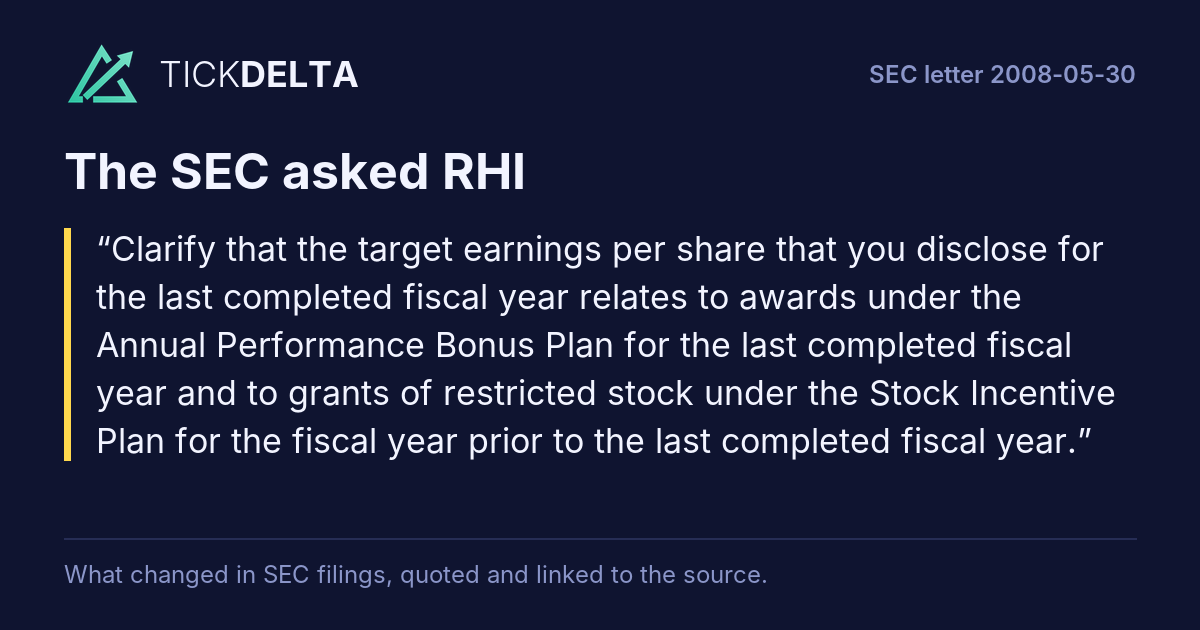
In correspondence with you in May 2008 regarding your Form 10-K for the year ended December 31, 2007, we asked that you provide in future filings an explanation of how the factors considered by the compensation committee in determining compensation resulted in the amount and form of compensation awarded to each named executive officer. See comment three in our letter to you dated May 30, 2008.
Rest of the question

In this regard, we continue to believe that more analysis is needed in your compensation discussion and analysis section related to this issue. Therefore, please amend your Form 10-K for the year ended December 31, 2008 to include a more thorough analysis of what factors the compensation committee considered and how its consideration of these factors resulted in the amount and form of compensation awarded to each named executive officer. For example: • Discuss how the compensation committee determined each named executive officer’s target bonus amount under the Annual Performance Bonus Plan. On page 8, you state that the compensation committee “set target earnings per share for purposes of the Annual Performance Bonus Plan such that the percentage by which actual earnings per share increased or decreased over the prior year would cause an identical percentage increase or decrease in the executive officer’s bonus relative to the prior year.” Please further illustrate how the $1.90 target earnings per share for 2008 and the amount of target bonus for the named executive officers reflect this policy. • Please explain how the compensation committee’s consideration of the factors listed in the fifth full paragraph on page 8 resulted in the amount of restricted shares granted to each named executive officer—which represented a increase in the amount of restricted shares granted in the prior year. • In addition, please discuss how the compensation committee applies the formulas under the Annual Performance Bonus Plan and Stock Incentive Plan to arrive at the actual amount of incentive compensation awarded to each named executive officer. For example, we note that your 2008 target earnings per share was $1.90 and that the actual earnings per share was $1.63. However, you do not provide analysis demonstrating how these numbers were used to calculate the bonus awards actually reported in your Summary Compensation Table. Further, with respect to restricted stock grants under the Stock Incentive Plan, while we note your description of the “multiplier” on page 13, more analysis is needed to explain how this multiplier was used to calculate the actual restricted stock retained by the named executive officers during the 2008 period. Your revised disclosure should discuss the actual number of restricted stock awards retained and the number of shares forfeited during the 2008 performance period and set forth how the compensation committee arrived at these numbers. See Instruction 2 to Item 402(b) of Regulation S-K.

RHI answered
1:

Factors Considered by the Compensation Committee in Determining Cash and Equity Awards

As discussed on page 7 and 8 of the

Proxy Statement, the Compensation Committee considers a number of factors when determining the amount and form of cash and equity compensation awarded to each named executive officer. Although the most important of these factors is the

Company’s performance, the Compensation Committee does not assign weights to individual factors.
Rest of the answer

Rather decisions are made using their business judgment based on the Compensation Committee’s long-term experience in compensating the management team in a manner that has been successful in producing favorable results for shareholders consistently. The factors considered in one year may not be representative of what may be considered in future years. Therefore, the Company believes the current disclosure is accurate and an amendment to the existing Form 10-K would not provide any material new information. However, the Company proposes to supplement the disclosure in its next proxy statement to reflect the above.

Annual Performance Bonus Plan

Executive officer bonuses are governed by the stockholder-approved Annual Performance Bonus Plan (the “Bonus Plan”). The Bonus Plan provides that bonuses shall be computed in accordance with a formula specified in the plan. The two factors determined by the Compensation Committee are the Target EPS for the year and each individual’s Target Bonus.

For 2008, the Compensation Committee chose for the Target EPS the internal forecast that had been adopted by the entire Board of Directors, which forecast was $1.90 per share. This Target EPS for 2008 represented a 4.97% increase over the actual earnings per share of $1.81 achieved for 2007. The Compensation Committee then determined that a 4.97% increase in earnings per share performance should result in a 4.97% increase in bonus. It therefore set each individual’s Target Bonus for 2008 at 4.97% more than his actual bonus for 2007.1

The sole exception to the foregoing was the Target Bonus for Michael C. Buckley, who was given a larger Target Bonus to reflect increased responsibilities.

The operation of the Bonus Plan is described on page 13 of the Proxy Statement. Because of the way the pay for performance formula operates, any variation in actual earnings per share from Target EPS would result in a corresponding variation in actual bonus from Target Bonus by the same percentage. Because actual earnings per share for 2008 was

$1.63, which is 85.8% of the Target EPS of $1.90, each executive officer’s 2008 actual bonus was 85.8% of his Target Bonus.

As noted on page 8 of the Proxy Statement, the Compensation Committee, at its February 2009 meeting, adopted the same proportional approach for 2009 cash bonuses under the Annual Performance Bonus Plan. In light of present economic conditions and reflecting the Compensation Committee’s pay for performance philosophy, it is currently anticipated that the Company’s earnings per share for 2009 will decrease very significantly from 2008. If such significant decrease occurs, then cash bonuses for

2009 will also then decrease significantly by the same proportional amount.

Equity Awards

For 2008, the Compensation Committee exercised its business judgment to grant to executive officers restricted stock with a fair market value on the date of grant (October 31, 2007) equal to the fair market value for the 2007 restricted stock awards as determined on the date of grant (November 1, 2006). Since the grant date fair market value was the same for both the 2007 and 2008 restricted stock awards, the number of shares granted for 2008 exceeded the number granted for 2007 based on a difference in the price of the Company’s stock.

However, and again consistent with the philosophy that the majority of compensation should be contingent on achieving outstanding results, the actual number of shares retained by executives depends on satisfaction of the performance condition of Target EPS for 2008 and satisfaction of the time-based vesting. As previously disclosed on page 13 of the Proxy Statement,

“Pursuant to the formula, the actual earnings per share are divided by the target earnings per share, yielding a “Performance Goal Ratio.” The “Multiplier” used to determine actual retention of restricted stock grants is defined as (a) 1, if the Performance Goal Ratio is equal to or exceeds 0.9, (b) 0, if the Performance Goal Ratio is less than 0, or (c) 0.1 plus the Performance Goal Ratio in all other cases. After the

Multiplier is determined, it is multiplied by each executive officer’s restricted stock grant to determine how many shares he may retain. Any shares in excess of this product are forfeited.”

For 2008, the Performance Goal Ratio was 0.858, which equals the actual earnings per share of $1.63 divided by the target earnings per share of $1.90. The Multiplier based on a Performance Goal Ratio of 0.858 is equal to 0.958 (0.1 plus the Performance Goal Ratio) resulting in retention and forfeiture of each executive officer’s restricted stock grant for 2008 as listed in the table below:

Name

Target Restricted

Stock Award

Multiplier

Shares Retained

Shares Forfeited

Harold M. Messmer, Jr.

244,515

0.958

234,220

10,295

M. Keith Waddell

166,986

159,955

7,031

Paul F. Gentzkow

119,276

114,254

5,022

Robert W. Glass

36,975

35,418

1,557

Michael C. Buckley

27,433

26,278

1,155

The percentage of shares of restricted stock forfeited was disclosed in footnote (d) of the

Outstanding Equity Awards table on page 15 of the Proxy Statement.

Amended Filing

Although the Company did not present the foregoing information in the format appearing above in the CD&A section, the Company believes that investors could easily have calculated such information by using the formula and discussion included on page 13 of the Proxy Statement, which was cross-referenced in the CD&A, and the data included in the CD&A and in the textual discussion accompanying the compensation tables (including the alternative compensation table appearing in the CD&A). For this reason, the Company does not believe that amending its existing disclosure would provide a meaningful benefit to investors and, therefore, respectfully requests that it be permitted to provide this additional analysis and tabular presentations in its next proxy statement rather than through an amendment to its Form 10-K for the year ended December 31, 2008.

Read in the reply
Definitive Proxy Statement filed on March 25, 2009 · Compensation Discussion and Analysis, page 6
SEC asked (2)
Please discuss why your executive officers agreed to adjust the vesting schedule of their last two restricted stock grants to delay a portion of the vesting.
RHI answered
2:

The requirement that the Summary Compensation Table reflect restricted stock awards using the FAS 123(R) expense rather than fair value on the date of grant created an anomaly that the Company’s Compensation Committee and the executive officers wished to address. While the fair value on the date of grant was essentially flat from 2006 through 2008 (see the alternative compensation table on page 11 of the Proxy Statement), the operation of FAS 123(R), without the vesting delay, would have made it appear in the Summary Compensation Table that there had been substantial increases in the
Rest of the answer

amount granted from year to year. By adjusting the vesting schedule so that 100% of the grant vests after four years, rather than 50% vesting after the first two years and the remaining 50% vesting after four years, the artificial, and potentially confusing, effects of FAS 123(R) were dampened. Notwithstanding the delayed vesting in the restricted stock awards, the amounts reported under the Stock Awards column in the Summary Compensation Table still increased significantly even though the fair value on the date of grant for the 2007 and 2008 grants were substantially identical. Reflecting fair value rather than FAS 123(R) expense (which will become the new disclosure standard if the change proposed by

Release No. 33-9052 becomes effective) was the main reason the Company elected to include an alternative compensation table in its CD&A analysis on page 11 of the Proxy Statement. If the reversion of the Summary Compensation Table to fair value on the date of grant occurs, the anomalous effects of FAS 123(R) will no longer be of concern.

Read in the reply
Definitive Proxy Statement filed on March 25, 2009 · Compensation Discussion and Analysis, page 6
SEC asked (3)
We note that approximately 4.2% of the restricted shares with respect to the 2008 performance period were forfeited. Please disclose the amount of dividends that each named executive officer received and will retain for the forfeited shares.
Rest of the question

* * * * As appropriate, please amend your filing and respond to these comments through correspondence over EDGAR within 10 business days or tell us when you will provide us with a response. Please furnish a letter that keys your response to our comment and provides any requested information. Detail letters greatly facilitate our review. Please understand that we may have additional comments after reviewing your response to our comment.

RHI answered
3:

In accordance with Item 402(c)(2)(ix), the Company disclosed in the footnotes to the Summary Compensation Table the total amount of dividends paid in 2008 on unvested restricted shares, including those paid on shares that were subsequently forfeited. The Company did not separately disclose the portion of this amount that was paid with respect to shares that were subsequently forfeited, because it was not aware of any rule requiring such separate disclosure.

Of the total dividends paid on restricted shares in 2008, the amount paid with respect to shares that were subsequently forfeited
Rest of the answer

was not material. The amount of dividends received and retained for the forfeited shares in 2008 for the named executive officers ranged from $624 for Mr. Buckley to $5,559 for

Mr. Messmer. Such dividends represented 0.04% or less of each individual’s total compensation as reported in the Summary Compensation Table.

As previously disclosed in the Proxy Statement, the Compensation Committee amended the Stock Incentive Plan in February 2009 to provide that, while the performance condition is pending, dividends will not be paid on a restricted share award. Instead, any such dividends shall accrue and be paid only after the final determination has been made as to whether or not the performance condition has been satisfied. If a portion of the award is forfeited, a like portion of the accrued dividends will also be forfeited.

Read in the reply
SEC asked
We note your response to comment one in our letter dated August 4, 2009 pertaining to your executive compensation disclosure. You state that decisions regarding executive compensation are made using the Compensation Committee’s business judgment, and that “factors considered in one year may not be representative of what may be considered in future years.” Please note you are expected to disclose to investors the
Rest of the question

reasons underlying the Committee’s decision to award last year’s compensation amounts, and in this regard, your executive compensation disclosure may need to be revised each year to reflect changes in how the Compensation Committee analyzed its list of factors. Therefore, please further revise your proposed disclosure to explain why the Compensation Committee chose to grant to executive officers restricted stock in 2008 with a fair market value equal to the fair market value for the 2007 restricted stock awards. Also, we are unable to agree with your request for disclosure in future filings because our August 4, 2009 comment letter was issued as a follow-up to our original comment letter to you dated May 30, 2008, which requested compliance in future filings. * * * * Please amend your Form 10-K and respond to our comment within 10 business days or tell us by that time when you will provide us with a response. Please furnish a letter that keys your response to our comment and provides any requested information. Detailed letters greatly facilitate our review. Please file your letter over EDGAR. Please understand that we may have additional comments after reviewing your response to our comment.

RHI answered
1:

As noted in the Compensation Discussion & Analysis, the Compensation Committee, when determining compensation for the coming year, considers a number of factors, including the value of the previous year’s grant, the number of shares granted the previous year, the price of the Company’s stock, the performance of the Company in the prior year, the target EPS the

Committee has set for the coming year, the levels of other compensation granted to the executive and the total compensation package for the executive.
Rest of the answer

The Compensation Discussion & Analysis also states that the most important factor is

Company performance. Also as noted in the Compensation Discussion & Analysis, the Compensation Committee has set base salaries at modest levels (which, in the case of the Chief Executive Officer and the Chief Financial Officer have not been increased since 1998) and ties incentive compensation directly to performance.

Attention: Larry Spirgel, Assistant Director

The restricted stock grants for 2008 were made by the Compensation Committee at its

October 31, 2007 meeting. At that time, when the Committee considered the factors discussed above, it noted that the Company’s earnings per share for the preceding nine months had grown approximately 10% compared to the same period for the prior year, and the Committee expected the Company to finish the year with this growth rate (which indeed happened). Based on this, and keeping in mind the Compensation Committee’s philosophy to pay superior remuneration for superior long term performance, the Committee determined to grant awards with the same dollar value for 2008 as it did for 2007.

Pursuant to your request, attached is draft of the changes to the CD&A disclosure that will appear in the amendment to the Company’s Form 10-K for the year ended December 31, 2008, marked to show the changes for your convenience. The Company will file the Form

10-K/A upon completion of the Staff’s review.

Read in the reply

Also in this review: closing letter, 2009-10-16

Form 10-K for the Fiscal Year Ended December 31, 2008

2009-03-18 to 2009-03-25 · 3 questions · 1 letter from the SEC, 1 from the company
Review closed 2009-03-25
RevenueSegmentsResults discussion (MD&A)Goodwill and impairmentCritical estimatesLiquidity and cashDebt
Operations, page 12 · Results of Operations for the Three Years Ended December 31, 2008, page 15
SEC asked (1)
We note that you have provided a discussion of your results of operations only on a consolidated basis. Management’s Discussion and Analysis should focus on each relevant reportable segment of business when it would be appropriate for an understanding of the business.
Rest of the question

One of the objectives of MD&A is to provide a narrative explanation of the company's financial statements that enables investors to see the company through the eyes of management. We note that reported revenue decreased in each of your reportable segments during the year ended December 31, 2008 as compared to the same period in 2007, and that reported revenue in the fourth of 2008 decreased approximately 19% from the same in 2007. On page 15, you indicate that the decrease in temporary and permanent staffing services was the result of weakening general macroeconomic conditions in the United States. We believe these disclosures are too general in nature and do not provide your investor with a complete picture of your enterprise by segment and as a whole. In this regard, for each period presented and for each of your reportable segments, revise to: • clearly disclose and quantify each material factor that contributed to the change in revenue and operating income, indicating the impact by geographic area; • provide insight into the underlying business drivers or conditions that contributed to these changes; • disclose the impact that the current weakened economy has had on your business and describe how and the extent to which it has or you expect it to have on your results of operations; and • describe any other known trends or uncertainties that have had or you expect may reasonably have a material impact on your operations and if you believe that these trends are indicative of future performance. For further guidance, please refer to Item 303 Regulation S-K and the Commission’s Interpretive Release on Management’s Discussion and Analysis of Financial Condition and Results of Operation on our website at: http://www.sec.gov/rules/interp/33-8350.htm.

RHI answered
1:

In response to the Staff’s comments, the Company intends to expand the Results of Operations discussion in future filings to provide more disclosure around the Company’s segments. Following is the expanded disclosure that the

Company would propose to include in future filings, based on the Results of Operations for the Three Years Ended December 31, 2008 disclosure on pages 15-16 of the Form 10-K for the year ended December 31, 2008:

Results of Operations—2008 versus 2007

Demand for the Company’s temporary and permanent staffing services and risk consulting and internal audit services
Rest of the answer

is largely dependent upon general economic and labor market conditions both domestically and abroad. Correspondingly, results of operations for 2008 were negatively impacted, particularly in the fourth quarter, by declining global economic conditions. Because of the inherent difficulty in predicting economic trends, and the absence of material long-term contracts in any of our business units, future demand for the Company’s services cannot be forecasted with certainty. We expect the Company’s results to continue to be negatively impacted by a relatively prolonged period of global economic contraction.

The Company’s temporary and permanent staffing services business has more than 370 offices in 42 states, the District of

Columbia and 20 foreign countries, while Protiviti has more than 60 offices in 23 states and 16 foreign countries.

Because fluctuations in foreign currency exchange rates have an impact on the Company’s results, the Company provides selected growth percentages below on a constant-currency basis. Constant-currency percentages are calculated using as-reported amounts which have been retranslated using the prior year’s foreign currency exchange rates.

Revenues. The Company’s revenues were $4.6 billion for the year ended December 31, 2008, remaining flat compared to $4.6 billion for the year ended December 31, 2007. Revenues from foreign operations represented 29% and 24% of total revenues for the years ended December 31, 2008 and

2007, respectively. The Company analyzes its revenues for three reportable segments: temporary and consultant staffing, permanent placement staffing and risk consulting and internal audit services. In 2008, revenues in the temporary and consultant staffing services division were flat compared to 2007, while revenues in both the permanent placement and risk consulting and internal audit services divisions were down compared to 2007. Contributing factors for each reportable segment are discussed below in further detail.

Temporary and consultant staffing services revenues were $3.6 billion for the year ended

December 31, 2008, remaining flat compared to revenues of $3.6 billion for the year ended December 31, 2007. On a constant-currency basis, temporary and consultant staffing services revenues decreased 1% for 2008 compared to 2007. In the latter part of 2008, demand for the Company’s temporary and consultant staffing services decreased significantly as global labor markets weakened along with general macroeconomic conditions. In the United States, 2008 revenues decreased 6% compared to 2007, driven primarily by an 18% decrease in the fourth quarter. The United States decrease was partially offset by the Company’s foreign operations, where 2008 constant currency revenues increased 14% compared to 2007 including a

4% increase in the fourth quarter.

Permanent placement revenues were $427 million for the year ended December 31, 2008, decreasing by 4% compared to revenues of $444 million for the year ended December 31, 2007. On a constant-currency basis, permanent placement revenues decreased 5% for 2008 compared to 2007. In the United States, 2008 revenues decreased 17% compared to 2007, driven primarily by a 41% decrease in the fourth quarter. Historically, demand for permanent placement services is even more sensitive to economic and labor market conditions than demand for temporary and consulting staffing services and this is expected to continue. The U.S. unemployment rate ended the year at 7.2% as of December 2008, its highest level since 1992. The United States decrease for the year ended December 31, 2008, was partially offset by the Company’s foreign operations, where 2008 constant currency revenues increased 17% compared to 2007 although constant currency revenues declined by 15% in the fourth quarter.

Risk consulting and internal audit services revenues were $547 million for the year ended December 31, 2008, decreasing by 1% compared to revenues of $552 million for the year ended December 31, 2007. On a constant-currency basis, risk consulting and internal audit services revenues decreased 2% for 2008 compared to 2007 due to a significant decline in revenues produced by compliance-related projects, mainly those tied to the Sarbanes-Oxley Act, a trend which may continue. In addition, the fourth quarter weakening in global macroeconomic conditions negatively impacted demand. In the United States, 2008 revenues decreased 6% compared to 2007, including a 23% decrease in the fourth quarter. The United States decrease was partially offset by the Company’s foreign operations, where 2008 constant currency revenues increased 7% compared to 2007 including a 4% increase in the fourth quarter.

Gross Margin. The Company’s gross margin dollars were $1.9 billion for the year ended December 31, 2008, decreasing by 3% from $2.0 billion for the year ended December 31, 2007. For 2008 compared to 2007, gross margin dollars for all three of the Company’s reportable segments decreased under difficult economic conditions. Gross margin dollars as a percentage of revenues also decreased for the Company’s temporary and consultant staffing services and risk consulting and internal audit services divisions on a year-over-year basis. Contributing factors for each reportable segment are discussed below in further detail.

Gross margin dollars from the Company’s temporary and consultant staffing services represent revenues less direct costs of services, which consist of payroll, payroll taxes and insurance costs for temporary employees, and reimbursable expenses. Gross margin dollars for the Company’s temporary and consultant staffing services division were $1.3 billion for the year ended December 31, 2008, decreasing by 2% compared to $1.4 billion for the year ended December 31, 2007. On a constant-currency basis, temporary and consultant staffing services gross margin dollars decreased 3% for 2008 compared to 2007. As a percentage of revenues, gross margin dollars for temporary and consultant staffing services were 36.7% in 2008, decreasing by 0.5% compared to 37.2% in 2007. This year-over year decrease was primarily the result of a decrease in temp-to-hire conversion revenues in 2008 compared to 2007.

Gross margin dollars from permanent placement staffing services represent revenues less reimbursable expenses. Gross margin dollars for the Company’s permanent placement staffing division were $427 million for the year ended December 31, 2008, decreasing by 4% compared to $444 million for the year ended December 31, 2007. On a constant-currency basis, permanent placement gross margin dollars decreased 5% for 2008 compared to 2007. Because reimbursable expenses for permanent placement staffing services are de minimis, the decrease in gross margin dollars is substantially explained by the decrease in revenues previously discussed.

Gross margin dollars for risk consulting and internal audit services represent revenues less direct costs of services, which consist primarily of professional staff payroll, payroll taxes, insurance costs and reimbursable expenses. Gross margin dollars for the

Company’s risk consulting and internal audit division were $155 million for the year ended December 31, 2008, decreasing by 11% compared to $175 million for the year ended December 31, 2007. On a constant-currency basis, risk consulting and internal audit gross margin dollars decreased 13% for 2008 compared to 2007. As a percentage of revenues, gross margin dollars for risk consulting and internal audit services were 28.3% in 2008, down from 31.6% in 2007. Because costs relative to revenues are generally higher in foreign operations than in the U.S., the gross margin percentage is unfavorably impacted as the mix of foreign activity increases. In 2008 risk consulting and internal audit services revenues from foreign operations increased to 30% compared to 27% in 2007, contributing most of the year-over-year margin decline.

Selling, General and

Administrative Expenses. The Company’s selling, general and administrative expenses were $1.5 billion for both the years ended December 31, 2008 and 2007. For 2008 compared to 2007, selling, general and administrative expenses decreased in the Company’s temporary and consultant staffing services and risk consulting and internal audit services divisions, and increased in the Company’s permanent placement staffing division. Selling, general and administrative expenses as a percentage of revenues were essentially flat in the Company’s temporary and consultant staffing services division, increased in the Company’s permanent placement staffing division and decreased in the Company’s internal audit and risk consulting services division, compared to 2007. Contributing factors for each reportable segment are discussed below in further detail.

Selling, general and administrative expenses for the Company’s temporary and consultant staffing services division were $983 million for the year ended December 31, 2008, virtually flat with the $986 million for the year ended December 31, 2007. As a percentage of revenues, selling, general and administrative expenses for temporary and consultant staffing services were 27.1% in 2008, essentially flat compared to 27.0% in 2007. For 2008 compared to

2007, increases as a percentage of revenues for administration costs, fixed overhead expenses and expenses related to doubtful accounts receivable were partially offset by decreases as a percentage of revenue for field compensation and advertising expenses. As revenues declined in the latter part of 2008 under difficult economic conditions, the Company enhanced its focus on cost alignment measures, resulting in an 11% decrease in selling, general and administrative expenses in the

Company’s temporary and consultant staffing services division in the fourth quarter of 2008 compared to the fourth quarter of 2007.

Selling, general and administrative expenses for the Company’s permanent placement staffing division were $367 million for the year ended December 31, 2008, increasing by 2% compared to $358 million for the year ended

December 31, 2007. As a percentage of revenues, selling, general and administrative expenses for permanent placement staffing services were 85.8% in 2008, up from 80.6% in 2007. For 2008 compared to 2007, increases as a percentage of revenues for field compensation, administration costs and fixed overhead expenses were the primary drivers of the year-over-year increase. As revenues declined in the latter part of 2008 under difficult economic conditions, the Company enhanced its focus on cost alignment measures, resulting in a 24% decrease in selling, general and administrative expenses in the Company’s permanent placement staffing division in the fourth quarter of 2008 compared to the fourth quarter of 2007.

Selling, general and administrative expenses for the Company’s risk consulting and internal audit services division were $147 million for the year ended December 31, 2008, decreasing by 4% compared to $154 million for the year ended December 31, 2007. As a percentage of revenues, selling, general and administrative expenses for risk consulting and internal audit services were 26.9% in 2008, down from 27.8% in 2007. For 2008 compared to 2007, decreases as a percentage of revenues for variable overhead and advertising expenses were partially offset by increases as a percentage of revenue for fixed overhead expenses and expenses related to doubtful accounts receivable. As revenues declined in the latter part of 2008 under difficult economic conditions, the Company enhanced its focus on cost alignment measures, resulting in a

17% decrease in selling, general and administrative expenses in the Company’s risk consulting and internal audit division in the fourth quarter of 2008 compared to the fourth quarter of 2007.

Operating Income. The Company’s total operating income was $417 million, or 9.1% of revenues, for the year ended December 31, 2008, decreasing by 13% compared to $480 million, or 10.3% of revenues, for the year ended December 31, 2007. For the Company’s temporary and consultant staffing services division, operating income was $349 million, or 9.6% of applicable revenues, decreasing by 6% compared to $373 million, or 10.2% of applicable revenues, in 2007. For the Company’s permanent placement staffing division, operating income was $60 million, or 14.1% of applicable revenues, decreasing by 30% compared to $86 million, or 19.4% of applicable revenues, in 2007. For the Company’s risk consulting and internal audit services division, operating income was $7 million or 1.3% of applicable revenues, decreasing by 65% compared to $21 million, or 3.8% of applicable revenues, in 2007.

Acquisitions. For acquisitions, the Company allocates the excess of cost over the fair market value of the net tangible assets first to identifiable intangible assets, if any, and then to goodwill. Identifiable intangible assets are amortized over their lives, typically ranging from two to five years. Goodwill is not amortized, but is tested at least annually for impairment. The Company completed its annual goodwill impairment analysis during each of the years ended December 31, 2008 and 2007, and determined that no adjustment to the carrying value of goodwill was required. Net intangible assets, consisting primarily of goodwill, represented 13% of total assets and 19% of total stockholders’ equity at December 31, 2008.

Interest income and expense. Interest income for the years ended December 31, 2008 and 2007, was $10.5 million and $17.2 million, respectively. Lower 2008 interest income was primarily due to lower interest rates. Interest expense for the years ended December 31, 2008 and 2007, was $5.3 million and $4.1 million, respectively.

Provision for income taxes. The provision for income taxes was 40% for both the years ended December 31, 2008 and 2007.

Results of Operations—2007 versus 2006

Demand for the Company’s temporary and permanent staffing services and risk consulting and internal audit services is largely dependent upon general economic and labor market conditions both domestically and abroad. Because of the inherent difficulty in predicting economic trends, and the absence of material long-term contracts in any of our business units, future demand for the Company’s services cannot be forecasted with certainty.

At

December 31, 2007, the Company’s temporary and permanent staffing services business had more than 360 offices in 42 states, the District of Columbia and 18 foreign countries, while Protiviti had 60 offices in 22 states and 14 foreign countries.

Because fluctuations in foreign currency exchange rates have an impact on the Company’s results, the Company provides selected growth percentages below on a constant-currency basis. Constant-currency percentages are calculated using as-reported amounts which have been retranslated using the prior year’s foreign currency exchange rates.

Revenues. The Company’s revenues were $4.6 billion for the year ended December 31, 2007, increasing by 16% compared to $4.0 billion for the year ended December 31, 2006. Revenues from foreign operations represented 24% and 21% for the years ended December 31, 2007 and 2006, respectively. The Company analyzes its revenues for three reportable segments: temporary and consultant staffing, permanent placement staffing and risk consulting and internal audit services. In 2007, revenues increased compared to 2006 for all three of the Company’s reportable segments. The most significant year-over-year increases were recognized in the Company’s temporary and permanent staffing services divisions, which increased 16% and 32%, respectively, compared to

2006. Contributing factors for each reportable segment are discussed below in further detail.

Temporary and consultant staffing services revenues were $3.6 billion for the year ended December 31, 2007, increasing by 16% compared to revenues of $3.1 billion for the year ended December 31, 2006. On a constant-currency basis, temporary and consultant staffing services revenues increased 14% for 2007 compared to 2006. In the United States, 2007 revenues increased 12% compared to 2006. In the Company’s foreign operations, 2007 constant currency revenues increased 24% compared to 2006.

Permanent placement revenues were $444 million for the year ended December 31, 2007, increasing by 32% compared to revenues of $336 million for the year ended December 31, 2006. On a constant-currency basis, permanent placement revenues increased 29% for 2007 compared to 2006. In 2007, the average U.S. unemployment rate remained flat at 4.6% compared to 2006, providing a sustained favorable growth environment for the Company’s permanent placement staffing division both domestically and abroad. In the United States, 2007 revenues increased 22% compared to 2006. In the Company’s foreign operations, 2007 constant currency revenues increased 46% compared to 2006.

Risk consulting and internal audit services revenues were $552 million for the year ended December 31, 2007, increasing by 2% compared to revenues of $543 million for the year ended December 31, 2006. On a constant-currency basis, risk consulting and internal audit services revenues were flat for 2007 compared to 2006. In the Company’s foreign operations, 2007 constant currency revenues increased 7% compared to 2006, highlighted by particularly strong growth in Asia. The foreign increase was partially offset in the United States, where 2007 revenues decreased 2% compared to 2006. There can be no assurances that there will be ongoing demand for risk consulting and internal audit services, or that future results can be reliably predicted by considering past trends or extrapolating past results.

Gross Margin. The Company’s gross margin dollars were $2.0 billion for the year ended December 31, 2007, increasing by 17% from $1.7 billion for the year ended December 31, 2006. For 2007 compared to 2006, gross margin dollars for the Company’s temporary and permanent staffing services divisions increased 17% and 32%, respectively. Gross margin dollars for the

Company’s risk consulting and internal audit services division decreased 12% on a year-over-year basis. Gross margin dollars as a percentage of revenues increased for the Company’s temporary and consultant staffing services division, and decreased for the Company’s risk consulting and internal audit services division, on a year-over-year basis. Contributing factors for each reportable segment are discussed below in further detail.

dollars from the Company’s temporary and consultant staffing services represent revenues less direct costs of services, which consist of payroll, payroll taxes and insurance costs for temporary employees, and reimbursable expenses. Gross margin dollars for the Company’s temporary and consultant staffing services division were $1.4 billion for the year ended December 31, 2007, increasing by 17% compared to $1.2 billion for the year ended December 31, 2006. On a constant-currency basis, temporary and consultant staffing services gross margin dollars increased 15% for 2007 compared to 2006. As a percentage of revenues, gross margin dollars for temporary and consultant staffing services were 37.2% in 2007, increasing by 0.2% compared to 37.0% in 2006.

Gross margin dollars from permanent placement staffing services represent revenues less reimbursable expenses. Gross margin dollars for the Company’s permanent placement staffing division were $444 million for the year ended December 31, 2007, increasing by 32% compared to $336 million for the year ended December 31,

2006. On a constant-currency basis, permanent placement gross margin dollars increased 29% for 2007 compared to 2006. Because reimbursable expenses for permanent placement staffing services are de minimis, the increase in gross margin dollars is substantially explained by the increase in revenues previously discussed.

Gross margin dollars for risk consulting and internal audit services represent revenues less direct costs of services, which consist primarily of professional staff payroll, payroll taxes, insurance costs and reimbursable expenses. Gross margin dollars for the Company’s risk consulting and internal audit division were $175 million for the year ended December 31, 2007, decreasing by 12% compared to $199 million for the year ended December 31, 2006. On a constant-currency basis, risk consulting and internal audit gross margin dollars decreased 13% for 2007 compared to 2006. As a percentage of revenues, gross margin dollars for risk consulting and internal audit services were 31.6% in 2007, down from 36.6% in 2007. Because costs relative to revenues are generally higher in foreign operations than in the U.S., the gross margin percentage is unfavorably impacted as the mix of foreign activity increases. In 2007, risk consulting and internal audit services revenues from foreign operations increased to 27% compared to 24% in 2006, contributing to the year-over-year margin decline. Also contributing to the year-over-year margin decline was decreased staff utilization.

Selling, General and Administrative Expenses. The Company’s selling, general and administrative expenses were $1.5 billion for the year ended December 31, 2007, increasing by 20% compared to $1.2 billion for the year ended

December 31, 2006. For 2007 compared to 2006, selling, general and administrative expense dollars and percentages of applicable revenue increased in all three of the Company’s reportable segments. Contributing factors for each reportable segment are discussed below in further detail.

Selling, general and administrative expenses for the Company’s temporary and consultant staffing services division were $986 million for the year ended December 31, 2007, increasing by 17% compared to $844 million for the year ended December 31, 2006. As a percentage of revenues, selling, general and administrative expenses for temporary and consultant staffing services were 27.0% in 2007, essentially flat compared to 26.9% in 2006. For 2007 compared to 2006, increases as a percentage of revenues in field compensation expenses and administration costs were partially offset by decreases as a percentage of revenues in fixed overhead, advertising and variable overhead expenses.

Selling, general and administrative expenses for the Company’s permanent placement staffing division were $358 million for the year ended December 31, 2007, increasing by 37% compared to $261 million for the year ended December 31, 2006. As a percentage of revenues, selling, general and administrative expenses for permanent placement staffing services were 80.6% in 2007, up from 77.8% in 2006. For 2007 compared to 2006, increases as a percentage of revenues for administration costs, field compensation expenses, fixed overhead expenses and advertising expenses were the primary drivers of the year-over-year increase.

Selling, general and administrative expenses for the Company’s risk consulting and internal audit services division were

$154 million for the year ended December 31, 2007, increasing by 11% compared to $138 million for the year ended December 31, 2006. As a percentage of revenues, selling, general and administrative expenses for risk consulting and internal audit services were 27.8% in 2007, up from 25.5% in 2006. For 2007 compared to 2006, increases as a percentage of revenue for administrative costs, fixed overhead expenses and variable overhead expenses were the primary drivers of the year-over-year

Operating Income. The Company’s total operating income was $480 million, or 10.3% of revenues, for the year ended

December 31, 2007, increasing by 7% compared to $450 million, or 11.2% of revenues, for the year ended December 31, 2006. For the Company’s temporary and consultant staffing services division, operating income was $372 million, or

10.2% of applicable revenues, increasing by 18% compared to $315 million, or 10.0% of applicable revenues, in 2006. For the Company’s permanent placement staffing division, operating income was $86 million, or 19.4% of applicable revenues, increasing by 15% compared to $75 million, or 22.2% of applicable revenues, in 2006. For the Company’s risk consulting and internal audit services division, operating income was $21 million or 3.8% of applicable revenues, decreasing by 66% compared to $61 million, or 11.2% of applicable revenues, in 2006.

Acquisitions. For acquisitions, the Company allocates the excess of cost over the fair market value of the net tangible assets first to identifiable intangible assets, if any, and then to goodwill. Identifiable intangible assets are amortized over their lives, typically ranging from two to five years. Goodwill is not amortized, but is tested at least annually for impairment. The Company completed its annual goodwill impairment analysis during each of the years ended December 31, 2007 and 2006, and determined that no adjustment to the carrying value of goodwill was required. Net intangible assets, consisting primarily of goodwill, represented 13% of total assets and 20% of total stockholders’ equity at December 31, 2007.

Interest income and expense. Interest income for the years ended December 31, 2007 and 2006, was $17.2 million and $19.3 million, respectively. Lower 2007 interest income resulted from lower average cash balances, partially offset by higher interest rates. Interest expense for the years ended December 31, 2007 and 2006, was $4.1 million and $2.5 million, respectively.

Provision for income taxes. The provision for income taxes was 40% for the year ended December 31, 2007, and 39% for the year ended December 31, 2006.
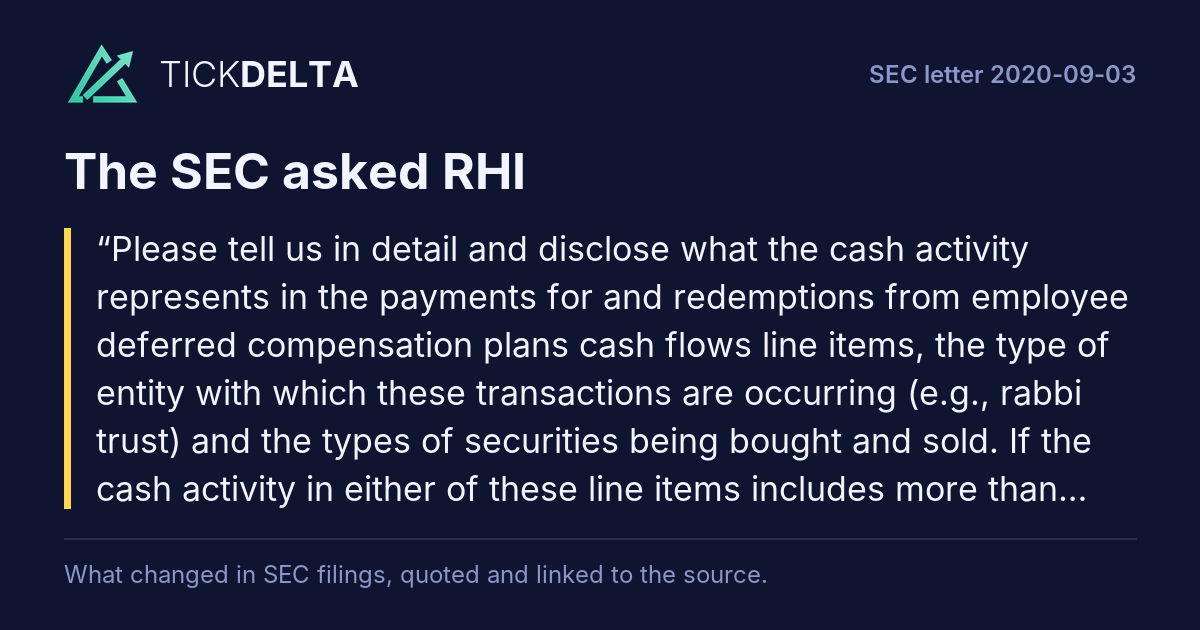
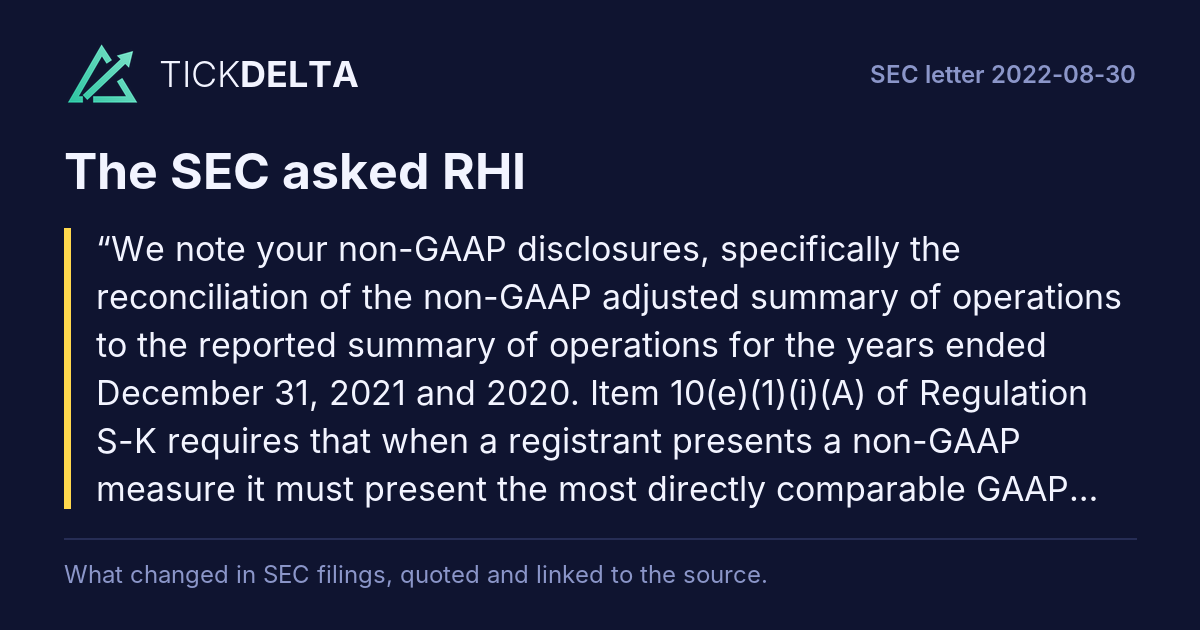
Read in the reply
In its next report

First report after the company's reply of Mar 24, 2009: 10-Q filed May 8, 2009 ↗, against the 10-Q filed Oct 31, 2008 ↗.

Tickdelta does not hold the text of both reports, so they are not compared here.

Critical Accounting Policies and Estimates, page 12
SEC asked (2)
We note that goodwill accounted for 13% of total assets as of December 31, 2008. We also note that revenues, operating income and segment income have declined in recent quarters due to the negative impact of the current economic environment. We note that you performed your annual goodwill impairment test in the second quarter of 2008 and concluded that goodwill was not impaired.
Rest of the question

Tell us whether you performed subsequent interim impairment tests. If you did not, tell us why, addressing the factors in paragraph 8 of SFAS 144. You should discuss in your critical accounting policies and estimates the factors you considered in determining why no interim impairment under SFAS 142 was required. In light of the significance of your goodwill balance, we expect robust and comprehensive disclosure in your critical accounting policies regarding your impairment testing policy. This disclosure should provide investors with sufficient information about management's insights and assumptions with regard to the recoverability of goodwill. Specifically, we believe you should provide the following information: • Provide a more detailed description of the steps you perform to review goodwill for recoverability. • Disclose a breakdown of your goodwill balance as of December 31, 2008 by reporting unit. • Describe the nature of the valuation techniques you employed in performing the impairment tests. Qualitatively and quantitatively describe the significant estimates and assumptions used in your valuation model to determine the fair value of your reporting units in your impairment analysis. For example, if you utilize the discounted cash flow approach, you should disclose at a minimum: 1) the discount rates for each reporting unit and how those discount rates were determined, 2) how cash flows were determined, including your assumed growth rates, period of assumed cash flows and determination of terminal value, and

RHI answered

No numbered answer found in the reply. Read the reply ↗

In its next report

First report after the company's reply of Mar 24, 2009: 10-Q filed May 8, 2009 ↗, against the 10-Q filed Oct 31, 2008 ↗.

Tickdelta does not hold the text of both reports, so they are not compared here.

Critical Accounting Policies and Estimates, page 12
SEC asked (3)
your consideration of any market risk premiums. • Describe changes to the assumptions and methodologies, if any, since your annual impairment test. In addition, tell us how the assumptions in your most recent test were impacted by the current economic environment.
Rest of the question

For example, you should explain in detail how your discount rates reflect the market risk premiums that have been noted in the current equity and debt markets. • Further, disclose any changes to your reporting units or allocations of goodwill by reporting unit and the reasons for such changes. • Provide a table showing: 1) the carrying value and the fair value of each reporting unit. Alternatively, if you do not disclose the fair value of each reporting unit, you should disclose its fair value if it does not exceed its carrying value by a significant amount; and 2) using hypothetical percentage reductions in fair value, disclose the percentage by which the fair value of a reporting unit would not exceed its carrying value. • In addition, if the fair value of any of your reporting units does not, or would not, exceed its carrying value by a significant amount, provide a sensitivity analysis of your most recent impairment test assumptions for this reporting unit based upon reasonably likely changes. For further guidance, refer to Release No. 33-8350 "Interpretation: Commission Guidance Regarding Management's Discussion and Analysis of Financial Condition and Results of Operations." * * * * Please respond to these comments through correspondence over EDGAR within 10 business days or tell us when you will provide us with a response. Please furnish a letter that keys your responses to our comments and provides any requested information. Detail letters greatly facilitate our review. Please understand that we may have additional comments after reviewing your responses to our comments.

RHI answered
2:

In response to the Staff’s comments, the Company intends to expand the Goodwill Impairment discussion in future filings to provide more disclosure around the

Company’s accounting for goodwill. Following is the expanded disclosure that the Company would propose to include in future filings, based on the Goodwill Impairment disclosure on page 13 of the Form 10-K for the year ended December 31, 2008:

Goodwill Impairment.
Rest of the answer

The Company assesses the impairment of goodwill annually in the second quarter, or more often if events or changes in circumstances indicate that the carrying value may not be recoverable in accordance with Statement of Financial Accounting Standards No. 142, Goodwill and Other Intangible Assets (SFAS 142). Due to the significant decline in global economic and labor market conditions during the fourth quarter of 2008, the Company updated its impairment assessment as of December 31, 2008.

SFAS 142 requires a two-step approach for determining goodwill impairment. In the first step the Company determines the fair value of each reporting unit utilizing a present value technique derived from a discounted cash flow methodology. For purposes of this assessment the Company’s reporting units are its lines of business. The fair value of the reporting unit is then compared to its carrying value. If the fair value of the reporting unit exceeds the carrying value of the net assets assigned to that unit, goodwill is not impaired and no further testing is performed. The second step under the provisions of SFAS 142 is contingent upon the results of the first step. To the extent a reporting unit’s carrying value exceeds its fair value, an indication exists that the reporting unit’s goodwill may be impaired and the Company must perform a second more detailed impairment assessment. The second impairment assessment involves allocating the reporting unit’s fair value to its net assets in order to determine the implied fair value of the reporting unit’s goodwill as of the assessment date. The implied fair value of the reporting unit’s goodwill is then compared to the carrying amount of goodwill to quantify an impairment charge as of the assessment date.

The Company’s reporting units are Accountemps, Robert Half Finance & Accounting, OfficeTeam, Robert Half Technology, Robert Half Management Resources and Protiviti, which had goodwill balances at December 31, 2008, of

$130.9 million, $26.3 million, $0.0 million, $6.9 million, $0.0 million and $23.4 million, respectively, totaling $187.5 million. There were no changes to the Company’s reporting units or to the allocations of goodwill by reporting unit in

2008.

The goodwill impairment assessment is based upon a discounted cash flow analysis. The estimate of future cash flows is based upon, among other things, a discount rate and certain assumptions about expected future operating performance. The discount rate for all reporting units was determined by management based on estimates of risk free interest rates, beta and market risk premiums. The discount rate used was compared to the rate published in various third party research reports, which indicated that the rate was within a range of reasonableness. The primary assumptions related to future operating performance include revenue growth rates and profitability levels. In addition, the impairment assessment requires that management make certain judgments in allocating shared assets and liabilities to the balance sheets of the reporting units. Solely for purposes of establishing inputs for the fair value calculations described above related to goodwill impairment testing, the Company made the following assumptions. The Company assumed that the current economic downturn would continue for all reporting units through 2010, followed by a recovery period in 2011 and 2012, using unique assumptions for each reporting unit. In addition, the Company applied profitability assumptions consistent with the each reporting unit’s historical trends at various revenue levels and, for years beyond 2012, used a 5% growth factor to calculate the terminal value at the end of ten years for each unit. This rate is 1% lower than the rate used in the prior year, and is significantly lower than the Company’s historical ten-year annual compound revenue growth rate. In its most recent calculation, the Company used a 10.9% discount rate, which is lower than the 12.5% discount rate used in the prior year, primarily due a reduction in risk free market rates, which more than offset an increase in market risk premiums.

In order to evaluate the sensitivity of the fair value calculations on the goodwill impairment test, the Company applied hypothetical decreases to the fair values of each reporting unit. The Company determined that hypothetical decreases in fair value of at least 41% would be required before any reporting unit would have a carrying value in excess of its fair value.

Given the current economic environment and the uncertainties regarding the impact on the Company’s business, there can be no assurance that the

Company’s estimates and assumptions regarding the duration of the ongoing economic downturn, or the period or strength of recovery, made for purposes of the Company’s goodwill impairment testing as of December 31, 2008, will prove to be accurate predictions of the future. If the Company’s assumptions regarding forecasted revenue or profitability growth rates of certain reporting units are not achieved, the Company may be required to recognize goodwill impairment charges in future periods, whether in connection with the Company’s next annual impairment testing in the second quarter of 2009 or prior to that, if any such change constitutes a triggering event outside of the quarter from when the annual goodwill impairment test is performed. It is not possible at this time to determine if any such future impairment charge would result or, if it does, whether such charge would be material.

Read in the reply
In its next report

First report after the company's reply of Mar 24, 2009: 10-Q filed May 8, 2009 ↗, against the 10-Q filed Oct 31, 2008 ↗.

Tickdelta does not hold the text of both reports, so they are not compared here.

Also in this review: closing letter, 2009-03-25

Form 10-K for the Year ended December 31, 2007

2008-05-30 to 2008-07-28 · 5 questions · 1 letter from the SEC, 1 from the company
Review closed 2008-07-28
Executive pay
Definitive Proxy Statement Incorporated By Reference Into Part III of Form 10-K · Compensation Discussion and Analysis, page 6
SEC asked (1)
Clarify that the target earnings per share that you disclose for the last completed fiscal year relates to awards under the Annual Performance Bonus Plan for the last completed fiscal year and to grants of restricted stock under the Stock Incentive Plan for the fiscal year prior to the last completed fiscal year.
RHI answered
1:

The target earnings per share set for the 2007 year was the performance criterion used for both the restricted stock grants made on November 1, 2006, and the Annual Performance Bonus Plan incentive awards for the 2007 year.
Read in the reply
In its next report

First report after the company's reply of Jul 11, 2008: 10-Q filed Jul 31, 2008 ↗, against the 10-Q filed May 9, 2008 ↗.

Tickdelta does not hold the text of both reports, so they are not compared here.

Definitive Proxy Statement Incorporated By Reference Into Part III of Form 10-K · Compensation Discussion and Analysis, page 6
SEC asked (2)
Please explain why you make restricted stock grants to your named executive officers in October, but set the performance target for the restricted stock in February of the next fiscal year.
RHI answered
2:

To balance its workload, the Compensation Committee has historically followed the practice of making restricted stock grants at its last regular meeting of the year. As noted above, the performance period for these grants is the calendar year immediately following the date of grant. The Compensation Committee waited until February 2007 to set the performance targets for the grants it made at the end of 2006 because it wanted to have final financial results for

2006 before it set 2007 targets.
Rest of the answer

The setting of performance targets in February 2007 was within the requirements of Section 162(m) of the Internal Revenue Code. Similarly,

Securities and Exchange Commission

Page with respect to the restricted stock grants made in the fall of 2007, the Compensation Committee waited until February 2008, when full audited results were available for 2007, before setting the performance targets for 2008.

Read in the reply
In its next report

First report after the company's reply of Jul 11, 2008: 10-Q filed Jul 31, 2008 ↗, against the 10-Q filed May 9, 2008 ↗.

Tickdelta does not hold the text of both reports, so they are not compared here.

Definitive Proxy Statement Incorporated By Reference Into Part III of Form 10-K · Compensation Discussion and Analysis, page 6
SEC asked (3)
Discuss more specifically the factors the compensation committee considers in determining compensation and explain how its consideration of these factors resulted in the amount and form of compensation awarded to each named executive officer. Analyze how each compensation elements is calculated and how the actual amounts awarded fit into the overall objectives and policies for each category of compensation.
Rest of the question

For example, provide more detail relating to the committee’s practice, referenced on page eight, of making awards under the Stock Incentive Plan and Annual Performance Bonus Plan in order to keep the current management team together. Explain how the committee considers such awards in the context of each individual’s total compensation and the conditions applicable to such awards. Discuss the reasons for aiming to keep the current management team together and how such an objective may impact individual executive performance, as opposed to group performance. As another example, discuss what factors the compensation committee considers in determining each named executive officer’s target bonus amount under the Annual Performance Bonus Plan and the amount of restricted stock granted under the Stock Incentive Plan. Explain how the committee applies the formulas under the Annual Performance Bonus Plan and Stock Incentive Plan to the earnings per share result achieved to arrive at the amount of incentive compensation awarded to each named executive officer.

RHI answered
3:

The factors the

Compensation Committee considers in determining the amount and form of each named executive officer’s salary and targets for the forthcoming year are Company and individual performance and retention. The Compensation Committee believes that base salaries, target bonuses and long-term incentives are set at levels necessary to retain each individual named executive officer and to incent strong company performance. Last year, based on individual performance, the Compensation Committee increased the base salary of one of the named executive officers.
Rest of the answer

In addition, based on a promotion, the Compensation Committee increased the base salary and target bonus of another named executive officer. The Compensation Committee believes that the ratio of total compensation between the named executive officers is appropriate for purposes of internal equity. In terms of how each element is calculated, base salaries are set at levels the Compensation Committee views as modest. The

Compensation Committee heavily weights total compensation towards performance with long-term incentives generally comprising more than 50% of each named executive officer’s total target compensation.

The most important factor considered by the Compensation Committee in deciding what adjustments to make in compensation for 2005 through 2007 was the

Company’s stellar performance for those years. (The Company achieved all-time records in revenues, net income and earnings per share in 2005. It set new all-time records in 2006. In 2007, it set all-time records in these areas for the third consecutive year.) The Compensation Committee views all-time records in revenues, net income and earnings per share as a positive result that reflects favorably upon management. Three straight years of ever increasing record results is one reason why the Compensation Committee wishes to retain present management. The use of the word “team” in the Proxy Statement was meant to be a collective term for present management, and not meant to imply any “team” compensation philosophy. The Compensation Committee does not compensate the named executive officers as a team but considers it important to retain the individual named executive officers by offering effective pay packages with appropriate incentives because as a management team, they have provided outstanding results for shareholders.

While the Compensation

Committee exercises discretion in setting base salaries and targets for the forthcoming year, once targets are set the Compensation Committee exercises very little discretion with respect to cash bonuses and restricted stock awards. Formulas specified in the plans pursuant to which these awards are made determine the final amount that is actually paid or retained, and the Compensation Committee’s sole discretion is to reduce the final amount of the cash bonus subject to certain limitations set forth in the Annual Performance Bonus Plan.

With respect to cash bonuses under the Annual Performance Bonus Plan, please note the following text on page 11 of the Proxy Statement:

“The target bonus amount is set by the Compensation Committee, which also adopts a target diluted earnings per share. Under the [Annual Performance Bonus Plan], each individual’s actual bonus will vary from his target bonus in direct proportion to the variation between the actual diluted earnings per share and the target diluted earnings per share. However, no bonus can exceed the lesser of twice the target bonus or $9,000,000, and no bonus at all is paid if actual diluted earnings per share are less than 50% of target. The Compensation Committee has the discretion to reduce any bonus that would otherwise exceed the target to an amount not less than the target, but has no discretion to increase any bonus above the amount that would be determined by the formula.”

Target bonuses are generally set in proportion to the earnings per share target and to the extent there is a percentage increase in the earnings per share target from the prior year, the target bonus will likewise increase. The formula for determining actual cash bonuses is a linear percentage formula. If, for example, actual earnings per share are 80% of target earnings per share, then each named executive officer would receive 80% of his target bonus. (As stated above, the linear percentage formula is subject to the limitation that no bonus may exceed the lesser of twice the target bonus or $9,000,000 and no bonus at all is paid if actual earnings per share are less than 50% of target earnings per share.) The formula is set forth in the text of the Annual Performance Bonus Plan, which has been filed by the Company with the Commission as an exhibit to the appropriate forms. In

2007, the actual earnings per share were below the target earnings per share, so each named executive officers received only 92% of his target bonus.

With respect to the restricted stock grants pursuant to the Stock Incentive Plan, the formula is also set forth in the text of the plan. (The plan has been filed by the Company with the Commission as an exhibit to the appropriate forms and was included as an Appendix to the Proxy Statement because stockholders were asked at the May 2008 meeting to approve the continuation of the plan for three additional years.) Pursuant to the formula, the actual earnings per share are divided by the target earnings per share, yielding a “Performance Goal Ratio.” The Multiplier used to determine actual retention of restricted stock grants is defined as (a) 1, if the Performance Goal Ratio is equal to or exceeds .9, (b) 0 if the Performance Goal Ratio is less than 0 or (c) 0.1 plus the Performance Goal Ratio in all other cases. After the Multiplier is determined, it is then multiplied by each executive officer’s restricted stock grant to determine how many shares he may retain. Any shares in excess of this product are forfeited. As indicated on page 11 of the Proxy Statement, if actual earnings per share exceed the target, there is no increase in the number of shares granted or retained. The initial grant is the maximum that can be received, and only downward adjustments can be made pursuant to the formula. In 2007, the Performance Goal Ratio exceeded .9, so each named executive officer retained his entire restricted stock grant.

Read in the reply
In its next report

First report after the company's reply of Jul 11, 2008: 10-Q filed Jul 31, 2008 ↗, against the 10-Q filed May 9, 2008 ↗.

Tickdelta does not hold the text of both reports, so they are not compared here.

Definitive Proxy Statement Incorporated By Reference Into Part III of Form 10-K · Compensation Discussion and Analysis, page 6
SEC asked (4)
We note your disclosure on page 11 that, with respect to the shares of restricted stock granted in 2007 under the Stock Incentive Plan, “[t]he 2008 earnings per share target is confidential.” In future filings, please disclose the performance target and threshold level that must be reached to avoid forfeiture of all or a portion of the restricted stock granted under the Stock Incentive Plan in the last completed
Rest of the question

fiscal year. If you believe that disclosure of performance goal is not required because it would result in competitive harm such that you may omit this information under Instruction 4 to Item 402(b) of Regulation S-K, please provide in your response letter a detailed explanation of such conclusion. If you believe you have a sufficient basis to keep the information confidential, disclose in future filings how difficult it would be for the executive or how likely it would be for you or a business unit to achieve the undisclosed performance goal. Note that general statements regarding the level of difficulty or ease associated with achieving the goals are not sufficient. In discussing how difficult it will be for an executive or how likely it will be for you or a business unit to achieve the performance goals, provide as much detail as necessary without providing information that would result in competitive harm.

RHI answered
4:

The timing of the setting of yearly compensation components may have created some confusion. The compensation that was set for each individual by the Compensation Committee with respect to 2007 consisted of base salary, bonus and restricted stock. The restricted stock component of this 2007 compensation was granted at the last regular Compensation Committee meeting of 2006. The base salary component, the bonus component, and the performance target that applied to both the bonus and the restricted stock were all set at the first regular Compensation Committee meeting in 2007.
Rest of the answer

Please see our answers to Questions 1 and 2, above. The performance standard for both the restricted stock and the bonus was earnings per share for 2007, which was disclosed in the proxy statement. The restricted stock grant that was made by the Compensation Committee in late 2007 was considered by it to be part of the 2008 compensation package, not part of the 2007 compensation package. Therefore, the 2008 performance standard for the restricted stock is neither related to nor in any way material to an understanding of 2007 compensation.

The compensation components for 2008 were constructed in a similar fashion to the components for 2007. The restricted stock component was granted at the last regular Compensation Committee meeting of 2007 and the base salary and bonus components, along with the performance target that applies to both the bonus and the restricted stock, were all set at the first regular Compensation Committee meeting in 2008. The performance target for these components of 2008 compensation will be disclosed in the 2009 proxy statement.

We also believe that requiring disclosure of the target earnings per share for the forthcoming year in a proxy statement that is issued less than three months after the year has started is essentially requiring us to give a public projection of earnings per share for the year, with all of the associated issues. The Company does not believe it should be required to make such a public “projection.” In addition, such a projection would result in competitive harm by allowing our competitors to model our business for both market competition purposes and recruiting purposes. As stated on page 6 of the

Proxy Statement, we are a “personal services business in which there are few tangible assets and in which people represent the true ‘assets’ of the Company.” As the year progresses, competitors would be able to assess whether we are performing better or worse than our beginning of the year projections and use this information in attempting to recruit key personnel at all levels.

Read in the reply
In its next report

First report after the company's reply of Jul 11, 2008: 10-Q filed Jul 31, 2008 ↗, against the 10-Q filed May 9, 2008 ↗.

Tickdelta does not hold the text of both reports, so they are not compared here.

2007 Grants of Plan-Based Awards, page 11
SEC asked (5)
Your narrative disclosure on page 11 appears to indicate that there is a threshold payout under the Annual Performance Bonus Plan for reaching 50% of the earnings per share target. Your disclosure that “all or portion of the [Stock Incentive Plan] award will be forfeited if actual diluted earnings per share for 2008 do not equal or exceed a specified target that has been established by the Compensation Committee”
Rest of the question

also suggests that there is a threshold payout under your Stock Incentive Plan. Please include threshold amounts payable under your non-equity and equity incentive plans in the grants of plan-based awards table. See Instruction 2 to Regulation S-K Item 402(d). * * * * Please respond to these comments within 10 business days or tell us when you will provide us with a response. Please furnish a letter that keys your responses to our comments and provides any requested information. Detailed letters greatly facilitate our review. Please file your letter over EDGAR. Please understand that we may have additional comments after reviewing your responses to our comments.

RHI answered
5:

We may have misunderstood Instruction 2 to Item 402(d) of Regulation S-K. The term “threshold” is not defined in either Item 402, the proposing release or the adopting release. We interpreted it to mean the minimum amount payable under the plan. Because it is possible for there to be no payout whatsoever under the Annual Performance Bonus Plan and a forfeiture of all restricted shares granted under the Stock Incentive Plan, we viewed the threshold payout to be zero in both cases.
Rest of the answer

If we understand your question correctly, it appears that you view “threshold” as meaning the minimum payment that can be made in excess of zero. We will adjust our disclosure accordingly in future proxy statements. For your information, with respect to the table appearing in the 2008 Proxy Statement, the threshold amounts for cash payments under the Annual Performance Bonus

Plan is 50% of the target and the threshold amounts for stock grants under the Stock Incentive Plan is 10% of the “target”.

We have been authorized by the Company to inform you that the Company hereby acknowledges that:

• the Company is responsible for the adequacy and accuracy of the disclosure in its filings;

Staff comments or changes to disclosure in response to Staff comments do not foreclose the Commission from taking any action with respect to the filings; and the Company may not assert Staff comments as a defense in any proceeding initiated by the Commission or any person under the federal securities laws of the United

States.

Read in the reply
In its next report

First report after the company's reply of Jul 11, 2008: 10-Q filed Jul 31, 2008 ↗, against the 10-Q filed May 9, 2008 ↗.

Tickdelta does not hold the text of both reports, so they are not compared here.

Also in this review: closing letter, 2008-07-28

From the SEC's correspondence on EDGAR: staff letters (form UPLOAD) and company letters (form CORRESP), 26 letters filed since 2008-07-11. Questions and answers are matched by their numbers; topics come from words in each question. The reports are compared word for word (same form, before the first SEC letter against the first report after the company's reply). No AI.

Sources

The SEC's correspondence on EDGAR: staff letters (form UPLOAD) and company letters (form CORRESP), matched question by question. No AI.

Also

Filings: the letters in the filing list.

Work with it

Excel workbook · CSV. Google Sheet that stays up to date: paste =IMPORTDATA("https://tickdelta.com/company/RHI/export.csv") into a cell.

Next in Owners and insiders:Insider trades
Esc

Type a ticker such as AAPL, a name, an investor such as Buffett, or a topic such as tariffs. ↑ ↓ to move, Enter to open.