Robert Half Inc. RHI
New risk paragraphs, branching off last year
Each branch is a paragraph in Risk Factors with nothing like it in the 10-K filed Feb 13, 2025. A box jumps to the paragraph as filed, below.
Paragraphs with nothing like them in last year's 10-K
5 paragraphs in Risk Factors of the 10-K filed Feb 13, 2026 with nothing like them in the 10-K filed Feb 13, 2025. Quoted exactly. Paragraphs that were only edited are under 10-K change.
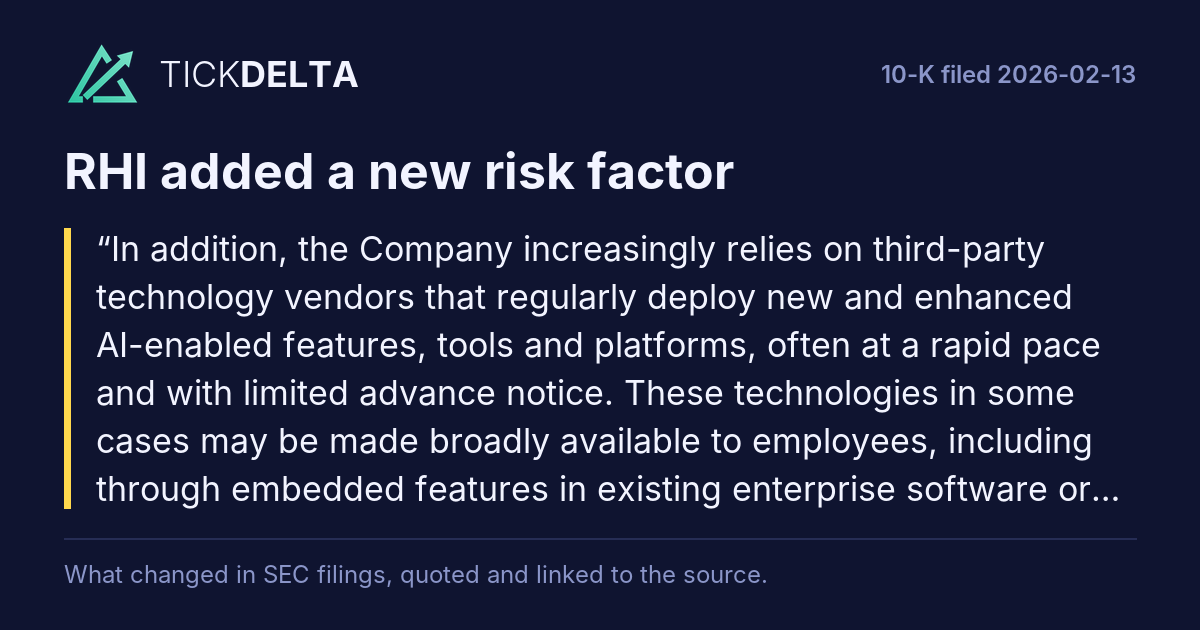
In addition, the Company increasingly relies on third-party technology vendors that regularly deploy new and enhanced AI-enabled features, tools and platforms, often at a rapid pace and with limited advance notice. These technologies in some cases may be made broadly available to employees, including through embedded features in existing enterprise software or low-code or no-code development environments that enable employees to build or customize AI-enabled tools. As a result, the Company may have limited ability to fully evaluate, test, restrict, monitor or govern the security, data handling practices, model behavior, or downstream uses of such AI technologies before or after deployment.
Governance, monitoring and security controls designed to manage the use of AI technologies, including controls related to data access, data retention, model training, prompt inputs and outputs, explainability, auditability and third-party risk management, are evolving and may not mature at the same pace as the deployment of new AI capabilities by vendors. This disparity may increase the risk of unauthorized or unintended use of AI, data leakage, regulatory non-compliance, intellectual property infringement, security vulnerabilities, or inconsistent application of Company policies. The Company may also incur additional costs and operational complexity through attempts to retrofit controls, implement safeguards, restrict access, or discontinue use of certain AI tools after deployment. Any failure to effectively manage these risks could adversely affect the Company’s business, results of operations, financial condition or reputation.
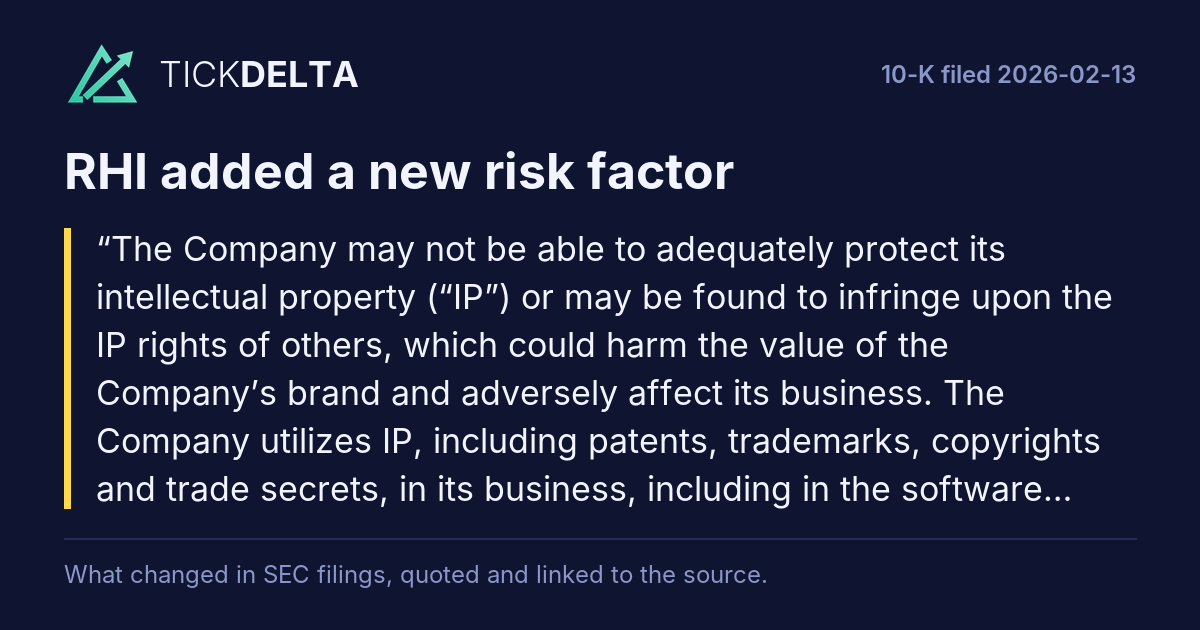
The Company may not be able to adequately protect its intellectual property (“IP”) or may be found to infringe upon the IP rights of others, which could harm the value of the Company’s brand and adversely affect its business. The Company utilizes IP, including patents, trademarks, copyrights and trade secrets, in its business, including in the software and AI the Company uses, and in its customer lists. A combination of patent, copyright, trademark and trade secret laws in the jurisdictions in which the Company operates are critical to protecting these IP rights. However, these laws may not be adequate to protect the Company’s IP from being challenged, invalidated, infringed, diluted or misappropriated. While the Company enters into confidentiality agreements with employees, consultants and partners, such agreements may not be effective in preventing unauthorized disclosure or use of its proprietary information. If such disclosures occur, the Company may not have adequate remedies.
Moreover, while it is the Company’s policy to protect and vigorously defend its IP rights, it cannot predict whether steps taken by it will be adequate to prevent misappropriation of these rights or the use by others of the Company’s IP. IP disputes and proceedings and infringement claims may result in a significant distraction for management and significant expense, which may not be recoverable regardless of whether the Company is successful. Such proceedings may be protracted with no certainty of success, and an adverse outcome could subject the Company to liabilities, force it to cease use of certain trademarks or other IP, or force it to enter into license agreements on terms which may not be favorable to the Company. Any one of these occurrences may have an adverse effect on the Company’s business, profitability, results of operation and financial condition.
The Company uses open-source software in connection with its software development, which could negatively affect its ability to operate its business and subject the Company to litigation or other actions. The Company uses and may continue to use open-source software in connection with the development and operation of its platforms. Open-source software is generally licensed under open-source licenses, which could subject the Company to unfavorable conditions, including requiring it to make publicly available the source code for any modifications or derivative works the Company develops using the open-source software. The Company may face claims demanding the release of software it developed that incorporates open-source software, which could include its source code, or otherwise seeking to enforce the terms of underlying license. Litigation could be costly for the Company to defend and could require it to devote additional research and development resources to change the Company’s platforms. Further, open-source licensors typically do not provide warranties or controls regarding the origin or security of the software and related support from the licensor is often unavailable. Therefore, the Company cannot be sure that the authors of the open-source software it uses will implement or offer updates to address security risks or will not abandon further development and maintenance. Many risks associated with usage of open-source software cannot be eliminated, and may, if not effectively addressed, negatively affect the Company’s operations, reputation and financial results.
Paragraphs in the 10-Q filed Oct 30, 2026 that were not in the one before
New in the latest 10-Q
1 paragraph in the 10-Q filed Oct 30, 2026 with nothing like it in the 10-Q filed Aug 4, 2026 (at least half the words must differ; new numbers alone do not count). Quoted exactly, grouped by the item heading above them. This is text that changed, not a judgement of how serious it is.
Financial statements and notes
The year-over-year increase in gross margin percentage was primarily due to increased conversions and improved pay-bill spreads.
Read in the 10-Q
The 10-Q's risk factors against the 10-K
Item 1A of the 10-Q filed Oct 30, 2026 against Item 1A of the 10-K filed Feb 13, 2026.
A 10-Q repeats only the risks that changed, so a 10-K paragraph that is missing from it is not counted as removed.
Added is a paragraph with nothing like it in the 10-K, Reworded a sentence that is in both with several words changed,
Quiet changes a sentence in both where one to four words changed and one is a hedge or a modal
(cut words struck through, new words highlighted).
Text on the page, not a score; each links to the filing at sec.gov.
What the 10-Q itself says about its risk factors:For a discussion of the Company’s potential risks and uncertainties, see the information under the heading “Risk Factors” in its Annual Report on Form 10-K for the year ended December 31, 2025 (the “Annual Report”).
Read in the 10-Q
1 paragraph in the 10-Q's Item 1A, and none of them adds, rewords or quietly edits a paragraph of the 10-K's.
Phrases used for the first time
Two-word phrases in Risk Factors of the 10-K filed Feb 13, 2026 that are in none of the 1 earlier 10-Ks stored, back to Feb 13, 2025
Where each one is used
- open-source software: The Company uses open-source software in connection with its software development, which could negatively affect its ability to operate its business and subject the Company to litigation or other actions. The Company uses and may continue to use open-source software in connection with the development and operation...
- safe harbor: In addition, changes in tax laws, treaties or regulations, or their interpretation or enforcement, have become more unpredictable and may become more stringent, which could materially adversely affect the Company’s tax position. A number of countries where the Company does business, including the U.S. and many...
- stakeholders lawmakers: Failure to meet evolving and increasingly contradictory expectations for action or inaction on sustainability and ESG commitments and initiatives could harm the Company’s reputation, or otherwise adversely impact the business, financial condition or results of operations. The Company has public sustainability and...
- facilitating allowing: The Company may incur potential liability to employees and clients. The Company’s contract talent solutions business entails employing individuals on a temporary basis and placing such individuals in clients’ workplaces. The Company’s ability to control the workplace environment is limited. As the employer of...
- stop cyberattacks: The Company may incur potential liability to employees and clients. The Company’s contract talent solutions business entails employing individuals on a temporary basis and placing such individuals in clients’ workplaces. The Company’s ability to control the workplace environment is limited. As the employer of...
- privacy security: The Company uses AI in its provision of services which may result in operational challenges, legal liability, reputational concerns, and privacy, security and competitive risks. The Company currently uses and intends to continue using its proprietary AI processes, algorithms and applications, as well as those of...
- property infringement: Use of generative AI in search operations and services offerings may be difficult to deploy successfully due to operational issues inherent to the nature of such technologies. AI algorithms use machine learning and predictive analytics, which may lead to flawed, biased, and inaccurate candidate and lead generation...
- dodd-frank act: The demand for the Company’s services related to regulatory compliance may decline. The operations of both the talent solutions business and Protiviti include services related to Sarbanes-Oxley, Anti-Money Laundering Act of 2020 reviews, the Bank Secrecy Act of 1970, as amended, and related anti-money laundering...
Used at least twice, small words left out. Counted, not picked: a phrase can be new because the company renamed something.
What was taken out
1 paragraph of last year's Risk Factors with nothing like them now. The longest are quoted.
Sources
Item 1A of each 10-K and 10-Q on EDGAR, quoted exactly. Each paragraph links to the filing at sec.gov.
Also
10-K change: what was reworded or cut, section by section.
Work with it
Excel workbook · CSV. Google Sheet that stays up to date: paste =IMPORTDATA("https://tickdelta.com/company/RHI/export.csv") into a cell.