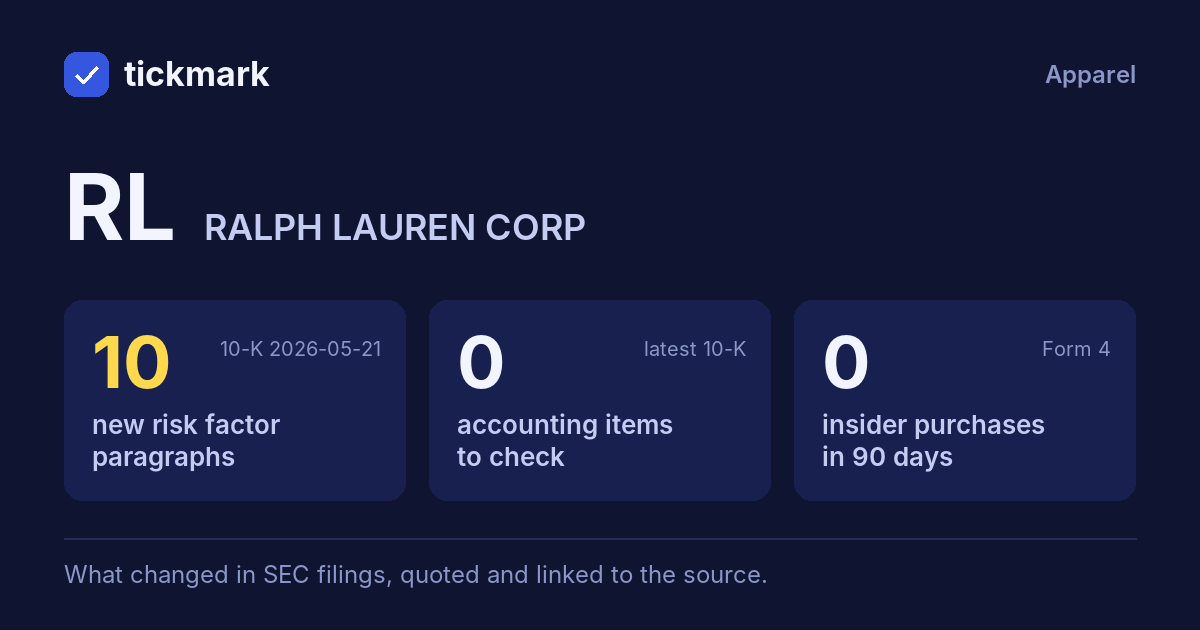
Sentences and paragraphs of RL's Risk Factors and MD&A, 10-K 2026-05-21 against 10-K 2025-05-22.
Each links to the text at sec.gov.
AddedRisk Factors
reduced retail traffic and the potential build-up of excess inventory as a result of store closures, other operational restrictions, and/or lower consumer demand; (iii) operational disruptions at our distribution centers and/or corporate facilities; (iv) potential declines in the level of consumer purchases of discretionary items; (v) our ability to attract, retain, and manage employees; (vi) the financial condition of our significant wholesale customers or licensing partners and their ability to meet obligations; (vii) our ability to successfully negotiate rent concessions and other relief with landlords; (viii) our ability to access capital markets and maintain compliance with debt covenants; and (ix) diversion of management attention and resources from ongoing business activities.
Read it in 10-K 2026-05-21 at sec.gov ↗
AddedRisk Factors
further development of "private labels" and exclusive product offerings in an effort to differentiate themselves from competitors, could have a material adverse effect on our business.
Read it in 10-K 2026-05-21 at sec.gov ↗
AddedRisk Factors
Our use and integration of artificial intelligence across our business presents risks and challenges that could adversely affect our business.
Read it in 10-K 2026-05-21 at sec.gov ↗
AddedRisk Factors
We are increasingly evaluating and deploying AI technologies, including generative AI and machine learning, across various aspects of our business. AI presents evolving risks that may be difficult to predict or mitigate. These risks include heightened data privacy, cybersecurity, and data protection risks, as the use of AI may involve processing sensitive data and, in some cases, sharing data with third-party providers. Such use may increase the risk of unauthorized access to, misuse, or disclosure of confidential information or personal data, introduce system vulnerabilities, and enable more sophisticated fraud and cyber-attacks. Any such event could result in operational disruptions, remediation costs, litigation, regulatory scrutiny, and reputational damage.
Read it in 10-K 2026-05-21 at sec.gov ↗
AddedRisk Factors
AI tools and systems may be unavailable, fail to perform as intended, or produce inaccurate or misleading outputs, and may be vulnerable to manipulation. When incorporated into our business processes, such risks could result in errors, inefficiencies, operational disruptions, or diminished customer experiences, and employees' use of AI tools may not always comply with our policies or controls. Further, we may rely on third-party AI technologies, cloud infrastructure, and data sets that could be subject to outages, security incidents, or changes in pricing or contractual terms, which may result in operational disruptions or the termination of our relationship with the providers of such technologies. AI-related activities also raise intellectual property, confidentiality, and content integrity risks, including potential claims that training data or outputs infringe third-party rights or that AI-generated content is inappropriate or inaccurate. Such risks could result in disputes, liability, regulatory inquiries, and reputational damage.
Read it in 10-K 2026-05-21 at sec.gov ↗
AddedRisk Factors
Our ability to successfully develop and deploy AI depends on attracting, developing, and retaining talent with AI-related skills and expertise. Competition for such talent is intense. If we are unable to build and maintain necessary AI capabilities, including such talent, we may not realize anticipated efficiencies or innovation benefits, or we may be competitively disadvantaged relative to peers that more effectively leverage AI. Conversely, investments in AI may not deliver expected returns, particularly in the near term, if adoption is limited or performance does not meet expectations.
Read it in 10-K 2026-05-21 at sec.gov ↗
AddedRisk Factors
The legal and regulatory environment governing AI is rapidly evolving. Emerging laws and regulations in jurisdictions where we operate may impose new obligations, limit the use of AI, or require changes to our products, processes, or controls. Compliance with such requirements could increase costs and expose us to investigations, enforcement actions, fines, or litigation.
Read it in 10-K 2026-05-21 at sec.gov ↗
AddedRisk Factors
Any perceived or actual failure to use AI responsibly, including with respect to fairness, bias, transparency, or governance, or to meet evolving stakeholder expectations, could harm our brand and reputation, reduce customer trust, negatively impact our workforce, and subject us to increased regulatory scrutiny or litigation, any of which could adversely affect our business, financial condition, and results of operations.
Read it in 10-K 2026-05-21 at sec.gov ↗
Show the other 9
AddedRisk Factors
Executive actions at the U.S. federal level and legislation in multiple U.S. states have sought to restrict or penalize corporate consideration of ESG factors, while jurisdictions in Europe and certain U.S. states have simultaneously expanded ESG-related mandates and disclosure requirements. This increasingly divergent regulatory environment creates operational complexity and legal risk, as actions taken to comply with or advance citizenship and sustainability objectives in one jurisdiction may expose us to criticism, regulatory scrutiny, or potential penalties in another, including limitations on our ability to do business. Any failure to effectively navigate these conflicting requirements, or the perception that we have insufficiently or excessively pursued such initiatives, could adversely affect our reputation, business, financial performance and growth.
Read it in 10-K 2026-05-21 at sec.gov ↗
AddedRisk Factors
We are involved in certain legal proceedings and regulatory matters and are subject from time to time to various claims involving alleged breach of contract claims, intellectual property and other related claims, escheatment and unclaimed property,
Read it in 10-K 2026-05-21 at sec.gov ↗
AddedMD&A
For discussion related to the results of operations and changes in our cash flows for Fiscal 2025 compared to Fiscal 2024, refer to Part II, Item 7. "Management's Discussion and Analysis of Financial Condition and Results of Operations" in our Fiscal 2025 Form 10-K.
Read it in 10-K 2026-05-21 at sec.gov ↗
AddedMD&A
periods and geographies the right to access our various trademarks in connection with the licensees' manufacture and sale of designated products, such as certain apparel categories, eyewear, fragrances, and home furnishings.
Read it in 10-K 2026-05-21 at sec.gov ↗
AddedMD&A
During Fiscal 2026, we continued to advance key workstreams under the NGT project including completion of global design templates that support our core enterprise resource planning platform and related processes, automating certain distribution center operations, and progressing the global roll-out of merchandise allocation and long-range demand planning tools.
Read it in 10-K 2026-05-21 at sec.gov ↗
AddedMD&A
During Fiscal 2026, we also recognized income of $24.2 million related to the settlements of credit card interchange fee litigation matters. We donated this income to The Ralph Lauren Corporate Foundation, which resulted in related offsetting donation expense of $24.2 million during Fiscal 2026.
Read it in 10-K 2026-05-21 at sec.gov ↗
AddedMD&A
related to a transaction entered into as part of a reorganization of our corporate entity structure, and the absence of state and local credits received in the prior fiscal year. See Note 9 to the accompanying consolidated financial statements.
Read it in 10-K 2026-05-21 at sec.gov ↗
AddedMD&A
•an unfavorable change in our non-current liability for unrecognized tax benefits, as detailed in Note 9 to the accompanying consolidated financial statements;
Read it in 10-K 2026-05-21 at sec.gov ↗
AddedMD&A
•an unfavorable change in income tax receivables and payables due to higher tax payments in connection with certain non-routine tax transactions and the higher level of pretax income, as well as the timing of tax payments; and
Read it in 10-K 2026-05-21 at sec.gov ↗