ROKRockwell Automation
Rockwell Automation, Inc. (Rockwell Automation or the Company) is the world’s largest company dedicated to industrial automation and digital transformation. 10-K, Item 1
- Headquarters
- Milwaukee, WI
- CEO
- Blake D. Moret
- Next results
- around Feb 4, 2027
7 paragraphs in Risk Factors of the 10-K filed Nov 12, 2025 with nothing like them in the 10-K filed Nov 12, 2024. Quoted exactly. Paragraphs that were only edited are under 10-K change.
Compared with the Risk Factors in the latest 10-K of the other 81 Industrials companies: a paragraph with at least half its words the same at another company is called similar, and the companies are listed under it. A paragraph most of them have is marked boilerplate. No line means no other company has one like it. This counts text; it does not say how serious a risk is.
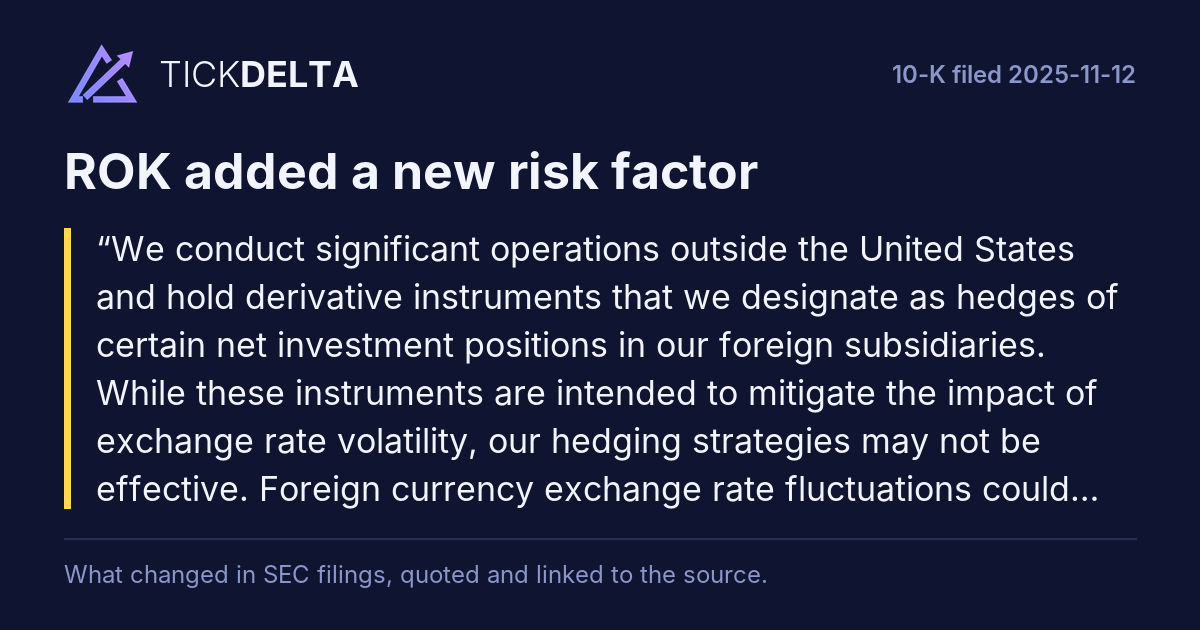
We conduct significant operations outside the United States and hold derivative instruments that we designate as hedges of certain net investment positions in our foreign subsidiaries. While these instruments are intended to mitigate the impact of exchange rate volatility, our hedging strategies may not be effective. Foreign currency exchange rate fluctuations could result in gains or losses on the derivative instruments that are not fully offset by corresponding changes in the value of our foreign net investments. In addition, the use of hedge accounting is subject to complex accounting requirements, and the inability to qualify for or maintain hedge accounting treatment could result in increased volatility in our reported earnings. Furthermore, counterparties to our derivative contracts could default on their obligations, exposing us to potential losses. Any of these events could adversely affect our financial condition, results of operations, and cash flows.
Our profitability and market competitiveness may be adversely impacted by changes in trade policies, including tariffs or other factors.
Similar paragraph at 1 of 81 other Industrials companies: PAYXChanges in trade policies, including the imposition of new tariffs or increases in existing tariffs between the United States, Mexico, Canada, China or other countries, or reactionary measures including retaliatory tariffs, legal challenges, or currency manipulation, could adversely affect our cost structure and profitability. If tariffs on imported materials, components, or finished goods increase, our manufacturing and supply chain costs may rise. Furthermore, changes to trade policies, retaliatory measures, or prolonged uncertainty in trade relationships could result in supply chain disruptions, delayed shipments, or increased operational complexity, adversely affecting our business and financial results. While we take steps to mitigate or avoid these increased costs and disruptions, our ability to do so may be limited by operational and supply chain constraints, especially in the short term. In addition, our ability to recover cost increases and maintain profitability levels through price adjustments may be limited by competitive pressures, customer acceptance, and contractual limitations.
Similar paragraph at 1 of 81 other Industrials companies: LHXRead in the 10-K ↗
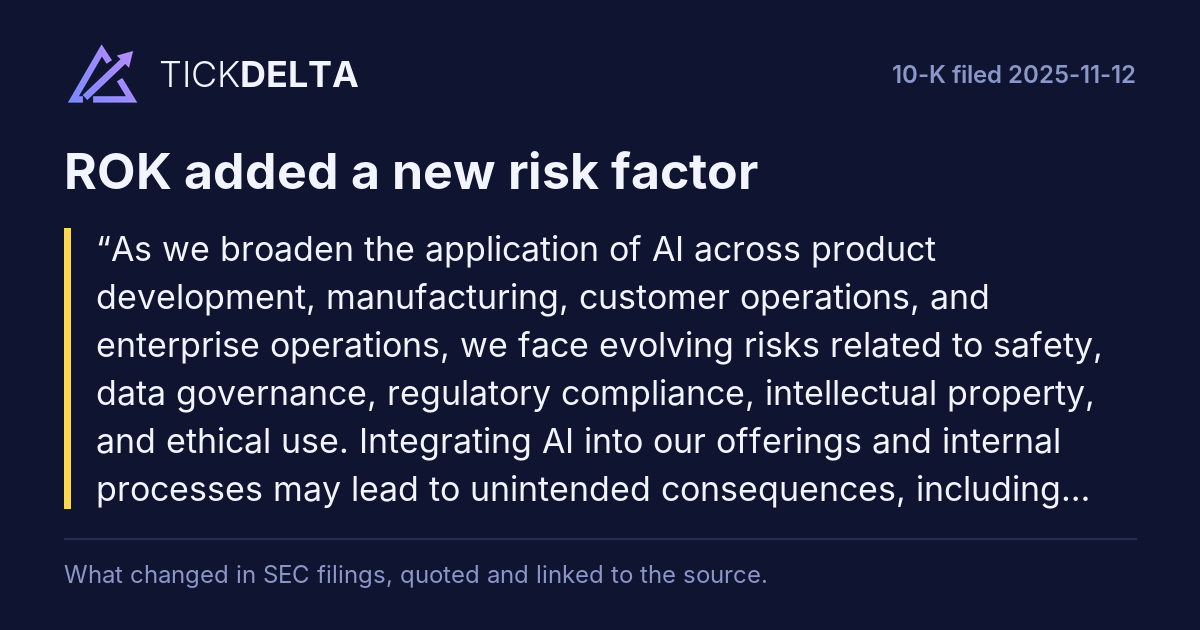
As we broaden the application of AI across product development, manufacturing, customer operations, and enterprise operations, we face evolving risks related to safety, data governance, regulatory compliance, intellectual property, and ethical use. Integrating AI into our offerings and internal processes may lead to unintended consequences, including biased outputs, inaccurate decision-making, and increased vulnerability to adversarial attacks, that could significantly impact our business, reputation, and financial results.
Read in the 10-K ↗
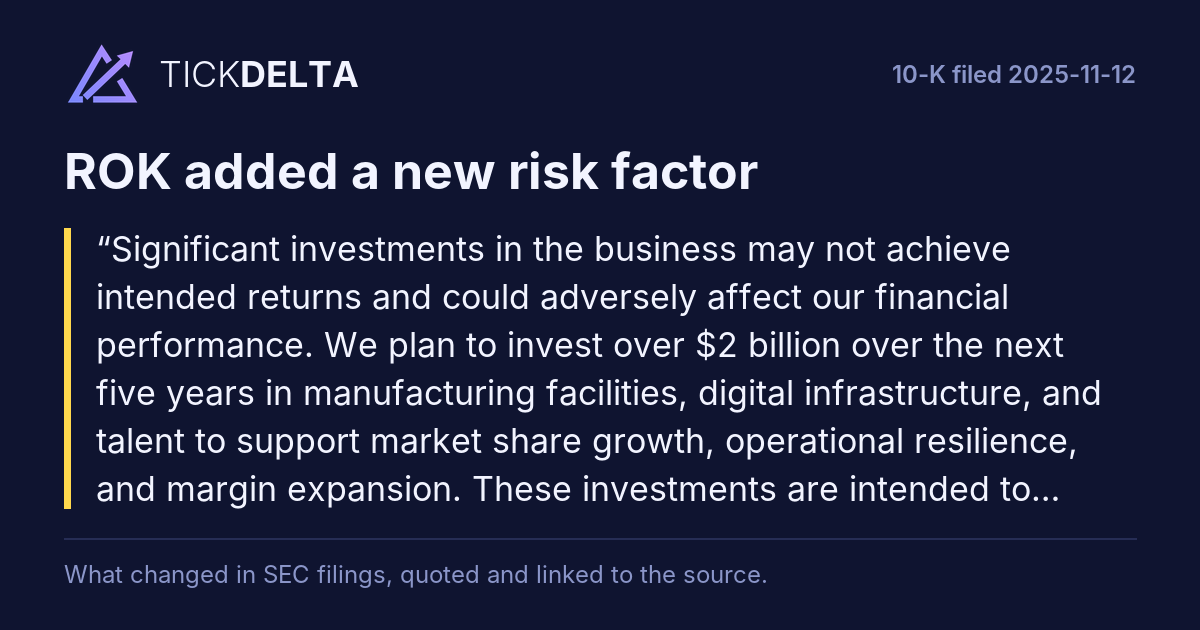
Significant investments in the business may not achieve intended returns and could adversely affect our financial performance.
We plan to invest over $2 billion over the next five years in manufacturing facilities, digital infrastructure, and talent to support market share growth, operational resilience, and margin expansion. These investments are intended to complement our productivity initiatives and enable long-term global growth. However, there is no assurance that these investments will yield the anticipated benefits. Risks include delays in implementation, cost overruns, supply chain disruptions, and challenges in integrating automation and technologies into our business and manufacturing operations. Additionally, if market conditions change or expected efficiencies do not materialize, the return on these investments may be lower than projected. Furthermore, due to global economic factors or company profitability targets, we may invest at a slower pace than planned, which could impact our ability to achieve desired outcomes. Failure to realize the expected outcomes could negatively impact our operating results and financial condition.
Read in the 10-K ↗
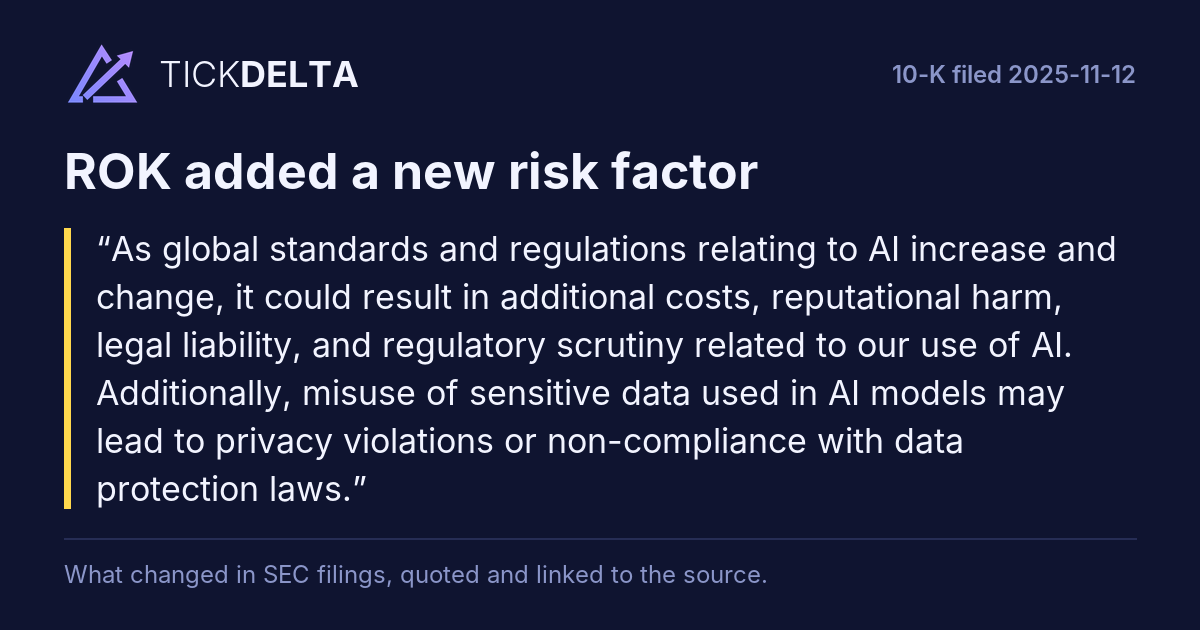
As global standards and regulations relating to AI increase and change, it could result in additional costs, reputational harm, legal liability, and regulatory scrutiny related to our use of AI. Additionally, misuse of sensitive data used in AI models may lead to privacy violations or non-compliance with data protection laws.
Read in the 10-K ↗
New in the latest 10-Q
3 paragraphs in the 10-Q filed Aug 4, 2026 with nothing like them in the 10-Q filed May 5, 2026 (at least half the words must differ; new numbers alone do not count). Quoted exactly, grouped by the item heading above them. This is text that changed, not a judgement of how serious it is.
Financial statements and notes
currency adjustments Receivables (51) (58) Inventories (49) 44 Accounts payable 47 1 Contract liabilities 41 65 Compensation and benefits (26) 87 Income taxes (92) (130) Other assets and liabilities 47 25 Cash provided by operating activities 1,278 1,090 Investing activities: Capital expenditures (179) (137) Purchases of investments (14) (13) Dissolution of Sensia, net of cash derecognized (7) — Other investing activities (5) (15) Cash used for investing activities (205) (165) Financing activities: Net issuance (repayment) of commercial paper 162 (398) Issuance of short-term debt 33 513 Issuance of long-term debt — 12 Repayment of short-term debt (70) — Repayment of long-term debt (62) (300) Cash dividends (464) (444) Purchases of treasury stock (754) (356) Proceeds from the exercise of stock options 93 78 Other financing activities — (9) Cash used for financing activities (1,062) (904) Effect of exchange rate changes on cash — 3 Increase in cash and cash equivalents 11 24 Cash and cash equivalents at beginning of period 468 471 Cash and cash equivalents at end of period $ 479 $ 495
Read in the 10-Q ↗
The dissolution of the Sensia joint venture was completed April 1, 2026. Upon the dissolution, the businesses contributed to the joint venture were distributed back to the respective joint venture partners at fair value and resulted in a $ 40 million cash payment from the joint venture partner to Rockwell. Additionally, a payment will be made to account for the proportional distribution of the book value of working capital assets distributed to each joint venture partner at closing. As a result of closing the transaction, we derecognized net assets of $ 94 million, primarily consisting of (i) cash and cash equivalents of $ 47 million, (ii) receivables of $ 60 million, (iii) inventories of $ 54 million, (iv) other intangible assets of $ 56 million, (v) short-term debt of $ 89 million, and (vi) contract liabilities of $ 20 million. We recognized a pre-tax gain on the dissolution of Sensia of $ 20 million, which was recorded in Other income in the Consolidated Statement of Operations. We incurred $ 2 million and $ 10 million of transaction costs during the three and nine months ended June 30, 2026, respectively, which were recorded in Selling, general and administrative expenses in the Consolidated Statement of Operations.
Read in the 10-Q ↗
June 30, 2026 September 30, 2025 ─────────────────────────────────────────────────────────────────────────────────────────────────────── Unrealized losses on foreign exchange contracts $ 18 $ 20 Product warranty obligations 21 23 Taxes other than income taxes 51 55 Legacy asbestos-related liabilities 34 34 Accrued interest 41 20 Dividends payable 154 — Income taxes payable 122 163 Operating lease liabilities 87 94 Other 92 96 Other current liabilities $ 620 $ 505
Read in the 10-Q ↗
The 10-Q's risk factors against the 10-K
Item 1A of the 10-Q filed Aug 4, 2026 against Item 1A of the 10-K filed Nov 12, 2025.
A 10-Q repeats only the risks that changed, so a 10-K paragraph that is missing from it is not counted as removed.
Added is a paragraph with nothing like it in the 10-K, Reworded a sentence that is in both with several words changed,
Quiet changes a sentence in both where one to four words changed and one is a hedge or a modal
(cut words struck through, new words highlighted and underlined).
Text on the page, not a score; each links to the filing at sec.gov.
What the 10-Q itself says about its risk factors:
Read in the 10-Q ↗
Information about our most significant risk factors is contained in Item 1A. Risk Factors, of our Annual Report on Form 10-K for the year ended September 30, 2025. We believe that at June 30, 2026, there has been no material change to this information, except as updated in our Quarterly Report on Form 10-Q filed May 5, 2026.
1 paragraph in the 10-Q's Item 1A, and none of them adds, rewords or quietly edits a paragraph of the 10-K's.
Work on ROK in a spreadsheet:
Excel workbook (a sheet per section, ten years by column, charts, links to the filings) ·
CSV.
For a Google Sheet that stays up to date, paste =IMPORTDATA("https://tickdelta.com/company/ROK/export.csv") into a cell.