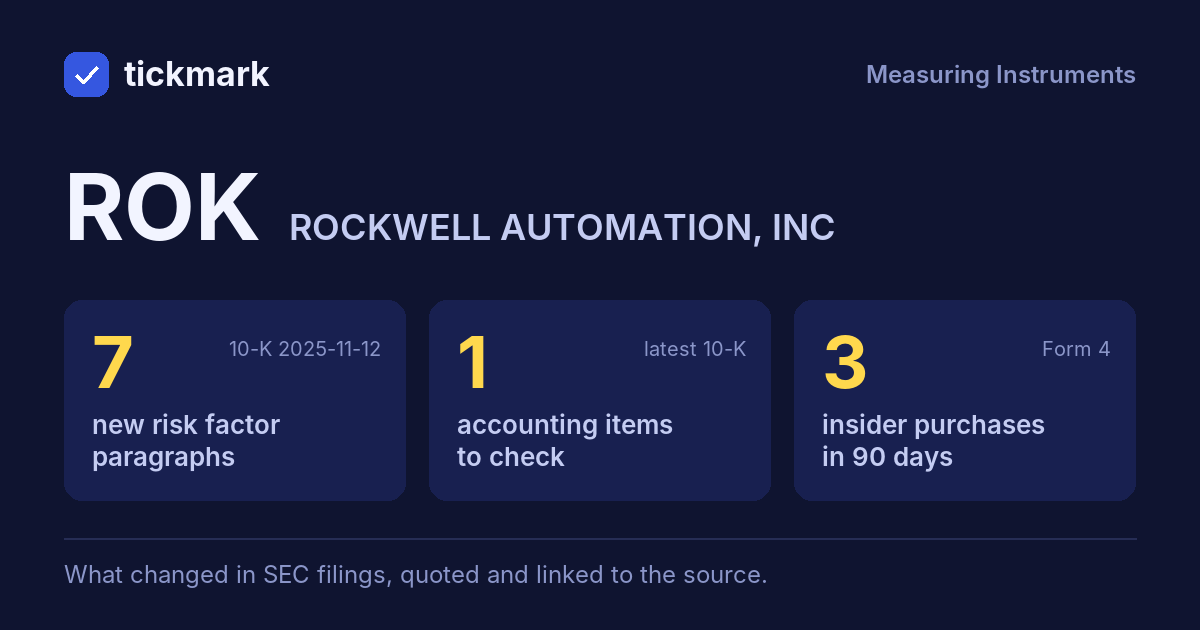
10-K 0001024478-25-000116 (2025-11-12) vs 10-K 0001024478-24-000107 (2024-11-12)
| Section | Compared text | Words now | Changed |
|---|
| Risk Factors | Item 1A | 4,888 |
10.0% |
| MD&A | Item 7 | 10,117 |
24.5% |
| Legal Proceedings | Item 3, via Note 17 – Commitments and Contingent Liabilities | 1,061 |
7.9% |
| Accounting Policies | Item 8, Note 1 – Basis of Presentation and Accounting Policies | 4,849 |
13.8% |
The redline: what was cut and what was added
In each section, the paragraph that changed most, marked against last year's 10-K:
cut words struck through, new words highlighted and underlined.
Accounting Policies 170 words changed in this paragraph; it is 56% similar to last year's version.
We record liabilities for asbestos and environmental and asbestos matters in the period in which our responsibility is probable and the costs can be reasonably estimated. We make changes to the liabilities in the periods in which the estimated costs of remediation or cost to defend and resolve claims change. At third-party environmental sites where more than one potentially responsible party has been identified, we record a liability for our estimated allocable share of costs related to our involvement with the site, as well as an estimated allocable share of costs related to the involvement of insolvent or unidentified parties. If we determine that recovery future recoveries from insurers or other third parties is are probable and a right of set off exists, we record the liability net of the estimated recovery. If we determine that recovery future recoveries from insurers or other third parties is are probable but a right of set off does not exist, we record a liability for the total estimated costs of remediation or resolution of the claims and a receivable for the estimated recovery. At Accruals for legacy asbestos and environmental sites where we matters are the sole responsible party, we record a liability for the total estimated costs of remediation. Ongoing operating and maintenance expenditures included in our environmental remediation obligations the Consolidated Balance Sheet in Other current liabilities and Other liabilities, and recoveries related to these matters when a right of set off does not exist are discounted to present value over the probable future remediation period. Our remaining environmental remediation obligations are undiscounted due to subjectivity of timing and/or amount of future cash payments. recorded in Receivables and Other assets.
Source: Item 8, Note 1 – Basis of Presentation and Accounting Policies, 10-K 0001024478-25-000116 vs Item 8, Note 1 – Basis of Presentation and Accounting Policies, 10-K 0001024478-24-000107
MD&A 161 words changed in this paragraph; it is 66% similar to last year's version.
Critical assumptions used in this approach included management’s estimated future revenue growth rates and Earnings Before Interest, Taxes, Depreciation, and Amortization (“EBITDA”) margins, and a discount rate, and a market multiple. rate. Estimated future revenue growth and EBITDA margins are based on management’s our best estimate about current and future conditions. The revenue growth rate assumption reflects above market growth over the next five years before moderating back to a growth rate approximating longer term average inflationary rates. The forecasted near-term growth rate projections take into account recent revenue performance and the orders order backlog. Margin assumptions reflect volume and volume, mix, productivity to offset cost inflation, and price used to fund investments. The estimates. These estimates and assumptions and estimates made are based on a number of factors, including historical experience, reference to external product available market and industry growth publications, and analysis of peer group projections, and information obtained from the management team, including backlog. projections. Actual results and forecasts of revenue growth and margins for our the Sensia reporting unit may be impacted by its concentration within the Oil & Gas industry and with its customer base. Demand for Sensia hardware and software products, solutions, and services is sensitive to industry volatility and risks, including those related to commodity prices, supply and demand dynamics, production costs, geological activity, and political activities. If such factors impact our ability to achieve forecasted revenue growth rates and margins, the fair value of the reporting unit could decrease, which may result in an impairment. We determined the discount rate using our a weighted average cost of capital adjusted for risk factors including risk associated with our above market revenue growth assumptions, historical performance, and industry-specific and economic factors. Also, industry-specific and economic factors that increase the discount rate or decrease the market multiple can decrease the fair value of the Sensia reporting unit, which may result in an impairment.
Source: Item 7, 10-K 0001024478-25-000116 vs Item 7, 10-K 0001024478-24-000107
Risk Factors 70 words changed in this paragraph; it is 82% similar to last year's version.
We face strong competition in all of our market segments in several significant respects. We compete based on breadth and scope of our hardware and software product portfolio and solution and service offerings, technology differentiation, the domain expertise of our employees and partners, product performance, quality of our hardware and software products, solutions, and services, knowledge of integrated systems and applications that address our customers’ business challenges, pricing, delivery, and customer service. The relative importance of these factors differs across the geographic markets and product areas that we serve and across our market segments. We seek strive to maintain stay competitive pricing levels across by continuously advancing technologies, including through the adoption and within geographic markets by continually developing advanced technologies integration of artificial intelligence (AI), for new hardware and software products products, product enhancements, and product enhancements and offering complete solutions for that address our customers’ business problems. challenges. If we fail to achieve our objectives, to keep pace with technological changes including the development of artificial intelligence and machine learning, or to provide high quality hardware and software products, solutions, and services, objectives we may lose business or experience price erosion and correspondingly lower sales and margins. We expect the level of competition to remain high in the future, which could limit our ability to maintain or increase our market share or profitability.
Source: Item 1A, 10-K 0001024478-25-000116 vs Item 1A, 10-K 0001024478-24-000107
Legal Proceedings 57 words changed in this paragraph; it is 78% similar to last year's version.
Additionally, we have maintained insurance coverage that includes indemnity and defense costs, over and above self-insured retentions, for many of these asbestos claims. We believe these arrangements will provide substantial coverage for future defense and indemnity costs for these asbestos claims for many years into the future. The uncertainties of asbestos claim litigation make it difficult to predict accurately the ultimate outcome of asbestos claims. outcome. That uncertainty is increased by the possibility of adverse rulings or new legislation affecting asbestos claim litigation or the settlement process. Subject to these uncertainties and based on our experience defending asbestos these claims, we do not believe these lawsuits will have a material effect on our business, financial condition, or results of operations. In the fourth quarter of 2025, we elected to change our method of accounting for net legacy asbestos-related defense costs from expensing as incurred to accruing for all future defense costs. See Note 1 for further information on this change.
Source: Item 3, via Note 17 – Commitments and Contingent Liabilities, 10-K 0001024478-25-000116 vs Item 3, via Note 17 – Commitments and Contingent Liabilities, 10-K 0001024478-24-000107
Every change, by type
Sentences and paragraphs of ROK's Risk Factors and MD&A, 10-K 2025-11-12 against 10-K 2024-11-12.
Each links to the text at sec.gov.
Quiet changes are sentences kept from last year with one to four words changed, at least one of them a hedge, a modal or a qualifier
(may, could, will, not, significant, material…). A year or date rolling forward is not counted.
The full word list
adverse, adversely, all, although, anticipate, anticipates, any, approximately, believe, believes, can, cannot, certain, could, expect, expects, generally, however, if, intend, intends, largely, likely, many, material, materially, may, might, most, must, never, no, not, possible, primarily, probable, should, significant, significantly, some, substantial, substantially, unlikely, will, would
AddedRisk Factors
We conduct significant operations outside the United States and hold derivative instruments that we designate as hedges of certain net investment positions in our foreign subsidiaries. While these instruments are intended to mitigate the impact of exchange rate volatility, our hedging strategies may not be effective. Foreign currency exchange rate fluctuations could result in gains or losses on the derivative instruments that are not fully offset by corresponding changes in the value of our foreign net investments. In addition, the use of hedge accounting is subject to complex accounting requirements, and the inability to qualify for or maintain hedge accounting treatment could result in increased volatility in our reported earnings. Furthermore, counterparties to our derivative contracts could default on their obligations, exposing us to potential losses. Any of these events could adversely affect our financial condition, results of operations, and cash flows.
Read it in 10-K 2025-11-12 at sec.gov ↗
AddedRisk Factors
Our profitability and market competitiveness may be adversely impacted by changes in trade policies, including tariffs or other factors.
Read it in 10-K 2025-11-12 at sec.gov ↗
AddedRisk Factors
Changes in trade policies, including the imposition of new tariffs or increases in existing tariffs between the United States, Mexico, Canada, China or other countries, or reactionary measures including retaliatory tariffs, legal challenges, or currency manipulation, could adversely affect our cost structure and profitability. If tariffs on imported materials, components, or finished goods increase, our manufacturing and supply chain costs may rise. Furthermore, changes to trade policies, retaliatory measures, or prolonged uncertainty in trade relationships could result in supply chain disruptions, delayed shipments, or increased operational complexity, adversely affecting our business and financial results. While we take steps to mitigate or avoid these increased costs and disruptions, our ability to do so may be limited by operational and supply chain constraints, especially in the short term. In addition, our ability to recover cost increases and maintain profitability levels through price adjustments may be limited by competitive pressures, customer acceptance, and contractual limitations.
Read it in 10-K 2025-11-12 at sec.gov ↗
AddedRisk Factors
As we broaden the application of AI across product development, manufacturing, customer operations, and enterprise operations, we face evolving risks related to safety, data governance, regulatory compliance, intellectual property, and ethical use. Integrating AI into our offerings and internal processes may lead to unintended consequences, including biased outputs, inaccurate decision-making, and increased vulnerability to adversarial attacks, that could significantly impact our business, reputation, and financial results.
Read it in 10-K 2025-11-12 at sec.gov ↗
AddedRisk Factors
Significant investments in the business may not achieve intended returns and could adversely affect our financial performance.
Read it in 10-K 2025-11-12 at sec.gov ↗
AddedRisk Factors
We plan to invest over $2 billion over the next five years in manufacturing facilities, digital infrastructure, and talent to support market share growth, operational resilience, and margin expansion. These investments are intended to complement our productivity initiatives and enable long-term global growth. However, there is no assurance that these investments will yield the anticipated benefits. Risks include delays in implementation, cost overruns, supply chain disruptions, and challenges in integrating automation and technologies into our business and manufacturing operations. Additionally, if market conditions change or expected efficiencies do not materialize, the return on these investments may be lower than projected. Furthermore, due to global economic factors or company profitability targets, we may invest at a slower pace than planned, which could impact our ability to achieve desired outcomes. Failure to realize the expected outcomes could negatively impact our operating results and financial condition.
Read it in 10-K 2025-11-12 at sec.gov ↗
AddedRisk Factors
As global standards and regulations relating to AI increase and change, it could result in additional costs, reputational harm, legal liability, and regulatory scrutiny related to our use of AI. Additionally, misuse of sensitive data used in AI models may lead to privacy violations or non-compliance with data protection laws.
Read it in 10-K 2025-11-12 at sec.gov ↗
RemovedRisk Factors
Potential liabilities and costs from litigation (including asbestos claims and environmental remediation) could reduce our profitability.
Read it in 10-K 2024-11-12 at sec.gov ↗
RemovedRisk Factors
(including asbestos claims) and the uncertainties related to the collection of insurance proceeds make it difficult to predict the ultimate resolution of these lawsuits.
Read it in 10-K 2024-11-12 at sec.gov ↗
RewordedRisk Factors
We seek strive to maintain stay competitive pricing levels across by continuously advancing technologies, including through the adoption and within geographic markets by continually developing advanced technologies integration of artificial intelligence (AI), for new hardware and software products products, product enhancements, and product enhancements and offering complete solutions for that address our customers’ business problems. challenges.
Read it in 10-K 2025-11-12 at sec.gov ↗
RewordedRisk Factors
If we fail to achieve our objectives, to keep pace with technological changes including the development of artificial intelligence and machine learning, or to provide high quality hardware and software products, solutions, and services, objectives we may lose business or experience price erosion and correspondingly lower sales and margins.
Read it in 10-K 2025-11-12 at sec.gov ↗
RewordedRisk Factors
The current cyber threat environment indicates increased risk for all companies, including those in industrial automation and information technology. technology, and the adoption of AI has resulted in more sophisticated attacks, increasing our risk exposure.
Read it in 10-K 2025-11-12 at sec.gov ↗
RewordedRisk Factors
We estimate the future asbestos litigation-related costs, including both future claim resolution costs and defense costs, that we expect to incur over the next several years. incur.
Read it in 10-K 2025-11-12 at sec.gov ↗
RewordedRisk Factors
Legislative Governmental actions and regulatory action, regulations, including those related to corporate income taxes, the environment, materials, products, certification, certification and labeling, trade policies, privacy, cybersecurity, AI, or climate change, may be taken in the jurisdictions where we operate that may affect our business activities or may otherwise increase our costs to do business.
Read it in 10-K 2025-11-12 at sec.gov ↗
RewordedRisk Factors
An inability to successfully execute cost productivity and margin expansion initiatives. initiatives could negatively impact our business and financial results.
Read it in 10-K 2025-11-12 at sec.gov ↗
RewordedRisk Factors
If we are not able to anticipate, identify, develop, and market products that respond to changes in customer preferences and emerging technological and broader industry trends, including the development adoption and integration of artificial intelligence and machine learning, AI, demand for our products could decline.
Read it in 10-K 2025-11-12 at sec.gov ↗
Quiet changesRisk Factors
The future success of our business depends on growth in our sales in all global markets.
Read it in 10-K 2025-11-12 at sec.gov ↗
AddedMD&A
(1) The September 2025 Manufacturing IP Index has not been published as of November 12, 2025. The Manufacturing IP Index was 100.3 for the month ended August 2025.
Read it in 10-K 2025-11-12 at sec.gov ↗
AddedMD&A
We continue to manage the impact of tariffs through actions including pricing and the use of alternative sources of materials and redundant manufacturing locations. Resiliency actions we took in recent years enable us to build certain high value product lines in more than one geographic location. In consideration of these mitigating actions, tariff costs are expected to be neutral to EPS in fiscal 2026.
Read it in 10-K 2025-11-12 at sec.gov ↗
AddedMD&A
(3) Legacy asbestos and environmental charges were previously included in Corporate and other. All periods have been recast to conform with current year presentation.
Read it in 10-K 2025-11-12 at sec.gov ↗
AddedMD&A
Purchase accounting depreciation and amortization, and impairment expense was $365 million in fiscal 2025 compared to $144 million in fiscal 2024. The increase was primarily due to a $224 million non-cash impairment charge related to the Sensia joint venture, or $110 million including the impact of non-controlling interest and tax effects.
Read it in 10-K 2025-11-12 at sec.gov ↗
AddedMD&A
In the fourth quarter of 2025, we elected to change our method of accounting for net legacy asbestos-related defense costs from expensing as incurred to accruing for all future defense costs for both known and unknown claims, similar to how we account for indemnity costs. We recorded pre-tax expense in Other (expense) income in the Consolidated Statement of Operations of $136 million in the fourth quarter of 2025 ($103 million after tax or $0.91 per share), which includes charges for a change in accounting method of $91 million and indemnity accrual increase of $45 million. See Notes 1 and 17 in the Consolidated Financial Statements for more information. Amounts were previously recorded in Corporate and other. All periods have been recast to conform with current year presentation.
Read it in 10-K 2025-11-12 at sec.gov ↗
AddedMD&A
In addition to BEPS Pillar Two, other items could also affect our effective tax rate, many of which are outside of our control,
Read it in 10-K 2025-11-12 at sec.gov ↗
AddedMD&A
•changes in the valuation of our deferred tax assets and liabilities, and in deferred tax valuation allowances;
Read it in 10-K 2025-11-12 at sec.gov ↗
AddedMD&A
•changes in the relative proportions of revenue and income before taxes in the various jurisdictions in which we operate that have differing statutory tax rates;
Read it in 10-K 2025-11-12 at sec.gov ↗
AddedMD&A
•changing tax laws, regulations, rates and interpretations in multiple jurisdictions in which we operate;
Read it in 10-K 2025-11-12 at sec.gov ↗
AddedMD&A
On July 4, 2025, the One Big Beautiful Bill Act (“OBBBA”) was enacted in the U.S. The OBBBA includes significant tax related provisions, such as the permanent extension of certain expiring provisions of the Tax Cuts and Jobs Act of 2017 (Tax Act), modifications to the international tax framework, and the restoration of favorable tax treatment for certain business provisions. The OBBBA has multiple effective dates with the earliest provisions taking effect in fiscal 2025 and others beginning in fiscal 2026 and beyond. ASC 740, “Income Taxes”, requires the effects of changes in tax rates and laws on deferred tax balances to be recognized in the period in which the legislation is enacted. We have reflected the impact in our deferred balances for the year ended September 30, 2025, and will monitor future effects as new guidance emerges. Based on our evaluation of the guidance available to date we believe the provisions will have an overall neutral impact.
Read it in 10-K 2025-11-12 at sec.gov ↗
AddedMD&A
In 2025, we updated the definition of our non-GAAP earnings measures to exclude net legacy asbestos and environmental charges. We believe the change to our definition provides a more useful presentation of our operating performance to investors as the charges are not reflective of our core operational performance and relate to products sold many years ago including products from divested businesses and environmental matters at previously owned properties. All previously reported amounts within this report have been recast to conform to this new definition. In the fourth quarter of 2025, we elected to change our method of accounting for net legacy asbestos-related defense costs from expensing as incurred to accruing for all future defense costs and a related receivable for insurance recoveries for both known and unknown claims, similar to how we account for indemnity costs. See Notes 1 and 17 for more information related to our legacy asbestos claims and environmental matters.
Read it in 10-K 2025-11-12 at sec.gov ↗
AddedMD&A
(4) Amounts reflect current estimates of net annual payments to resolve claims and will vary based on settlement rates and values, changes in state and national laws, defense strategies, and insurance recoveries.
Read it in 10-K 2025-11-12 at sec.gov ↗
RemovedMD&A
(2) Primarily relates to the change in fair value of our previous investment in PTC.
Read it in 10-K 2024-11-12 at sec.gov ↗
RemovedMD&A
(3) Restructuring charges include $92.3 million for severance benefits and $5.1 million for strategic advisory services related to the enterprise-wide severance actions.
Read it in 10-K 2024-11-12 at sec.gov ↗
RemovedMD&A
Total ARR is a key metric that enables measurement of progress in growing our recurring revenue business. It represents the annual contract value of all active recurring revenue contracts at any point in time. Recurring revenue is defined as a revenue stream that is contractual, typically for a period of 12 months or more, and has a high probability of renewal. The probability of renewal is based on historical renewal experience of the individual revenue streams, or management's best estimates if historical renewal experience is not available. Total ARR growth is calculated as the dollar change in ARR, adjusted to exclude the effects of currency, divided by ARR as of the prior period. The effects of currency translation are excluded by calculating Total ARR on a constant currency basis. Total ARR includes acquisitions even if there was no comparable ARR in the prior period. We believe that Total ARR provides useful information to investors because it reflects our recurring revenue performance period over period including the effect of acquisitions. Our measure of ARR may be different from measures used by other companies. Because ARR is based on annual contract value, it does not represent revenue recognized during a particular reporting period or revenue to be recognized in future reporting periods and is not intended to be a substitute for revenue, contract liabilities, or backlog.
Read it in 10-K 2024-11-12 at sec.gov ↗
RemovedMD&A
In July 2024, Standard & Poor’s downgraded our short-term rating from A-1 to A-2 and our long-term rating from A to A- and also changed our outlook from negative to stable. No changes were made to existing ratings by Moody’s or Fitch. The following is a summary of our credit ratings as of November 12, 2024:
Read it in 10-K 2024-11-12 at sec.gov ↗
RewordedMD&A
Year Ended September 30, 2025 2024 2023 2022 Net income attributable to Rockwell Automation $ 952.5 869 $ 1,387.4 953 $ 932.2 1,387 Non-operating pension and postretirement benefit cost (credit) cost (19.8) 82.7 4.7 1 (20) 83 Tax effect of non-operating pension and postretirement benefit cost (credit) cost 4.0 (20.6) (1.9) (1) 4 (21) Purchase accounting depreciation and amortization, and impairment attributable to Rockwell Automation (1) 132.8 178.3 91.9 249 133 178 Tax effect of purchase accounting depreciation and amortization, and impairment attributable to Rockwell Automation (1) (24.6) (9.4) (22.3) (38) (25) (9) Net legacy asbestos and environmental charges (2) 154 21 18 Tax effect of net legacy asbestos and environmental charges (2) (37) (5) (4) Change in fair value of investments (2) (0.1) (279.3) 136.9 3 — (279) Tax effect of change in fair value of investments (2) (0.7) 67.6 (30.8) (1) — 68 Restructuring charges (3) 97.4 — (5) 97 — Tax effect of restructuring charges (3) (24.3) — 1 (25) — Adjusted Income (2) $ 1,117.2 1,195 $ 1,406.7 1,133 $ 1,110.7 1,421 Diluted EPS $ 7.67 $ 8.28 $ 11.95 $ 7.97 Non-operating pension and postretirement benefit cost (credit) cost 0.01 (0.17) 0.72 0.04 Tax effect of non-operating pension and postretirement benefit cost (credit) cost (0.01) 0.03 (0.18) (0.02) Purchase accounting depreciation and amortization, and impairment attributable to Rockwell Automation 2.20 1.16 1.54 0.78 Tax effect of purchase accounting depreciation and amortization, and impairment attributable to Rockwell Automation (0.34) (0.22) (0.08) (0.19) Net legacy asbestos and environmental charges 1.36 0.18 0.16 Tax effect of net legacy asbestos and environmental charges (0.33) (0.04) (0.03) Change in fair value of investments (2) 0.02 — (2.42) 1.17 Tax effect of change in fair value of investments (2) (0.01) (0.01) 0.59 (0.26) Restructuring charges (0.05) 0.85 — — Tax effect of restructuring charges 0.01 (0.21) — — Adjusted EPS $ 9.71 10.53 $ 12.12 9.85 $ 9.49 12.25 Effective tax rate 18.3 % 13.8 % 20.5 % 14.4 % Tax effect of non-operating pension and postretirement benefit cost (credit) cost 0.1 % (0.1) % 0.3 % 0.1 % Tax effect of purchase accounting depreciation and amortization, and impairment attributable to Rockwell Automation (2.5) % 0.4 % (3.7) % 0.6 Tax effect of net legacy asbestos and environmental charges 1.1 % 0.2 % 0.1 % Tax effect of change in fair value of investments (2) 0.1 % 0.1 % (0.7) % 0.9 % Tax effect of restructuring charges — % 0.9 % — % — % Adjusted Effective Tax Rate 15.1 17.1 % 16.4 15.3 % 16.0 16.5 %
Read it in 10-K 2025-11-12 at sec.gov ↗
RewordedMD&A
(1) 2023 2025 includes $97.3 $110 million net expense from $157.5 a $224 million goodwill and intangible asset non-cash impairment charge included in Income before income taxes, ($7) million tax effect including related valuation allowances recorded in the Income tax provision, and ($107) million Net loss attributable to noncontrolling interests. 2023 includes $98 million net expense from a $158 million goodwill impairment charge included in Income before income taxes, $33.1 $33 million tax effect from goodwill impairment and including related valuation allowances recorded in the Income tax provision, and ($93.3) ($93) million Net loss attributable to noncontrolling interests.
Read it in 10-K 2025-11-12 at sec.gov ↗
RewordedMD&A
Year Ended September 30, 2025 2024 2023 2022 Purchase accounting depreciation and amortization, and impairment Intelligent Devices $ 37.9 37 $ 4.7 38 $ 2.5 5 Software & Control 67.4 68.5 69.0 66 68 69 Lifecycle Services 37.6 190.2 31.4 262 38 190 Non-operating pension and postretirement benefit (credit) cost Intelligent Devices $ (7.2) (2) $ 21.2 (7) $ (3.5) 21 Software & Control (7.2) 21.2 (3.5) (1) (7) 21 Lifecycle Services (9.5) 28.3 (4.8) (2) (10) 28 Restructuring Charges charges Intelligent Devices $ 44.4 (2) $ — 44 $ — Software & Control 32.6 — (2) 33 — Lifecycle Services 19.4 (1) 20 — —
Read it in 10-K 2025-11-12 at sec.gov ↗
RewordedMD&A
The year-over-year decreases increases in cash provided by operating activities and free cash flow were primarily due to lower pre-tax income, higher cost reduction and other margin expansion initiatives, no payout of incentive compensation payments in 2024 the first quarter of fiscal 2025 related to fiscal 2023 2024 performance, and higher lower tax payments, partially offset by decreases in working capital. a voluntary pre-tax contribution of $70 million to the company's U.S. pension plan.
Read it in 10-K 2025-11-12 at sec.gov ↗
RewordedMD&A
Year Ended Year Ended Year Ended September 30, 2025 September 30, 2024 September 30, 2023 September 30, 2023 2024 North America $ 5,052.8 (3)% (5)% 5,270 4% 4% Europe, Middle East and Africa 1,504.5 (20)% (21)% 1,488 (1)% (3)% Asia Pacific 1,072.8 (21)% (20)% 1,024 (5)% (4)% Latin America 634.1 5% 4% 560 (12)% (6)% Total Company Sales $ 8,264.2 (9)% (10)% 8,342 1% 1%
Read it in 10-K 2025-11-12 at sec.gov ↗
RewordedMD&A
Total segment operating earnings decreased increased to $1,595.3 $1,703 million from $1,929.8 $1,595 million in 2023, 2024, primarily due to lower productivity, higher sales volume driven by price realization, and unfavorable favorable mix, partially offset by lower incentive higher compensation and the positive impact of price realization exceeding input costs. unfavorable net currency.
Read it in 10-K 2025-11-12 at sec.gov ↗
RewordedMD&A
Segment operating margin decreased increased to 29.7 percent in 2025 from 24.2 percent in 2024 from 33.0 percent in 2023, 2024, primarily due to lower productivity, higher sales volume, partially offset by lower incentive compensation and the positive impact of price realization exceeding input costs. realization, partially offset by higher compensation.
Read it in 10-K 2025-11-12 at sec.gov ↗
RewordedMD&A
Segment operating margin decreased to 24.2 18.0 percent in 2024 2025 from 33.0 18.4 percent in 2023, 2024, primarily due to higher compensation, lower sales volume, and a prior year earnout accrual adjustment, partially offset by lower incentive compensation productivity and the positive impact of price realization exceeding input costs. realization.
Read it in 10-K 2025-11-12 at sec.gov ↗
RewordedMD&A
Purchase accounting depreciation and amortization, and impairment attributable to Rockwell Automation includes an a non-cash accounting charge related to goodwill and intangible asset impairment for our Sensia joint venture in the year ended September 30, 2023. 2025, and goodwill impairment for the year ended September 30, 2023, for the Sensia joint venture.
Read it in 10-K 2025-11-12 at sec.gov ↗
RewordedMD&A
The decrease increase in the adjusted effective tax rate was primarily due is related to valuation allowances and tax effects from the non-cash impairment charge for the Sensia joint venture and higher discrete tax benefits in 2024 as compared to 2023. 2025.
Read it in 10-K 2025-11-12 at sec.gov ↗
RewordedMD&A
The decrease increase in total segment operating margin was primarily due to lower productivity, higher sales volume driven by price realization, and unfavorable favorable mix, partially offset by lower incentive higher compensation and the benefits from cost reduction actions. unfavorable net currency.
Read it in 10-K 2025-11-12 at sec.gov ↗
RewordedMD&A
Adjusted Income, Adjusted EPS, and Adjusted Effective Tax Rate are non-GAAP earnings measures that exclude non-operating pension and postretirement benefit (credit) cost, cost (credit), purchase accounting depreciation and amortization, and impairment attributable to Rockwell Automation, net legacy asbestos and environmental charges, change in fair value of investments, and restructuring charges aligned with enterprise-wide strategic initiatives, and Net loss attributable to noncontrolling interests, including their respective tax effects. effects and related valuation allowances.
Read it in 10-K 2025-11-12 at sec.gov ↗