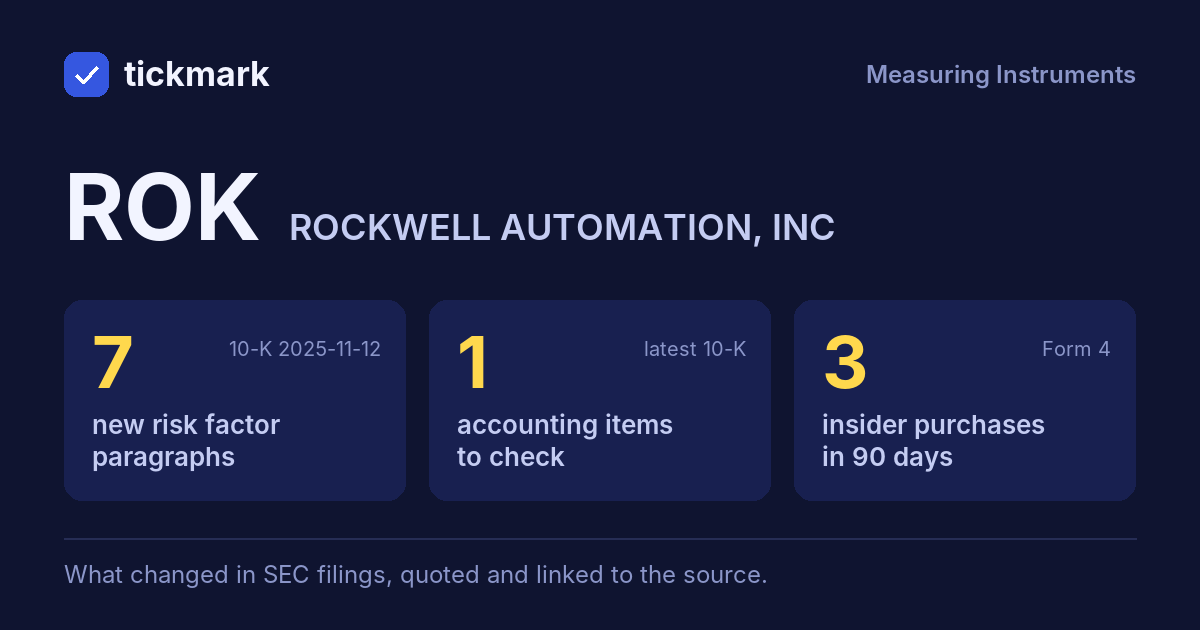
Sentences and paragraphs of ROK's Risk Factors and MD&A, 10-K 2025-11-12 against 10-K 2024-11-12.
Each links to the text at sec.gov.
AddedRisk Factors
We conduct significant operations outside the United States and hold derivative instruments that we designate as hedges of certain net investment positions in our foreign subsidiaries. While these instruments are intended to mitigate the impact of exchange rate volatility, our hedging strategies may not be effective. Foreign currency exchange rate fluctuations could result in gains or losses on the derivative instruments that are not fully offset by corresponding changes in the value of our foreign net investments. In addition, the use of hedge accounting is subject to complex accounting requirements, and the inability to qualify for or maintain hedge accounting treatment could result in increased volatility in our reported earnings. Furthermore, counterparties to our derivative contracts could default on their obligations, exposing us to potential losses. Any of these events could adversely affect our financial condition, results of operations, and cash flows.
Read it in 10-K 2025-11-12 at sec.gov ↗
AddedRisk Factors
Our profitability and market competitiveness may be adversely impacted by changes in trade policies, including tariffs or other factors.
Read it in 10-K 2025-11-12 at sec.gov ↗
AddedRisk Factors
Changes in trade policies, including the imposition of new tariffs or increases in existing tariffs between the United States, Mexico, Canada, China or other countries, or reactionary measures including retaliatory tariffs, legal challenges, or currency manipulation, could adversely affect our cost structure and profitability. If tariffs on imported materials, components, or finished goods increase, our manufacturing and supply chain costs may rise. Furthermore, changes to trade policies, retaliatory measures, or prolonged uncertainty in trade relationships could result in supply chain disruptions, delayed shipments, or increased operational complexity, adversely affecting our business and financial results. While we take steps to mitigate or avoid these increased costs and disruptions, our ability to do so may be limited by operational and supply chain constraints, especially in the short term. In addition, our ability to recover cost increases and maintain profitability levels through price adjustments may be limited by competitive pressures, customer acceptance, and contractual limitations.
Read it in 10-K 2025-11-12 at sec.gov ↗
AddedRisk Factors
As we broaden the application of AI across product development, manufacturing, customer operations, and enterprise operations, we face evolving risks related to safety, data governance, regulatory compliance, intellectual property, and ethical use. Integrating AI into our offerings and internal processes may lead to unintended consequences, including biased outputs, inaccurate decision-making, and increased vulnerability to adversarial attacks, that could significantly impact our business, reputation, and financial results.
Read it in 10-K 2025-11-12 at sec.gov ↗
AddedRisk Factors
Significant investments in the business may not achieve intended returns and could adversely affect our financial performance.
Read it in 10-K 2025-11-12 at sec.gov ↗
AddedRisk Factors
We plan to invest over $2 billion over the next five years in manufacturing facilities, digital infrastructure, and talent to support market share growth, operational resilience, and margin expansion. These investments are intended to complement our productivity initiatives and enable long-term global growth. However, there is no assurance that these investments will yield the anticipated benefits. Risks include delays in implementation, cost overruns, supply chain disruptions, and challenges in integrating automation and technologies into our business and manufacturing operations. Additionally, if market conditions change or expected efficiencies do not materialize, the return on these investments may be lower than projected. Furthermore, due to global economic factors or company profitability targets, we may invest at a slower pace than planned, which could impact our ability to achieve desired outcomes. Failure to realize the expected outcomes could negatively impact our operating results and financial condition.
Read it in 10-K 2025-11-12 at sec.gov ↗
AddedRisk Factors
As global standards and regulations relating to AI increase and change, it could result in additional costs, reputational harm, legal liability, and regulatory scrutiny related to our use of AI. Additionally, misuse of sensitive data used in AI models may lead to privacy violations or non-compliance with data protection laws.
Read it in 10-K 2025-11-12 at sec.gov ↗
AddedMD&A
(1) The September 2025 Manufacturing IP Index has not been published as of November 12, 2025. The Manufacturing IP Index was 100.3 for the month ended August 2025.
Read it in 10-K 2025-11-12 at sec.gov ↗
Show the other 11
AddedMD&A
We continue to manage the impact of tariffs through actions including pricing and the use of alternative sources of materials and redundant manufacturing locations. Resiliency actions we took in recent years enable us to build certain high value product lines in more than one geographic location. In consideration of these mitigating actions, tariff costs are expected to be neutral to EPS in fiscal 2026.
Read it in 10-K 2025-11-12 at sec.gov ↗
AddedMD&A
(3) Legacy asbestos and environmental charges were previously included in Corporate and other. All periods have been recast to conform with current year presentation.
Read it in 10-K 2025-11-12 at sec.gov ↗
AddedMD&A
Purchase accounting depreciation and amortization, and impairment expense was $365 million in fiscal 2025 compared to $144 million in fiscal 2024. The increase was primarily due to a $224 million non-cash impairment charge related to the Sensia joint venture, or $110 million including the impact of non-controlling interest and tax effects.
Read it in 10-K 2025-11-12 at sec.gov ↗
AddedMD&A
In the fourth quarter of 2025, we elected to change our method of accounting for net legacy asbestos-related defense costs from expensing as incurred to accruing for all future defense costs for both known and unknown claims, similar to how we account for indemnity costs. We recorded pre-tax expense in Other (expense) income in the Consolidated Statement of Operations of $136 million in the fourth quarter of 2025 ($103 million after tax or $0.91 per share), which includes charges for a change in accounting method of $91 million and indemnity accrual increase of $45 million. See Notes 1 and 17 in the Consolidated Financial Statements for more information. Amounts were previously recorded in Corporate and other. All periods have been recast to conform with current year presentation.
Read it in 10-K 2025-11-12 at sec.gov ↗
AddedMD&A
In addition to BEPS Pillar Two, other items could also affect our effective tax rate, many of which are outside of our control,
Read it in 10-K 2025-11-12 at sec.gov ↗
AddedMD&A
•changes in the valuation of our deferred tax assets and liabilities, and in deferred tax valuation allowances;
Read it in 10-K 2025-11-12 at sec.gov ↗
AddedMD&A
•changes in the relative proportions of revenue and income before taxes in the various jurisdictions in which we operate that have differing statutory tax rates;
Read it in 10-K 2025-11-12 at sec.gov ↗
AddedMD&A
•changing tax laws, regulations, rates and interpretations in multiple jurisdictions in which we operate;
Read it in 10-K 2025-11-12 at sec.gov ↗
AddedMD&A
On July 4, 2025, the One Big Beautiful Bill Act (“OBBBA”) was enacted in the U.S. The OBBBA includes significant tax related provisions, such as the permanent extension of certain expiring provisions of the Tax Cuts and Jobs Act of 2017 (Tax Act), modifications to the international tax framework, and the restoration of favorable tax treatment for certain business provisions. The OBBBA has multiple effective dates with the earliest provisions taking effect in fiscal 2025 and others beginning in fiscal 2026 and beyond. ASC 740, “Income Taxes”, requires the effects of changes in tax rates and laws on deferred tax balances to be recognized in the period in which the legislation is enacted. We have reflected the impact in our deferred balances for the year ended September 30, 2025, and will monitor future effects as new guidance emerges. Based on our evaluation of the guidance available to date we believe the provisions will have an overall neutral impact.
Read it in 10-K 2025-11-12 at sec.gov ↗
AddedMD&A
In 2025, we updated the definition of our non-GAAP earnings measures to exclude net legacy asbestos and environmental charges. We believe the change to our definition provides a more useful presentation of our operating performance to investors as the charges are not reflective of our core operational performance and relate to products sold many years ago including products from divested businesses and environmental matters at previously owned properties. All previously reported amounts within this report have been recast to conform to this new definition. In the fourth quarter of 2025, we elected to change our method of accounting for net legacy asbestos-related defense costs from expensing as incurred to accruing for all future defense costs and a related receivable for insurance recoveries for both known and unknown claims, similar to how we account for indemnity costs. See Notes 1 and 17 for more information related to our legacy asbestos claims and environmental matters.
Read it in 10-K 2025-11-12 at sec.gov ↗
AddedMD&A
(4) Amounts reflect current estimates of net annual payments to resolve claims and will vary based on settlement rates and values, changes in state and national laws, defense strategies, and insurance recoveries.
Read it in 10-K 2025-11-12 at sec.gov ↗