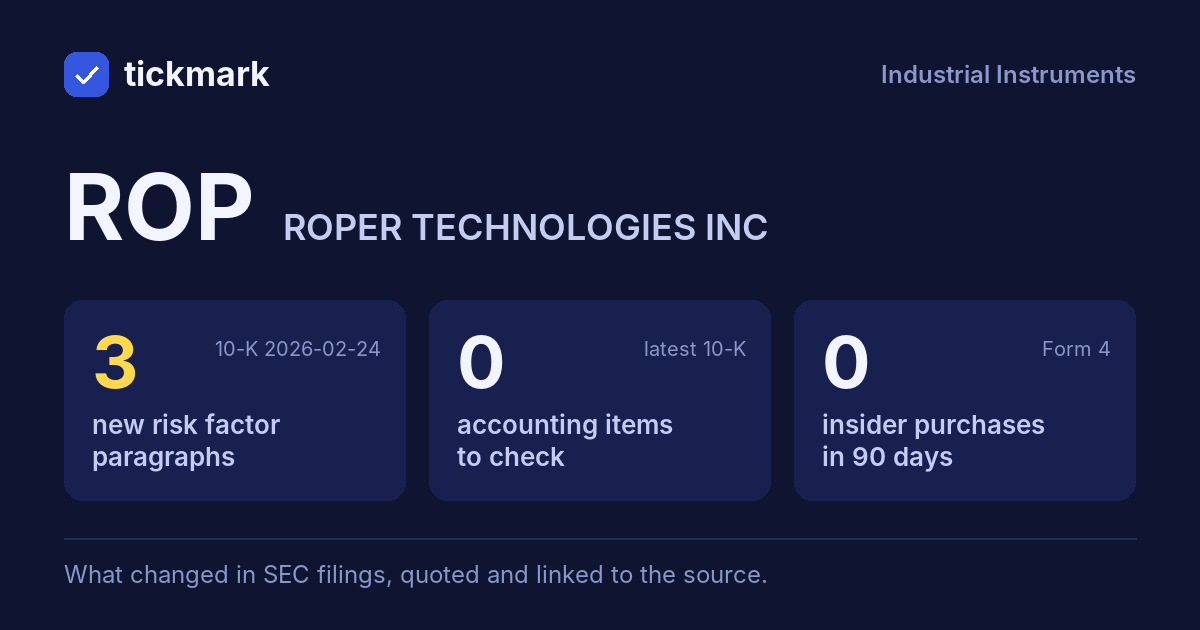
Sentences and paragraphs of ROP's Risk Factors and MD&A, 10-K 2026-02-24 against 10-K 2025-02-24.
Each links to the text at sec.gov.
AddedRisk Factors
We rely on third-party AI platforms and services, including proprietary and open-source large language models and other AI technologies provided by companies such as OpenAI, Anthropic, Google, and Microsoft. These providers may change their terms of service, increase pricing, discontinue services, experience outages, decline to provide certain indemnities, or make changes to their AI models that adversely affect our products or operations. As AI becomes more central to our offerings, our exposure to pricing changes from these providers increases, and we may not be able to pass such cost increases on to our customers. We have limited control over these third-party AI systems and their updates, and any disruption in access to these services could have a significant impact on our business. The use of AI applications may result in cybersecurity incidents that implicate the personal data of end users of such applications. Any such cybersecurity incidents related to our use of AI applications could adversely affect our reputation and results of operations. AI also presents emerging ethical issues, and if our use of AI becomes controversial, we may experience brand, reputational, or competitive harm, or legal liability.
Read it in 10-K 2026-02-24 at sec.gov ↗
AddedRisk Factors
Regulation limiting or controlling the use of AI may restrict our ability to use AI, our ability to create new products, and create increased compliance costs.
Read it in 10-K 2026-02-24 at sec.gov ↗
AddedRisk Factors
We are subject to an evolving landscape of laws and regulations governing the use of AI. The EU AI Act classifies AI systems by risk level and may prohibit certain high-risk applications, requiring significant change to product design, documentation, governance processes, and risk management practices to achieve compliance. In the U.S., several states, including Colorado and California, have enacted or are considering AI-specific regulations addressing transparency, bias, and accountability, particularly in the housing and employment fields. Regulatory uncertainty regarding how these laws will be interpreted and enforced creates additional compliance challenges, and may cause us to modify our data handling and compliance practices, limit our ability to use certain data to support our products or product development efforts, hinder our customers’ ability to adopt or continue to use our products, or require us to cease offering or using certain AI-enabled features or services in particular jurisdictions.
Read it in 10-K 2026-02-24 at sec.gov ↗
AddedMD&A
Net cash provided by operating activities increased by 6% to $2,540.3 in 2025 as compared to $2,393.2 in 2024 due primarily to the change in net earnings before non-cash expenses, and a benefit to cash income taxes paid in connection with the repeal of the requirement to capitalize and amortize domestic R&D expenditures under Internal Revenue Code Section 174 (“Section 174”) associated with the enactment of the One Big Beautiful Bill Act (the “OBBBA”). These increases were partially offset by less cash provided by net working capital primarily related to changes in the balances of accounts receivable and accrued expenses.
Read it in 10-K 2026-02-24 at sec.gov ↗
AddedMD&A
The enactment of the OBBBA on July 4, 2025, introduced various tax reform provisions, including the repeal of the requirement to capitalize and amortize domestic R&D expenditures under Section 174. The legislation includes multiple effective dates and, as enacted, did not have a material impact on our 2025 annual effective tax rate and is not expected to have a significant impact on our annual effective tax rate in future years. We continue to assess the broader impacts of the OBBBA.
Read it in 10-K 2026-02-24 at sec.gov ↗
AddedMD&A
The OBBBA repealed the domestic capitalization of R&D under Section 174, which resulted in a cash tax benefit of approximately $150 in 2025. The remaining cash tax benefit associated with the enactment of the OBBBA is expected to be utilized over the next three to five years. Management expects annual cash tax payments as a percentage of pre-tax earnings to be relatively consistent on a go-forward basis.
Read it in 10-K 2026-02-24 at sec.gov ↗
AddedMD&A
In October 2025, our Board approved a share repurchase program for the repurchase of up to $3,000.0 of our common stock. During the fourth quarter of 2025, we repurchased 1.121 shares of our common stock for an aggregate purchase price of $500.0 and an average price paid per share of $445.87, excluding broker commissions and excise tax. As of December 31, 2025, $2,500.0 of the originally authorized amount under the share repurchase program remained available for future repurchases.
Read it in 10-K 2026-02-24 at sec.gov ↗
AddedMD&A
From January 1, 2026 to February 20, 2026, we repurchased 3.723 shares of our common stock for an aggregate purchase price of $1,313.5 and an average price paid per share of $352.80, excluding broker commissions and excise tax. As of February 20, 2026, $1,186.5 of the originally authorized amount under the share repurchase program remained available for future repurchases.
Read it in 10-K 2026-02-24 at sec.gov ↗