Form 10-K for the Fiscal Year Ended December 31, 2013
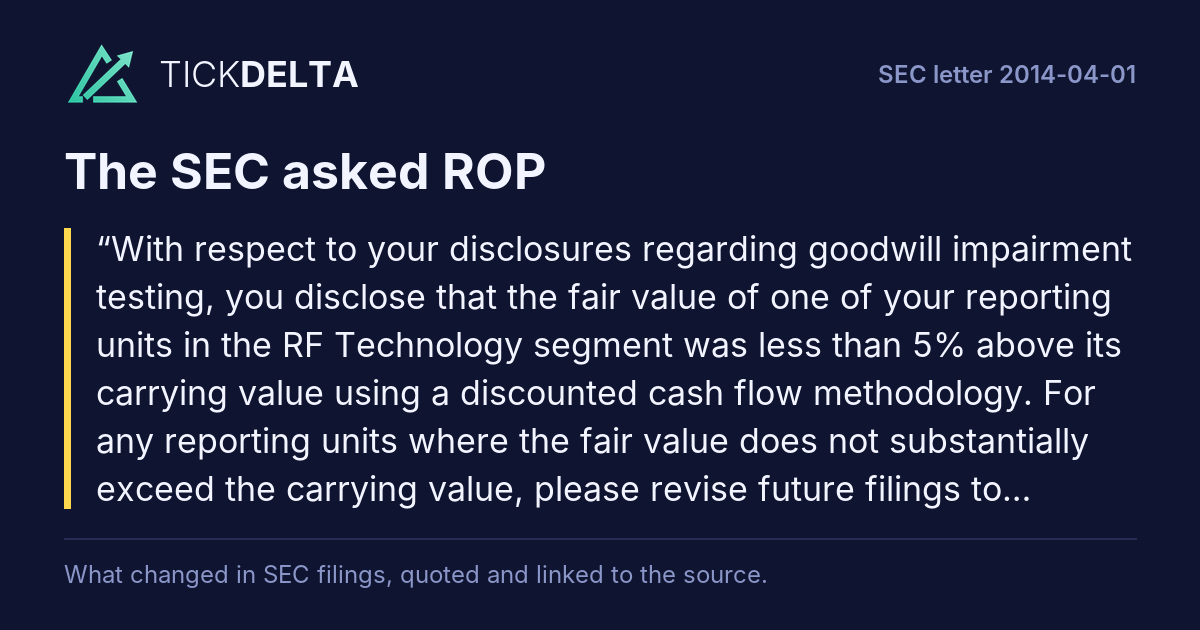
With respect to your disclosures regarding goodwill impairment testing, you disclose that the fair value of one of your reporting units in the RF Technology segment was less than 5% above its carrying value using a discounted cash flow methodology. For any reporting units where the fair value does not substantially exceed the carrying value, please revise future filings to provide expanded disclosure.Rest of the question
In this regard, disclose the amount of goodwill allocated to the reporting unit, the degree of uncertainty associated with key assumptions and a description of potential events and/or changes in circumstances that could reasonably be expected to negatively affect the key assumptions. Please provide us with any proposed revised disclosures.
We respectfully clarify that our disclosures regarding goodwill impairment testing include information on our use of both an income approach (discounted cash flows) and a market approach consisting of a comparable company earnings multiples methodology to estimate the fair value of a reporting unit. We further disclose that we believe the market value of the RF Technology unit in question to be significantly in excess of its carrying value based upon observed market data.Read in the reply ↗Rest of the answer
While we respect and utilize both valuation methods, we do believe the market approach to be more representative of the valuation methods we utilize in evaluating purchase prices of acquisitions. Therefore, taking into consideration both approaches, we believe the fair value of the unit does substantially exceed its carrying value, and additional disclosures were not required.
Specifically, $318 million was allocated to goodwill for this reporting unit. Key assumptions used in the formulation of our fair value estimates are the underlying growth rate of the business, anticipated future cash flows, interest rates and market multiples for comparable companies. Potential events that could negatively affect these assumptions are customer losses, decreases in price or margin performance, increases in working capital needs, a stock market decline that would lead to lower multiples for comparable companies or a general increase in interest rates, which would affect the discount rate used.
In future filings, if the fair value of a unit does not substantially exceed the carrying value based on our analysis, the Company will include expanded disclosures including the amount of goodwill allocated to the reporting unit, the degree of uncertainty associated with key assumptions and a description of potential events and/or changes in circumstances that could reasonably be expected to negatively affect the key assumptions.
First report after the company's reply of 2014-04-28: 10-Q filed 2014-05-02 ↗, against the 10-Q filed 2013-11-08 ↗.
Tickdelta does not hold the text of both reports, so they are not compared here.
We note your disclosure that you did not provide supplemental pro forma information for the 2013 acquisitions because the acquisitions did not have a material impact on your results of operations. We further note from your MD&A disclosures for 2013 vs. 2012 under results of operations that sales in your Medical and Scientific Imaging segment were positively impacted by $208 million due to acquisitions.Rest of the question
Please provide us with your analysis which demonstrates that the supplemental information is not material, and explain why no additional disclosures are required under FASB ASC 805-10-50-2(h).
to the Staff's comment, the Company respectfully submits that our 2013 acquisitions were not material to its financial statements taken as a whole. Accordingly, the Company believes that the disclosure requirements of ASC 805-10-50-2(h)(2) and (h)(3) are not required in this situation. In this regard, the Company advises the Staff as follows:
·
The net sales from our 2013 acquisitions as a percentage of the Company's consolidated net sales for the year ended December 31, 2012 was 5.1%;
The income from continuing operations of our 2013 acquisitions as a percentage of the Company'sRead in the reply ↗Rest of the answer
consolidated income from continuing operations for the year ended December 31, 2012 was 2.6%;
The proportionate share of the total assets acquired in our 2013 acquisitions as a percentage of the Company's total consolidated assets as of December 31, 2012 was 9.2%;
The Company's investment in 2013 acquisitions as a percentage of the Company's total consolidated assets as of December 31, 2012 was 14.1%; and
The Company's acquisitions in 2013 required no new or modified borrowings;
The Company also considered other qualitative factors under ASC 805 to assess the materiality of our 2013 acquisitions including the perception of historical acquisitions, the impact on cash flows, and the effect on loan covenants or other contractual requirements.
First report after the company's reply of 2014-04-28: 10-Q filed 2014-05-02 ↗, against the 10-Q filed 2013-11-08 ↗.
Tickdelta does not hold the text of both reports, so they are not compared here.
As a related matter we note the significance of your purchase price allocation to goodwill. Please revise future filings to describe the factors that led to such a significant allocation or tell us why a revision to future filings is not necessary. Refer to FASB ASC 805-30-50-1(a).
The Company respectfully acknowledges that when significant allocations of purchase price to goodwill exist in future filings, the factors that led to such allocation will be described. The Company generally purchases high margin, asset light businesses without significant identifiable tangible or intangible assets to which we can allocate a significant portion of the purchase price. Accordingly, these acquisitions result in a significant amount of goodwill. Read in the reply ↗
First report after the company's reply of 2014-04-28: 10-Q filed 2014-05-02 ↗, against the 10-Q filed 2013-11-08 ↗.
Tickdelta does not hold the text of both reports, so they are not compared here.
During 2013 and 2012 you recorded out of period corrections of tax adjustments for TransCore and iTrade. Please explain in further detail each of the adjustments made to your financial statements, including a discussion of how you became aware of the errors, the periods the adjustments relate to, and the prior and current accounting for each of these adjustments.
The Company respectfully informs the Staff that the tax adjustments for both iTrade and TransCore related to deferred income tax balances that were recorded on each acquired entity's pre-acquisition balance sheet and were erroneously included on each acquired entity's post-acquisition opening balance sheet. Such adjustments were deemed immaterial due to their size and balance-sheet-only impacts.
The TransCore acquisition occurred in 2004 and the adjustment was discovered in 2013.Read in the reply ↗Rest of the answer
The Company became aware of this adjustment during a data review associated with a software implementation project. During this review, the Company discovered that a deferred income tax liability that was recorded on TransCore's pre-acquisition balance sheet for a cumulative temporary difference relating to goodwill was also included on TransCore's post-acquisition opening balance sheet. Since there should be no cumulative temporary difference on TransCore's opening balance sheet for goodwill, the deferred income tax liability was incorrectly stated which caused TransCore's goodwill balance to be overstated.
The iTrade acquisition occurred in 2010 and the adjustment was discovered in 2012. The Company became aware of this adjustment during our provision-to-return true-up process when the Company compared the calculated tax effect of iTrade's cumulative temporary differences to the existing deferred income tax account balances. During this review, the Company determined that certain pre-acquisition deferred income tax balances were not properly eliminated from iTrade's post-acquisition opening balance sheet. iTrade's deferred income tax liability balance was therefore incorrectly stated on its opening balance sheet which resulted in an overstatement of iTrade's goodwill balance.
First report after the company's reply of 2014-04-28: 10-Q filed 2014-05-02 ↗, against the 10-Q filed 2013-11-08 ↗.
Tickdelta does not hold the text of both reports, so they are not compared here.
In note 1 of your financial statements you disclose that the amount of earnings of foreign subsidiaries that you consider are permanently reinvested was approximately $939 million at December 31, 2013. This amount was approximately $1.05 billion at December 31, 2012 as shown in note 1 of your 2012 10-K.Rest of the question
Additionally, in note 7 in your 2013 10-K your deferred tax assets related to foreign tax credits decreased from $20.3 million at December 31, 2012 to $425,000 at December 31, 2013. Please address the following: Explain to us the circumstances that led to the decrease in unremitted earnings and foreign tax credits, including the amount of repatriations to the U.S., and the amount of foreign tax credits used during 2013; To the extent you remitted earnings during 2013, p lease tell us how you determined that the remittance of foreign earnings did not impact your current or future assertions regarding permanent reinvestment.
The Company respectfully informs the Staff that it did not repatriate any unremitted prior year earnings to the U.S. in 2013, and that the decrease in unremitted earnings was the result of a review performed in 2013 on the methodology used to calculate the cumulative outside basis differences in the stock of its controlled foreign corporations ("CFCs"). As a result of this review, the Company determined the outside stock basis difference it reported at December 31, 2012 was overstated.Read in the reply ↗Rest of the answer
The overstatement was due to the exclusion of lower-tier CFC earnings deficits which the Company believes should have been aggregated with top-tier CFC earnings, with an effect of $275 million. The remaining difference between 2012 and 2013 is $165 million of unremitted earnings that the Company's CFCs generated in 2013.
The Company's deferred tax assets related to foreign tax credits decreased from $20.3 million at December 31, 2012 to $0.425 million at December 31, 2013 substantially due to provision to return true-ups and anticipated utilization of foreign tax credit carryforwards on the 2013 U.S. tax return.
To the extent you remitted earnings during 2013, please tell us how you determined that the remittance of foreign earnings did not impact your current or future assertions regarding permanent reinvestment.
The Company respectfully informs the Staff that it did not repatriate any earnings in 2013 from our foreign entities with respect to which we have made the indefinite reinvestment assertion.
First report after the company's reply of 2014-04-28: 10-Q filed 2014-05-02 ↗, against the 10-Q filed 2013-11-08 ↗.
Tickdelta does not hold the text of both reports, so they are not compared here.
As required by Instruction 2 to Item 2.02 of Form 8-K, we see that you present the reconciliation required by Item 10(e)(1)(i) of Regulation S-K for your non-GAAP financial information in the form of an “adjusted” income statement. Please tell us how your presentation considers the guidance set forth in Compliance and Disclosure Interpretation 102.10.Rest of the question
Under the cited guidance, it is generally not appropriate to present a non-GAAP income statement for purposes of reconciling non-GAAP measures to the most directly comparable GAAP measures.
to the Staff's comment, the Company respectfully advises the Staff that, in designing the table reconciling GAAP measures to non-GAAP measures that is the subject of the Staff's comment (the "Reconciliation Table"), the Company considered the guidance set forth in Compliance and Disclosure Interpretation 102.10 and the Staff's view that a full non-GAAP income statement is generally inappropriate, but believes that the Reconciliation Table provides additional, useful disclosure to investors without attaching undue prominence to the non-GAAP financial information contained therein.
However,Read in the reply ↗Rest of the answer
the Company acknowledges that including almost all of the income statement line items could be interpreted as presenting a financial statement. In future presentations, we will remove items which do not specifically require reconciliation. As an example, the noted disclosure from our Form 8-K dated January 27, 2014 would be presented going forward as follows:
2013
GAAP revenue
$
3,238,128
Sunquest adjustment to acquired deferred revenue
6,980
MHA accounting adjustment to revenue
26,433
Adjusted revenue
3,271,541
Reconciliation of GAAP diluted earnings per share to Adjusted diluted earnings per share
GAAP earnings
538,293
Special related to vendor component
9,100
Related tax effect of adjustments
(14,880
)
Adjusted earnings
565,926
Diluted share outstanding
100,209
GAAP diluted earnings per share
5.37
Adjusted diluted earnings per share
5.65
Reconciliation of GAAP operating margin to Adjusted operating margin
GAAP income from operations
842,361
Adjusted income from operations
884,874
GAAP operating margin
26.0
%
Adjusted operating margin
27.0
* * * *
In connection with the Company's response to the comments of the Staff set forth herein, the Company acknowledges the following:
the Company is responsible for the adequacy and accuracy of the disclosure in the filing;
Staff comments or changes to disclosure in response to Staff comments do not foreclose the Commission from taking any action with respect to the filing; and the Company may not assert Staff comments as a defense in any proceeding initiated by the Commission or any person under the federal securities laws of the United States.
____________________
Please address any comments or questions with respect to the foregoing to the undersigned at (941) 556-2616.
First report after the company's reply of 2014-04-28: 10-Q filed 2014-05-02 ↗, against the 10-Q filed 2013-11-08 ↗.
Tickdelta does not hold the text of both reports, so they are not compared here.
Also in this review: closing letter, 2014-05-13