Repay Holdings Corp RPAY
New risk paragraphs, branching off last year
Each branch is a paragraph in Risk Factors with nothing like it in the 10-K filed Mar 3, 2025. A box jumps to the paragraph as filed, below.
Paragraphs with nothing like them in last year's 10-K
5 paragraphs in Risk Factors of the 10-K filed Mar 9, 2026 with nothing like them in the 10-K filed Mar 3, 2025. Quoted exactly. Paragraphs that were only edited are under 10-K change.
third parties, and we may not be able to obtain or retain licenses and technologies from these third parties on reasonable terms or at all. The loss of intellectual property protection or the inability to license or otherwise use third-party intellectual property could harm our business and ability to compete. We regularly engage third parties for offshore development activities, which may heighten all of the risks noted above.
We depend on the ability and experience of a number of our key personnel who have substantial experience with our operations, the rapidly changing payment processing industry and the vertical markets in which we offer our products and services. Our success depends in part on the continued service and expertise of our senior management and other key personnel, many of whom have developed significant institutional knowledge and industry experience. Our senior leaders and other key employees have developed important relationships with the card networks and our sponsor banks, key clients, software integration partners and other payment processing and service providers, and the loss of one or more of these individuals could disrupt our operations, strategic initiatives or client relationships. From time to time, we have experienced, and may continue to experience, turnover in key management or other critical roles, and there can be no assurance that we will be able to retain or replace such personnel with individuals possessing comparable experience, expertise or industry relationships on a timely basis, or at all.
Periods of actual or perceived stress in the banking or broader financial services sector—whether resulting from liquidity concerns, changes in regulatory expectations, macroeconomic conditions or other factors—could adversely affect the financial institutions with which we do business or the terms on which they provide services to us. Any failure of, or material adverse development affecting, one or more of our sponsor banks or other financial institution counterparties, or market concerns regarding their financial condition, could impair our liquidity, disrupt our ability to process transactions for clients, or negatively affect our relationships with clients and partner. Similarly, adverse developments affecting the financial institutions on which our clients rely could negatively impact our clients’ operations or financial condition, which in turn could reduce payment volumes processed through our platform or otherwise adversely affect our business, financial condition or results of operations.
Our indebtedness under the Second Amended Credit Agreement bears interest at a variable rate, primarily based on the Secured Overnight Financing Rate (“SOFR”), and, as a result, our interest expense may increase if market interest rates rise, which could adversely affect our cash flows and results of operations.
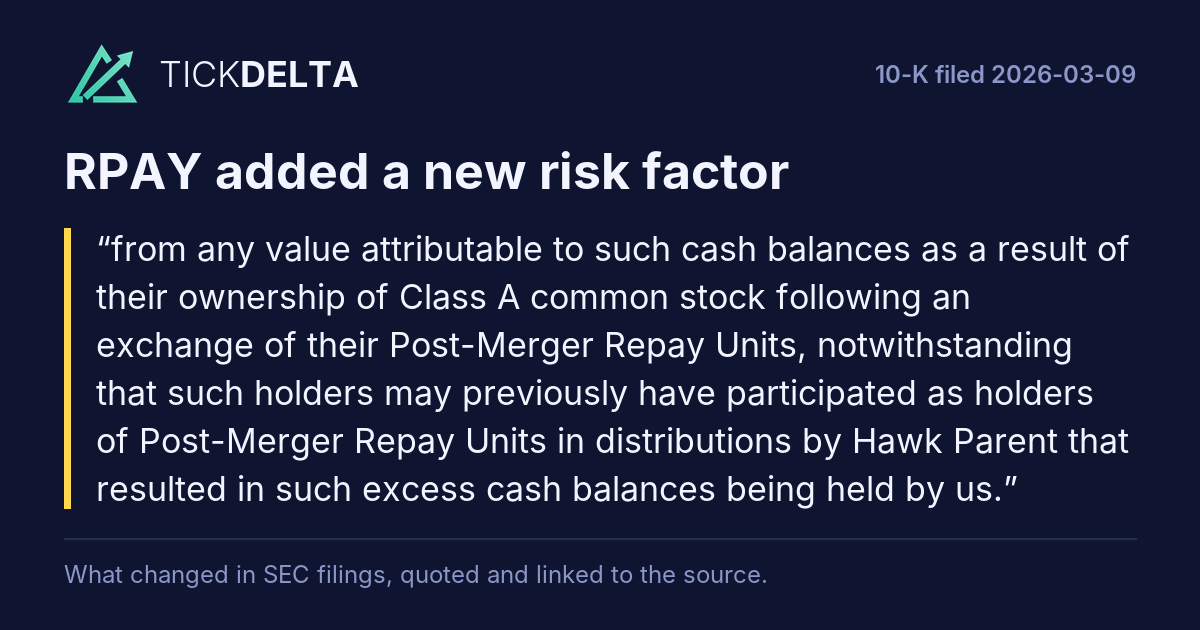
from any value attributable to such cash balances as a result of their ownership of Class A common stock following an exchange of their Post-Merger Repay Units, notwithstanding that such holders may previously have participated as holders of Post-Merger Repay Units in distributions by Hawk Parent that resulted in such excess cash balances being held by us.
Paragraphs in the 10-Q filed Nov 9, 2026 that were not in the one before
New in the latest 10-Q
14 paragraphs in the 10-Q filed Nov 9, 2026 with nothing like them in the 10-Q filed Aug 10, 2026 (at least half the words must differ; new numbers alone do not count). Quoted exactly, grouped by the item heading above them. This is text that changed, not a judgement of how serious it is.
Financial statements and notes
On August 13, 2026, the Company made a $14.0 million initial cash payment in connection with the acquisition of a license to a third party’s integrated payables software and rights with respect to certain related bank reseller contracts. The Company may also be required to make contingent cash payments up to $6.0 million in the aggregate based on the bank reseller contracts successfully assigned to the Company. The licensor is also providing transitional hosting, maintenance and other support services for specified periods while the bank reseller portfolio is migrated to the Company’s platform, and the Company will pay quarterly charges for these services.
Read in the 10-Q
2. Basis of Presentation and Summary of Significant Accounting Policies Unaudited Interim Condensed Consolidated Financial Statements These unaudited condensed consolidated interim financial statements should be read in conjunction with the Company’s audited condensed consolidated financial statements and accompanying notes, which are included in the Annual Report on Form 10-K for the year ended December 31, 2025 (the “2025 Form 10-K”). The accompanying unaudited condensed consolidated interim financial statements have been prepared in accordance with accounting principles generally accepted in the United States (“GAAP”) and with instructions to Form 10-Q and Rule 10-01 of SEC Regulation S-X as they apply to interim financial information. Accordingly, the interim condensed consolidated financial statements do not include all of the information and notes required by GAAP for complete financial statements, although the Company believes that the disclosures made are adequate to make the information not misleading. The Company uses the accrual basis of accounting whereby revenues are recognized when earned, usually upon the date services are rendered, and expenses are recognized at the date services are rendered or goods are received. The interim condensed consolidated financial statements are unaudited, but in the Company’s opinion include all adjustments of a normal recurring nature or a description of the nature and amount of any adjustments other than normal recurring adjustments, operations and cash flows as of and for the periods presented. The interim financial results are not necessarily indicative of results that may be expected for any other interim period or the fiscal year. Principles of Consolidation The condensed consolidated financial statements include the accounts of Repay Holdings Corporation, its wholly owned subsidiary KUBRA US Acquisition Corporation and its majority-owned subsidiary, Hawk Parent Holdings LLC, along with Hawk Parent Holdings LLC’s wholly owned subsidiaries. All significant intercompany accounts and transactions have been eliminated in consolidation. Reclassification The Company changed its presentation for customer deposits from Accrued expenses and Other liabilities to Contract liabilities and its presentation for deferred revenue from Other current liabilities to Contract liabilities within the Condensed Consolidated Balance Sheets. Prior period amounts have been revised to conform to the current presentation. Use of Estimates The preparation of financial statements in conformity with GAAP requires management to make estimates and assumptions that affect the reported amounts of assets and liabilities and disclosure of contingent assets and liabilities at the date of the financial statements and the reported Condensed Consolidated Statements of Operations during the reporting period. Actual results could differ materially from those estimates. Segment Reporting The Company reports operating results through two reportable segments: (1) Consumer Payments and (2) Business Payments, as further discussed in Note 15. Segments. Accounting Policies related to KUBRA Acquisition As a result of the KUBRA Acquisition, the Company implemented the following accounting policies in addition to the accounting policies in Note 2. Basis of Presentation and Summary of Significant Accounting Policies to the Company’s Notes to Consolidated Financial Statements in Part II, Item 8 of the 2025 Form 10-K. Inventories Inventories consist principally of paper, envelopes, ink and toner, and represent products available for sale and are accounted for using the first-in, first-out (“FIFO”) method and valued at the lower of cost or net realizable value.
Read in the 10-Q
3. Revenue For the Company’s accounting policies for recognizing revenue and contract costs, see Note 2. Basis of Presentation and Summary of Significant Accounting Policies and Note 3. Revenue to the Company’s Notes to Consolidated Financial Statements in Part II, Item 8 of the 2025 Form 10-K. As a result of the KUBRA Acquisition, the Company has acquired a bill presentment revenue stream, a communication services revenue stream and a professional services revenue stream. All revenue streams have been presented within Revenue in the Condensed Consolidated Statements of Operations. Bill Presentment Revenue Bill presentment revenue consists of fees for the design, preparation, printing and distribution of paper and electronic bills, invoices and other documents, including document fulfillment and print and mail services. Fees are generally a fixed amount per bill or document and are billed in arrears based on actual volumes. Revenue from print and mail services is recognized at the point in time when the data is processed and the documents are printed, folded, inserted and delivered to the postal service. Revenue from electronic bill presentment is recognized at the point in time the bill is delivered, as the service is provided. The amount of bill presentment revenue is driven primarily by clients’ underlying billing and statement volumes and is affected by factors such as postal rate changes and paper and print input costs. Communication Services Revenue Communication services revenue consists primarily of automated messaging, including text and email communications and service outage notifications, principally for utility clients. Fees consist of a fixed fee per interaction, annual subscription fees, and annual maintenance and support fees. Revenue from per-interaction fees is recognized when the message is delivered, and subscription, maintenance and support fees are recognized ratably over the contract term. Communication services revenue is included within professional services and other revenue in the disaggregation of revenue tables below. Professional Services Revenue Professional services revenue consists of fees from one-time professional services, consulting, implementation and delivery arrangements. Revenue is recognized over time or at a point in time depending on specific contract terms. For milestone-based contracts defined in statements of work (“SOW”), revenue is recognized as individual contract
Read in the 10-Q
milestones are achieved and accepted. For other arrangements, performance obligations are completed when the final deliverables or work results are placed into production and in use by the customer. Amounts invoiced in advance of revenue recognition are recorded as deferred revenue and recognized as revenue as the related performance obligations are satisfied. Deferred revenue is expected to be recognized as revenue within one year and is classified within Contract liabilities in the Condensed Consolidated Balance Sheets. Disaggregation of revenue The Company’s revenue is from three types of services: (i) payment processing, (ii) bill presentment and (iii) professional services and other. The payment processing revenue is further disaggregated by two types of relationships: (i) direct relationships and (ii) indirect relationships. The following table presents the Company’s revenue disaggregated by segment for the periods indicated. • Payment processing revenue is earned from fees on payment transactions processed and varies with payment volumes, interchange and network fees, and client attrition. It is further disaggregated by type of relationship: (a) direct relationships and (b) indirect relationships. • Bill presentment revenue is earned from fees for producing and distributing bills and related documents and varies with clients’ billing volumes, postal rates and print input costs. • Professional services and other revenue includes professional services, communication services, and other revenue, and varies with client onboarding and implementation activity and with messaging and subscription activity. Three Months Ended September 30, 2026 ($ in thousands) Consumer Payments Business Payments Elimination of intersegment revenues (1) Total ───────────────────────────────────────────────────────────────────────────────────────────────────────────────────────────────────────────────────────────────────────────────────────────────────────────────────────── Revenue Payment processing revenue Direct relationships (2) $ 86,262 $ 23,780 $ (7,593) $ 102,450 Indirect relationships 1,693 165 - 1,857 Total Payment processing revenue 87,955 23,945 (7,593) 104,307 Bill presentment revenue 36,785 - - 36,785 Professional services and other revenue 12,306 - - 12,306 Total Revenue $ 137,046 $ 23,945 $ (7,593) $ 153,398 Three Months Ended September 30, 2025 ($ in thousands) Consumer Payments Business Payments Elimination of intersegment revenues (1) Total ─────────────────────────────────────────────────────────────────────────────────────────────────────────────────────────────────────────────────────────────────────────────────────────────────────────────────────── Revenue Payment processing revenue Direct relationships (2) $ 69,340 $ 11,818 $ (6,006) $ 75,152 Indirect relationships 2,381 192 - 2,573 Total Payment processing revenue 71,721 12,010 (6,006) 77,725 Bill presentment revenue - - - - Professional services and other revenue - - - - Total Revenue $ 71,721 $ 12,010 $ (6,006) $ 77,725
Read in the 10-Q
Pro Forma Three Months Ended September 30, Pro Forma Nine Months Ended September 30,
Read in the 10-Q
Show the other 9
Net loss attributable to non-controlling interests (1,066) (748) (2,644) (7,652)
Read in the 10-Q
7. Property and Equipment Property and equipment consisted of the following: September 30, December 31, ($ in thousands) 2026 2025 ─────────────────────────────────────────────────────────────────────────────────────────────────────────────── Furniture, fixtures, and office equipment $ 7,470 $ 3,206 Computers 2,092 2,054 Leasehold improvements 929 587 Finance lease ROU assets 1,517 - Total 12,008 5,847 Less: Accumulated depreciation and amortization 7,628 4,604 $ 4,380 $ 1,243 Depreciation expense for property and equipment was $0.7 million and $1.2 million for the three and nine months ended September 30, 2026, respectively. Depreciation expense for property and equipment was $0.3 million and $0.9 million for the three and nine months ended September 30, 2025, respectively.
Read in the 10-Q
Costs of services. Costs of services primarily include commissions to our software integration partners and other third-party processing costs, such as front and back-end processing costs and sponsor bank fees. Following the KUBRA Acquisition, costs of services also include the direct costs of our bill presentment operations, consisting of paper, print supplies, postage, production labor and facility costs and the depreciation and amortization of the long-lived assets used directly to produce and deliver printed and mailed documents, including printing, inserting and mailing equipment, leasehold improvements at production facilities, and capitalized software used in bill presentment production. Prior to the KUBRA Acquisition, we did not have long-lived assets directly attributable to revenue-generating activities, and accordingly no depreciation or amortization was included in costs of services in prior periods.
Read in the 10-Q
agreements, and software and property not directly used in producing revenue, is presented separately as Depreciation and amortization.
Read in the 10-Q
Three Months Ended September 30, 2026 Compared to Three Months Ended September 30, 2025
Read in the 10-Q
Nine Months Ended September 30, 2026 Compared to Nine Months Ended September 30, 2025
Read in the 10-Q
Three Months Ended September 30, 2026 Compared to Three Months Ended September 30, 2025
Read in the 10-Q
Nine Months Ended September 30, 2026 Compared to Nine Months Ended September 30, 2025
Read in the 10-Q
Net cash provided by operating activities was $66.9 million for the nine months ended September 30, 2026, a decrease of $0.9 million or 1.3%, compared to $67.8 million for the nine months ended September 30, 2025. The decrease was primarily driven by changes in working capital, including a $12.3 million decrease in the change in accounts receivable due to political media receivables and KUBRA receivables and a $2.9 million decrease in contract liabilities associated with the recognition of deferred revenue, largely offset by a $13.4 million increase in the change in accounts payable largely attributable to payments due to political media partners and payables associated with the KUBRA Acquisition.
Read in the 10-Q
The 10-Q's risk factors against the 10-K
Item 1A of the 10-Q filed Nov 9, 2026 against Item 1A of the 10-K filed Mar 9, 2026.
A 10-Q repeats only the risks that changed, so a 10-K paragraph that is missing from it is not counted as removed.
Added is a paragraph with nothing like it in the 10-K, Reworded a sentence that is in both with several words changed,
Quiet changes a sentence in both where one to four words changed and one is a hedge or a modal
(cut words struck through, new words highlighted).
Text on the page, not a score; each links to the filing at sec.gov.
What the 10-Q itself says about its risk factors:There have been no material changes with respect to the risk factors disclosed in our Annual Report on Form 10-K for the year ended December 31, 2025, except as set forth below:
Read in the 10-Q
Show the other 12
Phrases used for the first time
Two-word phrases in Risk Factors of the 10-K filed Mar 9, 2026 that are in none of the 1 earlier 10-Ks stored, back to Mar 3, 2025
Where each one is used
- artificial intelligence: The electronic payments market is subject to constant and significant changes. This market is characterized by rapid technological evolution, new product and service introductions, evolving industry standards, changing client needs and the entrance of new competitors, including products and services that enable...
- regulatory priorities: We and the clients we serve are subject to numerous federal and state regulations that affect the electronic payments industry. The regulatory environment applicable to our business and our clients’ businesses is complex, fragmented and subject to change, and regulatory priorities, interpretations and enforcement...
- priorities interpretations: We and the clients we serve are subject to numerous federal and state regulations that affect the electronic payments industry. The regulatory environment applicable to our business and our clients’ businesses is complex, fragmented and subject to change, and regulatory priorities, interpretations and enforcement...
- enforcement approaches: We and the clients we serve are subject to numerous federal and state regulations that affect the electronic payments industry. The regulatory environment applicable to our business and our clients’ businesses is complex, fragmented and subject to change, and regulatory priorities, interpretations and enforcement...
Used at least twice, small words left out. Counted, not picked: a phrase can be new because the company renamed something.
What was taken out
6 paragraphs of last year's Risk Factors with nothing like them now. The longest are quoted.
Sources
Item 1A of each 10-K and 10-Q on EDGAR, quoted exactly. Each paragraph links to the filing at sec.gov.
Also
10-K change: what was reworded or cut, section by section.
Work with it
Excel workbook · CSV. Google Sheet that stays up to date: paste =IMPORTDATA("https://tickdelta.com/company/RPAY/export.csv") into a cell.