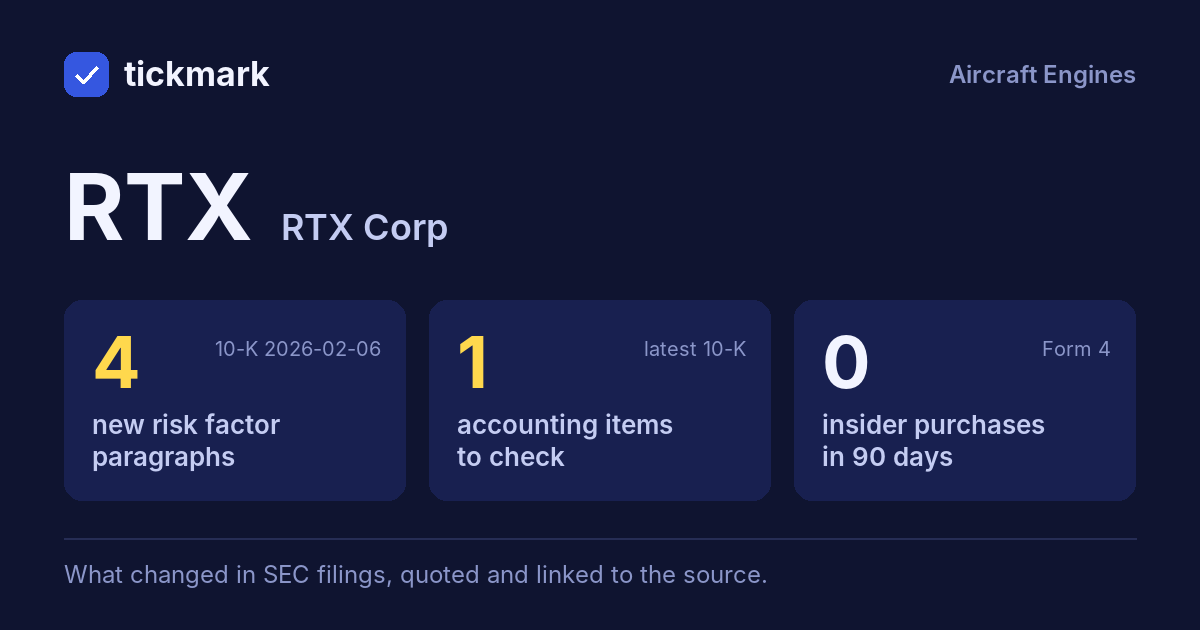
Marked against last year's 10-K:
cut words struck through, new words highlighted and underlined.
MD&A 424 words changed in this paragraph; it is 50% similar to last year's version.
Legal Matters. As previously announced, in 2024 the Company resolved several outstanding legal matters, herein referred to as “Resolution of Certain Legal Matters.” The Company entered into a deferred prosecution agreement (DPA) (DPA-1) with the Department of Justice (DOJ) and the Company settled an administrative proceeding with the Securities and Exchange Commission (SEC) (the SEC Administrative Order) to resolve the previously disclosed criminal and civil government investigations into payments made by Raytheon Company and its joint venture, Thales-Raytheon Systems (TRS), in connection with certain Middle East contracts since 2012 (Thales-Raytheon Systems and Related Matters). The Company also entered into a DPA and a False Claims Act (FCA) settlement agreement with the DOJ to resolve previously disclosed criminal and civil government investigations into defective pricing claims for certain legacy Raytheon Company contracts entered into between 2011 and 2013 and in 2017 (DOJ Investigation and Contract Pricing Disputes). 2017. Under these DPAs and the SEC Administrative Order, Raytheon Company and the Company are required to retain, among other things, an independent compliance monitor satisfactory to the DOJ and the SEC (for a term ending three years from the date on which the monitor is engaged) and are required to undertake certain cooperation and disclosure obligations (for a term commencing on the effective date of DPA-1 and the SEC Administrative Order, as applicable, and ending three years from the date on which Raytheon Company and the monitor is engaged). The Company engage an independent compliance monitor will satisfactory to the DOJ and SEC). A single independent compliance monitor was selected to oversee Raytheon Company’s and the Company’s compliance with their respective obligations under the DPAs and the SEC Administrative Order. The DPAs further provide that, Order, and that monitor is expected to be in place by the event end of the DOJ, in its sole discretion, determines during the period of deferral of prosecution that Raytheon Company or first quarter. In 2024, the Company have violated any provision of either DPA, Raytheon Company or the Company may be subject to prosecution for any federal criminal violation, including the charges against Raytheon Company in the relevant DPA. The SEC Administrative Order further provides that, in the event of a breach of the SEC Administrative Order, the SEC may vacate the SEC Administrative Order and institute proceedings against the Company. In the event of any such determination or breach, the Company may face additional adverse impacts. In addition, the Company also resolved certain voluntarily disclosed export controls violations primarily identified in connection with the integration of Rockwell Collins and, to a lesser extent, Raytheon Company, including certain violations that were resolved pursuant to a Consent Agreement (CA) with the U.S. Department of State (DOS) (Trade Compliance Matters). (DOS). The CA, which has a three-year term, requires the Company to implement remedial compliance measures and to conduct an external audit of the Company’s International Traffic in Arms Regulations (ITAR) ITAR compliance program. The CA also requires appointment of an external, independent Special Compliance Officer (SCO). The Company appointed its SCO on September 27, 2024. As a result of the DPAs, SEC Administrative Order, FCA settlement agreement and CA, we recorded a combined pre-tax charge of $918 million during the second quarter of 2024, which included $269 million related to the DOJ Investigation and Contract Pricing Disputes (in addition to amounts previously accrued), $364 million related to Thales-Raytheon Systems and Related Matters (in addition to amounts previously accrued), and $285 million related to Trade Compliance Matters. In the fourth quarter we made payments of $580 million related to the DOJ Investigation and Contract Pricing Dispute and $384 million related to Thales-Raytheon Systems and Related Matters. See “Note 17: Commitments and Contingencies” within Item 8 of this Form 10-K for additional information. further discussion of these and other government matters.
Source: Item 7, 10-K 0000101829-26-000006 vs Item 7, 10-K 0000101829-25-000005
Accounting Policies 283 words changed in this paragraph; it is 44% similar to last year's version.
Substantially all of our defense business revenue, which primarily relates to our Raytheon segment, and to a lesser extent Pratt & Whitney and Collins, is recognized over time because of the continuous transfer of control to our customers. For performance obligations satisfied over time, revenue is recognized on a percentage-of-completion basis generally using costs incurred to date relative to total estimated costs at completion to measure progress. Incurred costs represent work performed, which correspond with and best depict transfer of control to the customer. Contract costs can include labor, materials, subcontractors’ costs, or other direct costs and indirect costs. Our contracts with the U.S. government are typically subject to the Federal Acquisition Regulation (FAR) and are priced based on estimated or actual costs of producing goods or providing services. The FAR provides guidance on the types of costs that are allowable in establishing prices for goods and services provided under U.S. government contracts. The pricing for non-U.S. government contracts is based on the specific negotiations with each customer. Under the typical payment terms of our U.S. government fixed-price contracts, the customer pays us either performance-based payments (PBPs) or progress payments. PBPs are interim payments equal to a negotiated percentage of the contract price based on quantifiable measures of performance or on the achievement of specified events or milestones. Progress payments are interim payments up to 80-90% of costs incurred as the work progresses. Because the customer retains a portion of the contract price until completion of the contract, our U.S. government fixed-price contracts generally result in revenue recognized in excess of billings which we present as Contract assets on the Consolidated Balance Sheet. For our U.S. government cost-type contracts, the customer generally pays us for our costs incurred within a short period of time. For non-U.S. government contracts, we typically receive interim payments as work progresses, although for some contracts, we may be entitled to receive an advance payment. Such advances are not considered a significant financing component because they are used to meet working capital demands that can be higher in the early stages of a contract and to protect us from the other party failing to adequately complete some or all of its obligations under the contract. We recognize a liability for advance payments in excess of revenue recognized and present it as Contract liabilities on the Consolidated Balance Sheet.
Source: Item 8, Note 1 – BASIS OF PRESENTATION AND SUMMARY OF ACCOUNTING PRINCIPLES, 10-K 0000101829-26-000006 vs Item 8, Note 1 – BASIS OF PRESENTATION AND SUMMARY OF ACCOUNTING PRINCIPLES, 10-K 0000101829-25-000005
Risk Factors 231 words changed in this paragraph; it is 81% similar to last year's version.
We design, manufacture, and service products that incorporate advanced technologies; the introduction of new products and technologies involves risks, and we may not realize the degree or timing of benefits initially anticipated. The design, development, production, sale, and support of innovative commercial aerospace and defense systems and products involves advanced technologies. We invest substantial amounts in research and development efforts to pursue advancements in a wide range of technologies, products, and services aimed at meeting the ever-evolving product, program, and service needs of our customers. Our ability to realize the anticipated benefits of our investments depends on a variety of factors, including the competitiveness of our offerings’ performance relative to our peers; meeting development, production, certification, and regulatory approval schedules; receiving regulatory approvals; execution of internal and external performance plans; achieving cost and production efficiencies; availability and quality of supplier- and internally-produced parts and materials; availability of supplier and internal facility capacity to perform maintenance, repair, and overhaul services; availability of test equipment; development of complex software; hiring and training of qualified personnel; identification of emerging technological trends for our target end-customers; the level of customer interest in new technologies and products; requirements to provide disclosure and company intellectual property rights for certain government procurement programs; and customer acceptance of our products and technologies. For example we are investing in artificial intelligence, among other advanced technologies, and our business may be adversely affected if we are unable to successfully integrate the technology into our internal business processes and products and services in a timely, cost-effective, compliant, and responsible manner. The methods and processes we use to develop, deploy or otherwise use artificial intelligence systems may be found to not be in compliance with rapidly evolving regulatory standards thereby preventing or frustrating our use of the systems or creating liability for us. These methods and processes may further perform in unexpected ways or be misused, jeopardizing RTX’s intellectual property or potentially resulting in unexpected loss or misappropriation of intellectual property. Improper use of artificial intelligence could also lead to data breaches, undetected cyber-attacks, regulatory action, and reputational risks. In addition, our customers manufacture or acquire end products and systems that incorporate certain of our products. These end products and systems may also incorporate additional technologies manufactured by third parties and involve additional risks and uncertainties. As a result, the performance and industry acceptance of these larger systems and end products could affect the level of customer interest in, and acceptance of, our products in the marketplace. In addition, many of our products must adhere to strict regulatory and market-driven safety and performance standards in a variety of jurisdictions. The evolving nature of these standards, along with the long duration of development, production, and aftermarket support programs, creates uncertainty regarding program profitability, particularly with our aircraft engine products. Development efforts divert resources from other potential investments in our businesses, and these efforts may not lead to the development of new technologies or products on a timely basis or meet the needs of our customers as fully as alternative investments. In addition, the industries for our products or products that incorporate our technologies may not develop or grow as we anticipate. We, or our customers, suppliers, or subcontractors, may encounter difficulties in developing and producing new products and services, and may not realize the degree or timing of benefits initially anticipated or may otherwise suffer significant adverse financial consequences. Due to the design complexity of our products, or those of our customers or third party manufacturers that incorporate our products into theirs or our customers’ products, we may experience delays in completing the development and introduction of new products, or we may experience the suspension of production after these products enter into service due to safety concerns. Delays and/or suspension of production could result in increased development costs or deflect resources from other projects. If we fail in our development projects or if our new products or technologies fail to achieve customer acceptance or competitors develop more capable technologies or offerings, we may be unsuccessful in obtaining new contracts or winning all or a portion of next generation programs, including in key areas such as advanced sensing solutions, next-generation aircraft engine technologies, advanced avionics solutions and hypersonics. Any of the foregoing could have a material adverse effect on our competitive position, results of operations, financial condition, or liquidity.
Source: Item 1A, 10-K 0000101829-26-000006 vs Item 1A, 10-K 0000101829-25-000005
Legal Proceedings 85 words changed in this paragraph; it is 63% similar to last year's version.
Multiple lawsuits have been were filed in U.S. courts relating to the October 29, 2018 Lion Air Flight 610 and the March 10, 2019 Ethiopian Airlines Flight 302 accidents. Collins Aerospace (Collins) sold certain aircraft parts and systems to The Boeing Company for the 737 MAX aircraft involved in these accidents. Certain of our Collins businesses have been were named, along with other third parties, as parties in many of these lawsuits. We have also fully supported all governmental investigations and inquiries relating All lawsuits related to the accidents. We do not expect that Lion Air flight have been resolved, and the lawsuits Collins businesses have obtained a full release. Only one lawsuit related to the Ethiopian Airlines flight remains pending, and we anticipate during 2026 the lawsuit will either be resolved or governmental investigations or inquiries the claims against the Collins businesses will have a material adverse effect on our results of operations, financial condition, or liquidity. be dismissed.
Source: Item 3, 10-K 0000101829-26-000006 vs Item 3, 10-K 0000101829-25-000005