Form 10-K for the Fiscal Year Ended September 30, 2023
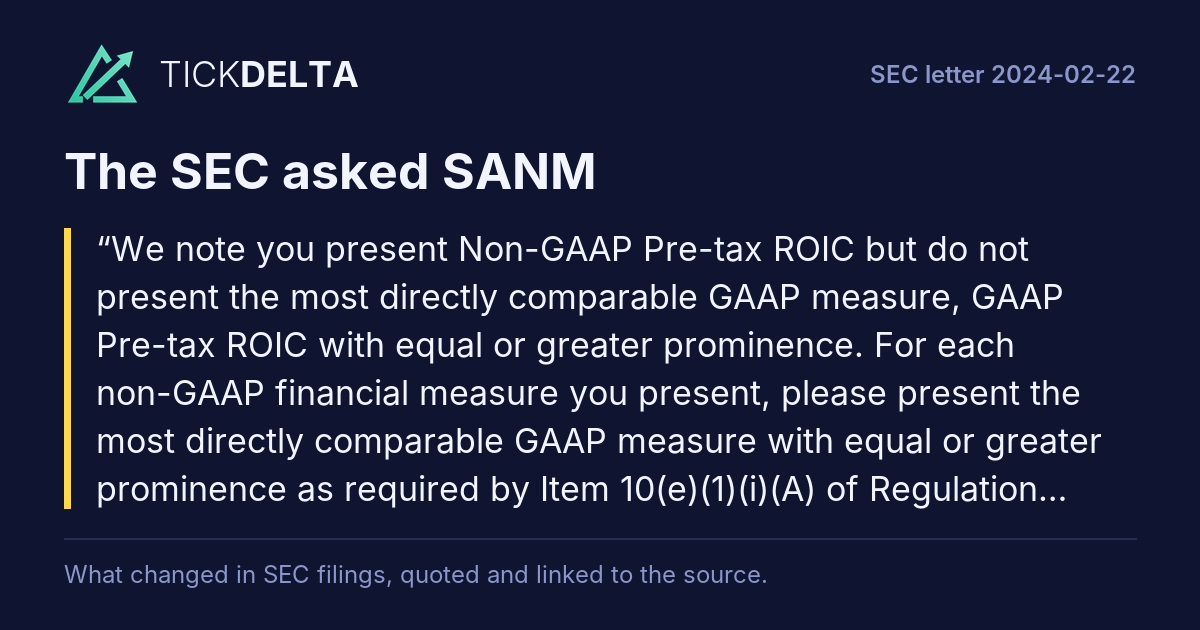
We note you present Non-GAAP Pre-tax ROIC but do not present the most directly comparable GAAP measure, GAAP Pre-tax ROIC with equal or greater prominence. For each non-GAAP financial measure you present, please present the most directly comparable GAAP measure with equal or greater prominence as required by Item 10(e)(1)(i)(A) of Regulation S-K and Question 102.10 of the Division of Corporation Finance’s ComplianceRest of the question
& Disclosure Interpretations on Non-GAAP Financial Measures.
We acknowledge the Staff’s comment and advise the Staff that, in future filings, we will present GAAP Pre-tax ROIC, the most directly comparable GAAP measure, with equal or greater prominence than Non-GAAP Pre-tax ROIC, if and as applicable.Read in the reply
U.S. Securities and Exchange Commission SANM2024-002
Management's Discussion and Analysis of Financial Condition and Results of Operations Critical Accounting Policies and Estimates
First report after the company's reply of Mar 14, 2024: 10-Q filed May 1, 2024 ↗, against the 10-Q filed Jan 31, 2024 ↗.
Tickdelta does not hold the text of both reports, so they are not compared here.
We note for certain contracts your application of the cost-to-cost method for revenue recognition requires the use of significant judgments with respect to estimated materials, labor, and subcontractor costs, included in the total estimated costs at completion.Rest of the question
You indicate such estimates are updated on a quarterly basis and if a change in estimate is deemed necessary, the impact of the change is recognized in the period of change. Please tell us whether you have recognized any material favorable or unfavorable changes in estimates with respect to such contracts and tell us the gross amounts of favorable and unfavorable changes recognized during each period presented as part of your response. If material, please revise your disclosure to include the impacts of changes in estimate pursuant to Item 303(b)(3) of Regulation S-K.
We assessed the materiality of the impact of changes in estimates resulting from application of the cost-to-cost method for recognizing revenue, using both quantitative and qualitative factors, and concluded that the effect of the changes in estimates were not material to our financial statements.Read in the reply
We review and update, as applicable, estimated costs at completion each fiscal quarter on a contract-by-contract basis. There is inherent uncertainty in estimating the amount of costs that will be required to complete a contract.Rest of the answer
Therefore, estimates may change periodically, resulting in favorable and unfavorable impacts to our revenue and profit. Factors that contribute to the inherent uncertainty in estimates include, among others, the long-term duration of contracts, the highly-complex nature of the products we manufacture (e.g., electronic components used in missile defense systems and flight instrumentation that are subject to very strict tolerances), and the readiness of our customer’s design for manufacturing.
The impact of changes in estimates resulting from application of the cost-to-cost method for recognizing revenue was as follows:
FISCAL 2023 FISCAL 2022 FISCAL 2021
$ in millions Favorable Unfavorable Net Unfavorable Favorable Unfavorable Net Unfavorable Favorable Unfavorable Net Unfavorable
Revenue [***] [***] [***] [***] [***] [***] [***] [***] [***]
Gross Profit [***] [***] [***] [***] [***] [***] [***] [***] [***]
In general, key drivers of the impacts noted above were (1) disruptions and costs associated with a high volume of engineering change orders that were required in order to achieve volume manufacturing, (2) supply chain challenges that resulted from the Covid-19 pandemic (which gradually eased in fiscal 2023 compared to the prior two fiscal years), and (3) with respect to certain new contracts, higher material costs because of lower than expected initial yields and costs associated with delays in achieving a state of volume production.
Revenue from these contracts represents about 2% of our total revenue for each of fiscal years 2023, 2022 and 2021. The maximum gross impact of changes in estimates to our revenues and gross profit was less than approximately [***]% and [***]%, respectively, in each fiscal year.
U.S. Securities and Exchange Commission SANM2024-003
For purposes of our materiality assessment, acknowledging the items were due to changes in estimates and not misstatements, we applied SEC Staff Accounting Bulletin No. 99 (SAB 99) – Materiality (codified in ASC 250-10-S99), which requires both a quantitative and qualitative assessment of materiality. Therefore, in addition to quantitative factors, we considered various qualitative factors and determined the impact of changes in estimates does not in any fiscal year (1) mask a change in earnings or other trends, (2) hide a failure to meet analysts’ consensus expectations, (3) have the effect of increasing management’s compensation, or (4) affect our compliance with regulatory requirements, loan covenants or other contractual requirements.
We will continue to monitor any gross favorable and gross unfavorable changes in estimates and will disclose such amounts in future filings if material.
First report after the company's reply of Mar 14, 2024: 10-Q filed May 1, 2024 ↗, against the 10-Q filed Jan 31, 2024 ↗.
Tickdelta does not hold the text of both reports, so they are not compared here.
We note certain customers represented "10% or more" of net sales during the periods presented. Please disclose the amount or percentage of net sales from each significant customer during each period presented and identity the segment or segments reporting the net sales as required by ASC 280-10-50-20 and ASC 280-10-50-42.
We acknowledge the Staff’s comment and advise the Staff that, in future filings, we will disclose the percentage of net sales from each significant customer and identify the segment or segments to which the net sales relate.Read in the reply
The table below presents the percentage of total net sales from each significant customer for fiscal years 2023, 2022 and 2021.
First report after the company's reply of Mar 14, 2024: 10-Q filed May 1, 2024 ↗, against the 10-Q filed Jan 31, 2024 ↗.
Tickdelta does not hold the text of both reports, so they are not compared here.
Please provide the disclosures required by ASC 280-10-50-40. In this regard, we note your disclosures under Business appear to describe various products and services included in both your IMS and CPS reportable segments. In addition, please also provide all the disclosures required by ASC 280-10-50-20 and ASC 280-10-50-41.Rest of the question
In this regard, we note your disclosures related to net sales from material individual foreign countries in Note 4 are only provided for the current fiscal year. We also note your current disclosures provide property, plant and equipment by geographic segment but you do not separately disclose your long-lived assets located in the US and by individual foreign countries, where material.
Disclosures under ASC 280-10-50-40:Read in the reply
We respectfully acknowledge the Staff’s comment and advise the Staff that we considered the guidance in ASC 280-10-50-40 which states that a public entity shall report the revenues from external customers for each product and service or each group of similar products and services unless it is impracticable to do so.
We operate in the Electronics Manufacturing Services (EMS) industry.Rest of the answer
EMS companies provide a wide range of value-added engineering and manufacturing outsourcing services to original equipment manufacturers (OEMs), allowing them to improve operational efficiencies and focus on core activities like research and development. Industry-leading EMS companies, such as Sanmina, offer end-to-end services including product design and engineering, manufacturing, final system assembly and test, direct-order-fulfillment and logistics services, after-market product service and support, and global supply chain management. We generated approximately 98% of our
U.S. Securities and Exchange Commission SANM2024-004 revenue in each of the last three fiscal years by providing manufacturing and related services for OEMs’ products. The remaining amount of our revenue is generated from the sale of our proprietary products.
In the Business section of our Form 10-K, we include a qualitative discussion of the different categories of products and services we offer because we believe this information provides a general overview of our capabilities and the broad range of comprehensive solutions we provide. These categories and solutions include product design and engineering, printed circuit board and final system assembly and test, direct-order-fulfillment, component manufacturing, and logistics and repair services.
In addition to the required disclosures of revenue by segment and geographic region, we disclose revenue by end market because we believe it best conveys the underlying trends in our business and provides meaningful insight to conditions and factors that contribute to such trends. As a contract manufacturer, our business trends are influenced by conditions in end markets and not by the specific products or services we provide. For example, we provide the same products (e.g., a component such as a printed circuit board) and services (e.g., final system assembly and test) to OEMs who serve the Communications Networks market that we provide to OEMs who serve the Medical market. However, it is the specific conditions in each of these end markets, as opposed to the products and services we provide, that impact our business trends. Additionally, revenue by end market is an important focus area of the analysts in our quarterly earnings conference calls.
For purposes of complying with the disclosure requirements under ASC 280-10-50-40, we also considered whether any further disaggregation of segment revenue is required.
Our IMS business, which contributed about 80% of our total revenues in each of fiscal years 2023, 2022 and 2021, provides integrated manufacturing solutions to customers – i.e., we manufacture a customer’s proprietary product; test the product to ensure it meets the customer’s unique specifications; and deliver the product to the customer’s specified delivery location. In addition, IMS provides services such as design, engineering, logistics and repair. The manufacturing process in our IMS business consists of assembly and test – i.e., we procure parts and components from our supply chain, assemble the parts into a subassembly or final product, and test the subassembly or final product to ensure it meets the customer’s specifications. This can be either (1) printed circuit board assembly, which involves attaching electronic components to printed circuit boards; (2) high level assembly and test, in which assemblies and modules are combined to form finished products; or (3) direct-order-fulfillment, which involves configuring products to a customer’s specification and delivering the products to the customer’s specified delivery location. Often, as part of our vertically integrated solutions, we will source certain components from our CPS business, assemble and test a printed circuit board and then include that assembled printed circuit board in a higher-level assembly for our customer. We consider our IMS business to be a single revenue stream, for which we only track revenue by customer, end market and manufacturing location. Therefore, it is not practicable for us to provide revenue information by products or services for this business.
Our CPS business, which contributed about 20% of our total revenues in each of fiscal years 2023, 2022 and 2021, is not a reportable segment; instead, it consists of more than 10 individual operating segments that are not individually reportable and are grouped together and captioned as CPS for disclosure purposes.
We believe “Components”, the largest portion of the CPS business, is similar to, and can therefore be grouped with, our IMS business for the following reasons:
•It provides a manufacturing service to its customers – i.e., it manufactures a customer’s proprietary product to the customer’s unique specifications,
•Its manufacturing services are provided to the same type and class of customers – primarily OEMs whose products incorporate advanced technologies,
•The products it manufactures address the same end markets as those addressed by IMS and therefore its business trends are influenced by the same external factors and conditions as IMS, and
•Its products and services are sold and provided using the same method of distribution – directly sold to customers.
U.S. Securities and Exchange Commission SANM2024-005
“Services” within CPS consists of design, engineering, logistics and repair. These services are also provided by our IMS business and “Products” (i.e., other operating segments within our CPS business). For example:
•One of the operating segments in our CPS business primarily provides manufacturing services similar to those in our IMS business, but also provides design, engineering, logistics and repair services and manufactures its own proprietary products.
•As noted previously, our IMS business also includes revenue from design, engineering and logistics services.
These sources of revenue are not tracked and reported separately within IMS or Products and therefore it would be impracticable for us to delineate this revenue and accurately and comprehensively disclose the amount of revenue we generate from these services.
Products within CPS consist of two operating segments that manufacture and sell our proprietary products. However, as noted above, one of these operating segments primarily provides manufacturing services for its customers’ proprietary products, similar to our IMS business, and also provides design, engineering, logistics and repair services, similar to Services. Because of this overlap, and that Products within CPS represents less than [***]% of our revenues for each of fiscal years 2023, 2022 and 2021, we do not believe separate disclosure of Products revenue is required.
We considered alternative groupings of our products and services for disclosure, including any natural groupings within and across our businesses, and do not believe such disclosure is required.
Therefore, considering the above factors, we believe our current disclosures meet, in all material respects, the requirements of ASC 280-10-50-40. In future filings, we will disclose that it is impracticable for us to provide revenues from external customers for each product and service we provide because, as an EMS company, we primarily provide manufacturing and related services for products built to our customers’ unique specifications. Further, we will continue to evaluate our disclosures to ensure they remain appropriate as facts and circumstances change.
Disclosures under ASC 280-10-50-20:
We respectfully acknowledge the Staff’s comment and advise the Staff that, in future filings, instead of limiting to the current period our disclosures related to net sales from material individual foreign countries, we will expand our disclosures to include each period for which an income statement is presented. Specifically, we will include a footnote to the table that presents revenue disaggregated by segment, market sector and geography, similar to the one shown below:
(1) Mexico represents approximately 65%, 60% and 60% of Americas revenue and the U.S. represents approximately 30%, 35% and 35% of Americas revenue for fiscal years 2023, 2022 and 2021, respectively. No other individual foreign country accounted for more than 10% of the net revenues for the fiscal years 2023, 2022 and 2021.
Disclosures under ASC 280-10-50-41:
We respectfully acknowledge the Staff’s comment and advise the Staff that, in future annual filings, we will separately disclose the amount of long-lived assets located in the U.S. and in any individual foreign country that represents 10% or more of total long-lived assets for each period for which a balance sheet is presented.
U.S. Securities and Exchange Commission SANM2024-006
As of September 30, 2023 and October 1, 2022, long-lived assets by country were as follows:
September 30, 2023 October 1, 2022
(In thousands)
U.S. (country of domicile) $168,808 $165,099
Mexico (> 10% of total) 235,797 176,502
Other 228,231 233,569
Total long-lived assets $632,836 $575,170
No other individual foreign country accounted for more than 10% of the long-lived assets as of September 30, 2023 and October 1, 2022.
First report after the company's reply of Mar 14, 2024: 10-Q filed May 1, 2024 ↗, against the 10-Q filed Jan 31, 2024 ↗.
Tickdelta does not hold the text of both reports, so they are not compared here.
We have considered your response to prior comment 2; however, we note Item 303(b)(3) defines CAEs as estimates made in accordance with generally accepted accounting principles that involve a significant level of estimation uncertainty and have had or are reasonably likely to have a material impact on financial condition or results of operations.Rest of the question
We also note CAE disclosures should supplement, but not duplicate, the accounting policies in the notes to the financial statements and, for each CAE, the disclosures should address, to the extent material and reasonably available, the following: • Why the CAE is subject to uncertainty; • How much the CAE or assumption (or both) changed during the relevant periods; and • The sensitivity of reported amounts to the methods, assumptions, and estimates underlying the CAE’s calculation. Based on these requirements and the information provided in your response letter, it appears to us you should revise future filings to disclose the impact of favorable and unfavorable changes in contract estimates during each period presented. If you continue to believe the disclosures are not material, please provide us your SAB 99 materiality analysis that includes both quantitative and qualitative factors considered in your assessment of materiality and supports your conclusion that the effect of changes in estimates are not material to your financial statements. Please be advised since changes in estimates impact Operating Income and Net Income, any materiality assessment should not be limited to the impact on revenue and gross profit.
U.S. Securities and Exchange Commission SANM2024-002Read in the reply
We respectfully acknowledge the Staff’s comment and advise the Staff that, in future filings, we will revise our critical accounting estimates and disclose the impact of favorable and unfavorable changes in contract estimates for each period presented as shown below. Changes from the disclosure provided in the 2023 Form 10-K filed with the SEC on November 16, 2023 are shown below in track changes format for the Staff’s convenience.
Revenue Recognition.Rest of the answer
We derive revenue principally from sales of integrated manufacturing solutions, components and Company-proprietary products. Other sources of revenue include logistic and repair services; design, development and engineering services; defense and aerospace programs; and sales of raw materials to customers whose requirements change after we have procured inventory to fulfill the customer’s forecasted demand.
For purposes of determining when to recognize revenue, and in what amount, we apply a 5-step model: (1) identify the contract with a customer; (2) identify the performance obligations in the contract; (3) determine the transaction price; (4) allocate the transaction price to the performance obligations in the contract; and (5) recognize revenue when (or as) we satisfy a performance obligation. Each of these steps may involve the use of significant judgments.
We recognize revenue for the majority of our contracts on an over time basis. This is primarily due to the fact that we do not have an alternative use for the end products we manufacture for our customers and have an enforceable right to payment, including a reasonable profit, for work-in-progress upon a customer's cancellation of a contract for convenience. In certain circumstances, we recognize over time because our customer simultaneously receives and consumes the benefits provided by our services or, our customer controls the end product as we perform manufacturing services (continuous transfer of control). For these contracts, revenue is recognized on an over time basis using the cost-to-cost method (ratio of costs incurred to date to total estimated costs at completion) which we believe best depicts the transfer of control to the customer. Revenue streams for which revenue is recognized on an over time basis include sales of vertically integrated manufacturing solutions (integrated manufacturing solutions and components); logistics and repair services; design, development and engineering services; and defense and aerospace programs.
In our Defense and Aerospace division, we apply the cost-to-cost method for government contracts which requires the use of significant judgments Application of the cost-to-cost method for government contracts in our Defense and Aerospace division requires the use of significant judgments with respect to estimated materials, labor and subcontractor costs included in the total estimated costs at completion. Additionally, we evaluate whether contract modifications for claims have been approved and, if so, estimate the amount, if any, of variable consideration that can be included in the transaction price of the contract. This division is an operating segment whose results are combined with thirteen other operating segments and reported under CPS. In 2023, CPS revenue and gross profit were $1.6 billion and $202 million, respectively.
Estimates of materials, labor and subcontractor costs expected to be incurred to satisfy a performance obligation are updated on a quarterly basis. These estimates consider costs incurred to date and estimated costs to be incurred over the remaining expected period of performance to satisfy a performance obligation. There is inherent uncertainty in estimating the amount of costs that will be required to complete a contract. Factors that contribute to the inherent uncertainty in estimates include, among others, (1) the long-term duration of contracts, (2) the highly-complex nature of the products we manufacture, (3) the readiness of our customer’s design for manufacturing, (4) the cost and availability of purchased materials, (5) labor cost, availability and productivity,(6) subcontractor performance and (7) the risk of delayed performance. Therefore, such estimates are reviewed each quarter by a group of employees that includes representatives from numerous functions such as engineering, materials, contracts, manufacturing, program management, finance and senior management. If a change in estimate is deemed necessary, the impact of the change is recognized in the period of change. Additionally, contract modifications for claims are assessed each quarter to determine whether the claims have been approved. If it is determined that a claim has been approved, the amount of the claim, if any, that can be included in transaction price is estimated considering a number of factors such as the length of time expected to lapse until uncertainty about the claim has been resolved and the extent to which our experience with claims for similar contracts has predictive value.
For contracts for which revenue is required to be recognized at a point-in-time, we recognize revenue when we have transferred control of the related goods, which generally occurs upon shipment or delivery of the goods to the customer. Revenue streams for which revenue is recognized at a point-in-time include our proprietary products and sales of raw materials.
U.S. Securities and Exchange Commission SANM2024-003
In addition to the above updates, we will also expand our disclosures in future filings to include a table similar to the table below for the applicable reporting periods. The table below illustrates the presentation that will be included in our Form 10-Q for the most recent quarter ended March 30, 2024 with amounts for the three and six months ended March 30, 2024 displayed as $XXXX.
Changes in our estimates of transaction price and/or cost result in a favorable or unfavorable impact to our revenue and operating income. The impact of changes in estimates on revenue and operating income resulting from application of the cost-to-cost method for recognizing revenue was as follows:
Revenue
(In thousands) March 30, 2024 April 1, 2023
First report after the company's reply of Apr 17, 2024: 10-Q filed May 1, 2024 ↗, against the 10-Q filed Jan 31, 2024 ↗.
Tickdelta does not hold the text of both reports, so they are not compared here.
Also in this review: request for more time, Feb 27, 2024, closing letter, 2024-04-18