Paragraph 117 · 49% changed
Every version of it
Screener
/
SEC EDGAR
/CIK 0002025410
/10-K filed Feb 26, 2026, compared with Mar 12, 2025
/Numbers from the XBRL of the 10-Ks
NYSE
Industrials · Aircraft Engines
StandardAero, Inc. SARO
The 10-K against last year's
124 changes: 26 added, 9 removed, 82 reworded, 7 quiet changes
10-K Feb 26, 2026 vs Mar 12, 2025
Risk Factors
10.3%
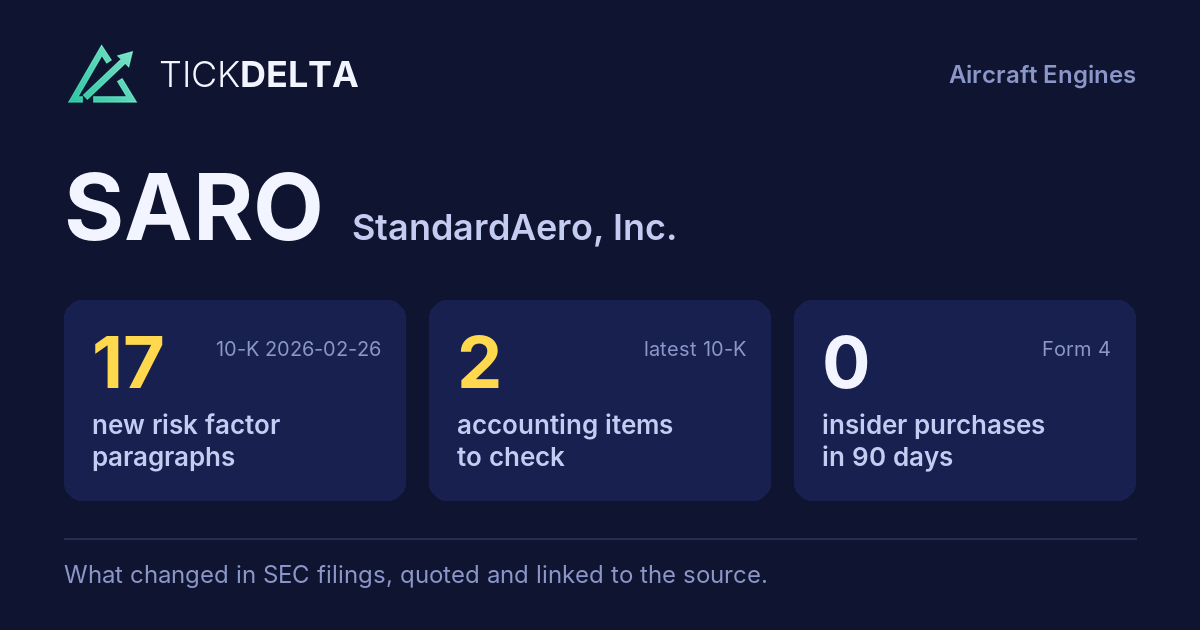
of the text changed · 26,239 words now · 17 new paragraphs, 2 gone
MD&A
21.3%
of the text changed · 7,854 words now · 9 new paragraphs, 7 gone
Legal Proceedings
6.5%
of the text changed · 305 words now
Accounting Policies
11.1%
of the text changed · 6,069 words now
10-K 0001193125-26-072618 (Feb 26, 2026) vs 10-K 0000950170-25-037939 (Mar 12, 2025)
Every paragraph, and how much of it changed
One bar per paragraph, in the order of the 10-K. Height and colour show the share of its words not in the closest paragraph a year earlier; the tallest bars are new paragraphs.
Risk Factors
300 paragraphs · 17 new · 70 reworded · 2 gone · 10-K Feb 26, 2026 against Mar 12, 2025
New paragraph
Reworded (5% of its words or more)
Same or nearly
Paragraph 193 · 47% changed
Every version of it
Paragraph 248 · 47% changed
Every version of it
Paragraph 98 · 43% changed
Every version of it
Like other companies, we regularly experience cyber-based attacks. Cybersecurity threats are continuously evolving and include, but are not limited to, both attacks on our IT Systems and attacks on the IT systems of our customers, suppliers, subcontractors and other third parties with whom we do business routinely, both on premises and in the cloud, attempting to gain unauthorized access to our confidential, proprietary, or otherwise protected information, regulated data, or information relating to our employees, customers and other third parties, or to disrupt our systems or the systems of third parties. Numerous and evolving cybersecurity risks that threaten the confidentiality, integrity and availability of our IT Systems and Confidential Information, including from diverse threat actors, such as state-sponsored organizations, opportunistic hackers and hacktivists, particularly those adverse to the security interests of the United States and its allies, which target us and other defense contractors, as well as through diverse attack vectors,
Paragraph 252 · 43% changed
Every version of it
Since May 2025, Carlyle no longer owns a majority of our common stock. As a result, we are no longer a “controlled company” within the meaning of the corporate governance standards of the NYSE and the rules of the SEC. Under these rules, a company of which more than 50% of the voting power is held by an individual, group or another company is However, even though we are no longer a “controlled company” company,” we continue to qualify for, and may rely on, exemptions from certain corporate governance requirements that would otherwise provide protection to stockholders of other companies during a one-year transition period concluding in May 2026. During this one-year transition period, we may elect not to comply with certain corporate governance requirements, including:
Paragraph 216 · 43% changed
Every version of it
Paragraph 166 · 41% changed
Every version of it
In addition, various regulatory authorities have imposed, and may continue to impose, mandatory substantive and/or disclosure requirements with respect to ESG matters that could otherwise materially impact our business and operations. For example, the SEC finalized rules that will require companies to provide certain climate-related disclosures, including with regards to greenhouse gas emissions and certain climate-related financial statement metrics. We are still assessing the scope and impact of these rules given how recently they were adopted, the subsequent legal challenges against the rules, and the expectation that the Trump Administration will not enforce the rules. We we may also be subject to the newly adopted climate-related laws from the State of California that will require in-scope entities to disclose their greenhouse gas emissions, provide a climate-related financial risk report, as well as, as for entities that market, sell, purchase, or use voluntary carbon offsets and/or make certain claims regarding the reduction of greenhouse gas emissions, or publish information about the offsets and/or reduction claims annually on their website. Other state legislatures have considered similar or conflicting rules. We may also be subject to, or indirectly impacted by, the requirements of the European Union’s sustainability reporting directives and related Taxonomy Regulation. In addition, we may be subject to International Sustainability Standards Board’s sustainability and climate-related disclosure standards, as various countries have indicated their intent to incorporate, account for or otherwise adopt such standards as law, including the United Kingdom, Canada, Japan, Singapore, Australia and Kenya. Further, we may be impacted by carbon taxes and renewable energy and fuels utilization mandates implemented across our operating jurisdictions, as well as our suppliers and customers, which might increase operational costs and procurements costs, negatively impacting our business. Any of the foregoing may require us to make additional investments in facilities and equipment, require us to incur additional costs for the collection of data and/or preparation of disclosures and associated internal controls, may impact the availability and cost of key raw materials used in the production of our products, and, in turn, may adversely affect our business, results of operations and financial condition. Moreover, these requirements may not always be uniform across jurisdictions, which may result in increased complexity, and cost, for compliance. Additionally, many of our suppliers, customers and business partners may be subject to similar requirements, which may augment or create additional risks, including risks that may not be known to us.
Paragraph 91 · 39% changed
Every version of it
authorities or changes in tax laws or regulations. From time to time, changes in tax laws or regulations may be proposed or enacted that could adversely affect our overall tax liability. There can be no assurance that changes in tax laws or regulations, both within the United States and the other jurisdictions in which we operate, such as the 15% global minimum tax under the Organisation for Economic Co-operation and Development Pillar Two, Global Anti-Base Erosion Rules (the “Pillar Two Rules”), will not materially and adversely affect our effective tax rate, tax payments, financial condition and results of operations. As of December 31, 2024, 2025, among the jurisdictions in which we operate, only the United Kingdom and France have States has not enacted legislation adopting the Pillar Two Rules, effective Rules. Furthermore, On January 5, 2026, the OECD released a “side-by-side” package that generally establishes an exemption for U.S. multinationals from the global 15% minimum tax. However, implementation of the package depends on domestic legislation and regulation in fiscal 2025. OECD member countries and is subject to subsequent review.
Paragraph 117 · 49% changed
Every version of it
10-K Mar 12, 2025The occurrence of any one of these events could adversely affect our business, results of operations and financial condition and ability to satisfy our obligations in respect of our outstanding debt.
10-K Feb 26, 2026
adverse outcomes may subject us to significant negative publicity and an erosion of trust. If any of these events were to occur, our business, results of operations and financial condition could be adversely affected.
Paragraph 193 · 47% changed
Every version of it
10-K Mar 12, 2025If we face labor shortages or increased labor costs, our results of operations and our growth could be adversely affected.
10-K Feb 26, 2026
coverage or workers’ compensation insurance), our operating expenses could increase and our business, results of operations and financial condition could be adversely affected.
Paragraph 248 · 47% changed
Every version of it
10-K Mar 12, 2025We are controlled by Carlyle, whose interests in our business may be different than yours.
10-K Feb 26, 2026
Carlyle owns a significant amount of our voting power, and their interests in our business may be different than yours.
Paragraph 98 · 43% changed
Every version of it
10-K Mar 12, 2025
Like other companies, we regularly experience cyber-based attacks. Cybersecurity threats are continuously evolving and include, but are not limited to, both attacks on our IT Systems and attacks on the IT systems of our customers, suppliers, subcontractors and other third parties with whom we do business routinely, both on premises and in the cloud, attempting to gain unauthorized access to our confidential, proprietary, or otherwise protected information, regulated data, or information relating to our employees, customers and other third parties, or to disrupt our systems or the systems of third parties. Numerous and evolving cybersecurity risks that threaten the confidentiality, integrity and availability of our IT Systems and Confidential Information, including from diverse threat actors, such as state-sponsored organizations, opportunistic hackers and hacktivists, particularly those adverse to the security interests of the United States and its allies, which target us and other defense contractors, as well as through diverse attack vectors,
10-K Feb 26, 2026
Like other companies, we regularly experience cyber-based attacks. Cybersecurity threats are continuously evolving and include, but are not limited to, both attacks on our IT Systems and attacks on the IT systems of our customers, suppliers, subcontractors and other third parties with whom we do business routinely, both on premises and in the
Paragraph 252 · 43% changed
Every version of it
10-K Mar 12, 2025
Carlyle owns a majority of our common stock. As a result, we are a “controlled company” within the meaning of the corporate governance standards of the NYSE and the rules of the SEC. Under these rules, a company of which more than 50% of the voting power is held by an individual, group or another company is a “controlled company” and may elect not to comply with certain corporate governance requirements, including:
10-K Feb 26, 2026
Since May 2025, Carlyle no longer owns a majority of our common stock. As a result, we are no longer a “controlled company” within the meaning of the corporate governance standards of the NYSE and the rules of the SEC. However, even though we are no longer a “controlled company,” we continue to qualify for, and may rely on, exemptions from certain corporate governance requirements that would otherwise provide protection to stockholders of other companies during a one-year transition period concluding in May 2026. During this one-year transition period, we may elect not to comply with certain corporate governance requirements, including:
Paragraph 216 · 43% changed
Every version of it
10-K Mar 12, 2025As of December 31, 2024, we had total indebtedness outstanding of $2,269.6 million, including $2,250.0 million under the New Credit Agreement. We and our subsidiaries may incur significant additional indebtedness in the future. Although the New Credit Agreement contains restrictions on the incurrence of additional indebtedness, these restrictions are subject to a number of qualifications and exceptions, including with respect to our ability to incur additional indebtedness. The additional indebtedness we may incur in compliance with these restrictions could be substantial. These restrictions also will not prevent us from incurring obligations that do not constitute indebtedness (including, among others, trade payables and other expenses incurred in the ordinary course of business). Additionally, pursuant to the New Senior Secured Credit Facilities, we have the option to raise incremental term loans, to raise incremental revolving credit facility commitments, to increase the commitments under the New 2024 Term Loan Facilities and to increase the commitments under the New 2024 Revolving Credit Facility by certain amounts. If new debt is added to our current debt levels, the related risks that we now face would increase.
10-K Feb 26, 2026
pursuant to the New Senior Secured Credit Facilities, we have the option to raise incremental term loans, to raise incremental revolving credit facility commitments, to increase the commitments under the New 2024 Term Loan Facilities and to increase the commitments under the New 2024 Revolving Credit Facility by certain amounts. If new debt is added to our current debt levels, the related risks that we now face would increase.
Paragraph 166 · 41% changed
Every version of it
10-K Mar 12, 2025
In addition, various regulatory authorities have imposed, and may continue to impose, mandatory substantive and/or disclosure requirements with respect to ESG matters that could otherwise materially impact our business and operations. For example, the SEC finalized rules that will require companies to provide certain climate-related disclosures, including with regards to greenhouse gas emissions and certain climate-related financial statement metrics. We are still assessing the scope and impact of these rules given how recently they were adopted, the subsequent legal challenges against the rules, and the expectation that the Trump Administration will not enforce the rules. We may also be subject to the newly adopted climate-related laws from the State of California that will require in-scope entities to disclose their greenhouse gas emissions, provide a climate-related financial risk report, as well as, for entities that market, sell, purchase, or use voluntary carbon offsets and/or make certain claims regarding the reduction of greenhouse gas emissions, publish information about the offsets and/or reduction claims annually on their website. We may also be subject to, or indirectly impacted by, the requirements of the European Union’s sustainability reporting directives and related Taxonomy Regulation. In addition, we may be subject to International Sustainability Standards Board’s sustainability and climate-related disclosure standards, as various countries have indicated their intent to incorporate, account for or otherwise adopt such standards as law, including the United Kingdom, Canada, Japan, Singapore, Australia and Kenya. Further, we may be impacted by carbon taxes and renewable energy and fuels utilization mandates implemented across our operating jurisdictions, as well as our suppliers and customers, which might increase operational costs and procurements costs, negatively impacting our business. Any of the foregoing may require us to make additional investments in facilities and equipment, require us to incur additional costs for the collection of data and/or preparation of disclosures and associated internal controls, may impact the availability and cost of key raw materials used in the production of our products, and, in turn, may adversely affect our business, results of operations and financial condition. Moreover, these requirements may not always be uniform across jurisdictions, which may result in increased complexity, and cost, for compliance. Additionally, many of our suppliers, customers and business partners may be subject to similar requirements, which may augment or create additional risks, including risks that may not be known to us.
10-K Feb 26, 2026
In addition, various regulatory authorities have imposed, and may continue to impose, mandatory substantive and/or disclosure requirements with respect to ESG matters that could otherwise materially impact our business and operations. For example, we may be subject to the climate-related laws from the State of California that require in-scope entities to disclose their greenhouse gas emissions, provide a climate-related financial risk report, as well as for entities that market, sell, purchase, or use voluntary carbon offsets and/or make certain claims regarding the reduction of greenhouse gas emissions, or publish information about the offsets and/or reduction claims annually on their website. Other state legislatures have considered similar or conflicting rules. We may also be subject to, or indirectly impacted by, the requirements of the European Union’s sustainability reporting directives and related Taxonomy Regulation. In addition, we may be subject to International Sustainability Standards Board’s sustainability and
Paragraph 91 · 39% changed
Every version of it
10-K Mar 12, 2025
minimum tax under the Organisation for Economic Co-operation and Development Pillar Two, Global Anti-Base Erosion Rules (the “Pillar Two Rules”), will not materially and adversely affect our effective tax rate, tax payments, financial condition and results of operations. As of December 31, 2024, among the jurisdictions in which we operate, only the United Kingdom and France have enacted legislation adopting the Pillar Two Rules, effective in fiscal 2025.
10-K Feb 26, 2026
authorities or changes in tax laws or regulations. From time to time, changes in tax laws or regulations may be proposed or enacted that could adversely affect our overall tax liability. There can be no assurance that changes in tax laws or regulations, both within the United States and the other jurisdictions in which we operate, such as the 15% global minimum tax under the Organisation for Economic Co-operation and Development Pillar Two, Global Anti-Base Erosion Rules (the “Pillar Two Rules”), will not materially and adversely affect our effective tax rate, tax payments, financial condition and results of operations. As of December 31, 2025, among the jurisdictions in which we operate, only the United States has not enacted legislation adopting the Pillar Two Rules. Furthermore, On January 5, 2026, the OECD released a “side-by-side” package that generally establishes an exemption for U.S. multinationals from the global 15% minimum tax. However, implementation of the package depends on domestic legislation and regulation in OECD member countries and is subject to subsequent review.
MD&A
96 paragraphs · 9 new · 45 reworded · 7 gone · 10-K Feb 26, 2026 against Mar 12, 2025
New paragraph
Reworded (5% of its words or more)
Same or nearly
Paragraph 46 · 48% changed
Selling, general and administrative expense. SG&A expense was $247.7 million and $254.1 million for the year ended December 31, 2025 and $202.8 million 2024, respectively, and was 4.1% and 4.9% of revenue for the years ended December 31, 2024 2025 and 2023, respectively, and was 4.9% and 4.5% of revenue for each of the years ended December 31, 2024 and 2023. 2024, respectively. The $51.3 $6.4 million increase decrease in SG&A expense was primarily due in large part to a $26.9 $4.1 million increase decrease in costs mainly attributable stock compensation expense, in addition to a decline in professional services fees incurred year over year, due to the IPO and a $17.4 million charge taken for the company's company’s initial recognition of stock compensation expense. The stock compensation expense relates to awards issued under 2019 Long-Term Incentive Plan in connection with Carlyle’s ownership. Because those awards do not vest until a liquidity event, the Company did not begin recognizing any associated stock compensation expense until the Company’s IPO public offering on October 2, 2024, when a liquidity event became probable. 2024.
Paragraph 56 · 46% changed
Paragraph 57 · 43% changed
Engine Services Segment Adjusted EBITDA increased $91.8 $96.0 million, or 17.7% 15.7%, to $610.9 $706.9 million for the year ended December 31, 2024 2025, from $519.1 $610.9 million for the for the year ended December 31, 2023. The increase 2024. Adjusted EBITDA margin of 13.2% was primarily in line with the prior year period, driven by increases in revenue. mix and improved productivity offset by the effect of ramping volumes on our new LEAP and CFM56 DFW Center of Excellence programs which are still coming down the learning curve.
Paragraph 82 · 41% changed
Revenue is recognized on contracts with customers for arrangements in which services and pricing are fixed and/or determinable and are generally based on customer purchase orders. We recognize revenue for performance obligations within a customer contract when control of as the associated product or service is transferred to the customer. services performed by us enhance customer-controlled assets. We have three significant types of aftermarket services revenue contracts: fixed price contracts, time and materials contracts and engine utilization contracts. The performance obligation in a contract can include: (i) repair services and parts/modules embodied and (ii) engine rental revenue. Most of the Company's arrangements with customers create a single performance obligation as the promise to transfer the individual manufactured product or service is capable of being distinct.
Paragraph 43 · 37% changed
Paragraph 76 · 36% changed
Net cash used in financing activities for the year ended December 31, 2023 2025 of $14.7 $25.5 million was primarily related attributable to incremental borrowings from the issuance $738.4 million in repayments of the Prior 2023 Term Loan Facilities of $1,479.6 million, partially long-term debt, offset by the repayment proceeds from long-term debt of $1,488.4 million of the 2019 Term Loan Facilities and 2021 Term Loan Facility, the payment of deferred financial charges of $2.9 million associated with the refinancing activities and the repayment of long-term agreements of $3.0 $715.0 million.
Paragraph 75 · 35% changed
Net cash used in investing activities for the year ended December 31, 2023 2025 of $112.9 $106.4 million was primarily due to investments made to stand up our LEAP-1A and LEAP-1B program, and consisted of $55.1 $82.4 million of purchases of property, plant and equipment equipment, rental engines and rental engines, $30.2 $30.4 million for in payment during the acquisition current period of intangible assets and $31.1 million for our licensing agreement acquired during the acquisition of Western Jet on February 2, 2023. Net cash used for investment was year ended December 2024, partially offset by the $5.1 million of proceeds from the disposal of property, plant and equipment and rental engines of $3.5 million. equipment.
Paragraph 49 · 34% changed
Interest expense. Interest expense was decreased $108.3 million, or 38.3%, from $282.5 million and $309.6 million for the years year ended December 31, 2024 and 2023, respectively. The to $174.2 million for the year ended December 31, 2025. This decrease in interest expense is attributable to was largely driven by (i) the repayment of $200.0 million on the Prior Senior Notes in March 2024, (ii) the repayment of the remaining balance of the Prior Senior Notes full on October 3, 2024 concurrent with the IPO in Company’s IPO, and (ii) entrance into the New Credit Agreement on October 2024, 31, 2024 providing for the New 2024 Term Loan Facilities and (iii) the refinancing of the Prior 2023 New 2024 Revolving Credit Facility and the use of the proceeds to repay in full amounts outstanding under the Prior Term Loan Credit Agreement and the Prior ABL Credit Agreement, terminating each of the debt facilities thereunder, and, resulting in a weighted average interest rate of borrowings for the years year ended December 31, 2024 and 2023 2025 of 6.8% compared to 8.7% and 9.2%, respectively, as for the underlying benchmark rates on our floating rate debt instruments continued to decline during 2024, which, along with the repayment of indebtedness with the proceeds of our IPO, drove the lower interest expense in the year. year ended December 31, 2024. See “—Liquidity and Capital Resources” for further discussion of our debt and financing activities.
Paragraph 46 · 48% changed
10-K Mar 12, 2025
Selling, general and administrative expense. SG&A expense was $254.1 million and $202.8 million for the years ended December 31, 2024 and 2023, respectively, and was 4.9% and 4.5% of revenue for each of the years ended December 31, 2024 and 2023. The $51.3 million increase in SG&A expense was due in large part to a $26.9 million increase in costs mainly attributable to the IPO and a $17.4 million charge taken for the company's initial recognition of stock compensation expense. The stock compensation expense relates to awards issued under 2019 Long-Term Incentive Plan in connection with Carlyle’s ownership. Because those awards do not vest until a liquidity event, the Company did not begin recognizing any associated stock compensation expense until the Company’s IPO on October 2, 2024, when a liquidity event became probable.
10-K Feb 26, 2026
Selling, general and administrative expense. SG&A expense was $247.7 million and $254.1 million for the year ended December 31, 2025 and 2024, respectively, and was 4.1% and 4.9% of revenue for the years ended December 31, 2025 and 2024, respectively. The $6.4 million decrease in SG&A expense was primarily due to a $4.1 million decrease in stock compensation expense, in addition to a decline in professional services fees incurred year over year, due to the company’s initial public offering on October 2, 2024.
Paragraph 56 · 46% changed
10-K Mar 12, 2025Component Repair Services segment revenue increased $79.0 million, or 15.4% to $592.4 million, for the year ended December 31, 2024 compared to the year ended December 31, 2023. Revenue generated from our commercial aerospace end market increased $54.7 million or 17.3%, primarily driven by an increases in component repair, which benefited from the continued growth in commercial air travel demand and reductions in pilot shortages that impacted the regional jet markets. Revenue generated from our military and helicopter end market increased $37.0 million or 56.6%, primarily attributable to the acquisition of Aero Turbine and demand strength on the platforms that we service.
10-K Feb 26, 2026
Engine Services segment revenue increased $709.3 million, or 15.3%, to $5,354.0 million for the year ended December 31, 2025, compared to $4,644.7 million for the year ended December 31, 2024. The increase was driven by continued strong commercial aerospace end market growth, underpinned by ramping volumes from our LEAP, CFM56 DFW Center of Excellence, and CF34 expansion investments, as well as growth on our mid-size and super mid-size business aviation platforms and select military transport programs.
Paragraph 57 · 43% changed
10-K Mar 12, 2025
Engine Services Segment Adjusted EBITDA increased $91.8 million, or 17.7% to $610.9 for the year ended December 31, 2024 from $519.1 million for the for the year ended December 31, 2023. The increase was primarily driven by increases in revenue.
10-K Feb 26, 2026
Engine Services Segment Adjusted EBITDA increased $96.0 million, or 15.7%, to $706.9 million for the year ended December 31, 2025, from $610.9 million for the year ended December 31, 2024. Adjusted EBITDA margin of 13.2% was in line with the prior year period, driven by mix and improved productivity offset by the effect of ramping volumes on our new LEAP and CFM56 DFW Center of Excellence programs which are still coming down the learning curve.
Paragraph 82 · 41% changed
10-K Mar 12, 2025
Revenue is recognized on contracts with customers for arrangements in which services and pricing are fixed and/or determinable and are generally based on customer purchase orders. We recognize revenue for performance obligations within a customer contract when control of the associated product or service is transferred to the customer. We have three significant types of aftermarket services revenue contracts: fixed price contracts, time and materials contracts and engine utilization contracts. The performance obligation in a contract can include: (i) repair services and parts/modules embodied and (ii) engine rental revenue. Most of the Company's arrangements with customers create a single performance obligation as the promise to transfer the individual manufactured product or service is capable of being distinct.
10-K Feb 26, 2026
Revenue is recognized on contracts with customers for arrangements in which services and pricing are fixed and/or determinable and are generally based on customer purchase orders. We recognize revenue for performance obligations within a customer contract as the services performed by us enhance customer-controlled assets. We have three
Paragraph 43 · 37% changed
10-K Mar 12, 2025Component Repair Services segment revenue increased $79.0 million, or 15.4% to $592.4 million, for the year ended December 31, 2024 compared to the year ended December 31, 2023. Revenue generated from our commercial aerospace end market increased $54.7 million or 17.3%, primarily driven by an increases in component repair, which benefited from the continued growth in commercial air travel demand and reductions in pilot shortages that impacted the regional jet markets. Revenue generated from our military and helicopter end market increased $37.0 million or 56.6%, primarily attributable to the acquisition of Aero Turbine and demand strength on the platforms that we service.
10-K Feb 26, 2026
Revenue. Revenue increased $825.4 million, or 15.8%, to $6,062.5 million for the year ended December 31, 2025 from $5,237.2 million for the year ended December 31, 2024. The increase was driven by both the Engine Services and Component Repair Services segments, with continued strength across the commercial aerospace and business aviation end markets, which increased 17.6% and 12.1%, respectively, compared to the prior year period. The military and helicopter end market increased 9.4% compared to the prior year period, including contribution from the acquisition of Aero Turbine on August 23, 2024 which contributed $64.5 million in incremental year over year revenue.
Paragraph 76 · 36% changed
10-K Mar 12, 2025
Net cash used in financing activities for the year ended December 31, 2023 of $14.7 million was primarily related to incremental borrowings from the issuance of the Prior 2023 Term Loan Facilities of $1,479.6 million, partially offset by the repayment of $1,488.4 million of the 2019 Term Loan Facilities and 2021 Term Loan Facility, the payment of deferred financial charges of $2.9 million associated with the refinancing activities and the repayment of long-term agreements of $3.0 million.
10-K Feb 26, 2026
Net cash used in financing activities for the year ended December 31, 2025 of $25.5 million was primarily attributable to $738.4 million in repayments of long-term debt, offset by proceeds from long-term debt of $715.0 million.
Paragraph 75 · 35% changed
10-K Mar 12, 2025
Net cash used in investing activities for the year ended December 31, 2023 of $112.9 million was primarily due to investments made to stand up our LEAP-1A and LEAP-1B program, and consisted of $55.1 million of purchases of property, plant and equipment and rental engines, $30.2 million for the acquisition of intangible assets and $31.1 million for the acquisition of Western Jet on February 2, 2023. Net cash used for investment was offset by the proceeds from the disposal of property, plant and equipment and rental engines of $3.5 million.
10-K Feb 26, 2026
Net cash used in investing activities for the year ended December 31, 2025 of $106.4 million primarily consisted of $82.4 million of purchases of property, plant and equipment, rental engines and $30.4 million in payment during the current period of our licensing agreement acquired during the year ended December 2024, partially offset by $5.1 million of proceeds from disposal of property, plant and equipment.
Paragraph 49 · 34% changed
10-K Mar 12, 2025
Interest expense. Interest expense was $282.5 million and $309.6 million for the years ended December 31, 2024 and 2023, respectively. The decrease in interest expense is attributable to (i) the repayment of $200.0 million on the Prior Senior Notes in March 2024, (ii) the repayment of the remaining balance of the Prior Senior Notes concurrent with the IPO in October 2024, and (iii) the refinancing of the Prior 2023 Revolving Credit Facility and the Prior Term Loan facilities resulting in a weighted average interest rate of borrowings for the years ended December 31, 2024 and 2023 of 8.7% and 9.2%, respectively, as the underlying benchmark rates on our floating rate debt instruments continued to decline during 2024, which, along with the repayment of indebtedness with the proceeds of our IPO, drove the lower interest expense in the year. See “—Liquidity and Capital Resources” for further discussion of our debt and financing activities.
10-K Feb 26, 2026
Interest expense. Interest expense decreased $108.3 million, or 38.3%, from $282.5 million for the year ended December 31, 2024 to $174.2 million for the year ended December 31, 2025. This decrease in interest expense was largely driven by (i) the repayment of the Prior Senior Notes in full on October 3, 2024 concurrent with the Company’s IPO, and (ii) entrance into the New Credit Agreement on October 31, 2024 providing for the New 2024 Term Loan Facilities and the New 2024 Revolving Credit Facility and the use of the proceeds to repay in full amounts outstanding under the Prior Credit Agreement and the Prior ABL Credit Agreement, terminating each of the debt facilities thereunder, and, resulting in a weighted average interest rate of borrowings for the year ended December 31, 2025 of 6.8% compared to 8.7% for the year ended December 31, 2024. See “—Liquidity and Capital Resources” for further discussion of our debt and financing activities.
A paragraph is matched with the one last year that shares the most of its words; under half in common makes it new. The paragraphs shown are the 8 reworded the most in each section.
The paragraph that changed most in each section
The redline
Marked against last year's 10-K: cut words struck through, new words highlighted.
Risk Factors303 words changed in this paragraph; it is 55% similar to last year's version.
Furthermore, the regulatory framework around the development and use of emerging artificial intelligence (“AI”) technologies is rapidly evolving, and many federal, state and foreign government bodies and agencies have introduced or are currently considering additional laws and regulations related to AI, machine learning, large language models, and additional emerging data technologies. Already, certain existing legal regimes (e.g., relating to data privacy) regulate certain aspects of AI technologies, and new laws regulating AI technologies have entered into force in the EU and United States. For example, in Europe, on August 1, 2024, the EU Artificial Intelligence Act (the “EU AI Act”) entered into force and establishes a comprehensive, risk-based governance framework for artificial intelligence AI in the EU market. The majority of the EU AI Act’s substantive requirements, such as transparency, conformity assessments and monitoring, risk assessments, human oversight, security and accuracy, will apply from August 2, 2026, and will impose penalties of between 3% and 7% of an undertaking’s worldwide annual turnover. Additionally, in the United States, legislation related to AI technologies have been the subject of executive orders under both the Biden and Trump administrations, and legislation has also been introduced at the federal level and enacted or passed proposed at the state level. Such level as well, including in California, Colorado and Texas. Some enacted or proposed frameworks include requirements focused on transparency, risk-management and accountability for AI technologies, while others focus on high-risk uses of AI, the use of automated decision-making technology or companies that are developers or deployers of AI technologies We expect more laws focused on the development and deployment of AI technologies to be passed in the future, which will create more compliance requirements and potentially differing requirements across different jurisdictions in which we operate. Furthermore, the Trump administration’s approach to investment in and regulation of AI technologies has and is expected to continue to deviate from that of the previous administration and we will need to adapt to any changes that may result from such approach, including as the result of new or changing executive orders. For instance, the federal government may seek to pre-empt state laws when they seek to govern certain topics, as evidenced by the Trump administration’s “Ensuring a National Policy Framework for Artificial Intelligence” Executive Order signed on December 11, 2025. This order calls for federal standards and legislation that would preempt conflicting state AI regulations and create a federal litigation task force focused on challenging state AI laws in court. The cost to comply with such laws, regulations, or decisions and/or guidance could be significant and would increase our operating expenses (such as by imposing additional regulations may reporting obligations regarding our use of AI technologies), which could impact our ability to develop, use, procure use and commercialize AI software or other AI technologies in the future and require us to expend significant resources to modify our products, services, or operations to ensure compliance or remain competitive. future.
Source: Item 1A, 10-K 0001193125-26-072618 vs Item 1A, 10-K 0000950170-25-037939
MD&A173 words changed in this paragraph; it is 77% similar to last year's version.
While the recent supply chain disruptions across our end markets are causing older aircraft and engines to remain in service longer and increasing their maintenance demand, our business also depends on maintaining a sufficient supply of parts, components and raw materials to meet the requirements of our customers. In recent years, we have experienced supply chain delays that impacted the availability of parts and ultimately engine throughput across all of our end markets. Any disruption to our supply chain and business operations, or to our suppliers’ supply chains and business operations, could have adverse effects on our ability to provide aftermarket support to our customers timely and efficiently and may increase our working capital as we wait for parts for the engines we service. Any such disruptions could adversely affect our business, results of operations and financial condition. See “Part I. Item 1A. Risk Factors—Risks Related to Our Business and Industry—We depend on certain component parts and material suppliers for our engine repair and overhaul operations, and any supply chain disruptions or loss of key suppliers could adversely affect our business, results of operations and financial condition.” In addition, the Company continues to closely monitor the implementation of tariffs tariffs, which has the potential to disrupt global trade and existing supply chains and impose additional costs on our business. While negotiations regarding tariffs are ongoing, if the resulting environment of retaliatory tariffs or other practices of additional trade restrictions or barriers require us to increase prices for our products or services, this could lead to decreased demand for our products and services, which would negatively impact our results of operations, cash flows, and financial condition. While tariff levels and related trade actions remain fluid, we expect to pass associated cost increases through to customers where possible, though timing delays may impact margins. However, factors such as the Company’s operations and supply chains, which are primarily located in regions where our products are sold, along with the applicability of the United States-Mexico-Canada Agreement, help reduce our exposure to trade disruptions, but there can be no assurance that these factors, or our pricing actions, will be effective mitigants given the uncertain environment. Most recently, in February 2026, the United States Supreme Court ruled that the use of IEEPA to impose tariffs was not authorized by Congress, invalidating a significant portion of tariffs that had been in effect since April 2025. While the ruling struck down the IEEPA-based tariffs, it does not prevent the administration from imposing tariffs using other legal authorities, and the administration has indicated its intention to pursue alternative statutory mechanisms to reinstate or impose new tariffs. See “Part I. I, Item 1A. Risk Factors—Risks Related to Our Business and Industry—United States trade policies that restrict imports or increase import tariffs may have a material adverse effect on our business.”
Source: Item 7, 10-K 0001193125-26-072618 vs Item 7, 10-K 0000950170-25-037939
Accounting Policies154 words changed in this paragraph; it is 61% similar to last year's version.
Engine utilization contracts are agreements in which the Company will provide a stand ready service of scheduled and unscheduled maintenance events. Revenue is recognized over time using an input method with revenue amounts being recognized proportionately as costs are incurred relative to total expected costs to satisfy the performance obligation. The Company identifies and estimates the variable consideration of the total contract revenue and costs of the engine utilization contract. The estimates used are based on the Company’s expected value with respect to the customer’s utilization of engines during the contract and only recognized to the extent that it is probable that a significant reversal in the amount of cumulative revenue recognized will not occur when the uncertainty associated with the variable consideration is subsequently resolved. As a result, such estimates may be materially impacted by changes in the customer’s engine utilization including, as a result of general economic slowdowns, fleet retirements and changes in the customer’s agreements. As a significant change in one or more of these estimates could affect the profitability of a contract, estimates are reviewed and updated on a quarterly basis. Revenue and profit in future periods of contract performance is recognized using the adjusted estimate. The Company’s engine utilization contracts with customers generally require monthly payments under normal commercial terms based on flight hours. The timing of satisfaction of performance obligations and actual receipt of payment from a customer may differ and affect the balance of contract assets and contract liabilities. The Company’s current contracts do not include any significant financing components as the timing of the transfer of the underlying products and services under contract are at the customer’s discretion.
Source: Item 8, Note 2 – SUMMARY OF SIGNIFICANT ACCOUNTING POLICIES, 10-K 0001193125-26-072618 vs Item 8, Note 2 – SUMMARY OF SIGNIFICANT ACCOUNTING POLICIES, 10-K 0000950170-25-037939
Legal Proceedings39 words changed in this paragraph; it is 56% similar to last year's version.
The Company has future contractual commitments of $30.9 million as of December 31, 2025, and had $30.6 million as of December 31, 2024, and $38.7 million as of December 31, 2023, for capital commitments. The aggregate amount of future contractual commitments due in each of the next five fiscal years is $29.3 million in 2025, $0.5 million in 2026, $0.4 million in 2027, $0.3 million in 2028 and $0.1 million in 2029.
Source: Item 3, via Note 15 – COMMITMENTS AND CONTINGENCIES, 10-K 0001193125-26-072618 vs Item 3, via Note 15 – COMMITMENTS AND CONTINGENCIES, 10-K 0000950170-25-037939
Sentences and paragraphs added, removed or reworded
Every change, by type
Sentences and paragraphs of SARO's Risk Factors and MD&A, 10-K Feb 26, 2026 against 10-K Mar 12, 2025. Each links to the text at sec.gov.
Quiet changes are sentences kept from last year with one to four words changed, at least one of them a hedge, a modal or a qualifier (may, could, will, not, significant, material…). A year or date rolling forward is not counted.
The full word list
adverse, adversely, all, although, anticipate, anticipates, any, approximately, believe, believes, can, cannot, certain, could, expect, expects, generally, however, if, intend, intends, largely, likely, many, material, materially, may, might, most, must, never, no, not, possible, primarily, probable, should, significant, significantly, some, substantial, substantially, unlikely, will, would
AddedRisk Factors
These material weaknesses contributed to the following additional material weaknesses:
Read it in 10-K Feb 26, 2026 at sec.gov
AddedRisk Factors
relation to an attack or incident will be covered by our existing insurance policies or that applicable insurance will be available to us in the future on economically reasonable terms or at all.
Read it in 10-K Feb 26, 2026 at sec.gov
AddedRisk Factors
remedies for trade secret misappropriation, the remedies and damages available to us under U.S. copyright laws for unauthorized use of our software may be limited.
Read it in 10-K Feb 26, 2026 at sec.gov
AddedRisk Factors
and other countries and regularly import and export goods and services to and from those countries. An increase in tariffs could have a material impact on our costs and on the demand for our products and services.
Read it in 10-K Feb 26, 2026 at sec.gov
AddedRisk Factors
accessories, embargoes on flights from certain airlines, sanctions on certain individuals and companies, and the stability of certain customers could impact the global economy and aviation sector.
Read it in 10-K Feb 26, 2026 at sec.gov
AddedRisk Factors
Given the nature of our business and the industries we serve, we must anticipate and respond to market, technological, regulatory and other changes driven by broader trends related to greenhouse gas emission reduction efforts in response
Read it in 10-K Feb 26, 2026 at sec.gov
AddedRisk Factors
available in the future or may be available only on unacceptable terms. We are also subject to warranty claims for which our reserves may prove to be inadequate.
Read it in 10-K Feb 26, 2026 at sec.gov
AddedRisk Factors
time and resources necessary to resolve them, would divert the resources of our management and harm our business, results of operations and financial condition.
Read it in 10-K Feb 26, 2026 at sec.gov
Show the other 53
AddedRisk Factors
We are not a “controlled company” within the meaning of the NYSE rules. However, we may continue to rely on exemptions from certain corporate governance requirements during a one-year transition period.
Read it in 10-K Feb 26, 2026 at sec.gov
AddedRisk Factors
The shares of our common stock held by Carlyle, together with shares held by certain of our directors, executive officers and other affiliates, as that term is defined under Rule 144 of the Securities Act (“Rule 144”), are “restricted securities” as defined under Rule 144 and subject to certain restrictions on resale. Restricted securities may be sold in the public market only if they are registered under the Securities Act or are sold pursuant to an exemption from registration such as Rule 144.
Read it in 10-K Feb 26, 2026 at sec.gov
AddedRisk Factors
Pursuant to the Stockholders Agreement, Carlyle has certain registration rights with respect to our common stock. Registration of any of these outstanding shares of common stock would result in such shares becoming freely tradable without compliance with Rule 144 upon effectiveness of the registration statement. If Carlyle exercises its registration rights, the market price of our common stock could drop significantly if the holders of these shares sell them or are perceived by the market as intending to sell them. These factors could also make it more difficult for us to raise additional funds through future offerings of our common stock or other securities.
Read it in 10-K Feb 26, 2026 at sec.gov
AddedRisk Factors
In addition, our shares of common stock reserved for future issuance under the 2024 Plan, the ESPP and the Prior Plan will become eligible for sale in the public market once those shares are issued, subject to provisions relating to various vesting agreements, lock-up agreements and Rule 144, as applicable.
Read it in 10-K Feb 26, 2026 at sec.gov
RemovedRisk Factors
RemovedRisk Factors
RewordedRisk Factors
Cybersecurity threats are continuously evolving and include, but are not limited to, both attacks on our IT Systems and attacks on the IT systems of our customers, suppliers, subcontractors and other third parties with whom we do business routinely, both on premises and in the cloud, attempting to gain unauthorized access to our confidential, proprietary, or otherwise protected information, regulated data, or information relating to our employees, customers and other third parties, or to disrupt our systems or the systems of third parties.
Read it in 10-K Feb 26, 2026 at sec.gov
RewordedRisk Factors
RewordedRisk Factors
Factors such as increased energy costs, the availability of certain raw materials for engine components, parts and accessories, embargoes on flights from certain airlines, sanctions on certain individuals and companies, and the stability of certain customers could impact the global economy and aviation sector.
Read it in 10-K Feb 26, 2026 at sec.gov
RewordedRisk Factors
A reduction in flight activity of aircraft and changes in customer travel patterns both in the United States and abroad has resulted in and may continue to could result in reduced demand for aftermarket services, which we experienced during the height of the COVID-19 pandemic in 2020 and 2021. services.
Read it in 10-K Feb 26, 2026 at sec.gov
RewordedRisk Factors
Furthermore, we will become are subject to enhanced requirements, including potential Cybersecurity Maturity Model Certification (“CMMC”) assessments and/or certifications as defined in 32 CFR Part 170 program rule, later in as of November 10, 2025 once when the 48 CFR CMMC acquisition rule is approved. became effective.
Read it in 10-K Feb 26, 2026 at sec.gov
RewordedRisk Factors
If such claims are successful, our business, results of operations and financial condition would be adversely affected, and even if the claims do not result in litigation or are resolved in our favor, these claims, and the time and resources necessary to resolve them, would divert the resources of our management and harm our business, results of operations and financial condition.
Read it in 10-K Feb 26, 2026 at sec.gov
RewordedRisk Factors
If we face labor shortages or increased labor costs because of increased competition for employees from our competitors and other industries, higher employee-turnover rates, increases in the federal- or state-mandated minimum wage, inflation, change in exempt and non-exempt status, or other employee benefit costs (including costs associated with health insurance coverage or workers’ compensation insurance), our operating expenses could increase and our business, results of operations and financial condition could be adversely affected.
Read it in 10-K Feb 26, 2026 at sec.gov
RewordedRisk Factors
Any or all of the foregoing public disclosure relating to a material cybersecurity incident could harm our reputation, result in litigation and adversely affect our business, results of operations and financial condition.
Read it in 10-K Feb 26, 2026 at sec.gov
RewordedRisk Factors
The DoD expects that all new contracts will be required to comply with the CMMC by 2026, and initial requests for information and for proposal have already begun. CMMC.
Read it in 10-K Feb 26, 2026 at sec.gov
RewordedRisk Factors
The CCPA has required and will likely continue to require us to modify our data collection or processing practices and policies or our business model and to incur substantial costs and expenses in an effort to comply and increase our potential exposure to regulatory enforcement and/or litigation. litigation, which could have an adverse effect on our business, results of operations, and financial condition.
Read it in 10-K Feb 26, 2026 at sec.gov
RewordedRisk Factors
RewordedRisk Factors
It is also possible that we could become subject to a regulatory inquiry or investigation and be required to take additional compliance steps or incur costs in remediating any identified issues.
Read it in 10-K Feb 26, 2026 at sec.gov
Quiet changesRisk Factors
Quiet changesRisk Factors
U.S. government rules allow contracting officers to impose contractual withholdings at no less than certain minimum levels if a contracting officer determines that one or more of a contractor’s business systems have one or more significant deficiencies.
Read it in 10-K Feb 26, 2026 at sec.gov
Quiet changesRisk Factors
As a result, we are no longer a “controlled company” within the meaning of the corporate governance standards of the NYSE and the rules of the SEC.
Read it in 10-K Feb 26, 2026 at sec.gov
Quiet changesRisk Factors
We have elected to opt out of Section 203 of the DGCL; however, our amended and restated certificate of incorporation will contain contains a provision that is of similar effect, except that it will exempt from its scope Carlyle, and any of its direct or indirect transferees and any group as to which such persons or entities are a party.
Read it in 10-K Feb 26, 2026 at sec.gov
Quiet changesRisk Factors
In addition, to the fullest extent permitted by law, in the event that Carlyle, the GIC Investor or any non-employee director acquires knowledge of a potential transaction or other business opportunity which may be a corporate opportunity for itself or himself or its or his affiliates or for us or our affiliates, such person will have has no duty to communicate or offer such transaction or business opportunity to us or any of our affiliates and they may take any such opportunity for themselves or offer it to another person or entity.
Read it in 10-K Feb 26, 2026 at sec.gov
Quiet changesRisk Factors
Our amended and restated certificate of incorporation and amended and restated bylaws will also require that the federal district courts of the United States of America will be are the exclusive forum for the resolution of any complaint asserting a cause of action arising under the Securities Act; however, there is uncertainty as to whether a court would enforce such provision, and investors cannot waive compliance with federal securities laws and the rules and regulations thereunder.
Read it in 10-K Feb 26, 2026 at sec.gov
Quiet changesRisk Factors
These provisions would do not apply to any suits brought to enforce any liability or duty created by the Exchange Act, or any other claim for which the federal courts of the United States have exclusive jurisdiction, subject to applicable law.
Read it in 10-K Feb 26, 2026 at sec.gov
AddedMD&A
In March 2025, two of the Company’s stockholders (the “Selling Stockholders”), affiliates of The Carlyle Group Inc. (“Carlyle”) and GIC Private Limited (“GIC”), completed a public offering of an aggregate of 36,000,000 shares of Common Stock at a price to the public of $28.00 per share. The Selling Stockholders received all of the net proceeds from this offering. No shares were sold by the Company.
Read it in 10-K Feb 26, 2026 at sec.gov
AddedMD&A
In May 2025, the Selling Stockholders completed a public offering of an aggregate of 34,500,000 shares of Common Stock (including full exercise by the underwriters of their option to purchase up to an additional 4,500,000 shares) at a price to the public of $28.00 per share. The Selling Stockholders received all of the net proceeds from this offering. No shares were sold by the Company. As of December 31, 2025, Carlyle and GIC own approximately 45.6% and 10.3% of our outstanding Common Stock, respectively.
Read it in 10-K Feb 26, 2026 at sec.gov
AddedMD&A
On January 29, 2026, the Selling Stockholders completed a public offering of an aggregate of 57,500,000 shares of Common Stock (including the full exercise by the underwriters of their option to purchase up to an additional 7,500,000 shares) at a price to the public of $31.00 per share (the “January 2026 Offering”).
Read it in 10-K Feb 26, 2026 at sec.gov
AddedMD&A
On January 29, 2026, the Company completed the repurchase of 1,637,465 shares of Common Stock from a selling stockholder affiliated with GIC (the “GIC Stockholder”) in a private transaction at a price of $30.54 per share (the “Share Repurchase”). The Share Repurchase was made pursuant to the Company’s existing stock repurchase program approved by its board of directors in December 2025 and pursuant to a stock purchase agreement, dated January 20, 2026, with the GIC Stockholder. The Share Repurchase was conditioned upon the completion of the January 2026 Offering and closed concurrently with such offering. The repurchased shares of Common Stock are no longer outstanding.
Read it in 10-K Feb 26, 2026 at sec.gov
AddedMD&A
As of January 29, 2026, Carlyle and GIC own approximately 31.4% and 7.1% of the Company’s outstanding Common Stock, respectively.
Read it in 10-K Feb 26, 2026 at sec.gov
AddedMD&A
September 6, 2024 with incremental borrowings from the Prior 2024 Term B-1 Loan Facility and the Prior 2024 Term B-2 Loan Facility.
Read it in 10-K Feb 26, 2026 at sec.gov
AddedMD&A
Increases from Adjusted EBITDA to Consolidated EBITDA Amount (in thousands) Last twelve months ended December 31, 2025 $5.1 Last twelve months ended December 31, 2024 $5.0
Read it in 10-K Feb 26, 2026 at sec.gov
AddedMD&A
Year Ended December 31, 2025 2024 Consolidated statements of cash flows data: (in thousands) Net cash provided by operating activities $ 316,705 $ 76,330 Net cash used in investing activities (106,402) (235,446) Net cash (used in) provided by financing activities (25,507) 203,756 Effect of exchange rate changes on cash 2,340 (41) Net increase in cash 187,136 44,599 Cash at beginning of period 102,581 57,982 Cash at end of period $ 289,717 $ 102,581
Read it in 10-K Feb 26, 2026 at sec.gov
AddedMD&A
accounting policy, including the estimation of obsolescence or unmarketable inventory on a part-by-part basis using aging profiles.
Read it in 10-K Feb 26, 2026 at sec.gov
RemovedMD&A
RemovedMD&A
RemovedMD&A
RemovedMD&A
RemovedMD&A
RemovedMD&A
RemovedMD&A
RewordedMD&A
Year Ended December 31, 2025 2024 2023 (in millions, thousands, except percentages) Net income (loss) $ 11.0 277,417 $ (35.1 10,974 Income tax expense 70.8 40.2 99,435 70,783 Depreciation and amortization 188.1 197.1 193,664 188,164 Interest expense 282.5 309.6 174,217 282,507 Business transformation costs (LEAP and 43.2 11.4 26,028 43,238 CFM) (4) (1) IPO-related costs 26.9 — 26,909 Refinancing costs 23.7 19.9 — 23,700 Loss on debt extinguishment 15.3 6.2 Stock — 15,255 Non-cash stock compensation (2) 17.4 — expense 13,237 17,376 Integration costs and severance (1) 2.8 1.4 (2) 5,601 2,782 Acquisition costs (3) 1.4 1.5 — 1,374 Insurance recovery (3,000) — Loss on disposals 2,764 — Secondary offering costs 4,990 — Other (5) 7.4 8.9 (4) 13,820 7,470 Adjusted EBITDA $ 690.5 808,173 $ 561.1 690,532 Revenue $ 5,237.2 6,062,513 $ 4,563.3 5,237,161 Net income (loss) margin 4.6% 0.2% (0.8 Adjusted EBITDA Margin 13.3% 13.2% 12.3
Read it in 10-K Feb 26, 2026 at sec.gov
RewordedMD&A
The tax expense expense, and corresponding effective tax rates for the years ended December 31, 2025 and 2024, were higher than the statutory rate for 2024 and 2023 were high of 21.0% primarily due to State income taxes and the Global Intangible Low-taxed Income (GILTI) (“GILTI”) provision which was enacted in 2017 as part of the Tax Cuts and Jobs Act as well as the partial valuation allowance recorded against our interest expense carryforward deferred tax asset under Section 163(j) of the Internal Revenue Code. Act.
Read it in 10-K Feb 26, 2026 at sec.gov
RewordedMD&A
A $6.2 $15.3 million loss on debt extinguishments was recorded during the year ended December 31, 2023, 2024 due to the write-off of unamortized deferred finance charges and debt discount related to the extinguished portion of the 2019 Prior 2023 Term Loan Facilities and 2021 Term Loan Facility (both defined below) redeemed portion of the Prior Senior Notes related to the refinancing activity. activity, with no similar charges incurred in the year ended December 31, 2025.
Read it in 10-K Feb 26, 2026 at sec.gov
RewordedMD&A
RewordedMD&A
The definition of Consolidated EBITDA utilized for these debt reporting covenants differs from the definition of Adjusted EBITDA presented in this Annual Report in that it represents Adjusted EBITDA as further adjusted for certain additional items including, among other things, certain start-up costs to give pro forma effect to acquisitions, including resulting synergies, and cost savings. items, as set forth in the New Credit Agreement.
Read it in 10-K Feb 26, 2026 at sec.gov
RewordedMD&A
Cost of revenue increased $555.0 $682.0 million, or 14.1%, 15.2%, to $5,165.1 million for the year ended December 31, 2025 from $4,483.0 million for the year ended December 31, 2024 from $3,928.0 million for the year ended December 31, 2023. 2024.
Read it in 10-K Feb 26, 2026 at sec.gov
RewordedMD&A
Refinancing costs of $19.9 $23.7 million associated with the amendment modified portion of the Prior Credit Agreement amendments in August 2023 March and September 2024 were incurred during the year ended December 31, 2023. 2024, with no similar charges incurred in the year ended December 31, 2025.
Read it in 10-K Feb 26, 2026 at sec.gov
RewordedMD&A
Year Ended December 31, 2025 2024 2023 (in millions, thousands, except percentages) Engine Services Segment Revenue $4,644.8 $4,049.9 $5,353,953 $4,644,739 Segment Adjusted EBITDA $610.9 $519.1 $706,883 $610,906 Segment Adjusted EBITDA Margin 13.2% 12.8% 13.2% Component Repair Services Segment Revenue $592.4 $513.4 $708,560 $592,422 Segment Adjusted EBITDA $154.7 $125.3 $202,704 $154,734 Segment Adjusted EBITDA Margin 28.6% 26.1% 24.4%
Read it in 10-K Feb 26, 2026 at sec.gov
RewordedMD&A
As of December 31, As of December 31, 2025 2024 2023 (in millions) thousands) Cash $ 102.6 289,717 $ 58.0 102,581 Net working capital (total current assets less total current liabilities) 1,211.6 1,066.3 1,580,122 1,211,590 Total debt (including current portion) (1) 2,231.4 3,198.8 2,214,605 2,231,426 Total stockholders' equity 2,373.4 1,146.7 2,667,311 2,373,404
Read it in 10-K Feb 26, 2026 at sec.gov
RewordedMD&A
The acquisition was funded with borrowings under the Prior ABL Credit Facility, which was repaid on September 6, 2024 with incremental borrowings from the Prior 2024 Term Loan B-1 Facility and the Prior 2024 Term Loan B-2 Facility.
Read it in 10-K Feb 26, 2026 at sec.gov
RewordedMD&A
Component Repair Services Segment Adjusted EBITDA segment revenue increased $29.4 $116.2 million, or 23.5%, 19.6%, to $154.7 $708.6 million for the year ended December 31, 2025, compared to $592.4 million for the year ended December 31, 2024.
Read it in 10-K Feb 26, 2026 at sec.gov
RewordedMD&A
Sources
The two latest 10-Ks on EDGAR, section by section. Each change links to the text at sec.gov.
Also
New risk factors: paragraphs with nothing like them last year, quoted in full.
Work with it
Excel workbook · CSV. Google Sheet that stays up to date: paste =IMPORTDATA("https://tickdelta.com/company/SARO/export.csv") into a cell.