Screener / SEC EDGAR /CIK 0001492298 /10-K filed Feb 12, 2026, compared with Feb 19, 2025 /Numbers from the XBRL of the 10-Ks
Nasdaq Real estate · REIT

Sabra Health Care REIT, Inc. SBRA

Compare with peers Embed
SEC comment letters, last 20 years

6 reviews of SBRA's filings by SEC staff

UPLOAD and CORRESP
Reviews 6 latest letter May 16, 2022
Questions asked 9 each answered in the company's own letter
No closing letter 1 reviews without a letter saying the staff completed it

When the SEC's staff reviews a filing, it writes to the company with numbered questions, and the company answers each one in a letter. SEC publishes the exchange once the review is over, at least 20 business days later. A question is not an accusation; most reviews end with the company adding detail to its next filing.

How the reviews went

Every review on EDGAR, from the first staff letter to the letter that closes it

  1. 1. Staff letters 6 UPLOAD
  2. 2. Questions in them 9 numbered comments
  3. 3. Company replies 7 CORRESP
  4. 4. Reviews closed 5 of 6 closing letter

Half the closed reviews took 9 days or less from the first letter to the closing letter.

Form 10-K for the year ended December 31, 2021

2022-05-16 to 2022-05-24 · 1 question · 1 letter from the SEC, 1 from the company
Review closed 2022-05-24
Results discussion (MD&A)Goodwill and impairment
Item 7. Management's Discussion and Analysis of Financial Condition and Results of Operations · Funds from Operations and Adjusted Funds from Operations, page 42
SEC asked
We note your define FFO as Net income as defined by GAAP excluding certain adjustments including your share of depreciation and amortization and impairment charges by your unconsolidated JV. Given that you own a 49% interest in your unconsolidated JV, please further tell us how you determined the $26.1 million depreciation, amortization and impairment of real state assets amount in your FFO calculation.
Rest of the question

In that regard, we note that total depreciation and amortization was $24 million and total impairment loss was $7.3 million based on the audited consolidated statement of of operations and comprehensive loss for your JV as included in Exhibit 99.1 of your Form 10-K/A filed on March 30, 2022.

SBRA answered
In addition to the items noted above, depreciation, amortization and impairment of real estate assets related to unconsolidated joint venture also includes basis difference amortization and impairment. The difference between Sabra’s stepped-up investment basis in the joint venture and its share of the historical book value of the joint venture (or basis difference) is amortized over the estimated useful life of the assets in the joint venture and if any of the assets in the joint venture are considered impaired, we record an impairment on a portion of the basis difference related to that
Rest of the answer

asset. Since the basis difference relates solely to Sabra’s investment, amortization and impairments of the basis difference are not a component of the financial performance of the joint venture and are therefore excluded from the joint venture’s audited consolidated statement of operations and comprehensive loss for the JV included in Exhibit 99.1 of our Form 10-K/A filed on March 30, 2022.

U.S. Securities and Exchange Commission

During the year ended December 31, 2021, Sabra recorded $10.8 million of basis difference amortization and impairment, which is included in depreciation, amortization and impairment of real estate assets related to unconsolidated joint venture. Below is a recap of the components (in millions):

Read in the reply
In its next report

First report after the company's reply of May 19, 2022: 10-Q filed Aug 3, 2022 ↗, against the 10-Q filed May 4, 2022 ↗.

Tickdelta does not hold the text of both reports, so they are not compared here.

Also in this review: closing letter, 2022-05-24

Form 10-K for the fiscal year ended December 31, 2020

2021-07-01 to 2021-08-06 · 3 questions · 1 letter from the SEC, 1 from the company
Review closed 2021-08-06
Non-GAAP measures
Exhibit 99.1 · Same-Store Senior Housing - Managed Occupancy and NOI Margins, page 2
SEC asked (1)
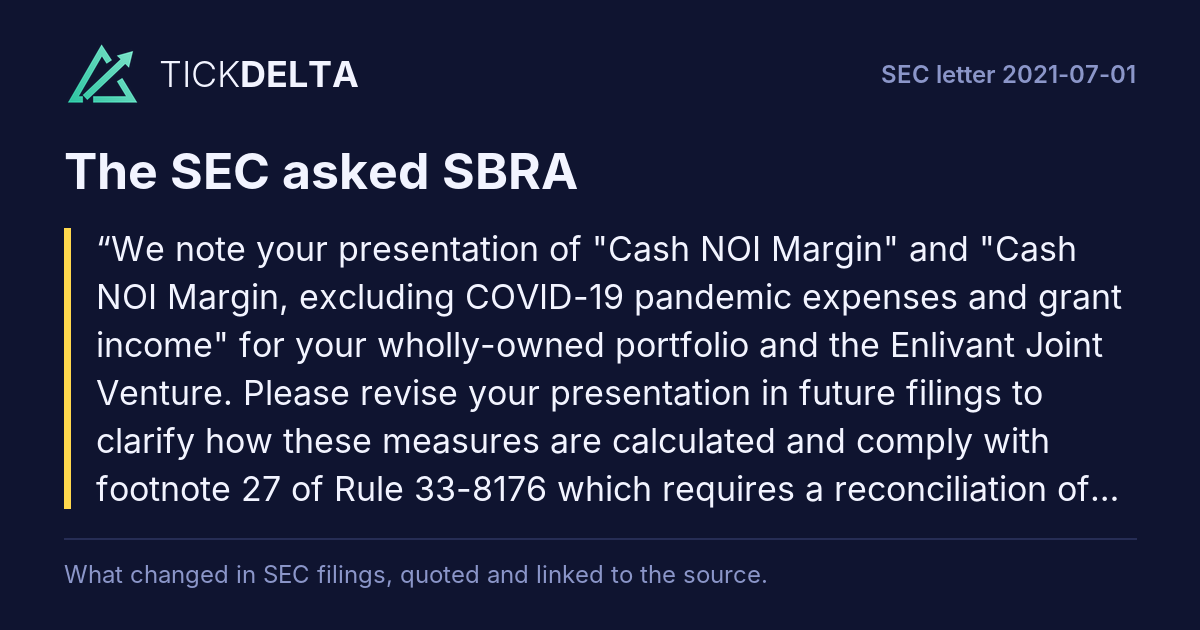
We note your presentation of "Cash NOI Margin" and "Cash NOI Margin, excluding COVID-19 pandemic expenses and grant income" for your wholly-owned portfolio and the Enlivant Joint Venture. Please revise your presentation in future filings to clarify how these measures are calculated and comply with footnote 27 of Rule 33-8176 which requires a reconciliation of each non-GAAP financial measure used in the calculation
Rest of the question

and presentation of the ratio as calculated using the most directly comparable GAAP financial measure.

SBRA answered
In future filings we will not include “Cash NOI Margin” and “Cash NOI Margin, excluding COVID-19 pandemic expenses and grant income” in our earnings release. Instead, in future filings, we plan to include “Cash NOI Margin” in our supplemental information presentation – this

U.S. Securities and Exchange Commission

Page of 3 was Exhibit 99.2 to the Form 8-K filed May 5, 2021.
Rest of the answer

In such future supplemental information presentations that include Cash NOI Margin, we plan to also include a description of how Cash NOI

Margin is calculated (Cash NOI divided by Resident Fees and Services) as well as a reconciliation of “Cash NOI” to the most comparable GAAP measure (Net Income). We believe that with the description of the calculation, the presentation of

Cash NOI Margin will comply with footnote 27 of Rule 33-8176 as the numerator (Cash NOI) is being reconciled to the most comparable GAAP measure (Net Income) and the denominator (Resident Fees and Services) is a GAAP measure.

Read in the reply
In its next report

First report after the company's reply of Jul 29, 2021: 10-Q filed Aug 4, 2021 ↗, against the 10-Q filed May 5, 2021 ↗.

Tickdelta does not hold the text of both reports, so they are not compared here.

Exhibit 99.1 · Same-Store Senior Housing - Managed Occupancy and NOI Margins, page 2
SEC asked (2)
Please tell us, and enhance future filings to describe the nature of the COVID-19 pandemic expenses and grant income and how you were able to determine they are incremental to your normal operations and nonrecurring. Refer to CF Disclosure Guidance: Topic No. 9.
SBRA answered
The following is a description of the COVID-19 pandemic expenses and grant income, which we referenced in Exhibit 99.1 to our Form 8-K filed May 5, 2021:

COVID-19 pandemic expenses consist primarily of (i) personal protective equipment (“PPE”) costs, (ii) incremental labor costs (including bonuses, hero pay and additional labor needed to implement new health and safety protocols) and

(iii) incremental supply costs required to implement new health and safety protocols (e.g., disposable food containers and stronger disinfectants), in each case incurred by operators in our Senior Housing -
Rest of the answer

Managed portfolio specifically as a result of the COVID-19 pandemic. Grant income consists of funds specifically paid to operators in our Senior Housing - Managed portfolio from state or federal governments related to the pandemic and were incremental to the amounts these operators would have otherwise received for providing care to their residents.

In future filings where we reference these terms, we will define them as set forth above.

Regarding the determination that COVID-19 pandemic expenses and grant income are non-recurring, we evaluated the nature of the income and expenses together with the observed historical trends in these items. The issuance of funds recognized by us as grant income varied from state to state and the methodologies included payment based on the number of beds or units in a facility, payment based on the submitted costs associated with the pandemic (e.g., testing supplies, PPE costs) and payment based on the number of hours worked by certain front-line staff. As a result, the amounts were clearly distinguishable from amounts billed for providing care to the residents of these facilities in the normal course. Although we may continue to experience heightened pandemic-related expenses during the pendency of the pandemic, including as a result of new and more contagious and/or vaccine resistant variants, we view both the COVID-19 pandemic expenses and the grant income to be nonrecurring since several of these items were one-time in nature and others have been reduced to immaterial amounts over time (e.g., disposable food containers, incremental labor for certain functions) and are therefore not expected to be part of the normal and recurring income and expense structure of these facilities. We intend to discontinue our adjustments for COVID-19 pandemic expenses and grant income when such costs are no longer incurred or, with respect to any COVID-19 pandemic expenses, at such time as we determine that such COVID-19 pandemic expenses are expected to continue beyond the current

COVID-19 pandemic and become normal and recurring expenses of the facilities (which we do not currently expect).

Read in the reply
In its next report

First report after the company's reply of Jul 29, 2021: 10-Q filed Aug 4, 2021 ↗, against the 10-Q filed May 5, 2021 ↗.

Tickdelta does not hold the text of both reports, so they are not compared here.

Exhibit 99.3 · Cash NOI by Facility Type, page 6
SEC asked (3)
Please describe and disclose in further detail the annualizing adjustments made to same store cash NOI.
SBRA answered
In future filings that include this reconciliation, we will include the following footnote to the “Annualizing Adjustments” line item:

Represents the annual effect of acquisitions, dispositions, lease modifications and scheduled rent increases completed during the period and mathematical adjustments needed to make Cash Net Operating Income for the period representative of Cash Net Operating Income for a full year. Annualizing adjustments also include the removal of COVID-19 pandemic expenses, grant income, and triple-net operating expenses (net of recoveries).
Read in the reply
In its next report

First report after the company's reply of Jul 29, 2021: 10-Q filed Aug 4, 2021 ↗, against the 10-Q filed May 5, 2021 ↗.

Tickdelta does not hold the text of both reports, so they are not compared here.

Also in this review: closing letter, 2021-08-06

Form 10-K for the fiscal year ended December 31, 2018

2019-09-12 to 2019-09-19 · 1 question · 1 letter from the SEC, 1 from the company
Review closed 2019-09-19
Goodwill and impairmentLeases
Notes to Consolidated Finanacial Statements · Note 4. Real Estate Properties Held For Investment, page F-21
SEC asked
We note your agreement established on December 5, 2018 and amended in January 2019 to sell 26 skilled nursing/transitional care facilities and two senior housing communities operated by Senior Care Centers for an aggregate sales price of $282.5 million.
Rest of the question

We further note you previously planned to retain the remaining 10 facilities operated by Senior Care Centers and re-lease those facilities to one or more new operators, and have subsequently revised your expectations and now planned to sell an additional two facilities. We further note you recorded an impairment charge of $92.2 million related to the Senior Care Centers facilities during the quarterly period ended March 31, 2019. Please tell us how you determined it was unnecessary to record an impairment charge for the Senior Care Centers facilities during the year ended December 31, 2018. In your response, please separately address the 28 properties that were sold on April 1, 2019 and the 10 properties that were retained. Reference is made to ASC 360-10-35. We remind you that the company and its management are responsible for the accuracy and adequacy of their disclosures, notwithstanding any review, comments, action or absence of action by the staff.

SBRA answered
During the third quarter of 2018, Senior Care Centers defaulted under the terms of its master leases with us due to non-payment of rent. Because of this default, we

Ms. Monick and Mr. McPhun, September 17, 2019 terminated the master leases in August 2018. Following such termination, Senior Care Centers continued to operate the 38 facilities that had previously been subject to the master leases (the

“SCC Facilities”) on a month-to-month basis.
Rest of the answer

Deposits were fully exhausted to pay contractual rents through a portion of September 2018, and no revenue was recorded subsequent to September 2018 related to our master leases with Senior Care

Centers until our receipt of post-petition rent in March 2019. On August 27, 2018, we entered into a non-binding letter of intent to sell the SCC Facilities to a third party purchaser (the “Purchaser”) for an aggregate sales price of

$405.0 million, inclusive of a potential earnout opportunity of $27.5 million.

Notwithstanding our entry into this letter of intent, we considered the sale of the SCC Facilities to be subject to substantial uncertainty until shortly before the actual closing. Transactions of this nature are subject to substantial purchaser diligence and it is not unusual for a purchaser to walk away from a transaction or seek to renegotiate its terms during, or even after, the due diligence period. As described in more detail below, that was the case for the sale of the SCC Facilities. Throughout the sale process, our asset management team was in fluid discussions with the Purchaser about the facilities to be included in the transaction and the price. In addition, we had to deal with the uncertainty of the eventual bankruptcy process for Senior Care Centers and the need for regulatory approvals in connection with the proposed change in ownership of the SCC Facilities. During this process, we continued to believe that an alternative to selling the SCC Facilities was to lease the SCC Facilities to new operators, and that we could do so in a manner (as described in more detail below) that would result in the future undiscounted cash flows from these new leases exceeding the carrying value of the SCC Facilities as of the relevant measurement date.

On December 5, 2018, we entered into a purchase and sale agreement to sell the SCC Facilities for an aggregate sales price of $385 million (the “Initial PSA”). The Initial PSA included a due diligence period that was initially set to expire on December 14, 2018 and that was extended first to December 28, 2018 and then ultimately to January 17, 2019. At any time before the due diligence period expiration date, the Purchaser would be able to terminate the Initial PSA without penalty for any reason. In addition, the closing of the transaction was contingent upon our ability to negotiate a settlement agreement with Senior Care Centers pursuant to which Senior Care Centers would agree to cooperate with the sale and enter into operating transfer agreements (the “Transition Agreements”) with the Purchaser for the transfer of the operations of the SCC Facilities at closing. As a result of the filing of Senior Care Centers’ bankruptcy petition earlier in December, any such settlement agreement (together with the forms of the Transition Agreements) would require the approval of the bankruptcy court. Due to the Purchaser’s unrestricted termination right, as well as our experience to date in negotiating with this Purchaser (including the change in terms from the initial non-binding letter of intent) and concerns regarding our ability to obtain bankruptcy court approval in a timely manner, as of December 31, 2018, we determined that there was significant uncertainty as to whether the sale would close. As of December 31, 2018, we believed that if the sale did not close, we could lease the SCC Facilities to new operators. On January 17, 2019, the Purchaser delivered written notice terminating the Initial PSA just prior to the expiration of the due diligence period.

Notwithstanding the termination of the Initial PSA, we continued to discuss alternative sale terms with the Purchaser and on January 27, 2019, we entered into an amended purchase and sale agreement with the Purchaser pursuant to which the

Purchaser would acquire 28 of the 38 SCC Facilities for an aggregate sales price of $282.5 million (the “Amended PSA”).

2 of 5

We assessed our investment in the SCC Facilities for impairment as of December 31, 2018 in accordance with ASC 360-10-35. As part of this assessment, we performed an undiscounted cash flow analysis utilizing expected cash flows for the SCC Facilities as of December 31, 2018. As noted above, the master leases related to the SCC

Facilities had been terminated and, as of December 31, 2018, we believed that the resolution could result in two principal outcomes:

• we sell all of the SCC Facilities; or we lease all of the SCC Facilities to one or more new tenants.

Accordingly, because we believed there were two alternative courses of action under consideration as of December 31, 2018, we reviewed the collectability of the carrying value of the SCC Facilities using a probability-weighted undiscounted cash flow analysis, as contemplated by ASC 360-10-35-30.

We used two scenarios in this analysis:

Scenario 1: We sell all of the SCC Facilities at the $385.0 million price set forth in the Initial PSA and incur $0.3 million of selling costs. We assigned a probability of 51% to Scenario 1 because, as of December 31, 2018, our preference was to sell all of the SCC Facilities (rather than entering into new leases for the SCC Facilities with one or more tenants) but due to the factors described above (required regulatory and bankruptcy court approvals, together with the Purchaser’s ability to terminate the Initial PSA and multiple extensions of the due diligence period), we believed there were significant uncertainties around ultimately completing a sale and that, accordingly, a sale was only slightly more likely to occur than leasing the SCC Facilities. However, we were prepared to move to a leasing scenario if the proposed sale was not consummated.

Scenario 2: All of the SCC Facilities we owned as of December 31, 2018 are transferred to new tenants with a transition period of two months to bring in the new tenants, a 10 year lease with aggregate initial annual rent of $35.0 million, and 2.0% annual rent escalators. We applied a 10.0% exit capitalization rate based on year 10 rents. We assigned a probability of 49% to Scenario 2.

○

Note: We considered each of our key assumptions for Scenario 2 to be reasonable as follows:

◾

We developed our assumption for initial annual rent of $35.0 million by dividing the trailing twelve months

EBITDAR as of September 30, 2018 for the SCC Facilities (approximately $45.5 million) by a rent coverage ratio of 1.3, which is the rent coverage ratio we would typically target for a new triple net lease of a skilled nursing facility.

3 of 5

We developed our assumption for the annual lease escalator by reference to our typical annual lease escalators for our triple net leases of skilled nursing facilities of 2.5% to 3.0%.

We developed our assumption for a 10% exit capitalization rate by reference to our then current expectations for capitalization rates of performing (i.e., rent paying) skilled nursing portfolios with well covered (i.e., rent coverage ratio of at least 1.3) rents, which was in the 8.0% to 10.0% range.

As reflected in the table below, based upon the assumptions outlined above, as of December 31, 2018, the probability-weighted undiscounted cash flows exceeded the net book value of our investment in the SCC Facilities. We also performed a sensitivity analysis with respect to our probability assumptions, noting that the sale probability percentage as of

December 31, 2018 could increase by 22 percentage points (to 73%) and the investment value would still be considered recoverable. Given the nature of the continuing negotiations with the Purchaser and where the due diligence process stood as of

December 31, 2018, we did not believe that there was a more than 51% likelihood that the sale would occur at the then-existing contractual terms (much less a greater than 73% likelihood).

Based on this recoverability analysis, we determined that as of December 31, 2018, the carrying value of the SCC Facilities was recoverable, and therefore, in accordance with ASC 360-10-35-17, we did not record an impairment of the SCC Facilities as of December 31, 2018. As of December 31, 2018, we were still operating under the Initial

PSA pursuant to which we had agreed to sell the SCC Facilities for an aggregate sales price of $385 million. Although we ultimately entered into the Amended PSA on January 27, 2019, pursuant to which we agreed to reduce the number of facilities being sold to 28 (and the associated sales price) and would retain the remaining 10 SCC Facilities, this was not our expectation at December 31, 2018, and accordingly, consistent with ASC 360-10-45-13, we did not consider it appropriate to include these subsequent changes to the terms of the transaction in our impairment analysis.
Read in the reply
In its next report

First report after the company's reply of Sep 17, 2019: 10-Q filed Oct 30, 2019 ↗, against the 10-Q filed Aug 7, 2019 ↗.

Tickdelta does not hold the text of both reports, so they are not compared here.

Also in this review: closing letter, 2019-09-19

Form 10-K for the Fiscal Year Ended December 31, 2017

2018-07-16 to 2018-07-25 · 1 question · 1 letter from the SEC, 1 from the company
Review closed 2018-07-25
Revenue
SEC asked
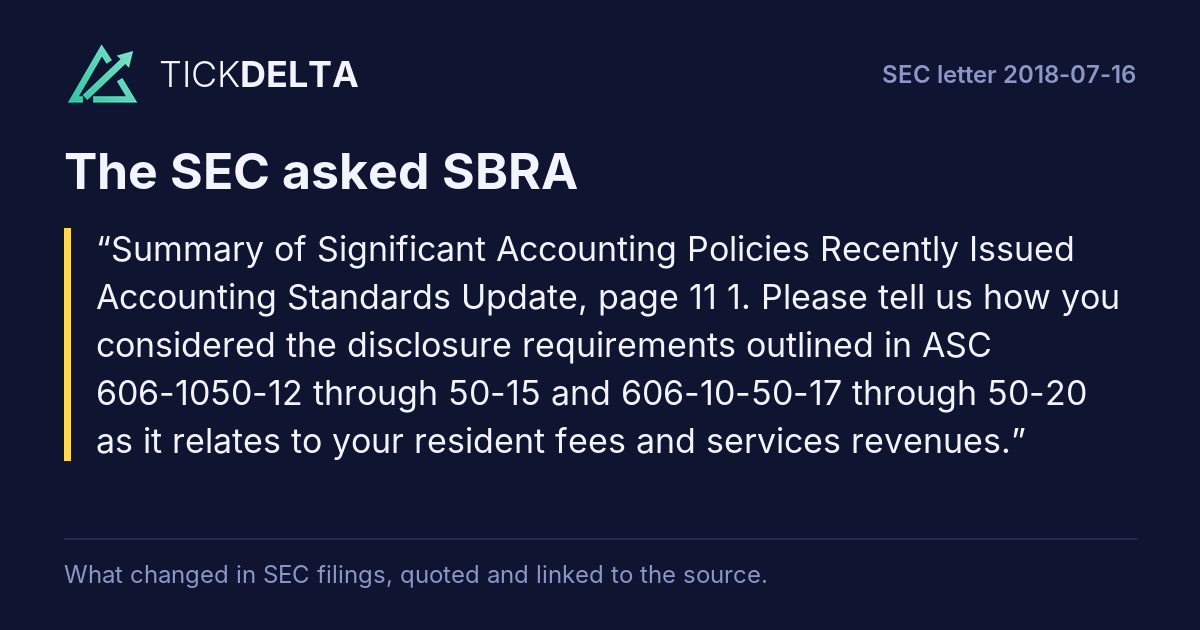
Summary of Significant Accounting Policies Recently Issued Accounting Standards Update, page 11 1. Please tell us how you considered the disclosure requirements outlined in ASC 606-1050-12 through 50-15 and 606-10-50-17 through 50-20 as it relates to your resident fees and services revenues.
SBRA answered
In the “Recently Issued Accounting Standards Update” section of Note 2,

“Summary of Significant Accounting Policies,” in the Notes to Consolidated Financial Statements in Sabra’s annual report on Form 10-K for the fiscal year ended December 31, 2017, the

Company included a discussion of the expected impact of the adoption of Financial Accounting Standards Board (“FASB”) Accounting Standards Update (“ASU”) No. 2014-09, Revenue from

Contracts with Customers (“ASU 2014-09”), ASU No. 2016-08, Principal versus Agent Considerations (Reporting Revenue Gross versus Net) (“ASU 2016-08”) and ASU No.
Rest of the answer

2016-12, Narrow-Scope Improvements and Practical Expedients (“ASU 2016-12”) (together, herein referred to as the “Revenue ASUs”).

Mr. Isaac Esquivel, July 23, 2018

In the above referenced discussion, the Company noted that it expected the impact of the Revenue ASUs to its consolidated financial statements to include “[a] requirement to disclose ancillary resident service revenue that is not included in the monthly base fees charged under resident agreements through its Senior Housing—Managed communities structures. The

Company will separately disclose the amount, nature and timing of these ancillary resident service revenues in its future quarterly and annual reports.”

The Revenue ASUs became effective for the Company on January 1, 2018, and the adoption thereof had no material impact to beginning retained earnings as of January 1, 2018.

In the Company’s quarterly report on Form 10-Q for the quarterly period ended March 31, 2018, the Company reported Resident Fee and Service Revenues of $17.5 million, which consisted primarily of monthly base fees under resident agreements under its Senior Housing – Managed communities structures. Revenues generated through these resident agreements are excluded, as leases, from the Revenue ASUs. For the three months ended March 31, 2018, ancillary resident service revenue that is not included in the monthly base fees charged under resident agreements represented less than 1% of the Company’s Total Revenues for the period. Accordingly, the Company concluded that these amounts were quantitatively and qualitatively immaterial to its condensed consolidated financial statements as of and for the three months ended March 31, 2018, and therefore did not include the disclosures outlined in ASC 606-10-50-12 through 50-15 and

606-10-50-17 through 50-20.

In future periods, the Company will continue to evaluate the quantitative and qualitative materiality of these ancillary resident service revenues and, if these amounts are determined to be material, the Company will include the relevant required disclosures under ASC 606.

Read in the reply

Also in this review: closing letter, 2018-07-25

Form S-4

2017-06-27 to 2017-07-06 · 1 question · 1 letter from the SEC, 2 from the company
No closing letter
Income taxes
Material U.S. Federal Income Tax Consequences of the Merger, page 131
SEC asked
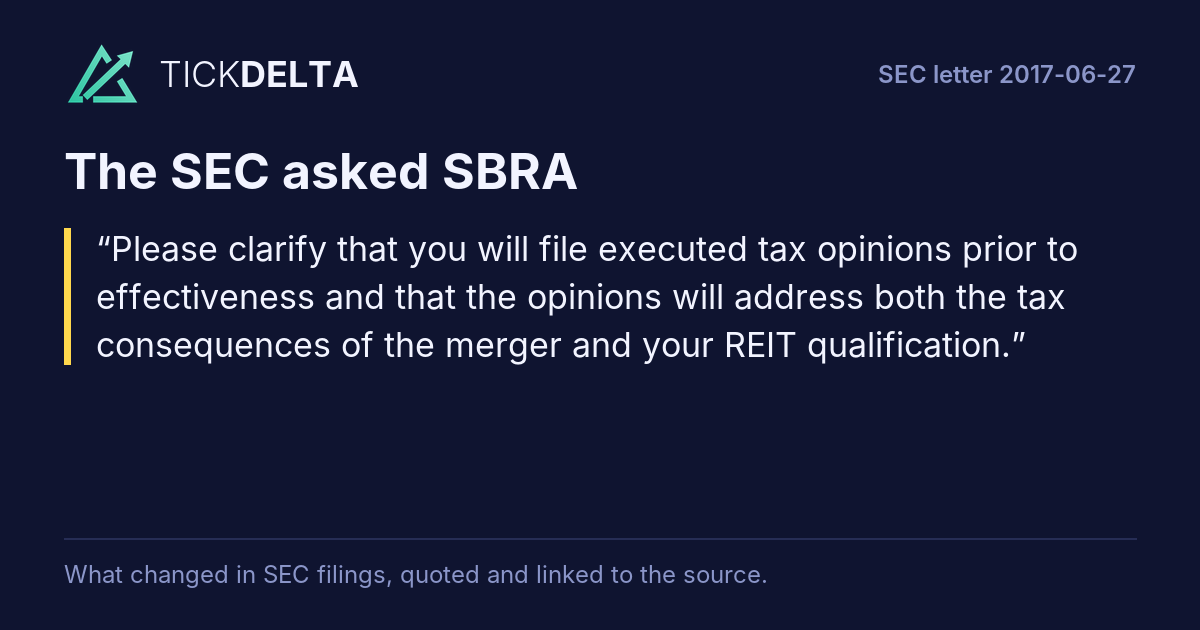
Please clarify that you will file executed tax opinions prior to effectiveness and that the opinions will address both the tax consequences of the merger and your REIT qualification.
SBRA answered
In response to the Staff’s comment Sabra has filed executed opinions of Fried, Frank, Harris, Shriver &

Jacobson LLP as to the tax consequences of the merger, Sidley Austin LLP as to the tax consequences of the merger, Fried, Frank, Harris, Shriver & Jacobson LLP as to Sabra’s REIT qualification and Sidley Austin LLP as to Care Capital

Properties, Inc.’s REIT qualification as exhibits 8.1, 8.2, 8.3 and 8.4, respectively, to Amendment No. 1.

* *

*

Century City • Los Angeles • Newport Beach • New York • San Francisco • Silicon Valley • Washington,
Read in the reply

Also in this review: company letter, Jul 6, 2017

Form 10-K for the fiscal year ended December 31, 2016

2017-05-10 to 2017-06-02 · 2 questions · 1 letter from the SEC, 1 from the company
Review closed 2017-06-02
RevenueAcquisitionsNon-GAAP measures
Real Estate Investments and Rental Revenue Recognition · Real Estate Acquisition Valuation, page F-9
SEC asked (1)
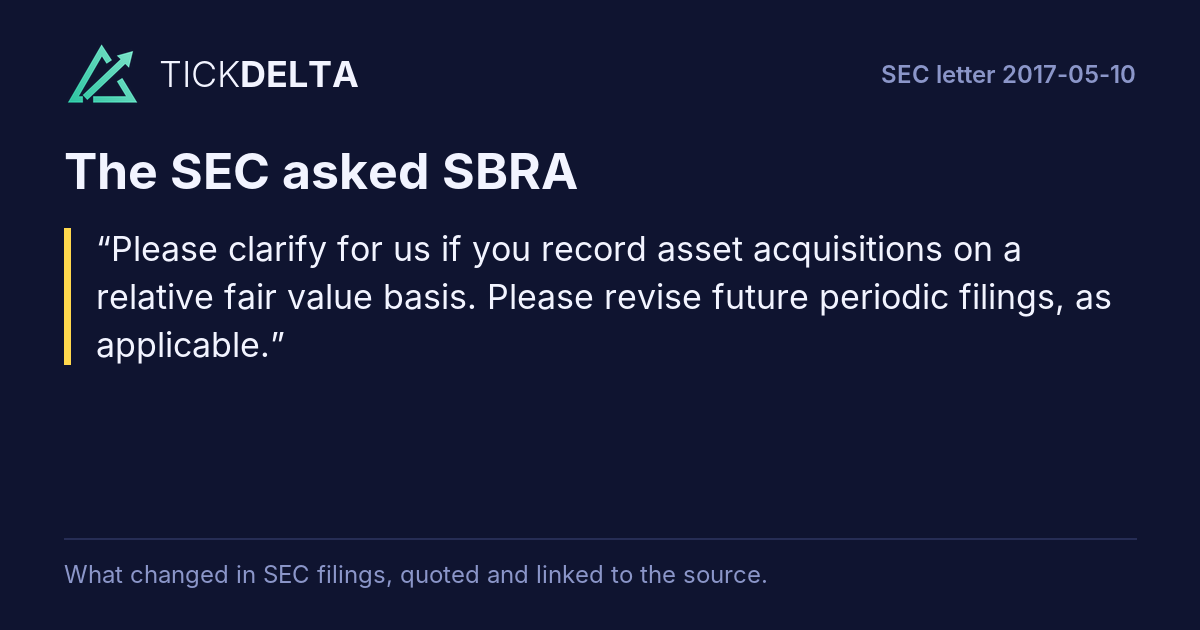
Please clarify for us if you record asset acquisitions on a relative fair value basis. Please revise future periodic filings, as applicable.
SBRA answered
We account for acquisitions of real estate that are considered asset acquisitions on a relative fair value basis. In future periodic filings, we will revise our disclosure of accounting policies to state the following:

“All assets acquired and liabilities assumed in an acquisition of real estate accounted for as a business combination are recorded at their acquisition date fair values.
Rest of the answer

For acquisitions of real estate accounted for as an asset acquisition, the fair value of consideration transferred by the Company (including transaction costs) is allocated to all assets acquired and liabilities assumed on a relative fair value basis.”

Read in the reply
In its next report

First report after the company's reply of May 22, 2017: 10-Q filed Aug 2, 2017 ↗, against the 10-Q filed May 8, 2017 ↗.

Tickdelta does not hold the text of both reports, so they are not compared here.

Exhibit 99.1 · Reconciliation of NOI and Cash NOI, page 12
SEC asked (2)
In future press releases, please revise your NOI reconciliation to comply with Item 10(e)(1)(i)(B) of Regulation S-K which requires a reconciliation of non-GAAP financial measures disclosed or released with the most directly comparable GAAP measure (i.e. net income). Further, your reconciliation should begin with the GAAP measure, so the non-GAAP measures do not receive undue prominence.
Rest of the question

Please refer to Question 102.10 of the updated Compliance and Disclosure Interpretations issued on May 17, 2016. This comment should also be applied to your presentation of NOI within your supplemental information.

SBRA answered
In our future earnings releases and other applicable disclosures, including our quarterly supplemental information package, we will revise our reconciliation of NOI to reconcile to the most directly comparable GAAP measure (i.e., net income). Consistent with our historical practice for our non-GAAP reconciliations, we will begin the reconciliation with the GAAP measure.
Read in the reply
In its next report

First report after the company's reply of May 22, 2017: 10-Q filed Aug 2, 2017 ↗, against the 10-Q filed May 8, 2017 ↗.

Tickdelta does not hold the text of both reports, so they are not compared here.

Also in this review: closing letter, 2017-06-02

From the SEC's correspondence on EDGAR: staff letters (form UPLOAD) and company letters (form CORRESP), 18 letters filed since 2017-05-10. Questions and answers are matched by their numbers; topics come from words in each question. The reports are compared word for word (same form, before the first SEC letter against the first report after the company's reply). No AI.

Sources

The SEC's correspondence on EDGAR: staff letters (form UPLOAD) and company letters (form CORRESP), matched question by question. No AI.

Also

Filings: the letters in the filing list.

Work with it

Excel workbook · CSV. Google Sheet that stays up to date: paste =IMPORTDATA("https://tickdelta.com/company/SBRA/export.csv") into a cell.

Next in Owners and insiders:Insider trades
Esc

Type a ticker such as AAPL, a name, an investor such as Buffett, or a topic such as tariffs. ↑ ↓ to move, Enter to open.