Form 10-K for the Fiscal Year Ended December 31, 2019
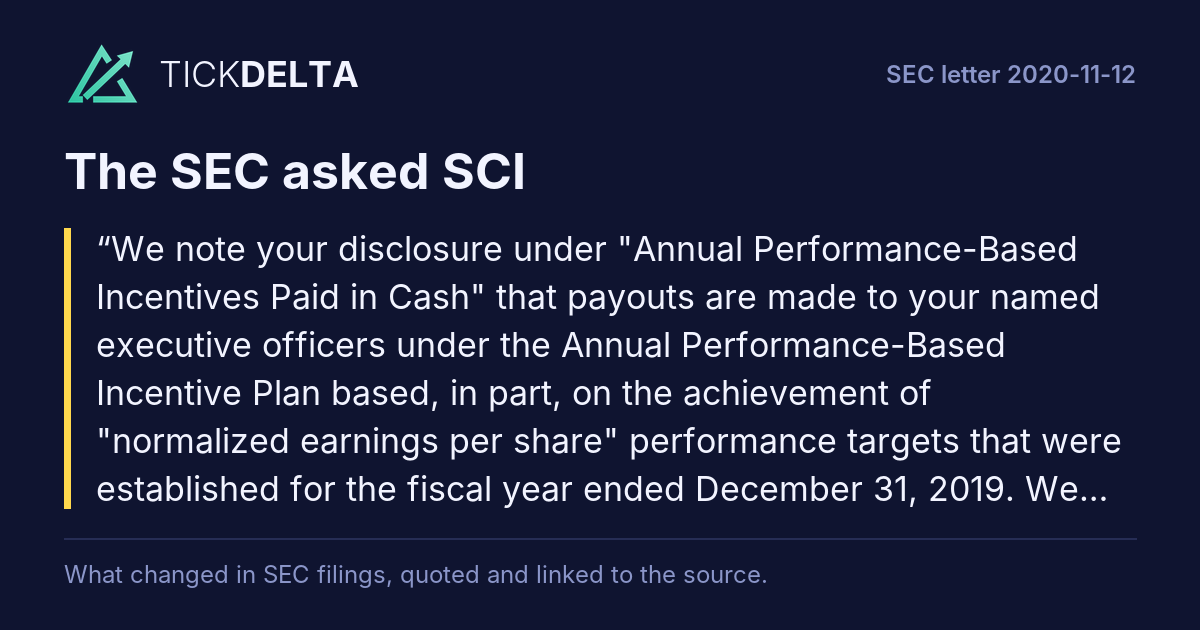
We note your disclosure under "Annual Performance-Based Incentives Paid in Cash" that payouts are made to your named executive officers under the Annual Performance-Based Incentive Plan based, in part, on the achievement of "normalized earnings per share" performance targets that were established for the fiscal year ended December 31, 2019.Rest of the question
We also note that the number of outstanding shares of your common stock has been significantly reduced as a result of your share repurchases. In future filings, please discuss if and how the share repurchases factored into the manner in which the Compensation Committee set targets and determined whether such targets were met with respect to normalized earnings per share (including whether such repurchases materially affected your calculation of basic earnings per share or diluted earnings per share).
As described in our 2020 proxy statement on page 45 (“Annual Performance-Based Incentives Paid in Cash”) , we utilized diluted weighted average shares outstanding in 2019 to calculate normalized earnings per share. Estimated share repurchases are factored into the setting of performance targets each year. The actual share repurchases that occurred in 2019 did not materially affect the incentive calculations or associated achievement of performance targets.Read in the replyRest of the answer
In future filings, we will disclose how share repurchases were considered in setting performance targets and determining performance results (including whether such repurchases materially affected the calculation of normalized earnings per share).
First report after the company's reply of Dec 11, 2020: 10-K filed Feb 16, 2021 ↗, against the 10-K filed Feb 18, 2020 ↗.
Tickdelta does not hold the text of both reports, so they are not compared here.
You disclose on pages 38 and 53 that trust investments include marketable securities that are classified as available-for-sale and that these investments are assessed for other-thantemporary declines in fair value. In discussing your trust investments on page 40, you also state that your market-sensitive instruments and positions are considered to be “otherthan-trading”.Rest of the question
Please tell us how you concluded the cash flows related to your trust investments represent operating activities, rather than investing activities. Also, explain your basis for not classifying fixed income instruments as trading and recording their unrealized gains (losses) through earnings, if their cash flow activity is included in operating activities. Refer to ASC 230-10-45-11, ASC 230-10-45-12(b), ASC 230-10-4513(b), ASC 320-10-35-1(a) and 320-10-45-11.
Due to the nature of the underlying operations, the accounting and financial reporting for the deathcare industry is unique and we, along with the small group of other deathcare registrants, have worked together over the last 15 years to ensure the accounting, as well as presentation and disclosure, of our business conforms with generally accepted accounting standards.Read in the replyRest of the answer
Our financial reporting for preneed funeral and cemetery contracts with customers has been the subject of significant research, deliberation, consultation, and discussion with the Staff and the Office of the Chief Accountant over the last 15 years. State laws generally require all or a substantial portion of the funds collected for preneed funeral and cemetery merchandise and service contracts to be placed into merchandise and service trusts ("M&S Trusts"). State laws also require a portion of the funds collected from sales of cemetery interment rights to be placed into perpetual care trusts ("Care Trusts", collectively with the M&S Trusts, the "Trusts"). The Trusts hold investments in marketable securities that we have generally considered other-than-trading as we have limited ability to impact the operations of the Trusts. The trustees of the Trusts are third-party financial institutions and have the responsibility for and oversight of their operating activities, including the execution of their investment policy and distributions.
In the course of our consultations with the Staff, we agreed upon the following conclusions (as updated for changes in terminology for new accounting standards that have been adopted since the original communications):
•The Trusts represented variable interest entities that should be consolidated in our consolidated balance sheet.
•We are not the legal beneficiary of the Trusts and the interests of the legal beneficiaries (i.e. our customers) should be reflected as a liability to perform upon the promises in the contracts.
•Accordingly, we consolidate the assets of the Trusts (Trust investments) with corresponding contract liabilities (Deferred receipts/Care Trusts' Corpus).
•Ordinary income and realized gains and losses are recorded in Other income, net. Unrealized gains and losses are recorded in Other comprehensive income1 (collectively, the "earnings"). The earnings represent variable consideration on our contracts with customers and we record an offsetting reduction of Other income, net and Other comprehensive income to defer the recognition (in Deferred receipts/Care Trusts' Corpus) until:
◦For the M&S Trusts, we fulfill the performance obligations in the contracts with the customers as the earnings represent variable consideration in those contracts.
◦For the Care Trusts, until the earnings are legally distributable, based on State law, which is generally when we have incurred maintenance expenses.
•When the above criteria are met, the earnings are reflected as a component of revenue from contracts with customers and
1 Upon adoption of Accounting Standards Update 2016-01, "Financial Instruments—Overall (Subtopic 825-10): Recognition and Measurement of Financial Assets and Financial Liabilities" ("ASU 2016-01") we began recording the unrealized gains and losses on equity securities in Other income, net with the unrealized gains and losses on debt securities continuing to be recorded in Other comprehensive income. We record an offsetting reduction of Other income, net and Other comprehensive income to defer the recognition as described above. We believe adoption of this standard does not impact any of the other conclusions reached in our previous correspondence.
◦The M&S Trusts distribute the principal and associated earnings relating to the fulfilled performance obligation.
◦The Care Trusts distribute the earnings.
•As the cash flows related to changes in Trust investments and Deferred receipts/Care Trusts' Corpus relate closely to our core business activities and enter into the determination of net income, these activities represent operating activities as set forth in the glossary to Topic 230 Statement of Cash Flows ("Topic 230").
•Disclosure of the gross movements within the Trusts' investment portfolios is required. We track and disclose the gross movements in Note 3 - Preneed Activities of our consolidated financial statements. These gross movement disclosures include gross purchases and sales within the trusts' investments as well as realized gains and losses related to the sales. We also include in Note 3 the gross withdrawals from and deposits to the trusts.
These conclusions are further detailed and supported by the following correspondence with the Staff:
•Our letter to the SEC dated November 21, 2008 related to the adoption of Statement of Accounting Standards No. 160, Noncontrolling Interests in Consolidated Financial Statements ("FAS 160"), now codified in ASC Topic 810, Consolidation ("ASC 810") (see Exhibit A).
•Correspondence between the Staff and ourselves that elaborate upon the various conclusions reached during our previous consultations with the Staff regarding the adoption of FASB Interpretation No. 46 (revised December 2003), Consolidation of Variable Interest Entities ("FIN 46R"), now codified in Topic 810, are attached herein as Exhibit B (letter dated April 14, 2004) and Exhibit C (letter dated July 21, 2004).
•We have also attached as Exhibits D and E our prior correspondence with the Staff, dated June 30, 2006 and September 25, 2006, concerning inquiries from the Staff about how activities related to the M&S Trusts and Care Trusts are reflected in our Statement of Cash Flows.
We believe these Exhibits are relevant to this letter because they clearly describe the unique attributes of our preneed trusts and evidence of the Staff's concurrence with our presentation of cash flows associated with the trusts.
We believe there have been no changes, except as noted above for ASU 2016-01, in our business operations or accounting standards that would call the previous correspondence into question.
First report after the company's reply of Dec 11, 2020: 10-K filed Feb 16, 2021 ↗, against the 10-K filed Feb 18, 2020 ↗.
Tickdelta does not hold the text of both reports, so they are not compared here.
We have reviewed your response to comment 2. In arriving at your current accounting treatment for the debt securities in your trusts, please tell us how you considered the guidance in ASC 320-10-45-11, which permits the inclusion of cash flows related to trading securities in cash flows from operating activities in certain circumstances, but requires cash flows related to other types of debt securities to beRest of the question
classified as investing activities. Also, refer to ASC 320-10-35-1.
Vice President / Corporate ControllerRead in the reply
December 21, 2020
Division of Corporation Finance - Office of Trade & Services
U.S. Securities and Exchange Commission
100 F. Street, N.E.
Washington, D.C. 20549
RE: SEC Comment Letter dated December 17, 2020 related to Service Corporation International's Form 10-K for the Year ended December 31, 2019 filed February 18, 2020 and Response dated December 11, 2020
File No.Rest of the answer
001-06402
With respect to the above referenced letter, Service Corporation International respectfully requests that the due date for our response be extended to the end of the day on January 15, 2021. We make this request in order to allow sufficient time for our draft and review process.
First report after the company's reply of Dec 21, 2020: 10-K filed Feb 16, 2021 ↗, against the 10-K filed Feb 18, 2020 ↗.
Tickdelta does not hold the text of both reports, so they are not compared here.
Also in this review: company letter, Nov 16, 2020, company letter, Jan 15, 2021, company letter, Jan 25, 2021, closing letter, 2021-01-26