Screener / SEC EDGAR /CIK 0000720672 /10-K filed Feb 24, 2026, compared with Feb 26, 2025 /Numbers from the XBRL of the 10-Ks
NYSE Financials · Brokers & Investment Banks

Stifel Financial Corp SF

Compare with peers Embed
SEC comment letters, last 20 years

2 reviews of SF's filings by SEC staff

UPLOAD and CORRESP
Reviews 2 latest letter Aug 29, 2025
Questions asked 4 each answered in the company's own letter
No closing letter 0 reviews without a letter saying the staff completed it

When the SEC's staff reviews a filing, it writes to the company with numbered questions, and the company answers each one in a letter. SEC publishes the exchange once the review is over, at least 20 business days later. A question is not an accusation; most reviews end with the company adding detail to its next filing.

How the reviews went

Every review on EDGAR, from the first staff letter to the letter that closes it

  1. 1. Staff letters 3 UPLOAD
  2. 2. Questions in them 4 numbered comments
  3. 3. Company replies 3 CORRESP
  4. 4. Reviews closed 2 of 2 closing letter

Half the closed reviews took 80 days or less from the first letter to the closing letter.

Form 10-K

2025-08-29 to 2025-11-17 · 1 question · 1 letter from the SEC, 1 from the company
Review closed 2025-11-17
RevenueNon-GAAP measuresResults discussion (MD&A)Income taxes
After reviewing your response to this letter, we may have additional comments. IV. Deposits, page 48
SEC asked
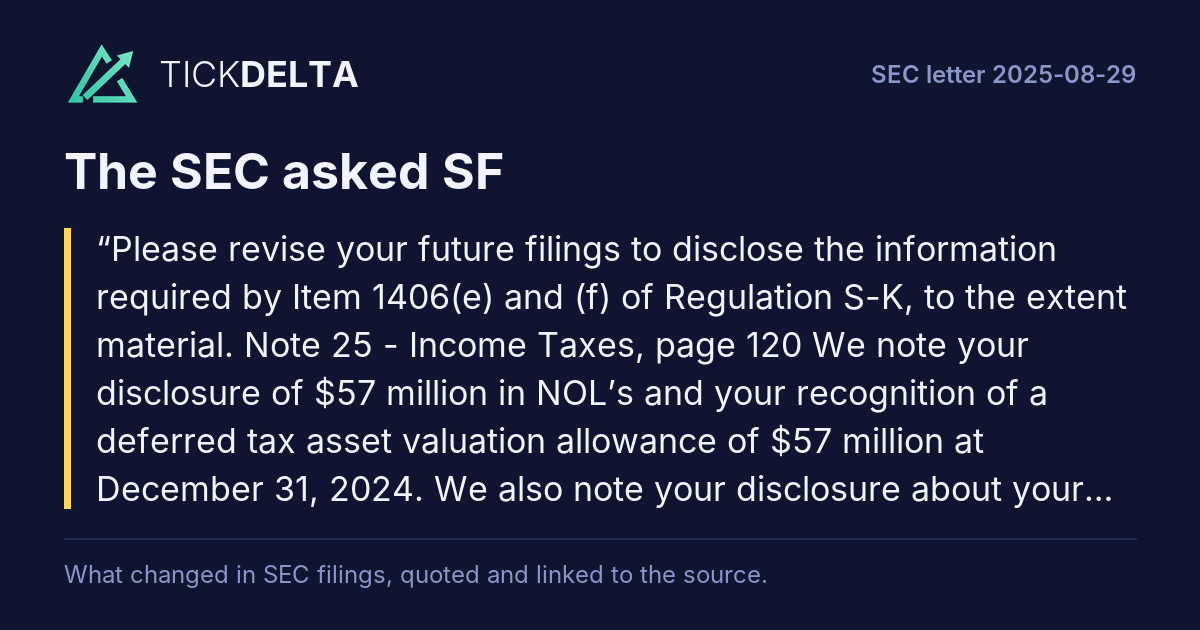
Please revise your future filings to disclose the information required by Item 1406(e) and (f) of Regulation S-K, to the extent material. Note 25 - Income Taxes, page 120 We note your disclosure of $57 million in NOL’s and your recognition of a deferred tax asset valuation allowance of $57 million at December 31, 2024.
Rest of the question

We also note your disclosure about your “ability to carry back certain tax attributes against prior year taxable income for tax years before 2024 and to carry forward net operating losses indefinitely after 2024, and expectations of future taxable income, which is supported by a history of cumulative income.” Please tell us in detail and revise your future filings, here or in the MD&A, to provide additional information regarding the specific component(s) to which the material amount of deferred tax asset valuation allowance relates and clarify the negative evidence considered under ASC 740-10-30 which 2. resulted in the recognition of a deferred tax asset valuation allowance. Further, disclose the portion of NOL’s that do not require a valuation allowance, if material. Exhibit 99.2, page 4 3. We note disclosure on page 4 of your “Non-GAAP Consolidated Results of Operations” which represents a full income statement of non-GAAP measures. Please revise your future filings to remove the presentation of your full non-GAAP income statement. Refer to Question 102.10(a) of the Non-GAAP Compliance and Disclosure Interpretations for guidance. 4. While you label certain groups of information as non-GAAP, we note your non- GAAP financial measures have the same line-item names as the related GAAP financial measure (e.g., net revenues, earnings per diluted common share, etc.). Please revise the description of each non-GAAP financial measure in future filings to use a different line-item name, for example, adjusted net revenues, adjusted earnings per diluted common share, etc. Refer to Question 100.05 of the Non-GAAP Compliance and Disclosure Interpretations for guidance.

SF answered
In response to the Staff’s comment, we acknowledge the requirements of Item 1406 of Regulation

S-K and, to the extent material, will include the information required by Item 1406(e) and (f) of Regulation S-K in our Annual Report on Form 10-K for the fiscal year ending December 31, 2025 and subsequent filings.
Read in the reply
In its next report

First report after the company's reply of Oct 7, 2025: 10-Q filed Nov 5, 2025 ↗, against the 10-Q filed Aug 6, 2025 ↗.

Tickdelta does not hold the text of both reports, so they are not compared here.

Also in this review: closing letter, 2025-11-17
Form 10-K for the fiscal year ended December 31, 2018

2019-05-08 to 2019-07-11 · 3 questions · 2 letters from the SEC, 2 from the company
Review closed 2019-07-11
RevenueResults discussion (MD&A)ChinaSegmentsRisk factors
Management's Discussion and Analysis of Financial Condition and Results of Operations · Results of Operations - Global Wealth Management, page 39
SEC asked (1)
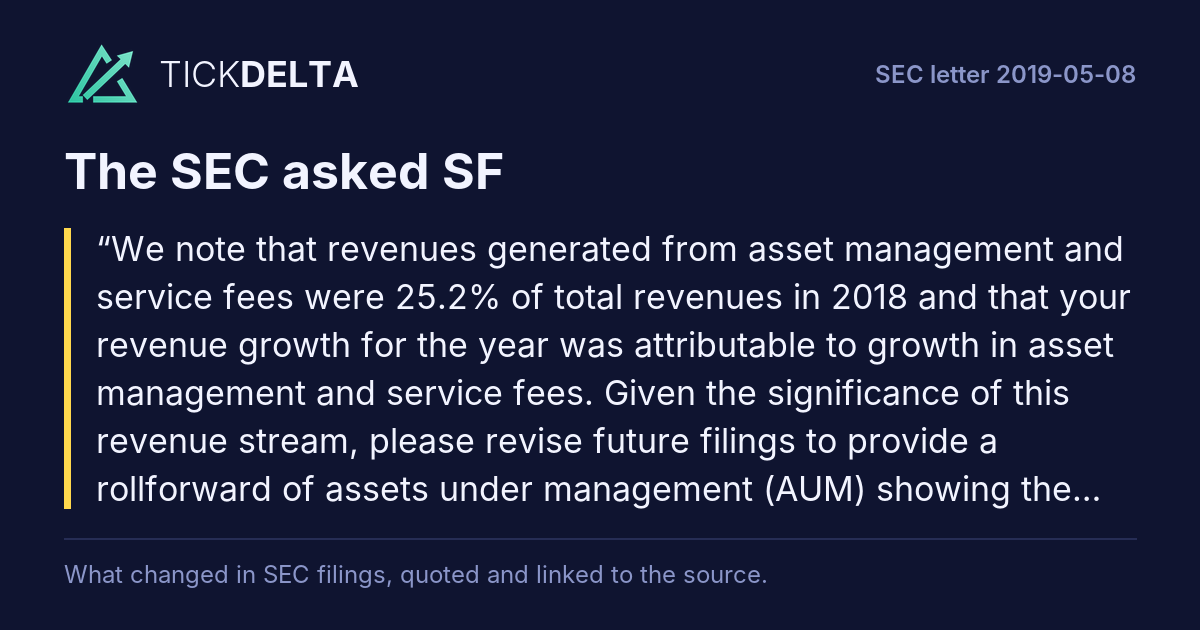
We note that revenues generated from asset management and service fees were 25.2% of total revenues in 2018 and that your revenue growth for the year was attributable to growth in asset management and service fees.
Rest of the question

Given the significance of this revenue stream, please revise future filings to provide a rollforward of assets under management (AUM) showing the beginning balance, gross inflows, gross outflows and market appreciation/depreciation to arrive at an ending AUM balance. Additionally, to the extent fee levels vary significantly by AUM product type (fixed income, equities, etc.), please disaggregate the AUM rollforward by the different products.

SF answered
Please be advised that a significant part of our asset management and service fee revenues are derived from investment advisory fees that are charged based on the value of assets in fee-based accounts. Fees are charged in advance based on fixed rates applied to the value of the customers’ account at the end of the previous quarter.

Management does not currently utilize comprehensive rollforward information for fee-based assets to manage our business as substantially all of the asset management fees we earn on such assets are calculated based on point-in-time balances as of the end of the
Rest of the answer

previous quarter. In addition, the current infrastructure, which supports the administration of our assets in fee-based accounts, is not a centralized platform and does not provide this information.

The Company included in its Annual Report on Form

10-K for the year ended December 31, 2018 the value of assets in its fee-based accounts, which management believes is a primary factor in the growth of this revenue stream. In future filings, the Company will continue to provide this quantitative information.

The Company will also provide other enhanced quantitative or qualitative information in future filings to the extent it determines such additional information explains changes in certain aspects of the Company’s results of operations or is otherwise meaningful to investors.

Read in the reply
In its next report

First report after the company's reply of Jun 13, 2019: 10-Q filed Aug 7, 2019 ↗, against the 10-Q filed May 8, 2019 ↗.

Tickdelta does not hold the text of both reports, so they are not compared here.

Notes to the Consolidated Financial Statements · Consolidation Policies, page 80
SEC asked (2)
In your consolidation policy you reference ASU 2010-10; Consolidation, Amendments for Certain Investment Funds with regard to entities eligible for the deferral and in Note 28. Variable Interest Entities on page 130, you state that for certain other entities you review other relevant accounting guidance, which states that the general partner in a limited partnership is presumed to control the limited partnership.
Rest of the question

Tell us and revise your disclosures accordingly, as to how these provisions comply with ASC 810 and the issuance of ASU 2015-02; Amendments to the Consolidation Analysis. In closing, we remind you that the company and its management are responsible for the accuracy and adequacy of their disclosures, notwithstanding any review, comments, action or absence of action by the staff.

SF answered
We have investments or interests in other entities for which we must evaluate whether to consolidate by determining whether we have a controlling financial interest or are considered to be the primary beneficiary. Under our current consolidation policy, which complies with the provisions of ASC 810 as amended by ASU 2015-02, we consolidate those entities where we have the power to direct the activities of the entity that most significantly impact the entity’s economic performance and the obligation to absorb losses of the entity or the rights to receive benefits from the entity that could
Rest of the answer

potentially be significant to the entity.

We determine whether we are the primary beneficiary of a variable interest entity

(“VIE”) by performing an analysis of the VIE’s control structure, expected benefits and losses, and expected residual returns. This analysis includes a review of, among other factors, the VIE’s capital structure, contractual terms, which interests create or absorb benefits or losses, variability, related party relationships, and the design of the VIE. We reassess our evaluation of whether an entity is a VIE when certain reconsideration events occur. We reassess our determination of whether we are the primary beneficiary of a VIE on an ongoing basis based on current facts and circumstances.

In response to the Staff’s comment, we will revise our consolidation policies and variable interest entity footnote to reflect the above and remove references to the guidance under ASU 2010-10 starting with our Quarterly Report on Form 10-Q for the period ended June 30, 2019, and in other applicable future filings.

Read in the reply
In its next report

First report after the company's reply of Jun 13, 2019: 10-Q filed Aug 7, 2019 ↗, against the 10-Q filed May 8, 2019 ↗.

Tickdelta does not hold the text of both reports, so they are not compared here.

Management's Discussion and Analysis of Financial Condition and Results of Operations · Results of Operations - Global Wealth Management, page 39
SEC asked
We note your response to our comment and that you do not utilize comprehensive rollforward information for fee-based assets to manage your business as substantially all of the asset management fees you earn are calculated based on point-in-time balances as of the end of the previous quarter and that in addition, the current infrastructure, which supports the administration of your assets in fee-based accounts, is
Rest of the question

not a centralized platform and does not provide this information. We also note your risk factor on page 17, that fee revenue is impacted by AUM balances, including net inflows/outflows of client assets and market values and that below-market investment performance by your funds and portfolio managers could result in a loss of managed accounts. Please address the following: • Disclose, in future filings, how you manage the risk(s) of your decentralized investment advisory platform, considering also the potential impact to fee revenues or add a risk factor to address how your decentralized platform impacts your ability to track total client asset activity and the related financial statement risks; and • Disclose, in future filings, in your Global Wealth Management segment discussion, the number of underlying accounts for both total client assets managed (AUM) and feebased assets, consistent with the disclosure in your investor presentations to support asset management and service fees recognized for the periods presented. Refer to Item 303 of Regulation S-K.

SF answered
In response to the Staff’s comment, we will revise our discussion of our asset management and service fee revenue line, including the structure of this key revenue stream and how we manage the risk(s) of our decentralized investment advisory platform, starting with our Quarterly Report on Form 10-Q for the period ended June 30, 2019, and in other applicable future filings.

Disclose, in future filings, in your Global Wealth Management segment discussion, the number of underlying accounts for both total client assets managed (AUM) and fee-based assets, consistent with the disclosure in your
Rest of the answer

investor presentations to support asset management and service fees recognized for the periods presented. Refer to Item 303 of Regulation S-K.

Response:

In response to the Staff’s comment, we will revise our discussion of our Global Wealth Management segment to include the number of underlying accounts for both total client assets and fee-based client assets consistent with our disclosure of client assets in other public documents starting with our Quarterly Report on Form 10-Q for the period ended June 30, 2019, and in other applicable future filings.

Read in the reply
In its next report

First report after the company's reply of Jul 3, 2019: 10-Q filed Aug 7, 2019 ↗, against the 10-Q filed May 8, 2019 ↗.

Tickdelta does not hold the text of both reports, so they are not compared here.

Also in this review: closing letter, 2019-07-11

Letters without questions

Other letters

UPLOAD and CORRESP
4 other letters: notices that a filing will not be reviewed, requests to declare a registration effective, and the like

From the SEC's correspondence on EDGAR: staff letters (form UPLOAD) and company letters (form CORRESP), 12 letters filed since 2017-08-16. Questions and answers are matched by their numbers; topics come from words in each question. The reports are compared word for word (same form, before the first SEC letter against the first report after the company's reply). No AI.

Sources

The SEC's correspondence on EDGAR: staff letters (form UPLOAD) and company letters (form CORRESP), matched question by question. No AI.

Also

Filings: the letters in the filing list.

Work with it

Excel workbook · CSV. Google Sheet that stays up to date: paste =IMPORTDATA("https://tickdelta.com/company/SF/export.csv") into a cell.

Next in Owners and insiders:Insider trades
Esc

Type a ticker such as AAPL, a name, an investor such as Buffett, or a topic such as tariffs. ↑ ↓ to move, Enter to open.