tickdelta
Sign in

Tickdelta is free for now. Sign up and get Pro free

← Screener

SHWSherwin-Williams

Materials · Home Improvement Retail · NYSE
Employees
64,249
Headquarters
Cleveland, OH
CEO
Heidi G. Petz
Next results
around Jan 28, 2027
Compare with peers → Embed

When the SEC's staff reviews a filing, it writes to the company with numbered questions, and the company answers each one in a letter. SEC publishes the exchange once the review is over, at least 20 business days later. Below: what the staff asked SHW, and the company's answer to each question, quoted from the letters. A question is not an accusation; most reviews end with the company adding detail to its next filing.

Form 10-K

2025-06-18 to 2025-07-08 · 1 question · 1 letter from the SEC, 1 from the company
Review closed 2025-07-08
Non-GAAP measuresSegments
Operations · Summary, page 24
SEC asked
We note you disclose Adjusted EBITDA within your summary bullet points. When presenting non-GAAP measures, please present the most directly comparable GAAP measure with equal or greater prominence. Refer to Item 10(e)(1)(i)(A) of Regulation S-K and Question 102.10(a) of the staff's Compliance and Disclosure Interpretations on Non-GAAP Financial Measures.
Rest of the question

Please make similar revisions to your press releases furnished under Item 2.02 of Form 8-K when presenting your non-GAAP measures in the summary section of your releases. Notes to the Consolidated Financial Statements Note 22 - Reportable Segment Information, page 90 Please tell us how your disclosure complies with the requirement to disclose how the chief operating decision maker uses your reported measure of segment profit or 2. loss in assessing segment performance and deciding how to allocate resources pursuant to ASC 280-10-50-29.f. Refer to ASC 280-10-55-47.bb for guidance. In closing, we remind you that the company and its management are responsible for the accuracy and adequacy of their disclosures, notwithstanding any review, comments, action or absence of action by the staff.

SHW answered
The Company respectfully acknowledges the Staff’s comment. The Company advises the Staff that in future periodic reports, as well as the Company’s press releases furnished under Item 2.02 of Form 8-K, when the Company presents a non-GAAP measure, it will present the most directly comparable GAAP measure with equal or greater prominence. The Company confirms when presenting Adjusted EBITDA, it will include a presentation of Net income with equal or greater prominence. Read in the reply ↗
In its next report

First report after the company's reply of 2025-06-30: 10-Q filed 2025-07-24 ↗, against the 10-Q filed 2025-04-29 ↗.

Tickdelta does not hold the text of both reports, so they are not compared here.

Also in this review: closing letter, 2025-07-08

Form 10-K for the Fiscal Year Ended December 31, 2023

2024-09-09 to 2024-10-10 · 1 question · 1 letter from the SEC, 1 from the company
Review closed 2024-10-10
RevenueNon-GAAP measuresSegmentsResults discussion (MD&A)Liquidity and cashAcquisitionsDebt
Item 7: Management's Discussion and Analysis of Financial Condition and Results of Operations · Outlook, page 24
SEC asked
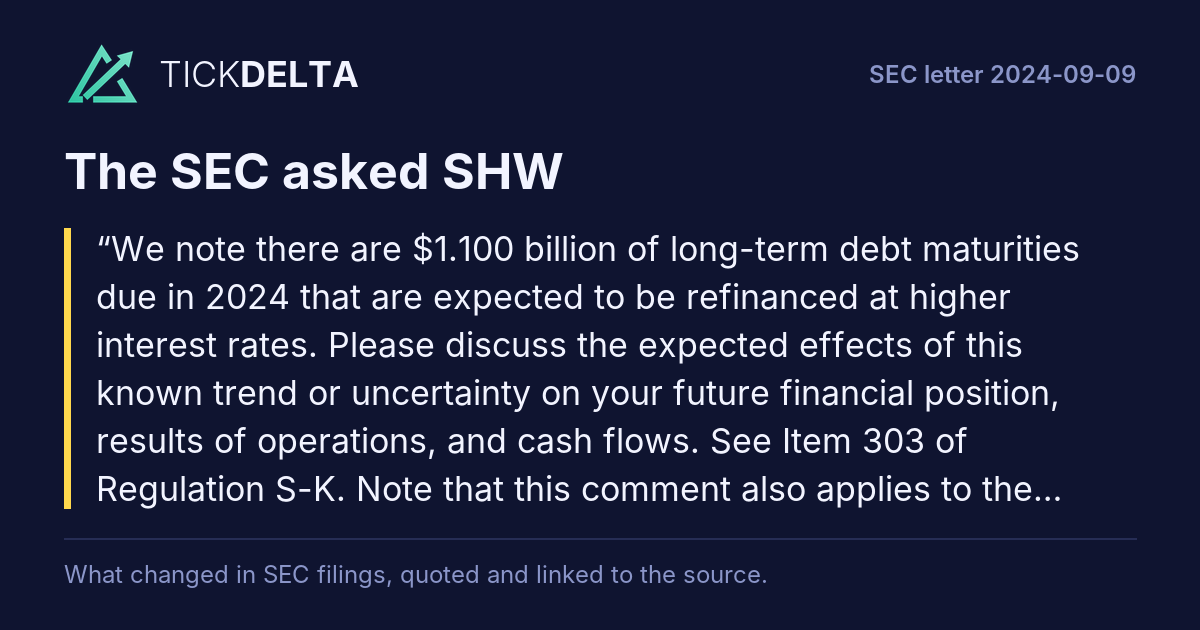
We note there are $1.100 billion of long-term debt maturities due in 2024 that are expected to be refinanced at higher interest rates. Please discuss the expected effects of this known trend or uncertainty on your future financial position, results of operations, and cash flows. See Item 303 of Regulation S-K. Note that this comment also applies to the $1.051 billion of long-term debt maturities due in 2025.
Rest of the question

Non-GAAP Financial Measures Free Cash Flow, page 34 We note you include an adjustment in your calculation of free cash flow that is not typically included in the calculation of the measure. Please revise the title of the measure to "adjusted" free cash flow. Refer to Question 102.07 of the Non-GAAP Financial Measures Compliance and Disclosure Interpretations. 2. Adjusted Diluted Net Income Per Share and Adjusted Segment Profit, page 35 3. We note that you exclude acquisition-related amortization expense relating to the Valspar acquisition from adjusted segment profit and adjusted diluted net income per share. Please revise to more clearly describe the nature of the amortization being excluded and why, and clarify that the related revenue being generated from these assets is not also being excluded.

SHW answered
The Company respectfully acknowledges the Staff’s comment and confirms the refinancing of the long-term debt maturing in 2024 was disclosed in the Outlook section of Management’s Discussion and Analysis of Financial Condition and Results of Operations to address the known uncertainty on the Company’s future financial position.
Rest of the answer

Based on the amount of debt maturing in 2024 and interest rate forecasts at the time of the Company’s filing, the Company did not expect the impact of higher interest rates from the refinancing of debt maturing in 2024 would be reasonably likely to have a material effect on our future results of operations, financial position, or cash flows. As such, the Company did not discuss the potential future impacts of the refinancing.

Regarding the Company’s long-term debt maturing in 2025, at the time of filing its 2023 Form 10-K, the Company was assessing a course of action to manage its senior notes due in 2025 and determined there was no known trend or uncertainty that would be reasonably likely to have a material effect on our future financial position, results of operations, or cash flows. The Company regularly reviews its options and strategies to manage its long-term debt structure and discloses material trends and uncertainties when known. We acknowledge the guidance in Item 303 of Regulation S-K and confirm we will continue to disclose any known material favorable or unfavorable trends and uncertainties in future filings.

Read in the reply ↗
In its next report

First report after the company's reply of 2024-09-19: 10-Q filed 2024-10-22 ↗, against the 10-Q filed 2024-07-23 ↗.

Tickdelta does not hold the text of both reports, so they are not compared here.

Also in this review: closing letter, 2024-10-10

Form 10-K

2023-05-04 to 2023-05-22 · 1 question · 1 letter from the SEC, 1 from the company
Review closed 2023-05-22
RevenueResults discussion (MD&A)
Management's Discussion and Analysis · Results of Operations, page 23
SEC asked
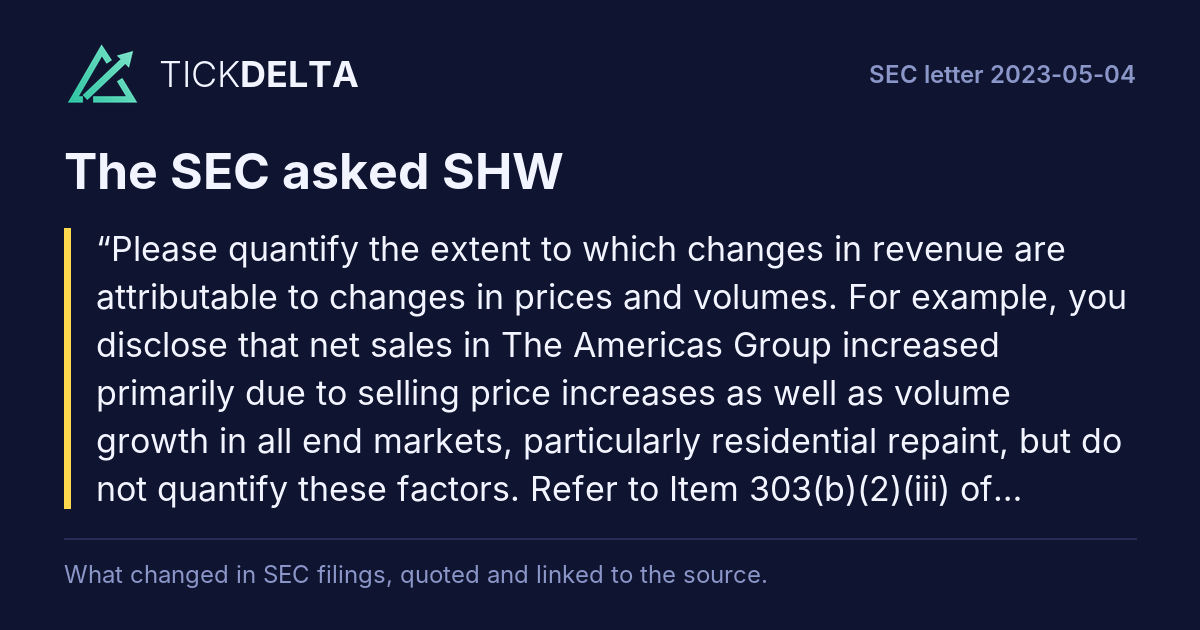
Please quantify the extent to which changes in revenue are attributable to changes in prices and volumes. For example, you disclose that net sales in The Americas Group increased primarily due to selling price increases as well as volume growth in all end markets, particularly residential repaint, but do not quantify these factors. Refer to Item 303(b)(2)(iii) of Regulation S-K.
SHW answered
The Company respectfully acknowledges the Staff’s comment. We sell thousands of products, including, but not limited to, liquid and powder coatings, painting sundries, caulks, adhesives, aerosols and floor coverings to professional, industrial, commercial and retail customers across multiple geographic regions. These products have varying pricing structures and sell in numerous volumes, unit compositions and measures of weight. These factors make it impractical for the Company to precisely quantify changes in revenue whether due to prices or volumes.
Rest of the answer

As a result, we do not publicly disclose specific price and volume impacts. However, for managerial purposes, we estimate these impacts at a higher level to understand changes in revenue and would propose leveraging this information for future disclosures.

Below is the Company’s proposed disclosure using the Annual Report on Form 10-K for the year ended December 31, 2022 for illustrative purposes, which has been marked to facilitate the Staff's review.

Net Sales

Year Ended December 31,

2022 2021 $ Change % Change

Net Sales:

The Americas Group $ 12,661.0 $ 11,217.0 $ 1,444.0 12.9 %

Consumer Brands Group 2,690.7 2,721.6 (30.9) (1.1) %

Performance Coatings Group 6,793.5 6,003.8 789.7 13.2 %

Administrative 3.7 2.2 1.5 68.2 %

Total $ 22,148.9 $ 19,944.6 $ 2,204.3 11.1 %

Consolidated Net sales for 2022 increased 11.1% primarily due to selling price increases in all Reportable Segments and higher product sales volume in The Americas Group, partially offset by lower sales volume in the Consumer Brands and Performance Coatings Groups. Currency translation rate changes decreased 2022 consolidated Net sales by 1.5%, while acquisitions which were completed during the past twelve months added approximately 1.1% to consolidated Net sales. Net sales of all consolidated foreign subsidiaries increased 1.7% to $4.294 billion for 2022 versus $4.223 billion for 2021 primarily due to benefits from acquisitions offset by weakening demand in the Europe and Asia Pacific regions. Net sales of all operations other than consolidated foreign subsidiaries increased 13.6% to $17.855 billion for 2022 versus $15.722 billion for 2021.

Net sales in The Americas Group increased primarily due to selling price increases, which impacted sales by a low double digit percentage, as well as low single digit volume growth in all end markets, particularly residential repaint. Net sales from stores in U.S. and Canada open for more than twelve calendar months increased 11.7% in the year over last year’s comparable period. Currency translation rate changes reduced Net sales by 0.4% compared to 2021. During 2022, The Americas Group opened 89 new stores and closed 17 redundant locations for a net increase of 72 stores, with a net increase of 75 new stores in the U.S. and Canada. The total number of stores in operation at December 31, 2022 was 4,931 in the United States, Canada, Latin America and the Caribbean. The Americas Group’s objective is to expand its store base by an average of 2% each year, primarily through organic growth. Sales of products other than paint increased approximately 0.2% over last year. A discussion of changes in volume versus pricing for sales of products other than paint is not pertinent due to the wide assortment of general merchandise sold.

Net sales of the Consumer Brands Group decreased in 2022 primarily due to lower a high single digit decrease in sales volumes in all regions and, inclusive of the Wattyl divestiture, partially offset by selling price increases in all regions which impacted sales by a high single digit percentage. Currency translation rate changes decreased Net sales by 1.1% compared to 2021.

The Performance Coatings Group’s Net sales in 2022 increased primarily due to higher organic sales driven by selling price increases in all end markets which impacted sales by a mid-teens percentage, partially offset by lower a low single digit decrease in sales volumes. Currency translation rate changes decreased Net sales 3.8% compared to 2021, largely offset by the impact of acquisitions completed during the past twelve months which added approximately 3.7% to Net sales. In 2022, the Performance Coatings Group added 35 new branches, increasing the total to 317 branches open in the United States, Canada, Mexico, South America, Europe and Asia.

Net sales in the Administrative segment, which primarily consists of external leasing revenue of excess headquarters space and leasing of facilities no longer used by the Company in its primary business, increased by an insignificant amount in 2022.

We want to thank the Staff for its review of our filing to assist us in compliance with the applicable disclosure requirements and to enhance the overall disclosures in our filings.

If the Staff has any questions regarding our responses or any additional comments, please feel free to contact me at (216) 566-2066.

Read in the reply ↗
In its next report

First report after the company's reply of 2023-05-12: 10-Q filed 2023-07-25 ↗, against the 10-Q filed 2023-04-25 ↗.

Tickdelta does not hold the text of both reports, so they are not compared here.

Also in this review: closing letter, 2023-05-22

Schedule 14A

2022-09-19 to 2022-10-06 · 3 questions · 1 letter from the SEC, 1 from the company
Review closed 2022-10-06
Controls
Definitive Proxy Statement on Schedule 14A filed April 20, 2022 · General
SEC asked (1)
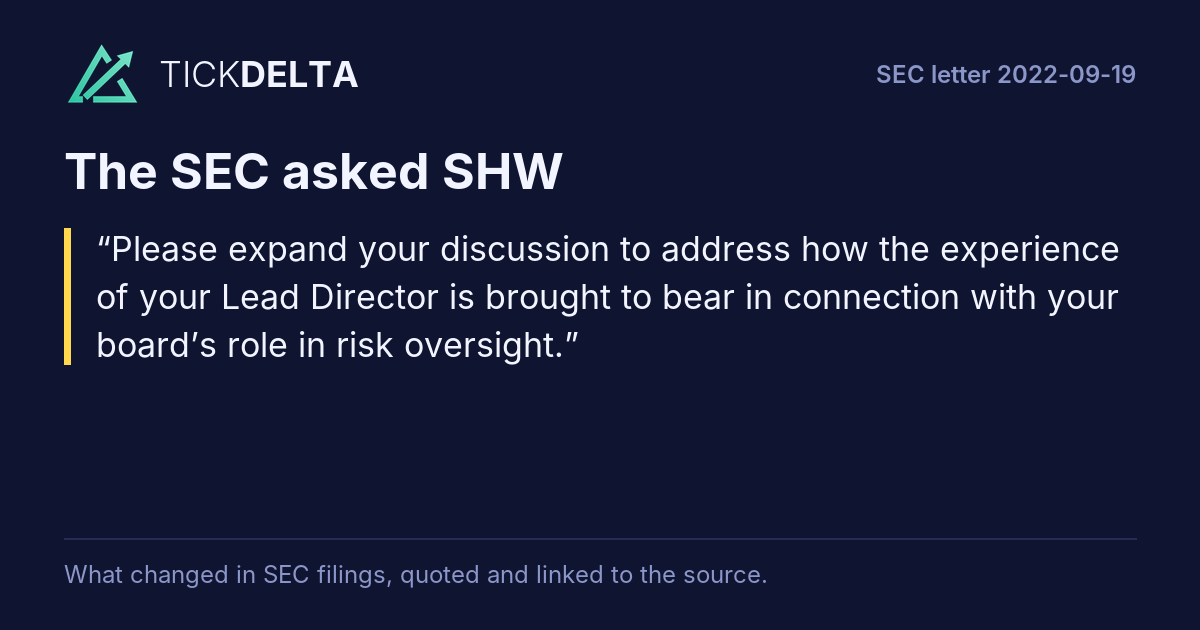
Please expand your discussion to address how the experience of your Lead Director is brought to bear in connection with your board’s role in risk oversight.
SHW answered
The Company respectfully acknowledges the Staff’s comment and confirms that it will enhance its future proxy disclosures in accordance with this topic. Read in the reply ↗
Definitive Proxy Statement on Schedule 14A filed April 20, 2022 · General
SEC asked (2)
Please expand upon the role that your Lead Director plays in the leadership of the board. For example, please enhance your disclosure to address whether or not your Lead Director may: • represent the board in communications with shareholders and other stakeholders; • require board consideration of, and/or override your CEO on, any risk matters; or • provide input on design of the board itself.
SHW answered
The Company respectfully acknowledges the Staff’s comment and confirms that it will enhance its future proxy disclosures in accordance with this topic. Read in the reply ↗
Definitive Proxy Statement on Schedule 14A filed April 20, 2022 · General
SEC asked (3)
Please expand upon how your board administers its risk oversight function. For example, please disclose: • the timeframe over which you evaluate risks (e.g., short-term, intermediate-term, or long-term) and how you apply different oversight standards based upon the immediacy of the risk assessed; • whether you consult with outside advisors and experts to anticipate future threats and trends, and how often you
Rest of the question

re-assess your risk environment; • how the board interacts with management to address existing risks and identify significant emerging risks; • whether you have a Chief Compliance Officer and to whom this position reports; and • how your risk oversight process aligns with your disclosure controls and procedures.

SHW answered
The Company respectfully acknowledges the Staff’s comment and confirms that it will enhance its future proxy disclosures in accordance with this topic.

The Company also confirms it will describe any material developments to its risk oversight structure in future proxy disclosures.

* * * * * * * *

We want to thank the Staff for its review of our filings to assist us in compliance with the applicable disclosure requirements and to enhance the overall disclosures in our filings.

If the Staff has any questions regarding our responses or any additional comments, please feel free to contact
Rest of the answer

Stephen J.

Perisutti at (216) 566-2543 or me at (216) 566-2478.

Read in the reply ↗

Also in this review: closing letter, 2022-10-06

Form 10-K for the Fiscal Year Ended December 31, 2020

2021-06-21 to 2021-07-22 · 3 questions · 1 letter from the SEC, 1 from the company
Review closed 2021-07-22
Results discussion (MD&A)Income taxesRevenueSegments
Management's Discussion and Analysis of Financial Condition and Results of Operations · Results of Operations, page 27
SEC asked (1)
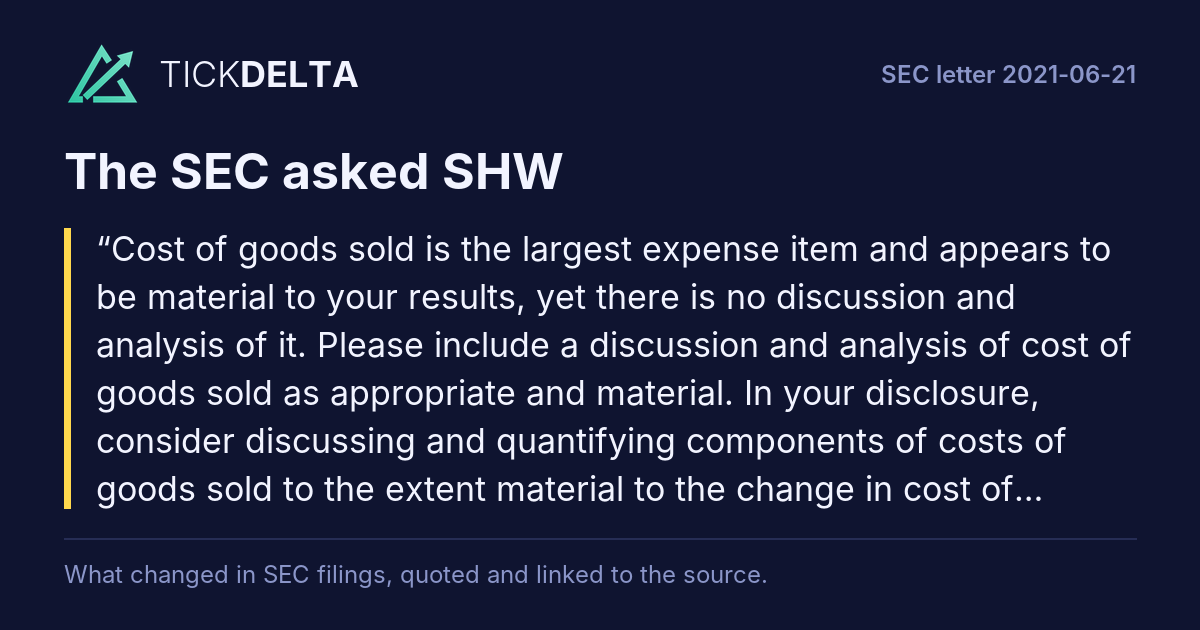
Cost of goods sold is the largest expense item and appears to be material to your results, yet there is no discussion and analysis of it. Please include a discussion and analysis of cost of goods sold as appropriate and material. In your disclosure, consider discussing and quantifying components of costs of goods sold to the extent material to the change in cost of goods sold between periods.
Rest of the question

Include a description in quantitative and qualitative terms of the underlying reasons associated with any components discussed. Refer to Item 303(a), introductory paragraph of Item 303(b) and Item 303(b)(2) of Regulation S-X and Section III.B.4 of Release No. 33-8350 for guidance.

SHW answered
The Company respectfully acknowledges the Staff’s comment. Although the Company believes that the material drivers of cost of goods sold are included within the discussion of gross profit in order of quantitative significance, the Company confirms that in future filings, it will expand its disclosure to separately address cost of goods sold and include a quantitative and qualitative analysis as appropriate.

Below is the Company’s proposed disclosure using 2020 for illustrative purposes, which has been marked to show changes from the Company’s Annual Report on Form 10-K disclosure for the
Rest of the answer

year ended December 31, 2020 to facilitate the Staff’s review.

Income Before Income Taxes

The following tables presents the components of income before income taxes as a percentage of net sales:

(millions of dollars, except % of sales data) Year Ended December 31,

2020 2019

% of Net Sales % of Net Sales

Net sales $ 18,361.7 100.0 % $ 17,900.8 100.0 %

Cost of goods sold 9,679.1 52.7 % 9,864.7 55.1 %

Gross profit 8,682.6 47.3 % 8,036.1 44.9 %

Selling, general, and administrative expenses 5,477.9 29.8 % 5,274.9 29.5 %

Other general expense - net 27.7 0.2 % 39.1 0.2 %

Amortization 313.4 1.7 % 312.8 1.7 %

Impairment of trademarks 2.3 — % 122.1 0.7 %

Interest expense 340.4 1.9 % 349.3 2.0 %

Interest and net investment income (3.6) — % (25.9) (0.1) %

California litigation expense — — % (34.7) (0.2) %

Other expense - net 5.3 — % 16.7 — %

Income before income taxes $ 2,519.2 13.7 % $ 1,981.8 11.1 %

Cost of goods sold decreased $185.6 million, or 1.9%, in 2020 compared to 2019 primarily due to lower raw material costs and currency translation rate changes, partially offset by higher sales volume. Although the trend in recent years has been for increases in raw material costs (including titanium dioxide and petrochemical feedstock sources), the Company experienced a decrease in raw material costs primarily due to market conditions arising from the COVID-19 pandemic. Currency translation rate changes decreased 2020 cost of goods sold by 1.3%.

Consolidated gross profit increased $646.5 million in 2020 compared to the same period in 2019. Consolidated gross profit as a percent to consolidated net sales increased to 47.3% in 2020 from 44.9% in 2019. Consolidated gross profit dollars and percent improved as a result of favorable customer and product mix in The Americas Group and the Consumer Brands Group, and moderating raw material costs, partially offset by unfavorable currency translation rate changes.

The Americas Group’s gross profit for 2020 increased $388.2 million compared to the same period in 2019. The Americas Group’s gross profit dollars and margin improved as a result of favorable customer and product mix and moderating raw material costs. Favorable customer and product mix in The Americas Group was driven by higher demand in residential repaint, DIY and new residential paint sales, partially offset by the impact of COVID-19 on demand in some end markets served. The Consumer Brands Group’s gross profit increased $221.0 million in 2020 compared to the same period in 2019. The Consumer Brands Group’s gross profit dollars and margin improved due primarily to higher volume sales, product portfolio improvements and international cost reductions. The Performance Coatings Group’s gross profit for 2020 increased $21.1 million compared to the same period in 2019. The Performance Coatings Group’s gross profit dollars and margin improved due primarily to moderating raw material costs, partially offset by unfavorable currency translation rate changes.

Read in the reply ↗
In its next report

First report after the company's reply of 2021-07-02: 10-Q filed 2021-07-27 ↗, against the 10-Q filed 2021-04-28 ↗.

Tickdelta does not hold the text of both reports, so they are not compared here.

Income Before Income Taxes, page 28
SEC asked (2)
In the discussion of gross profit on page 28, you state gross profit dollars and percent improved as a result of favorable customer and product mix. Please expand your disclosure to describe the underlying reasons in quantitative and qualitative terms associated with these factors. Refer to the introductory paragraph of Item 303(b) of Regulation S-X and Section III.B.4 of Release No. 33-8350 for guidance.
Rest of the question

Additionally, quantify other factors cited as causes for the change in gross profit so investors may understand the magnitude of the impact of each, pursuant to section 501.04 of the staff’s Codification of Financial Reporting Policies.

SHW answered
The Company respectfully acknowledges the Staff’s comment and confirms that in future filings, it will expand its disclosure to include further quantitative and qualitative discussion of the factors driving the change in gross profit. The proposed disclosure included in the response to the Staff's first comment illustrates the expanded disclosure. Read in the reply ↗
In its next report

First report after the company's reply of 2021-07-02: 10-Q filed 2021-07-27 ↗, against the 10-Q filed 2021-04-28 ↗.

Tickdelta does not hold the text of both reports, so they are not compared here.

Item 8. Financial Statements and Supplementary Data · Note 17. Revenue, page 80
SEC asked (3)
You disclose you provide disaggregated revenue by reportable segment. You also disclose the CODM uses information by geographic region/divisions, product and customer type, business units and subsidiaries to assess performance of and allocate resources to your reportable segments.
Rest of the question

We also note discussion in your first quarter 2021 earnings conference call in regard to sales for various product types, businesses, divisions, segments and regions. Please tell us what consideration you gave to guidance in ASC 606-10-50-5 in disclosing additional disaggregated revenue information.

SHW answered
The Company respectfully acknowledges the Staff’s comment and confirms that pursuant to ASC 606-10-50-5, it considered the appropriate level of revenue disaggregation to depict the nature, amount, timing and uncertainty of revenue and cash flows that are affected by economic factors.

In applying the disaggregation framework, the Company began with its segment information that management utilizes internally to assess performance and make decisions regarding allocation of resources.
Rest of the answer

This was then supplemented with consideration of multiple factors, including the following categories discussed in ASC 606-10-55-91:

–Reportable segments: The Company’s three reportable operating segments as of December 31, 2020 were:

◦The Americas Group (TAG), which represented 57% of consolidated net external sales with over 95% generated in the Company's North America region (comprised of the United States, Canada and the Caribbean region).

◦Consumer Brands Group (CBG), which represented 16% of consolidated net external sales with over 80% generated in the Company’s North America region.

◦Performance Coatings Group (PCG), which represented 27% of consolidated net external sales with over 50% generated in the Company’s North America region.

–Type of good or service: The Company manufacturers and sells paint, stains, supplies, equipment and floor covering products, as well as a broad range of industrial coatings. As described in Note 21, this product differentiation is reflected in our reportable segments as follows:

◦TAG sells paints, stains and supplies primarily through its company-operated specialty paint stores. These stores market and sell Sherwin-Williams® and other controlled brand architectural paint and coatings, protective and marine products, OEM product finishes and related products.

◦CBG supplies a broad portfolio of branded and private-label architectural paint, stains, varnishes, industrial products, wood finishes products, wood preservatives, applicators, corrosion inhibitors, aerosols, caulks and adhesives to retailers and distributors throughout North America, as well as in Australia, New Zealand, China and Europe.

◦PCG develops and sells industrial coatings for wood finishing and general industrial (metal and plastic) applications, automotive refinish, protective and marine coatings, coil coatings, packaging coatings and performance-based resins and colorants worldwide.

–Geographical region: As described in Note 21, the Company is organized around its operating segments with operations in the following regions:

◦TAG operates in the United States, Canada, Latin America and the Caribbean region.

◦CBG operates in North America, Australia, New Zealand, China and Europe.

◦PCG operates worldwide.

Further, the Company highlights the disclosure of consolidated revenue by geography in Note 21 with the disclosure of external sales by foreign subsidiaries. External sales by foreign subsidiaries as a percent of the Company’s consolidated total sales for 2020, 2019 and 2018 were 19.5%, 20.6% and 23.0%, respectively. Additionally, external sales in each geographic region outside of the North America region were each less than 10% of consolidated sales. As a result, management believes there is no individual geographic risk that is material to the Company's revenues outside of North America.

–Type of contract / duration: As disclosed in Note 17, a large portion of the Company's revenue is recognized at a point in time and generated with customers who are not engaged in a long-term supply agreement or any form of contract with the Company.

–Timing of transfer of goods or services: As disclosed in Note 17, revenue is primarily recognized at a point in time for transactions in all segments based on nature of products sold.

–Sales channels: As disclosed in Note 21, TAG is engaged in servicing the needs of architectural and industrial paint contractors and do-it-yourself homeowners, CBG supplies a broad portfolio of products to retailers and distributors, while PCG primarily sells industrial coatings to global manufacturing customers.

After evaluating the information above, the Company determined that the disaggregation of revenue by reportable segment, coupled with the disclosures in Note 17 around the Company’s revenue and in Note 21 around the Company’s reportable segments, provided a user with an appropriate view of the

Company’s revenue as the current disclosure provides a view of the Company’s revenue by the (i) product type given the distinct nature of offerings in each segment, (ii) sales channel given the distinct customer targeted by each segment with their product offerings, and (iii) geography given the relative proportion of consolidated results that each segment represents and the geographies in which each segment operates.

The Company acknowledges that its quarterly communications with investors since the acquisition of Valspar in June 2017 have included expanded disclosure around directional sales information for various product types, businesses, divisions, segments and regions to supplement investors understanding of the Company’s quarterly results. The Company does not believe that this supplemental information changes the depiction of how the nature, amount, timing and uncertainty of revenue and cash flows are impacted by economic factors given the composition of products sold, targeted customer base and sales channels utilized by each reportable segment.

While the Company believes that its disclosure of revenue at the reportable segment level remains appropriate as discussed above, the Company will expand its disclosure in future filings to clarify the geographic distribution of its sales. Below is the Company’s proposed enhancement to the Revenue disclosure using 2020 for illustrative purposes, which has been marked to show changes from the Company’s Annual Report on Form 10-K disclosure for the year ended December 31, 2020.

Refer to Note 21 for the Company’s disaggregation of net sales by reportable segment. As the reportable segments are aligned by similar economic factors, trends and customers, this disaggregation best depicts how the nature, amount, timing and uncertainty of revenue and cash flows are affected by economic factors. Approximately 80% of the Company’s net external sales are in the Company’s North America region (which is comprised of the United States, Canada and the Caribbean region), slightly less than 10% in the EMEAI region (Europe, Middle East, Africa and India), with the remaining global regions accounting for the residual balance. No individual country outside of the United States is individually significant.

We want to thank the Staff for its review of our filings to assist us in compliance with the applicable disclosure requirements and to enhance the overall disclosures in our filings.

If the Staff has any questions regarding our responses or any additional comments, please feel free to contact me at (216) 566-2986.
Read in the reply ↗
In its next report

First report after the company's reply of 2021-07-02: 10-Q filed 2021-07-27 ↗, against the 10-Q filed 2021-04-28 ↗.

Tickdelta does not hold the text of both reports, so they are not compared here.

Also in this review: closing letter, 2021-07-22

Form 10-K for the Year Ended December 31, 2018

2019-09-04 to 2019-12-06 · 7 questions · 2 letters from the SEC, 2 from the company
Review closed 2019-12-06
Results discussion (MD&A)Income taxesAcquisitionsNon-GAAP measuresInventoryLiquidity and cashLegal and contingencies
After reviewing your response to these comments, we may have additional comments. Exhibit 13 · Note 1 - Significant Accounting Policies - Inventory Accounting Change, page 45
SEC asked (1)
We note during the fourth quarter of 2018 you made a voluntary change in accounting principle to reduce the number of pools used for determining inventory cost under the lastin, first-out (LIFO) method of accounting for inventory in the United States that you appear to attribute to the acquisition of Valspar. Please more fully explain to us the changes you made.
Rest of the question

Also, please help us more fully understand how the acquisition of Valspar impacted your inventory pools as we assume you recorded Valspar's inventory at fair value when it was acquired.

SHW answered
Prior to the June 1, 2017 acquisition of The Valspar Corporation (“Valspar”), Sherwin-Williams maintained three LIFO pools for its domestic inventory: Coatings, Specialty and Purchased. Also prior to the acquisition, Valspar accounted for its domestic inventory using LIFO and maintained two pools: Raw Materials and Conversion Costs.

Following the acquisition, and for the year-ended December 31, 2017, the Company applied LIFO using five separate pools: the three unaltered pre-acquisition Sherwin-Williams LIFO pools and two new pools for the acquired Valspar inventory (Valspar Raw Materials
Rest of the answer

and Valspar Conversion Costs). These new pools were representative of the two pre-acquisition Valspar pools. Consistent with the guidance published in the AICPA Issues Paper titled "Identification and Discussion of Certain Financial Accounting and Reporting Issues Concerning LIFO Inventories" (November 30, 1984), ("AICPA Issues Paper"), the 2017 pooling structure was based on the “natural business unit pooling method,” which consists of aggregating similar items of inventory into pools. This pooling was consistent with the fact that the inventory of the two organizations (Sherwin-Williams and Valspar) was separately procured, manufactured and maintained during 2017, as efforts to integrate the companies were not undertaken until 2018. Because Valspar inventory was placed into new LIFO pools (for Sherwin-Williams' post-acquisition application of LIFO), the acquired inventory, which was recorded at fair value on the acquisition date, represented the base layers of the two new pools.

After a year of phased integration of elements of the Valspar business, the Company concluded during the fourth quarter of 2018 that it was appropriate under the circumstances to re-evaluate its existing LIFO pools. At that time, only a portion of the Valspar inventory had been physically and systemically integrated into the Company's systems, manufacturing operations and distribution channels. As a result, the Company could have continued to use five pools. However, reducing the number of pools from five to three lessened the potential that further planned integration activities could produce increments or decrements based on movement of similar product types between pools rather than true changes in inventory quantities, which is a risk described in the AICPA Issues Paper. By continuing to use the five pools, artificial integration-driven LIFO liquidations could have been caused by inventory moving out of the Valspar pools and into the Coatings pool. Based on the above and the consistency of product types between Valspar and Sherwin-Williams, the Company concluded that a voluntary change from five pools to the following three pools was preferable: Coatings (primarily manufactured paints, pigments, solvents and resins), Specialty (aerosols, caulks, manufactured brushes and rollers) and Purchased (brushes, ladders, applicators and supplies purchased from third parties). All legacy Sherwin-Williams inventory SKUs remained in the same pools they were previously included in, and inventory from the Valspar Raw Materials and Valspar Conversion Costs pools were placed into the Coatings pool. Valspar inventory did not include aerosol products or outside purchases from third parties.

There was no impact from the change in LIFO pools prior to acquisition as the legacy Sherwin-Williams inventory and related pools were not impacted by the accounting change. In calculating the retrospective application of the accounting change dating back to the acquisition date, the acquired inventory was included as part of the current year purchases in the Coatings pool under the guidance published in the AICPA Issues Paper, which states, “when an acquiring entity has an existing LIFO pool and the acquired inventory is combined into this pool, the fair value of the acquired inventory is included in the current period’s purchases.”

As disclosed in Note 1 of the financial statements contained in Company's 2018 Form 10-K, the retrospective application of the accounting change resulted in a reduction of pre-tax income of $58.9 million for the year ended December 31, 2017. As previously discussed, there was no impact to any period prior to 2017.

Read in the reply ↗
In its next report

First report after the company's reply of 2019-09-18: 10-Q filed 2019-10-22 ↗, against the 10-Q filed 2019-07-24 ↗.

Tickdelta does not hold the text of both reports, so they are not compared here.

Note 9 - Other Long-Term Liabilities, page 62
SEC asked (2)
We note your disclosure on page 32 that you reached a series of agreements with the Environmental Protection Agency for remediation plans with cost estimates at one of your four major sites which required significant environmental provisions to be recorded primarily during the fourth quarter of 2018.
Rest of the question

We note that SAB Topic 5:Y indicates that environmental remediation liabilities are of such significance that detailed disclosures regarding the judgments and assumptions underlying the recognition and measurement of such liabilities are necessary to prevent the financial statements from being misleading and to inform readers fully regarding the range of reasonably possible outcomes that could have a material effect on your financial condition, results of operations, or cash flows. It appears to us that you should enhance your disclosures to provide additional information about the agreements with the Environmental Protection Agency that required you to record significant environmental provisions during 2018. It also appears to us you that should enhance your disclosures to explain the specific facts and circumstances that resulted in the increase in the amount of reasonably possible additional losses as well as how such amounts are determined. In this regard, we note that the amount you accrued during the fourth quarter of 2018, which related to one of four primary sites, exceeded the amount of reasonably possible additional losses you disclosed as of September 30, 2018 and we also note that, subsequent to the accruals in 2018, you disclose additional reasonably possible losses. Your disclosures should also include a discussion of the material components of the amount you accrued as well as the significant assumptions underlying your estimates. Refer to SAB Topic 5:Y for additional information.

SHW answered
The Company has developed an accrual process for environmental-related loss contingencies in accordance with ASC 410-30 and 450. Accordingly, the Company recognizes a liability as the costs become reasonably estimable. At the early stages of the estimation process, certain aspects of the overall liability may not be reasonably estimable, such as remediation activity and implementation costs.
Rest of the answer

Remediation activity and implementation costs based on information gathered during the Remedial Investigation ("RI") phase are reasonably estimable once sufficient progress has been made in preparation of an Environmental Feasibility Study ("FS") to be submitted to the United States Environmental Protection Agency ("EPA"). The costs associated with the remediation alternatives are used to develop an estimated loss. If the best estimate of costs can only be identified as a range and no specific amount within that range can be determined more likely than any other amount with the range, the lower end of the range is recorded as an accrual in accordance with ASC 450-20-25-5. Based on its experience, the Company believes that the portion of the environmental-related loss contingency related to remediation activities cannot be reasonably estimated until potential alternatives have been substantially considered during the FS preparation process. It should be noted that the remediation loss estimate range is continually refined after the FS has been submitted.

Four of the Company’s currently and formerly owned manufacturing sites ("Major Sites") account for the majority of the accrual for environmental-related activities, which includes the Gibbsboro, New Jersey site ("Gibbsboro"). Gibbsboro, which is our largest and most complex site, has been divided by the EPA into six operable units ("OUs") based on location and characteristics. At the third quarter 2018 reporting date, four of the six OUs had completed the RI phases and submitted an FS. The Ground Water OU was in early stage investigation with remediation activity and implementation costs reasonably estimated. Sufficient progress had not been made with respect to the Waterbodies OU in order to reasonably estimate the remediation activity and implementation costs portion of the liability.

During the fourth quarter of 2018, the Company continued its dialogue with the EPA and made enough progress regarding material aspects of the remedial action plan for the Waterbodies OU, which enabled the development of a range of estimates. A remediation accrual representing the low end of the reasonably estimable range was therefore recorded in the fourth quarter of 2018.

As noted in the Staff's comment, the goal of SAB Topic 5:Y is to provide detailed disclosures regarding the judgments and assumptions underlying the recognition and measurement of significant environmental remediation liabilities to prevent the financial statements from being misleading and to fully inform readers regarding the range of reasonably possible outcomes that could have a material effect on the financial condition, results of operations, or cash flows. Per SAB Topic 5:Y, necessary footnote disclosures may include the following related to environmental remediation liabilities:

Circumstances affecting the reliability and precision of loss estimates.

The extent to which unasserted claims are reflected in any accrual or may affect the magnitude of the contingency.

Read in the reply ↗
In its next report

First report after the company's reply of 2019-09-18: 10-Q filed 2019-10-22 ↗, against the 10-Q filed 2019-07-24 ↗.

Tickdelta does not hold the text of both reports, so they are not compared here.

Form 8-K Filed July 23, 2019 · General
SEC asked (3)
We note you include adjustments in your non-GAAP financial measure, Adjusted diluted net income per share, that you identify as acquisition-related costs and that you also disclose such amounts in MD&A in your exchange act filings. Please tell us, and revise your filings to disclose and discuss, the specific nature of these adjustments.
Rest of the question

Please specifically address the nature of the integration costs, including if and how they are related to the restructuring costs disclosed in your exchange act filings and where they are recorded in your financial statements. Please also specifically address the nature of the purchase accounting impacts, including what they relate to and where they are recorded in your financial statements.

SHW answered
Uncertainties with respect to joint and several liability that may affect the magnitude of the contingency, including disclosure of the aggregate expected cost to remediate particular sites that are individually material if the likelihood of contribution by the other significant parties has not been established. Read in the reply ↗
Note 11 - Income Taxes, page 16
SEC asked (4)
We note your disclosure here and in the Form 8-K filed on June 28, 2019 that you invested in federal renewable energy tax credit funds exclusively with DC Solar Solutions, Inc. and certain of its affiliates during 2011 and 2013 through 2017. In December 2018, you initiated an investigation after becoming aware of an ongoing investigation by federal authorities, which included the seizure of DC Solar’s assets.
Rest of the question

Further, in February 2019, DC Solar filed for Chapter 11 (reorganization) bankruptcy protection, which was subsequently converted to Chapter 7 (liquidation) in March 2019. You stated that it did not appear reasonably possible that a material loss had occurred in the first quarter of 2019; however, in the second quarter of 2019, you determined it is more likely than not that the tax benefits expected to be received related to these investments would no longer be ultimately realizable and recognized a charge of approximately $74 million to reflect the entire loss of the investment with DC Solar and the related expected tax benefits. Given that you were aware of the investigation in December 2018 and the fact that DC Solar was in Chapter 7 bankruptcy in March 2019, please address the following: • Tell us what if any disclosure you provided in your 2018 Form 10-K and 3/31/19 Form 10-Q related to this contingency or explain to us how you determined no disclosures were required by ASC 450; • More fully explain to us the specific reasons why you did not believe a loss was probable and reasonably estimable when you filed your 3/31/19 Form 10-Q and tell us the specific events that occurred subsequent to that date that resulted in you recording a loss during the second quarter of 2019; and • More fully explain to us the increase in unrecognized tax benefits at June 30, 2019 and the potential impact they could have on your financial statements. In closing, we remind you that the company and its management are responsible for the accuracy and adequacy of their disclosures, notwithstanding any review, comments, action or absence of action by the staff.

SHW answered
Disclosure of the nature and terms of cost-sharing arrangements with other potentially responsible parties. Read in the reply ↗
In its next report

First report after the company's reply of 2019-09-18: 10-Q filed 2019-10-22 ↗, against the 10-Q filed 2019-07-24 ↗.

Tickdelta does not hold the text of both reports, so they are not compared here.

Exhibit 13 · Note 9 – Other Long-Term Liabilities, page 62
SEC asked (1)
We note your response to comment 2 and appreciate the additional disclosures you provided regarding the Gibbsboro site. Please expand your disclosures to also clarify the current stage at each of your other Major Sites, including whether remediation activities and implementation costs at each Major Site are reasonably estimable. Form 10-Q for the period ended June 30, 2019
SHW answered
The Company respectfully acknowledges the Staff's comment and will enhance its Other Long-Term Liabilities disclosure accordingly. For reference, excluding Gibbsboro, the other three Major Sites comprise in total between 10% and 20% of both the total environmental-related accrual and the total unaccrued maximum.

Below is the Company's proposed disclosure using information as of the third quarter of 2019 for illustrative purposes, which has been marked to show changes from the Company's Form 10-Q disclosure for the period ended September 30, 2019 to facilitate the Staff's review.
Rest of the answer

The following proposed Form 10-Q disclosure encompasses the enhancements discussed in the Company's comment letter response dated September 18, 2019. The Company will present the following enhanced disclosure in both its future Forms 10-K and 10-Q, beginning with the Company's Form 10-K for the period ended December 31, 2019.

NOTE 8—OTHER LONG-TERM LIABILITIES

The operations of the Company, like those of other companies in its industry, are subject to various domestic and foreign environmental laws and regulations. These laws and regulations not only govern current operations and products, but also impose potential liability on the Company for past operations. Management expects environmental laws and regulations to impose increasingly stringent requirements upon the Company and the industry in the future. Management believes that the Company conducts its operations in compliance with applicable environmental laws and regulations and has implemented various programs designed to protect the environment and promote continued compliance.

The Company is involved with environmental investigation and remediation activities at some of its currently and formerly owned sites (including sites which were previously owned and/or operated by businesses acquired by the Company). In addition, the Company, together with other parties, has been designated a potentially responsible party under federal and state environmental protection laws for the investigation and remediation of environmental contamination and hazardous waste at a number of third-party sites, primarily Superfund sites. In general, these laws provide that potentially responsible parties may be held jointly and severally liable for investigation and remediation costs regardless of fault. The Company may be similarly designated with respect to additional third-party sites in the future.

The Company initially provides for estimated costs of environmental-related activities relating to its past operations and third-party sites for which commitments or clean-up plans have been developed and when such costs can be reasonably estimated based on industry standards and professional judgment. These estimated costs, which are not discounted, are determined based on currently available facts regarding each site. If the reasonably estimable costs can only be identified as a range and no specific amount within that range can be determined more likely than any other amount within the range, the minimum of the range is provided.

The Company continuously assesses its potential liability for investigation and remediation-related activities and adjusts its environmental-related accruals as information becomes available upon which more accurate costs can be reasonably estimated and as additional accounting guidelines are issued. At September 30, 2019 and 2018, the Company had accruals reported on the Company's balance sheet as other long-term liabilities of $321.8 million and $209.9 million, respectively. Estimated costs of current investigation and remediation activities of $51.0 million and $27.0 million are included in other accruals at September 30, 2019 and 2018, respectively.

Actual costs incurred may vary from the accrued estimates due to the inherent uncertainties involved including, among others, the number and financial condition of parties involved with respect to any given site, the volumetric contribution which may be attributed to the Company relative to that attributed to other parties, the nature and magnitude of the wastes involved, the various technologies that can be used for remediation and the determination of acceptable remediation with respect to a particular site. If the Company's future loss contingency is ultimately determined to be at the unaccrued maximum of the estimated range of possible outcomes for every site for which costs can be reasonably estimated, the Company's accrual for environmental-related activities would be $116.4 million higher than the minimum accruals at September 30, 2019. Additionally, costs for environmental-related activities may not be reasonably estimable at early stages of investigation and therefore would not be included in the unaccrued maximum amount.

Four of the Company’s currently and formerly owned manufacturing sites ("Major Sites") account for the majority of the accrual for environmental-related activities and the unaccrued maximum of the estimated range of possible outcomes at September 30, 2019. At September 30, 2019, $322.2 million, or 86.4% of the total accrual, related directly to the Major Sites. In the aggregate unaccrued maximum of $116.4 million at September 30, 2019, $92.7 million, or 79.7%, related to the Major Sites. The significant cost components of this liability continue to be related to remedy implementation, regulatory agency interaction, project management and other costs. While different for each specific environmental situation, these components generally each account for approximately 85%, 10%, and 5%, respectively, of the accrued amount and those percentages are subject to change over time. While environmental investigations and remedial actions are in different stages at these sites, additional investigations, remedial actions and monitoring will likely be required at each site.

The largest and most complex of the Major Sites is the Gibbsboro, New Jersey site ("Gibbsboro") which comprises the substantial majority of the environmental-related accrual. Gibbsboro, a former manufacturing plant, and related facilities, which ceased operations in 1978, has had various facilities included on the National Priorities List since 1999. This location has soil, waterbodies, and groundwater contamination related to the historic operations of the facility. Gibbsboro has been divided by the Environmental Protection Agency ("EPA") into six operable units ("OUs") based on location and characteristics, whose investigation and remediation efforts are likely to occur over an extended period of time. Each of the OUs are in various phases of investigation and remediation with the EPA that provide enough information to reasonably estimate cost ranges and record environmental-related accruals. The most significant assumptions underlying the reliability and precision of remediation cost estimates for the Gibbsboro site are the types and extent of contamination.

The remaining three Major Sites comprising the majority of the accrual include (1) a multi-party Superfund site that has received a record of decision from the federal EPA and is currently in the remedial design phase for one operable unit and for which a remedial investigation/feasibility study has been submitted for another operable unit, (2) a closed paint manufacturing facility that is in the operation and maintenance phase of remediation under both federal and state EPA programs, and (3) a formerly-owned site containing warehouse and office space that is in the remedial investigation phase under a state EPA program. Each of these three Major Sites are in phases of investigation and remediation that provide sufficient information to reasonably estimate cost ranges and record environmental-related accruals.

Excluding the four Major Sites making up the majority of the accrual discussed above, no sites are individually material to the total accrual balance. There are multiple, future events yet to occur, including further remedy selection and design, remedy implementation and execution, and securing applicable governmental agency approvals, all of which have the potential to contribute to the uncertainty surrounding these future events. As these events occur and to the extent that the cost estimates of the environmental remediation change, the existing reserve will be adjusted.

Management cannot presently estimate the ultimate potential loss contingencies related to these sites or other less significant sites until such time as a substantial portion of the investigation at the sites is completed and remedial action plans are developed. Unasserted claims could have a material effect on the Company's loss contingency as more information becomes available over time. At September 30, 2019, the

Company did not have material loss contingency accruals related to unasserted claims. Management does not expect that a material portion of unrecognized loss contingencies will be recoverable through insurance, indemnification agreements or other sources. In the event any future loss contingency significantly exceeds the current amount accrued, the recording of the ultimate liability may result in a material impact on net income for the annual or interim period during which the additional costs are accrued. Moreover, management does not believe that any potential liability ultimately attributed to the Company for its environmental-related matters will have a material adverse effect on the Company’s financial condition, liquidity, or cash flow due to the extended length of time during which environmental investigation and remediation takes place. An estimate of the potential impact on the Company’s operations cannot be made due to the aforementioned uncertainties.

Management expects these contingent environmental-related liabilities to be resolved over an extended period of time. Management is unable to provide a more specific time frame due to the indeterminate amount of time to conduct investigation activities at any site, the indeterminate amount of time to obtain environmental agency approval, as necessary, with respect to investigation and remediation activities, and the indeterminate amount of time necessary to conduct remediation activities.

The Asset Retirement and Environmental Obligations Topic of the ASC requires a liability to be recognized for the fair value of a conditional asset retirement obligation if a settlement date and fair value can be reasonably estimated. The Company recognizes a liability for any conditional asset retirement obligation when sufficient information is available to reasonably estimate a settlement date to determine the fair value of such a liability. The Company has identified certain conditional asset retirement obligations at various current and closed manufacturing, distribution and store facilities. These obligations relate primarily to asbestos abatement, hazardous waste Resource Conservation and Recovery Act (RCRA) closures, well abandonment, transformers and used oil disposals and underground storage tank closures. Using investigative, remediation and disposal methods that are currently available to the Company, the estimated costs of these obligations were accrued and are not significant. The recording of additional liabilities for future conditional asset retirement obligations may result in a material impact on net income for the annual or interim period during which the costs are accrued. Management does not believe that any potential liability ultimately attributed to the Company for its conditional asset retirement obligations will have a material adverse effect on the Company’s financial condition, liquidity, or cash flow due to the extended period of time over which sufficient information may become available regarding the closure or modification of any one or group of the Company’s facilities. An estimate of the potential impact on the Company’s operations cannot be made due to the aforementioned uncertainties.

Read in the reply ↗
In its next report

First report after the company's reply of 2019-11-25: 10-K filed 2020-02-21 ↗, against the 10-K filed 2019-02-22 ↗.

Tickdelta does not hold the text of both reports, so they are not compared here.

Note 11 - Income Taxes, page 16
SEC asked (2)
We note your response to comment 4 related to the reversal of net tax benefits recognized in previous tax years from federal renewable energy tax credit funds. Please address the following: • Please quantify for us the tax benefits recognized in each of the previous three years and subsequent interim period.
Rest of the question

• Please tell us how you determined the tax provision recognized in the 2nd quarter of 2019 did not represent a correction of an error in previously issued financial statements under ASC 250-10. In this regard, tell us how the recognition of tax benefits in previous years based upon potentially fraudulent information did not constitute an oversight or misuse of facts. Conversely, also tell us how you determined the recognition of tax benefits and the reversal thereof represents a change in estimate.

SHW answered
The Company recorded tax credits of $10.0 million in 2016 and 2017, respectively. There were no tax credits recorded in 2018, and there have been no tax credits recorded in 2019. As described in our prior response, the Company recognized total expense of $76.7 million ($74.3 million during the first six months of 2019).

As described below, it was not until the second quarter of 2019 that the Company learned of information concerning the nature and extent of the fraudulent scheme as it applied to the Company's previously recognized tax credits.
Rest of the answer

Management evaluated this new information under the guidance in ASC 250-10 and concluded that the derecognition of the tax position should be accounted for as a change in estimate rather than the correction of an error.

As explained in our prior response, these tax positions are based on the Company's investments in legal entities (“Funds”) that purchased mobile solar generators (“MSGs”) from DC Solar. The Funds hold title to the MSGs. In order to qualify for federal renewable energy tax credits, the MSGs owned by the Funds generally must have been (1) manufactured, (2) placed in service and (3) appropriately valued.

Upon initiation of the investments and upon the recognition of the related tax benefits in the years ended 2011 to 2017, the Company reasonably relied on expert and qualified information such as legal opinions, tax opinions, accounting and tax representations from a certified public accounting firm, engineering reports from a certified engineering firm and valuation reports from a certified appraisal firm. Management viewed this information as necessary to assess the Company's tax position. After evaluating this information, management determined that the opinions, representations, reports and valuations represented sufficient reasonable evidence to support the recognition of the tax position and concluded that the MSGs qualified for federal renewable energy tax credits. Each year, the Company received and reviewed audited financial statements and tax information reported on Form K-1 from the Funds and appropriately included this information on the Company's tax return. The Company has concluded its interpretation of information available at the time of calculating its tax provision and evaluating its tax position for all periods prior to the second quarter of 2019 was appropriate, and that the change in estimate in the second quarter of 2019 was due to the reasonable and timely application of newly discovered facts rather than a change in interpretation or evaluation of previous information.

In late December 2018, the Company became aware of allegations of potential unlawful conduct by DC Solar and an ongoing investigation by federal authorities of DC Solar and its various principals, including Jeff and Paulette Carpoff. The Company considered all information reasonably available at the time, which included the fact that the MSGs were owned by the Funds and not DC Solar or the Carpoffs. In addition, the Company received independent third party verification supporting the Company's determination that each of the three required elements necessary to sustain its tax benefit were satisfied through 2017. Based upon this information and the facts set forth below, the Company concluded that there was sufficient evidence to continue to support the measurement of its tax position for the year ended 2018. At the time the Company completed its December 31, 2018 Form 10-K, the investigation of DC Solar and the Carpoffs was still ongoing and nothing had come to light determinatively indicating that the previously recognized tax benefits should be derecognized.

In addition, as late as December 2018, the Company received assurances that a routine Internal Revenue Service ("IRS") audit opened in 2014 would be resolved favorably with no impact to the Company’s investments in the fund. This information further supported the Company's conclusion that each of the three factors required to generate federal renewable energy tax credits were satisfied both for that fund and for the other similarly structured Funds.

Additionally, in July 2017, the Company consented to the sale of 192 MSGs from one of the Funds to an unrelated third party. This sale of MSGs to an unrelated third party provided further support to the periodic valuations received by the Company. The Company believed the appraisal reports utilized for the sale provided strong support for the valuation of the MSGs. It was not until the second quarter of 2019, that the Company first learned of the government allegations that this sale may have been consummated based upon fraudulent information provided to the buyer from unrelated third parties.

As explained in the Company’s prior response, the Company was confident that, most of the MSGs owned by its Funds had been manufactured and placed in service. Great American Insurance Group, the third party engaged to conduct an inventory of the MSGs, reported in April 2019 that unlike many other investors, over seventy five percent of the Company’s units had been identified. These efforts continue with additional MSGs having been located but not yet assigned to the appropriate fund.

On or about May 10, 2019, in response to government allegations regarding the accuracy of appraisals of the MSGs, the Company joined other fund investors in engaging a third-party consultant to provide new guidance as to the fair market value of the MSGs. Although appraisal and valuation efforts are ongoing, on or about May 28, 2019, the Company received preliminary information about the valuation of the MSGs which indicated lower market values than previous reports. During the second quarter of 2019, the Company also learned new information that the solar converting capabilities of the MSGs were less than the specifications previously certified by the engineering firm. Considering this new appraisal and engineering information, together with the discovery of new allegations regarding potential fraudulent conduct by DC Solar in the 2017 sale of one of the Fund's MSGs to an unrelated third party, as well as other considerations of the position in the aggregate, the Company determined that based upon new information, it no longer believed it could assert a “more-likely-than-not” tax position regarding its investments in the Funds. The tax position was derecognized in the three-months ended June 30, 2019 as a change in estimate based upon the events and new information described herein.

The facts relating to the Company's investments in the Funds continue to be developed, and there are and will continue to be material differences in facts relevant to Funds owned by other investors. The ultimate recognition of the tax benefits previously recognized relating to the Company’s investments continue to be uncertain. The Company’s management will continue to use its best judgment based upon the facts related to its investments when determining the scope and timing of financial disclosures. The Company continues to participate with other fund investors to gather facts and obtain experts advice in assessing its tax position in these investments.

Read in the reply ↗
In its next report

First report after the company's reply of 2019-11-25: 10-K filed 2020-02-21 ↗, against the 10-K filed 2019-02-22 ↗.

Tickdelta does not hold the text of both reports, so they are not compared here.

Form 8-K filed on October 22, 2019 · Regulation G Reconciliation, page 5
SEC asked (3)
We note your response to comment 3. Please revise reconciliations related to your non- GAAP financial measure, adjusted net income per share, to address the following: • We note you identify certain adjustments as non-operating.
Rest of the question

Although you do not present a measure that you identify as operating income in your statements of income, it appears to us that certain adjustments you identify as non-operating would be required to be included in the determination of operating income. Please avoid identifying such adjustments as non-operating. • Please reflect the impact of income taxes as a separate adjustment and explain how the tax impact is calculated. Refer to the guidance provided in Question 102.11 of the updated Compliance and Disclosure Interpretations on Non-GAAP Financial Measures (April 4, 2018).

SHW answered
The Company respectfully acknowledges the Staff's comment and will adjust future Regulation G Reconciliations accordingly. Below is the Company's proposed disclosure as of the third quarter of 2019 for illustrative purposes, which has been marked to show changes from the Company's third quarter disclosure as filed on Form 8-K to facilitate the Staff's review.

Regulation G Reconciliation

Management of the Company believes that investors’ understanding of the Company’s operating performance is enhanced by the disclosure of diluted net income per share excluding Valspar acquisition-related
Rest of the answer

costs and certain other non-operating adjustments. This adjusted earnings per share measurement is not in accordance with U.S. generally accepted accounting principles (GAAP). It should not be considered a substitute for earnings per share computed in accordance with U.S. GAAP and may not be comparable to similarly titled measures reported by other companies. The following tables reconcile diluted net income per share computed in accordance with U.S. GAAP to adjusted diluted net income per share.

Three Months Ended

September 30, 2019

September 30, 2018

Pre-Tax

Tax

Effect (3)

After-Tax

Diluted net income per share

$

6.16

3.72

California litigation expense (reduction)/provision

(.37

)

(.09

(.28

1.43

.34

1.09

Integration costs (1)

.17

.03

.14

.32

.10

.22

Acquisition-related amortization expense (2)

.82

.19

.63

.86

.21

.65

Total acquisition-related costs

.99

.77

1.18

.31

.87

Adjusted diluted net income per share

6.65

5.68

Year Ended

December 31, 2019

(after-tax guidance)

Low

High

17.07

17.47

Tax credit investment loss

.79

Pension plan settlement expense

.27

Total other non-operating expenses adjustments

.78

.51

2.54

3.05

20.90

21.30

(1)

Integration costs consist primarily of professional service expenses, salaries and other employee-related expenses dedicated directly to the integration effort, and severance expense. These costs are included in Selling, general and administrative and other expenses and Cost of goods sold.

(2)

Acquisition-related amortization expense consists primarily of the amortization of intangible assets related to the Valspar acquisition and is included in Amortization.

(3)

The tax effect is calculated based on the statutory rate and the nature of the item, unless otherwise noted.

We want to thank the Staff for its review of our filings to assist us in compliance with the applicable disclosure requirements and to enhance the overall disclosures in our filings.

If the Staff has any questions regarding our responses or any additional comments, please feel free to contact me at (216) 566-2066.

Read in the reply ↗
In its next report

First report after the company's reply of 2019-11-25: 10-K filed 2020-02-21 ↗, against the 10-K filed 2019-02-22 ↗.

Tickdelta does not hold the text of both reports, so they are not compared here.

Also in this review: closing letter, 2019-12-06

3 other letters: notices that a filing will not be reviewed, requests to declare a registration effective, and the like

From the SEC's correspondence on EDGAR: staff letters (form UPLOAD) and company letters (form CORRESP), 23 letters filed since 2017-06-23. Questions and answers are matched by their numbers; topics come from words in each question. The reports are compared word for word (same form, before the first SEC letter against the first report after the company's reply). No AI.

Work on SHW in a spreadsheet: Excel workbook (a sheet per section, ten years by column, charts, links to the filings) · CSV. For a Google Sheet that stays up to date, paste =IMPORTDATA("https://tickdelta.com/company/SHW/export.csv") into a cell.